
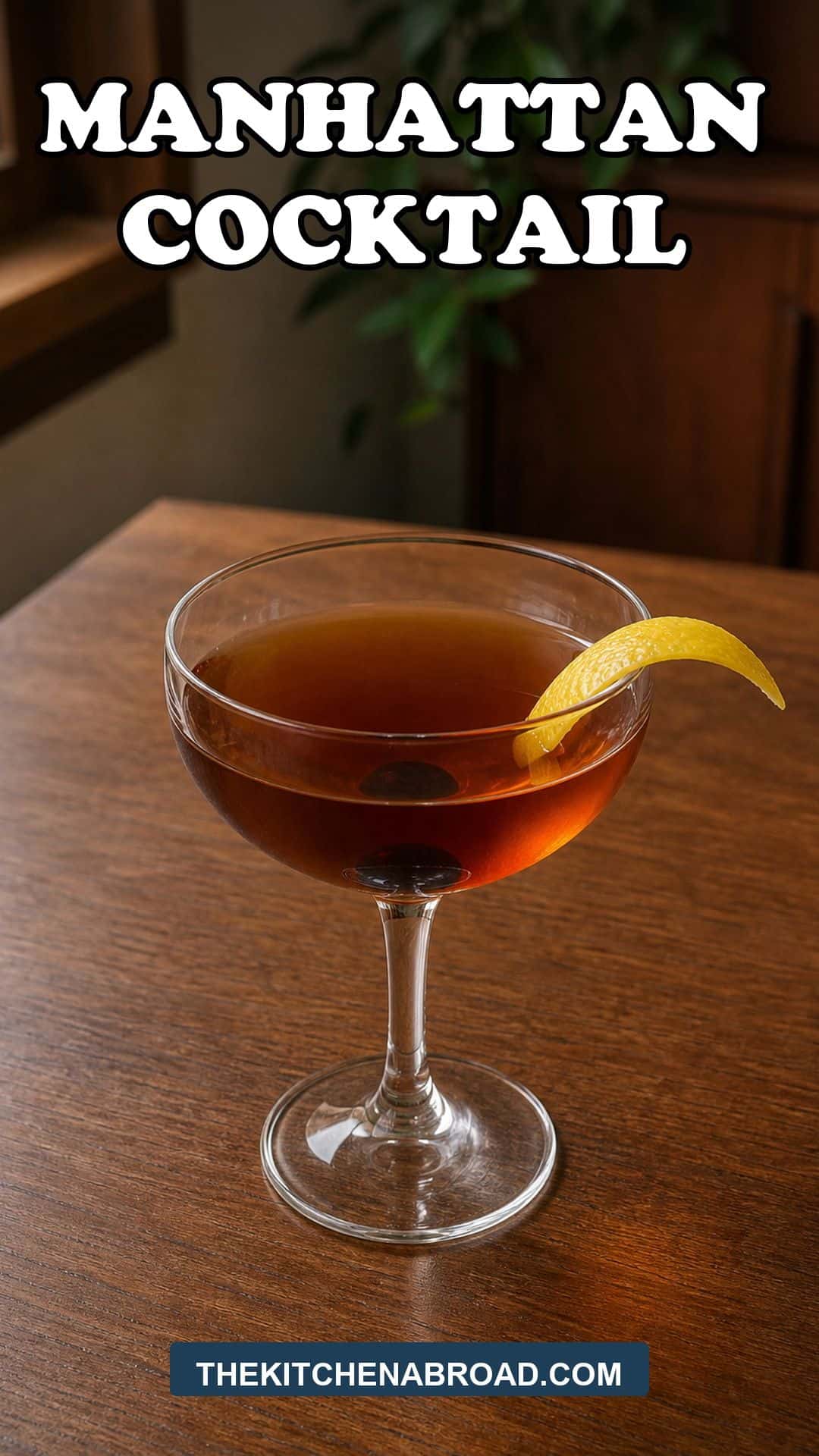
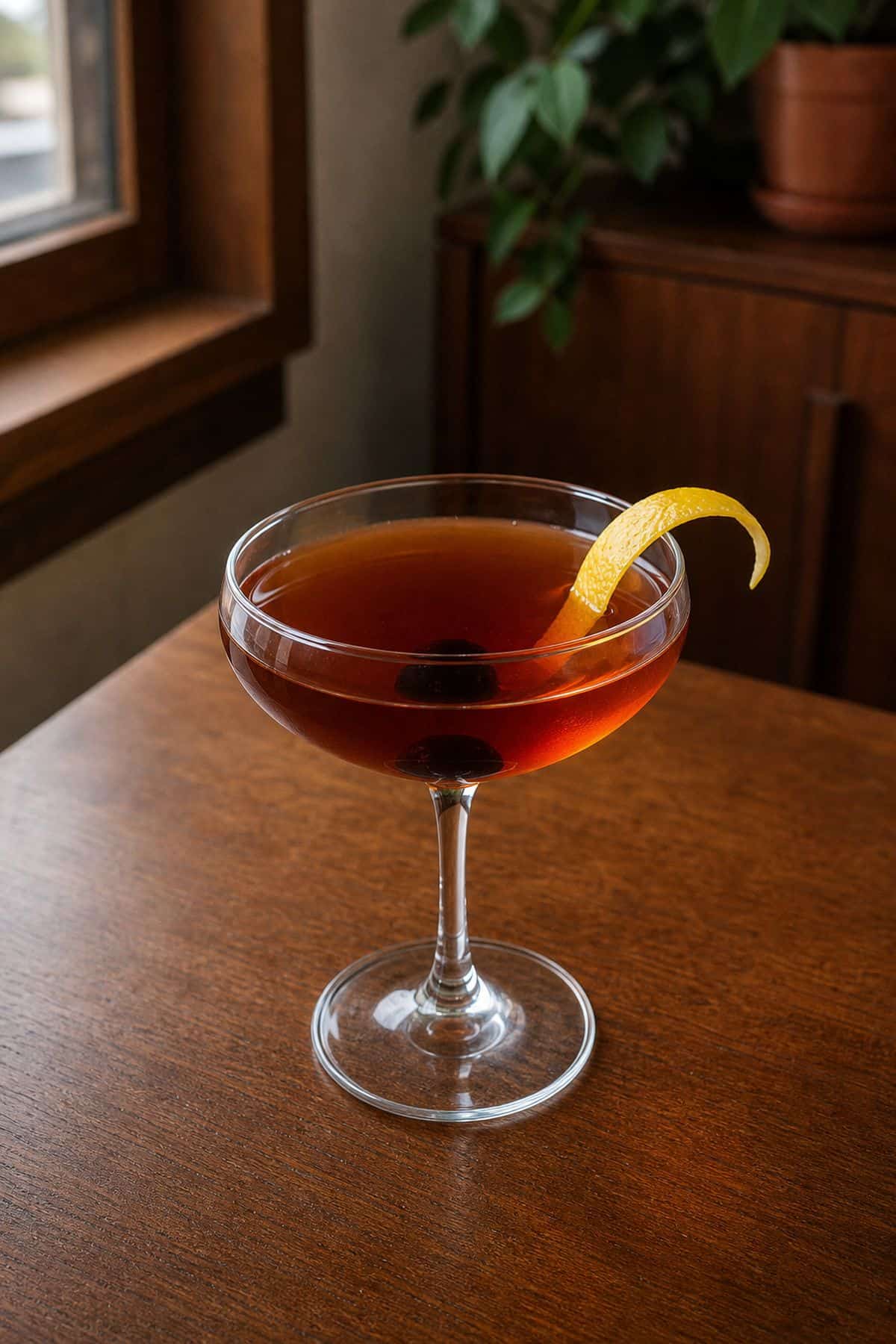
The classic manhattan cocktail recipe is a 2:1 build: 2 oz rye whiskey, 1 oz sweet vermouth, and 2 dashes Angostura bitters, stirred over ice for 30 seconds and strained into a chilled coupe or Nick & Nora glass. Garnish with a brandied or Luxardo cherry. Rye keeps the drink spicy and structured; bourbon makes a sweeter cousin called the Bourbon Manhattan. Vermouth quality matters more than people admit, and refrigerating the bottle after opening is the hidden move that keeps the drink from going flat.
The Manhattan was first poured at the Manhattan Club in late-1870s New York City, reportedly at a banquet that Lady Randolph Churchill (Winston’s mother) hosted for presidential candidate Samuel J. Tilden. A bartender named Iain Marshall is credited with the build: American rye, Italian sweet vermouth, a few dashes of Angostura, stirred and strained. For the 150 years since, the Manhattan has been the template for what a spirit-forward cocktail is supposed to taste like. The version below is the canonical 2:1, with notes on the three styles (sweet, perfect, dry) and the cherry-and-vermouth choices that actually change the drink.
What You’ll Need to Make This Cocktail
A cocktail mixing glass and a long bar spoon for the 30-second stir. A Hawthorne or julep strainer. A jigger for accurate pours, and a chilled coupe or Nick & Nora ready in the freezer before you start mixing.
The whiskey, the vermouth, the bitters, the cherries. Four ingredients, but each one is doing real work; the products below are the bottles and tools that hold up.


Recommended Reads
- Old Fashioned
- Cinnamon Old Fashioned
- Long Island Iced Tea
- Best Fall Cocktails
- Halloween Cocktail Ideas
Where the Manhattan Came From
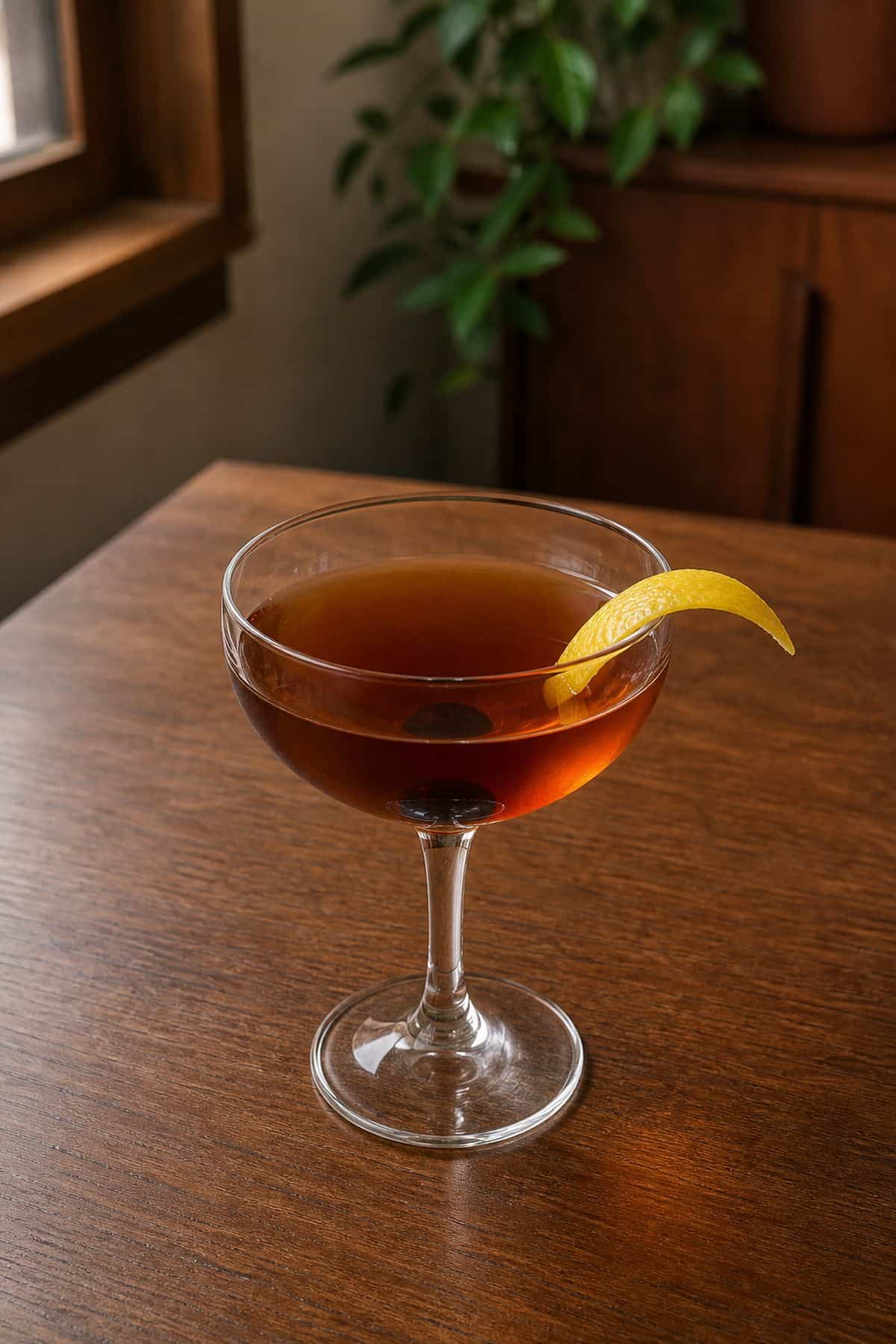
The most-cited origin story sets the Manhattan at the Manhattan Club on Fifth Avenue and 26th Street in late-1870s New York. Lady Randolph Churchill, an American socialite then living in London (and the mother of a young Winston), was hosting a banquet in honor of Samuel J. Tilden, the New York governor who had just run for president. The bartender that night, Iain Marshall, mixed American rye whiskey with Italian sweet vermouth, added a couple of dashes of Angostura, stirred the whole thing over ice, and strained it into a stemmed glass.
That banquet detail has been disputed by cocktail historians (Lady Randolph was apparently in England at the time and very pregnant), but the Manhattan Club’s role in popularizing the drink is solid; the first printed recipe ran in 1884. What’s not disputed is the shape of the cocktail. Whiskey plus aromatized fortified wine plus bitters, stirred not shaken, served up. That template ran through the Martini, the Rob Roy, the Negroni, and most of the spirit-forward cocktails on a modern bar menu.
So when you stir a Manhattan at home, you’re working with the drink that taught the 20th century what a cocktail could be. It’s sibling to the Old Fashioned in DNA (whiskey, bitters, sweet element, stirred) but reads completely different in the glass; the vermouth gives it a lifted, herbaceous quality the Old Fashioned can’t replicate.
A Few Notes on the Ingredients
Rye vs bourbon. Rye is the canonical Manhattan whiskey because its spicy, drier backbone holds up against an ounce of sweet vermouth. Bourbon, which is corn-led and sweeter, makes a softer drink that some bartenders sell as a “Bourbon Manhattan.” Both are valid, but if you want the Manhattan that the Manhattan Club poured, reach for rye. Rittenhouse 100 proof, Sazerac, and Bulleit Rye are reliable options under $35 a bottle.
Sweet vermouth. Vermouth is wine, not spirit. That single fact changes everything about how you store and use it. Three bottles cover most of what bartenders pour. Carpano Antica Formula is the heavyweight: full-bodied, slightly bitter, vanilla-spiced; it makes a richer, more cocktail-bar Manhattan. Cocchi di Torino is lighter, more drinkable, and arguably the strongest balance for a home bar. Dolin Rouge sits on the drier side and is gentler with the whiskey. Skip the supermarket plastic-shouldered Martini Rosso for a Manhattan; the difference is genuinely audible.
Angostura bitters. Two dashes is the standard. The classic yellow-cap Angostura bottle is the right call; orange or chocolate bitters can play, but Angostura is the bitterness profile the drink was built on. A 4 oz bottle costs around $10 and lasts a year of regular mixing.
The cherry. Three options, three different drinks. Brandied cherries (think Filthy, Woodford Reserve Bourbon Cherries) are soaked in spirit, less syrupy, and bring whiskey-friendly warmth. Luxardo Originals are the Italian benchmark: dense, dark, candied in their own thick marasca syrup, and the cherry most cocktail bars reach for. Commercial maraschino cherries (the neon-red Shirley Temple kind) are dyed, sweetened sugar bombs and don’t belong in a Manhattan. Spend the $20 on a jar of Luxardo or brandied; they last six months in the fridge.
And the critical, mostly-unspoken move: refrigerate your sweet vermouth the moment you open it. It oxidizes like any wine. A bottle of vermouth left in a warm liquor cabinet for three months is the most common reason a home Manhattan tastes flat or bitter. Keep it in the door of the fridge and use it within 4 to 6 weeks.
Recipe: Manhattan
Prep time: 3 minutes | Total time: 3 minutes | Serves: 1
Ingredients
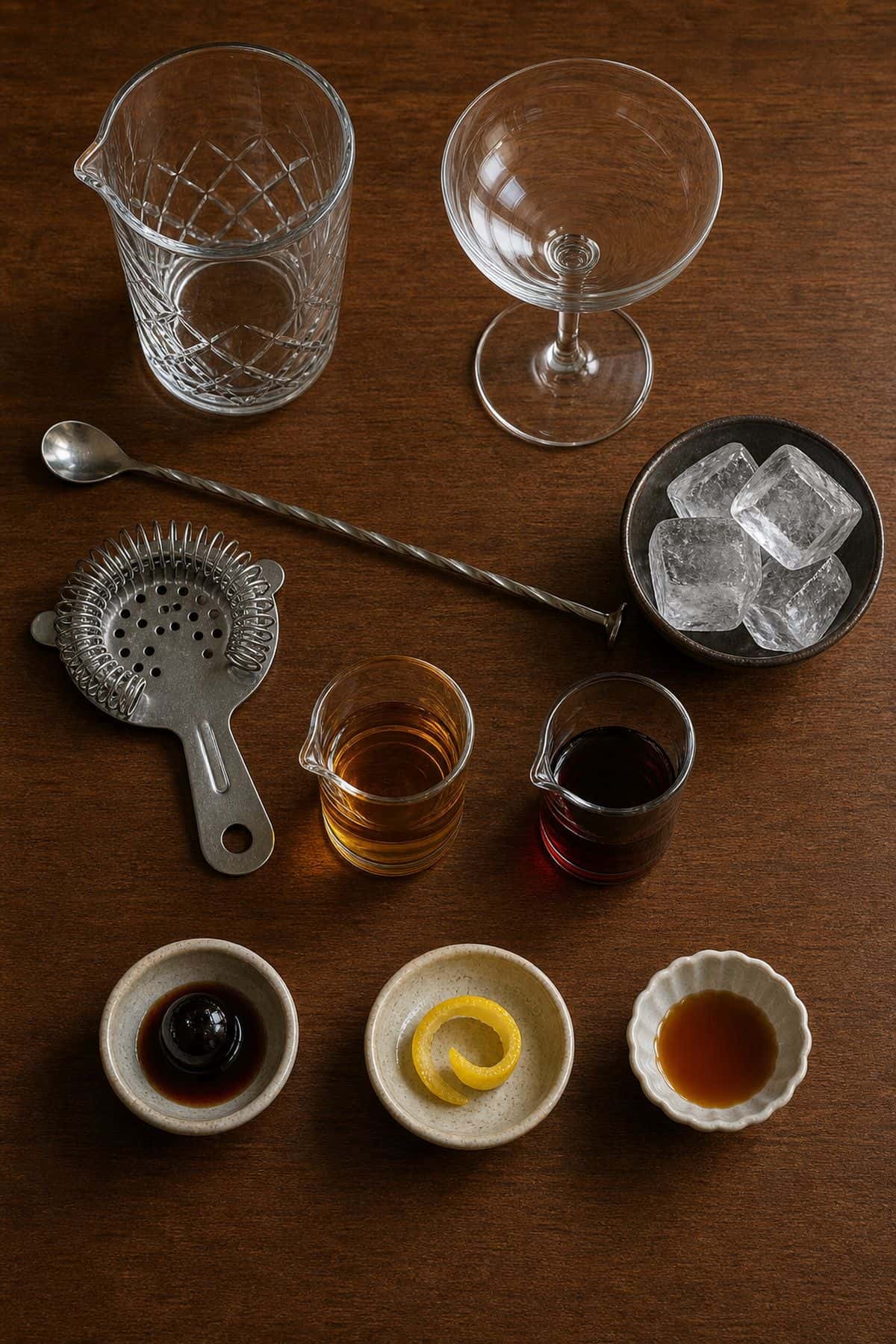
- 60 ml (2 oz) rye whiskey
- 30 ml (1 oz) sweet vermouth
- 2 dashes Angostura bitters
- 1 brandied cherry or Luxardo cherry, for garnish
- 1 lemon twist, optional
- Cracked or large-cube ice, for stirring
Instructions
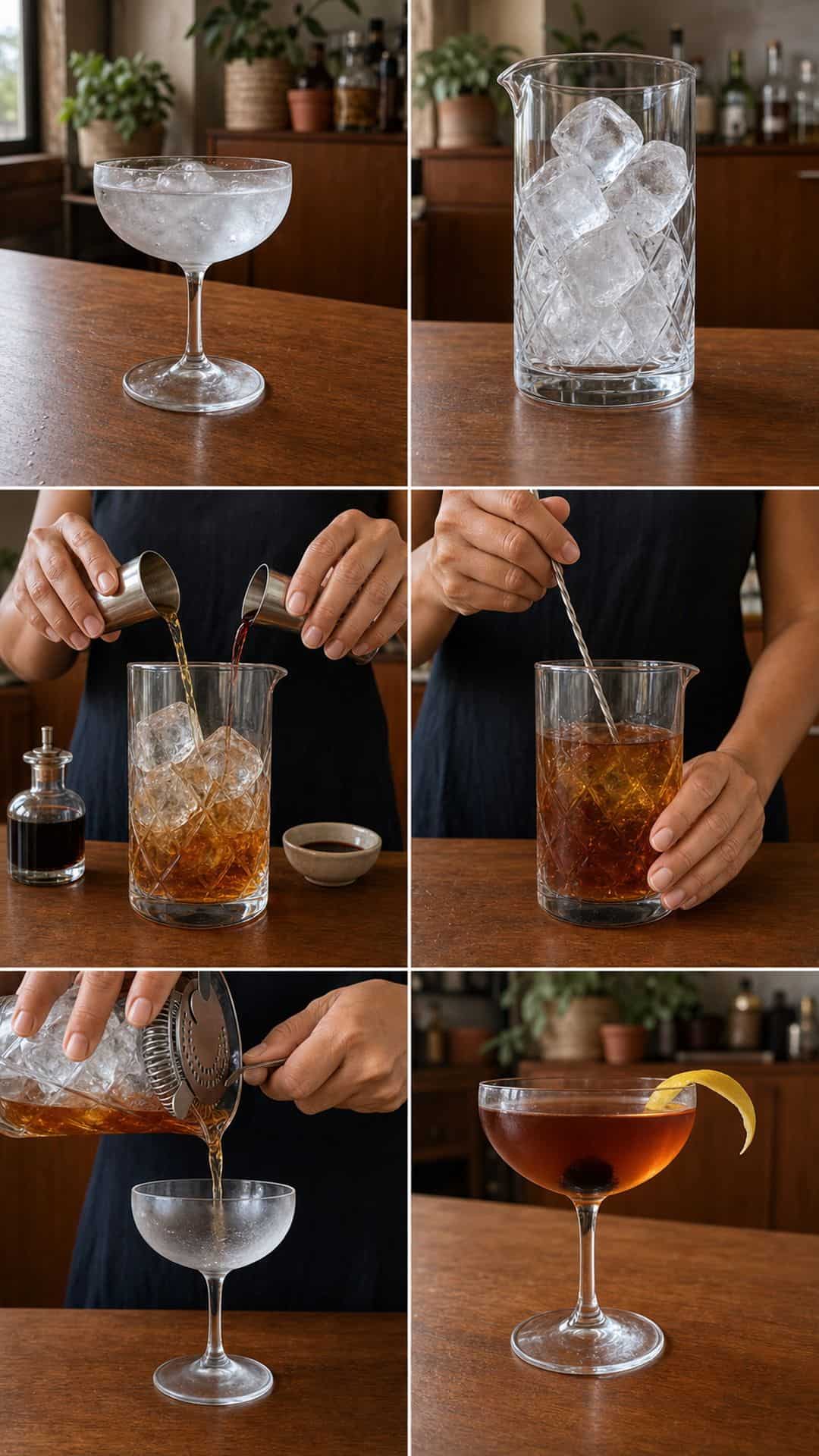
- Chill the glass first. Set a coupe or Nick & Nora glass in the freezer for at least 5 minutes, or fill it with ice and water while you build the drink. A warm glass is the easiest way to ruin a Manhattan.
- Fill a cocktail mixing glass two-thirds full with cracked or large-cube ice. Big, hard ice melts slowly and dilutes the drink predictably; small wet ice waters it down too fast.
- Pour 60 ml (2 oz) rye whiskey and 30 ml (1 oz) sweet vermouth over the ice. Add 2 dashes of Angostura bitters directly on top.
- Stir with a long bar spoon for 30 seconds. Count it. The motion is wrist-led, not arm-led; the spoon should trace the inside wall of the mixing glass smoothly. You’re aiming for proper dilution and a temperature drop of roughly 20 degrees, not for foam.
- Empty the chilling water from the coupe and strain the drink into the chilled glass using a Hawthorne or julep strainer. The cocktail should fill the glass to about a centimeter below the rim.
- Garnish with a brandied or Luxardo cherry dropped into the glass (skewered, or just dropped in). If you want a brighter finish, express a lemon twist over the surface by pinching the peel skin-side down, then drop it in. Serve immediately.
Notes
The 30-second stir isn’t arbitrary. Around the 30-second mark, you’ve added roughly 25% dilution and dropped the temperature to about 0 degrees C (32 F). Shorter and the drink is too hot and boozy; longer and it goes watery.
Shaking a Manhattan is wrong. The shake aerates the drink and clouds the clear, transparent texture that a stirred whiskey cocktail is supposed to have. Reserve the shake for cocktails with citrus or egg white.
Garnish prep is fast but worth doing. If using brandied or Luxardo cherries, scoop the cherry out with a clean bar spoon (not your fingers), let any excess syrup drip off, then drop into the glass. If pairing with a lemon twist, cut a strip of peel from a fresh lemon with a vegetable peeler, avoiding the bitter white pith.
Tips and Variations
The Perfect Manhattan (Split Vermouth)
“Perfect” here means equal parts sweet AND dry vermouth, not a value judgement. The build is 2 oz rye, 0.5 oz sweet vermouth, 0.5 oz dry vermouth, 2 dashes Angostura. Same stir, same chilled coupe, but garnish with a lemon twist instead of a cherry.
The dry vermouth cuts the sugar and brings a brighter, herbaceous top note. This is the version to mix when you want a Manhattan with a lighter footprint, or when you’re serving someone who finds the classic sweet too rich. Dolin Dry is the easiest dry vermouth to start with.
The Dry Manhattan (All Dry Vermouth)
The full swap: 2 oz rye, 1 oz dry vermouth, 2 dashes Angostura, stirred 30 seconds, strained into a chilled coupe. Garnish with a green olive, the way you’d garnish a martini.
This is the leanest, driest Manhattan style. The flavor is more austere, almost martini-adjacent, and the olive (or a lemon twist if you prefer) is the right counterweight. Worth knowing for the cocktail-curious dinner guest who doesn’t want anything sweet.
The Bourbon Manhattan (Sweeter Style)
Swap the rye for bourbon and keep everything else the same: 2 oz bourbon, 1 oz sweet vermouth, 2 dashes Angostura, brandied cherry. The result is softer, sweeter, and rounder, with more vanilla and caramel coming through the corn-led spirit.
Bourbon Manhattans are common on American bar menus and read as a friendly entry point to the cocktail. Buffalo Trace, Maker’s Mark, and Woodford Reserve all sit well here. If you find rye too spicy, this is the version to make at home.
Cherry Choice: Brandied vs Luxardo vs Maraschino
Brandied cherries are cherries soaked in brandy or another spirit; they’re less sweet, more boozy, and a natural fit for whiskey cocktails. Brands like Filthy, Woodford Reserve Bourbon Cherries, and Jack Rudy run $15 to $25 a jar. Luxardo Originals are the Italian classic, dense marasca cherries candied in their own thick syrup, dark and intense. They cost about $20 to $25 a jar and last six months in the fridge.
The neon-red commercial maraschino cherry from the ice cream sundae aisle is a different product entirely: bleached, dyed Red 40, sweetened with corn syrup, and not the cherry the cocktail was built around. Stick with brandied or Luxardo for any spirit-forward drink.
Vermouth Storage and Freshness (The Hidden Tip)
The most common reason a home Manhattan tastes flat is oxidized vermouth. Sweet vermouth is fortified wine at around 16 to 18 percent ABV; once the bottle is open, oxygen starts breaking down the flavor. A vermouth that’s been sitting on a warm shelf for three months tastes muddy, slightly sour, and washed-out.
Refrigerate the bottle the moment you open it. Use it within 4 to 6 weeks for best flavor. If you don’t mix Manhattans often enough to finish a 750 ml bottle in that window, buy the 375 ml half-bottle instead. The taste-test difference between a fresh vermouth and a two-month-old room-temperature one is the single biggest upgrade most home cocktails will ever get.
What to Serve It With
The Manhattan is a steakhouse drink. It pairs with a dry-aged ribeye or strip steak the way few cocktails can: the rye’s spice cuts the fat, and the sweet vermouth picks up the caramelized crust. A wedge salad with blue cheese on the side is the full move.
For something quieter, pair the Manhattan with a charcuterie board. Cured meats, aged Manchego or Comté, marcona almonds, and a few cornichons; the salt and fat reset the palate between sips. A dark-chocolate dessert, especially anything with bittersweet ganache or espresso, is the closer.
For seasonal pairings, the Manhattan reads beautifully on a fall menu next to other whiskey-forward drinks. If you’re hosting in autumn, fold it into a roundup of best fall cocktails alongside an Old Fashioned and a Hot Toddy, or feature it on a winter cocktail spread next to a few Halloween cocktail ideas for an October dinner party.
Frequently Asked Questions
Rye or bourbon for a Manhattan?
Rye is the canonical choice. Its drier, spicier profile stands up to an ounce of sweet vermouth without the cocktail going syrupy. Bourbon makes a softer, sweeter drink (sometimes called a Bourbon Manhattan) that’s a fine alternative if you find rye too sharp.
What is a Perfect Manhattan?
A Perfect Manhattan uses equal parts sweet and dry vermouth (0.5 oz each) instead of 1 oz of sweet vermouth alone. The dry vermouth lightens and brightens the drink. It’s traditionally garnished with a lemon twist rather than a cherry.
Is a Manhattan shaken or stirred?
Always stirred, never shaken. Shaking aerates the drink and clouds the clear, transparent texture that defines a stirred whiskey cocktail. Stir for 30 seconds over cracked or large-cube ice, then strain.
What vermouth is best for a Manhattan?
Carpano Antica Formula is the richest and most full-bodied option. Cocchi di Torino is lighter and arguably the strongest all-rounder. Dolin Rouge sits on the drier side and is gentler against the whiskey. All three are noticeably better than supermarket Martini Rosso for a cocktail.
What’s the difference between a Manhattan and an Old Fashioned?
Both are whiskey-led, stirred cocktails with bitters, but the modifier changes everything. A Manhattan uses sweet vermouth (an ounce of fortified wine) for an herbaceous, lifted profile, served up in a coupe. A Cinnamon Old Fashioned or classic Old Fashioned uses sugar or simple syrup and serves on a big rock in a rocks glass, with a much more direct whiskey flavor.
Key Takeaways
- The canonical Manhattan is 2 oz rye, 1 oz sweet vermouth, 2 dashes Angostura, stirred 30 seconds, strained into a chilled coupe or Nick & Nora.
- Rye is the classical whiskey choice; bourbon makes a softer, sweeter cousin.
- Vermouth quality matters. Carpano Antica, Cocchi di Torino, or Dolin Rouge all outperform supermarket bottles.
- Refrigerate sweet vermouth after opening and use within 4 to 6 weeks; oxidized vermouth is the #1 reason home Manhattans taste flat.
- Stir, never shake; count the 30 seconds for proper dilution and temperature.
- Brandied or Luxardo cherries only; the neon-red commercial maraschino has no place in this drink.
Final Thoughts
The Manhattan is one of the rare cocktails that’s both technically simple and genuinely hard to make boring. Three ingredients, one stir, one chilled glass. The drink rewards you for caring about the small things (the cut of ice in the mixing glass, the temperature of the coupe, the freshness of the vermouth) and forgives almost nothing when you don’t.
The 2:1 sweet Manhattan is the version to learn first. Once it’s in your hands, the Perfect (split vermouth) and the Dry (all dry vermouth) variations are an easy pivot, and the Bourbon Manhattan is there for guests who want something softer. For a more whiskey-direct cousin try the Old Fashioned; for a multi-spirit highball that goes the other direction entirely, the Long Island Iced Tea is on the menu.
Make this one before dinner with a steak, after dinner with a square of dark chocolate, or on a quiet Wednesday when you want the kitchen to feel like an old hotel bar. The Manhattan has been doing this work since the 1870s; it’s earned the spot.
Manhattan
The classic manhattan cocktail recipe is a 2:1 build: 2 oz rye whiskey, 1 oz sweet vermouth, and 2 dashes Angostura bitters, stirred over ice for 30 seconds and strained into a chilled coupe or Nick & Nora glass. Garnish with a brandied or Luxardo cherry.
Ingredients
- 60 ml (2 oz) rye whiskey
- 30 ml (1 oz) sweet vermouth
- 2 dashes Angostura bitters
- 1 brandied cherry or Luxardo cherry, for garnish
- 1 lemon twist, optional
- Cracked or large-cube ice, for stirring
Instructions
- Chill the glass first. Set a coupe or Nick & Nora glass in the freezer for at least 5 minutes, or fill it with ice and water while you build the drink. A warm glass is the easiest way to ruin a Manhattan.
- Fill a cocktail mixing glass two-thirds full with cracked or large-cube ice. Big, hard ice melts slowly and dilutes the drink predictably; small wet ice waters it down too fast.
- Pour 60 ml (2 oz) rye whiskey and 30 ml (1 oz) sweet vermouth over the ice. Add 2 dashes of Angostura bitters directly on top.
- Stir with a long bar spoon for 30 seconds. Count it. The motion is wrist-led, not arm-led; the spoon should trace the inside wall of the mixing glass smoothly. You're aiming for proper dilution and a temperature drop of roughly 20 degrees, not for foam.
- Empty the chilling water from the coupe and strain the drink into the chilled glass using a Hawthorne or julep strainer. The cocktail should fill the glass to about a centimeter below the rim.
- Garnish with a brandied or Luxardo cherry dropped into the glass (skewered, or just dropped in). If you want a brighter finish, express a lemon twist over the surface by pinching the peel skin-side down, then drop it in. Serve immediately.
Notes
The 30-second stir isn't arbitrary. Around the 30-second mark, you've added roughly 25% dilution and dropped the temperature to about 0 degrees C (32 F). Shorter and the drink is too hot and boozy; longer and it goes watery.
Shaking a Manhattan is wrong. The shake aerates the drink and clouds the clear, transparent texture that a stirred whiskey cocktail is supposed to have. Reserve the shake for cocktails with citrus or egg white.
Last update on 2026-10-03 / Affiliate links / Images from Amazon Product Advertising API