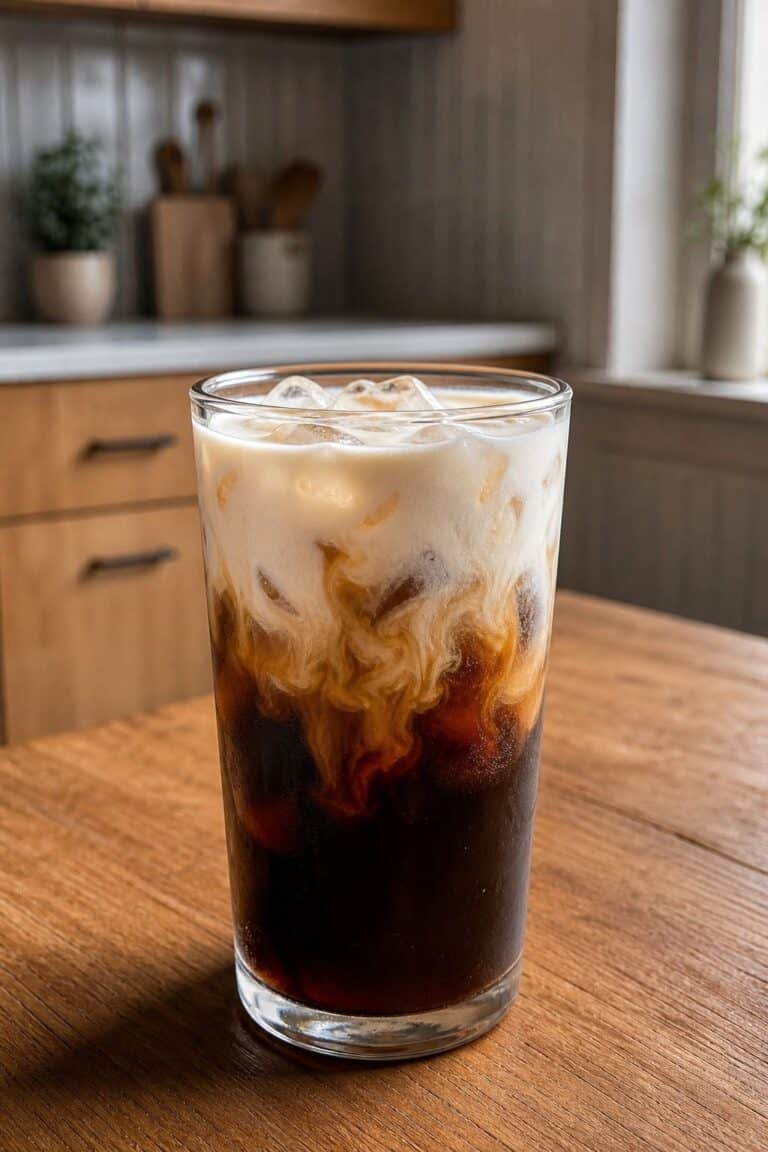
A strawberry matcha latte at home is a three-layer build: macerated strawberries at the bottom, ice and cold milk in the middle, and a thin pour of ceremonial matcha whisked with hot water at 175 to 180°F resting on top. The drink stays layered because the unsweetened matcha tea is less dense than the sweetened milk underneath, so you get the pink-and-green look that made this drink a TikTok favorite without a single drop of food coloring. Total time about 20 minutes, including a 15-minute strawberry maceration.
The strawberries hit the glass first, bruised pink with sugar still clinging to the back of the fork. Then the ice, then cold oat milk, then a pour of bright green matcha that lands on top and stays there. A strawberry matcha latte is a drink you build with your eyes as much as your tongue, and the version below is the home cook’s answer to the $7 cafe cup: fresh fruit instead of syrup, ceremonial matcha whisked properly, and a build that holds its layers from the first sip to the last.

Gear That Helps Here
A bamboo chasen whisk is the single biggest upgrade. A small ceramic matcha bowl gives the whisk room to move in a proper W or M motion, which is what gets the matcha frothy without clumps.
A clear glass tumbler matters more than it should. You built this drink for the layers, so let yourself see them. A small fine-mesh sifter for the matcha powder, a fork for crushing strawberries, and a measuring cup with a spout for a clean pour round out the kit.


Recommended Reads
- Earl Grey Matcha
- Iced Caramel Latte
- Vanilla Sweet Cream Cold Brew
- Perfect Cold Brew Coffee
- best fall mocktails
Why the Three-Layer Build Works
The three-layer build is not a styling trick; it is a density story. Macerated strawberries sit at the bottom because their sugared juice is the heaviest liquid in the glass. Cold milk, sweetened lightly by that strawberry syrup as it mingles around the ice, sits in the middle. The matcha layer floats on top because two ounces of whisked tea, with no sweetener and no fat, is less dense than the milk underneath.
This is the same physics that keeps a tequila sunrise pretty. As long as the matcha is poured slowly, off the back of a spoon or down the side of the glass, the layers hold for about ten to fifteen minutes before they start to blur. Stirring before drinking is encouraged; the flavors only come together once everything moves.
It also means that hot whisked matcha layered onto cold milk and ice works just fine. The matcha cools as it lands and the layers still set. The whisking is what matters; properly aerated matcha is lighter than unaerated matcha, and that frothy texture is part of why the top layer sits so cleanly.
A Few Notes on the Ingredients
Ceremonial-grade matcha: Use ceremonial, not culinary. Culinary matcha is meant for baking and cooking, where it competes with butter and sugar; it turns sharp and astringent in a cold milk drink. Ceremonial matcha is the stone-ground first-harvest leaf, sweeter, smoother, and the right call for a drink where the matcha is the headline. Ippodo, Encha, and Mizuba are the names worth knowing. A 30 g (1 oz) tin is enough for about fifteen drinks.
Strawberries: Fresh strawberries macerated with sugar are the gold-standard build. The maceration draws juice out of the fruit and turns it into a loose syrup; fifteen minutes is enough for ripe summer berries, an hour is better for pale winter ones. Freeze-dried strawberries crushed into powder and stirred into a little hot water make a shelf-stable syrup substitute that works year-round and is the move when fresh berries are sad. A spoonful of good strawberry jam loosened with a splash of water is the in-a-pinch alternative.
Milk: Oat milk barista blend is the pick most cafes default to, and the layer holds cleanly because the added fat and gum make it slightly denser than regular oat. Whole dairy works too, and the flavor is rounder. Almond milk thins the drink and the layer wobbles; skip unless it is what you have. The total milk pour is 6 to 8 ounces; less if you want a stronger matcha note, more if you want it creamier.
Water temperature: 175 to 180°F (80°C) is the sweet spot for whisking matcha. Boiling water at 212°F scorches the leaf, kills the L-theanine that gives matcha its mellow caffeine, and turns the drink bitter. Bring water to a boil, then let it sit off the heat for about 90 seconds; that is the temperature window without a thermometer. A goose-neck kettle with a built-in temperature display makes it foolproof.
Sweetener: The strawberries usually bring enough sugar through the maceration. If the drink reads thin, half a teaspoon of simple syrup or a small drizzle of vanilla syrup into the milk fixes it. Skip honey; it sinks and clumps in cold milk.
Recipe: Strawberry Matcha Latte

Prep time: 5 minutes (plus 15 minutes maceration) | Total time: 20 minutes | Serves: 1
Ingredients
- 75 g (1/2 cup) fresh strawberries, hulled and roughly chopped
- 15 g (1 to 2 Tbsp) granulated sugar
- 3 g (1 to 1.5 tsp) ceremonial-grade matcha powder, sifted
- 60 ml (2 oz) hot water at 175 to 180°F (80°C)
- 180 to 240 ml (6 to 8 oz) cold milk, oat barista blend or whole dairy
- 1 cup ice cubes
Instructions
- Macerate the strawberries first. In a small bowl, combine 75 g (1/2 cup) chopped strawberries with 15 g (1 to 2 Tbsp) sugar. Crush lightly with a fork until the berries break down into a chunky, juicy compote. Let sit at room temperature for at least 15 minutes; up to an hour produces more syrup and softer fruit.
- Heat water to 175 to 180°F (80°C) while the strawberries macerate. Bring water to a boil in a kettle, then take it off the heat and let it sit for about 90 seconds. If you have a temperature-display kettle, set it to 175°F.
- Sift 3 g (1 to 1.5 tsp) ceremonial matcha into a small ceramic bowl through a fine-mesh strainer. Sifting matters; it is what prevents clumps in the final whisk.
- Pour 60 ml (2 oz) of the 175°F water over the matcha. Hold the bamboo chasen whisk and whisk in a fast W or M motion (not in a circle) for about 20 to 30 seconds, until the matcha is fully dissolved and a fine layer of bright green foam sits on top. The foam tells you the matcha is aerated and ready.
- Build the drink. Spoon the macerated strawberries and their syrup into the bottom of a 16 oz (480 ml) clear glass. Fill the glass about two-thirds full with ice on top of the strawberries.
- Pour 180 to 240 ml (6 to 8 oz) cold milk over the ice, slowly, to keep the strawberry layer at the bottom. The milk should sit cleanly between the strawberries and the air.
- Pour the whisked matcha on top, slowly, down the back of a spoon or against the inside of the glass. The matcha should form a green layer that floats on the milk. Do not stir.
- Serve immediately with a long spoon and a straw. Stir before drinking so the strawberries and matcha mix through the milk in every sip.
Notes
The strawberry maceration can be made up to a day ahead and stored in the fridge in a sealed jar. The longer it sits, the more syrupy it gets. Stir before using if liquid and pulp separate.
If the matcha is bitter, the water was too hot. If the matcha is grainy on the tongue, it was not whisked long enough or not sifted. Both are fixable on the next drink; matcha is a 30-second skill that gets sharp after about five tries.
For a hot version, skip the ice and use warm milk steamed or heated to about 150°F. Build strawberries at the bottom, warm milk in the middle, and whisked matcha on top. The layers still hold for the first few minutes; the drink is meant to be stirred and sipped.
Tips and Variations
When Fresh Strawberries Are Out of Season
Freeze-dried strawberries are the year-round substitute for fresh. Crush 10 g (about 1/3 cup) freeze-dried strawberries to a fine powder in a small bag with a rolling pin or in a spice grinder. Stir into 30 ml (2 Tbsp) just-boiled water with 15 g (1 Tbsp) sugar to make a fast, thick syrup. Use in place of the macerated strawberries; the flavor is concentrated and the color stays bright pink for the bottom layer.
Frozen strawberries also work, thawed first and macerated with sugar for an hour. They produce more juice than fresh and the texture is softer, which is a good thing in this drink.
The Hot Strawberry Matcha Build
The hot version is closer to a steamed latte. Heat 180 ml (6 oz) milk to about 150°F (65°C) in a small saucepan or with a milk frother. Spoon the macerated strawberries into the bottom of a heat-safe glass mug, pour the warm milk over them, and float the whisked matcha on top. Skip the ice. The drink is for cold mornings, especially in winter when freeze-dried strawberries are doing the work.
Warm dairy holds the layers slightly less than cold milk, so pour the matcha slowly and serve right away. Reach for whole dairy here; the steamed milk reads richer.
How to Hit the Starbucks Copycat Profile
The Starbucks-style strawberry matcha (a TikTok secret-menu drink, not a regular menu item) leans on a pre-made strawberry puree and a slightly sweeter milk base. To get closer at home, blend the macerated strawberries smooth in a small blender or with an immersion blender before spooning into the glass; that gives the bottom layer the smooth, puree-style texture. Add a half-teaspoon of vanilla syrup to the milk for the Starbucks-style background note.
Cost comparison: a Starbucks Grande version runs about $6.75 to $7.25 plus tax in most US markets. The home version, made with good ceremonial matcha and fresh fruit, lands at about $1.10 per drink once the matcha tin and milk container are paid for.
Vegan and Dairy-Free Layer Integrity
Oat milk barista blend is the dairy-free pick that holds the layer best. The added fat and gums make it dense enough for the matcha to float cleanly on top. Coconut milk (carton, not canned) is the second-best option and brings a tropical edge that works with the strawberries. Soy barista holds the layer reliably but the flavor competes with the matcha.
Skip plain almond milk and unsweetened cashew milk; both are too thin, and the matcha falls through into the milk in the first few seconds. If almond is all you have, look for a barista-blend version that includes added thickeners.
Batching the Strawberry Puree
Make a bigger batch of the strawberry syrup once and use it through the week. Macerate 300 g (about 2 cups) chopped strawberries with 60 g (4 Tbsp) sugar in a jar overnight, then blend smooth and strain through a fine-mesh sieve if you want a clear syrup or leave chunky if you like the fruit. Store covered in the fridge.
The batch keeps 4 to 5 days refrigerated. Use 2 to 3 tablespoons per drink. The strawberry syrup also works in lemonade, over yogurt, and stirred into sparkling water for a quick non-alcoholic spritz.
What to Pair It With
A strawberry matcha latte is a breakfast or mid-morning drink. It is sweet but not heavy, caffeinated but not sharp, and pairs with the kind of food that wants a creamy, fruit-forward cup next to it. Buttery croissants and pain au chocolat are the obvious pick. Almond croissants, ricotta toast with honey, or a slice of lemon pound cake all sit in the same lane.
For brunch, this is the drink that goes with eggs and bacon when coffee feels too heavy. It also works with yogurt parfaits, granola, and fresh fruit plates. Avoid pairing with very savory or spiced food; the strawberry and matcha read better next to butter and sugar than next to chorizo and chili.
This recipe is also in my coffee recipes, Easter brunch ideas and Galentine’s brunch ideas.
Frequently Asked Questions
What is in a Starbucks strawberry matcha latte?
It is a TikTok secret-menu order, not a standard menu item. Baristas build it as strawberry puree at the bottom, milk and ice in the middle, and a matcha shot on top. The home version uses fresh macerated strawberries (or freeze-dried syrup) in place of the bottled puree, which makes the flavor cleaner and the color brighter.
Can you make strawberry matcha at home cheaper than Starbucks?
About six times cheaper per drink once the matcha tin is open. A Grande at Starbucks runs $6.75 to $7.25 with tax in most US markets. The home version, with good ceremonial matcha, oat milk, and fresh strawberries, comes in around $1.10 per drink. The matcha tin is the big upfront cost; a 30 g (1 oz) tin makes about fifteen drinks.
Do you use strawberry puree or syrup for matcha latte?
Fresh macerated strawberries make the strongest version when berries are in season; the texture is real fruit and the color is bright pink. Freeze-dried strawberry syrup is the off-season substitute and keeps for weeks. A spoonful of good strawberry jam loosened with water is the lazy alternative and works in a pinch.
What kind of matcha is best for strawberry matcha latte?
Ceremonial grade, always. Culinary matcha is bred for baking and gets sharp and bitter when whisked into a cold milk drink. Ceremonial matcha is the stone-ground first-harvest leaf and stays smooth and sweet. Look for Japanese-grown matcha from Uji or Nishio; Ippodo, Encha, and Mizuba are the names to know.
How much caffeine is in a strawberry matcha latte?
About 70 mg of caffeine in a typical drink made with 1 to 1.5 tsp ceremonial matcha. Roughly the same as a small cup of brewed coffee, with the matcha’s L-theanine giving it a smoother, longer release. A Starbucks Grande tops up to around 80 mg with their larger matcha pour.
Key Takeaways
- Macerate fresh strawberries with sugar for 15 minutes to an hour to build the bottom layer.
- Use ceremonial-grade matcha; culinary grade turns bitter in cold milk.
- Whisk matcha with water at 175 to 180°F, never boiling, to protect the L-theanine and avoid a sharp finish.
- Oat milk barista blend holds the three-layer build the cleanest; whole dairy is the close second.
- Pour the matcha last and slowly down the back of a spoon to keep the green-on-pink layers visible.
Final Thoughts
A strawberry matcha latte is one of the rare cafe drinks that gets better at home than in a paper cup. Fresh strawberries beat any bottled puree, ceremonial matcha beats whatever a chain is whisking up at scale, and the build takes five active minutes once the berries have macerated. The drink is photogenic, but the reason to make it is the taste; strawberry and matcha is a pairing that does not feel obvious until the first sip.
Make this for a Sunday morning, a slow weekday breakfast, or whenever the cafe craving hits and you do not feel like leaving the house. Pair with a croissant, an almond pastry, or a slice of pound cake; nothing too rich.
And if the strawberry-matcha combination clicks, the Earl Grey matcha lives next door; same matcha base, different flavor partner. Worth trying on the next quiet morning.
Last update on 2026-11-18 / Affiliate links / Images from Amazon Product Advertising API