
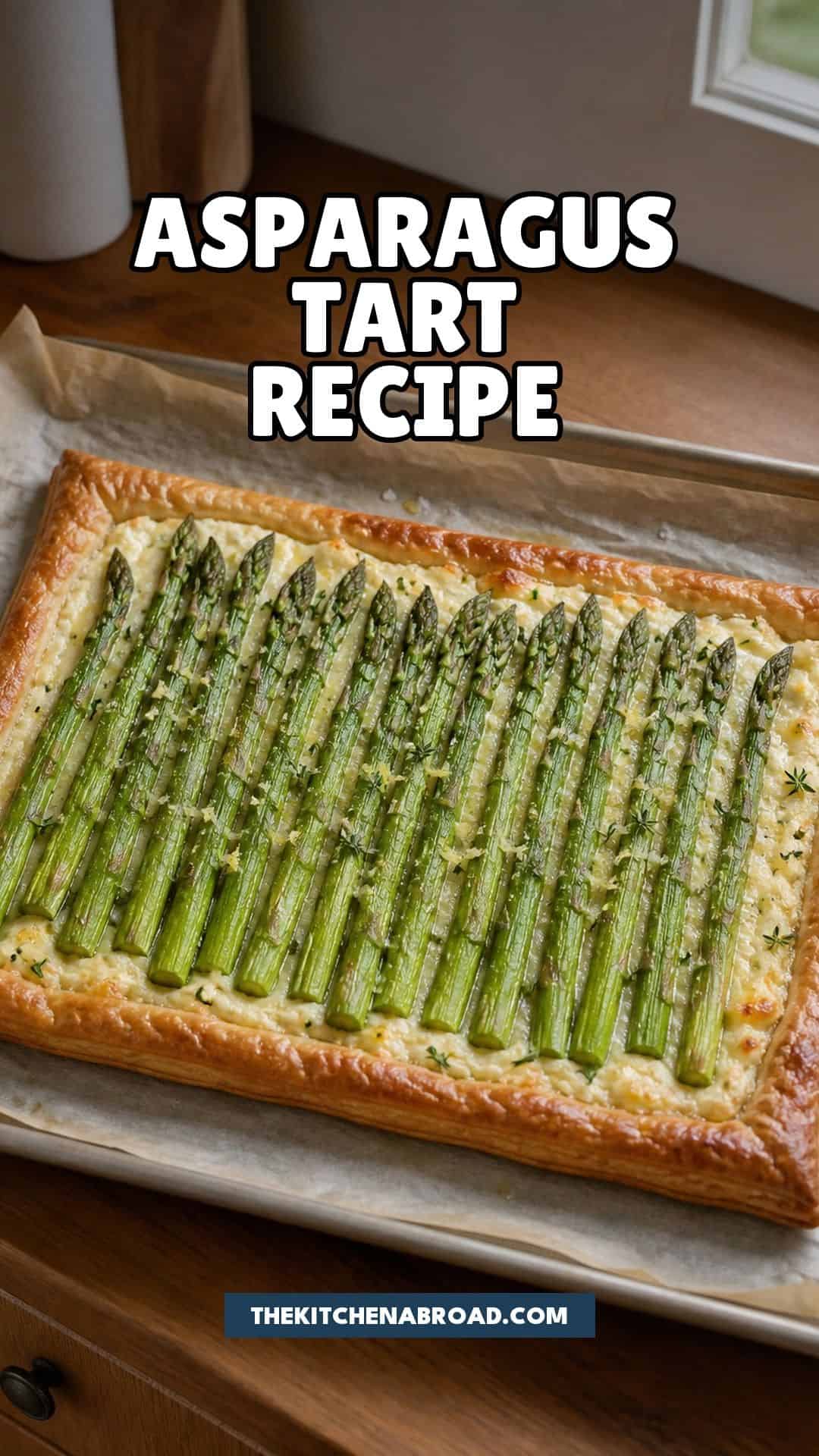
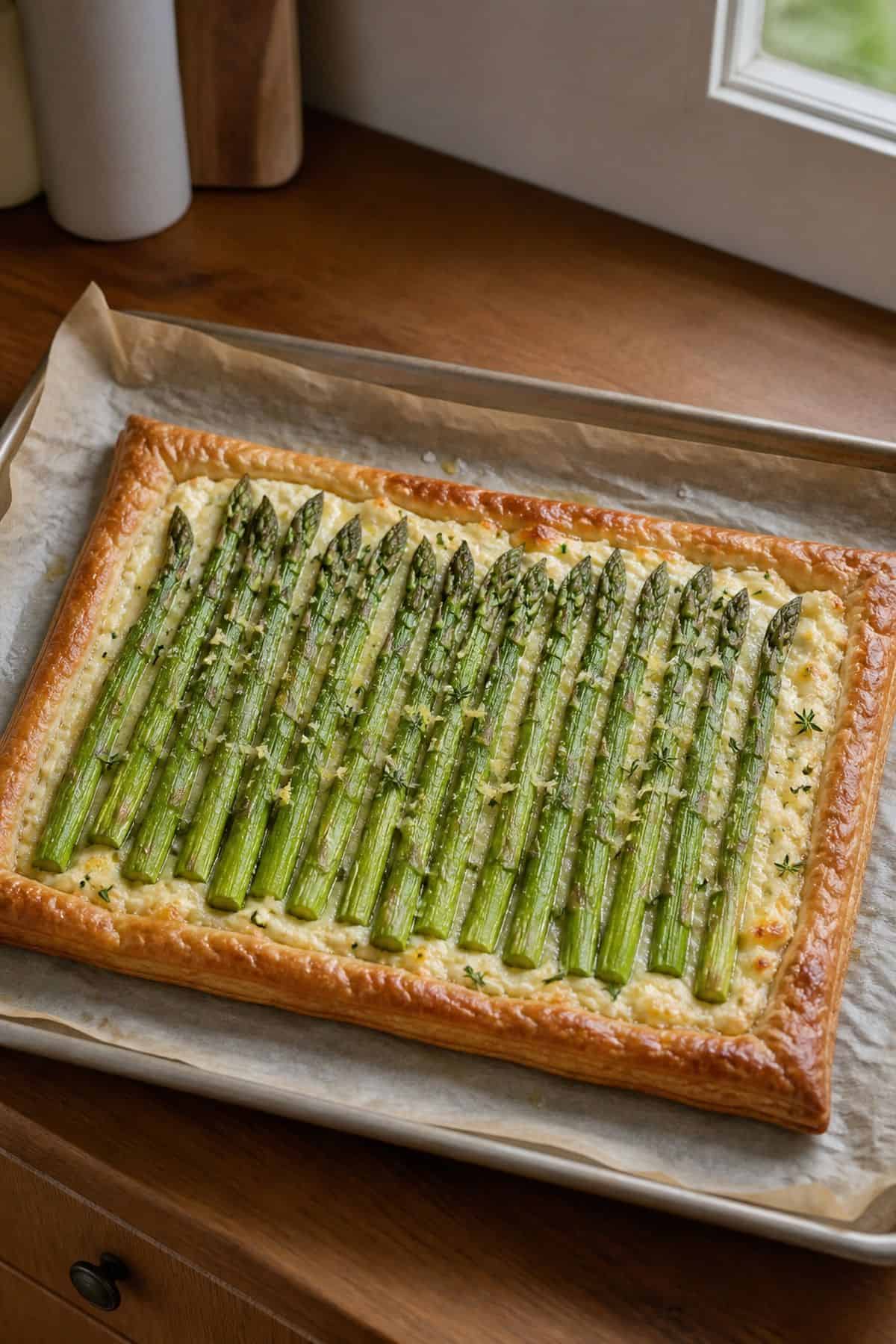
An asparagus tart is the spring centerpiece dish: a sheet of all-butter puff pastry, a three-cheese base of ricotta, Gruyère, and Parmesan spread edge-to-edge as a moisture barrier, and whole spears arranged in a tight geometric row. Blanch the asparagus 30 seconds, score the pastry at a half-inch border, bake at 400°F for 22 to 25 minutes. Yes, you need to blanch first; raw spears bake out grey. The whole thing comes together in 45 minutes and serves six.
In Provence it is tarte aux asperges. On American spring tables, it is the dish that signals winter is finally done. The version here pulls from both lineages, the French Provençal tart built on goat cheese and ham and the English garden-table pastry that lands on long outdoor tables at Easter, then runs them through the modern brunch playbook Melissa Clark and Smitten Kitchen made the standard a decade ago. Whole spears lined up like soldiers, a cheese base that doubles as a moisture barrier, a puffed mahogany frame.
What You’ll Need
A rimmed half sheet pan lined with parchment, a sharp 8-inch chef’s knife for trimming the spears and slicing the finished tart cleanly, a silicone pastry brush for the egg wash, and a rectangular ceramic platter for the table.


Recommended Reads
- Chopped Asparagus Salad
- Lemon Parmesan Asparagus
- Roasted Spring Vegetables with Lemon Herb Drizzle
- Best Easter Dinner Ideas
- Mother’s Day Brunch Ideas
Where the Asparagus Tart Came From
The dish has two parents. The French tarte aux asperges is a Provençal spring staple, built historically on a shortcrust or puff base with fresh goat cheese, sometimes a layer of cured ham, and whole green or white spears laid across the top. It shows up in regional cookbooks from the early 20th century and on bistro chalkboards every April. The English version comes from the garden-table tradition: savory pastries served outdoors at Easter weekend, often using the first asparagus cut from the kitchen garden, a tradition that survives at country house teas and Chelsea Flower Show lunches.
The modern American version owes its shape to two food writers. Melissa Clark put a goat-cheese-and-tarragon take in The New York Times in the late 2000s and Smitten Kitchen ran a puff-pastry-and-Gruyère riff that became the Pinterest template every spring blog has been copying since. The format settled: store-bought all-butter puff, one creamy cheese plus one melting cheese, whole spears arranged in rows, 400°F oven, twenty-something minutes. The recipe below takes that template and tightens the three places it most often slips, the cheese ratio, the blanch, and the geometry.
A Few Notes on the Ingredients
- All-butter puff pastry: Dufour is the gold standard, Trader Joe’s all-butter sheets are the reliable workhorse, and any generic all-butter brand at a decent supermarket will work. Read the label; if the first fat listed is shortening or palm oil, put it back.
- Whole-milk ricotta: Half a cup, for body in the cheese base. It softens and binds the other cheeses into something that spreads cleanly across the docked interior.
- Gruyère: One cup grated, for the nutty melt that gives the tart its savory backbone. The cheese seals the pastry surface so steam from the asparagus escapes upward instead of soaking into the dough.
- Parmesan: A quarter cup grated, for the salt and the umami top note. Together the three cheeses are doing flavor work and structural work; spread edge-to-edge as a moisture barrier, never as a garnish.
- Medium asparagus spears: About the diameter of a pencil. They cook through in the same 22 to 25 minutes the pastry needs to brown. Pencil-thin spears go limp; jumbo spears need a longer blanch and a peel down the bottom third.
- Blanch and shock: Thirty seconds in salted boiling water, 60 seconds in ice water, then dry thoroughly on a kitchen towel. Raw spears on a tart finish grey, fibrous, and undercooked at the base. The blanch costs you 90 seconds and saves the dish.
- Egg wash on the border only: One beaten egg, brushed on the scored border only. Take care not to drip wash down the cut edge; it can seal the layers and stop the puff.
- Lemon zest off heat: Zest of one lemon scattered across the tart after it comes out of the oven. Never bake the zest; the oils flatten in heat. This is the finish that tells the table the dish is done.
Recipe: Asparagus Tart
Prep time: 20 minutes | Cook time: 25 minutes | Total time: 45 minutes | Serves: 6
Ingredients
- 1 sheet (about 250 g) all-butter puff pastry, thawed in the fridge overnight
- 1 lb (450 g) asparagus, trimmed to fit the length of the pastry
- 1/2 cup (115 g) whole-milk ricotta
- 1 cup (100 g) Gruyère, grated
- 1/4 cup (25 g) Parmesan, grated
- 1 egg, beaten, for the wash
- 1 tbsp (15 ml) extra-virgin olive oil
- Zest of 1 lemon
- Salt and freshly ground black pepper
- Fresh thyme leaves, optional, for finishing
Instructions
- Heat the oven to 400°F (200°C) with a rack in the middle position. Line a half sheet pan with parchment.
- Bring a wide skillet of salted water to a rolling boil and prepare an ice bath in a large bowl. Drop the trimmed asparagus into the boiling water for exactly 30 seconds, then lift it straight into the ice bath for 60 seconds. Drain on a clean kitchen towel and pat completely dry. Wet spears will steam under the cheese and soften the pastry.
- Unroll the puff pastry onto the parchment-lined sheet pan. If it cracks, press the seams together with your fingers. Using a sharp knife, score a 1/2-inch border around the perimeter, cutting about halfway through the pastry but not all the way down. Dock the interior (inside the border) all over with a fork to keep it from puffing in the middle.
- In a small bowl, stir together the ricotta, Gruyère, and Parmesan with a pinch of salt and a few grinds of pepper. Spread the mixture edge-to-edge inside the scored border, pressing it into the corners. This is the moisture barrier; do not leave gaps.
- Arrange the asparagus spears in a tight row across the cheese, all running the same direction, or alternate tip direction every other spear for a wedge pattern. Trim the tail ends so they sit cleanly inside the border. Drizzle the spears lightly with olive oil and season with salt and pepper.
- Brush the scored border with the beaten egg, taking care not to drip wash down the cut edge (it can seal the layers and stop the puff).
- Bake on the middle rack for 22 to 25 minutes, rotating the pan front-to-back at minute 14, until the border is deep mahogany and the cheese is bubbling. If the spear tips are darkening before the pastry sets, tent loosely with foil at minute 18.
- Pull the tart from the oven. While it is still hot, scatter the lemon zest and the thyme leaves (if using) across the surface and finish with a thread of olive oil and a pinch of flaky salt. Never bake the zest; the oils flatten in heat.
- Slide the tart onto a cutting board and let it rest 5 minutes. Slice with a sharp chef’s knife in long downward presses (not a sawing motion, which shatters the puff). Cut into six rectangles or twelve fingers for a starter.
Notes
The cheese base is doing structural work, not just flavor work. Spread it like grout, edge-to-edge inside the border, with no bare pastry visible. That seal is the single biggest reason this tart bakes crisp underneath instead of soggy.
Spear geometry is the photograph. A tight row of identical-thickness spears all pointing the same way reads as a magazine shot. Alternating tip-to-tail creates the wedge pattern that pins well. Chopped spears scattered across the cheese will taste fine but will not read as a tart.
To reheat leftovers, place slices on a wire rack inside a sheet pan and warm at 350°F (175°C) for 8 minutes. The microwave makes the pastry leathery and the cheese rubbery within 30 seconds; the oven is non-negotiable.
Tips and Variations
How to Score the Border Without Cutting Through
Use the tip of a sharp paring knife held nearly vertical and press down about halfway through the pastry, just enough that you can feel resistance but not see the parchment underneath. The point is to give the border a path to puff straight up while the docked interior stays flat. A full cut-through severs the layers and gives you a sad collapsed frame. A 1/2-inch border is the sweet spot; an inch is overkill and steals real estate from the asparagus.
Picking the Right Asparagus Thickness for the Pastry
Medium spears (about the diameter of a pencil) are the right size for a brunch tart: they cook through in the same 22 to 25 minutes the pastry needs to brown. Pencil-thin spears will overcook and go limp by minute 20, and jumbo spears need a longer blanch (45 to 60 seconds) and may still finish woody at the base. If all you can find is jumbo, peel the bottom third with a vegetable peeler before blanching.
Making This Vegetarian for Easter Brunch
The default recipe is already vegetarian, which is part of why it earns its place on Easter and Mother’s Day tables alongside ham and lamb. To make it the centerpiece of an entirely vegetarian spread, plate the tart on a long rectangular platter with a bright herb salad alongside (parsley, dill, chives, lemon vinaigrette) and serve with a soft-boiled egg on top of each slice. The egg yolk into the cheese is the move that turns a starter into a main.
The Goat-Cheese-and-Tarragon Variation (Melissa Clark Style)
For the French-leaning version, swap the three-cheese base for 6 ounces (170 g) of softened fresh goat cheese mashed with 2 tablespoons of crème fraîche, the zest of one lemon, and 2 tablespoons of chopped fresh tarragon. Spread it edge-to-edge as you would the ricotta blend. The goat cheese gives a sharper tang and a more obviously Provençal read; tarragon plus asparagus is the classic spring pairing in French cooking. Skip the Gruyère and Parmesan if you go this route.
Make-Ahead Components and Reheating
The tart can be fully assembled (cheese spread, asparagus arranged, border egg-washed) up to 4 hours ahead and held uncovered on the sheet pan in the fridge. Bake straight from cold and add 2 to 3 minutes to the bake time. The cheese mixture can be made a day ahead and refrigerated in a tub; the asparagus can be blanched and shocked the night before and held dry in a kitchen towel in the fridge. For leftovers, the wire-rack-and-oven reheat at 350°F for 8 minutes brings the pastry back to crisp. Never microwave a puff pastry tart; the steam destroys the layers.
What to Serve It With
For Easter brunch, plate it alongside a glazed ham, deviled eggs, and a basket of hot cross buns. For Mother’s Day, lean into the spring-table mood with a glass of dry rosé or a French 75. As a vegetarian main, pair with a generous arugula salad in lemon vinaigrette and a loaf of crusty bread. For a dinner-party starter, cut the tart into long fingers and pass with chilled white burgundy. For a light lunch, slide a poached egg onto each slice and call it dinner.
Frequently Asked Questions
Do I need to blanch the asparagus first?
Yes. Thirty seconds in salted boiling water, then 60 seconds in an ice bath, then dry thoroughly. The blanch locks in the bright green color and partially cooks the spears so they finish tender in the same 22 to 25 minutes the pastry needs to brown. Raw spears on a tart finish grey-green at the tips and fibrous at the base. The cost is 90 seconds; the payoff is the entire visual.
Can I use phyllo instead of puff pastry?
No. Phyllo is too thin to support the cheese layer and will not give you the puffed mahogany border that defines this tart. The whole architecture depends on all-butter puff pastry, which lifts into a frame around the filling. Phyllo collapses under the weight of the ricotta and Gruyère and gives you a flat, cracker-like base instead of a tart.
Why is my asparagus tart soggy in the middle?
Two usual causes: the asparagus was wet when it went onto the tart (water from the blanch turning to steam inside the cheese), or the cheese layer was not spread edge-to-edge as a sealed moisture barrier. Pat the spears completely dry on a kitchen towel after the ice bath, and spread the cheese mixture so there is zero exposed pastry inside the border. The cheese is grout, not garnish.
What’s the most reliable cheese combination for an asparagus tart?
The magazine version is whole-milk ricotta for body, Gruyère for the nutty melt, and Parmesan for the salt. Boursin garlic-and-herb spread is the credible one-ingredient shortcut. Fresh goat cheese plus lemon zest and tarragon is the French move. All three work; the three-cheese blend is the most balanced and the most photogenic.
Can I make an asparagus tart ahead of time?
Yes, with a window. Assemble the tart fully (cheese spread, spears arranged, border egg-washed) up to 4 hours ahead and refrigerate uncovered on the sheet pan. Bake straight from cold and add 2 to 3 minutes to the bake time. Components hold longer: the cheese mixture can be made a day ahead, and the blanched spears keep dry in a kitchen towel in the fridge overnight.
How thick should the asparagus spears be?
Medium, about the diameter of a pencil. They cook through in the same time the pastry takes to brown and stay structured enough to lift cleanly with a slice. Pencil-thin spears overcook and go limp; jumbo spears need a longer blanch and a peel down the bottom third or they finish woody.
Key Takeaways
- Use all-butter puff pastry only, never the margarine-based supermarket sheets.
- Blanch the asparagus 30 seconds, ice-bath 60 seconds, and dry thoroughly before assembly.
- Spread the cheese layer edge-to-edge inside the border as a moisture barrier, not a garnish.
- Score a 1/2-inch border, dock the interior with a fork, egg-wash the border only.
- Arrange whole spears in a tight row for the visual; chopped reads as a frittata.
- Bake 22 to 25 minutes at 400°F (200°C), rotating at minute 14, and finish with lemon zest off the heat.
Final Thoughts
An asparagus tart is one of those recipes where every step looks optional until you skip one. Skip the blanch and the spears finish grey. Skip the moisture-barrier cheese spread and the middle goes soggy. Buy the margarine puff pastry and the flavor floor drops out from under everything else. None of these steps is hard; all of them are non-negotiable.
The reward is a dish that earns its place at the center of a spring table. Easter brunch, Mother’s Day lunch, the first dinner party of the season, a vegetarian main when the rest of the meal leans rich. Forty-five minutes, six servings, one sheet pan. The geometry photographs itself.
Make it the first warm Saturday of April. Pour a glass of rosé, slice the tart into six clean rectangles, and let it sit on the table while everyone helps themselves. That is exactly what the Provençal cooks and the English garden-table hosts had in mind, and it still works on a sheet pan in an American kitchen two centuries later.
Asparagus Tart
An asparagus tart is the spring centerpiece dish: a sheet of all-butter puff pastry, a three-cheese base of ricotta, Gruyère, and Parmesan spread edge-to-edge as a moisture barrier, and whole spears arranged in a tight geometric row.
Ingredients
- 1 sheet (about 250 g) all-butter puff pastry, thawed in the fridge overnight
- 1 lb (450 g) asparagus, trimmed to fit the length of the pastry
- 1/2 cup (115 g) whole-milk ricotta
- 1 cup (100 g) Gruyère, grated
- 1/4 cup (25 g) Parmesan, grated
- 1 egg, beaten, for the wash
- 1 tbsp (15 ml) extra-virgin olive oil
- Zest of 1 lemon
- Salt and freshly ground black pepper
- Fresh thyme leaves, optional, for finishing
Instructions
- Heat the oven to 400°F (200°C) with a rack in the middle position. Line a half sheet pan with parchment.
- Bring a wide skillet of salted water to a rolling boil and prepare an ice bath in a large bowl. Drop the trimmed asparagus into the boiling water for exactly 30 seconds, then lift it straight into the ice bath for 60 seconds.
- Unroll the puff pastry onto the parchment-lined sheet pan. If it cracks, press the seams together with your fingers. Using a sharp knife, score a 1/2-inch border around the perimeter, cutting about halfway through the pastry but not all the way down.
- In a small bowl, stir together the ricotta, Gruyère, and Parmesan with a pinch of salt and a few grinds of pepper. Spread the mixture edge-to-edge inside the scored border, pressing it into the corners. This is the moisture barrier; do not leave gaps.
- Arrange the asparagus spears in a tight row across the cheese, all running the same direction, or alternate tip direction every other spear for a wedge pattern. Trim the tail ends so they sit cleanly inside the border.
- Brush the scored border with the beaten egg, taking care not to drip wash down the cut edge (it can seal the layers and stop the puff).
- Bake on the middle rack for 22 to 25 minutes, rotating the pan front-to-back at minute 14, until the border is deep mahogany and the cheese is bubbling. If the spear tips are darkening before the pastry sets, tent loosely with foil at minute 18.
- Pull the tart from the oven. While it is still hot, scatter the lemon zest and the thyme leaves (if using) across the surface and finish with a thread of olive oil and a pinch of flaky salt. Never bake the zest; the oils flatten in heat.
- Slide the tart onto a cutting board and let it rest 5 minutes. Slice with a sharp chef's knife in long downward presses (not a sawing motion, which shatters the puff). Cut into six rectangles or twelve fingers for a starter.
Notes
The cheese base is doing structural work, not just flavor work. Spread it like grout, edge-to-edge inside the border, with no bare pastry visible. That seal is the single biggest reason this tart bakes crisp underneath instead of soggy.
Spear geometry is the photograph. A tight row of identical-thickness spears all pointing the same way reads as a magazine shot. Alternating tip-to-tail creates the wedge pattern that pins well. Chopped spears scattered across the cheese will taste fine but will not read as a tart.
Last update on 2026-08-08 / Affiliate links / Images from Amazon Product Advertising API