
Quick answer: A canonical deviled eggs recipe holds to one ratio across every magazine kitchen worth citing: 3 tablespoons mayonnaise, 1 teaspoon Dijon mustard, and 1 teaspoon apple cider vinegar per 6 yolks, plus salt and a pinch of white pepper. The eggs steam for 13 minutes over an inch of simmering water rather than the traditional hard boil, which is the cleanest way to keep the whites intact during peeling. Yolks pass through a fine-mesh sieve for a filling that pipes cleanly through a star tip. Sweet paprika on top, fresh chives on the platter. Twelve halves, 28 minutes, the Easter plate that disappears first.
This is the canonical deviled egg, which is to say the one that belongs on the Easter buffet next to the ham, on the picnic table at Memorial Day, on the appetizer tray at the bridal shower. Mayonnaise, Dijon mustard, a splash of apple cider vinegar, salt, white pepper, sweet paprika dust, fresh chives. Nothing else. For the modern creamy-avocado treatment, our avocado version takes the lane; for the Spanish pimenton finish, the smoky paprika variation handles that turn. This post stays in the reference standard.

Recommended Products
The kit is short and reusable: a stainless steel pot with a tight lid for the steaming step, a digital timer that pulls the eggs at exactly 13:00, a fine-mesh strainer for pushing the yolks into restaurant-smooth filling, a pastry piping bag with a star tip for the cross-section that signals “magazine cover,” and a ceramic platter with shallow wells to hold the twelve halves steady on the way to the table.


Recommended Reads
- Avocado Deviled Egg Recipe
- Deviled Eggs with Smoked Paprika
- Best Easter Dinner Ideas
- Best Easter Snacks
- Friendsgiving Appetizer Ideas
Where Deviled Eggs Came From
The lineage runs deep. Apicius, the Roman cookbook compiled around the fourth or fifth century, includes a recipe for hard-boiled eggs served with a peppery pine-nut sauce, though the yolks were not yet piped back into the whites. The deliberate stuffed-egg technique surfaces in 13th-century Andalusian manuscripts as ova ripiena, with yolks mashed alongside cilantro, coriander, and pepper, then returned to the cradle of the white. By the late medieval period, stuffed eggs had spread across the Iberian peninsula and into French kitchens.
The word “deviled” enters English in 1786, applied to dishes seasoned heavily with mustard, pepper, or other sharp spices: the implied heat of the devil himself. By the mid-20th century the dish had become American picnic furniture, a Pyrex platter dusted with paprika that showed up at every Easter Sunday, every church potluck, every Memorial Day cookout. The recipe below is the version those platters held: mayonnaise, Dijon, vinegar, paprika, chives, twelve halves, no apology.
A Few Notes on the Ingredients
- Mayonnaise: Three tablespoons per six yolks is the canonical bind. Use real mayonnaise (Hellmann’s, Duke’s, or Kewpie) and skip Miracle Whip or anything labeled “salad dressing,” which is sweetened and pushes the filling into picnic-coleslaw territory.
- Dijon mustard: One teaspoon per six yolks. Dijon is the mustard of record because it carries tang without the diner-yellow color, and it reads savory rather than sweet against the mayonnaise.
- Apple cider vinegar: One teaspoon per six yolks for the acid that brightens the filling. The softer, slightly fruity finish is what wins it the slot; white wine vinegar substitutes one-for-one if that is what is in the pantry.
- White pepper: Used rather than black so the filling stays a clean pale yellow. A quarter teaspoon of fine salt seasons the yolks from inside.
- Sweet paprika: Dusted across the tops, not smoked. The sweet version is the canonical finish; smoked paprika is a different recipe entirely.
- Fresh chives: Snipped over the platter rather than mixed into the filling so the green stays sharp against the yellow.
- Eggs: Steam for 13 minutes over an inch of boiling water with the lid on. The high heat shocks the membrane away from the white in seconds, which keeps the whites intact during peeling. An immediate ice bath is non-negotiable either way.
Recipe: Deviled Eggs
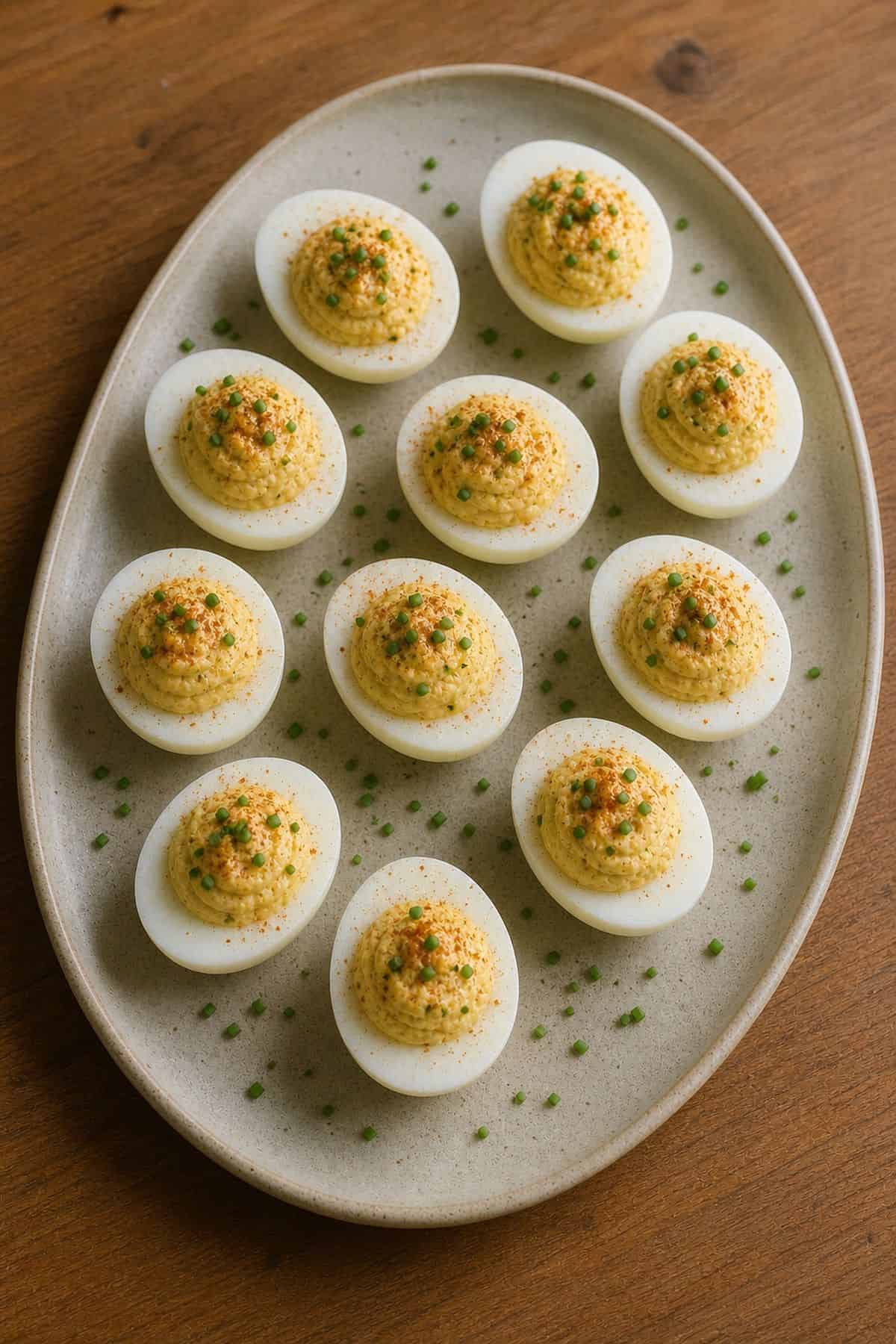
Prep time: 15 minutes | Cook time: 13 minutes | Total time: 28 minutes | Serves: 6 (12 halves)
Ingredients
- 6 large eggs
- 3 tbsp (45 g) mayonnaise
- 1 tsp Dijon mustard
- 1 tsp apple cider vinegar
- 1/4 tsp fine sea salt
- 1 pinch white pepper
- Sweet paprika, for dusting
- 2 tbsp (8 g) fresh chives, finely chopped, for garnish
Instructions
- Set a steamer basket in a large stainless steel pot and add 1 inch (2.5 cm) of water. Bring to a steady boil over high heat with the lid on so the steam builds. Lower the 6 eggs directly from the fridge into the basket, replace the lid, and set the digital timer for 13 minutes. Keep the heat on high for the full duration.
- While the eggs steam, fill a large bowl with cold water and ice. At the 13-minute mark, transfer the eggs straight from the basket to the ice bath using a slotted spoon. Let them sit in the ice bath for 10 full minutes; the shock is what releases the membrane from the white.
- Peel the eggs one at a time under a thin stream of cold running water. Tap the wide end first to crack, then roll the egg gently against the counter and start the peel where the air pocket sits. The shell should come off in two or three pieces.
- Halve the eggs lengthwise with a sharp knife. Wipe the blade between cuts so the yolks separate cleanly. Pop the yolks out into a medium bowl and arrange the whites on the ceramic platter, hollow side up.
- Push the yolks through a fine-mesh strainer set over the bowl, pressing with the back of a spoon. This is the step that takes the filling from rustic crumb to restaurant-smooth.
- Add the 3 tbsp (45 g) mayonnaise, 1 tsp Dijon, 1 tsp apple cider vinegar, 1/4 tsp salt, and pinch of white pepper to the sieved yolks. Mash with a fork until completely smooth and uniformly pale yellow, roughly 30 seconds.
- Spoon the filling into a piping bag fitted with a Wilton 1M open star tip. Pipe a tall rosette into each white, working from the outside in so the swirl finishes at a peak in the center.
- Dust the tops lightly with sweet paprika, holding the shaker 6 inches (15 cm) above the platter for an even coat. Scatter the 2 tbsp (8 g) chopped chives across the platter, not the eggs themselves, so the green stays sharp against the yellow. Serve within 2 hours of assembly.
Notes
For a make-ahead strategy: boil and peel the eggs up to 3 days in advance, and store them whole in a covered container with a damp paper towel. Mix the filling up to 1 day ahead and keep it in a sealed bag pressed flat in the fridge. Assemble within 2 hours of serving so the whites do not weep onto the platter.
The greenish-gray ring that sometimes shows up around the yolk is an iron-sulfur reaction: iron in the yolk binds with sulfur compounds in the white when the egg cooks past about 12 minutes at sustained high heat. The 13-minute steam method, followed by an immediate ice bath, keeps the yolk a clean pale yellow.
Older eggs peel cleaner than day-fresh ones. Eggs that have been in the refrigerator 7 to 10 days have a slightly looser inner membrane and release the shell in big pieces. If you have access to truly fresh eggs (a farm box, a backyard flock), the steam method is the better route because it works around the membrane problem entirely.
Tips and Variations
How to Steam-Peel Eggs Without Tearing the Whites
The fix is the steamer basket. Set the basket in a pot over 1 inch (2.5 cm) of boiling water, lower the eggs straight from the fridge into the basket, lid on, 13 minutes on high, then an immediate ice bath for 10 minutes. The high steam temperature shocks the membrane away from the white in the first 30 seconds, which is why this method peels reliably even on day-fresh eggs. Peel under thin running cold water for the cleanest release; the water washes between the shell and the membrane as it comes away.
The Sieve Step That Makes Filling Restaurant-Smooth
Fork-mashing yolks leaves visible crumb in the filling no matter how long you work at it. The professional move is to push the yolks through a fine-mesh strainer with the back of a spoon before adding any mayonnaise. The sieve breaks every clump down to a powder, and the filling that comes off the other side is uniformly pale and pipes through a star tip without snagging. This single step is the difference between home cooking and the version you see on a holiday cookbook cover.
Piping Bag vs Spoon (Why Piping Wins)
A spoon gives you a flat, unstructured mound that reads home-cooked in the casual way. A piping bag fitted with an open star tip like the Wilton 1M gives you a tall ridged rosette that catches paprika dust on the high points and looks deliberate from across the room. Cut the corner off a zip-top bag if you have no piping bag, but the star tip is the visual upgrade worth the four dollars. Work from outside in so the swirl finishes at a clean peak in the center of each white.
Make-Ahead Strategy for a Crowd of 24
Twenty-four halves means a dozen eggs and the canonical ratio doubled: 6 tablespoons mayonnaise, 2 teaspoons Dijon, 2 teaspoons apple cider vinegar, 1/2 teaspoon salt, two pinches white pepper. Steam and peel the eggs up to 3 days ahead. Mix the filling 1 day ahead, sealed in a piping bag with the air pressed out, refrigerated flat on a sheet pan. Halve the whites the morning of the party and store them cut-side down on a paper-towel-lined tray. Pipe within 2 hours of serving. Dust paprika and scatter chives at the last minute so neither bleeds into the filling.
Swapping Dijon for Whole-Grain Mustard
Whole-grain mustard turns the filling slightly speckled and adds a low-grade pop of seed texture in every bite. Swap one-for-one (1 teaspoon for 1 teaspoon per 6 yolks) if that texture appeals; the flavor stays in the Dijon family with a softer, earthier finish. For a diner-nostalgia version, yellow mustard substitutes one-for-one and pushes the dish toward the picnic end of the spectrum: brighter color, sharper tang, less of the magazine register. Use whichever fits the table.
What to Serve It With
Deviled eggs are appetizer architecture for a long list of American occasions: Easter Sunday next to glazed ham and a green salad, the Memorial Day picnic alongside potato salad and grilled chicken, the Friendsgiving spread before the turkey lands, the brunch board with smoked salmon and bagels, the bridal shower with cucumber sandwiches and tea. The dish reads “I made an effort” without requiring any actual difficulty, which is the social superpower that keeps it on the table 60 years after the Pyrex era.
FAQ
How long do you boil eggs for deviled eggs?
For the hard-boil route, bring the eggs to a full boil in cold water, cover the pot, and pull it off the heat for 12 minutes, then move the eggs straight into an ice bath for 10 minutes. For the steam route used in this recipe, 13 minutes in a steamer basket over 1 inch of boiling water with the lid on, followed by the same 10-minute ice bath. Either window puts the yolk fully set without the greenish ring.
Why do my deviled egg yolks turn green?
Overcooking. Iron in the yolk reacts with sulfur in the white above roughly 12 minutes at sustained high heat, leaving a greenish-gray ring along the yolk surface. The fix is to pull the eggs at the 12 or 13-minute mark and shock them in an ice bath immediately, which stops the cook and prevents the iron-sulfur bond from forming.
Can you make deviled eggs ahead of time?
Yes. Boil and peel the eggs up to 3 days in advance and store them whole in a sealed container in the refrigerator. Mix the filling up to 1 day ahead and keep it in a piping bag with the air pressed out. Assemble within 2 hours of serving so the whites do not weep liquid onto the platter and the piped filling holds its shape.
What is the ratio of mayo to mustard in deviled eggs?
The canonical magazine ratio is 3 tablespoons mayonnaise to 1 teaspoon Dijon mustard per 6 yolks, plus 1 teaspoon apple cider vinegar for acid, 1/4 teaspoon salt, and a pinch of white pepper. The mayo binds, the Dijon brings savory tang, and the vinegar lifts the whole filling. Scale linearly: a dozen eggs takes 6 tablespoons mayonnaise and 2 teaspoons Dijon.
How do you peel hard-boiled eggs without tearing the whites?
Three tactics stack: use eggs that are 7 to 10 days old rather than day-fresh, steam them in a steamer basket instead of hard-boiling, and shock them in an ice bath for 10 minutes the moment they come off the heat. Peel under a thin stream of cold running water, starting at the wide end where the air pocket sits. The shell should release in two or three large pieces rather than tiny shards.
Should I use Dijon or yellow mustard for deviled eggs?
Dijon for a magazine-clean tang and a pale yellow filling, yellow mustard for diner nostalgia and a brighter color. The choice is editorial rather than technical: both bring acid and savory weight, and either substitutes one-for-one (1 teaspoon per 6 yolks). Whole-grain mustard works as a textured third option, adding seed pop and a softer, earthier finish to the same filling.
Key Takeaways
- The canonical ratio is 3 tablespoons mayonnaise, 1 teaspoon Dijon, and 1 teaspoon apple cider vinegar per 6 yolks. Salt and white pepper finish the seasoning.
- Steam the eggs for 13 minutes over 1 inch of boiling water with the lid on, then ice-bath for 10 minutes. The membrane releases cleanly and the whites stay intact.
- Push the yolks through a fine-mesh strainer before adding the mayonnaise. This is the single step that turns home-cook crumb into restaurant-smooth filling.
- Pipe with a Wilton 1M open star tip, not a spoon. The ridged rosette catches paprika and signals “magazine cover” from across the room.
- Use real mayonnaise (Hellmann’s, Duke’s, Kewpie), not Miracle Whip or salad dressing. The latter is sweetened and pushes the filling out of lane.
- Assemble within 2 hours of serving. Filling and peeled eggs can be prepped up to 1 to 3 days ahead, but the assembled platter weeps if it sits too long.
Final Thoughts
What separates this version from the picnic plate of memory is restraint and technique. The canonical ratio is locked, the steam-peel method handles the whites, and the sieve takes the filling somewhere a fork-mashed version cannot reach. No relish, no Tabasco, no Worcestershire shortcut. Just the six ingredients that define the dish.
The single move that changes the result most is the piping bag. A spoon gives you a flat scoop that reads casual; the open star tip gives you a tall rosette that catches paprika on its ridges and looks deliberate from the moment the platter lands on the table. Add the sieve step and the steam-peel method, and the recipe sits one league above the version most American kitchens turn out for Easter.
Make a dozen for a small Easter, twenty-four for a full holiday buffet, thirty-six for a Memorial Day picnic. Prep the eggs ahead, hold the filling in a piping bag, and assemble in the final 2 hours so the whites stay sharp and the rosettes stand tall. Dust the paprika at the last second. Scatter the chives across the platter, not into the filling. Bring it out cold and watch it disappear.
Classic Deviled Eggs
Deviled eggs are hard-cooked egg whites filled with a creamy yolk mixture of mayonnaise, mustard, vinegar or pickle juice, salt, and paprika. Steam or gently boil the eggs, chill them well, mash the yolks smooth, and season the filling until it tastes bright, not just rich.
Ingredients
- 6 large eggs
- 3 tbsp (45 g) mayonnaise
- 1 tsp Dijon mustard
- 1 tsp apple cider vinegar
- 1/4 tsp fine sea salt
- 1 pinch white pepper
- Sweet paprika, for dusting
- 2 tbsp (8 g) fresh chives, finely chopped, for garnish
Instructions
- Steam eggs over simmering water for 12 minutes, or gently boil them for 10 to 11 minutes.
- Transfer eggs to ice water and chill for 10 minutes.
- Peel the eggs, halve lengthwise, and remove yolks.
- Mash yolks with mayonnaise, mustard, pickle juice or vinegar, salt, and pepper until smooth.
- Taste and adjust with more acid or salt if needed.
- Spoon or pipe the filling into the egg whites.
- Dust with paprika and add herbs or pickles if using. Serve chilled.
Notes
The filling should taste slightly sharper than you think because the plain egg white softens it once eaten together.
Last update on 2026-08-11 / Affiliate links / Images from Amazon Product Advertising API