
Quick answer: A proper italian easter bread is a citrus-and-anise enriched dough, braided into a three-strand ring, with raw eggs dyed in food-safe color and set into the dough’s valleys before the final rise. The eggs cook through during the bake. The flavor stack is orange zest plus lemon zest plus anise (not vanilla, which most American versions default to). The finish is a thin powdered-sugar glaze and rainbow nonpareils. One braided ring, about 28 minutes in the oven, ten generous slices.
Pane di Pasqua is the bread Italian nonnas have been pulling from the oven on Easter morning for centuries, a soft, citrus-and-anise braid coiled into a ring with dyed eggs cradled in the valleys of the dough like ornaments. The ring most likely started in Lombardy, where the three strands of the braid stand for the Holy Trinity and the circle stands for the crown of thorns. Bake it once, and it becomes the centerpiece every spring after, the loaf that gets sliced before the ham hits the table and the one wrapped in parchment and twine to take to the neighbors next door.

Recommended Products
A stand mixer with a dough hook to knead the enriched dough to windowpane in seven minutes flat, a half sheet pan with parchment to shape and bake the ring on, a food-safe Easter egg dye kit for the raw eggs, a silicone pastry brush for the egg wash, and a large glass mixing bowl for the bulk rise so you can see the dough double through the side.


Recommended Reads
- Hot Cross Buns Recipe
- Carrot Cake Recipe
- Best Easter Dinner Ideas
- Best Easter Cake Ideas
- Christmas Brunch Ideas
Where Italian Easter Bread Came From
Pane di Pasqua, literally “bread of Easter,” most likely originated in Lombardy, northern Italy, before it traveled south through every nonna’s kitchen and eventually crossed the Atlantic with Italian immigrants. The word Pasqua itself echoes the Hebrew Pesach (Passover), a linguistic thread that ties this loaf to thousands of years of spring-festival baking. The braided ring sits on top of an older pre-Christian template: Roman and pre-Roman cooks baked eggs into round wheat loaves as offerings to celebrate the earth’s return to fertility. The Church layered the resurrection on top of those older rites rather than replacing them.
The Italian decorated-egg tradition is documented as early as the 9th century, and by the 12th century the church-blessed egg (the benedictio ovorum) had become a ritualized part of Easter. In the braided ring that became standard in Italian-American households, the three strands stand for the Holy Trinity, the circle stands for the crown of thorns, and the eggs set into the dough stand for the resurrection. Underneath all of that, the eggs and the wheat are still doing the older work, the work they did for the Romans, of marking the moment in the year when the cold breaks and the spring starts to push back through.
A Few Notes on the Ingredients
- Enriched dough base: Butter, whole eggs, granulated sugar, and warm whole milk produce a soft, slightly sweet, almost brioche-adjacent crumb. None of those four ingredients is optional. Whole milk over skim, full-fat butter over margarine, and three large eggs at room temperature so the dough comes together without seizing the butter.
- Yeast and salt: Instant yeast goes into the dough with the dry ingredients. Salt goes in to balance, but never directly on the yeast — mix the salt with the flour first so they meet through the flour rather than head-on.
- Orange and lemon zest: Use both, not one or the other. The orange brings sweetness and roundness, the lemon brings lift, and together they make the dough taste like spring rather than like a plain sweet roll.
- Anise: The primary flavor and the one that signals Easter on an Italian-American table. Use 2 teaspoons of lightly crushed anise seed or 1 teaspoon of anise extract. If anise reads as licorice and you cannot stand it, swap in 1 tablespoon vanilla extract plus a quarter teaspoon of almond extract, but know you are stepping outside the heritage version.
- Dyed raw eggs: Five raw eggs in their shells get dyed with food-safe coloring (a PAAS-style kit or vinegar plus supermarket food coloring), dried on a rack, then set into the braid valleys before the final rise. They cook with the bread during the 25 to 28 minute bake.
- Powdered-sugar glaze: A thin drizzle of powdered sugar, a splash of milk, and a quarter teaspoon of vanilla goes over the cooled braid. Drizzle in stripes, avoiding the eggs themselves.
- Rainbow nonpareils: Scattered across the glaze while it is still tacky so they set into the icing rather than rolling off. The final color signal that the loaf is for Easter.
Recipe: Italian Easter Bread
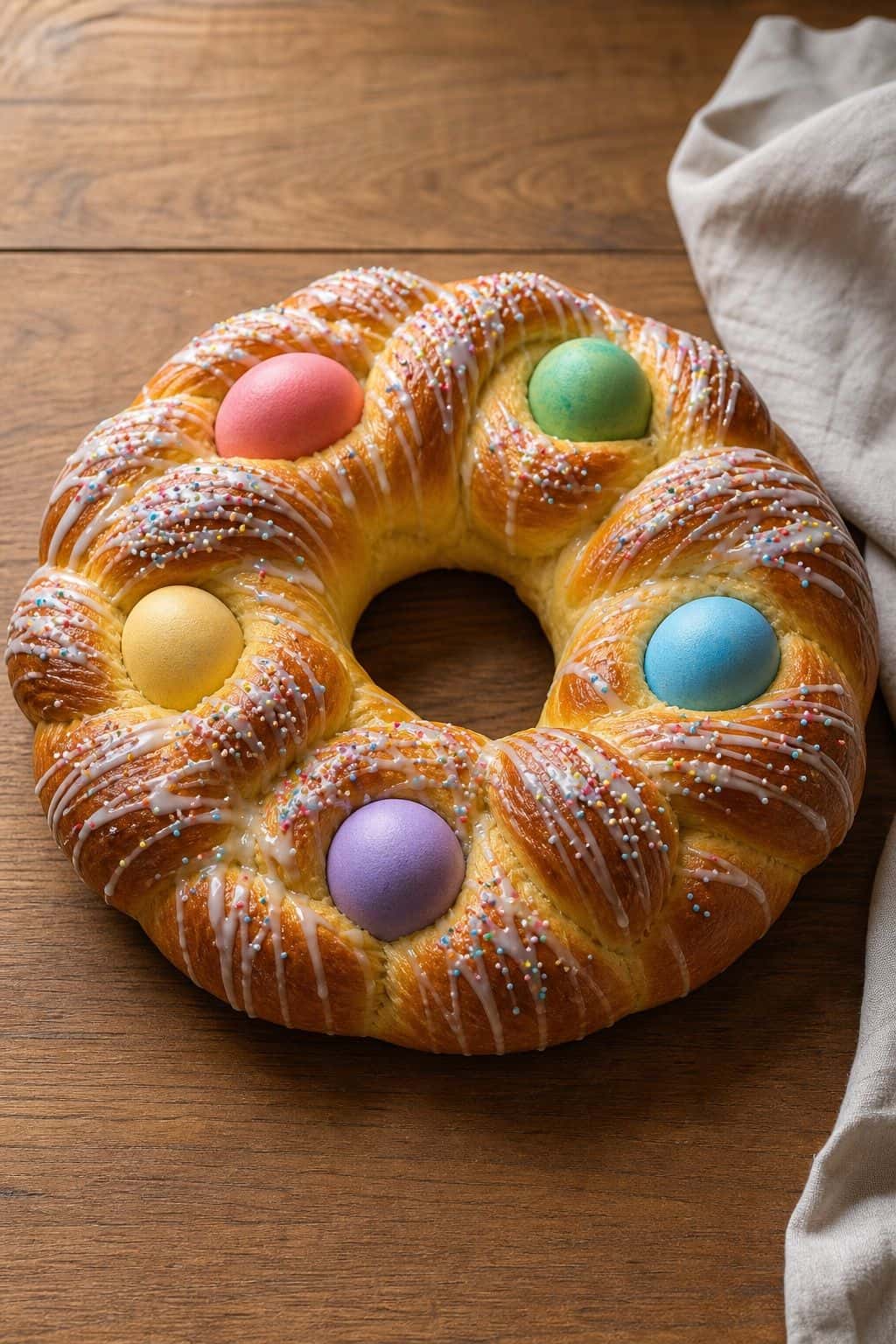
Prep time: 30 minutes + 2 hours rise | Cook time: 28 minutes | Total time: 3 hours | Serves: 10 (one ring)
Ingredients
For the dough:
- 4 cups (500 g) all-purpose flour
- 1/3 cup (65 g) granulated sugar
- 2 1/4 tsp instant yeast
- 1 tsp salt
- 2 tsp anise seed, lightly crushed (or 1 tsp anise extract)
- Zest of 1 orange
- Zest of 1 lemon
- 3/4 cup (180 ml) whole milk, warmed to about 110°F (43°C)
- 4 tbsp (56 g) unsalted butter, melted and slightly cooled
- 3 large eggs, room temperature
- 1 egg yolk + 1 tbsp water, whisked, for the egg wash
- 5 raw eggs, in the shell, dyed with food-safe coloring, for the braid
For the glaze and finish:
- 1 cup (120 g) powdered sugar
- 2 tbsp (30 ml) whole milk
- 1/4 tsp vanilla extract
- Rainbow nonpareils for finishing
Instructions
- Dye the eggs first so they have time to dry. Bring 5 raw eggs to room temperature, then dye them per the kit’s instructions (or in a bath of 1 cup warm water + 1 tbsp white vinegar + 10 drops food coloring per color). Dry the dyed eggs on a wire rack while you mix the dough.
- In the bowl of a stand mixer fitted with the dough hook, whisk together 500 g flour, 65 g sugar, 2 1/4 tsp instant yeast, 1 tsp salt, the anise seed, and the orange and lemon zest. This is where the salt meets the yeast safely, separated by flour.
- In a separate bowl or jug, whisk together 180 ml warm whole milk, the 56 g melted butter, and the 3 room-temperature eggs until smooth. Pour the wet mix into the dry. Mix on low for about 1 minute to bring everything together, then increase to medium-low and knead for 7 minutes until the dough is smooth, soft, and pulls cleanly from the sides of the bowl. Test for windowpane: pinch off a walnut-sized piece and stretch it thin between your fingers. If you can see light through it without tearing, the gluten is ready.
- Transfer the dough to a lightly oiled large glass bowl, cover with plastic or a damp towel, and let it rise in a warm spot until doubled, about 90 minutes. Use the glass-bowl sight line; “doubled” is more reliable than a clock.
- Turn the dough out onto a lightly floured counter and divide into 3 equal pieces by weight (about 285 g each). Roll each piece into an 18-inch (45 cm) rope, working from the center outward so the rope tapers evenly.
- Lay the three ropes side by side on a parchment-lined half sheet pan. Pinch the tops together and braid loosely (a tight braid tears during the second rise). When you reach the end, pinch the tails together, then bring both ends around to form a ring, pinch the seam together, and tuck it underneath. Aim for a 9 to 10 inch (23 to 25 cm) diameter ring.
- Nestle the 5 dyed eggs into the valleys of the braid, pressing them in gently but firmly so the dough holds them in place. The eggs sit deep enough to anchor but high enough to show their color after the bake.
- Cover the ring loosely with plastic or a clean towel and let it rise for 30 minutes, until puffed and pillowy but not fully doubled (the dough is doing most of its second rise during the early oven minutes). Heat the oven to 350°F (175°C) while it rises.
- Brush the dough (avoiding the dyed eggs) gently with the egg wash, getting into the seams of the braid. Bake on the middle rack for 25 to 28 minutes, until the loaf is deep golden and an instant-read thermometer in the thickest part of the dough reads 190°F (88°C). Tent with foil at minute 20 if the top is browning faster than the center is setting.
- Cool on the pan for 10 minutes, then transfer the ring carefully (lift by the parchment) to a wire rack and cool for another 20 minutes. Warm bread melts glaze flat, so the wait matters.
- Whisk 120 g powdered sugar, 30 ml milk, and 1/4 tsp vanilla into a thick but pourable glaze. Drizzle in stripes across the braid, avoiding the eggs themselves. Scatter rainbow nonpareils across the wet glaze while it is still tacky so they set into the icing rather than rolling off.
Notes
The dyed-egg food-safety question deserves a direct answer: yes, the eggs are safe to eat. They cook through during the 25 to 28 minute bake at 350°F, ending up at roughly soft-to-medium-boiled doneness. Use a food-safe dye (PAAS, Wilton gel, or supermarket food coloring with vinegar). Refrigerate any leftover ring within two hours of baking, exactly as you would any cooked egg.
To make ahead, do the first rise in the refrigerator overnight: mix and knead the dough, drop it in the oiled glass bowl, cover tightly, and refrigerate up to 18 hours. Pull the bowl out 45 minutes before shaping so the dough can come back to room temperature. The cold rise also deepens the flavor of the citrus and anise.
For the freezer, remove the eggs from the cooled ring (they do not freeze well), then wrap the bread tightly in plastic followed by foil and freeze up to 2 months. Thaw at room temperature still wrapped, then refresh in a 300°F (150°C) oven for 8 minutes.
Tips and Variations
How to Braid a Three-Strand Ring
The braid is the same one most people learned on hair: three ropes laid side by side, alternate the outer strand over the middle, left then right, until you reach the end. Two notes that change a braid from tidy to oven-ready. Roll the ropes from the center outward in both directions rather than from one end, which gives you an even taper. Then braid loosely, not tightly. A tight braid looks beautiful before it proofs and rips itself apart during the second rise and the bake. Loose braids look slightly under-defined raw and read cleanly defined once the dough swells around itself. To join into a ring, bring the ends together, pinch the seam firmly, and tuck the joined seam underneath so the top of the ring stays clean.
The Dyed-Raw-Egg Technique (Food Safety Answered)
This is the single most-asked question on this recipe, and the answer is yes, they are safe. Raw eggs in the shell, dyed with food-safe coloring before the bake, cook through during the oven time. A 25 to 28 minute bake at 350°F brings the bread to 190°F internal, which is well past the temperature an egg needs to reach safe doneness through the shell. The eggs come out soft- to medium-boiled. Two non-negotiables: use food-safe dye (PAAS-style kits, Wilton gel, or vinegar plus standard supermarket food coloring, never craft-store dye that is not food-grade), and refrigerate leftovers within two hours. If you are serving the bread several hours later, the eggs still hold up fine at room temperature for the meal, the same as any cooked egg.
Swapping Anise for Vanilla if You’re Anise-Averse
Anise reads as licorice to a chunk of the population, and there is no point baking a loaf you will not enjoy slicing. The cleanest swap is 1 tablespoon pure vanilla extract plus a quarter teaspoon of almond extract in place of the anise seed or anise extract. The almond gives you a similar floral lift to what the anise was providing, the vanilla rounds it out, and the citrus carries the flavor profile from there. A second option that stays closer to traditional: fennel seed, lightly crushed, at 2 teaspoons. Fennel is anise’s close cousin, slightly milder and slightly more vegetal, and it lands in the same neighborhood without the medicine-cabinet edge that anise sometimes hits.
Make-Ahead and Day-Before Strategy
Easter mornings rarely include three free hours, so the make-ahead workflow is worth knowing. Two real options. One, the cold first rise: mix and knead the dough the night before, drop it in a large oiled glass bowl, cover tightly with plastic, and refrigerate up to 18 hours. The dough rises slowly in the fridge and deepens flavor as it goes. Pull it out 45 minutes before you want to shape so it can come back to room temperature. Two, the bake-the-day-before: bake the ring fully, cool, store wrapped tightly in plastic at room temperature overnight (no fridge, which dries out enriched breads). Glaze and scatter nonpareils the morning of, after the ring has come back to room temperature for an hour.
The Almond-and-Citron Italian Variation
If you have seen the version of Pane di Pasqua with bits of candied fruit through the crumb, that is the regional southern variation, common in Naples and parts of Sicily. To shift in that direction, fold 1/2 cup (75 g) chopped candied citron and 1/3 cup (40 g) toasted slivered almonds into the dough after the first knead, before the first rise. Keep the orange and lemon zest, keep the anise, and the loaf reads instantly more old-world. The candied citron is the traditional inclusion; chopped candied orange peel is a clean substitute if citron is hard to find, and dried apricots cut into small dice will work in a pinch.
What to Serve It With
The braided ring is the centerpiece of the Italian Easter brunch table, set down between the baked ham, the deviled eggs, the frittata, and the asparagus. Slice it thick and serve with salted butter or, more traditionally, fresh ricotta with a drizzle of honey. The citrus-anise crumb is built for coffee, so pour an espresso or a cappuccino alongside on Easter morning. Wrap a second loaf in parchment and twine and walk it to the neighbors or the godparents; this is the bread that gets gifted, the bread that says the holiday is here, the bread that has been doing exactly this work in Italian-American kitchens for generations.
FAQ
What is Italian Easter bread called?
Pane di Pasqua, which translates literally to “bread of Easter.” Pasqua itself comes from the Hebrew Pesach (Passover), the same linguistic root that ties Italian Easter baking to thousands of years of spring-festival breads. Regional names exist (casatiello in Campania, for instance, which is a savory cousin) but Pane di Pasqua is the standard term for the sweet, braided, citrus-and-anise loaf with dyed eggs.
Are the dyed eggs on Easter bread safe to eat?
Yes. The eggs go into the oven raw, dyed with food-safe coloring (PAAS, Wilton gel, or supermarket food coloring with vinegar), and they cook through during the 25 to 28 minute bake at 350°F. The bread itself hits 190°F internal, which is well past the temperature an egg needs to reach safe doneness through the shell. Refrigerate leftovers within two hours, the same as any cooked egg.
Do you put raw or hard-boiled eggs in Italian Easter bread?
Traditional method is raw, dyed and set into the braid before the final rise so the dough proofs around them and locks them in place. They cook with the bread. Hard-boiled is a kid-friendly shortcut some American versions use, but pre-cooked eggs continue cooking during the bake and end up rubbery and overcooked. Raw is the better answer in nearly every case.
What flavors are in traditional Italian Easter bread?
Orange zest, lemon zest, and anise, on an enriched dough of butter, eggs, sugar, whole milk, and yeast. The double-citrus stack is the heritage version, not orange-only. Vanilla is the American shortcut, not the traditional flavor. Some southern Italian regions add candied citron and slivered almonds for a more festival-cake feel, but the core flavor is always citrus plus anise.
Can I make Easter bread without anise?
Yes. The cleanest swap is 1 tablespoon vanilla extract plus a quarter teaspoon almond extract in place of the anise seed or extract. You can also use 2 teaspoons of crushed fennel seed (anise’s close cousin) for a milder, more vegetal version of the same flavor neighborhood. Know that you are stepping outside the heritage version when you swap anise out, but the loaf is still excellent.
What’s the difference between Italian Easter bread and Greek tsoureki?
Both are braided Easter breads, but the flavor and the eggs are different. Italian Pane di Pasqua is flavored with orange, lemon, and anise; the eggs are dyed in multiple colors (pastel rainbow) and set into the braid. Greek tsoureki is flavored with mahlepi (ground cherry pits) and mastiha (a tree resin), and the eggs are dyed deep red (the color of Christ’s blood in the Greek Orthodox tradition) and tucked into a longer, sometimes straight braid rather than a ring. Different culture, different flavor stack, different egg meaning.
Key Takeaways
- Pane di Pasqua originated in Lombardy: three braid strands for the Trinity, the circle for the crown of thorns, the eggs for the resurrection.
- Flavor stack is orange zest plus lemon zest plus anise (the heritage flavor), not vanilla.
- Eggs go in raw, dyed with food-safe coloring, set into the braid before the final rise; they cook through safely during the 25 to 28 minute bake.
- Knead to windowpane (7 minutes in a stand mixer) and rise until doubled in a glass bowl so you can see the doubled mark.
- Bake at 350°F (175°C) until the bread reads 190°F internal, then cool fully before glazing.
- Anise-averse swap: 1 tbsp vanilla + 1/4 tsp almond extract, or 2 tsp crushed fennel seed.
Final Thoughts
Pane di Pasqua is one of those recipes that looks intimidating from the outside (a braided ring, dyed eggs, glaze, sprinkles) and turns out to be mostly patient waiting once you start. The dough is forgiving. The braid is the same braid you already know how to do. The eggs cook themselves. The two real moves are using both orange and lemon zest instead of one or the other, and leaning into anise as the primary flavor rather than reaching for vanilla.
What you are baking is older than the symbolism it carries. The Trinity and the crown of thorns and the resurrection are layered on top of a much older spring template: eggs and wheat, baked together, set on the table to mark the moment the year turns. Italian nonnas have been pulling this bread from the oven on Easter morning for centuries, and the version on your sheet pan is the same loaf they were making.
Make it once and the photograph will pull you back next year. The dyed eggs in the dough, the rainbow nonpareils across the glaze, the braid coiled into its ring on the Easter table. This is the bread that gets sliced first, the bread that gets wrapped and walked to the neighbors, the bread that quietly does what Easter bread has always done.
Soft Braided Easter Bread
Easter bread is a soft, lightly sweet enriched bread shaped into braids or rings and often decorated with colored eggs. The dough should feel soft and elastic, not dry. Let it rise fully, braid gently, and bake until the center reaches about 190°F / 88°C so the bread stays tender.
Ingredients
- 4 cups (500 g) all-purpose flour
- 1/3 cup (65 g) granulated sugar
- 2 1/4 tsp instant yeast
- 1 tsp salt
- 2 tsp anise seed, lightly crushed (or 1 tsp anise extract)
- Zest of 1 orange
- Zest of 1 lemon
- 3/4 cup (180 ml) whole milk, warmed to about 110°F (43°C)
- 4 tbsp (56 g) unsalted butter, melted and slightly cooled
- 3 large eggs, room temperature
- 1 egg yolk + 1 tbsp water, whisked, for the egg wash
- 5 raw eggs, in the shell, dyed with food-safe coloring, for the braid
- 1 cup (120 g) powdered sugar
- 2 tbsp (30 ml) whole milk
- 1/4 tsp vanilla extract
- Rainbow nonpareils for finishing
Instructions
- Stir warm milk, yeast, and 1 tablespoon sugar together. Rest 5 to 10 minutes until foamy.
- Add remaining sugar, 2 eggs, butter, vanilla, citrus zest, salt, and 420 g flour. Knead until smooth and elastic, adding only enough extra flour to make a soft dough.
- Cover and rise until doubled, 1 to 1 1/2 hours.
- Divide dough into 3 ropes for one braid, or 6 ropes for two small rings. Braid loosely and transfer to a parchment-lined baking sheet.
- Tuck dyed raw eggs into the braid if using. Cover and rise 30 to 45 minutes until puffy.
- Heat oven to 350°F / 175°C. Brush dough with beaten egg and add sprinkles or pearl sugar.
- Bake 22 to 28 minutes, until golden and the center reaches about 190°F / 88°C.
- Cool at least 20 minutes before slicing.
Notes
If the dough resists rolling into ropes, cover it and rest for 10 minutes. Relaxed dough braids more neatly.
Last update on 2026-08-08 / Affiliate links / Images from Amazon Product Advertising API