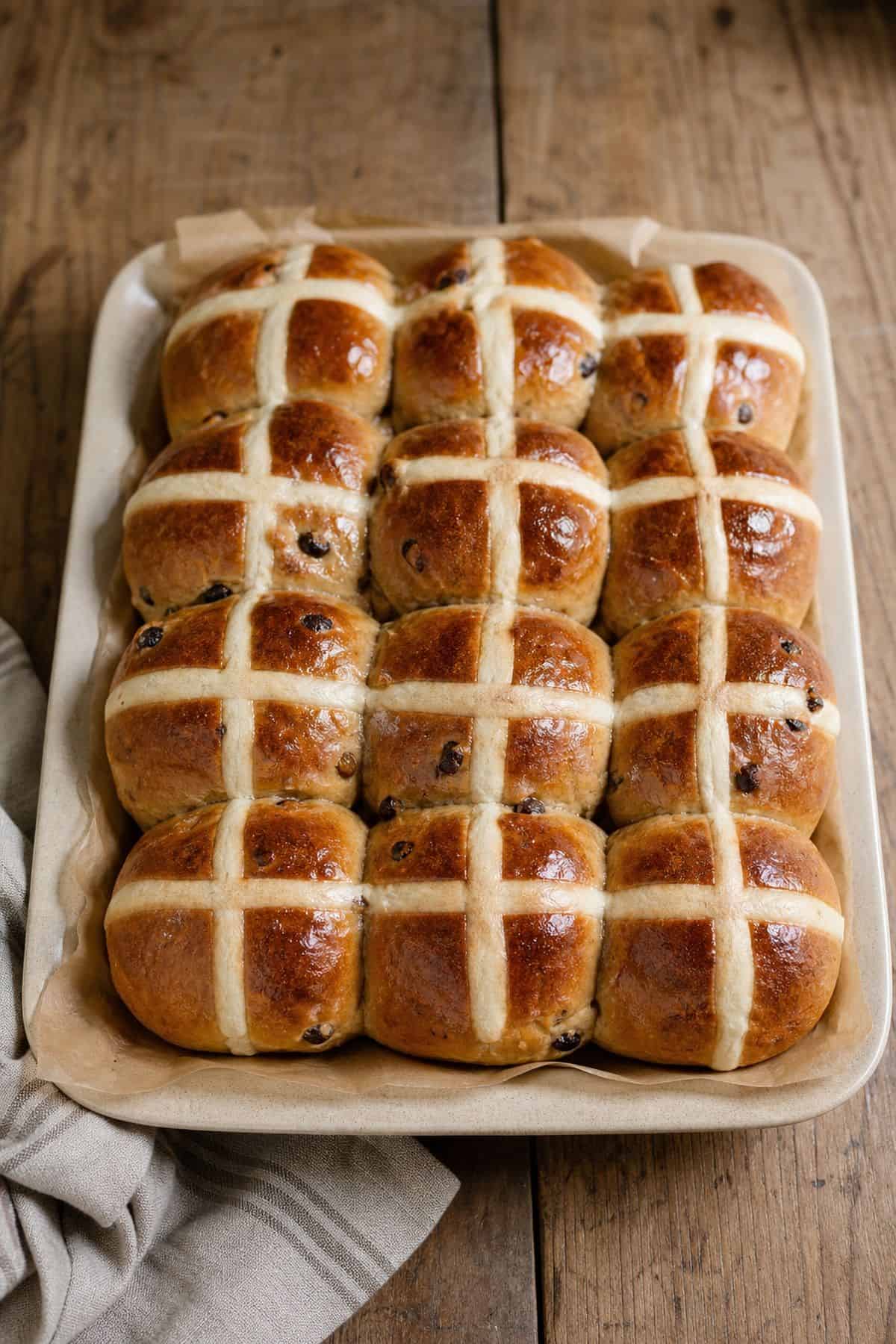
A hot cross buns recipe done the traditional way is a soft enriched yeast dough scented with a six-spice blend, dotted with currants and raisins, baked under a piped flour-paste cross, and finished while still oven-hot with a double brush of apricot-jam-and-water glaze. Not icing crosses, not a plain sugar wash. Flour-paste cross. Apricot glaze. Cinnamon, nutmeg, allspice, cardamom, clove, and orange zest. Bake at 350°F for 20 to 22 minutes until they hit 190°F internal, glaze them twice in ninety seconds, and you have twelve lacquered Good Friday buns on a single half sheet pan.
The lineage runs back to 1361, when Brother Thomas Rocliffe baked small spiced buns in the refectory at St Albans Abbey in Hertfordshire and gave them to the poor on Good Friday. The Alban Bun, as it was called then, used honey, fresh yeast, currants, and cardamom (or grains of paradise), and the cross was knife-cut into the top rather than piped. By 1733 the street cry “one a penny, two a penny, hot cross buns” had been recorded in Poor Robin’s Almanack and the nursery rhyme had its first written line. Six hundred and sixty-five years after Brother Rocliffe’s first batch, every English bakery from Cornwall to Adelaide still pulls trays of them from Lent through Easter Monday.

What You’ll Need
A stand mixer with a dough hook for the seven-minute knead to windowpane, a large glass mixing bowl for the first rise (see-through walls help you read the doubled mark), a silicone pastry brush for the double-glaze pass, a half sheet pan that holds twelve buns in a tight three-by-four grid, and a bench scraper for dividing the dough into equal pieces.


Recommended Reads
- Easter Bread Recipe
- Carrot Cake Recipe
- Best Easter Dinner Ideas
- Best Easter Cake Ideas
- Christmas Brunch Ideas
Where Hot Cross Buns Came From
The documented origin sits in the refectory at St Albans Abbey in Hertfordshire in 1361, where a monk named Brother Thomas Rocliffe began baking small spiced buns and giving them to the poor on Good Friday alongside a basin of sack, the fortified wine of the period. His version (still partly held in the records at St Albans Cathedral) used honey for sweetness, fresh yeast, currants, and either grains of paradise or cardamom for the spice. The cross was cut into the top with a knife before baking, a symbol of the crucifixion and a practical mark to identify the bun as fasting-day food. The Alban Bun is the direct ancestor of every hot cross bun on every English bakery shelf today.
The street-cry version arrives in print in 1733, when Poor Robin’s Almanack records the rhyme: “Good Friday comes this month, the old woman runs, with one a penny, two a penny, hot cross buns.” London vendors hawked them from baskets on Good Friday morning, and the rhyme survived into the modern nursery canon. The bun itself spread outward through the British Empire (which is why it is as much a Good Friday fixture in Sydney and Auckland as it is in St Albans) and the recipe gradually shifted from the medieval honey-and-cardamom version to the modern enriched yeast dough with mixed spice and dried fruit that turns up in BBC Good Food and Paul Hollywood today. The recipe below threads that line: Brother Rocliffe’s cardamom and zest, the modern enriched crumb, and the traditional piped flour-paste cross that has been on top since the Tudor period.
A Few Notes on the Ingredients
- Bread flour: Use bread flour, not all-purpose. The higher protein content holds up to the second rise and the windowpane knead, giving the tender pull-apart crumb that defines an enriched dough.
- Whole milk and butter: Warm the milk to about 110°F and combine with melted unsalted butter and two whole eggs. The enriched profile is what makes the crumb tender instead of dense and bready, closer to a brioche cousin than a lean baguette dough.
- Instant yeast: One packet (2 1/4 teaspoons) goes straight in with the dry ingredients. Active dry works if you bloom it in the warm milk for five minutes first and add fifteen minutes to each rise.
- Six-spice blend: Build it from scratch with 1 1/2 teaspoons cinnamon, 3/4 teaspoon nutmeg, 1/2 teaspoon allspice, 1/2 teaspoon cardamom, 1/4 teaspoon clove, plus the zest of one orange. The cardamom and zest are the Brother Rocliffe nod most US recipes leave out.
- Currants and raisins: Currants are the traditional dried fruit, sometimes mixed with raisins. Use one cup of the two combined, plumped briefly in warm water if they are dry from the bag.
- Flour-paste cross: Half a cup of flour whisked with five tablespoons of water makes a thick pipeable paste that survives the oven and bakes into a matte white cross. Icing crosses are a modern shortcut that sit on top like a sugar squiggle.
- Apricot glaze: Three tablespoons of apricot jam whisked with one tablespoon of boiling water, strained if the jam has chunks. Brush twice while the buns are oven-hot, ninety seconds between coats, for the lacquer shine.
Recipe: Hot Cross Buns
Prep time: 30 minutes (plus 2 hours 15 minutes for both rises) | Cook time: 22 minutes | Total time: 3 hours | Serves: 12 buns
Ingredients
- 4 cups (500 g) bread flour
- 1/3 cup (65 g) granulated sugar
- 2 1/4 tsp instant yeast (1 packet)
- 1 1/2 tsp salt
- 1 1/2 tsp ground cinnamon
- 3/4 tsp ground nutmeg
- 1/2 tsp ground allspice
- 1/2 tsp ground cardamom
- 1/4 tsp ground clove
- Zest of 1 orange
- 1 cup (240 ml) whole milk, warmed to 110°F
- 4 tbsp (56 g) unsalted butter, melted
- 2 large eggs
- 1 cup (150 g) currants and raisins, mixed
- For the cross: 1/2 cup (60 g) flour plus 5 tbsp (75 ml) water
- For the glaze: 3 tbsp (45 g) apricot jam plus 1 tbsp (15 ml) water
Instructions
- In the bowl of a stand mixer fitted with the dough hook, whisk together the bread flour, sugar, instant yeast, salt, cinnamon, nutmeg, allspice, cardamom, clove, and orange zest until evenly combined. The dry mix should smell faintly of mulling spice; that is the spice blend doing its job.
- Warm the milk to 110°F (just barely warm to the wrist, never hot) and combine in a separate bowl with the melted butter and the two eggs, whisking until smooth. Pour the wet mixture into the dry ingredients with the mixer on low.
- Knead with the dough hook on medium-low for 7 minutes, or turn out onto a lightly floured surface and knead by hand for 10 minutes. The dough is ready when you can stretch a walnut-sized piece between your fingers into a thin translucent film without tearing. This is the windowpane test, and skipping it gives you dense buns.
- Add the currants and raisins to the kneaded dough and mix on low (or knead by hand) for 30 seconds, just enough to distribute the fruit evenly without smashing it.
- Transfer the dough to a lightly oiled large bowl, cover with a damp tea towel or plastic wrap, and let rise at warm room temperature for 90 minutes, until doubled in volume. Use a glass bowl if you have one so you can read the doubled mark on the wall.
- Turn the risen dough out onto a clean surface and divide with a bench scraper into 12 equal pieces (a kitchen scale helps; each piece should weigh about 80 g). Shape each piece into a tight smooth ball by cupping it under your palm and rolling against the counter until the surface tension is even.
- Arrange the twelve balls in a tight three-by-four grid on a parchment-lined half sheet pan, leaving about a half inch between balls so they can join as they rise. Cover loosely with plastic wrap and let rise a second time for 45 minutes, until visibly puffed and touching each other at the edges.
- Heat the oven to 350°F (175°C) with a rack in the middle position. While the oven heats, whisk the 1/2 cup flour and 5 tablespoons water in a small bowl until smooth and the consistency of thick toothpaste. Transfer to a piping bag or a zip-top bag with a tiny corner snipped off.
- Pipe a single line of flour paste across the top of each bun in one direction, then a second perpendicular line, forming a clean cross on each. Work quickly, just before the pan goes in the oven, so the paste does not skin over.
- Bake on the middle rack for 20 to 22 minutes, until the tops are deep gold and an instant-read thermometer in the center bun registers 190°F. Rotate the pan front-to-back at minute 14 for even color.
- While the buns bake, warm the apricot jam and water in a small saucepan over low heat until liquid and pourable; strain through a fine sieve to remove any fruit chunks. Keep warm.
- The moment the buns come out of the oven, brush the tops generously with the warm apricot glaze. Wait 90 seconds and brush a second coat. The double brush is where the sticky-shine lacquer comes from. Let the buns cool on the pan for 10 minutes before pulling them apart.
Notes
The windowpane test is the moment you stop kneading. Pull off a piece the size of a walnut, stretch it between your thumbs and forefingers, and hold it up to the light. If you can see through it without it tearing, the gluten is developed enough to trap gas around the fruit and hold the shape through both rises. If it tears immediately, keep kneading and try again in two minutes.
If the flour-paste cross cracks or splits in the oven, the paste was too thin. Whisk in more flour, a teaspoon at a time, until the consistency is closer to thick toothpaste than to crepe batter. The paste should hold a piped line that does not slump. Cracking can also mean the dough was still under-risen when piped; pipe right after the second rise has fully puffed.
Freeze fully baked and fully glazed buns wrapped tight in foil and then a freezer bag, up to two months. Thaw on the counter for an hour, then warm in a 300°F oven for 8 minutes to refresh the crust. You can also freeze the raw shaped dough on the sheet pan, transfer to a freezer bag once solid, and bake from frozen by thawing in the fridge overnight, doing the second rise on the counter for 60 minutes, and proceeding from step 8.
Tips and Variations
Why Flour-Paste Cross Beats Icing (Traditional Method)
The flour-paste cross is the traditional method, going back to the Tudor period at least, and it bakes into the bun as part of the structure. The paste itself is just flour and water (no sugar, no fat) and it goes on before the oven, so the cross is set and matte and architectural by the time the buns come out. Icing crosses are a modern American shortcut piped on after the bake, and they read as a sugar squiggle sitting on top of the bun, not as a proper hot cross bun. The flour paste also has zero sweetness, which lets the spiced enriched crumb and the apricot lacquer carry the flavor instead of competing with a layer of confectioners’ sugar. If a recipe asks for icing, it is taking a shortcut. The fix is a half cup of flour and five tablespoons of water in a piping bag, and ninety seconds of work before the oven.
How to Hit the Windowpane Knead Stage
Windowpane is the goal of the knead. The test: pinch off a walnut-sized piece of dough, gently stretch it between thumbs and forefingers, and hold it up to the kitchen light. If the dough stretches into a translucent membrane thin enough to see your hand through without tearing, the gluten is developed and the dough is done. If it tears immediately or feels stubby and rubbery, you have another two to three minutes to go. In a stand mixer with a dough hook on medium-low, the window is at seven minutes; by hand on a lightly floured surface it is closer to ten. The mistake is calling it done at five minutes because the dough looks smooth. Smooth and elastic are different from windowpane, and the difference shows up in the crumb.
The Apricot-Glaze Move for Sticky-Shine Finish
Apricot jam is the right glaze for two reasons. The jam is light enough in color to give shine without muddying the gold of the bun underneath, and the natural pectin in the jam sets to a clean sticky lacquer instead of staying tacky. Strain the warm jam through a fine sieve to remove any fruit chunks so the glaze brushes on as a smooth film. The other half of the move is timing: the first brush goes on the second the buns leave the oven, while the crust is still steaming. The heat melts the glaze into the top of the bun. Wait ninety seconds and brush a second coat over the first, which lays a thicker visible layer on top of the absorbed first pass. Two thin brushes stack into one glassy lacquer; one thick brush on cool buns gives you a dull tacky coating instead.
Make-Ahead and Overnight Cold-Rise Method
For a fresh Good Friday morning bake without the 5 a.m. start, run the dough through step 5 the night before, then refrigerate the covered bowl for up to 18 hours instead of the 90-minute counter rise. The slow cold rise actually develops deeper flavor (the yeast works slower and produces more aromatic byproducts). In the morning, take the dough out of the fridge, let it warm on the counter for an hour, then shape the twelve balls and do the 45-minute second rise as written. Bake, glaze, and serve. The whole timeline from fridge to plate is about two and a half hours, and the buns hit the table warm.
Swapping Currants for Dried Cranberries or Cherries
Currants and golden raisins are the classic dried-fruit mix and the most authentic to the Alban Bun lineage, but the recipe is forgiving. Sub craisins for a tart-sweet American twist, dried sour cherries for a deeper note, or chopped dried apricots for a softer chew. If you go with cranberries or cherries, full them in warm water for five minutes first to keep them from drying out the crumb during the bake. Mixed peel (candied orange and lemon) is the deep-traditional British add; one or two tablespoons folded in alongside the dried fruit gives the buns the bakery-window flavor. Skip the peel if you are not a fan and add an extra tablespoon of fresh orange zest to the dough instead.
What to Serve It With
For Good Friday breakfast, serve warm from the pan with cold salted butter and a pot of strong English breakfast tea. For Easter brunch, plate them alongside scrambled eggs, smoked salmon, and a bowl of fresh berries on the buffet line. For afternoon tea, split each bun, lightly butter the cut sides, and serve with Earl Grey. Day-two buns are the sleeper move: split, toast cut-side down in a knob of butter until the crust crackles, and top with a thick smear of raspberry jam or a slice of sharp cheddar. The bun keeps three days in a covered tin at room temperature, or up to two months in the freezer.
Frequently Asked Questions
Why do we eat hot cross buns on Good Friday?
The Good Friday tradition traces to Brother Thomas Rocliffe at St Albans Abbey in 1361, who baked spiced buns marked with a cross and gave them to the poor on Good Friday. The cross symbolized the crucifixion and the spices echoed the spices used to embalm Christ. The tradition was reinforced under Elizabeth I, who restricted the baking of crossed buns to Good Friday, Christmas, and burials. Today the buns are a fixture of Good Friday breakfast across Britain, Australia, and New Zealand, and are sold in bakeries from Ash Wednesday through Easter Monday.
What’s the difference between active dry yeast and instant yeast?
Instant yeast goes straight in with the dry ingredients with no proofing step, which is why the recipe is written for it. Active dry yeast needs to be bloomed in the warm milk for five minutes (until foamy) before being added, and you should add about fifteen minutes to each rise time because active dry is a slower starter. The amounts are interchangeable one-to-one: 2 1/4 teaspoons of either is one standard packet. If your yeast doesn’t foam during the bloom, it’s dead, and the buns won’t rise. Buy fresh and store in the freezer.
Why does the cross on my hot cross buns crack or disappear?
Two causes. Either the flour paste was too thin (add flour a teaspoon at a time until it holds a piped line without slumping, closer to thick toothpaste than to crepe batter) or you piped onto under-risen buns and the dough kept expanding under the paste during the bake, stretching the cross until it split or vanished. Pipe right after the second rise has fully puffed and right before the pan goes in the oven. The cross should pipe as a thick visible line that holds its shape, not a thin trail.
Can I make hot cross buns without mixed peel?
Yes. The recipe as written uses currants and raisins and no peel, which is the cleaner American-readable version. If you want the traditional British bakery flavor, add one to two tablespoons of mixed peel (chopped candied orange and lemon) along with the currants and raisins in step 4. If you actively dislike mixed peel, swap an extra tablespoon of fresh orange zest into the dough at the dry-mix stage to keep the citrus bright.
Can I make the dough the night before?
Yes, and the slow cold rise actually deepens the flavor. After the windowpane knead and the fruit fold-in, cover the bowl tightly and refrigerate for up to 18 hours instead of the 90-minute counter rise. In the morning, take the dough out, let it warm at room temperature for an hour, then shape the twelve balls and proceed with the 45-minute second rise. From fridge to plate is about two and a half hours, which makes it possible to bake fresh buns for Good Friday morning without setting an alarm for five.
Why are my hot cross buns dense and dry?
Three usual causes. The yeast was dead (milk was too hot and killed it; keep the milk at 110°F or just barely warm to the wrist), the dough was under-kneaded so you never hit windowpane and the gluten couldn’t trap gas, or you over-floured the kneading surface and worked too much flour into the dough. Hot cross bun dough should feel soft and slightly tacky, not stiff and dry. If it sticks lightly to your fingers but pulls off cleanly, the hydration is right. Pile on more flour and you’re baking biscuits.
Key Takeaways
- Use a flour-paste cross (1/2 cup flour plus 5 tbsp water), not icing , the traditional method that survives the oven.
- Build the spice blend from six: cinnamon, nutmeg, allspice, cardamom, clove, and the zest of one orange.
- Knead to windowpane , 7 minutes in a stand mixer or 10 by hand , until the dough stretches translucent without tearing.
- Two rises: 90 minutes for the first, 45 minutes for the second after shaping into twelve balls.
- Glaze with apricot jam and water, brushed twice while the buns are oven-hot, ninety seconds between coats.
- Bake at 350°F (175°C) for 20 to 22 minutes until 190°F internal, then double-brush and cool 10 minutes.
Final Thoughts
Hot cross buns are one of those recipes where the small choices make the difference. Icing cross or flour paste. Three-spice or six-spice. Plain sugar wash or apricot lacquer. Five-minute knead or windowpane. Each of those decisions either lands you with a supermarket bun that tastes like a sweet roll with a sugar squiggle, or with the bakery-window version that earns the heritage and the rhyme. The flour paste, the six-spice blend with cardamom and zest, and the double apricot glaze are the three moves that get you to the second outcome.
The recipe also rewards patience. Two rises, a real knead, a glaze that has to go on while the buns are still steaming. Three hours from start to finish, most of it hands-off, and the entire kitchen smells of cardamom and orange zest on Good Friday morning. That smell is the point. Brother Thomas Rocliffe was working in a stone refectory in 1361 and the same six spices were in the air. The recipe has been quietly accumulating for six and a half centuries and it still works on a half sheet pan in an American kitchen.
Bake them on Good Friday morning, glaze them twice, serve them warm with butter and tea. Toast the leftovers on Saturday and Sunday. The cry is still “one a penny, two a penny” but the buns are worth the three hours, the windowpane test, and the second brush. That is exactly what Brother Rocliffe and the London street vendors and every English bakery from St Albans to Sydney had in mind, and it still works the same way.
Last update on 2026-10-14 / Affiliate links / Images from Amazon Product Advertising API