

Finnish pulla is a braided cardamom bread made from an enriched yeast dough of warm milk, butter, eggs, sugar and flour. The flavor depends on crushing whole green cardamom pods right before mixing and warming the milk to 41 to 43°C. Two rises and a 25-minute bake give you two large loaves in about 3 hours.
Crack a green cardamom pod between your fingers and smell it. That sharp, citrusy, almost piney warmth is the whole point of this Finnish pulla bread recipe. Everything else in the dough, the milk and butter and eggs and flour, is there to carry it.
Which is why so much homemade pulla tastes flat. It’s almost always the cardamom: pre-ground, from a jar that’s been open since last Christmas. Crush the pods fresh, get the milk temperature right, and this braided cardamom bread tastes like the loaves in a Finnish bakery window. Metric and imperial measurements are given throughout.


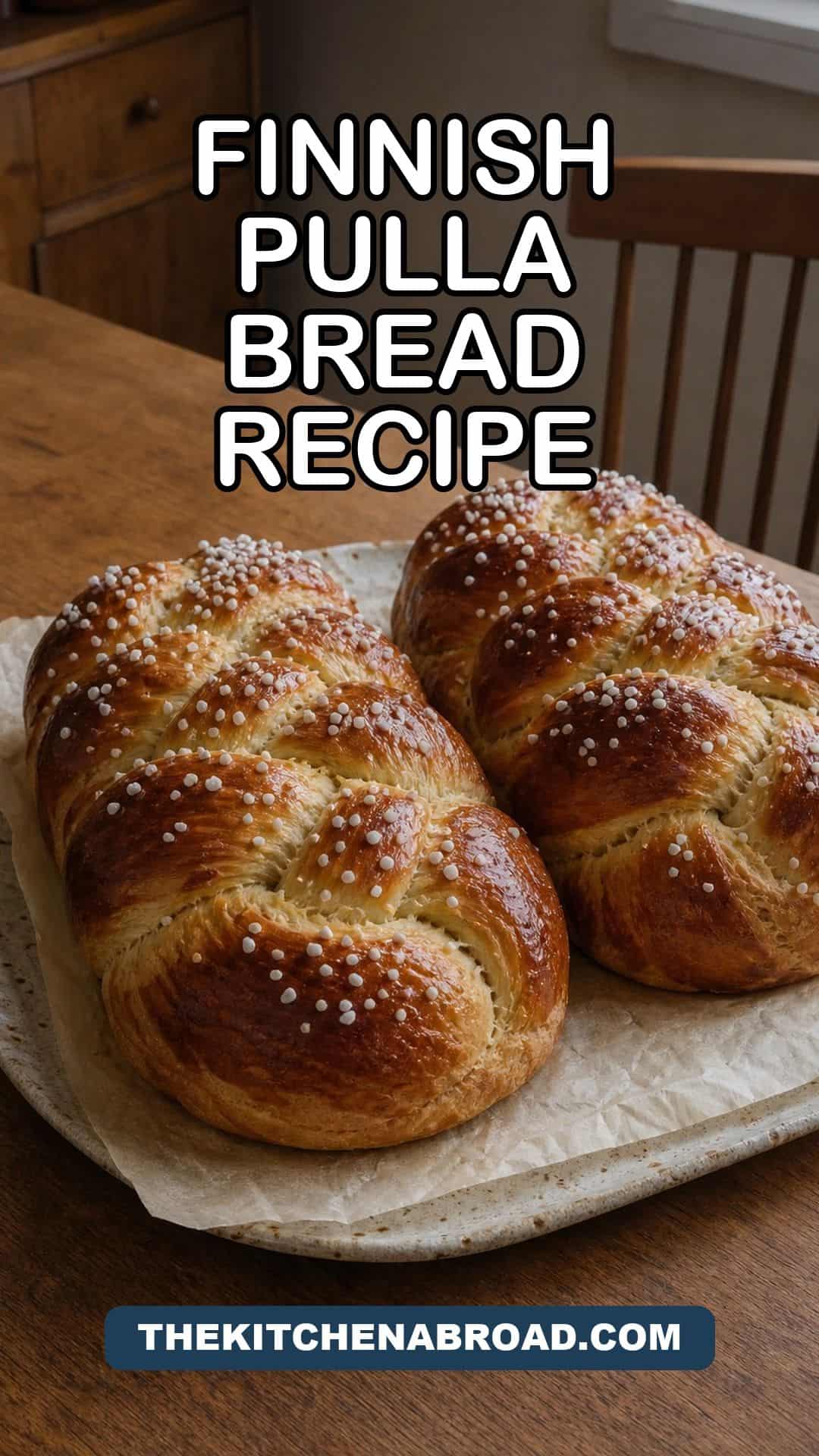
What is pulla, and when do Finns eat it?
Pulla is Finland’s everyday sweet bread: mildly sweet, soft, scented with cardamom. It’s what appears next to the coffee pot, at name days, at a neighbor’s kitchen table and at almost every Finnish celebration. Finnish communities in North America often call it nisu, and a braided loaf is called a pitko. The cardamom bread entry on Wikipedia lists the regional names and shapes if you’re curious.
The same dough has many forms. Braid it and you have a pitko. Shape it into small rounds and you get coffee buns. Roll it with butter and cinnamon sugar and it becomes korvapuusti, the Finnish cinnamon roll. Learn this one dough and you have half of Finnish home baking covered.
Why do whole cardamom pods matter so much?
Because cardamom’s aroma lives in volatile oils that fade fast once the seeds are ground. Pre-ground cardamom loses much of that perfume within weeks, so the bread ends up sweet but vague.
Crack the pods in a mortar about 5 minutes before you start the dough. Pick out the small black seeds and throw away the papery green husks; they’re bitter and make the bread taste slightly astringent. Then grind the seeds to a coarse-fine powder. Ten to twelve pods give you about 2 teaspoons, which is what this recipe uses.
If ground cardamom is all you can get, use about 1½ times the amount and buy the freshest jar you can find. It’ll be good bread. It won’t be the same bread.
How do you get a soft, fluffy pulla dough?
Three details decide it: milk temperature, flour choice and when the butter goes in.
Warm the milk to 41 to 43°C (105 to 110°F)
Active dry yeast blooms best in that range. Above 49°C (120°F) you start killing it, and the dough never rises properly. Too cool and the yeast wakes up slowly, so the first rise drags on and the dough underdevelops. Use a thermometer. In professional kitchens dough temperatures are measured, not guessed, and it’s the cheapest insurance a home baker can buy. Your yeast should be foamy after 10 minutes; if it isn’t, start again with a fresh packet.
Use all-purpose flour, not bread flour
Pulla should be tender and slightly cakey, not chewy like a baguette. Bread flour builds too much gluten for that. Standard unbleached all-purpose flour is the right strength. Sift it so it mixes evenly into the wet ingredients.
Add the butter after 5 minutes of kneading
This is the step most recipes skip over. Butter coats flour proteins and stops gluten from forming, so if it goes in too early you get a weak, dense crumb. Knead the dough on its own for 5 minutes first, then add very soft butter a tablespoon at a time. The dough will look greasy and broken for a minute, then come back together glossy and elastic.
How to braid pulla and finish the crust
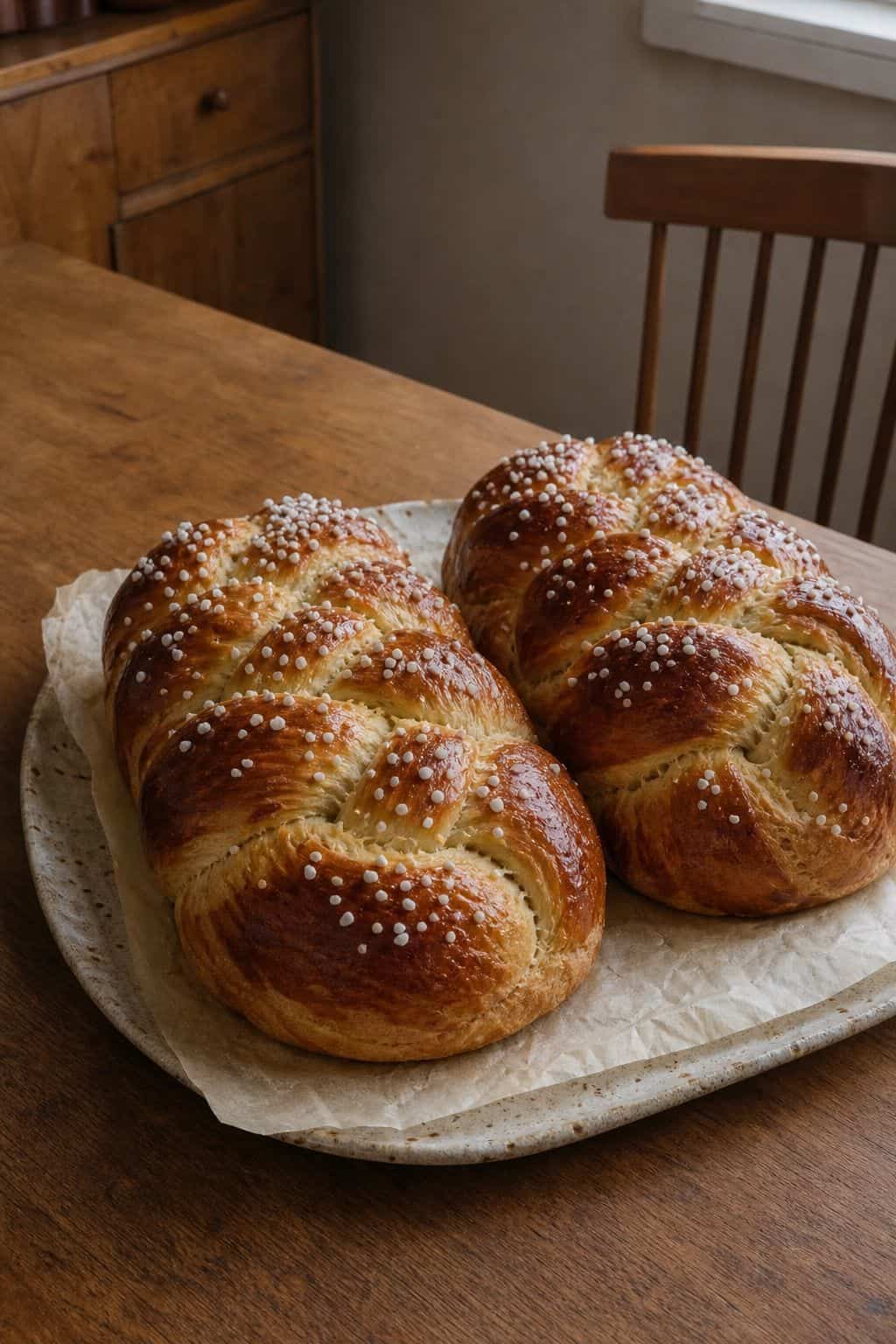
A three-strand braid is the classic Finnish loaf, and it’s the same braid you’d do with hair. Pinch the tops of the ropes together, cross the right strand over the middle, then the left over the middle, and keep alternating. Tuck both ends under so the loaf looks rounded rather than pinched. Once you’re comfortable, a six-strand braid makes a taller, showier loaf for holidays, but master three strands first.
The egg wash makes a bigger visual difference than people expect. A whole beaten egg gives a medium gold. An egg yolk loosened with a tablespoon of cream gives the deep, glossy mahogany you see on bakery loaves. Same effort.
Then the pearl sugar: hard white nibs that don’t melt in the oven. They give pulla its crunchy, sparkly top. Sanding sugar or raw sugar won’t work; they dissolve into the crust. Slivered almonds are the traditional substitute if you can’t find pearl sugar.
Finnish pulla bread recipe
Prep time: 30 minutes
Rise time: 2 hours (combined)
Cook time: 25 minutes
Total time: 3 hours
Yield: 2 large braided loaves (about 20 servings)
Ingredients
For the dough:
- 240 ml (1 cup) whole milk, warmed to 41 to 43°C (105 to 110°F)
- 7 g (2¼ tsp / 1 packet) active dry yeast
- 100 g (½ cup) granulated sugar
- 2 large eggs, room temperature
- 1 tsp fine sea salt
- 2 tsp freshly crushed cardamom (from about 10 to 12 whole green pods)
- 520 g (4¼ cups) all-purpose flour, sifted, plus more for kneading
- 115 g (½ cup / 1 stick) unsalted butter, very soft (not melted)
For the topping:
- 1 egg yolk
- 1 tbsp (15 ml) heavy cream
- 3 tbsp Swedish pearl sugar (or 3 tbsp slivered almonds)
Instructions
- Crush the cardamom pods in a mortar 5 minutes before mixing. Discard the green husks, grind the black seeds to a coarse-fine powder and measure 2 tsp.
- Warm the milk to 41 to 43°C (105 to 110°F), checking with a thermometer. Stir in the yeast and 1 tbsp of the sugar. Leave for 10 minutes, until foamy. No foam means the yeast is dead; start again with fresh yeast.
- In a stand mixer fitted with the dough hook (or a large bowl if kneading by hand), combine the yeast mixture, remaining sugar, eggs, salt and cardamom. Mix on low for 1 minute.
- Add the flour 1 cup at a time, mixing on low until a shaggy dough forms. Switch to medium-low and knead for 5 minutes. The dough will be sticky but coming together.
- Add the soft butter 1 tablespoon at a time, letting each piece disappear before adding the next, about 5 minutes in total. Knead for another 8 minutes on medium-low, until the dough pulls cleanly from the sides of the bowl but stays slightly tacky.
- Place the dough in a buttered bowl, cover with a kitchen towel and let it rise in a warm spot for 90 minutes, or until doubled.
- Punch the dough down gently and turn it out onto a lightly floured surface. Divide into 2 equal portions (about 470 g each), then divide each portion into 3 strands. Roll each strand into a 30 cm (12 inch) rope.
- Braid each set of 3 strands: pinch the tops together, lay the right strand over the middle, then the left over the middle, alternating to the end. Pinch the bottoms together and tuck both ends under.
- Move both loaves to a parchment-lined baking sheet with plenty of space between them. Cover and let rise for 30 minutes.
- While the loaves rise, heat the oven to 190°C (375°F).
- Whisk the egg yolk with the cream. Brush the loaves generously, then scatter the pearl sugar (or almonds) over the top.
- Bake for 22 to 25 minutes, until deep mahogany and 88 to 90°C (190 to 195°F) inside on an instant-read thermometer. If the tops brown too quickly, tent with foil for the last 5 minutes.
- Cool on a wire rack for at least 30 minutes before slicing; the crumb keeps setting as it cools.
Notes
Pulla stays fresh at room temperature in a sealed bag for 2 days. After that, slice and freeze it. Whole loaves freeze for up to 3 months wrapped tightly in plastic and then foil; thaw at room temperature and refresh in a 150°C (300°F) oven for 8 minutes.
What else can you make with pulla dough?
Coffee buns are the quickest. Divide the dough into small portions, roll them into balls, brush with egg wash and top with pearl sugar and slivered almonds. Bake at 200°C (400°F) for 12 to 14 minutes. These are the buns Finns eat with afternoon coffee.
For korvapuusti, roll the proofed dough into a rectangle, spread it with soft butter and scatter cinnamon sugar over it. Roll it up, slice into 4 cm (1½ inch) pieces and press each one down firmly in the middle so the sides splay out. That squashed shape is where the name comes from: it translates roughly as “slapped ears”. Bake at 200°C (400°F) for 14 minutes.
For Easter and Christmas, spread 200 g of marzipan, thinned with a tablespoon of warm milk, over the rolled-out dough before shaping. And if you want to plan ahead, refrigerate the dough overnight after the first rise. The slow, cold fermentation deepens the flavor and makes the dough firmer and easier to braid. Give it an hour at room temperature before shaping.
Pulla also suits a slow weekend table. It fits naturally into a spread of winter brunch hosting ideas, sliced next to butter, cheese and a big pot of coffee.
Pulla baking questions
What is pulla?
Pulla is a mildly sweet Finnish yeast bread flavored with crushed cardamom, enriched with milk, butter, eggs and sugar. It is usually braided into a loaf or shaped into buns, topped with egg wash and pearl sugar, and served with coffee.
Can I use ground cardamom instead of whole pods?
Yes, but use about 1½ times the amount (roughly 3 teaspoons instead of 2) because pre-ground cardamom loses much of its aroma within weeks. The bread will still taste milder than one made with freshly crushed seeds.
Why is my pulla dense instead of fluffy?
Dense pulla almost always comes from milk that was too hot, expired yeast, or butter added before the gluten had 5 minutes of kneading. Check the milk with a thermometer, proof the yeast until foamy, and add the butter only once the dough is elastic.
What can I use instead of pearl sugar?
Slivered almonds are the traditional substitute, and crushed sugar cubes also hold their shape in the oven. Avoid sanding sugar, raw sugar or turbinado, which melt into the crust and disappear.
Can I make pulla dough the night before?
Yes, refrigerate the dough after the first proof for up to 24 hours. Cold dough is firmer and easier to braid; let it sit at room temperature for 1 hour before shaping.
How do I know when pulla is baked through?
Pulla is done when the top is a deep mahogany brown and the center reads 88 to 90°C (190 to 195°F) on an instant-read thermometer, which takes 22 to 25 minutes at 190°C (375°F).
Key takeaways
- Crush whole green cardamom pods 5 minutes before mixing and use only the black seeds.
- Warm the milk to 41 to 43°C (105 to 110°F) with a thermometer; above 49°C the yeast dies.
- Knead for 5 minutes before adding the butter so the gluten can form first.
- An egg yolk and cream wash gives the deep mahogany crust; pearl sugar gives the crunch.
- The same dough makes braided loaves, coffee buns and korvapuusti.
Stale pulla, French toast and the next Finnish bake
Day-old pulla makes the best French toast you’ll ever eat. Slightly dry slices soak up an egg and milk custard without falling apart, and a pinch of cardamom sugar on top finishes them. So make the full two loaves even if you’re baking for two: eat one fresh, freeze the other in slices for weekday breakfasts.
If you like freezer-friendly baking for busy mornings, these oat muffins with berries and coconut work on the same plan.
And for the full Finnish meal, make a pot of creamy lohikeitto salmon soup for lunch and put the pulla out afterward with coffee. That’s a very Finnish afternoon.
Finnish Pulla Bread (Braided Cardamom Bread)
Finnish pulla is a soft, braided cardamom bread made from an enriched yeast dough of warm milk, butter, eggs, sugar, and flour, perfumed with freshly crushed green cardamom pods, finished with egg wash and pearl sugar.
Ingredients
- 240 ml (1 cup) whole milk, warmed to 41 to 43°C (105 to 110°F)
- 7 g (2¼ tsp / 1 packet) active dry yeast
- 100 g (½ cup) granulated sugar
- 2 large eggs, room temperature
- 1 tsp fine sea salt
- 2 tsp freshly crushed cardamom (from about 10 to 12 whole green pods)
- 520 g (4¼ cups) all-purpose flour, sifted, plus more for kneading
- 115 g (½ cup / 1 stick) unsalted butter, very soft (not melted)
- 1 egg yolk
- 1 tbsp (15 ml) heavy cream
- 3 tbsp Swedish pearl sugar (or 3 tbsp slivered almonds as fallback)
Instructions
- Crush the cardamom pods in a mortar and pestle 5 minutes before mixing. Discard the green husks, keep the black seeds, and grind those seeds to a coarse-fine powder. Measure 2 tsp.
- Warm the milk to 41 to 43°C (105 to 110°F). Verify with a thermometer. Stir in the yeast and 1 tbsp of the sugar. Let stand for 10 minutes until foamy. If the milk does not foam, the yeast is dead, start over with fresh yeast.
- In the bowl of a stand mixer fitted with the dough hook (or a large bowl if kneading by hand), combine the bloomed yeast mixture, the remaining sugar, eggs, salt, and crushed cardamom. Mix on low for 1 minute to combine.
- Add the flour 1 cup at a time, mixing on low until a shaggy dough forms. Switch to medium-low and knead for 5 minutes. The dough will be sticky but coming together.
- Add the soft butter 1 tablespoon at a time, allowing each piece to incorporate fully before adding the next. This takes about 5 minutes total. Once all the butter is incorporated, knead for another 8 minutes on medium-low.
- Transfer the dough to a buttered bowl, cover with a kitchen towel, and let rise in a warm spot for 90 minutes, or until doubled in size.
- Punch the dough down gently and turn out onto a lightly floured surface. Divide into 2 equal portions (about 470 g each). For each loaf, divide that portion into 3 equal strands. Roll each strand into a 30 cm (12 inch) rope.
- Braid the 3 strands together: pinch the tops together, then lay the rightmost strand over the middle, then the leftmost over the middle, alternating. When you reach the end, pinch the bottoms together and tuck both ends under the loaf.
- Transfer both braided loaves to a parchment-lined baking sheet, leaving plenty of space between them. Cover with a kitchen towel and let rise for 30 minutes.
- While the loaves proof, preheat the oven to 190°C (375°F).
- Whisk the egg yolk with the cream. Brush the proofed loaves generously with the wash, then sprinkle pearl sugar (or slivered almonds) over the top.
- Bake for 22 to 25 minutes, until the tops are deep mahogany and the internal temperature reads 88 to 90°C (190 to 195°F) on an instant-read thermometer. If the tops are browning too fast, tent with foil for the last 5 minutes.
Notes
Milk temperature is non-negotiable. Use a thermometer. The 41 to 43°C (105 to 110°F) window is where active dry yeast performs best. Above 49°C (120°F) you kill the yeast.
Cardamom seeds only, not husks. The green papery shells around the seeds carry bitterness that turns the bread astringent. Crack each pod, scoop out the small black seeds, and grind only those.
Last update on 2026-10-03 / Affiliate links / Images from Amazon Product Advertising API