
A bakery-grade lemon meringue pie recipe is really three small recipes stacked, and the version that does not weep, sog, or run is the one that treats each layer as its own discipline. Blind-baked all-butter crust. Cornstarch-thickened lemon curd cooked to a real internal number (180°F). And Italian meringue, not French. The hot 240°F sugar syrup poured into whipping whites is the wedge most recipes skip, and it is the move that keeps a tall, shiny meringue cap proud on day two instead of beading water down the slice.
A finished lemon meringue pie should look like architecture. A tall, torched meringue cap shouldering down to a clean lemon line that sits over butter pastry, no weeping puddle on the plate, no soggy seam where the curd meets the crust. Many versions miss in one of three places: the crust softens under the wet filling, the curd never sets, or the meringue beads up overnight. The fix for all three is the same answer, written into the steps below. The crust gets blind-baked in two stages, the curd cooks to a real temperature, and the meringue is Italian-style , hot sugar syrup poured into whipping whites , which is the only kind that holds its shape and does not weep.

What You’ll Need
A 9-inch pie dish (ceramic holds heat evenly for blind baking), ceramic pie weights for the crust, an instant-read thermometer for both the curd and the syrup, a stand mixer for the meringue, and a fine-mesh strainer to keep the curd smooth.


Recommended Reads
- Carrot Cake Recipe
- Pineapple Upside Down Cake Recipe
- Best Easter Cake Ideas
- Best Easter Dinner Ideas
- Coffee Cake Recipe
Where Lemon Meringue Pie Came From
The earliest documented thread runs through Philadelphia. Elizabeth Goodfellow, who ran America’s first cooking school out of her shop on Washington Square around 1806, is credited with the original lemon pudding pie, a custard-style ancestor of the modern dessert. By 1869, published recipes labeled “lemon meringue pie” , crust, lemon custard, beaten egg-white topping , were appearing in American cookbooks, and the form was set: pastry on the bottom, citrus custard in the middle, sweetened whipped whites on top.
There is a British thread too. Victorian “lemon honey” curds, thickened with eggs and butter, predate the American pie by decades and supplied the curd-filling logic that crossed the Atlantic. The mid-20th-century version most Americans grew up with , the diner-counter, pie-shop, Sunday-dinner standard , is a marriage of the two: a Goodfellow-style pastry shell, a curd descended from the British lemon honey tradition, and a meringue cap that came into its own once domestic ovens could broil reliably. The recipe below is that mid-century shape, with the meringue swapped to the Italian style.
A Few Notes on the Ingredients
- All-butter crust: Cold cubed butter cut into the flour until the pieces are still pea-sized, with just enough ice water to bring the dough together. No shortening, no store-bought disclaimer.
- Two-stage blind bake: Weights at 425°F to set the walls, then 350°F for another 10 minutes uncovered so the base dries to pale gold. A wet curd hitting a soft crust is how the dreaded sog happens; this is the antidote.
- Cornstarch-thickened curd: Built for stability rather than spread. Cornstarch and water build the body, six egg yolks add richness and color, butter at the end gives shine.
- Fresh lemon zest and juice: The zest of three lemons plus a half cup of fresh juice carry the flavor. Bottled juice loses the volatile oils that give the pie its lift.
- 180°F internal curd temperature: The critical move. That is the temperature where cornstarch fully gelatinizes and the yolk proteins set into a sliceable curd. Stop short and the slice runs.
- Italian meringue: Sugar and water boiled to 240°F, then poured down the side of the bowl while the whites are whipping. The syrup cooks the whites as they incorporate, dissolving the sugar completely and stabilizing the foam.
- 240°F soft-ball syrup: The wedge that makes Italian meringue shiny, marshmallow-firm, and shockingly stable. Holds peaks overnight and does not bead water onto the slice the next morning.
- Cream of tartar and salt: Go into the whites at the start to insure against over-whipping.
Recipe: Lemon Meringue Pie
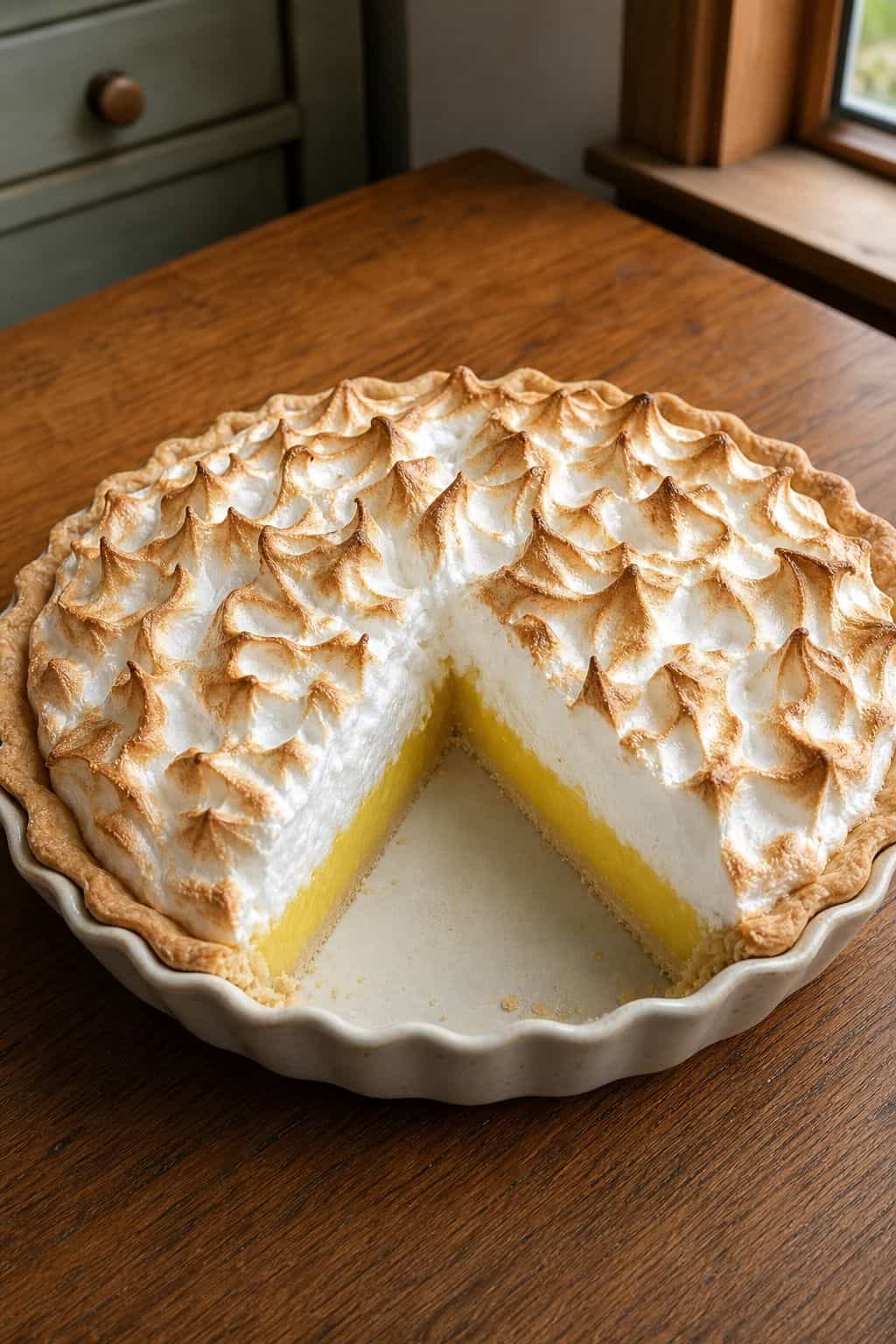
Prep time: 1 hour | Cook time: 40 minutes | Total time: 1 hour 40 minutes plus 3 hours cooling | Serves: 8
Ingredients
For the crust:
- 1 1/4 cups (160 g) all-purpose flour
- 1/2 tsp salt
- 1/2 cup (113 g) unsalted butter, cold and cubed
- 3-4 tbsp (45-60 ml) ice water
For the filling:
- 1 1/4 cups (250 g) granulated sugar
- 1/3 cup (40 g) cornstarch
- 1/4 tsp salt
- 1 1/2 cups (360 ml) water
- 6 large egg yolks (reserve whites for meringue)
- 2 tbsp (28 g) unsalted butter
- Zest of 3 lemons
- 1/2 cup (120 ml) fresh lemon juice (about 3 lemons)
For the Italian meringue:
- 1 cup (200 g) granulated sugar
- 1/4 cup (60 ml) water
- 6 large egg whites (reserved from yolks)
- 1/4 tsp cream of tartar
- Pinch of salt
Instructions
- Make the crust. Whisk the flour and salt in a bowl, then cut the cold cubed butter into the flour with a pastry cutter (or your fingers, quickly) until the pieces are pea-sized and the mixture looks like coarse sand. Add the ice water 1 tablespoon at a time, tossing with a fork, until the dough just holds together when pinched. Tip it onto a sheet of plastic wrap, press into a disk, and chill 30 minutes.
- Roll the chilled dough on a lightly floured surface into a 12-inch round. Drape it into a 9-inch pie dish, ease it into the corners (do not stretch it), and trim the overhang to about 1 inch. Tuck the overhang under and crimp the edges. Chill the lined pan another 15 minutes while the oven heats.
- Heat the oven to 425°F (220°C). Line the chilled crust with parchment paper, fill with ceramic pie weights all the way to the rim, and blind-bake 15 minutes until the edges are set and pale gold.
- Carefully lift out the parchment and weights. Reduce the oven to 350°F (175°C) and bake the crust another 10 minutes uncovered until the base is dry, pale gold, and fully cooked. Cool completely on a rack. Leave the oven on (you will need it for the broiler later if you skip the torch).
- Make the filling. In a medium saucepan, whisk the sugar, cornstarch, and salt until no streaks remain. Gradually whisk in the water until smooth, then set over medium heat. Cook, whisking constantly, until the mixture thickens, comes to a simmer, and bubbles slowly for 3 minutes , the surface will turn from cloudy to shiny and translucent. This is the gelatinization point.
- Whisk the egg yolks in a separate bowl. Ladle about a cup of the hot cornstarch mixture into the yolks while whisking constantly , this tempers them so they do not scramble. Pour the tempered yolks back into the saucepan, whisking the whole time.
- Return the pan to medium heat and cook, whisking constantly, for 2 to 3 minutes more, until the curd reaches 180°F (82°C) on an instant-read thermometer. The curd should be thick enough to hold a trail from the whisk.
- Off the heat, whisk in the butter, lemon zest, and lemon juice until smooth. Pass the curd through a fine-mesh strainer directly into the cooled pie crust for the cleanest texture, and smooth the top with an offset spatula. Leave the filling hot , this is critical for the meringue seal.
- Make the Italian meringue. In a small saucepan, combine the 200 g sugar with 60 ml water. Set over medium-high heat and bring to a boil without stirring, brushing down any crystals on the sides of the pan with a wet pastry brush. Clip on a thermometer and cook until the syrup reaches 240°F (115°C), the soft-ball stage.
- Meanwhile, in the bowl of a stand mixer fitted with the whisk, whip the egg whites, cream of tartar, and pinch of salt on medium speed until the whites hold medium peaks (about 3 minutes).
- With the mixer running on medium, slowly pour the hot 240°F syrup down the side of the bowl in a thin, steady stream , avoid the moving whisk so it does not fling syrup up the sides. Once the syrup is in, increase to medium-high and whip until the bowl is room-temperature, the meringue is shiny, and stiff peaks hold when the whisk is lifted, about 4 to 5 minutes.
- Pile the meringue onto the hot filling immediately, starting at the crust edges and working inward. Seal the meringue completely to the crust rim all the way around , any gap is where weeping will start. Once sealed, swirl the surface with the back of an offset spatula to build tall peaks.
- Brown the meringue. Either torch the peaks with a kitchen torch until deeply golden in spots, or slide the pie under the broiler for 60 to 90 seconds, rotating once, until the tips are gold and the valleys are pale. Watch it the whole time , broilers move fast.
- Cool the pie at room temperature for at least 3 hours before slicing so the curd sets fully. Slice with a hot, dry knife (dipped in hot water, wiped between cuts) for clean cross-sections.
Notes
The seal-to-crust step in step 12 is the single most important move in the recipe. Meringue piled into the center of the filling but not pushed all the way to the crust edge will shrink as it cools, opening a ring around the rim where weeping pools collect. Spread the meringue first to the rim, then build the center.
Italian meringue holds peaks for 24 to 48 hours in the fridge, well past the lifespan of French meringue, which is why this is the version worth the extra pan. The hot syrup also pasteurizes the whites, which is a nice side benefit if anyone at the table is wary of raw whites.
For clean slices through a tall meringue cap, dip a long thin knife in hot water, wipe it dry, then cut straight down (not sawing). Hot water melts a thin film at the meringue surface, the knife slides through, and the slice keeps its profile.
Tips and Variations
Why Italian Meringue Beats French (Weeping Solved)
French meringue weeps because undissolved sugar crystals stay in the foam and slowly pull water out of the whites in the fridge. Italian meringue dissolves the sugar fully in the hot syrup before it ever meets the whites, so there is nothing left to draw moisture out later. The 240°F syrup also cooks the whites into a stable foam (egg proteins denature around 145°F), which is why Italian meringue holds its shape for two days while French meringue starts to bead within hours. If you have only ever made the French version, the difference on day two is dramatic.
How to Cook Lemon Curd to 180°F (Cornstarch + Yolks)
The 180°F target is the temperature at which cornstarch reaches full gelatinization and egg yolk proteins set into a sliceable curd. Below that, the slice runs; above 185°F, the yolks scramble. Whisk constantly, scrape the corners of the saucepan with a heatproof spatula every 20 seconds (cornstarch likes to seize in corners), and pull the curd the moment the thermometer hits 180°F. Off-heat residual cooking will carry it another degree or two. If you do not own a thermometer, the visual cue is a slow, lazy bubble that takes a second to break the surface, and a whisk trail that holds for two beats before flowing back in.
Blind-Baking the Crust Without Shrinkage
Three habits prevent the dreaded shrinkage. First, rest the rolled-and-fitted crust in the fridge for 15 minutes before it hits the oven so the gluten relaxes and the butter chills back down. Second, fill the parchment with pie weights all the way to the top of the rim, not just the base , the weights need to press the walls outward as the crust sets. Third, do not skip the second uncovered stage at 350°F. That stage drives off the last of the moisture and locks the walls in place. A two-stage blind bake gives you a fully cooked, gold-bottomed shell that will not soften under the wet curd.
Slicing Through Tall Meringue Without Smashing It
A cold pie cuts cleaner than a warm one, so let the pie set the full three hours. Use a long, thin-bladed knife (a granton-edge slicer or a clean chef’s knife both work) dipped in hot tap water and wiped dry between every cut. Press straight down in one motion , no sawing, no rocking. The hot blade melts a fractional layer of meringue and curd as it passes through, which is what gives the slice its clean architectural edge. Cold knife into tall meringue produces drag, which produces smashing.
Make-Ahead Strategy (Crust + Filling Components)
The crust can be blind-baked a day ahead and stored at room temperature under a clean towel , it will be slightly less crisp than fresh but recovers in a 300°F oven for 5 minutes. The curd can be cooked up to 24 hours ahead and refrigerated covered, then gently rewarmed to a steam in a clean saucepan before going into the crust (it must be hot to seal the meringue properly). The meringue, however, is a same-day task. Build the pie the morning of, or no more than 6 hours before serving, and refrigerate uncovered until the surface dries slightly, then loosely tent.
What to Serve It With
Lemon meringue pie is built for the spring and summer end of the calendar. It is an Easter dessert next to ham and roast lamb, a July afternoon dessert pulled cold from the fridge, a tea-time slice with Earl Grey, and the classic after-Sunday-dinner pie. Pair it with strong unsweetened coffee or black tea , anything sweet (sparkling wine, dessert wines) doubles up on the sugar and flattens the lemon. A small glass of cold limoncello on the side is the move if you want to lean further into the citrus.
Frequently Asked Questions
Italian vs French meringue , which should I use for lemon meringue pie?
Italian. The hot 240°F sugar syrup poured into whipping whites cooks the whites as they incorporate, dissolving the sugar completely and stabilizing the foam. The result is a shiny, marshmallow-firm meringue that holds peaks for 24 to 48 hours and does not weep. French meringue (raw whites whipped with sugar) is faster but fragile, beads water within hours, and is the reason many pies look sad on day two.
Why is my lemon meringue pie weeping?
Three causes, in order of frequency. First, meringue spread on cold filling , the meringue must hit a hot, steaming curd surface to seal, otherwise condensation forms in the gap. Second, undissolved sugar in a French-style meringue draws water out of the foam in the fridge. Third, condensation from a loosely covered pie in a cold fridge. The Italian-meringue-on-hot-filling combination in this recipe fixes all three at once.
Why is my lemon meringue pie filling runny?
The curd was undercooked. Cornstarch needs to reach 180°F (82°C) to fully gelatinize, and the yolks need that same temperature to set into a sliceable curd. Pull the pan off the heat too early and the slice runs onto the plate. Use a thermometer, hit 180°F, and whisk for the full 2 to 3 minutes after the eggs go in. The other culprit is letting the pie cool less than 3 hours , the curd continues to set as it cools, and slicing early gives you a runny center even when the temperature was right.
Can I make lemon meringue pie the day before?
Yes, with the Italian-meringue version. The crust and curd can be prepped a day ahead (crust at room temp, curd refrigerated). Reheat the curd to a steam, pour into the crust, then build the meringue and brown it the day of serving. Italian meringue holds 24 to 48 hours in the fridge, so a pie assembled in the morning will be perfect at dinner. With French meringue, same-day assembly is essentially required , another reason Italian wins for entertaining.
Can I use a store-bought crust?
If you have to. A refrigerated all-butter rolled crust (Pillsbury, Wholly Wholesome, or Trader Joe’s pie dough) is the closest substitute , still blind-bake it in two stages as written. Avoid frozen pre-formed shells, which are usually shortening-heavy and have thin walls that bend under wet fillings. Avoid graham crust entirely; it is a different pie. Homemade all-butter remains the most reliable version by a meaningful margin, and the dough comes together in 10 minutes.
Can I use bottled lemon juice?
No. Half the flavor of this pie comes from the zest oils and the volatile aromatics in fresh lemon juice. Bottled juice loses both within days of pressing , what remains is acid without character. Fresh lemons cost a few dollars and the difference in the finished slice is immediate. If you are squeezing the juice anyway, zest the lemons first; the zest goes into the curd alongside the juice.
Key Takeaways
- Italian meringue (hot 240°F sugar syrup poured into whipping whites) is the wedge , it does not weep, French does.
- Pile the meringue on hot filling and seal it to the crust edge all the way around. Cold filling = guaranteed weeping.
- Cook the curd to 180°F on an instant-read thermometer. That is where cornstarch fully gelatinizes and the slice sets.
- Blind-bake the crust in two stages: 425°F with weights for 15 minutes, then 350°F uncovered for 10 minutes.
- Use fresh lemon zest and juice. Bottled juice loses the aromatic oils that give the pie its character.
- Cool the finished pie at least 3 hours before slicing, and cut with a hot, dry knife for clean cross-sections.
Final Thoughts
Lemon meringue pie has a reputation for being temperamental, and that reputation is earned by the recipes that try to shortcut it. Three components, three failure modes, three fixes , that is the honest shape of this dessert, and once you see it that way, the pie stops being a gamble and starts being a project with known steps.
The Italian meringue swap is the move worth keeping in your back pocket past this recipe. Once you have made it, you will find yourself reaching for it on lemon tarts, baked Alaska, and any dessert with a marshmallowy topping. The technique is older than the home oven and more stable than anything a hand mixer and a bag of sugar will ever produce.
Make this for an Easter table, a summer dinner, or a Sunday when there is no reason to rush. Cool it the full three hours, slice with a hot knife, and serve it with strong unsweetened coffee. A pie that looks like architecture and holds its shape into day two is the version this dessert was always supposed to be.
Lemon Meringue Pie
A bakery-grade lemon meringue pie recipe is really three small recipes stacked, and the version that does not weep, sog, or run is the one that treats each layer as its own discipline. Blind-baked all-butter crust.
Ingredients
- 1 1/4 cups (160 g) all-purpose flour
- 1/2 tsp salt
- 1/2 cup (113 g) unsalted butter, cold and cubed
- 3-4 tbsp (45-60 ml) ice water
- 1 1/4 cups (250 g) granulated sugar
- 1/3 cup (40 g) cornstarch
- 1/4 tsp salt
- 1 1/2 cups (360 ml) water
- 6 large egg yolks (reserve whites for meringue)
- 2 tbsp (28 g) unsalted butter
- Zest of 3 lemons
- 1/2 cup (120 ml) fresh lemon juice (about 3 lemons)
- 1 cup (200 g) granulated sugar
- 1/4 cup (60 ml) water
- 6 large egg whites (reserved from yolks)
- 1/4 tsp cream of tartar
- Pinch of salt
Instructions
- Make the crust. Whisk the flour and salt in a bowl, then cut the cold cubed butter into the flour with a pastry cutter (or your fingers, quickly) until the pieces are pea-sized and the mixture looks like coarse sand.
- Roll the chilled dough on a lightly floured surface into a 12-inch round. Drape it into a 9-inch pie dish, ease it into the corners (do not stretch it), and trim the overhang to about 1 inch. Tuck the overhang under and crimp the edges.
- Heat the oven to 425°F (220°C). Line the chilled crust with parchment paper, fill with ceramic pie weights all the way to the rim, and blind-bake 15 minutes until the edges are set and pale gold.
- Carefully lift out the parchment and weights. Reduce the oven to 350°F (175°C) and bake the crust another 10 minutes uncovered until the base is dry, pale gold, and fully cooked. Cool completely on a rack.
- Make the filling. In a medium saucepan, whisk the sugar, cornstarch, and salt until no streaks remain. Gradually whisk in the water until smooth, then set over medium heat.
- Whisk the egg yolks in a separate bowl. Ladle about a cup of the hot cornstarch mixture into the yolks while whisking constantly , this tempers them so they do not scramble. Pour the tempered yolks back into the saucepan, whisking the whole time.
- Return the pan to medium heat and cook, whisking constantly, for 2 to 3 minutes more, until the curd reaches 180°F (82°C) on an instant-read thermometer. The curd should be thick enough to hold a trail from the whisk.
- Off the heat, whisk in the butter, lemon zest, and lemon juice until smooth. Pass the curd through a fine-mesh strainer directly into the cooled pie crust for the cleanest texture, and smooth the top with an offset spatula.
- Make the Italian meringue. In a small saucepan, combine the 200 g sugar with 60 ml water. Set over medium-high heat and bring to a boil without stirring, brushing down any crystals on the sides of the pan with a wet pastry brush.
- Meanwhile, in the bowl of a stand mixer fitted with the whisk, whip the egg whites, cream of tartar, and pinch of salt on medium speed until the whites hold medium peaks (about 3 minutes).
- With the mixer running on medium, slowly pour the hot 240°F syrup down the side of the bowl in a thin, steady stream , avoid the moving whisk so it does not fling syrup up the sides.
- Pile the meringue onto the hot filling immediately, starting at the crust edges and working inward. Seal the meringue completely to the crust rim all the way around , any gap is where weeping will start.
Notes
The seal-to-crust step in step 12 is the single most important move in the recipe. Meringue piled into the center of the filling but not pushed all the way to the crust edge will shrink as it cools, opening a ring around the rim where weeping pools collect. Spread the meringue first to the rim, then build the center.
Italian meringue holds peaks for 24 to 48 hours in the fridge, well past the lifespan of French meringue, which is why this is the version worth the extra pan. The hot syrup also pasteurizes the whites, which is a nice side benefit if anyone at the table is wary of raw whites.
Last update on 2026-08-08 / Affiliate links / Images from Amazon Product Advertising API