
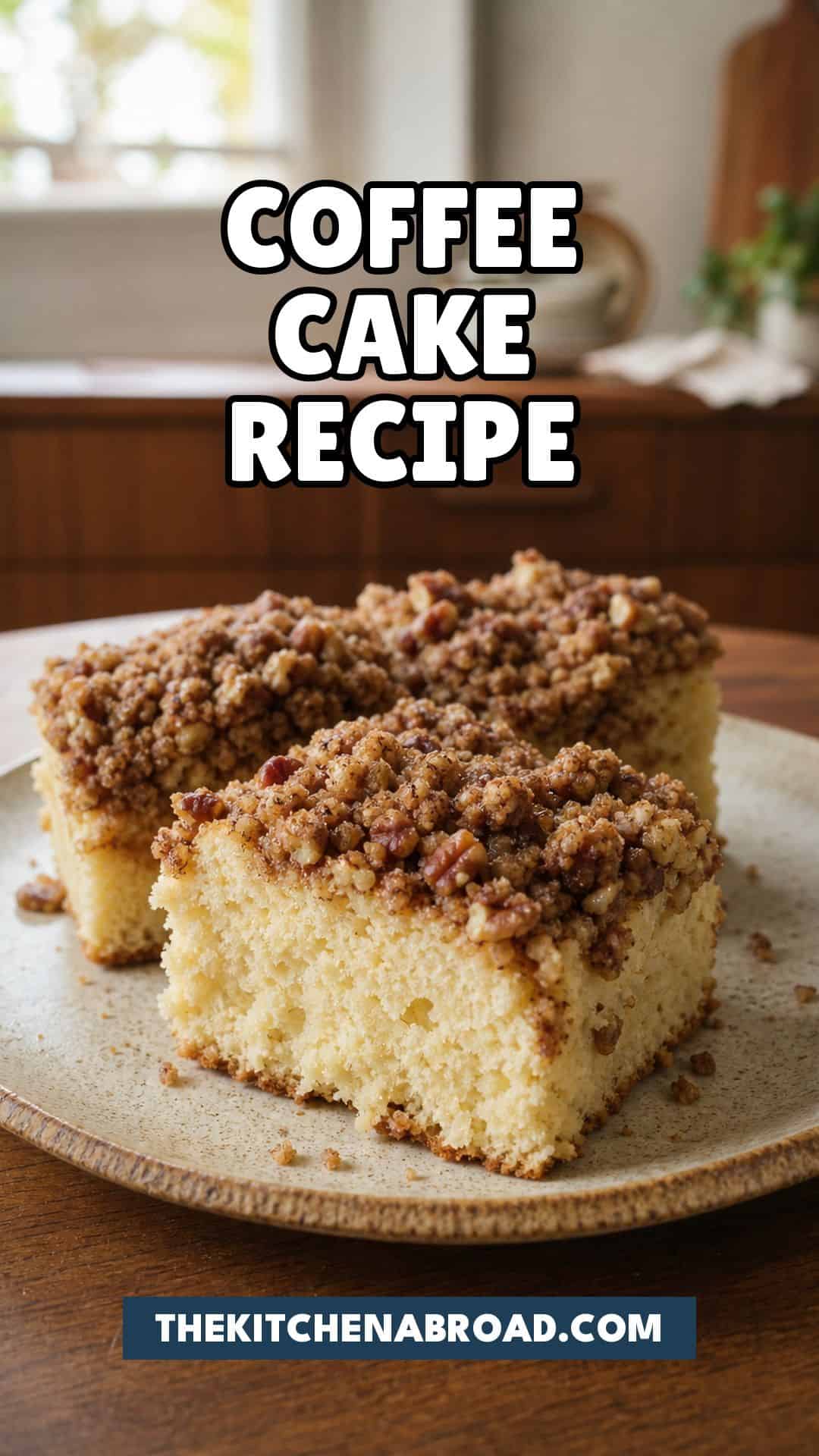
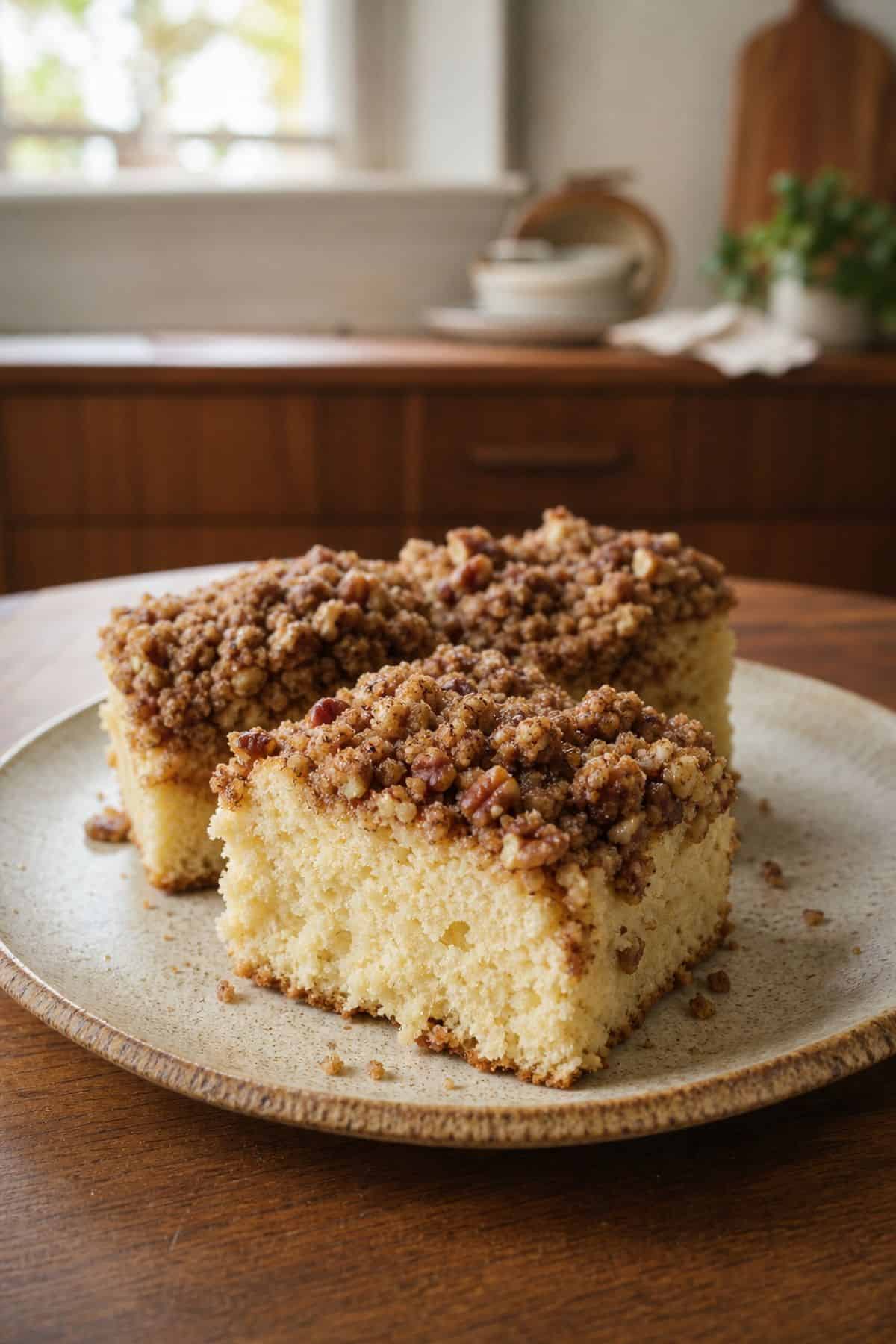
A coffee cake recipe is a sour-cream Sunday-morning cake built with the reverse-creaming method and a 1:1 streusel-to-flour ratio so the crumb topping arrives in real crumbs. Bakes in a 9-inch square pan for 45 minutes. Makes nine generous squares.
There is no coffee in coffee cake, and there never was. The name comes from what gets poured next to it, a holdover from the German Kaffeeklatsch tradition where the cake sat beside the afternoon pot. What it actually is, in its American form, is a sour-cream-and-streusel cake built for slow mornings. The version here leans hard on the two moves most recipes underuse: full-fat sour cream for the tang and tender crumb, plus a streusel layer doubled to a 1:1 ratio with the cake flour so every bite gets a real top.
Tools You’ll Want
A 9-inch square pan, a stand mixer for the reverse creaming, a glass mixing bowl set for the dry and streusel, a pastry cutter for the cold-butter cut-in, and parchment for a clean lift-out.


Recommended Reads
- Mother’s Day Brunch Ideas
- Christmas Brunch Ideas
- Hot Coffee Recipe
- Perfect Cold Brew Coffee
- Oat Muffins with Berries and Coconut
Where Coffee Cake Came From
Coffee cake traces back to German Kaffeekuchen, the yeast-and-streusel cakes (Streuselkuchen, Krümelkuchen) baked for Kaffeeklatsch, the 17th-to-19th-century afternoon ritual of coffee, cake, and gossip. The cake never had coffee in it. The coffee sat in the cup beside it.
German immigrants brought the tradition to America starting in the 1840s. By the middle of the 19th century, coffee had replaced tea as the American social drink, and German-style kuchen had pushed British baked goods off the brunch table. The American sour-cream version that sits on family recipe cards today emerged in the early 20th century, when chemical leaveners replaced yeast and bakers added dairy fat for a richer crumb. That is the version on most family recipe cards, and it is the one written below.
A Few Notes on the Ingredients
- Full-fat sour cream: The load-bearing ingredient. Its acidity activates the baking soda for lift, its fat keeps the cake tender on day two, and its tang balances the sugar in the streusel above it.
- Light sour cream and yogurt swaps: Light sour cream gives you a gummy crumb and a flatter rise. Greek yogurt works as a swap if that is what you have, but full-fat sour cream is the texture this cake was built for.
- Streusel ratio (1:1): Most American recipes use a 1:3 streusel-to-flour ratio. This recipe goes 1:1: roughly 250g of streusel sitting on 250g of cake flour. That is double what most recipes call for, and the reason a slice tastes more like crumb cake at the top and butter cake at the bottom.
- Cinnamon: Saigon is bolder and slightly hot; Ceylon is softer and floral. Either works, but use what you like, not what has been in the cabinet since 2019.
- Cake butter: Softened to about 65F (18C) for the reverse creaming step. Coats the flour in fat before any liquid hits, which blocks gluten and guarantees a tender crumb.
- Streusel butter: Cold straight from the fridge, cubed, and cut in with a pastry cutter until the pieces are pea-sized. Melting it (the common mistake) gives you a flat, hard top instead of distinct crumbs.
Recipe: Coffee Cake
Prep time: 25 minutes | Cook time: 45 minutes | Total time: 1 hour 10 minutes | Serves: 9 (one 9-inch square)
Ingredients
For the cake:
- 250 g (2 cups) all-purpose flour
- 200 g (1 cup) granulated sugar
- 1 1/2 tsp baking powder
- 1/2 tsp baking soda
- 1/2 tsp fine sea salt
- 115 g (1/2 cup / 1 stick) unsalted butter, softened to about 65°F (18°C)
- 240 g (1 cup) full-fat sour cream, room temperature
- 2 large eggs, room temperature
- 2 tsp pure vanilla extract
For the streusel topping (a 1:1 ratio with the cake flour, which is double what most recipes use):
- 250 g (2 cups) all-purpose flour
- 200 g (1 cup) light brown sugar, packed
- 2 tsp ground cinnamon (Saigon or Ceylon)
- 1/4 tsp fine sea salt
- 170 g (3/4 cup / 1 1/2 sticks) unsalted butter, cold, cut into 1 cm cubes
- 60 g (1/2 cup) chopped pecans or walnuts, optional
Instructions
- Heat the oven to 350°F (175°C). Line a 9-inch (23 cm) square pan with parchment, leaving a 5 cm overhang on two sides so the cake can be lifted out cleanly. Lightly butter the parchment.
- Make the streusel first so it can rest in the fridge while you mix the cake. In a glass bowl, whisk 250 g flour, 200 g brown sugar, 2 tsp cinnamon, and 1/4 tsp salt. Add the cold cubed butter and cut it in with a pastry cutter (or your fingers, working quickly) until the mixture looks like coarse sand with pea-sized lumps of butter still visible. Stir in the nuts if using. Chill the bowl in the fridge for at least 10 minutes.
- Now the cake, using the reverse-creaming method. In the bowl of a stand mixer fitted with the paddle, combine 250 g flour, 200 g sugar, 1 1/2 tsp baking powder, 1/2 tsp baking soda, and 1/2 tsp salt. Mix on low for about 30 seconds to combine.
- With the mixer on low, add the softened butter one tablespoon at a time. Once all the butter is in, increase to medium-low and beat for about 2 minutes. The mixture will look like coarse damp sand, slightly clumping when pressed. This step coats the flour in fat before any liquid hits, which blocks gluten development and guarantees a tender crumb.
- In a separate bowl, whisk the sour cream, eggs, and vanilla until smooth. With the mixer on low, pour the wet ingredients into the dry in a steady stream. Once incorporated, increase to medium and beat for about 1 minute, stopping once to scrape the bowl. The batter should look thick, smooth, and pale yellow.
- Scrape about two-thirds of the batter into the prepared pan and smooth the top with an offset spatula. Sprinkle about a third of the chilled streusel evenly over the surface, pressing very lightly so it adheres. Spoon the remaining batter on top and gently smooth it (it will not cover every patch of streusel, and that is fine).
- Pile the rest of the streusel evenly across the top. Use all of it. This is the double-streusel move, and the layer should look generous, almost too much. Press gently so it stays put as it bakes.
- Bake on the middle rack for 40 to 45 minutes, until the top is golden and a skewer inserted into the center comes out with a few moist crumbs (not wet batter). If the streusel is browning before the center sets, tent the pan loosely with foil at minute 35.
- Cool the cake in the pan on a rack for about 30 minutes before lifting it out by the parchment. Slice into 9 squares. The crumb continues to firm as it cools, so resist the urge to cut at minute 10.
Notes
Wrapped tightly in plastic or in an airtight container, the cake keeps 3 to 4 days at room temperature. The crumb stays tender thanks to the sour cream fat. Skip the fridge; cold air dries out streusel cakes fast.
For longer storage, freeze the whole cake (cooled, wrapped in plastic then foil) for up to 2 months, or freeze individual slices on a tray, then transfer to a zip-top bag. Thaw at room temperature, still wrapped, for about 2 hours.
Reheat in a 300°F (150°C) oven for 8 to 10 minutes to revive the streusel crisp. The microwave will warm the cake but will go straight through the topping, leaving it soft. The oven is worth the extra time.
Tips and Variations
Dialing the Streusel Ratio Up or Down
The 1:1 ratio in this recipe is the over-deliver version. If you want a more traditional balance, cut the streusel ingredients by a third (roughly 165 g flour, 130 g brown sugar, 115 g butter). For a true crumb-cake top, go 1.5:1 instead: increase the streusel components by half. The cake batter stays the same in all three scenarios; only the topping shifts.
Sour Cream vs Buttermilk: Which Works Better
Buttermilk works as a substitute, but the cake reads differently. Sour cream gives you fat (about 18-20%) plus acidity; buttermilk gives you acidity but almost no fat. Substituting buttermilk one-for-one will produce a lighter, slightly drier crumb that goes stale faster. If buttermilk is what you have, use 200 g buttermilk plus 40 g melted butter to replace the 240 g sour cream and recover the missing fat.
Going Gluten-Free Without a Gummy Crumb
A good 1:1 gluten-free flour blend with xanthan gum included (Bob’s Red Mill 1:1 or King Arthur Measure for Measure) substitutes well by weight. Two notes: rest the batter in the pan for 10 minutes before topping with streusel, which lets the GF flour hydrate, and add an extra 1 tablespoon of sour cream to the batter to compensate for the slightly drier crumb gluten-free flours tend to produce.
Adding Fruit or Nuts to the Streusel
Toasted pecans or walnuts (60 g, chopped) fold straight into the streusel before baking. Fresh fruit needs a different home: scatter 150 g blueberries, sliced strawberries, or quartered apricots over the middle batter layer, just before the first streusel sprinkle. Skip frozen fruit unless you toss it in a tablespoon of flour first; it bleeds water and the center of the cake will go soggy.
Whole Cake vs Sliced for the Freezer
If you know you will reheat the whole pan for a brunch, freeze it whole; the texture survives best that way. If the cake is going to be eaten one piece at a time over a few weeks, slice it after a full cool, freeze the squares on a tray for an hour, then transfer them to a zip-top bag with parchment between layers. Pull what you need and reheat from frozen in a 300°F (150°C) oven for 12 minutes.
The Cinnamon-Ribbon Variation
For a coffee cake with a cinnamon swirl through the middle (not just a top crumb), combine 50 g brown sugar with 1 1/2 tsp cinnamon in a small bowl. After spreading two-thirds of the batter in the pan, scatter this cinnamon sugar evenly, then top with the remaining batter, then the full streusel. The ribbon stays distinct after baking and adds a second layer of cinnamon depth without changing the cake’s structure.
What to Serve It With
The cake’s namesake pairing is its best one. A medium-roast pour-over or a milky drink like a cortado or oat-milk latte holds up to the cinnamon without overpowering it; very dark roasts fight the streusel. Cold brew works just as well in warm weather. Beyond coffee, this cake belongs on a Sunday brunch table next to soft scrambled eggs, fresh berries, and a citrus salad. Skip the bacon; the salt-fat-savory combination crowds the cake.
Frequently Asked Questions
Does coffee cake have coffee in it?
No. American coffee cake contains no brewed coffee or coffee extract. The name refers to the coffee you drink alongside it, a tradition borrowed from the German Kaffeeklatsch ritual. Any recipe that adds brewed coffee to the batter is a different cake entirely.
Why is it called coffee cake if there’s no coffee in it?
Because it was designed to be served with coffee. German immigrants in the 1840s brought Kaffeekuchen (literally “coffee cake”) to America as the cake that accompanied the afternoon coffee pot. The name stuck across the ocean even though the cake itself never contained the drink.
What’s the difference between coffee cake and crumb cake?
Coffee cake is a tender butter cake with a streusel top, usually in a roughly 1:3 ratio of streusel to cake. Crumb cake (especially New York-style) flips that, with a thick crumb topping nearly equal in volume to the cake itself. The recipe above sits between the two at a 1:1 ratio: more crumb than a classic coffee cake, less than a true New York crumb cake.
Can I substitute Greek yogurt for sour cream?
Yes, with one swap. Use full-fat plain Greek yogurt one-for-one by weight, but add 1 tablespoon of vegetable oil or melted butter to make up for the slightly lower fat content. The crumb stays tender and the tang is similar; the cake will read very slightly drier on day three than the sour cream version.
Why did my streusel sink to the bottom?
Two common causes: the streusel butter was too warm (melted or very soft instead of cold), which makes the mixture wet and heavy, or the cake batter was too thin to support the topping. Cold butter cut into pea-sized lumps gives you discrete crumbs that bake on top; chilling the streusel 10 minutes before sprinkling reinforces that structure. The reverse-creaming method also produces a thicker, more supportive batter than standard creaming.
How do I store coffee cake and how long does it keep?
Wrapped airtight at room temperature, 3 to 4 days. Refrigeration dries the cake and softens the streusel, so avoid the fridge. For longer storage, freeze the whole cake or individual slices for up to 2 months, then thaw at room temperature and reheat in a 300°F (150°C) oven for 8 to 10 minutes to re-crisp the top.
Key Takeaways
- Coffee cake contains no coffee; the name refers to what you drink with it.
- Use full-fat sour cream, not milk or buttermilk, for tang plus tender crumb on day two.
- Reverse creaming (dry plus softened butter, then wet) blocks gluten and guarantees tenderness.
- Use a 1:1 streusel-to-flour ratio. Most recipes skimp at 1:3.
- Cold butter cut into pea-sized pieces for the streusel; chill 10 minutes before topping.
- Bake at 350°F (175°C) for 40 to 45 minutes; tent with foil at minute 35 if the top browns fast.
Final Thoughts
Coffee cake is one of those recipes that sits in nearly every American kitchen and rarely gets revisited. Most versions are fine, a few are good, and the difference between fine and good comes down to two ingredients (full-fat sour cream over milk) and one ratio (double the streusel).
The reverse-creaming method is the third lever. It is the technique professional bakers use when they want guaranteed tenderness in a beginner mixer hand. King Arthur made it their 2023 Recipe of the Year for a reason; once it is in your hand, classic creaming starts to feel optional.
Make this on a Sunday morning when there is no reason to rush. Cut a square, pour a cup of medium-roast coffee, and sit with both for a while. That is exactly what the German immigrants who brought this cake to America had in mind, and it still works two centuries later.
Coffee Cake
A coffee cake recipe is a sour-cream Sunday-morning cake built with the reverse-creaming method and a 1:1 streusel-to-flour ratio so the crumb topping arrives in real crumbs. Bakes in a 9-inch square pan for 45 minutes. Makes nine generous squares.
Ingredients
- 250 g (2 cups) all-purpose flour
- 200 g (1 cup) granulated sugar
- 1 1/2 tsp baking powder
- 1/2 tsp baking soda
- 1/2 tsp fine sea salt
- 115 g (1/2 cup / 1 stick) unsalted butter, softened to about 65°F (18°C)
- 240 g (1 cup) full-fat sour cream, room temperature
- 2 large eggs, room temperature
- 2 tsp pure vanilla extract
- 250 g (2 cups) all-purpose flour
- 200 g (1 cup) light brown sugar, packed
- 2 tsp ground cinnamon (Saigon or Ceylon)
- 1/4 tsp fine sea salt
- 170 g (3/4 cup / 1 1/2 sticks) unsalted butter, cold, cut into 1 cm cubes
- 60 g (1/2 cup) chopped pecans or walnuts, optional
Instructions
- Heat the oven to 350°F (175°C). Line a 9-inch (23 cm) square pan with parchment, leaving a 5 cm overhang on two sides so the cake can be lifted out cleanly. Lightly butter the parchment.
- Make the streusel first so it can rest in the fridge while you mix the cake. In a glass bowl, whisk 250 g flour, 200 g brown sugar, 2 tsp cinnamon, and 1/4 tsp salt.
- Now the cake, using the reverse-creaming method. In the bowl of a stand mixer fitted with the paddle, combine 250 g flour, 200 g sugar, 1 1/2 tsp baking powder, 1/2 tsp baking soda, and 1/2 tsp salt. Mix on low for about 30 seconds to combine.
- With the mixer on low, add the softened butter one tablespoon at a time. Once all the butter is in, increase to medium-low and beat for about 2 minutes. The mixture will look like coarse damp sand, slightly clumping when pressed.
- In a separate bowl, whisk the sour cream, eggs, and vanilla until smooth. With the mixer on low, pour the wet ingredients into the dry in a steady stream. Once incorporated, increase to medium and beat for about 1 minute, stopping once to scrape the bowl.
- Scrape about two-thirds of the batter into the prepared pan and smooth the top with an offset spatula. Sprinkle about a third of the chilled streusel evenly over the surface, pressing very lightly so it adheres.
- Pile the rest of the streusel evenly across the top. Use all of it. This is the double-streusel move, and the layer should look generous, almost too much. Press gently so it stays put as it bakes.
- Bake on the middle rack for 40 to 45 minutes, until the top is golden and a skewer inserted into the center comes out with a few moist crumbs (not wet batter). If the streusel is browning before the center sets, tent the pan loosely with foil at minute 35.
- Cool the cake in the pan on a rack for about 30 minutes before lifting it out by the parchment. Slice into 9 squares. The crumb continues to firm as it cools, so resist the urge to cut at minute 10.
Notes
Wrapped tightly in plastic or in an airtight container, the cake keeps 3 to 4 days at room temperature. The crumb stays tender thanks to the sour cream fat. Skip the fridge; cold air dries out streusel cakes fast.
For longer storage, freeze the whole cake (cooled, wrapped in plastic then foil) for up to 2 months, or freeze individual slices on a tray, then transfer to a zip-top bag. Thaw at room temperature, still wrapped, for about 2 hours.
Last update on 2026-10-03 / Affiliate links / Images from Amazon Product Advertising API