
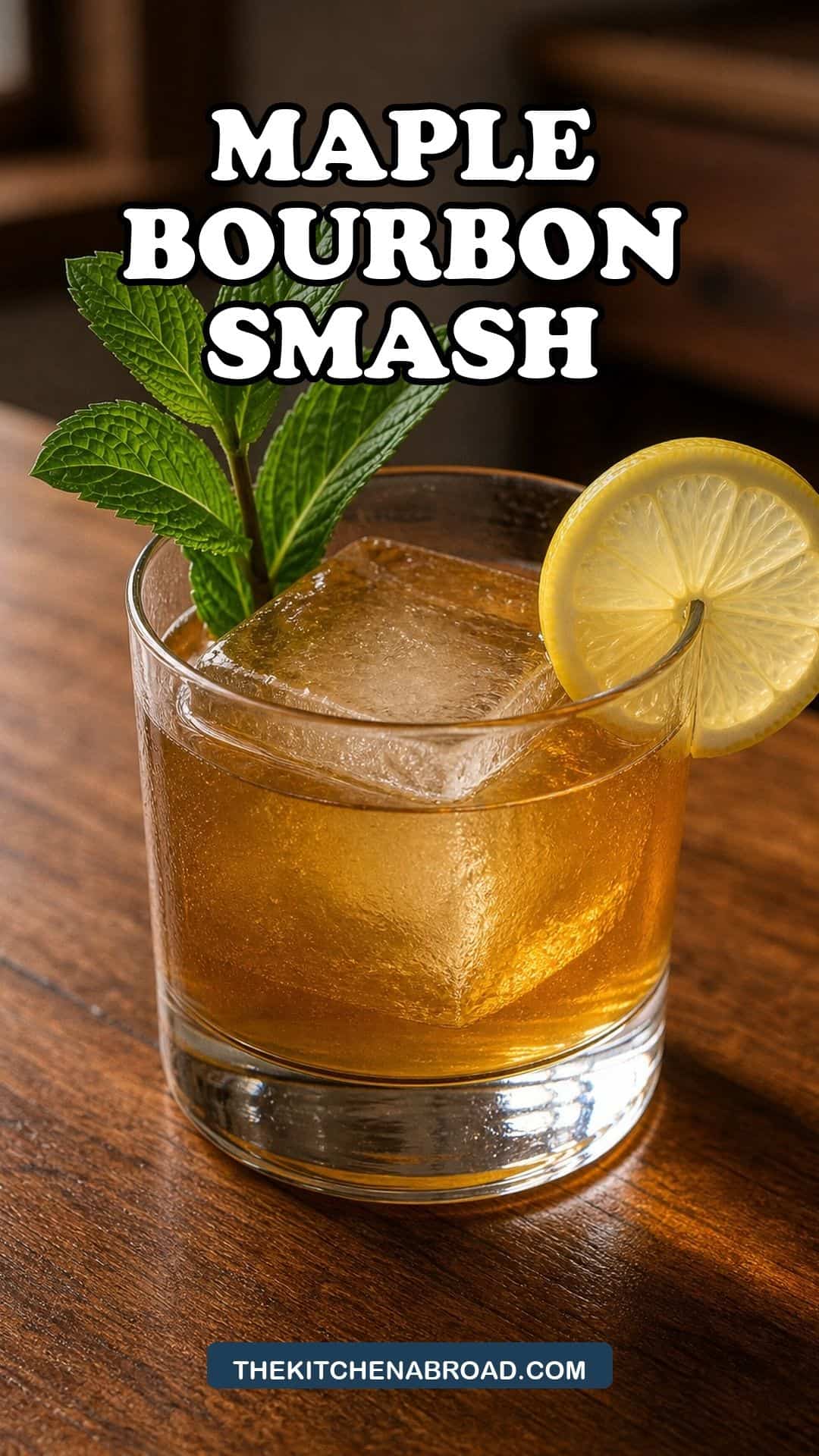
A maple bourbon smash combines 100-proof bourbon, Grade A Dark maple syrup, fresh lemon juice, and lightly pressed (not ground) mint, shaken and strained over fresh ice in a rocks glass. The maple’s molasses depth plays into the bourbon’s vanilla and caramel notes. A grade A Dark or formerly-Grade-B syrup is the right pick.
The whiskey smash first appears in Jerry Thomas’s 1862 Bartenders Guide, where it’s described as a julep with citrus, basically. The great-grandfather of every craft-cocktail-bar smash on the menu today. The maple version is a Northeastern winter riff that works because Grade A Dark maple syrup carries molasses depth that plays into bourbon’s vanilla and caramel. Use a 100-proof bourbon (Wild Turkey 101, Knob Creek), press the mint instead of grinding it, and the drink survives the ice.
Bar Setup You’ll Want
The smash needs a wooden muddler to press the mint without grinding it. A Boston shaker handles the cold integration. A jigger pours honest. A Hawthorne strainer and a fine-mesh sieve do the double-strain to keep mint bits out of the rocks glass. Use a thick-bottomed rocks glass that holds 200 to 300 ml (8 to 10 ounces) with room for a single large ice cube.


Recommended Reads
- Salted Caramel Bourbon Milkshake Recipe
- Sweet Potato Whiskey Sour Recipe
- Maple Vanilla Soda Recipe
- Ginger Pear Collins Recipe
- Christmas Dinner Ideas
Where the Whiskey Smash Came From
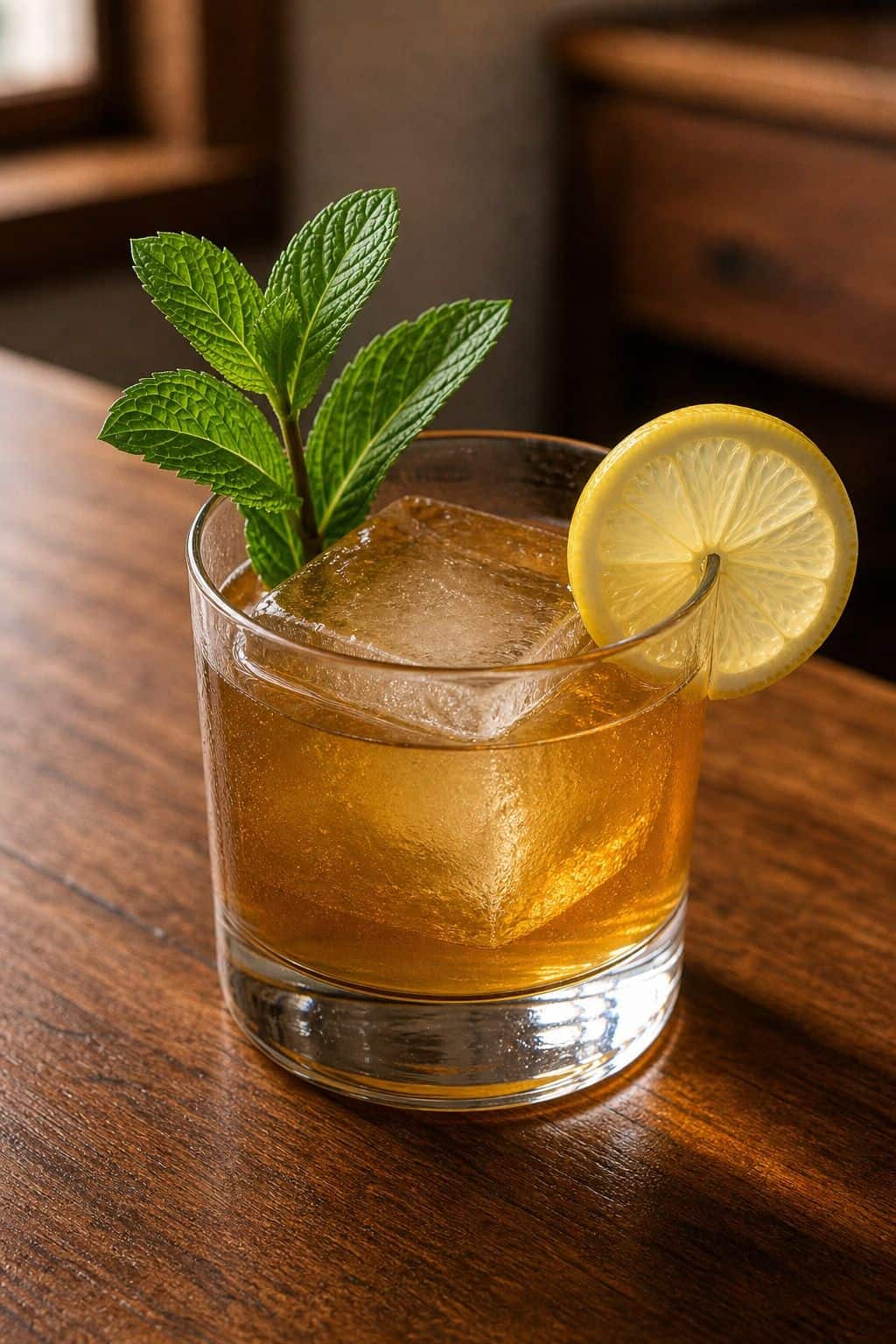
Jerry Thomas, often called the father of American bartending, published How to Mix Drinks; or, The Bon-Vivant’s Companion in 1862, the first thorough American cocktail book. Inside is a recipe for the “Whiskey Smash,” which Thomas describes as a julep with citrus added: spirit, sugar, muddled mint, ice, and a slice of lemon or orange. The smash format predates Thomas (mint juleps were established 18th-century Virginia drinks), but his book is where the smash got codified as a category of cocktail with its own template.
The maple variation is much newer. It emerged from the post-2008 craft-cocktail revival, when bartenders in the Northeast (Vermont, New Hampshire, upstate New York, Quebec) started swapping local maple syrup for the simple syrup or sugar cube that traditional smashes call for. The maple replaces the sugar entirely. The drink picks up depth and a slight smokiness from the syrup, especially the darker grades.
The most-asked question about a smash is the difference between a smash and a sour. Both use spirit, citrus, and sweetener. The smash adds muddled (pressed) herb, traditionally mint. The sour traditionally uses egg white for foam. Both fall under the broader “sour cocktail” family, with the smash being the herb-leaning cousin.
A Few Notes on the Ingredients
Bourbon proof matters more than you’d think in a cocktail. An 80-proof bourbon (Jim Beam White, Maker’s Mark) is built for sipping. It shines neat or over a single rock. In a shaken cocktail, the ice dilution drops the proof another 20 percent, and the drink reads thin. A 100-proof bourbon (Wild Turkey 101, Knob Creek, Old Grand-Dad Bonded) survives the dilution and stays bourbon-forward. For this drink, 100-proof is the move.
Maple syrup grading changed in 2015. What used to be called Grade B (the dark stuff) is now called Grade A Dark. What used to be Grade A is now divided into Grade A Golden, Grade A Amber, and Grade A Dark. For cocktails, Grade A Dark (formerly Grade B) is the right pick. It has the deepest molasses notes and stands up to bourbon’s vanilla and caramel. Grade A Amber works in a pinch. Grade A Golden is too delicate, it disappears in the drink. Skip pancake syrup entirely, which is corn syrup with maple flavoring, not maple syrup.
Fresh mint is the only option. Dried mint has no aromatic lift. Look for sprigs with bright green leaves, no brown or wilted edges. Spearmint is the bar standard. Peppermint is too aggressive (you’ll taste toothpaste). Six to eight leaves per drink, pressed (not ground) with a wooden muddler.
Fresh lemon juice, always. Bottled lemon is a sour, preservative-forward shadow of the fresh stuff. One half-lemon squeezed at the build is the move. For a fall variation, orange juice can substitute or supplement (more on that below).
Recipe: Maple Bourbon Smash
Prep time: 5 minutes | Total time: 5 minutes | Serves: 1 (scale by multiplying)
Ingredients
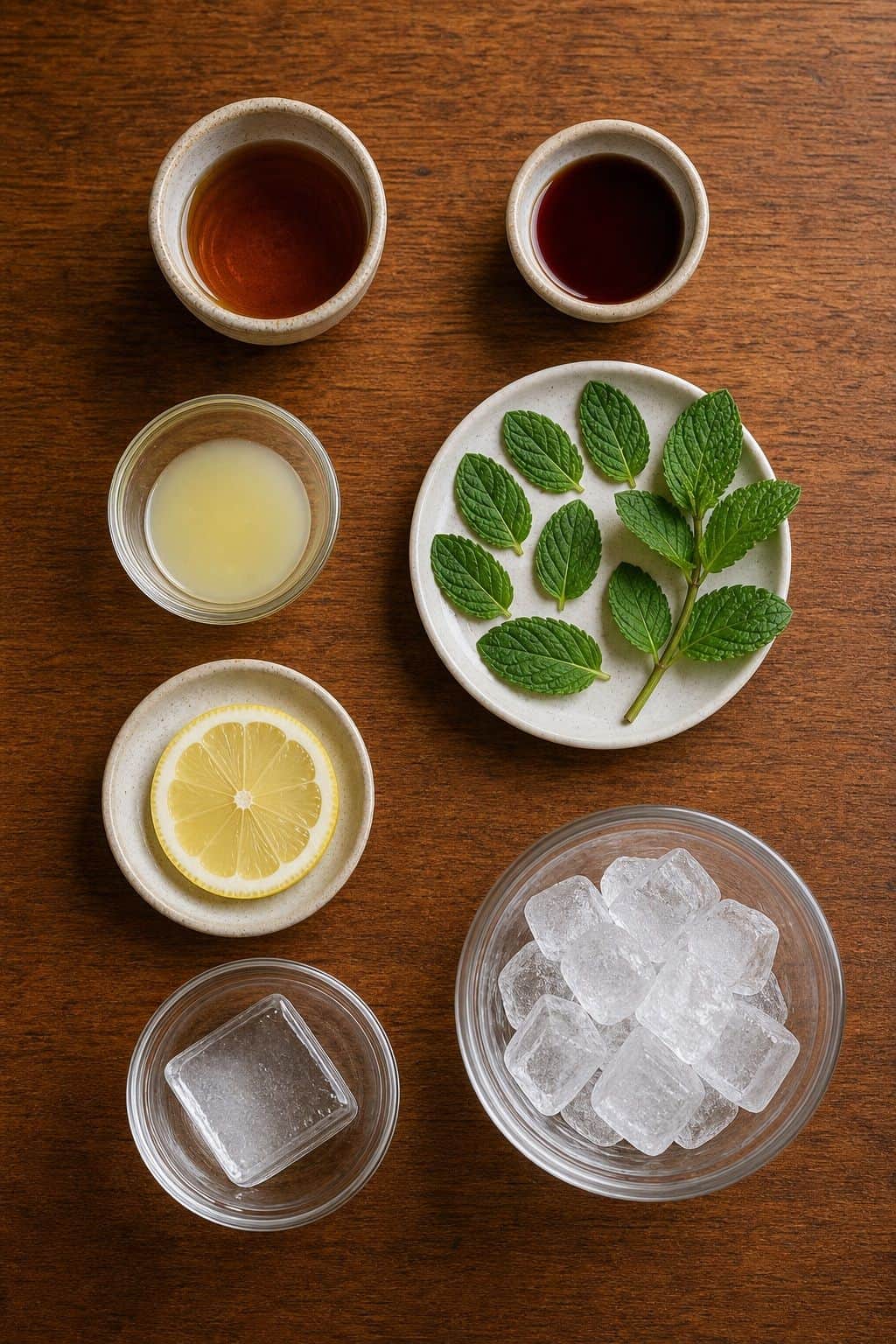
- 60 ml (2 ounces) 100-proof bourbon (Wild Turkey 101 or Knob Creek)
- 15 ml (1/2 ounce) Grade A Dark maple syrup (formerly Grade B)
- 22.5 ml (3/4 ounce) fresh lemon juice
- 6 to 8 fresh spearmint leaves, plus 1 sprig for garnish
- 1 large ice cube (about 5 cm / 2 inches) or 2 to 3 cubed ice
- 1 thin lemon wheel or orange wheel, for garnish
- Ice, for the shaker
Instructions
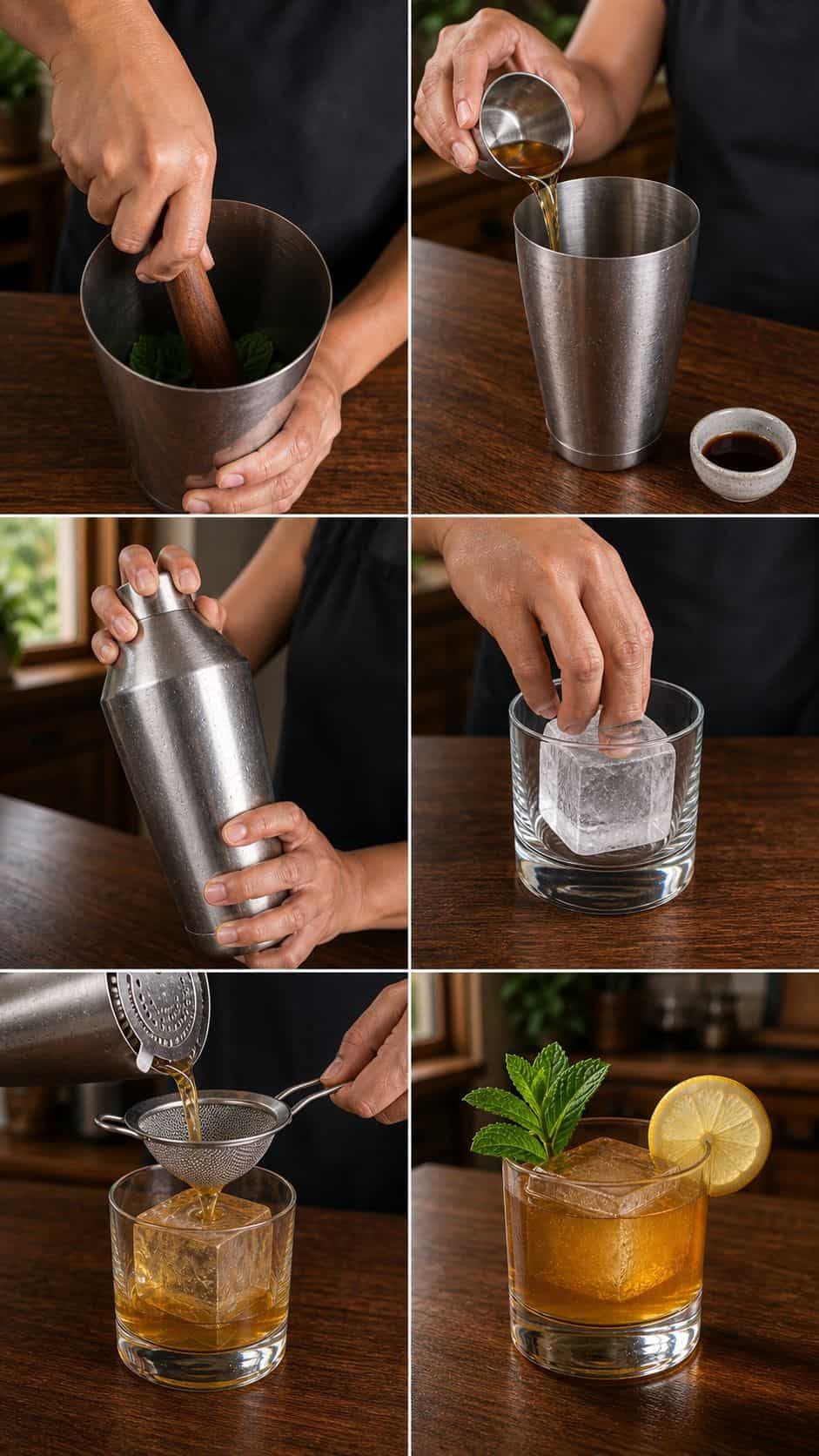
- Place the 6 to 8 mint leaves in the bottom of a Boston shaker. Press them gently with a wooden muddler 4 to 5 times. The leaves should release their oils, you’ll smell mint immediately. Don’t grind them. Grinding tears the leaves and releases chlorophyll bitterness that ruins the drink. The leaves should look bruised, not pulverized.
- Add the 60 ml (2 ounces) bourbon, 15 ml (1/2 ounce) maple syrup, and 22.5 ml (3/4 ounce) fresh lemon juice to the shaker.
- Fill the shaker about two-thirds full with ice. Seal and shake hard for 10 to 12 seconds. The shake should be aggressive, both hands gripping, the tin getting noticeably cold against your fingers.
- Place the large ice cube in the rocks glass. Open the shaker. Position a Hawthorne strainer over the ice side, hold a fine-mesh sieve above the rocks glass, and pour through both for a double strain. The double strain catches the small ice chips and the mint fragments.
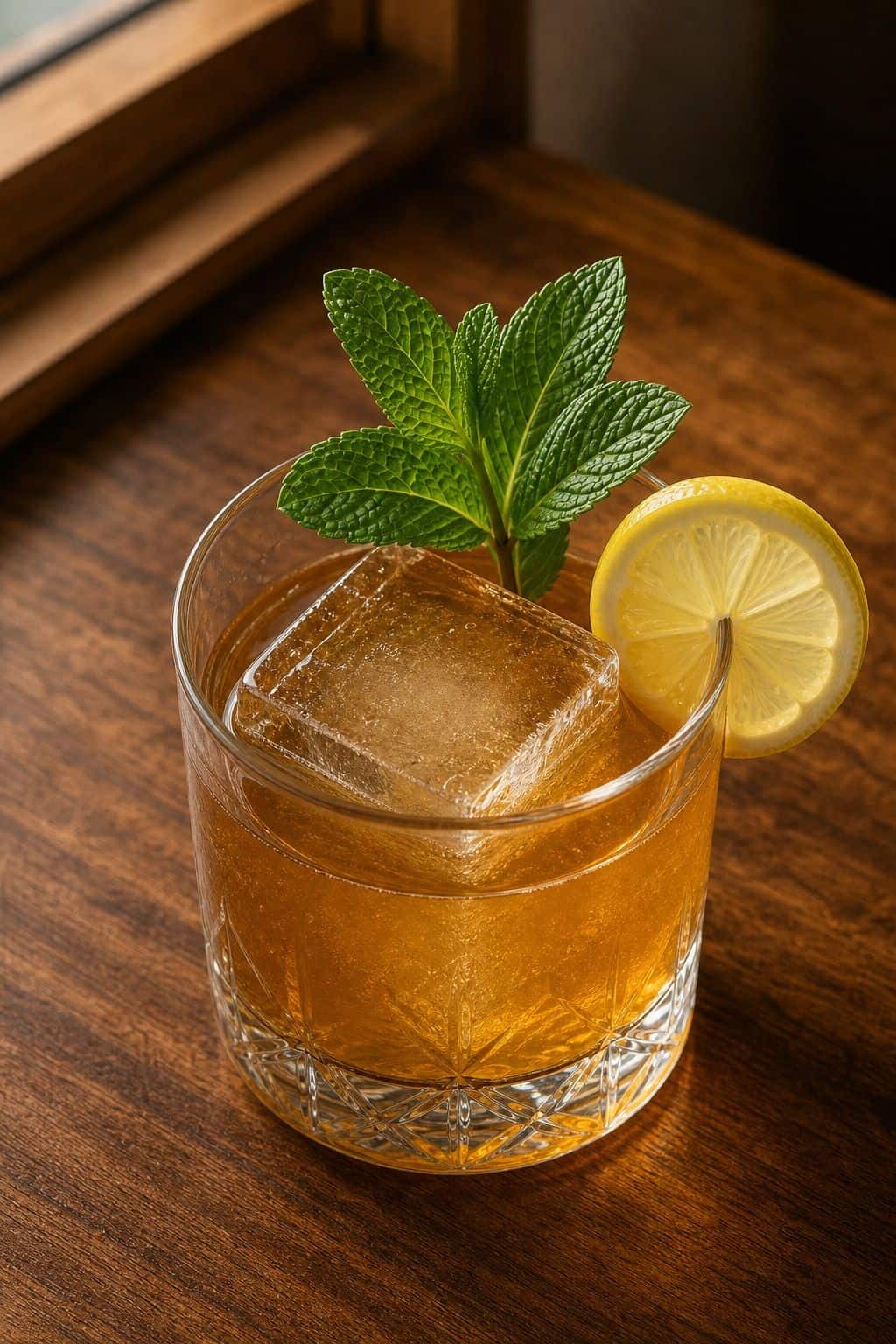
- Garnish with a fresh mint sprig (slap the sprig once between your palms to release aromatic oils) standing upright next to the ice cube. Add the lemon wheel clipped to the rim of the glass.
- Serve immediately. The first sip should land bourbon-forward with maple’s molasses depth in the middle and lemon and mint lifting the finish.
Notes
The mint press is the move. Five gentle presses with the flat base of a wooden muddler is enough. If you can taste a green grassy bitterness in the drink, you ground the mint instead of pressing it. The fix is fewer presses, not less mint.
The mint sprig slap before garnishing is the bar move that catches every nose. Lay the sprig flat in one palm, slap it gently with the other hand. The oils release. The drinker smells mint before they sip.
If you don’t have a large ice cube, use the biggest cube your freezer makes. Avoid crushed ice, which dilutes the drink in 90 seconds and turns it watery. A single big cube is the right answer.
Tips and Variations
Press the mint, don’t grind it
The single most-broken rule in a smash is the mint technique. The temptation is to muddle hard, the way you would for a mojito. Don’t. A mojito uses sugar against the mint to absorb the oils. A smash relies on the bourbon and lemon to pull the oils into the drink, which requires a gentler touch. Four to five firm presses, then stop. The mint should be bruised, not pulverized.
Orange for fall, lemon for the classic
The traditional smash uses lemon, and it’s the right call for a year-round template. For a fall variation, swap the lemon for fresh orange juice (use 30 ml / 1 ounce instead of the 22.5 ml of lemon). The orange complements maple’s caramel notes better than lemon, especially when serving with Thanksgiving or Friendsgiving snacks. Garnish with an orange wheel instead of lemon.
Use 100-proof bourbon, not 80-proof
80-proof bourbon is for neat sipping. In a shaken cocktail, the ice dilution drops the proof further, and the drink reads thin. 100-proof bourbons (Wild Turkey 101, Knob Creek, Old Grand-Dad Bonded) survive the ice and stay bourbon-forward. Higher-proof bourbons (Maker’s 46 at 94, Booker’s at 121+) also work and are worth experimenting with if you have them.
Brown-sugar swap for a milder version
If you’re out of maple syrup, brown sugar dissolved in hot water (15 g / 1 tablespoon brown sugar + 15 ml / 1 tablespoon hot water, stirred until dissolved, cooled) approximates the molasses note. The drink loses the maple’s distinctive aromatic but stays in the same flavor family. Honey is a wrong substitute. It adds floral notes that fight the bourbon.
Make-ahead and storage
The smash doesn’t batch well, the mint press is part of the build and the shake is what aerates the drink. For 4 to 6 guests, pre-measure the bourbon, maple, and lemon into a sealed jug at room temperature (no mint, no ice). At service, add 6 to 8 mint leaves per drink to the shaker, press, pour the pre-mix from the jug, add ice, shake. The jug holds 48 hours.
Glassware and When to Pour
A thick-bottomed rocks glass (Old Fashioned glass, 200 to 300 ml capacity) is the format. The wide mouth lets the mint aromatic reach the drinker. The thick base sits well in the hand. Skip tall glasses, Collins glasses, and any stemmed glass for a smash. The format is a rocks glass.
For garnish, a fresh mint sprig (slapped) standing upright and a lemon (or orange) wheel clipped to the rim is the right pair. Skip the multi-garnish version with mint, lemon, orange, a maple-syrup drizzle, and a cinnamon stick. The drink has a clean flavor profile that doesn’t need a maximalist garnish stack.
When to serve: Thanksgiving cocktail hour, Friendsgiving, autumn dinner parties, Sunday football, fireside drinks. Pair with cheese boards (sharp cheddar, blue cheese, Stilton), pecans, smoked salmon, pulled pork sliders, or pumpkin pie. October through January is peak season, but the drink works year-round.
Frequently Asked Questions
What’s the best bourbon for a smash cocktail?
A 100-proof bourbon like Wild Turkey 101 or Knob Creek. The higher proof survives the ice dilution and keeps the drink bourbon-forward. 80-proof bourbons are too soft for a shaken cocktail. Maker’s 46 (94-proof) and Booker’s (121+) also work if you have them.
What grade of maple syrup is best for cocktails?
Grade A Dark (formerly known as Grade B). It has the deepest molasses notes and stands up to bourbon’s vanilla and caramel. Grade A Amber works as a substitute. Grade A Golden is too delicate, it disappears in the drink. Pancake syrup (corn syrup with flavoring) is the wrong product.
How do you muddle mint without bruising it?
You want bruising, not pulverizing. Press the mint leaves gently with a wooden muddler 4 to 5 times. Each press should feel like a firm tap, not a grind. The leaves should look bruised but mostly intact. If you see green pulp at the bottom of the shaker, you over-muddled.
Can I use brown sugar instead of maple syrup?
Yes, as a substitute. Dissolve 15 g (1 tablespoon) brown sugar in 15 ml (1 tablespoon) hot water, cool, and use as a 1:1 maple replacement. The drink loses the maple’s distinctive aromatic but stays in the same molasses-and-bourbon family. Don’t use honey. Its floral notes fight bourbon.
What’s the difference between a smash and a sour?
Both use spirit, citrus, and sweetener. The smash adds muddled herb (usually mint), the sour traditionally uses egg white for foam. They’re cousins in the broader “sour cocktail” family. A whiskey sour with mint added (no egg white) approximates a smash.
Key Takeaways
- 100-proof bourbon (Wild Turkey 101, Knob Creek) survives the ice dilution.
- Grade A Dark maple syrup (formerly Grade B) has the molasses depth bourbon needs.
- Press the mint 4 to 5 times. Grinding releases bitter chlorophyll.
- Slap the garnish sprig before placing it. Releases aromatic oils.
- One large ice cube. Crushed ice over-dilutes in 90 seconds.
- Orange juice swap for fall, lemon for the classic year-round version.
Final Thoughts
The maple bourbon smash is the cold-weather smash. The maple anchors the drink to fall, the bourbon carries the weight, the mint lifts the room. Jerry Thomas’s 1862 template still holds 160-plus years later.
Pour it for the first cold night, after a long Sunday in the kitchen, or on the porch with the last warm sun of October. Pair with sharp cheddar, smoked almonds, or pecan pie. A single drink with a big cube holds the room for 20 minutes, which is exactly how long a smash is supposed to last.
Maple Bourbon Smash
A maple bourbon smash combines 100-proof bourbon, Grade A Dark maple syrup, fresh lemon juice, and lightly pressed (not ground) mint, shaken and strained over fresh ice in a rocks glass.
Ingredients
- 60 ml (2 ounces) 100-proof bourbon (Wild Turkey 101 or Knob Creek)
- 15 ml (1/2 ounce) Grade A Dark maple syrup (formerly Grade B)
- 22.5 ml (3/4 ounce) fresh lemon juice
- 6 to 8 fresh spearmint leaves, plus 1 sprig for garnish
- 1 large ice cube (about 5 cm / 2 inches) or 2 to 3 cubed ice
- 1 thin lemon wheel or orange wheel, for garnish
- Ice, for the shaker
Instructions
- Place the 6 to 8 mint leaves in the bottom of a Boston shaker. Press them gently with a wooden muddler 4 to 5 times. The leaves should release their oils, you'll smell mint immediately. Don't grind them.
- Add the 60 ml (2 ounces) bourbon, 15 ml (1/2 ounce) maple syrup, and 22.5 ml (3/4 ounce) fresh lemon juice to the shaker.
- Fill the shaker about two-thirds full with ice. Seal and shake hard for 10 to 12 seconds. The shake should be aggressive, both hands gripping, the tin getting noticeably cold against your fingers.
- Place the large ice cube in the rocks glass. Open the shaker. Position a Hawthorne strainer over the ice side, hold a fine-mesh sieve above the rocks glass, and pour through both for a double strain.
- Garnish with a fresh mint sprig (slap the sprig once between your palms to release aromatic oils) standing upright next to the ice cube. Add the lemon wheel clipped to the rim of the glass.
- Serve immediately. The first sip should land bourbon-forward with maple's molasses depth in the middle and lemon and mint lifting the finish.
Notes
The mint press is the move. Five gentle presses with the flat base of a wooden muddler is enough. If you can taste a green grassy bitterness in the drink, you ground the mint instead of pressing it. The fix is fewer presses, not less mint.
The mint sprig slap before garnishing is the bar move that catches every nose. Lay the sprig flat in one palm, slap it gently with the other hand. The oils release. The drinker smells mint before they sip.
Last update on 2026-10-03 / Affiliate links / Images from Amazon Product Advertising API