

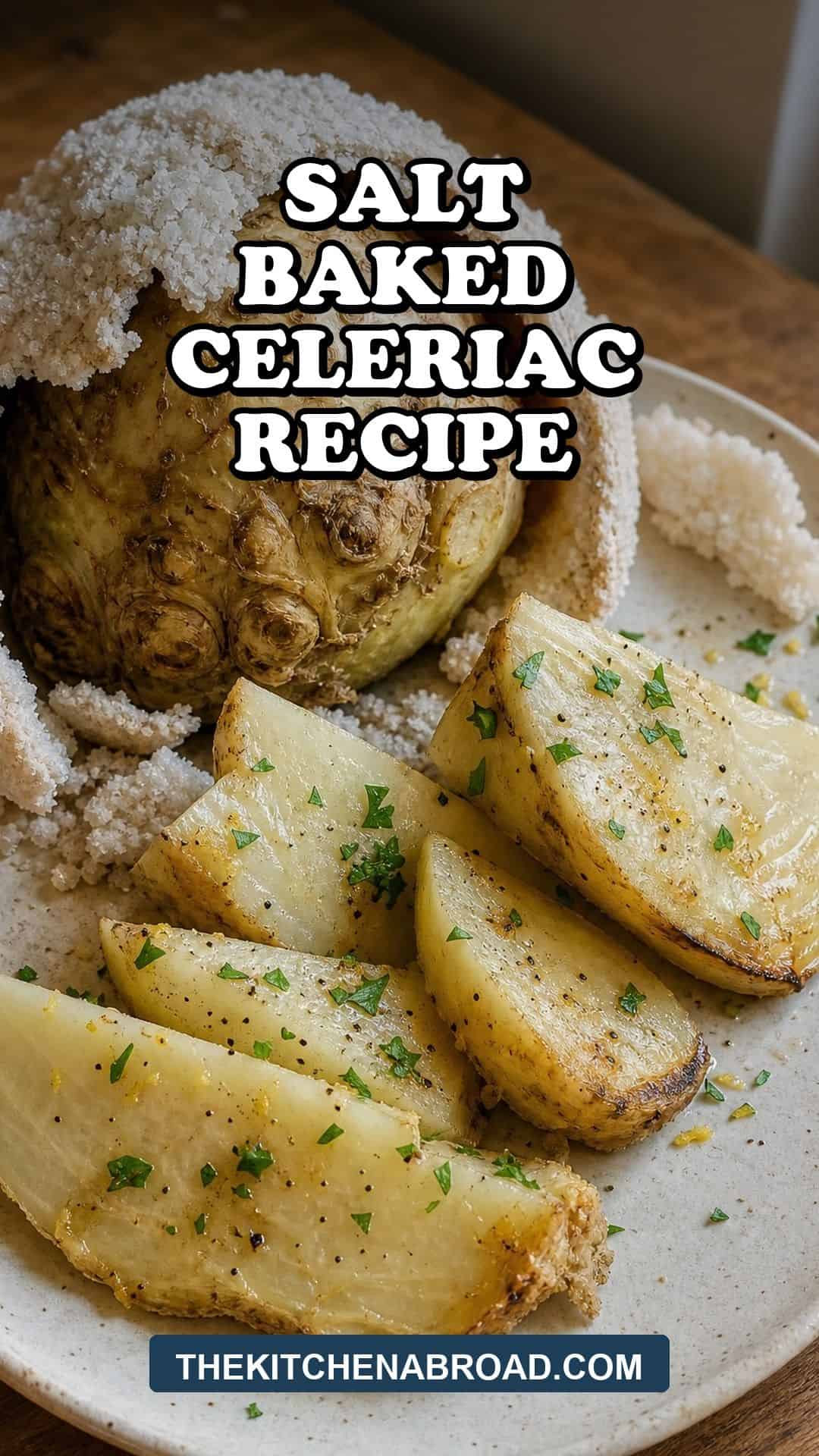
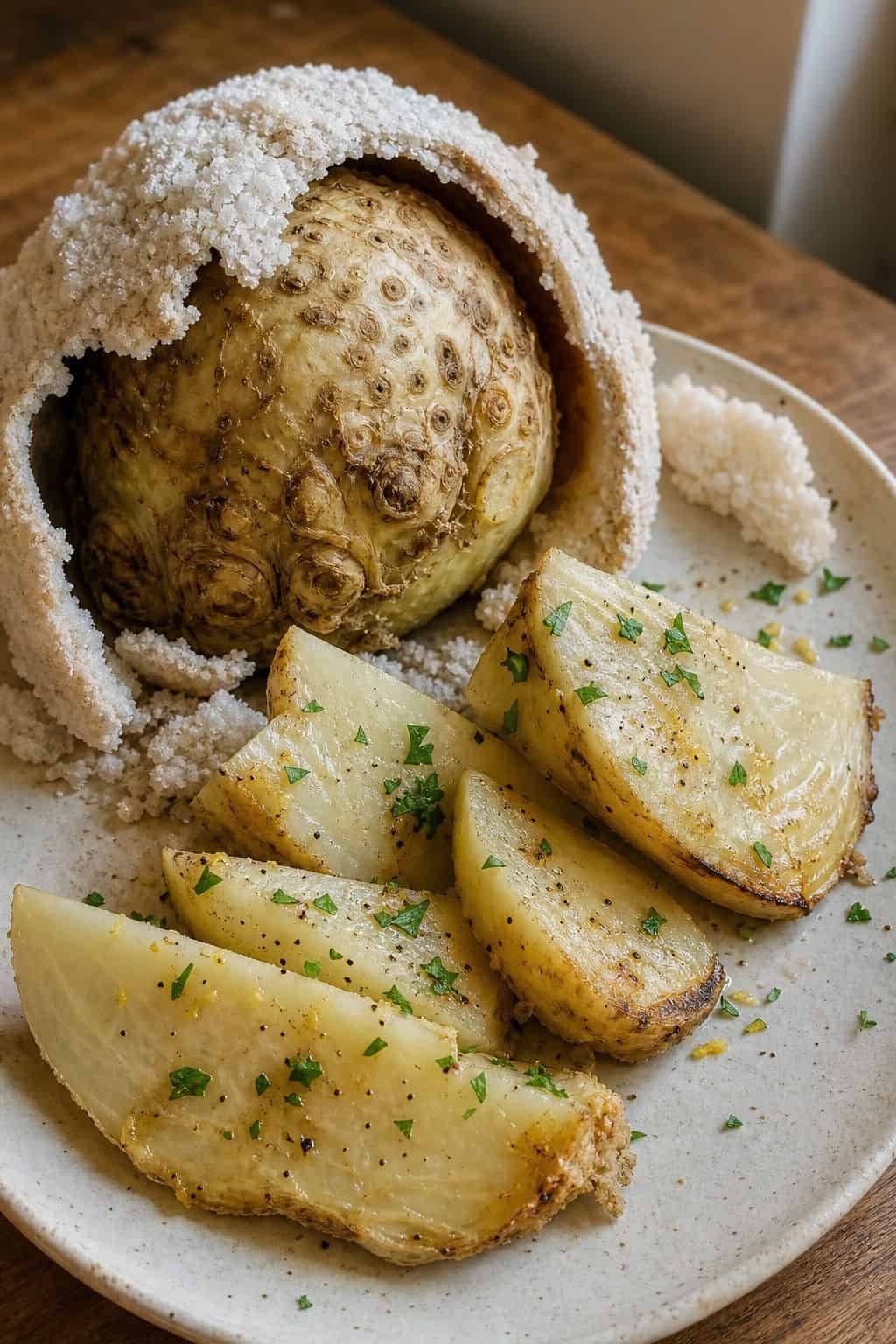
Salt-baked celeriac is cooked whole inside a coarse salt crust until the center turns tender, creamy, and deeply savory. The crust is cracked off after baking, so you eat the seasoned celeriac inside, not the salt shell.
Salt-baked celeriac is one of those recipes that looks dramatic but is quietly practical. The rough root goes into the oven wrapped in a salt crust, and the crust traps heat and steam around the vegetable while it bakes.
The result is not salty in the way people sometimes expect. You do not eat the crust. You crack it open, brush the celeriac clean, and slice into a creamy center that tastes earthy, sweet, and almost buttery.
This is a good recipe when you want celeriac to feel like the main event instead of a background vegetable. Serve it in thick wedges with browned butter, yogurt sauce, herbs, mustard dressing, or roasted mushrooms.
Recommended Baking Tools for Salt-Baked Celeriac
You do not need special equipment, but a sturdy baking tray and a mixing bowl make the salt crust easier to handle. Parchment helps with cleanup, and a skewer or thin knife is useful for checking the center without tearing the crust apart.
Use coarse salt rather than fine table salt. Coarse salt forms a better shell and is easier to brush away after baking. Fine salt packs too tightly and can make the outside taste harsher.


Why Baking Celeriac in Salt Works So Well
Celeriac is dense, uneven, and a little intimidating when raw. A salt crust solves that by creating a sealed cooking environment. The outside of the root is protected while the inside slowly softens.
The salt pulls a little moisture toward the surface, while the trapped steam cooks the center. Instead of drying out, the flesh turns tender and concentrated. The flavor becomes more rounded than plain boiled or steamed celeriac.
The crust also seasons gently. It does not work like boiling vegetables in salty water. The salt stays mostly outside, while the celeriac absorbs enough seasoning to taste finished once it is brushed clean.
Choosing and Preparing the Celeriac
Pick a celeriac that feels heavy for its size and is not hollow or spongy. A medium root is easiest because it cooks through before the crust gets too hard. Very large roots can be baked this way, but they need more time.
Scrub the outside well, especially around the root end. You can trim off hairy roots and any muddy crevices, but do not peel the whole celeriac before baking. The skin helps protect the flesh inside the salt crust.
If the top is uneven, trim just enough so the celeriac can sit flat. A stable root is easier to cover evenly with the salt mixture.
Salt-Baked Celeriac Recipe
This makes 4 side-dish servings or 2 generous main-course servings with toppings. The timing depends on the size of the root, so use tenderness as the final test.
Ingredients
- 1 medium celeriac/celery root, about 1 1/2 to 2 pounds (680 to 900 g)
- 3 cups (900 g) coarse sea salt or kosher salt
- 3 large egg whites, about 90 g
- 2 tablespoons (30 ml) water, only if needed
- 1 tablespoon (15 ml) olive oil, for serving
- 2 tablespoons (28 g) butter or vegan butter, optional, for serving
- 1 tablespoon chopped parsley, dill, or chives
- 1 teaspoon lemon juice, plus zest if you like
- Black pepper, to taste
Instructions
- Heat the oven to 400°F (200°C). Line a baking tray with parchment.
- Scrub the celeriac well and trim away hairy roots or muddy crevices. Leave most of the skin intact.
- Mix the coarse salt and egg whites in a bowl until the texture looks like wet sand. Add 1 to 2 tablespoons (15 to 30 ml) water only if the mixture feels dry and crumbly.
- Spread a thick layer of the salt mixture on the tray where the celeriac will sit.
- Place the celeriac on top and pack the remaining salt mixture around it, covering the sides and top as evenly as possible.
- Bake for 1 hour 30 minutes to 2 hours, depending on size. A skewer should slide through the center with little resistance.
- Let the celeriac rest for 10 to 15 minutes so the steam settles.
- Crack the salt crust with the back of a spoon or a small knife, then lift the celeriac out carefully.
- Brush off loose salt, slice into wedges, and serve with olive oil, browned butter, herbs, lemon juice, and black pepper.
Notes
- Do not eat the salt crust. It is only the cooking shell.
- If the crust cracks while baking, press a little extra salt mixture over the opening if you notice it early.
- Very large celeriac may need another 20 to 30 minutes in the oven.
- For dairy-free serving, skip the butter and use olive oil, lemon, herbs, and toasted nuts.
- Leftovers can be sliced and pan-seared until golden.
How to Serve Salt-Baked Celeriac
The simplest serving is warm wedges with olive oil, lemon, herbs, and black pepper. That lets the mellow celeriac flavor stay central. If you want it richer, spoon browned butter over the top and add chopped parsley or dill.
For a main dish, serve the wedges over lentils, white beans, or a garlicky yogurt sauce. Roasted mushrooms are especially good because they echo the earthy flavor of the celeriac without making the plate heavy.
Cold leftovers are useful too. Slice the cooked celeriac thinly and add it to salads with mustard vinaigrette, apples, walnuts, or bitter greens.
Troubleshooting the Salt Crust
If the crust slides off, the mixture is probably too wet or the celeriac surface was too smooth and damp. Pat the root dry before packing the crust, and aim for wet sand rather than paste.
If the crust crumbles before baking, add a spoonful of water or another egg white. The mixture should hold together when squeezed in your hand.
If the cooked celeriac tastes too salty, brush it more thoroughly and remove the outermost skin before serving. Most excess salt sits on the surface, not deep in the flesh.
Frequently Asked Questions
What does salt-baked celeriac taste like?
Salt-baked celeriac tastes earthy, nutty, gently sweet, and savory. The salt crust seasons the outside while the inside steams into a soft, spoonable center.
Do you eat the salt crust?
No. The crust is a cooking shell, not a topping. Crack it open, lift the celeriac out, and brush away any loose salt before slicing.
Can salt-baked celeriac become too salty?
It can if loose salt is left on the surface after baking. The flesh itself should taste seasoned, not aggressively salty, as long as the crust is brushed away before serving.
Do I need egg whites for the salt crust?
Egg whites help the salt pack together and harden around the celeriac. A water-based crust can work, but it is more fragile and may crack during baking.
How do I know when celeriac is done?
A skewer or thin knife should slide through the center with little resistance. For a medium celeriac, start checking after 1 hour 30 minutes.
Can I make salt-baked celeriac ahead?
Yes. Bake it, crack off the crust, cool the celeriac, and refrigerate it for up to 3 days. Reheat slices gently in a covered pan or low oven.
What should I serve with salt-baked celeriac?
Serve it with browned butter, herbs, lemony yogurt, mustard dressing, roasted mushrooms, lentils, or a simple green salad.
Key Takeaways
- Use coarse salt and egg whites to make a firm baking crust.
- Leave most of the celeriac skin on so the flesh is protected.
- Bake until a skewer slides through the center easily.
- Crack off and discard the salt crust before serving.
- Serve with lemon, herbs, browned butter, yogurt sauce, lentils, or mushrooms.
Wrapping Up
Salt-baked celeriac is a low-effort way to make one root vegetable feel generous and special. The oven does most of the work, and the salt crust gives you a tender center with a quiet, savory depth.
Once you have made it once, the method is easy to repeat with different finishes. Keep it simple with lemon and herbs, make it richer with butter, or turn it into a full meal with lentils and mushrooms.
Last update on 2026-10-05 / Affiliate links / Images from Amazon Product Advertising API