
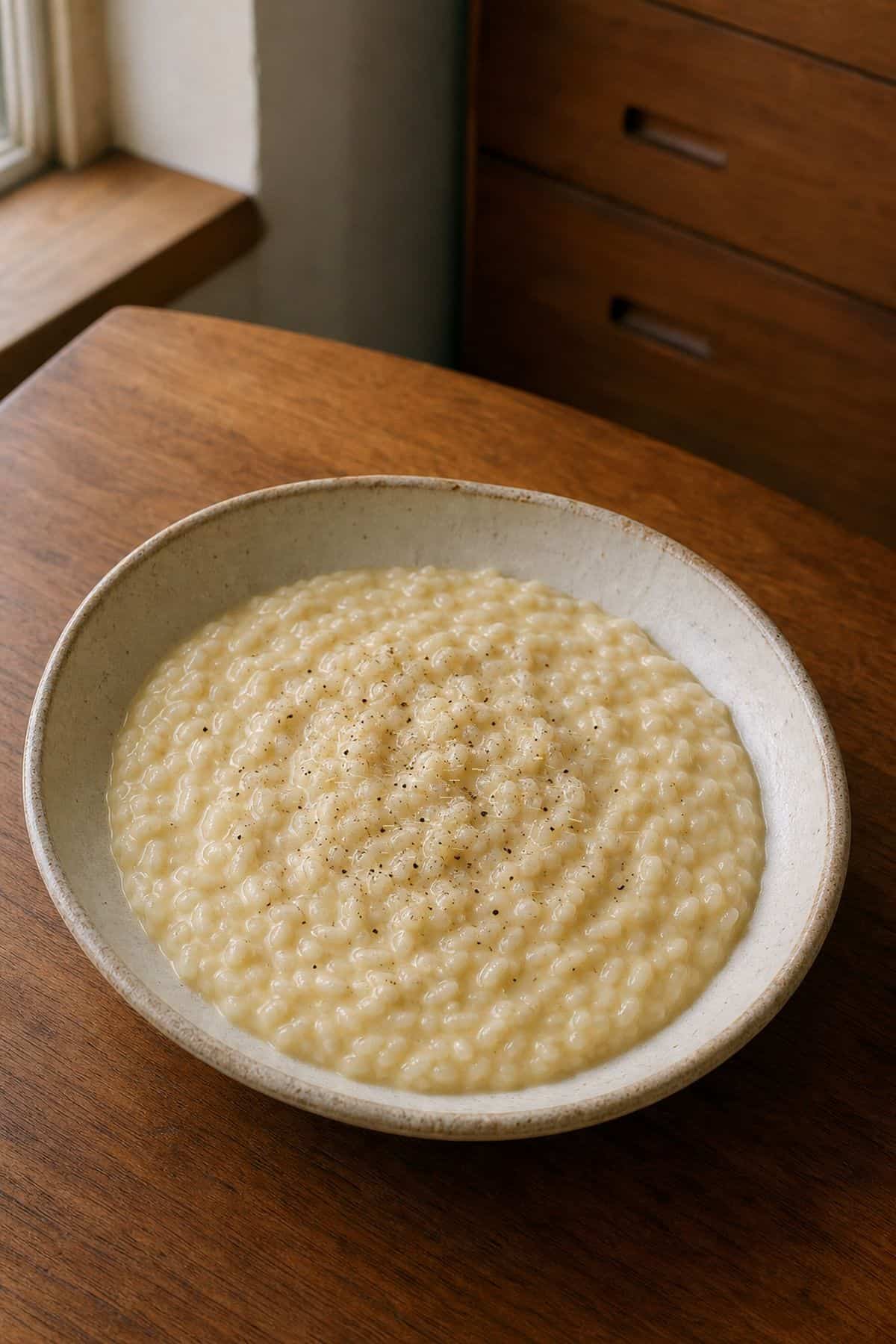
Toast unrinsed Carnaroli rice in butter, deglaze with dry white wine, then add hot stock a ladle at a time for 16 to 18 minutes, until each grain has a tiny firm core. Off the heat, beat in cold butter and Parmigiano for about a minute. The rice should flow across the plate in a slow wave, which Italians call all’onda.
Tilt the pan. If the rice slides across the bottom in a slow, glossy wave, your risotto is done right. If it sits there in a stiff mound, it isn’t, no matter how good it tastes.
That wave is what this Carnaroli risotto is built around. The rice does half the work, because Carnaroli holds its shape far longer than the Arborio most supermarkets sell. The other half is a finishing move called mantecatura, where cold butter and grated cheese get beaten into the rice off the heat. Learn those two things and plain Parmigiano risotto becomes a 30-minute weeknight dinner you can change with every season.
A wide, heavy pan matters more than any gadget. Deep pots trap steam and cook the rice unevenly, while a wide pan lets the stock reduce at the same rate across the whole surface. A long wooden spoon and a fine grater for the cheese cover the rest.


![Newness Soup Ladle, [Rustproof, Heat Resistance, Integral Forming] Resilient 304...](https://www.thekitchenabroad.com/wp-content/plugins/aawp/public/image.php?url=YUhSMGNITTZMeTl0TG0xbFpHbGhMV0Z0WVhwdmJpNWpiMjB2YVcxaFoyVnpMMGt2TXpFMlYxVjZSRk5hYlV3dVgxTk1NVFl3WHk1cWNHYz18MTc5MTIwNDQzOQ= "Carnaroli Risotto Recipe the Way Italian Kitchens Make It")

Carnaroli or Arborio: which rice is better for risotto?
Carnaroli, if you can find it. Both are short, plump Italian rices grown in the Po Valley, mainly in Piedmont and Lombardy, but Carnaroli has more amylose, the type of starch that keeps a grain firm while it cooks. The outside still sheds enough starch to thicken the stock, so you get a creamy pot with distinct grains suspended in it.
Arborio breaks down faster. Leave it a minute or two too long, or let the simmer run hot, and the grains slump into something closer to porridge. Carnaroli gives you a wider margin, which is why Italians nickname it the king of risotto rice and why I’d pay the extra euro or two for it every time.
There’s a third option worth knowing about. Vialone Nano, a smaller grain popular in the Veneto, soaks up liquid quickly and is the usual pick for looser seafood risottos.
Whichever you buy, don’t rinse it. The loose starch on the surface of the grains is what turns the stock creamy.
Do you have to stir risotto constantly?
No. Stir often, not nonstop. Constant beating knocks extra starch loose and cools the pan every time the spoon goes round, so the rice cooks slower and turns gluey at the edges.
What does matter is temperature. The stock sits in its own pot at a quiet simmer right next to the rice, and it goes in hot, one ladle at a time. Cold stock stops the cooking dead and the grains seize. Each time a spoon drawn across the bottom of the pan leaves a dry trail for a second, add the next ladle.
Toasting the rice before any liquid goes in is the other step people skip. Two or three minutes in the butter and oil, stirring, until the grains click against the pan and their edges turn translucent while the centers stay white. That thin seal helps the grains release starch slowly instead of all at once.
What is mantecatura, and why does it make risotto creamy?
Mantecatura is the finish. The pan comes off the heat, cold cubed butter and finely grated Parmigiano go in, and you beat hard with a wooden spoon for 60 to 90 seconds. The cold fat emulsifies with the hot, starchy liquid, and the texture goes from rough and porridge-stiff to glossy and loose.
Two mistakes ruin it. Doing it over the flame makes the butter split and turn greasy. Waiting too long before plating lets the rice keep cooking and tighten up. In restaurant kitchens risotto is often pulled a minute before it’s fully done for exactly this reason, because the grains keep softening in their own heat while you beat and plate.
If the rice looks tight when it comes off the heat, loosen it with a splash of stock before the butter goes in. It should look almost too wet. It’ll settle.
Buy real Parmigiano Reggiano for this, ideally aged around 24 months, and grate it yourself. The Parmigiano Reggiano Consortium explains the aging stages if you want to know what you’re paying for. Grana Padano is the cheaper everyday stand-in. Pre-grated supermarket parmesan won’t melt smoothly into the rice.
Carnaroli risotto recipe
- Active time: 25 to 30 minutes once the stock is hot
- Servings: 4 (80 g of rice per person, the standard Italian primo portion)
Ingredients
- 320 g (about 1 1/2 cups) Carnaroli rice, not rinsed
- 1.2 to 1.5 liters (5 to 6 cups) chicken or vegetable stock, kept hot in a separate pan
- 120 ml (1/2 cup) dry white wine, such as Soave, Pinot Grigio or Vermentino
- 1 small yellow onion or shallot, finely diced
- 80 g (5 1/2 tablespoons) unsalted butter: 30 g for toasting, 50 g cold and cubed for finishing
- 1 tablespoon olive oil
- 60 g (about 3/4 cup, grated) Parmigiano Reggiano, 24-month aged if possible
- Sea salt, a light hand
- Freshly cracked black pepper, at the table
Instructions
- Bring the stock to a quiet simmer in a small saucepan over low heat and keep it there, next to the risotto pan, for the whole cook.
- Melt 30 g (2 tablespoons) butter with the 1 tablespoon olive oil in a wide, heavy-bottomed pan over medium heat. Add the onion or shallot and cook gently for 3 to 4 minutes, stirring now and then, until soft and translucent but not browned.
- Add the 320 g Carnaroli rice and stir to coat every grain in fat. Toast for 2 to 3 minutes, stirring constantly, until the grains click against the pan, the edges look translucent and the kitchen smells faintly toasty.
- Pour in the 120 ml (1/2 cup) wine. It will hiss and steam. Stir until it has evaporated and the bottom of the pan stays nearly dry when you drag a spoon through, about 2 minutes.
- Add the first ladle of hot stock, about 150 ml (2/3 cup), and keep the pan at a low, steady simmer. When a spoon drawn across the bottom leaves a dry trail for a moment, add the next ladle. Stir often but not constantly. This takes 16 to 18 minutes from the first ladle.
- Bite a grain at the 14-minute mark. You want a tender outside with a tiny white, barely firm dot in the center. If it’s chalky, give it another minute and a small splash of stock. When the center is just right, stop adding stock.
- Take the pan off the heat. The rice should look loose; if it has tightened, stir in a splash more stock. Add the 50 g (3 1/2 tablespoons) cold cubed butter and the 60 g grated Parmigiano and beat vigorously with a wooden spoon for 60 to 90 seconds, until creamy and unified.
- Cover and rest for 1 minute. Season with a little salt if it needs it. Spoon onto warm shallow plates and tap the edge of each plate twice. The rice should spread into a low, even layer. Crack black pepper over at the table.
Notes
If your risotto turns gummy, it’s almost always one of three things: rinsed rice, a simmer that ran too hard, or butter added back over the flame. Keep the heat gentle and the finish off the burner.
Ways to change it with the season
Once the plain version works, the same method carries almost anything. Add flavorings at the stage that suits them and keep the rice, wine and stock ratios exactly as they are.
Mushroom risotto for autumn
Sauté 250 g (about 9 oz) of mixed mushrooms in olive oil until golden and set them aside before you start the onion. Fold them back in halfway through the stock. Brown them hard, past the point where they release their water, or they’ll taste boiled.
Risotto alla milanese for winter
Steep a generous pinch of saffron threads in a small ladle of hot stock for 10 minutes and add it with the first regular ladle. For the full Milanese version, melt a tablespoon of beef bone marrow in the pan before the onion. The rice turns deep yellow and the flavor gets rounder and warmer.
Peas and asparagus for spring
Fold in a cup of shelled peas, blanched asparagus tips and a handful of pea shoots for the last 2 minutes. Finish with lemon zest and a drizzle of good olive oil, and cut the Parmigiano back if you want it lighter.
What should you serve with Carnaroli risotto?
In Italy, risotto is a primo, a course of its own like pasta, eaten from a shallow plate before the main. Serve it that way and all it needs is a glass of the same wine you cooked with.
Outside Italy it usually ends up under or beside a protein, and that works too. A piece of white fish in a soft sauce is the easiest pairing; this cod in parsley sauce cooks in about the time the rice does. Roast chicken, braised short ribs and seared scallops all sit well next to it too.
Something sharp and green on the side keeps the butter in check. A handful of bitter leaves dressed in a sherry vinaigrette does the job in five minutes.
For wine, stay dry and Italian. Soave from the Veneto is the classic pick, with enough body for the cheese and enough acid for the butter. Pinot Grigio from Friuli or a Sardinian Vermentino work as well. Skip heavily oaked whites, which clash with the Parmigiano.
Risotto also earns its place at a dinner party, as long as you’re happy to spend 20 minutes at the stove while guests hover with a drink. It fits neatly into a Valentine’s Day dinner for two, where the stirring is half the fun.
Carnaroli risotto FAQ
What is the difference between Carnaroli and Arborio rice?
Carnaroli has a higher amylose content, so its grains stay firm and separate through a long cook. Arborio softens faster and turns gummy more easily. Both make risotto, but Carnaroli is more forgiving with timing.
Should you rinse Carnaroli rice before making risotto?
No, never rinse risotto rice. The starch on the surface of the grains is what thickens the stock and makes the risotto creamy, and washing it away leaves you with thin, watery rice.
How long does Carnaroli risotto take to cook?
About 16 to 18 minutes from the first ladle of stock. Add a few minutes for softening the onion, toasting the rice and reducing the wine, and the whole thing takes roughly 25 to 30 minutes once the stock is hot.
Can I make risotto with water instead of stock?
Yes, though it will taste cleaner and less savory. Italian home cooks sometimes do it for a lighter dish. A half-stock, half-water mix is a good middle ground if your stock is strong or salty.
Why is my risotto gummy?
Gummy risotto usually comes from rinsed rice, a simmer that ran too hard, or skipping the off-heat finish. Keep the heat low and steady, never let it boil hard, and beat in the cold butter and cheese away from the flame.
Key takeaways
- Use Carnaroli for a firmer, more forgiving risotto than Arborio, and never rinse it.
- Toast the rice until the grains click and their edges turn translucent.
- Keep the stock hot and add it one ladle at a time, stirring often.
- Stop cooking when each grain has a tiny firm core, around 16 to 18 minutes.
- Finish off the heat with cold butter and Parmigiano, beaten hard for 60 to 90 seconds.
Make the plain version twice before you improvise
The first time, watch the clock. The second time, watch the rice: the dry trail behind the spoon, the color of the grain edges, how loose the pan looks when you pull it off the heat. By the third batch you’ll do it by eye. Then pick a season, start with mushrooms or saffron, and plan the rest of the plate around it.
Carnaroli Risotto
Carnaroli risotto is the classic northern Italian version made with Carnaroli rice, dry white wine, hot stock, and a finish of cold butter and parmesan beaten in off the heat.
Ingredients
- 320 g (about 1 1/2 cups) Carnaroli rice
- 1.2 to 1.5 liters (5 to 6 cups) chicken or vegetable stock, warm and ready in a separate pan
- 120 ml (1/2 cup) dry white wine
- 1 small yellow onion or shallot, finely diced
- 80 g (5 1/2 tablespoons) unsalted butter, split between the toasting step and the finishing mantecatura
- 1 tablespoon olive oil, alongside the toasting butter to raise the smoke point
- 60 g (about 3/4 cup, grated) Parmigiano Reggiano, 24-month aged if possible
- Sea salt, light hand
- Freshly cracked black pepper, at the table, not during the cook
Instructions
- Warm about 1 liter (4 cups) of stock in a small saucepan over low heat and keep it at a quiet simmer next to the risotto pan throughout the cook. The stock should never go in cold.
- Melt 30 g (2 tablespoons) of butter with a splash of olive oil in a wide heavy-bottomed pan over medium heat. Add the finely diced onion or shallot and cook gently for about 3 to 4 minutes, stirring now and then, until softened and translucent but not browned.
- Add 300 g (about 1 1/2 cups) of dry Carnaroli rice and stir to coat each grain in the fat. This is the tostatura, the toasting step, and it is non-negotiable.
- Pour in 120 ml (1/2 cup) of dry white wine. The pan will hiss and the alcohol will lift away in a cloud of steam. Stir steadily until the wine has fully evaporated and the bottom of the pan stays nearly dry when you draw a spoon through, about 2 minutes.
- Add the first ladle of hot stock, about 150 ml (2/3 cup). Stir to settle the rice into the liquid and let it cook at a low, steady simmer.
- Taste a grain at the 14-minute mark. Carnaroli al dente has a barely-firm core, a tiny white dot at the center, and a tender outer body. If you bite a grain and it feels chalky, give it another minute and another small splash of stock.
- Pull the pan off the heat. The risotto should look loose, not stiff; if it tightened up, add another splash of stock and stir it through. Drop in 50 g (3 1/2 tablespoons) of cold cubed butter and 60 g (2/3 cup) of finely grated Parmigiano.
- Rest the pan, covered, for 1 minute. Spoon the risotto onto warm shallow plates. Tap the edge of each plate twice to spread the rice; it should settle in a low, flat layer rather than a mound.
Last update on 2026-10-03 / Affiliate links / Images from Amazon Product Advertising API