
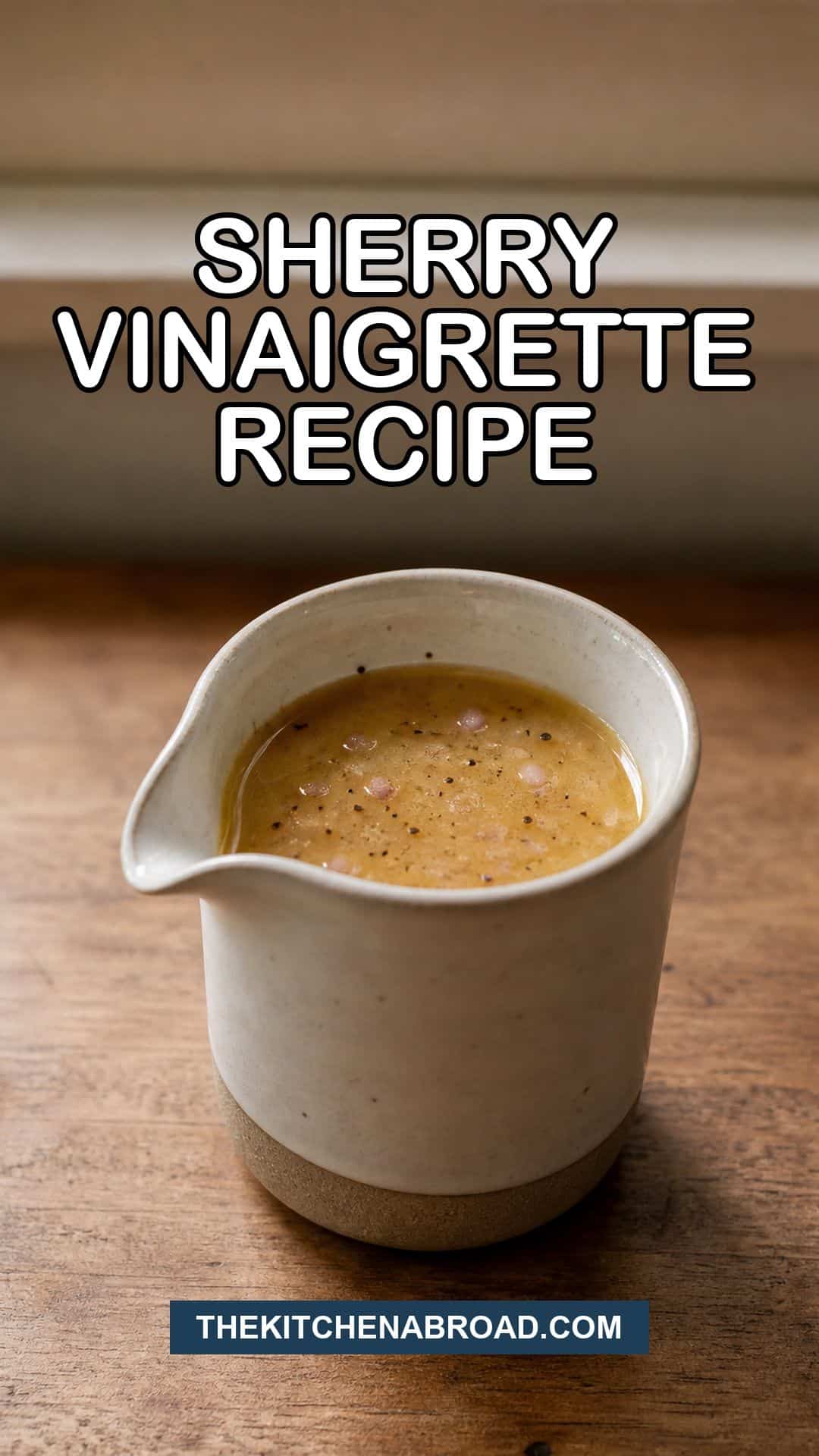
A classic sherry vinaigrette is a 1:3 emulsion of Vinagre de Jerez and good olive oil, built around a teaspoon of Dijon, a minced shallot, and a pinch of salt. Macerate the shallot in the vinegar for five to ten minutes first, then whisk in the mustard, then stream the oil in slowly until the dressing thickens and coats the whisk. Good on frisée with lardons, butter lettuce, roasted beets with goat cheese, and anywhere a salad wants a nutty, caramel-edged acidity.
Spanish sherry vinegar is aged in American oak barrels using the same solera system the bodegas built for sherry wine, with a Reserva sitting at least two years and a Gran Reserva at least ten. That barrel time is where the nutty, caramel-edged profile comes from, and it’s why a sherry vinaigrette tastes nothing like the red-wine version most American salads default to. The dressing below leans into that difference instead of muting it.
What You’ll Want on Hand
A small whisk, a clean mason jar with a tight lid, a microplane for the shallot if you prefer it grated over minced, a small pitcher or cruet for serving, and a fine mesh strainer if you want to filter out the shallot before bottling. None of this is fancy, but the whisk and the jar are the two pieces of gear the dressing actually depends on.


Recommended Reads
Why Sherry Vinegar Matters
Vinagre de Jerez is a protected designation of origin (PDO) vinegar, meaning the European Union has drawn a legal box around the production: it must be made from sherry wine, aged in American oak casks within the Jerez triangle (the Andalusian towns of Jerez de la Frontera, El Puerto de Santa María, and Sanlúcar de Barrameda), and follow specific aging rules. The legal box exists because the producers fought to protect a centuries-old practice that fundamentally different vinegars cannot copy.
The aging happens in a solera, which is a stacked system of barrels where the oldest vinegar lives on the bottom row (called the solera, from the Spanish for floor) and newer vintages sit above in tiers called criaderas. Every time the producer draws from the bottom row to bottle, that volume is replaced from the row above, and that row from the one above it, all the way up. The vinegar in any given bottle is a blend of dozens of years, with the average age guaranteed by the PDO.
The PDO recognizes three grades. Vinagre de Jerez sits at the entry tier, with a minimum of six months in barrel. Vinagre de Jerez Reserva requires at least two years and is the sweet spot for most cooking, with the nutty, faintly caramel note you want in a vinaigrette. Vinagre de Jerez Gran Reserva requires ten years minimum and runs darker, denser, and more concentrated; it’s good for finishing a dish, less practical for a dressing batch. The label tells you which one you’re buying, and it matters more than the brand name.
Recipe: Sherry Vinaigrette
Ingredients
- 30 ml (2 tablespoons) Vinagre de Jerez Reserva. Look for the PDO seal on the label. If you can’t find Reserva, the standard Vinagre de Jerez (six-month) still works; it’s just less complex.
- 90 ml (6 tablespoons) extra-virgin olive oil, Spanish if you want to keep the geography consistent. A Picual or Hojiblanca has the right grassy weight; arbequina is gentler if you prefer the vinegar in front.
- 1 teaspoon Dijon mustard. The emulsifier. Smooth Dijon, not whole-grain. Maille and Edmond Fallot are the reliable supermarket options.
- 1 small shallot, about 2 tablespoons, finely minced or microplaned. Macerates in the vinegar to soften the raw bite.
- 1/4 teaspoon fine sea salt, plus more to taste. Maldon for finishing if you have it; for the dressing itself, fine salt dissolves cleanly.
- A few grinds of freshly cracked black pepper, adjust at the end.
- 1/4 teaspoon honey, optional. A small touch rounds the acidity if the vinegar runs sharp. Many classic versions skip it entirely.
Instructions
- Put the minced shallot into a small bowl or directly into the mason jar and pour the sherry vinegar over it. Add the salt. Let the shallot sit in the vinegar for five to ten minutes. The acid pulls the sulfur compounds out of the raw shallot and softens the bite so it folds into the dressing instead of sitting on top of it. Skip this step and the finished vinaigrette will taste sharper and rawer for the first day.
- Whisk in the Dijon mustard until the mixture looks uniform and slightly cloudy. The mustard does two jobs here. It carries flavor, and it functions as the emulsifier that keeps the oil and vinegar bound together for days instead of separating in an hour. A vinaigrette without mustard breaks fast, even when it’s made carefully; the lecithin and mucilage in the mustard are what hold the suspension.
- Start the oil in a thin, steady stream while whisking constantly. Pour with one hand, whisk with the other. The first few drops should disappear into the vinegar before the next ones go in, which is how the emulsion builds. Picking up speed too early is the most common mistake, and it leaves you with a broken dressing that needs to be restarted.
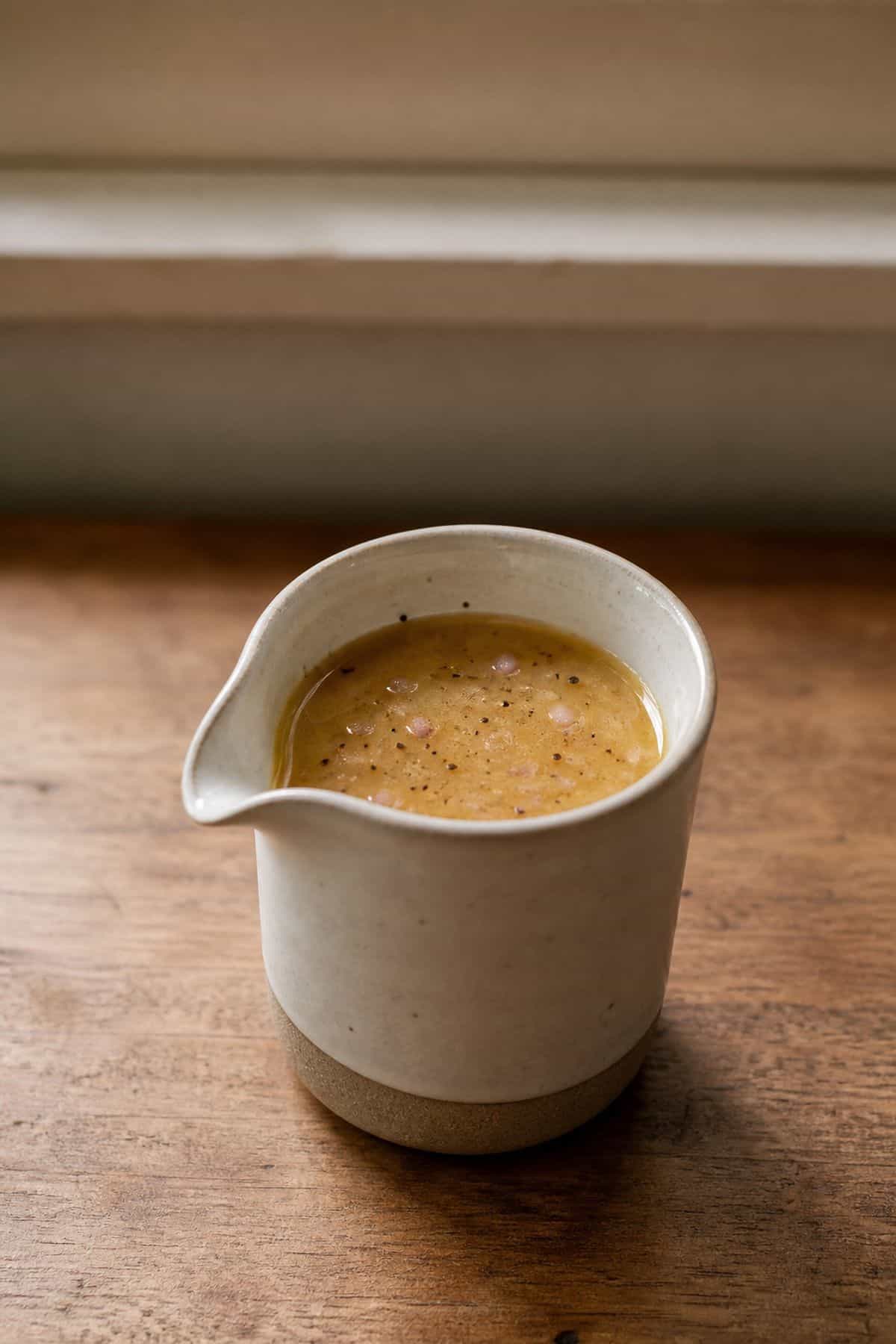
- Keep streaming and whisking until all the oil is in and the dressing thickens to a uniform, pourable body that coats the wires of the whisk when you lift it. The texture should look like a thinned mayonnaise, smooth and pourable, not separated into layers. Add the cracked pepper and the honey if you’re using it, and taste. If the acid is too sharp, another quarter teaspoon of honey or a teaspoon more oil rounds it out. If it tastes flat, a pinch more salt.
- The vinaigrette is ready to use right away. If you want to bottle it, transfer to the mason jar, seal the lid, and shake before each pour to re-emulsify (the mustard holds it well, but a brief separation can happen on the second or third day).
Tips and Variations
The Shallot-Free Version
Some classic French versions skip the shallot entirely and lean on a small garlic clove rubbed against the salt on a cutting board until it dissolves into a paste. Stir that paste into the vinegar in place of the shallot and proceed with the recipe. The result is sharper and more savory, less sweet, and reads more clearly Provençal than Andalusian. Good with hardier greens like escarole or radicchio.
Adding Fresh Herbs
A teaspoon of finely chopped thyme leaves added with the pepper gives the vinaigrette a low, woody background that pairs especially well with roasted beets and goat cheese. Tarragon (a half teaspoon, finely minced) pushes it in a different direction, anise-leaning and slightly grassy, which works on butter lettuce and chicken salads. Add herbs at the end so they keep their color; whisking them in early dulls them.
Honey or No Honey
The classic Spanish version skips honey. Sherry vinegar of any decent age already has a faint caramel sweetness from the wood, and the Reserva grade often has enough body to balance the acid on its own. If your bottle is younger or sharper, a quarter teaspoon of honey takes the edge off without making the dressing sweet. Taste the vinegar straight from the bottle first; that tells you whether the dressing needs the honey or not.
Swapping in Walnut Oil
Replace one tablespoon of the olive oil (so 5 tablespoons olive, 1 tablespoon walnut) for a nuttier, richer dressing that doubles down on the sherry vinegar’s barrel notes. Toasted walnut oil is best; the untoasted version is flatter. This variation is the move for any salad with cheese, especially manchego or aged goat, and for anything with toasted nuts in it. Don’t go beyond one tablespoon of walnut oil or it overtakes the other flavors.
What to Use It On
Sherry vinaigrette is the dressing for frisée with lardons and a poached egg, the bistro salad it was practically invented for. It goes over butter lettuce wedges with shaved radish, roasted beet salads with goat cheese and toasted walnuts, manchego with marcona almonds on a winter board, and jamón draped over chilled cantaloupe or melon. It dresses a white bean salad with parsley and red onion as well as anything, brightens grilled mushrooms or asparagus, and works as the binding acidity on a warm air fryer chickpea salad with arugula. Drizzle it over a cantaloupe salad when you want a more savory finish, or use it as the dressing on a buffalo mozzarella salad in place of straight olive oil and lemon. A thin drizzle also brightens a celeriac steak at the table in place of a heavier sauce.
Frequently Asked Questions
What is sherry vinegar?
Sherry vinegar (Vinagre de Jerez) is a Spanish PDO vinegar made from sherry wine and aged in American oak barrels in the Jerez triangle of Andalusia. The aging happens in a solera, a stacked-barrel system that blends vintages across years. The result is a nutty, caramel-edged vinegar that runs deeper and more complex than red-wine vinegar.
What can I substitute for sherry vinegar?
The closest substitute is a good red-wine vinegar with a quarter teaspoon of dry sherry stirred in per tablespoon, which approximates the wood-aged sweetness. Champagne vinegar is brighter and lighter and works in a pinch, though it lacks the depth. Balsamic is too sweet and too thick; it will throw the ratio off.
What’s the ratio for a classic vinaigrette?
The standard French ratio is 1:3 vinegar to oil, plus mustard, salt, and aromatics. The recipe above follows that ratio (2 tablespoons sherry vinegar to 6 tablespoons olive oil). For a sharper, more vinegar-forward dressing, push to 1:2; for a softer one, go to 1:4. Anything outside that range starts to read as either flat or harsh.
How long does sherry vinaigrette last in the fridge?
About two weeks in a sealed glass jar, sometimes longer. The Dijon mustard keeps the emulsion stable; a quick shake before pouring will pull it back together if it separates. The olive oil can solidify a little when cold, so pull the jar out about ten minutes before serving and shake again.
What does sherry vinaigrette go with?
Frisée with lardons and a poached egg, butter lettuce, roasted beet and goat cheese salads, manchego and almond plates, jamón and melon, white bean salads, warm chickpea salads, and grilled mushrooms or asparagus. It works on any salad where you’d otherwise reach for red-wine vinaigrette, with more depth and a softer acidity.
Is sherry vinaigrette the same as red wine vinaigrette?
No. Red-wine vinegar is sharper, fruitier, and less wood-aged. Sherry vinegar runs nuttier, deeper, and more caramelized because of the years it spends in oak. A sherry vinaigrette will read as a more layered dressing on the same salad, with less of the bracing acidity that defines a red-wine version.
Key Takeaways
- The 1:3 ratio of sherry vinegar to olive oil is the classic French vinaigrette structure, with Dijon mustard as the emulsifier.
- Look for Vinagre de Jerez Reserva on the label (minimum two years in barrel) for the nutty caramel note that defines the dressing.
- Macerate the minced shallot in the vinegar for five to ten minutes before adding the oil. It softens the raw bite.
- Stream the oil in slowly while whisking. Pouring too fast breaks the emulsion.
- Keeps about two weeks in a sealed glass jar in the fridge. Shake to re-emulsify before pouring.
- Pairs with frisée and lardons, butter lettuce, roasted beets and goat cheese, manchego and almonds, jamón and melon, and white bean salads.
Final Thoughts
A bottle of good Vinagre de Jerez Reserva costs more than a bottle of supermarket red-wine vinegar, and it lasts roughly forever in the pantry. The difference shows up in every dressing made from it, and it shows up most clearly in this one, where the vinegar carries half the flavor and the oil carries the rest.
Make a small jar on Sunday and it’ll cover the week’s salads. Pull it out for a frisée and lardon plate on a weeknight, drizzle it over roasted beets at the start of a dinner, or thin it with a teaspoon of water and use it as a marinade for grilled mushrooms.
The mustard keeps the emulsion stable for two weeks, so the labor is front-loaded. Shake the jar, pour, and the salad assembles itself around the dressing.
Sherry Vinaigrette
A classic sherry vinaigrette is a 1:3 emulsion of Vinagre de Jerez and good olive oil, built around a teaspoon of Dijon, a minced shallot, and a pinch of salt.
Ingredients
- 30 ml (2 tablespoons) Vinagre de Jerez Reserva
- 90 ml (6 tablespoons) extra-virgin olive oil, Spanish if you want to keep the geography consistent
- 1 teaspoon Dijon mustard
- 1 small shallot, about 2 tablespoons, finely minced or microplaned
- 1/4 teaspoon fine sea salt, plus more to taste
- A few grinds of freshly cracked black pepper, adjust at the end
- 1/4 teaspoon honey, optional
Instructions
- Put the minced shallot into a small bowl or directly into the mason jar and pour the sherry vinegar over it. Add the salt. Let the shallot sit in the vinegar for five to ten minutes.
- Whisk in the Dijon mustard until the mixture looks uniform and slightly cloudy. The mustard does two jobs here. It carries flavor, and it functions as the emulsifier that keeps the oil and vinegar bound together for days instead of separating in an hour.
- Start the oil in a thin, steady stream while whisking constantly. Pour with one hand, whisk with the other. The first few drops should disappear into the vinegar before the next ones go in, which is how the emulsion builds.
- Keep streaming and whisking until all the oil is in and the dressing thickens to a uniform, pourable body that coats the wires of the whisk when you lift it. The texture should look like a thinned mayonnaise, smooth and pourable, not separated into layers.
- The vinaigrette is ready to use right away. If you want to bottle it, transfer to the mason jar, seal the lid, and shake before each pour to re-emulsify (the mustard holds it well, but a brief separation can happen on the second or third day).
Last update on 2026-08-08 / Affiliate links / Images from Amazon Product Advertising API