
For creamy baked mac and cheese that never turns grainy, build a butter and flour roux, whisk in cold milk and cream, then take the pot off the heat and melt in block cheese you grated yourself. Fold in pasta cooked a minute short of al dente, cover with buttery panko and bake at 190°C (375°F) for 25 to 30 minutes. This version uses cheddar, Gruyère and parmesan and serves 8.
Grate your own cheese. If you take one thing from this page, take that.
Bagged shredded cheese is coated with anti-caking starch or cellulose so the strands don’t stick together in the packet. The same coating stops them from melting into each other in a sauce, and that’s where the sandy, slightly powdery texture in a lot of homemade mac and cheese comes from. A block and a box grater cost you a few minutes and fix it completely.
The rest of this creamy baked macaroni and cheese is classic cooking: a roux, cold dairy, three cheeses melted off the heat, and a crisp panko lid. It feeds eight, holds well on a buffet, and reheats better than most baked pasta.


Why does baked mac and cheese turn grainy?
Two reasons, usually together. The first is that bagged cheese. The second is heat.
Cheese is fat and protein held together in a fairly delicate balance. Push it too hot, too fast, and the proteins tighten and squeeze the fat out. You see it as a greasy sheen with little gritty curds in it, and once a sauce has split like that you can’t really bring it back.
So the cheese goes in off the heat. The roux sauce is hot enough to melt it, especially if you add it in handfuls and whisk until each batch disappears before the next. It feels slow the first time. It’s about two minutes.
Baking is gentler than people expect, because the pasta and sauce are packed together and heat through slowly. The sauce that went into the dish smooth will come out smooth.
How do you make a cheese sauce that stays smooth?
Start with a proper roux. Melt 60 g of butter in a wide pot over medium heat, add 30 g of flour and whisk for 2 minutes. You’re looking for something like wet sand that smells faintly of biscuits. Pale is right. Brown roux tastes nutty and thickens less, and that’s for gumbo, not this.
Then add the dairy cold, straight from the fridge, in a slow stream while whisking. Cold liquid into a warm roux gives the starch time to disperse before it swells, so you don’t get lumps. Pour hot milk into a hot roux and the flour seizes into little dumplings almost instantly. The same rule runs through every white sauce, from potatoes au gratin to cod in parsley sauce.
How thick should the sauce be?
Thick enough to coat the back of a spoon and leave a clean line when you run your finger through it. That takes 4 to 5 minutes at a gentle simmer. It will look a little loose for mac and cheese at this point. That’s what you want, because 510 g of cheese is about to go in, and the pasta keeps drinking sauce in the oven.
Season the sauce before the cheese. A teaspoon of Dijon mustard sharpens the cheddar without tasting of mustard. A quarter teaspoon of freshly grated nutmeg is the old béchamel trick. Nobody will pick it out, but the sauce tastes rounder with it.
Which cheeses melt best for mac and cheese?
Extra-sharp cheddar does the heavy lifting here. It brings the flavour, and aged cheddar melts well as long as you keep the heat low. Gruyère makes the sauce silkier and adds a nutty, almost sweet depth. Parmesan doesn’t melt as smoothly, so it goes in small amounts for a salty, savoury hit, with a little more on top.
Other combinations that work well:
- Cheddar, fontina and parmesan, for a milder, very gooey sauce
- Cheddar, smoked Gouda and parmesan, for a smoky one
- Sharp cheddar and pepper Jack, if you want heat
Don’t build it around mozzarella. It goes stringy and rubbery in the oven and doesn’t taste of much. If you’re buying extra blocks for this, store the leftover cheese properly and it’ll last weeks.
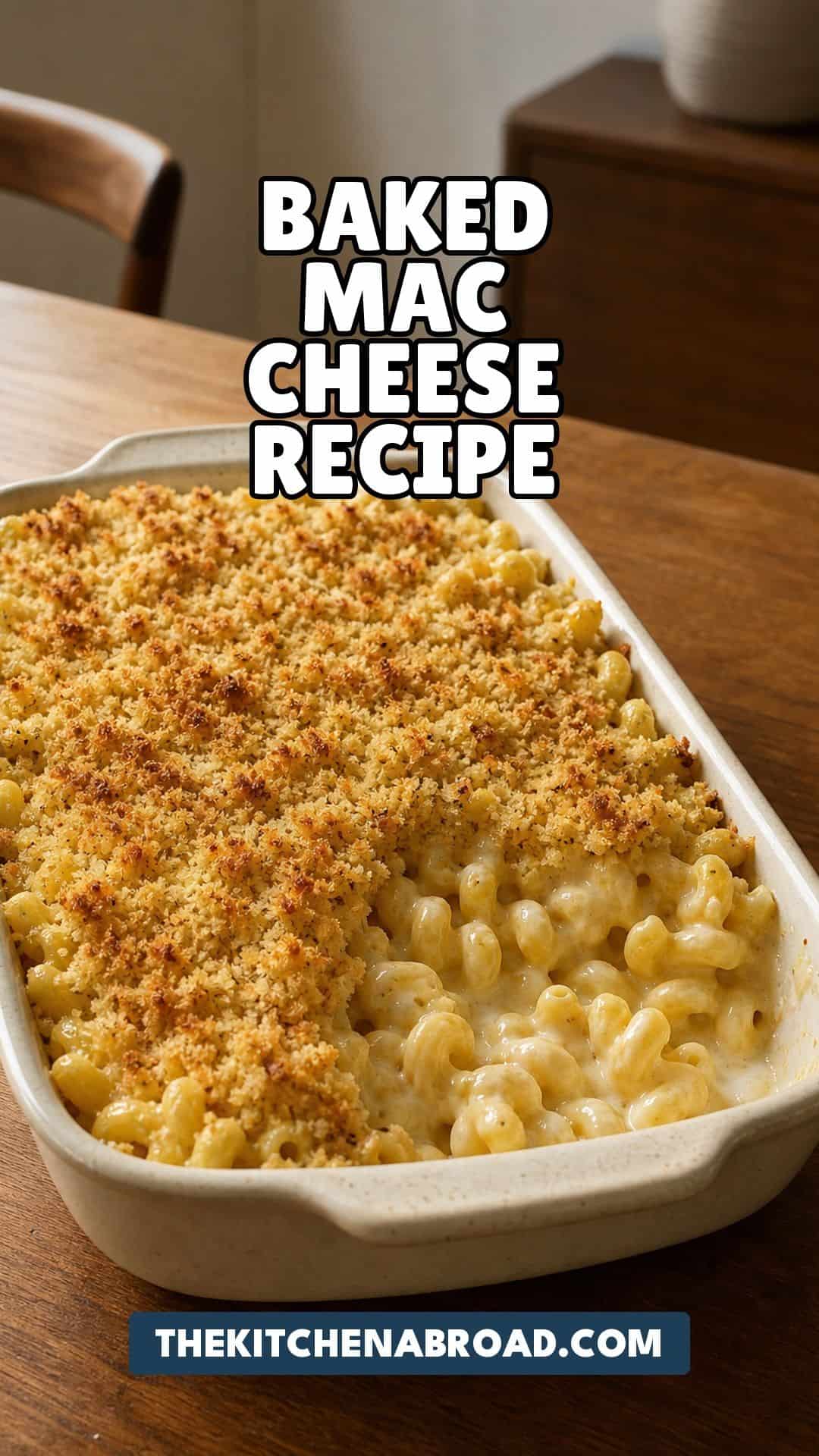
Creamy baked macaroni and cheese recipe
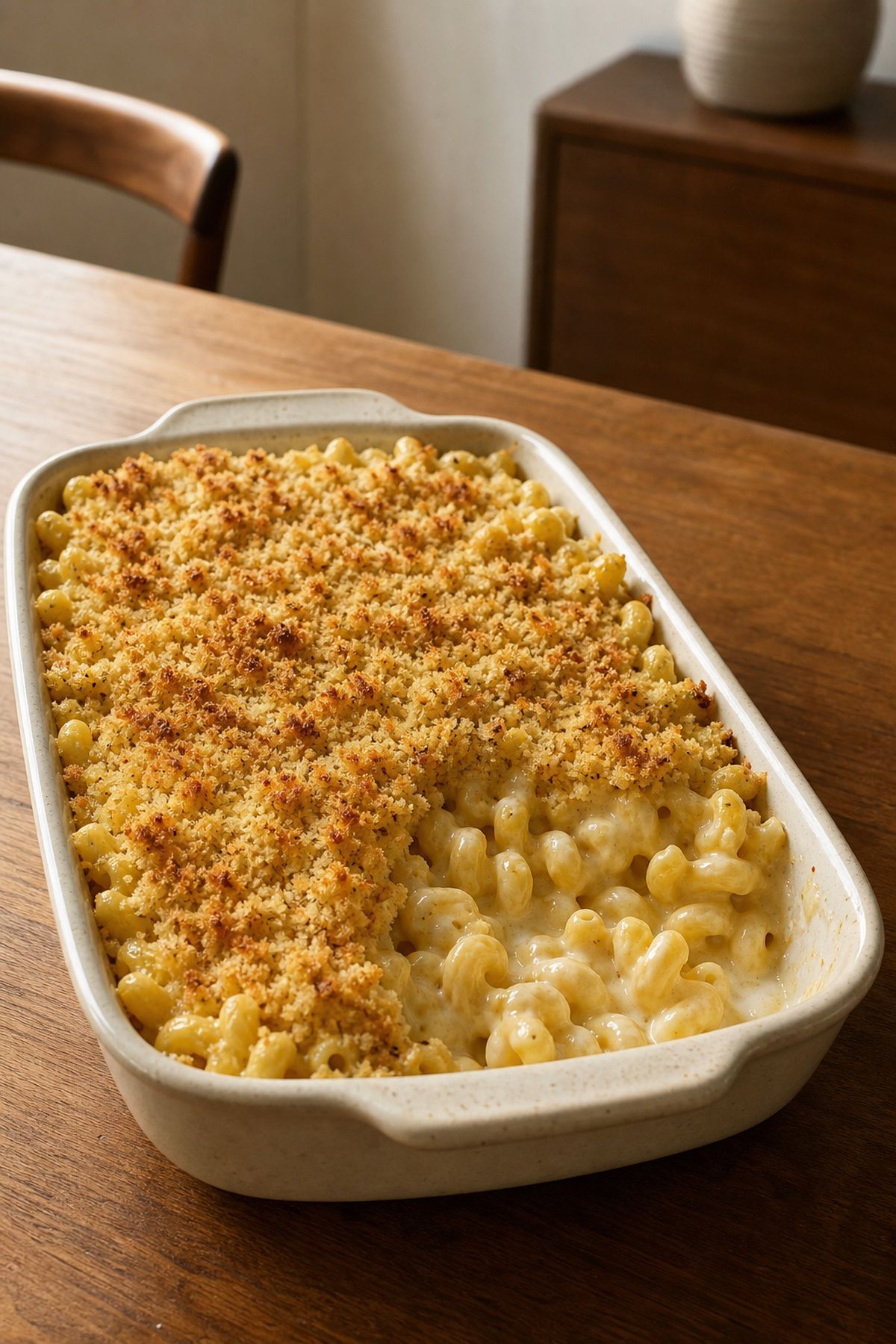
Prep time: 20 minutes | Cook time: 30 minutes | Total time: 50 minutes | Serves: 8
Ingredients
- 450 g (1 lb) elbow macaroni or cavatappi
- 60 g (4 Tbsp) unsalted butter
- 30 g (¼ cup) all-purpose flour
- 720 ml (3 cups) cold whole milk
- 240 ml (1 cup) cold heavy cream
- 340 g (12 oz) freshly grated extra-sharp cheddar
- 115 g (4 oz) freshly grated Gruyère
- 55 g (2 oz) freshly grated parmesan, plus 25 g (¼ cup) for topping
- 1 tsp Dijon mustard
- ¼ tsp freshly grated nutmeg
- 1 tsp kosher salt (about 6 g)
- ½ tsp freshly cracked black pepper
- 60 g (1 cup) panko breadcrumbs
- 45 g (3 Tbsp) melted butter (for topping)
Instructions
- Heat the oven to 190°C (375°F) with a rack in the middle.
- Boil the pasta in plenty of well-salted water for 1 minute less than the packet time. Drain and set aside.
- Meanwhile, melt the 60 g butter in a Dutch oven or wide pot over medium heat. Add the flour and whisk constantly for 2 minutes, until it looks like wet sand and smells slightly nutty. Don’t let it colour.
- Pour in the cold milk slowly, whisking the whole time, then the cold cream. Whisk until smooth, then simmer gently for 4 to 5 minutes, whisking now and then, until the sauce coats the back of a spoon.
- Turn the heat to low and whisk in the mustard, nutmeg, salt and pepper.
- Take the pot off the heat. Add the cheddar, Gruyère and 55 g parmesan a handful at a time, whisking until each addition has melted smooth before adding more.
- Fold in the pasta until every piece is coated. If your pot isn’t ovenproof, tip everything into a 23 x 33 cm (9 x 13 inch) baking dish.
- Toss the panko with the melted butter and the remaining 25 g parmesan until evenly coated, then scatter it over the top.
- Bake for 25 to 30 minutes, until the top is deep golden and the edges are bubbling.
- Rest for 5 minutes before serving so the sauce settles and thickens slightly.
Notes
Cavatappi holds more sauce in its spirals, while elbows give the classic look. Shells work too. Skip long pasta like spaghetti, which doesn’t trap the sauce.
Can you add extras or make it gluten-free?
Yes, as long as the extras are cooked and fairly dry before they go in. Fold them through just before the topping:
- 115 g (4 oz) crispy bacon, chopped
- 225 g (8 oz) sautéed mushrooms
- 2 cups steamed broccoli florets
- About 1 cup caramelized onions
For a dinner-party version, stir in 225 g (8 oz) cooked lobster meat with a tablespoon of chopped tarragon. A bit over the top, and very good.
To make it gluten-free, use gluten-free elbow pasta and cook it 2 minutes short, because it softens faster. Replace the roux with 2 Tbsp cornstarch whisked into 60 ml (¼ cup) cold milk, then stir that into the warmed dairy and simmer until thick. Use gluten-free panko on top.
Can you make mac and cheese ahead?
Yes. Assemble it completely without the topping, cover and refrigerate for up to 24 hours. Scatter the panko over just before it goes in the oven, and bake from cold for about 10 minutes longer.
Leftovers keep for 4 days in a sealed container in the fridge. Reheat portions covered in a 160°C (325°F) oven for about 15 minutes with a splash of milk stirred in, until hot all the way through. The USDA guidance on leftovers is to reheat to 74°C (165°F), so check the middle if you have a thermometer. The microwave works in a pinch but dries the edges.
Skip the freezer. Cream sauces like this one split when they thaw, and you’re back to grainy.
Mac and cheese questions, answered
Why is my mac and cheese grainy?
Grainy mac and cheese usually comes from pre-shredded cheese or from melting the cheese over too much heat. Grate the cheese from a block, take the pot off the burner, and whisk the cheese in a handful at a time.
Can I make baked mac and cheese ahead of time?
Yes, assemble it without the topping and refrigerate it covered for up to 24 hours. Add the panko just before baking and give it about 10 extra minutes in the oven.
Can I skip the breadcrumb topping?
Yes, bake it covered for 20 minutes, then uncovered for 5 minutes to brown the cheese on top. It will be less crisp but still creamy.
What is the best pasta for baked mac and cheese?
Elbow macaroni is the classic, and cavatappi holds the most sauce in its spirals. Shells also work; avoid long shapes like spaghetti or fettuccine.
What should I serve with mac and cheese?
Serve it with something sharp or green, such as a salad with vinaigrette, roasted broccoli or green beans. As a side, it goes with pulled pork, fried chicken, ham or grilled sausages.
Key takeaways
- Grate cheese from the block; bagged shreds carry a coating that keeps them from melting smoothly.
- Whisk cold milk and cream into a warm roux to avoid lumps.
- Take the pot off the heat before the cheese goes in, and add it in handfuls.
- Boil the pasta 1 minute short of the packet time, because it keeps cooking in the oven.
- Assemble up to 24 hours ahead and add the panko just before baking.
Feeding a crowd? Round out the table
This dish is rich, so serve it next to something sharp: a green salad with a mustardy vinaigrette, roasted broccoli, or green beans. If you’re cooking a full casserole spread for a potluck, an easy tuna casserole uses a similar creamy base and bakes at the same time.
Creamy Baked Macaroni and Cheese
Creamy baked macaroni and cheese stays smooth and silky when you build the sauce on a proper roux, add cold milk to prevent clumping, and use freshly grated cheese in a three-cheese blend (extra-sharp cheddar, Gruyère, and parmesan).
Ingredients
- 450 g (1 lb) elbow macaroni or cavatappi
- 60 g (4 Tbsp) unsalted butter
- 30 g (1/4 cup) all-purpose flour
- 720 ml (3 cups) cold whole milk
- 240 ml (1 cup) cold heavy cream
- 340 g (12 oz) freshly grated extra-sharp cheddar
- 115 g (4 oz) freshly grated Gruyère
- 55 g (2 oz) freshly grated parmesan, plus 25 g (1/4 cup) for topping
- 1 tsp Dijon mustard
- 1/4 tsp freshly grated nutmeg
- 1 tsp kosher salt (about 6 g)
- 1/2 tsp freshly cracked black pepper
- 60 g (1 cup) panko breadcrumbs
- 45 g (3 Tbsp) melted butter (for topping)
Instructions
- Preheat the oven to 190°C (375°F) with a rack in the middle.
- Bring a large pot of well-salted water to a boil. Add the pasta and cook for the time on the package, minus 1 minute. Drain and set aside.
- While the pasta cooks, melt 60 g (4 Tbsp) butter in a Dutch oven or wide pot over medium heat. Add 30 g (1/4 cup) flour and whisk constantly for 2 minutes, until the mixture looks like wet sand and smells slightly nutty. Do not let it brown.
- Slowly pour in the cold whole milk while whisking continuously. Then pour in the cold heavy cream, still whisking.
- Reduce the heat to low. Add 1 tsp Dijon mustard, 1/4 tsp grated nutmeg, 1 tsp salt, and 1/2 tsp black pepper. Whisk to combine.
- Remove the pot from the heat. Add the grated cheddar, Gruyère, and 55 g (2 oz) parmesan in batches, whisking after each addition until the cheese melts smooth before adding the next. Off-heat whisking prevents the cheese from breaking.
- Fold the cooked pasta into the cheese sauce until every piece is coated. Transfer the mixture to a 23 x 33 cm (9 x 13 inch) baking dish if your pot is not oven-safe.
- In a small bowl, combine 60 g (1 cup) panko, 45 g (3 Tbsp) melted butter, and the remaining 25 g (1/4 cup) parmesan. Toss until the breadcrumbs are evenly coated with butter. Sprinkle the panko mixture evenly over the top of the mac and cheese.
- Bake at 190°C (375°F) for 25 to 30 minutes, until the topping is golden brown and the edges are bubbling.
- Let the dish rest for 5 minutes before serving. The sauce thickens slightly as it cools. Scoop generously.
Notes
Cold milk into a warm roux is the move that prevents lumps. Hot milk into hot roux makes the sauce clump.
Add the cheese off-heat in batches, whisking after each addition. Adding the cheese while the pot is still on the burner causes the proteins to separate and the sauce to break.
Last update on 2026-10-03 / Affiliate links / Images from Amazon Product Advertising API