

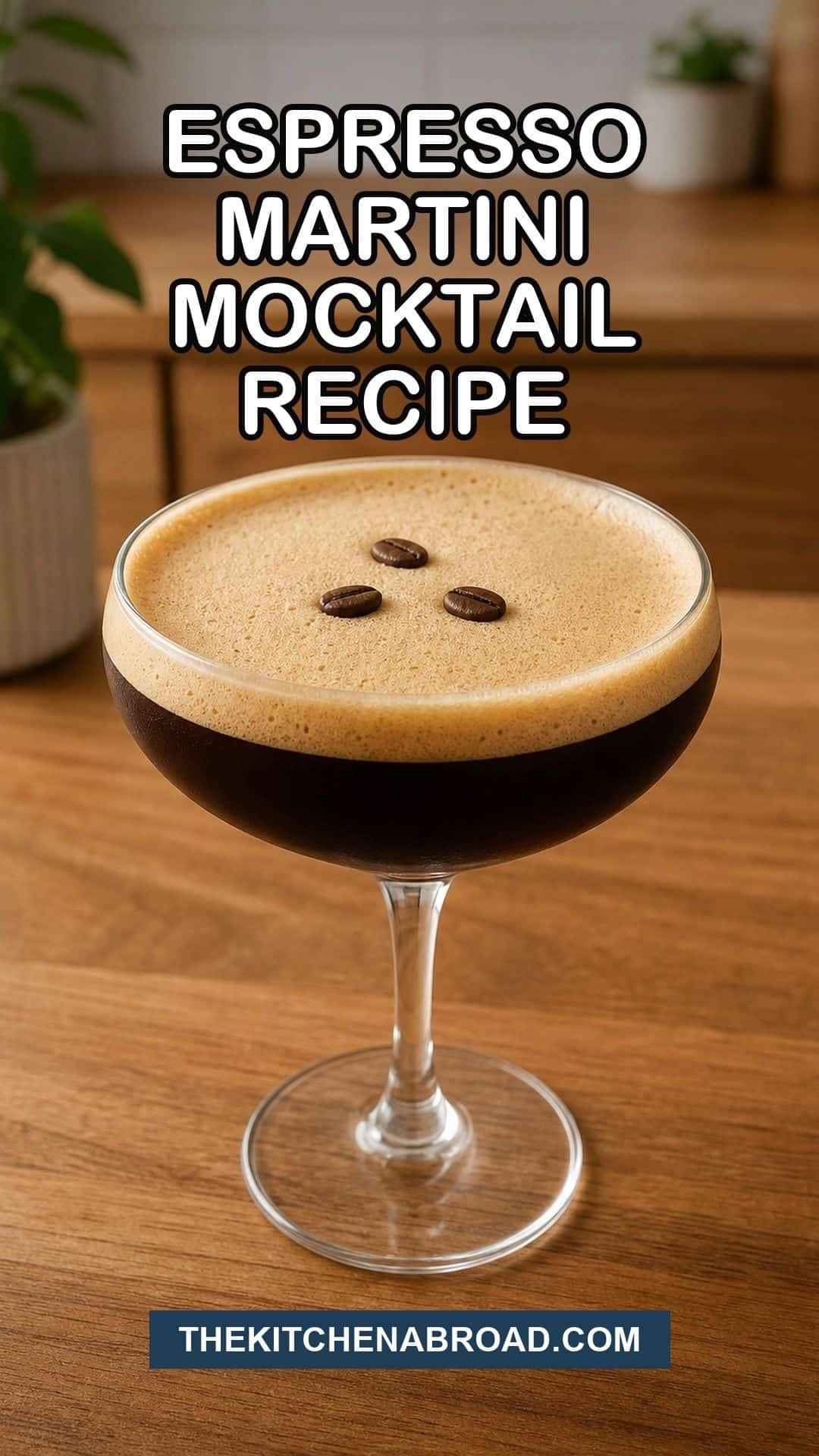
A bar-quality non-alcoholic espresso martini comes down to a single move: dry-shake first, then wet-shake. Pull 2 oz of fresh espresso, let it cool four minutes, and shake it without ice for 15 seconds against brown sugar syrup and cold brew. The crema whips into a stable foam. Then add ice and shake another 20 seconds to chill and dilute. Double-strain into a chilled coupe. Three coffee beans on top. The foam holds for 10 to 15 minutes, which is longer than a vodka version, because the espresso is the engine.
The reason an espresso martini mocktail can taste like a real cocktail and not a sad coffee tonic comes down to one mechanism: the dry shake builds the foam without alcohol doing any of the lift. Crema, the tan-gold layer on a fresh espresso shot, is dissolved CO2 from the puck. Shake it hard against syrup for 15 seconds and it whips into a stable head that survives the ice. Looking for the version with vodka? It’s here. This zero-proof version is what the dinner-party-with-half-sober-guests crowd has been quietly asking for.
Gear That Helps Here
A stainless steel cocktail shaker is the one piece of kit that actually matters for this drink. The metal gets cold fast in the wet shake and helps the foam set up. A two-piece Boston shaker or a three-piece cobbler shaker both work; pick the one that already lives in your kitchen.
A Hawthorne strainer plus a fine mesh strainer for the double strain. A chilled martini glass or coupe so the foam does not collapse on contact. An espresso machine or a Moka pot to pull a fresh shot. Without a fresh shot, the foam is the first thing that goes.


Recommended Reads
- Ultimate Coffee Martini (the alcoholic version of this drink)
- Pumpkin Spice Latte Mocktail
- Cortisol Cocktail
- Virgin Dirty Martini
- Blackberry Lemon Mocktail
Where the Espresso Martini Came From
Dick Bradsell built the original in 1983, behind the bar at the Soho Brasserie in London. The story, repeated enough times that it has the polish of a parable now, goes like this: a young model walked up to the bar and asked for something that would wake her up and then mess her up. Bradsell had a freshly pulled espresso shot at his station because the espresso machine sat next to the bar. He combined the shot with vodka, sugar syrup, and Kahlua, shook the whole thing hard over ice, and poured it into a coupe. The drink went on the Soho Brasserie menu and stayed there.
The drink went quiet through the 2000s, then came back hard in 2020 and 2021. Late-pandemic dinner parties, TikTok bar tutorials, and a wave of Sopranos-era nostalgia put it back on every cocktail menu in New York and London. The mocktail wave followed close behind. Roughly 27 percent of US adults planned to do Dry January in 2026, and “zebra striping,” the practice of alternating boozy and zero-proof drinks across an evening, moved from a wellness blog talking point to a mainstream bar order. A non-alcoholic espresso martini is the natural translation of a forty-year-old cocktail into a drinking culture that wants the ritual without the bottle.
A Few Notes on the Ingredients
- Fresh-pulled espresso: The whole engine. The crema, the tan-gold layer on a freshly pulled shot, is dissolved CO2 trapped in microscopic oil droplets. That CO2 powers the foam. Within ten minutes of pulling, the crema collapses and the gas dissipates. Pull the shot the moment you start building.
- Cooling the espresso: Let the shot cool on the counter for four to six minutes before shaking. Hot espresso melts ice and kills foam. The shot should feel warm to the touch, not hot.
- Brown sugar syrup: The single biggest upgrade over plain simple syrup and the closest thing to the Kahlua note a boozy version carries. Use 1 cup dark brown sugar to 1 cup hot water, whisk until dissolved, and cool. The molasses gives you the same baking-spice depth Kahlua brings.
- Vanilla extract: A half teaspoon added to the brown sugar syrup pushes it even closer to the Kahlua profile. Store the finished syrup sealed in the fridge for two weeks.
- Cold brew concentrate: The vodka stand-in. Adds coffee-on-coffee body that water cannot, without pushing the caffeine into uncomfortable territory the way a second espresso shot would.
- Non-alcoholic coffee liqueur: Optional but worth knowing about. The category has grown into a real shelf at most liquor stores. A half ounce adds a faint bittersweet edge that brown sugar syrup alone does not deliver.
- Heavy cream or coconut cream: A tablespoon in the dry shake pushes the drink into richer, dessert-leaning territory. Canned full-fat coconut cream stands in for a dairy-free version and behaves almost identically because the fat content is similar.
Recipe: Non-Alcoholic Espresso Martini

Prep time: 5 minutes | Total time: 5 minutes | Serves: 1
Ingredients
- 60 ml (2 oz) fresh espresso, cooled 4 to 6 minutes on the counter
- 30 ml (1 oz) brown sugar syrup (1:1 dark brown sugar to hot water)
- 30 ml (1 oz) cold brew concentrate or strong cold coffee
- 15 ml (0.5 oz) non-alcoholic coffee liqueur, optional
- 4 to 5 large ice cubes
- 3 whole coffee beans, for garnish
Instructions
- Place a coupe or martini glass in the freezer to chill while you build the drink. Pull a fresh double shot of espresso into a small cup and let it cool on the counter for 4 to 6 minutes. The shot should be warm to the touch, not hot.
- Pour 60 ml (2 oz) cooled espresso, 30 ml (1 oz) brown sugar syrup, 30 ml (1 oz) cold brew concentrate, and the optional 15 ml (0.5 oz) non-alcoholic coffee liqueur into the larger half of a stainless steel cocktail shaker. Do not add ice yet.
- Seal the shaker and shake hard for 15 seconds with no ice. This is the dry shake. It whips the crema into a stable foam against the syrup. The shaker will feel light and slosh loudly; the sound changes from a sharp slap to a frothy thump as the foam builds.
- Open the shaker and add 4 to 5 large ice cubes. Seal again and shake hard for another 20 seconds. This is the wet shake. The metal will frost and the rattle will slow as the ice breaks down. That slowdown is the dilution sweet spot; stop shaking when the rattle goes quiet.
- Set a Hawthorne strainer across the shaker and hold a fine mesh strainer below it. Double-strain the drink into the chilled coupe. The double strain catches any chips of ice and keeps the foam tight on top.
- Float 3 whole coffee beans on the foam in a small triangle. Serve immediately while the foam stands at its tallest.
Notes
Caffeine content lands around 120 to 150 mg per drink, which is roughly a strong cup of drip coffee. If you are caffeine-sensitive, skip this one after 4 pm or pull the espresso with decaf beans for a near-zero-caffeine version that still foams.
The foam holds 10 to 15 minutes in the glass, which is actually longer than the vodka version because there is no alcohol to thin the structure. Pour and drink within that window for a clean, photo-ready head. Past 20 minutes the head starts to settle and the drink looks like iced coffee.
Fresh espresso is non-negotiable. The CO2 that builds the foam comes from the crema, and the crema starts dissipating within ten minutes of the shot pulling. Stale espresso, even from earlier the same morning, gives you a flat drink no matter how long you shake.
Tips and Variations
Decaf for the After-Dinner Slot
Pull the espresso shot with decaf beans and the drink still foams the same way; the CO2 in the crema is independent of the caffeine. A decaf espresso martini lets you serve this after a long dinner without sending the table into a wired sleepless night. Most decaf beans carry slightly less crema than caffeinated, so shake the dry shake for 18 seconds instead of 15 to compensate.
No-Machine Workaround with a Moka Pot or AeroPress
A Moka pot pulls a shot that is close enough to espresso for this drink. Use the smallest Moka size you have, pack the basket level and tight, and pull two shots’ worth. AeroPress works too; brew with the inverted method, 20 grams of fine-ground coffee to 60 grams of water, 90-second steep. Neither pulls as much crema as a proper espresso machine, so the foam will be slightly thinner. Shake a few seconds longer on the dry shake and the drink still holds its head.
Brunch Variation with Lighter Syrup
For a brunch-coded version that pairs with eggs and pastries instead of dessert, drop the brown sugar syrup to 1/2 oz and add a splash of cold oat milk in the dry shake. The drink reads lighter, with a milky cap on the foam that fits the daytime context. Garnish with a thin shaving of orange peel instead of coffee beans for a citrus note that lifts the whole glass.
Batched for a Sober-Curious Dinner Party
Make the espresso-syrup-vanilla base ahead. Combine cooled espresso, brown sugar syrup, and a half teaspoon of vanilla extract per drink in a sealed jar and refrigerate for up to 24 hours. When guests arrive, shake each drink individually with ice. Pre-shaken foam collapses within 20 minutes, so do not try to batch the shake itself. The base prep cuts each subsequent build down to 90 seconds at the bar, which is the only way to serve eight of these without missing dinner.
The Non-Alcoholic Coffee Liqueur Question
The non-alcoholic coffee liqueur category has grown into a real shelf at most liquor stores, with multiple zero-proof brands competing for the same spot Kahlua holds in the regular section. Any of them work in this drink. They add a faint bittersweet, slightly herbal edge that brown sugar syrup alone does not give you. Skip it entirely and the drink still works; the brown sugar syrup carries enough body to stand on its own. Add it and the result reads more like a proper bar pour, which is the move if you are serving a guest who used to order espresso martinis and recently stopped drinking.
Dairy-Free with Coconut Cream
A tablespoon of full-fat canned coconut cream in the dry shake gives the drink a richer texture without dairy. Coconut cream behaves almost identically to heavy cream in the shake because the fat content is similar, and the coconut note reads as faintly tropical underneath the coffee rather than as a separate flavor. Shake the coconut cream the bottle around before opening so the fat and water mix, and scoop only the thick layer at the top.
What to Serve It With
This is a post-dinner drink first. Anything with dark chocolate, a flourless chocolate cake, brownies straight from the pan, tiramisu (meta but it works), pairs especially well because the bitter notes in the espresso lean into the chocolate. Salted caramel, hazelnut spread on a piece of bread, and vanilla bean ice cream all sit well next to a glass. For a sober-curious dinner party, this drink does the double duty of replacing both the after-dinner espresso and the after-dinner drink in one pour, which closes the meal cleanly without sending guests off too wired or too sleepy. Biscotti on the side reads classic, almost too on-the-nose, but the textural contrast against the foam is worth it.
Frequently Asked Questions
Can you make an espresso martini without alcohol?
Yes, and the foam mechanism that defines the drink works just as well without vodka or Kahlua. The crema in fresh espresso carries the CO2 that builds the foam, not the alcohol. Replace the vodka with cold brew concentrate, the Kahlua with brown sugar syrup, and the dry-shake-then-wet-shake technique does the rest. The result tastes like a proper espresso martini, not a watered-down coffee drink.
What can I use instead of vodka in an espresso martini?
Cold brew concentrate is the cleanest swap because it adds coffee-on-coffee depth without flattening the drink. Strong cold-brewed coffee works too if you do not have concentrate; just use the same 1 oz pour. Skip the temptation to use just water or extra espresso; the cold brew adds body that water cannot, and another shot of espresso shifts the caffeine into uncomfortable territory.
Does a non-alcoholic espresso martini still have caffeine?
Yes, roughly 120 to 150 mg per drink between the espresso and the cold brew. That is about a strong cup of drip coffee. Anyone caffeine-sensitive should skip this drink after 4 pm or build the decaf version, which pulls the caffeine load down to under 10 mg per drink without sacrificing the foam.
How do you get the foam on an espresso martini without alcohol?
Three things have to be true. The espresso has to be freshly pulled (CO2 in the crema dissipates within 10 minutes). The first shake has to be dry, no ice, for 15 seconds, so the crema whips against the syrup before the water arrives. And the second shake has to be wet, with ice, for 20 seconds, to chill and dilute. Skip any of these and the foam collapses.
Can I use cold brew instead of espresso?
You can, but the drink will not foam. Cold brew has no crema because it is never under pressure during extraction, so there is no CO2 to whip into a head. The drink still tastes like coffee, but it looks more like an iced coffee cocktail than an espresso martini. If you have no espresso machine, a Moka pot or AeroPress is a better workaround than cold brew because both produce a small crema layer.
What is a good non-alcoholic substitute for Kahlua?
Brown sugar simple syrup at a 1:1 ratio of dark brown sugar to hot water, plus a half teaspoon of vanilla extract. The molasses in the brown sugar carries the same baking-spice depth that Kahlua brings, and the vanilla rounds it out. For an even closer match, any of the non-alcoholic coffee liqueurs on the market work; use a half ounce alongside the brown sugar syrup, not in place of it.
Key Takeaways
- Dry shake first, 15 seconds, no ice. This builds the foam from the crema CO2.
- Wet shake second, 20 seconds, with 4 to 5 large ice cubes. Chills and dilutes.
- Fresh-pulled espresso is the engine. Cooled four minutes, never hot, never stale.
- Brown sugar syrup at 1:1 dark brown sugar to water is the Kahlua stand-in.
- Double-strain into a chilled coupe and serve within 10 minutes.
Final Thoughts
A non-alcoholic espresso martini works because the mechanics of the original drink were never about the alcohol. Bradsell’s 1983 cocktail held its foam because of crema, sugar, and a hard shake. Take the vodka and Kahlua out, lean harder into those three mechanics, and the result is a glass that looks and drinks like the real thing.
The drink fits the moment. Roughly one in four US adults are running a Dry January, sober-curious dinner parties are now standard, and “zebra striping” through an evening is mainstream bar behavior. A zero-proof espresso martini gives the non-drinker at the table a glass that holds its own next to the cocktail order, which is the whole point of a mocktail in 2026.
Make this after dinner for a small group, or build it as the centerpiece of a sober-curious nightcap. Three coffee beans on the foam, a chilled coupe, and the technique of the original drink doing all the work. The vodka was never the point. The shake was.
Non-Alcoholic Espresso Martini
A bar-quality non-alcoholic espresso martini comes down to a single move: dry-shake first, then wet-shake. Pull 2 oz of fresh espresso, let it cool four minutes, and shake it without ice for 15 seconds against brown sugar syrup and cold brew.
Ingredients
- 60 ml (2 oz) fresh espresso, cooled 4 to 6 minutes on the counter
- 30 ml (1 oz) brown sugar syrup (1:1 dark brown sugar to hot water)
- 30 ml (1 oz) cold brew concentrate or strong cold coffee
- 15 ml (0.5 oz) non-alcoholic coffee liqueur, optional
- 4 to 5 large ice cubes
- 3 whole coffee beans, for garnish
Instructions
- Place a coupe or martini glass in the freezer to chill while you build the drink. Pull a fresh double shot of espresso into a small cup and let it cool on the counter for 4 to 6 minutes. The shot should be warm to the touch, not hot.
- Pour 60 ml (2 oz) cooled espresso, 30 ml (1 oz) brown sugar syrup, 30 ml (1 oz) cold brew concentrate, and the optional 15 ml (0.5 oz) non-alcoholic coffee liqueur into the larger half of a stainless steel cocktail shaker. Do not add ice yet.
- Seal the shaker and shake hard for 15 seconds with no ice. This is the dry shake. It whips the crema into a stable foam against the syrup. The shaker will feel light and slosh loudly; the sound changes from a sharp slap to a frothy thump as the foam builds.
- Open the shaker and add 4 to 5 large ice cubes. Seal again and shake hard for another 20 seconds. This is the wet shake. The metal will frost and the rattle will slow as the ice breaks down.
- Set a Hawthorne strainer across the shaker and hold a fine mesh strainer below it. Double-strain the drink into the chilled coupe. The double strain catches any chips of ice and keeps the foam tight on top.
- Float 3 whole coffee beans on the foam in a small triangle. Serve immediately while the foam stands at its tallest.
Notes
Caffeine content lands around 120 to 150 mg per drink, which is roughly a strong cup of drip coffee. If you are caffeine-sensitive, skip this one after 4 pm or pull the espresso with decaf beans for a near-zero-caffeine version that still foams.
The foam holds 10 to 15 minutes in the glass, which is actually longer than the vodka version because there is no alcohol to thin the structure. Pour and drink within that window for a clean, photo-ready head. Past 20 minutes the head starts to settle and the drink looks like iced coffee.
Last update on 2026-10-04 / Affiliate links / Images from Amazon Product Advertising API
