
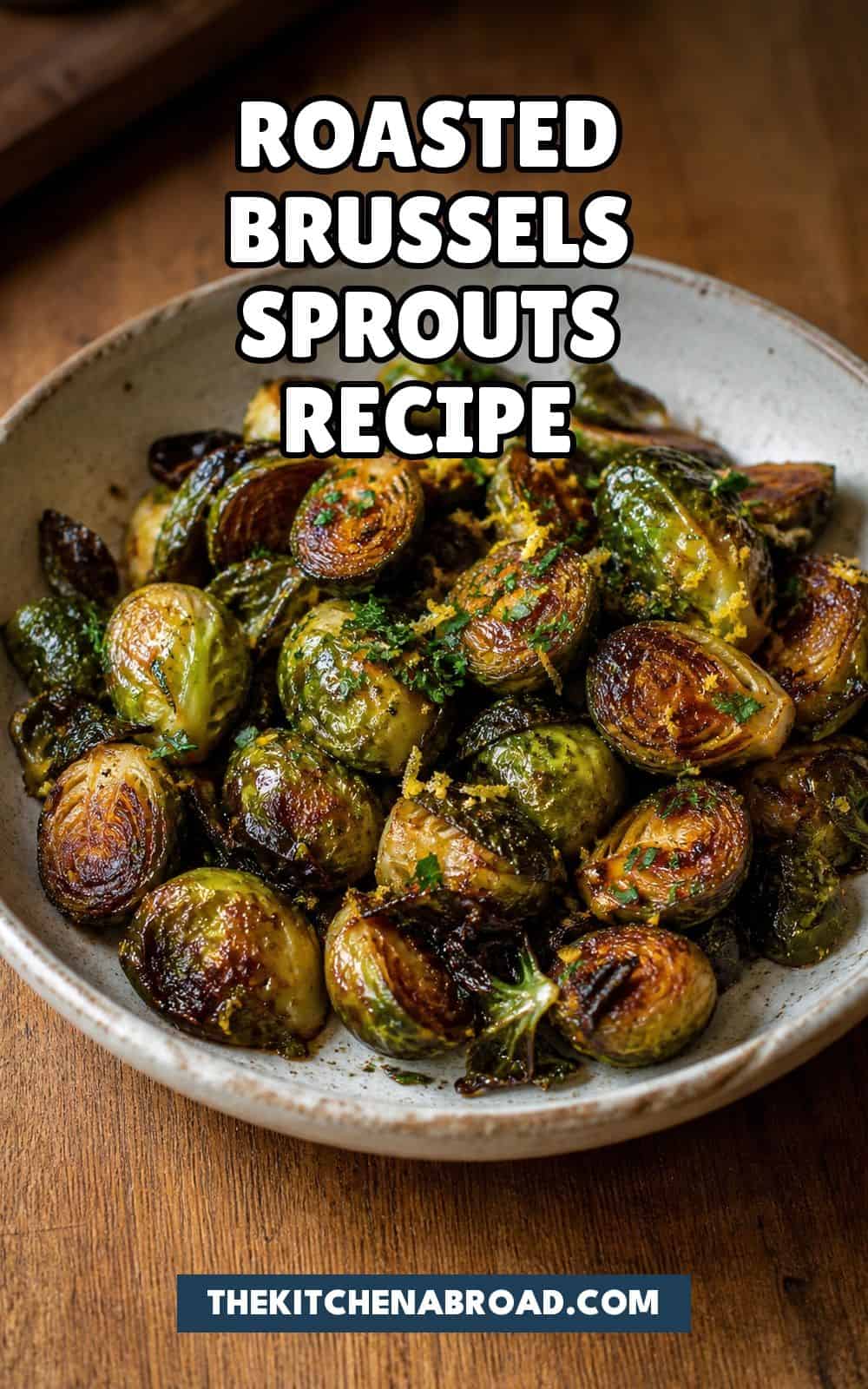
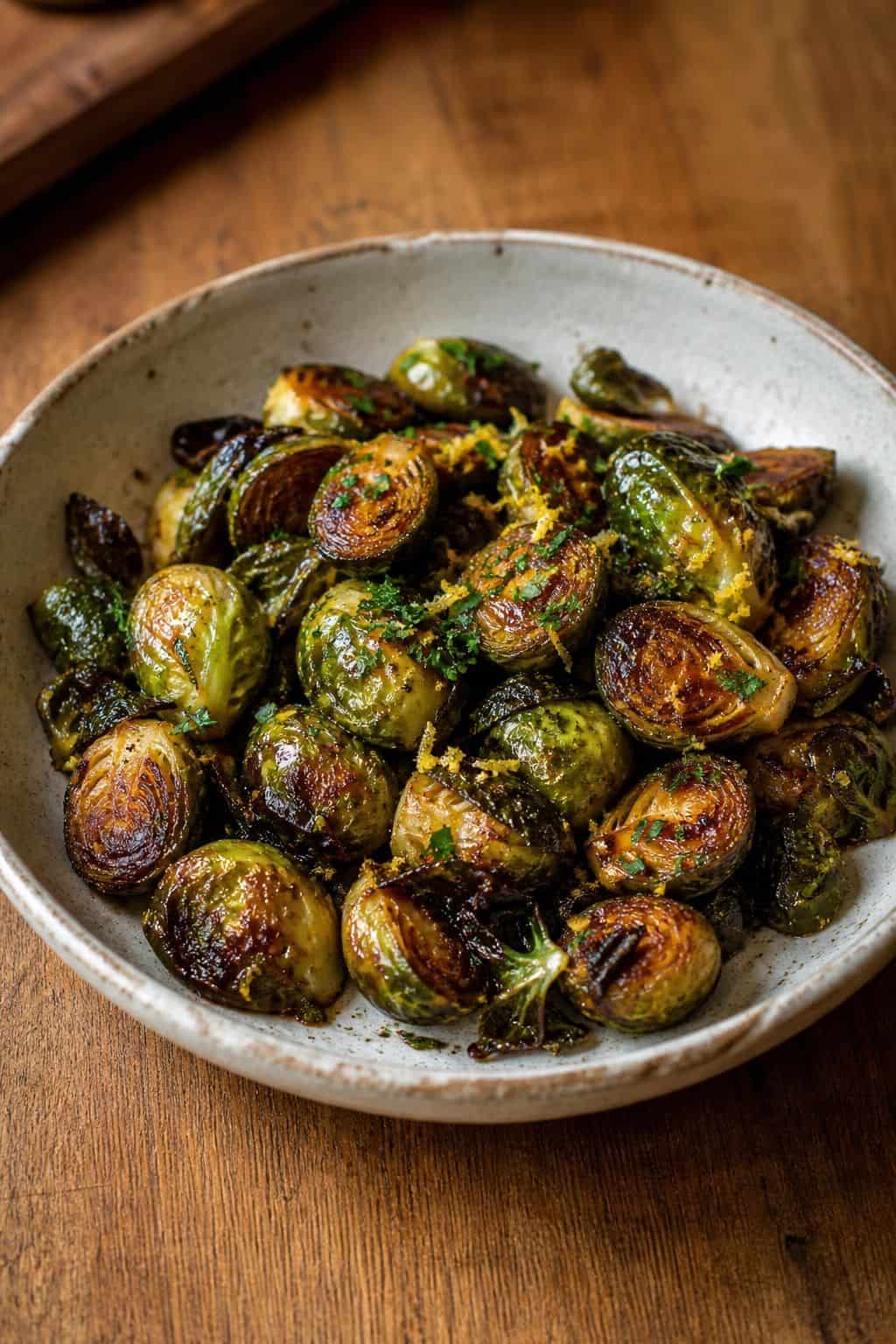
roasted brussels sprouts are the side dish that earns a steakhouse plate. Halved, tossed in olive oil and salt, and laid cut-side-down on a preheated 425°F sheet pan, then left alone for 22 to 25 minutes without a single stir. Off heat they get a quick drizzle of reduced balsamic and a snow of fresh lemon zest. Six servings, eight ingredients, about thirty-two minutes start to finish, and the cut faces come out lacquered and crackling.
The side dish on a steakhouse plate has a job. It cannot upstage the ribeye, but it has to earn its real estate. Brussels sprouts spent thirty years failing that test in American homes , boiled grey, sulfurous, hidden in napkins , until somebody figured out what happens when you stop stirring them. You preheat the pan, you halve the sprouts, you lay them cut-side-down, and you walk away for twenty-two minutes. The cut face caramelizes against the screaming aluminum the way a steak caramelizes against cast iron, and nothing about the dish goes back to grey again.
What You’ll Need
A heavy aluminum half-sheet pan that can take 425°F preheating without warping, a sharp 8-inch chef’s knife to halve and trim cleanly, a microplane for the lemon-zest finish, a small olive oil bottle so the coat is even (not pooled), and a bottle of aged balsamic that’s syrupy enough to reduce into glaze in a few minutes.


Recommended Reads
- Honey and Balsamic Roasted Beets
- Green Beans Almondine
- Roasted Carrots with Honey Glaze
- Best Thanksgiving Side Dishes
- Best Easter Dinner Ideas
Where Brussels Sprouts Came From
The vegetable takes its name from the city. Brussels sprouts were first documented in 1587 in market regulations at Sint-Lambrechts-Woluwe, a parish on the eastern edge of Brussels, Belgium, where cultivation in the southern Netherlands had been quietly flourishing through the 16th century. From there they moved north into Britain in the 1600s, and then across the Atlantic with European immigrants. The tiny cabbage that you halve and roast today is, almost literally, the same compact little brassica that 16th-century Flemish farmers sold by the bushel under their city’s name.
The American story is shorter and uglier. From the 1970s through the 1990s the sprout was the punchline of every sitcom dinner scene , boiled to grey mush, sulfurous and bitter, the vegetable kids hid in napkins. The rehabilitation has a date and an address: 2008, David Chang at Momofuku Ssäm Bar in New York’s East Village. Chang’s deep-fried Brussels sprouts in a fish-sauce vinaigrette, sweet and sour and salty and crackling, became the single most-copied vegetable dish in American restaurants for the next five years. By 2012 the sprout’s reputation was completely laundered. Every crispy roasted version on the internet now , including this one , is a direct descendant of that plate.
A Few Notes on the Ingredients
- Brussels sprouts: Halve every sprout lengthwise through the root. The cut surface is what gives you the crackling, deeply browned face that defines the dish. Whole sprouts cannot do this work, no matter how long you roast them.
- Preheated pan: The oven goes to 425°F (220°C) and the sheet pan goes in empty to preheat for five minutes. When the halved sprouts hit that pan, the cut face starts caramelizing the second it lands, the same Maillard reaction that browns a seared steak in cast iron.
- Olive oil and salt: Toss the sprouts so every cut face is coated, then lay them in a single uncrowded layer. Steam is the enemy of crisp. If your pan is full, get a second pan.
- The no-stir rule: Twenty-two to twenty-five minutes, no movement. Most home cooks reach for the spatula at the 12-minute mark, and every one of those stirs lifts the half-formed Maillard crust off the pan before it has finished setting. Defend the crust.
- Aged balsamic vinegar: Two tablespoons reduced for three to four minutes with a tablespoon of honey or maple syrup until it coats the back of a spoon. Drizzle warm at the finish; adding it before roasting burns the sugars into something acrid.
- Lemon zest: A microplane pass right after the glaze cuts through the caramelized sweetness with a clean citrus top note. It is the difference between a good sprout and a steakhouse one.
Recipe: Roasted Brussels Sprouts
Prep time: 10 minutes | Cook time: 22 minutes | Total time: 32 minutes | Serves: 6
Ingredients
- 1.5 lb (680 g) brussels sprouts, trimmed and halved
- 3 tbsp (45 ml) olive oil
- 1 tsp salt
- 1/2 tsp black pepper
- 2 tbsp (30 ml) aged balsamic vinegar
- 1 tbsp (15 ml) honey or maple syrup
- Zest of 1 lemon
- 1 tbsp (3 g) fresh parsley, chopped
- Optional: 2 tbsp (15 g) toasted pine nuts or pomegranate seeds
Instructions
- Heat the oven to 425°F (220°C) with a half-sheet pan inside, preheating for at least 5 minutes. The pan needs to be hot enough to sizzle on contact.
- While the pan heats, trim the dry stem ends from the brussels sprouts and pull off any loose or yellowed outer leaves. Halve each sprout lengthwise through the root so the leaves stay attached on both halves.
- In a wide bowl, toss the halved sprouts with the olive oil, salt, and pepper until every cut face is coated.
- Pull the hot sheet pan from the oven. Working quickly, arrange the sprouts cut-side-down in a single layer with a little space between each one. Crowding will steam them; if your pan is full, use two pans on two racks.
- Return the pan to the oven and roast for 22 to 25 minutes WITHOUT STIRRING, flipping, or opening the door. The cut sides will deeply caramelize and the outer leaves will crisp into thin chips.
- While the sprouts roast, combine the balsamic vinegar and honey (or maple syrup) in a small saucepan over medium heat. Bring to a low simmer and reduce for 3 to 4 minutes, stirring once, until the mixture coats the back of a spoon. Pull off the heat.
- When the sprouts are done, transfer them to a wide platter cut-side-up so the lacquered faces show. Drizzle the warm balsamic glaze across the top off heat, then immediately zest the lemon directly over the platter.
- Scatter the chopped parsley across the dish, along with the toasted pine nuts or pomegranate seeds if using. Serve warm.
Notes
The no-stir rule is the whole point of the technique. A stirred sprout is a steamed sprout. The cut face needs to stay pressed against hot aluminum for the full duration to build the dark, crackling crust that this recipe is named for. Set a timer, walk out of the kitchen, and trust the oven.
Frozen brussels sprouts can work, but they need a different method. Do not thaw them; spread frozen halves on a preheated 450°F (230°C) pan and roast for 28 to 30 minutes total. The cut face will brown but the centers will stay softer than fresh sprouts, and you’ll never get quite the same crackling outer leaves. Fresh wins for the canonical version.
Scaling up does not mean more time, it means more pan. For a double batch (3 lb / 1.4 kg), use two half-sheet pans on two racks and rotate them top-to-bottom at the 15-minute mark. Piling more sprouts onto a single crowded pan will steam them into grey mush, no matter how long you roast. Pan space is the limiting resource, not oven time.
Tips and Variations
The Cut-Side-Down Rule That Builds the Caramel
Every dark, lacquered face you see on a finished sprout comes from one decision: the half landed cut-side-down on a screaming-hot pan and stayed there. The Maillard reaction , the same browning that crusts a seared steak or toasts a slice of bread , kicks in around 285°F and accelerates fast above 350°F. A halved sprout has one flat surface that can press against the pan and one curved leafy side that cannot. The flat side gets the crust. The curved side gets crisped outer leaves from radiant oven heat. Both are good. But the cut face is the headline, and the only way to deliver it is to start with a preheated pan and lay every sprout cut-side-down before sliding into the oven.
Why You Shouldn’t Stir Roasted Brussels
Stirring is the single most common mistake home cooks make with this recipe. Around the twelve-minute mark, when the kitchen starts to smell good and the impatience kicks in, the urge to “redistribute” the sprouts becomes overwhelming. Resist it. The Maillard crust at twelve minutes is only half-formed , the surface proteins and sugars are still in the middle of polymerizing into that deep brown lacquer. Lift the sprout off the pan now and you peel the crust right off with it. The browning you’ve built so far stays welded to the aluminum, the cut face loses contact with heat, and the second half of the roast becomes a steam bath. Twenty-two to twenty-five minutes, one continuous press. No exceptions.
The Momofuku Fish-Sauce-Vinaigrette Variation
This is the David Chang original, and it deserves a place in any sprout repertoire. Skip the balsamic glaze entirely. While the sprouts roast, whisk together a quarter cup of fish sauce, a quarter cup of water, two tablespoons of fresh lime juice, one tablespoon of sugar, a thinly sliced Thai chili, and a small minced garlic clove. The moment the sprouts come out of the oven, drizzle the vinaigrette over the warm platter and toss gently. It will be aggressively salty, sour, sweet, and hot all at once , which is exactly how it tasted at Ssäm Bar in 2008. Finish with torn cilantro instead of parsley. This is the dish that single-handedly rehabilitated the Brussels sprout in American restaurants, and it still earns its reputation.
Adding Bacon and Maple for the Steakhouse-Side Version
For the version that lands on a steakhouse menu next to a dry-aged ribeye, cut four ounces of thick-cut bacon into half-inch lardons and render them in a cold skillet over medium heat for about eight minutes until crisp. Reserve the bacon and a tablespoon of the rendered fat; substitute that fat for one of the three tablespoons of olive oil when tossing the sprouts. Swap the honey for pure maple syrup in the glaze. After the sprouts come out, scatter the crisped lardons across the platter along with the glaze and lemon zest, and finish with a few cracks of black pepper. The smoke, the sweet, the salt, and the caramel together are why this combination ends up on every American steakhouse menu in November.
How to Scale for a Thanksgiving Crowd of 12
Double everything to three pounds of sprouts, and double the pan, not the cook time. Use two half-sheet pans on two oven racks, rotate top-to-bottom at the 15-minute mark, and pull both at the 24-minute mark. The temptation to crowd more sprouts onto a single pan is exactly how Thanksgiving sprouts go grey , steam off the bottom layer cooks the top layer before either gets a chance to brown. If you only have one pan, roast in two consecutive batches and hold the first batch uncovered at room temperature while the second roasts. They re-crisp in 5 minutes at 425°F when the second batch comes out. Glaze and zest both batches together right before serving.
What to Serve It With
Roasted brussels sprouts earn the steakhouse plate and the Sunday roast in equal measure. Plate them next to a dry-aged ribeye, a prime rib, a leg of lamb, or a glazed ham and they hold their own without crowding the protein. On a Thanksgiving table they sit alongside honey-balsamic roasted beets, green beans almondine, and roasted carrots with honey glaze as part of a side-dish trio that covers every color on the spectrum. For a weeknight, they finish a sheet-pan dinner with sliced Italian sausage and sliced apples tossed in at the 10-minute mark, or sit beside a pan-seared chicken thigh and a wedge of focaccia. They also slot into a fall grain bowl over farro with roasted squash, goat cheese, and pomegranate seeds , the same plate, just rearranged into a lunch. Build the full holiday menu around them at our Thanksgiving side dishes roundup or our Easter dinner ideas collection.
Frequently Asked Questions
Can I use frozen Brussels sprouts instead of fresh?
Yes, but don’t thaw them. Spread frozen halves on a preheated 450°F (230°C) sheet pan and roast for 28 to 30 minutes without stirring. The cut face will brown but the centers will stay softer than fresh, and the outer leaves won’t crisp into chips quite the same way. Fresh is the canonical version, but frozen is a workable backup when sprouts aren’t in season.
Why are my roasted Brussels sprouts soggy?
Three culprits, in order of frequency. A crowded pan steams the sprouts instead of searing them , give every half breathing room. A cold pan delivers no initial sear , preheat for at least five minutes. And stirring mid-roast peels the half-formed Maillard crust off the bottom of each sprout , set a timer and walk away. Fix any one of these and the texture improves; fix all three and you get the crackling cut face that defines the dish.
Can I use a smaller sheet pan or a baking dish?
Pan size matters more than pan brand. A half-sheet (roughly 18 by 13 inches) holds 1.5 lb of halved sprouts in a single uncrowded layer. A smaller quarter-sheet or a 9-by-13 baking dish will force the sprouts to touch, which steams them. If a half-sheet isn’t available, roast in two batches on the smaller pan or split across two pans on two oven racks. Heavy aluminum browns better than glass or ceramic.
Do I roast Brussels sprouts cut side up or down?
Cut side down, every time. The flat cut face needs direct contact with a preheated pan to develop the deep, lacquered Maillard crust that gives roasted Brussels sprouts their flavor. Lay each half cut-side-down in a single layer and leave them , flipping to cut-side-up partway through gives you a paler, less caramelized face on both sides. Plate them cut-side-up at the end so the dark crust shows.
Can I make these ahead of time?
Yes, up to about four hours. Roast as directed, then hold uncovered at room temperature on the pan or platter , don’t refrigerate or cover, because condensation kills the crust within minutes. Just before serving, re-crisp the sprouts on the same pan at 425°F for 5 minutes, then drizzle the balsamic glaze and lemon zest fresh off the heat. They will not be quite as crackling as straight-from-the-oven, but the difference is small enough that Thanksgiving cooks lean on this trick every year.
Why are my Brussels sprouts bitter?
Two reasons. Old sprouts develop more sulfur compounds and taste sharper , look for small-to-medium heads (golf-ball-sized), bright green color, and tightly packed leaves. Oversized sprouts (anything larger than a walnut) are also more bitter and benefit from being quartered instead of halved so the dense centers cook through. A good drizzle of balsamic glaze and a hit of lemon zest counteract residual bitterness in any batch.
Key Takeaways
- Preheat a half-sheet pan in a 425°F (220°C) oven for at least 5 minutes before the sprouts touch it , the sizzle on contact is what starts the Maillard crust.
- Halve every sprout lengthwise and lay them cut-side-down in a single uncrowded layer. The cut face is the headline of the dish.
- Do not stir, flip, or open the door for 22 to 25 minutes. Every stir lifts the half-formed crust off the pan.
- Reduce 2 tbsp balsamic vinegar and 1 tbsp honey (or maple) in a small saucepan for 3 to 4 minutes, then drizzle off the heat. Roasting the glaze on burns it acrid.
- Finish with fresh lemon zest and chopped parsley , optional pine nuts or pomegranate seeds for crunch and color.
- Scale by adding a second pan, not by piling more sprouts onto one. Pan space is the limiting resource.
Final Thoughts
Every great roasted Brussels sprout recipe is really a recipe about restraint. Halve them, oil them, salt them, lay them cut-side-down, and then stop touching the pan. The oven does the rest. The single hardest thing a home cook will do in this recipe is not stir at the 12-minute mark , and the entire dish lives or dies on that one decision. Defend the crust.
The balsamic glaze and lemon zest at the end are what move the dish from good to plated. A pure salt-and-oil sprout is excellent on its own, but the bright acid of fresh zest and the syrupy sweetness of a quick balsamic reduction lift the caramelized faces into something that earns the steakhouse plate. Off heat, both. Always off heat.
There is a reason David Chang’s fish-sauce sprouts changed American restaurants overnight in 2008, and the reason is technique, not ingredients. Once you understand what a screaming pan and a still hand can do to a halved sprout, you can put almost anything on top , bacon and maple, fish sauce and lime, balsamic and lemon , and the dish will still work. Get the crust right and the rest is just garnish.
Roasted Brussels Sprouts
roasted brussels sprouts are the side dish that earns a steakhouse plate. Halved, tossed in olive oil and salt, and laid cut-side-down on a preheated 425°F sheet pan, then left alone for 22 to 25 minutes without a single stir.
Ingredients
- 1.5 lb (680 g) brussels sprouts, trimmed and halved
- 3 tbsp (45 ml) olive oil
- 1 tsp salt
- 1/2 tsp black pepper
- 2 tbsp (30 ml) aged balsamic vinegar
- 1 tbsp (15 ml) honey or maple syrup
- Zest of 1 lemon
- 1 tbsp (3 g) fresh parsley, chopped
- Optional: 2 tbsp (15 g) toasted pine nuts or pomegranate seeds
Instructions
- Heat the oven to 425°F (220°C) with a half-sheet pan inside, preheating for at least 5 minutes. The pan needs to be hot enough to sizzle on contact.
- While the pan heats, trim the dry stem ends from the brussels sprouts and pull off any loose or yellowed outer leaves. Halve each sprout lengthwise through the root so the leaves stay attached on both halves.
- In a wide bowl, toss the halved sprouts with the olive oil, salt, and pepper until every cut face is coated.
- Pull the hot sheet pan from the oven. Working quickly, arrange the sprouts cut-side-down in a single layer with a little space between each one. Crowding will steam them; if your pan is full, use two pans on two racks.
- Return the pan to the oven and roast for 22 to 25 minutes WITHOUT STIRRING, flipping, or opening the door. The cut sides will deeply caramelize and the outer leaves will crisp into thin chips.
- While the sprouts roast, combine the balsamic vinegar and honey (or maple syrup) in a small saucepan over medium heat. Bring to a low simmer and reduce for 3 to 4 minutes, stirring once, until the mixture coats the back of a spoon. Pull off the heat.
- When the sprouts are done, transfer them to a wide platter cut-side-up so the lacquered faces show. Drizzle the warm balsamic glaze across the top off heat, then immediately zest the lemon directly over the platter.
- Scatter the chopped parsley across the dish, along with the toasted pine nuts or pomegranate seeds if using. Serve warm.
Notes
The no-stir rule is the whole point of the technique. A stirred sprout is a steamed sprout. The cut face needs to stay pressed against hot aluminum for the full duration to build the dark, crackling crust that this recipe is named for. Set a timer, walk out of the kitchen, and trust the oven.
Frozen brussels sprouts can work, but they need a different method. Do not thaw them; spread frozen halves on a preheated 450°F (230°C) pan and roast for 28 to 30 minutes total. The cut face will brown but the centers will stay softer than fresh sprouts, and you'll never get quite the same crackling outer leaves. Fresh wins for the canonical version.
Last update on 2026-08-08 / Affiliate links / Images from Amazon Product Advertising API