
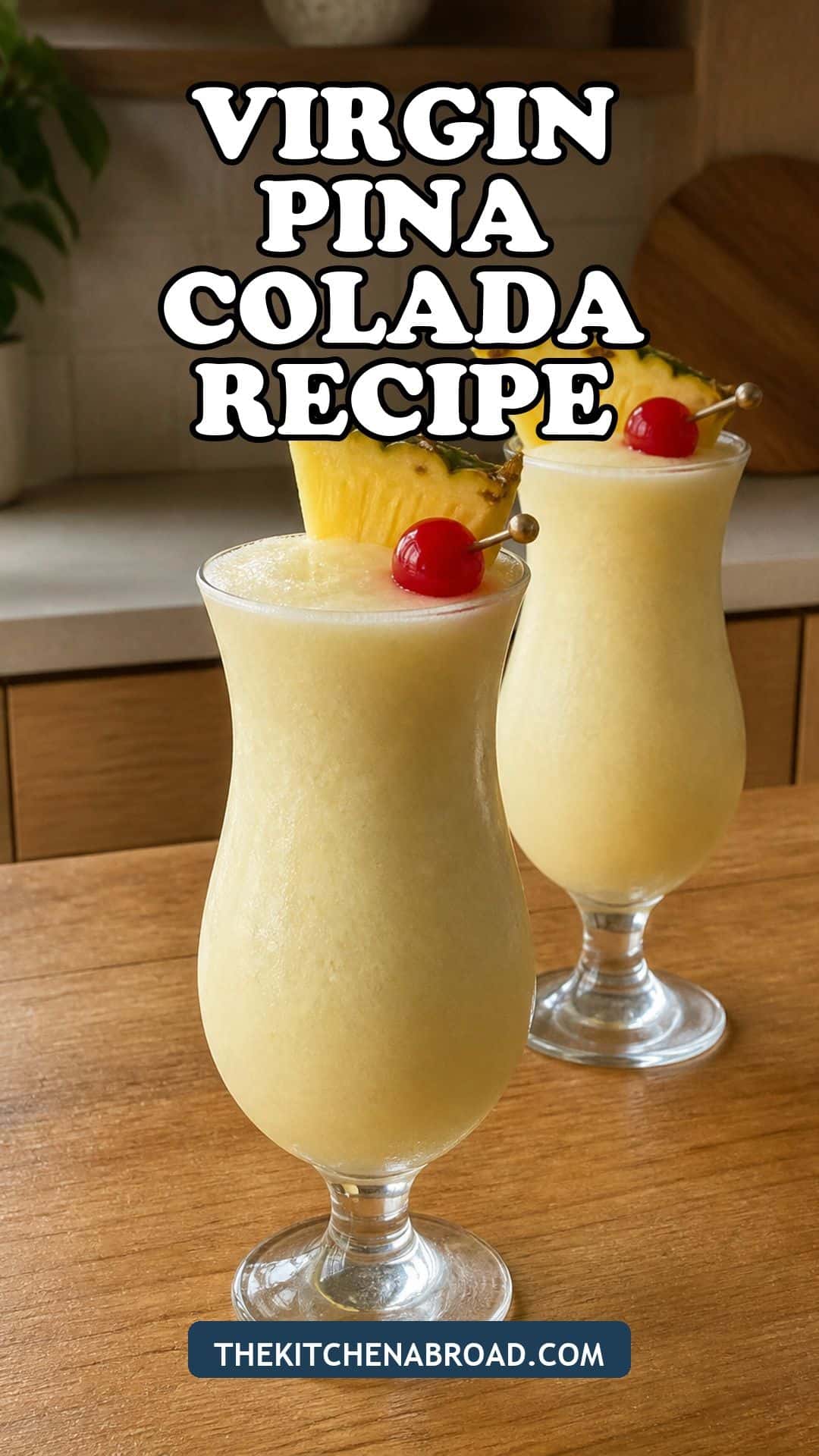
Quick answer: A virgin pina colada is a non-alcoholic tropical blender drink built on the canonical Caribbean trio of fresh pineapple, real coconut cream, and fresh lime juice. The pineapple does the heavy lifting on flavor and body, the coconut pulls velvet across the tongue, and the squeeze of lime keeps the whole thing from reading like dessert in a glass. Five minutes, one blender, two hurricane glasses. Serves two.
A virgin pina colada is the rum-free version of the 1954 Caribe Hilton original: pineapple, coconut cream, lime, ice, blended cold until the drink turns the color of soft sand. Three ingredients do nearly all the work, and getting them right is most of the recipe. Skip the bottled mix, skip the canned crushed pineapple, and use real coconut cream over the artificial stuff. Everything else is the blender and the order things go in.
Recommended Products
A pair of hurricane glasses gives the drink its tropical-bar silhouette and reads as a real cocktail rather than a juice. A personal blender does the emulsification work a shaker cannot, suspending coconut fat into pineapple and lime acid until the texture turns velvety. A can of cream of coconut (Coco Lopez is the canonical brand Marrero used in 1954) carries the structural sweetness. A hand-press citrus juicer pulls every drop from the lime without grinding bitter peel oil into the juice. Glass straws finish the visual.


Recommended Reads
- Sweet & Zesty Coconut Lime Drink
- Strawberry Lime Mocktail Margarita
- Virgin Strawberry Daiquiri
- Orange Coconut Creamsicle Drink
- Best Fall Mocktails
Where the Piña Colada Came From
The piña colada was invented on August 15, 1954, at the Caribe Hilton Hotel in San Juan, Puerto Rico. Bartender Ramón “Monchito” Marrero spent three months tuning the welcome drink before settling on white rum, pineapple juice, and the newly available Coco Lopez cream of coconut. He poured the drink at the Beachcomber Bar for the next 35 years. In 1978, Puerto Rico declared the piña colada its official drink. In 2004, Governor Sila María Calderón formalized the 50th anniversary at the hotel itself.
Difford’s Guide notes two competing claimants worth flagging for the historical record: Ricardo García, also at the Caribe Hilton, and Ramón Portas Mingot at the Barrachina restaurant in 1963. The Caribe Hilton and Marrero attribution is the version cited by Hilton’s own archives, by the Puerto Rican state proclamation, and by most cocktail historians. The virgin version simply lifts out the rum and lets pineapple, coconut, and lime carry the drink on their own.
A Few Notes on the Ingredients
- Fresh pineapple: The gold standard. Cut a whole ripe pineapple into chunks, freeze them overnight on a sheet tray, and bag them. Frozen fresh chunks blend up thicker than ice and do the cooling work without dilution.
- Bagged frozen pineapple: The next best option when you cannot freeze your own. Skip canned crushed pineapple altogether; it bleeds water as it sits and dulls the natural acid that gives the finished drink its tart edge.
- Cream of coconut: A sweetened syrup at roughly 50% sugar by weight (Coco Lopez, Coco Real). This is the canonical 1954 build. Use 1/2 cup and skip any added sweetener.
- Unsweetened coconut cream: The cleaner-flavored alternative at around 24% fat (Native Forest, Aroy-D, Thai Kitchen Premium). Use 1/2 cup plus 2 tablespoons of simple syrup to match the sweetness of the cream of coconut version.
- Fresh lime juice: One ounce is the yield of one large lime. Lime carries the Caribbean register and a slight bitterness from the peel oils that keeps the drink from sliding into smoothie territory. Lemon flattens the whole thing toward a generic blended fruit drink.
- Ice or frozen pineapple: Enough to blend up thick enough that a spoon stands up briefly before it tips. The ratio that works across both coconut paths is two parts pineapple to one part coconut element to a squeeze of lime.
Recipe: Virgin Piña Colada
Prep time: 5 minutes | Total time: 5 minutes | Serves: 2
Ingredients
- 2 cups (300 g) frozen pineapple chunks, OR fresh pineapple chunks plus 1 cup (240 g) ice
- 1/2 cup (120 ml) cream of coconut (Coco Lopez), OR 1/2 cup (120 ml) unsweetened coconut cream plus 2 tbsp (30 ml) simple syrup
- 1 oz (30 ml) fresh lime juice, from 1 large lime
- 1/2 cup (120 ml) pineapple juice (skip if using fresh pineapple chunks and want a thicker pour)
- Two hurricane glasses, chilled in the freezer for 10 minutes
- Pineapple wedge and maraschino cherry, to garnish
Instructions
- Pull two hurricane glasses from the cupboard and slide them into the freezer for 10 minutes while you build the drink. A frosted glass slows the melt once the blended pour hits it and earns the drink the look of something served at a beach bar instead of a kitchen counter.
- Pour the liquids into the blender first: cream of coconut (or coconut cream and simple syrup), fresh lime juice, and pineapple juice if using. Pulse for 5 seconds to combine and dissolve the syrup if you are using it. Building the liquid base first lets the frozen fruit blend evenly without forcing the blade to chip its way through a wall of ice.
- Add the frozen pineapple chunks on top of the liquids. If you are using fresh pineapple chunks instead of frozen, add them now along with 1 cup of ice. The frozen route gives a noticeably thicker, fruit-forward pour; the fresh-plus-ice route is lighter and reads slightly more like the classic bar version.
- Blend on high for 15 to 20 seconds, pulsing toward the end, until the drink reaches a thick slushy consistency that holds the trail of a spoon for a beat before falling back. Stop the moment it looks unified. Over-blending heats the mix, melts the pineapple, and thins the texture.
- Pull the hurricane glasses from the freezer. Divide the drink evenly between them. The pour should be thick enough to support a straw but loose enough to sip without a spoon.
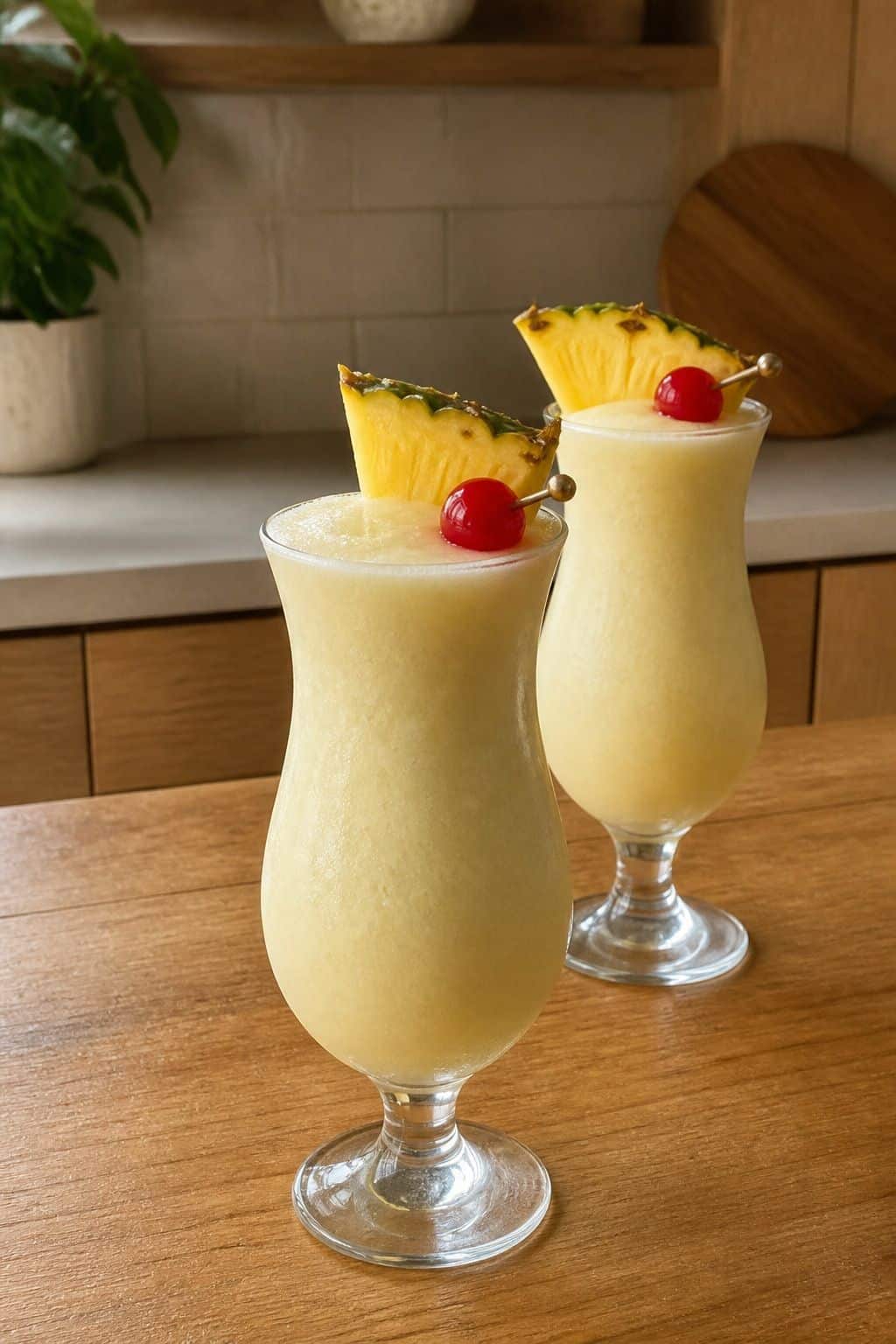
- Slide a pineapple wedge onto the rim of each glass and skewer a maraschino cherry alongside it on a cocktail pick. Add a glass straw. Serve immediately while the drink is still cold and the texture is still tight.
Notes
If the drink sits for more than 15 minutes before serving, the ice will start to melt and the coconut fat will begin to separate from the pineapple juice. A short whisk or another 5-second pulse in the blender brings it back together. Do not freeze the blended mix; it separates and the texture never quite returns.
To scale for a pitcher of six, multiply everything by three and blend in two batches if your blender jar is small. Pour into a chilled pitcher and stir gently before pouring into individual hurricane glasses. Garnish at the rim of each glass rather than the pitcher; coconut fat clings to the inside of the pitcher and looks streaky.
If a blender is not on the counter, a cocktail shaker is a workable second choice. Combine the cream of coconut, pineapple juice, and lime juice in the shaker tin and stir for 20 seconds to dissolve. Fill with crushed ice, seal, and shake hard for 15 seconds. Strain into chilled hurricane glasses over fresh crushed ice. The texture is thinner than the blender version, but the flavor reads correctly.
Tips and Variations
Fresh and Frozen Pineapple Over Canned Crushed
Canned crushed pineapple sits in syrup and water for shelf stability, and the moment it hits the blender it bleeds that water into the drink and dulls the fruit’s natural acid. Fresh pineapple chunks frozen overnight are the home-friendly best. Bagged frozen pineapple from the freezer aisle is a strong second. Fresh pineapple at room temperature works if you add a cup of ice to compensate. Canned crushed pineapple is the only path worth skipping outright.
The Adult Non-Alcoholic Upgrade With NA Rum
For a more grown-up reading without the alcohol, add 1 to 2 ounces of a non-alcoholic white rum (Ritual Zero Proof, Lyre’s White Cane Spirit, or Spiritless Jalisco 55 if you can find it) to the blender alongside the liquids. The NA rum adds a faint vanilla and oak finish that pulls the drink closer to the 1954 original and is the move when you are serving a mixed crowd that includes designated drivers, pregnant guests, and friends who simply do not drink.
Frozen Pineapple Vs Ice for Texture
The two methods produce noticeably different drinks. Frozen pineapple plus pineapple juice gives a thicker, denser, more fruit-forward pour with the body of a smoothie and very little dilution. Fresh pineapple plus a cup of ice gives a lighter, more liquid pour with the texture of a classic bar-style frozen drink. A 50-50 split (1 cup frozen pineapple plus 1/2 cup ice) is the middle path and the version most home blenders handle best.
Scaling for a Poolside Pitcher of Six
Multiply the recipe by three: 6 cups frozen pineapple, 1.5 cups cream of coconut, 3 ounces fresh lime juice, 1.5 cups pineapple juice. Blend in two batches and combine in a chilled pitcher with a long stir. Pour into individual hurricane glasses at the time of serving; the drink holds its texture in a chilled pitcher for about 30 minutes before separation starts. Garnish at the glass rim, not the pitcher.
The Strawberry-Piña Twist for Color
For a strawberry-piña hybrid that swings the color from pale sand to soft coral, add 1 cup of frozen strawberries to the blender alongside the frozen pineapple. The strawberries pull the drink in a slightly tart direction and read as a piña colada layered with a frozen strawberry daiquiri. Keep the lime, keep the coconut, drop the pineapple juice down to 1/4 cup so the texture stays tight. Serve in the same hurricane glass with a strawberry pressed onto the rim alongside the pineapple wedge.
What to Serve It With
The virgin pina colada is built for hot weather and salt air. It sits comfortably alongside Caribbean food (jerk chicken, coconut shrimp, mango salsa over grilled fish), beach picnic spreads (cold sesame noodles, watermelon salad, citrus slaw), and pool-party menus (grilled shrimp skewers, pineapple-glazed ribs, charred corn). At a backyard BBQ it cools the palate between bites of smoke and char. On a hot summer afternoon with nothing to do, it works on its own with a paper umbrella and a slow porch chair.
FAQ
What is in a virgin piña colada?
Fresh or frozen pineapple, real coconut cream or cream of coconut, fresh lime juice, and ice (or frozen pineapple acting as the ice). The classic 1954 Caribe Hilton build adds white rum; the virgin version simply lifts the rum out and lets pineapple and coconut carry the drink. Some recipes add a small pour of pineapple juice for body, which is helpful when using fresh rather than frozen pineapple.
What’s the difference between coconut cream and cream of coconut?
Coconut cream is unsweetened, around 24% fat, and thick (Native Forest, Aroy-D, Thai Kitchen Premium). Cream of coconut is a heavily sweetened syrup at roughly 50% sugar by weight (Coco Lopez, Coco Real). The two are not interchangeable. With cream of coconut, skip added sweetener. With coconut cream, add 2 tablespoons of simple syrup to balance.
Can you make a piña colada without a blender?
Yes. Combine cream of coconut, pineapple juice, and fresh lime juice in a cocktail shaker. Stir for 20 seconds to dissolve, then fill with crushed ice and shake hard for 15 seconds. Strain into a hurricane glass over fresh crushed ice. The texture is thinner than the blender version, with a small separation line that forms after about 10 minutes, but the flavor stays right.
Is a virgin piña colada safe during pregnancy?
Yes, no alcohol is involved. The drink is built on pineapple, coconut cream, lime juice, and ice. Always confirm with your provider if you have specific dietary restrictions during pregnancy. Skip any garnish that uses a maraschino cherry packed with red dye if that is a concern, and use a fresh pineapple wedge instead.
Why is my piña colada watery instead of creamy?
Three common reasons. Too much ice and not enough frozen fruit (switch to frozen pineapple chunks as the cooling agent). Canned crushed pineapple bleeding water into the drink (switch to fresh or frozen fresh chunks). Over-blending heating the mix and breaking the texture (stop the blender the moment the drink unifies, usually around 15 to 20 seconds on high).
What glass is a piña colada served in?
A hurricane glass is the Caribbean default: a curvy, footed 15 to 20 oz glass shaped like a hurricane lamp, designed for blended tropical drinks. A footed pilsner, large stemless wine glass, or tall rocks glass all work as substitutes. Clear glass shows off the pale yellow color and the rim should be wide enough for a pineapple wedge, a cherry, and a straw.
Key Takeaways
- Pineapple, coconut cream, and lime is the canonical Caribbean trio. Hold that line and the drink runs itself.
- Fresh or frozen-fresh pineapple beats canned crushed every time. Canned crushed bleeds water and dulls the acid.
- Coco Lopez cream of coconut is sweetened and built for the drink. Unsweetened coconut cream needs 2 tablespoons of simple syrup to match.
- Fresh lime, not lemon. Lime keeps the Caribbean register; lemon flattens the drink toward a generic smoothie.
- A blender beats a shaker for texture, but a hard 15-second shake with crushed ice is a workable backup.
- Serve in a chilled hurricane glass with a pineapple wedge and a maraschino cherry. The ritual is part of the drink.
Final Thoughts
The virgin pina colada is a five-minute build that lives or dies on three small decisions made before the blender turns on. Fresh or frozen-fresh pineapple over canned crushed. Real coconut cream (sweetened Coco Lopez or unsweetened coconut cream plus simple syrup) over bottled mix. Fresh lime over bottled lime or lemon. Get those three right and the rest of the recipe is the blender, the cold, and the order things go in.
The drink earns its place in the rotation not because it copies a bar pour but because it carries a 70-year Puerto Rican lineage straight from the Beachcomber Bar of the Caribe Hilton into a home kitchen. Marrero spent three months developing the original. The home version takes five minutes. The honest reading is that the work was done in 1954 and the home cook is simply borrowing the template.
Pour it at a pool party, a backyard summer brunch, a Caribbean-themed dinner, or a hot porch afternoon where the cooler holds nothing more complicated than a bag of frozen pineapple and a can of Coco Lopez. Add a pineapple wedge, a cherry, and a glass straw. Everything else is the blender and the cold.
Virgin Pina Colada
A virgin pina colada is a non-alcoholic frozen pineapple coconut drink. Use frozen pineapple for body, cream of coconut for sweetness, coconut milk for flow, and lime to keep it from tasting flat. Blend only until smooth so it stays thick and frosty.
Ingredients
- 2 cups (300 g) frozen pineapple chunks, OR fresh pineapple chunks plus 1 cup (240 g) ice
- 1/2 cup (120 ml) cream of coconut (Coco Lopez), OR 1/2 cup (120 ml) unsweetened coconut cream plus 2 tbsp (30 ml) simple syrup
- 1 oz (30 ml) fresh lime juice, from 1 large lime
- 1/2 cup (120 ml) pineapple juice (skip if using fresh pineapple chunks and want a thicker pour)
- Two hurricane glasses, chilled in the freezer for 10 minutes
- Pineapple wedge and maraschino cherry, to garnish
Instructions
- Add frozen pineapple, pineapple juice, cream of coconut, coconut milk, and lime juice to a blender.
- Blend until thick and smooth. If the blender struggles, add a splash more pineapple juice.
- Taste before adding ice. If you want it thicker or colder, add ice a little at a time and blend briefly.
- Pour into chilled glasses and garnish. Serve immediately.
Notes
If using fresh pineapple instead of frozen, add 1 1/2 cups ice and expect a lighter, icier texture.
Last update on 2026-08-24 / Affiliate links / Images from Amazon Product Advertising API