

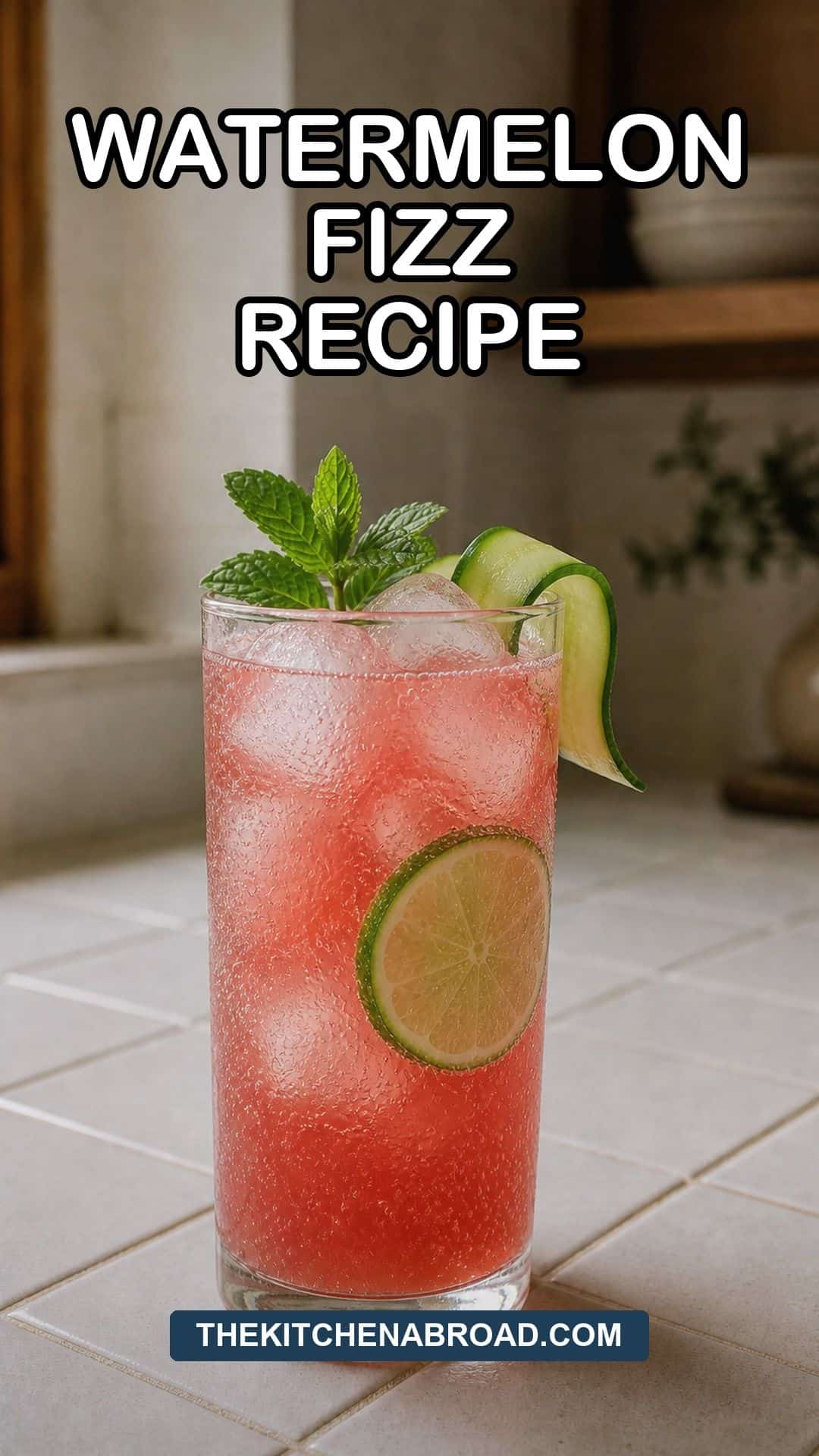
A watermelon fizz is fresh-juiced watermelon over ice with lime, a pinch of salt to push the sweetness, and cold club soda poured last. Two cups of cubed seedless watermelon yields about three-quarters of a cup of strained juice. Ten minutes, serves two.
Watermelon was domesticated in northeastern Africa about 5,000 years ago, on the dry edge of the Egyptian and Sudanese desert, where the fruit served as both food and water. Seeds turned up in Tutankhamun’s tomb, packed in for the afterlife. The drink in front of you is essentially the same fruit reframed for August: agua de sandia with club soda, lime to brighten, a pinch of salt to make the sweetness read louder. A watermelon mocktail that earns the tall glass.
On the Counter
A Collins glass is the vessel for a fizz. Tall, narrow, holds the carbonation longer than a tumbler and gives the pink color a clean column to read against. A personal smoothie blender handles two cups of watermelon without overwhelming the jar. A fine-mesh nut milk bag is the cheapest path to clear, cocktail-bar juice; a hand citrus juicer pulls the lime in two seconds; a watermelon slicer turns a half melon into cubes faster than a knife. None expensive, all useful for anything fruit-juiced you make after this.


Recommended Reads
- Virgin Strawberry Daiquiri Recipe (the frozen, blended sibling)
- Cucumber Basil Citrus Mocktail Recipe (the savory, herbal counterpoint)
- Summer Picnic Food Ideas (where this drink lives)
- Blackberry Lemon Mocktail Recipe
- Cantaloupe Juice Recipe
Where Watermelon Drinks Come From
The fruit predates the recipe by 5,000 years. Watermelon was first cultivated along the Nile in what is now Sudan and southern Egypt around 3,000 BCE, prized less for sweetness than for the water locked inside the rind. Tomb paintings from the period show watermelons stacked beside grain and figs, and dried seeds were buried in Pharaohs’ tombs, Tutankhamun’s included, so the dead had a water source for the journey ahead. The sweet, red, seedless fruit on a modern counter is the result of about three millennia of selective breeding from a hard, pale-fleshed ancestor that tasted closer to a bitter cucumber.
The drink itself traces to the Aztecs. Aguas frescas, fresh fruit pressed into water, are documented as far back as Tenochtitlan, where vendors pulled fruit from canoes in the canals and crushed them straight into the water. Agua de sandia, the watermelon version, is the direct ancestor of every watermelon drink ordered at a Mexican restaurant today, and the direct ancestor of the recipe below. The watermelon fizz is the carbonated upgrade: same fruit, same lime, same logic, with club soda standing in for still water. Pati Jinich serves the still version on her platform; the fizz is what happens when you swap the water for bubbles and reach for a Collins glass.
A Few Notes on the Ingredients
- Fresh watermelon: Never bottled juice. Bottled is pasteurized, which flattens the volatile aromatic compounds that make the fruit taste like watermelon in the first place, and most brands cut it with apple or pear to stretch the yield. A 2-cup wedge from any grocery store is cheaper than the bottle.
- Pick the right melon: Heavy for its size with a yellow ground spot, the patch where it rested on the dirt. Pale or white ground spots mean it was picked early.
- A pinch of salt: The one move every competitor skips. Under one-sixteenth teaspoon, sprinkled on the cubes before they go in the blender. Sodium ions suppress the bitter compounds in the fruit and amplify perceived sweetness, the same reason Southern cooks have been salting watermelon slices for two hundred years.
- Lime, not lemon: Lime keeps the drink in the agua fresca lineage where it belongs. Lemon pushes the glass into spa-water territory and buries the fruit under sharper citrus.
- Club soda or unflavored seltzer: Plain bubbles let the fruit lead. Never ginger ale, which adds a second sweet and a warm note that fights the watermelon for control of the glass. Never Sprite or 7UP, which pile on sugar and sneak lemon back in.
- Pulp or clear: Reader choice. Strain through a nut milk bag for clear, cocktail-bar juice that pours like rose water. Skip the strain for a rustic, agua-fresca-style drink with more body and visible pink flecks. Both versions are correct.
Recipe: Watermelon Fizz
Prep time: 10 minutes | Total time: 10 minutes | Serves: 2
Ingredients
- 2 cups (300 g) cubed seedless watermelon, cold
- 1 pinch fine sea salt, under 1/16 teaspoon
- 1 oz (30 ml) fresh lime juice, from about 1 large lime
- 0.5 oz (15 ml) simple syrup, optional; the ripeness of the watermelon sets the need
- 4 oz (120 ml) cold club soda or unflavored seltzer
- 4 to 6 large ice cubes
- 1 lime wheel, 1 mint sprig, and 1 cucumber ribbon, optional garnish
Instructions
- Cube 2 cups (300 g) of cold seedless watermelon, drop the cubes into the blender jar or a bowl, and sprinkle a true pinch of fine sea salt over the top. Rest the salted fruit 5 minutes. The salt pulls a small amount of liquid out of the cells and primes the blender for a smoother puree.
- Blend on medium for 20 to 30 seconds, no longer. Blades running too long warm the juice and dull the flavor. The puree should look pink and uniform with no chunks.
- Decide pulp or clear. For a rustic, agua-fresca-style fizz with more body, pour the puree straight into a measuring cup. For a clear, cocktail-bar finish, pour the puree into a nut milk bag set over a measuring cup and let gravity do the work for 2 to 3 minutes. Do not squeeze the bag; pressing forces fiber through and clouds the juice. You should end up with about 3/4 cup (180 ml) of juice.
- Roll one large lime under your palm for ten seconds, halve, and press through a hand citrus juicer for 1 oz (30 ml) of fresh juice. Taste the watermelon juice first, then decide on the simple syrup. A ripe August melon needs none; an early-season melon needs the full 0.5 oz (15 ml).
- Fill two Collins glasses with 4 to 6 large ice cubes each. Big cubes hold the fizz longer than crushed ice, which melts fast and turns the drink into watery pink water inside a minute.
- Split the watermelon juice between the two glasses. Add 0.5 oz (15 ml) of fresh lime to each, and the simple syrup if you are using it. Stir briskly with a bar spoon for 5 seconds to integrate.
- Top each glass with 2 oz (60 ml) of cold club soda, poured slowly down the side of the glass to preserve carbonation. Lift the bar spoon once from bottom to top. Do not stir in circles; circular stirring knocks the bubbles out.
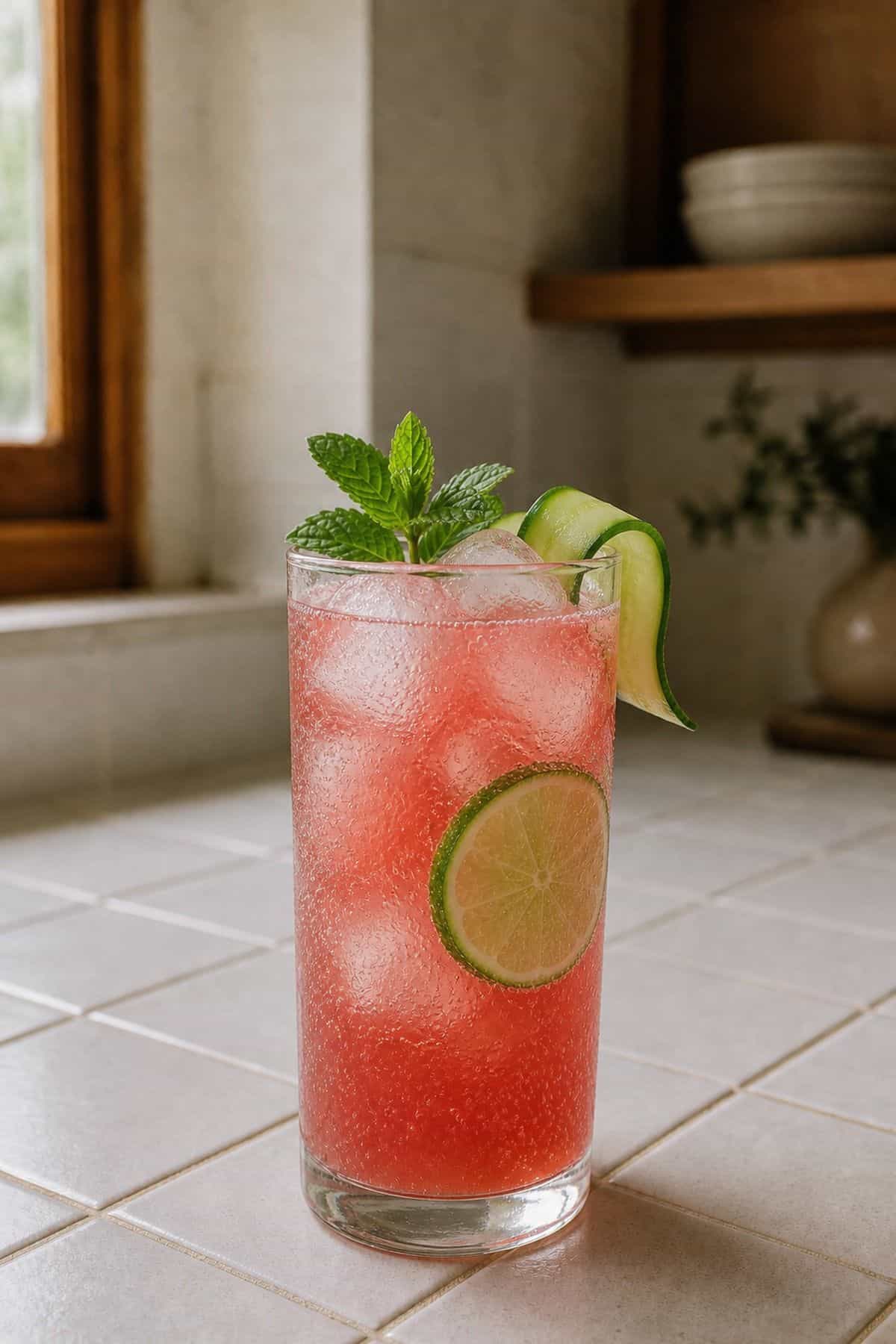
- Garnish with a lime wheel slipped down the side, a mint sprig, and a long cucumber ribbon draped over the rim. Serve immediately while the bubbles climb.
Notes
Fresh watermelon juice keeps 2 days in a sealed jar in the fridge, after that the flavor flattens and the color dulls toward brown-pink. Squeeze the lime separately and stir it in at pour time; lime juice oxidizes faster than the watermelon and turns bitter inside about 4 hours.
For a pitcher of eight, multiply the watermelon by four (8 cups cubed, about 1.2 kg), the lime by four (4 oz, about 120 ml), and the syrup by four if you need it. Blend in two batches, strain or not, and store the juice in a sealed glass pitcher in the fridge. Pour roughly 3 oz (90 ml) of base over ice in each Collins glass and top with 2 oz (60 ml) of cold club soda individually. Never add the soda to the pitcher; the bubbles flatten inside an hour.
The pulp-versus-clear texture difference is real. Strained juice pours thin and fizzes hard, closer to a bar drink, and reads cleaner on the palate. Unstrained juice pours thicker, holds the fizz less aggressively, and tastes more like fresh fruit because it is. Try both glasses side by side once and the preference will be obvious for next time.
Tips and Variations
The Salt-Pinch Science
Sodium ions interfere with the receptors on the tongue that perceive bitterness, which means the bitter notes in any fruit recede when salt is added. The brain reads the same sweetness as louder by contrast. The effect is subtle but consistent: a salted watermelon tastes about 15 percent sweeter than an unsalted one, no added sugar required. A quarter teaspoon is too much and will read as savory; a true pinch is the right call.
Pulp vs Clear Juice
Pulp gives you body and a deeper pink. Clear gives you a true fizz texture, the kind of pour you would see at a cocktail bar. Nut milk bag for the cleanest result, fine-mesh sieve for a middle ground that still lets some pulp through. Skip straining entirely for the agua fresca version. The recipe holds either way; only the mouthfeel changes.
Batching for a Pitcher of Eight
Blend 8 cups of cubed watermelon (about 1.2 kg) in two batches with a pinch of salt in each. Strain or not, combine in a glass pitcher with 4 oz of fresh lime and 2 oz of simple syrup. Pour 3 oz over ice in each of eight Collins glasses and top with 2 oz of cold club soda at pour time. Set a small bowl of lime wheels and a bunch of mint on the bar for self-serve garnish.
Mint or Basil Garnish
A mint sprig clapped once between your palms to release the oil, then floated on top, is the standard move. Basil works equally well and pushes the drink closer to the savory side; a single basil leaf slapped on the back of one hand and dropped in the glass changes the whole register. Pair the basil version with the cucumber basil mocktail if you are serving both at the same table.
Frozen Watermelon Juice Ice Cubes
Pour any leftover strained juice into a silicone ice cube tray and freeze. Drop the pink cubes into the next round of fizz instead of regular ice, and the drink stays full-strength as it melts. The same trick works for any agua fresca, lemonade, or sangria; the cubes hold flavor for about two weeks in the freezer before they pick up freezer notes.
The Agua Fresca Version
Drop the club soda and use still water in its place, 4 oz per glass, with a bump in juice to 4 oz per glass for a higher fruit ratio. This is the traditional agua de sandia, the way it has been served in Mexico for centuries. Pour over a glass of ice in a tall tumbler instead of a Collins, garnish the same. Less fizz, more fruit, same lineage.
What to Serve It With
A hot-weather drink for hot-weather food. Pour it alongside a summer BBQ (burgers, grilled corn, pulled pork sandwiches), at a poolside afternoon with chips and guacamole, on a picnic blanket with sandwiches and a bowl of fruit salad, or on the back deck on a 95-degree afternoon with a book and shade. For a brunch table, set the pitcher between the avocado toast and a fruit plate. The drink reads as considered next to anything alcoholic on the same bar; it photographs in pink against a green tablecloth or a teak deck.
Frequently Asked Questions
What is a watermelon fizz made of?
Fresh watermelon juice, a pinch of salt, fresh lime juice, optional simple syrup, and cold club soda, built over ice in a Collins glass. Two cups of cubed seedless watermelon yields about three-quarters of a cup of strained juice, enough for two tall glasses. No bottled juice, no ginger ale, no lemon-lime soda. The watermelon does the heavy lifting; the rest of the build is there to brighten and lift.
How do you make watermelon juice without a juicer?
Cube seedless watermelon, drop the cubes into a blender, salt lightly, and pulse for 20 to 30 seconds until smooth. Pour the puree through a nut milk bag or fine-mesh sieve set over a measuring cup and let gravity strain the juice for 2 to 3 minutes. Do not press the pulp; pressing forces fiber through and clouds the juice. Two cups of cubed melon makes roughly three-quarters of a cup of clear juice.
Should you strain watermelon juice?
Reader choice. Strain through a nut milk bag for a clear, cocktail-bar finish that pours thin and fizzes hard. Skip the strain for a rustic, agua-fresca-style drink with more body and visible pink flecks. Both versions are correct; the texture is different. Try them side by side once and the preference for next time will be obvious.
Why do people put salt on watermelon?
A pinch of salt suppresses the bitter compounds in the fruit and amplifies perceived sweetness. Sodium ions interfere with the receptors on the tongue that read bitterness, so the same fruit tastes about 15 percent sweeter with salt than without. Southern cooks have used the trick on watermelon slices for two hundred years. In a fizz, a true pinch sprinkled on the cubes before blending does the same job.
Can you make watermelon mocktail ahead of time?
Yes, partially. Strain the watermelon juice up to 24 hours ahead and refrigerate in a sealed glass jar. Add lime juice, simple syrup, ice, and cold club soda only at serving so the fizz stays alive and the lime stays bright. Carbonation does not survive overnight no matter how tight the seal; a drink built fully ahead reads flat the next morning.
Is watermelon fizz the same as watermelon agua fresca?
Same family, different build. Agua de sandia is fresh watermelon juice with still water, lime, and sugar, served over ice in a tall tumbler; a tradition from Aztec-era Tenochtitlan still served across Mexico daily. Watermelon fizz swaps the still water for club soda and uses a higher juice-to-water ratio. Same lineage, fizzier finish, served in a Collins glass instead of a clay-cooled jar.
Key Takeaways
- Fresh watermelon, never bottled juice. Two cups cubed seedless watermelon yields about three-quarters of a cup of strained juice, enough for two glasses.
- A true pinch of salt on the cubes before blending. Sodium suppresses bitterness and pushes perceived sweetness about 15 percent louder.
- Lime, not lemon. Keeps the drink in the agua fresca lineage; lemon pushes it into spa-water territory.
- Club soda or unflavored seltzer, never ginger ale or lemon-lime soda. The fruit should lead, not the bubbles.
- Pulp or clear, reader choice. Nut milk bag for cocktail-bar finish, skip the strain for agua-fresca body.
- Build over big ice cubes in a Collins glass, soda last, single bar spoon lift. Serve immediately.
Final Thoughts
A watermelon fizz built this way tastes like the inside of a melon and nothing else. Fresh-juiced fruit, a tiny pinch of salt doing the quiet work of lifting the sweetness, fresh lime keeping the drink in its proper lane, and clean bubbles to give the whole thing lift. Ten minutes from cutting board to first sip.
The lineage goes back further than the recipe lets on. Five thousand years in Egypt, then west across the ocean and into Mexico, where agua de sandia became the daily summer drink it still is. The fizz is the carbonated version of that same idea: same fruit, same lime, same logic, with club soda standing in for canal water.
Build it for a pool party, a back-deck afternoon, a picnic blanket, or a hot Sunday lunch where nobody wants anything heavy. Pour it for the friends running Dry July, the kids who deserve a glass that reads as adult, or for yourself at 3pm on a 95-degree afternoon. The vodka was never part of this drink. The salt always was.
Last update on 2026-10-05 / Affiliate links / Images from Amazon Product Advertising API