
An apple sour cream slice built on the Australian Country Women’s Association template: a shortbread base of butter, flour, and a little sugar pressed into a 9×9 dish and blind-baked for fifteen minutes, a middle layer of Granny Smith apples slumped with cinnamon and a pinch of nutmeg, and a sour cream custard (sour cream, eggs, sugar, vanilla) poured over the top and baked at 350°F until the surface barely jiggles. Cooled fully in the pan before slicing, cut into squares, served at room temperature with afternoon tea. The recipe traces back to the CWA cookbooks of the 1950s and 60s and was canonised by Australian Women’s Weekly in the 1970s, when this exact slice ran in nearly every suburban kitchen between Brisbane and Perth.
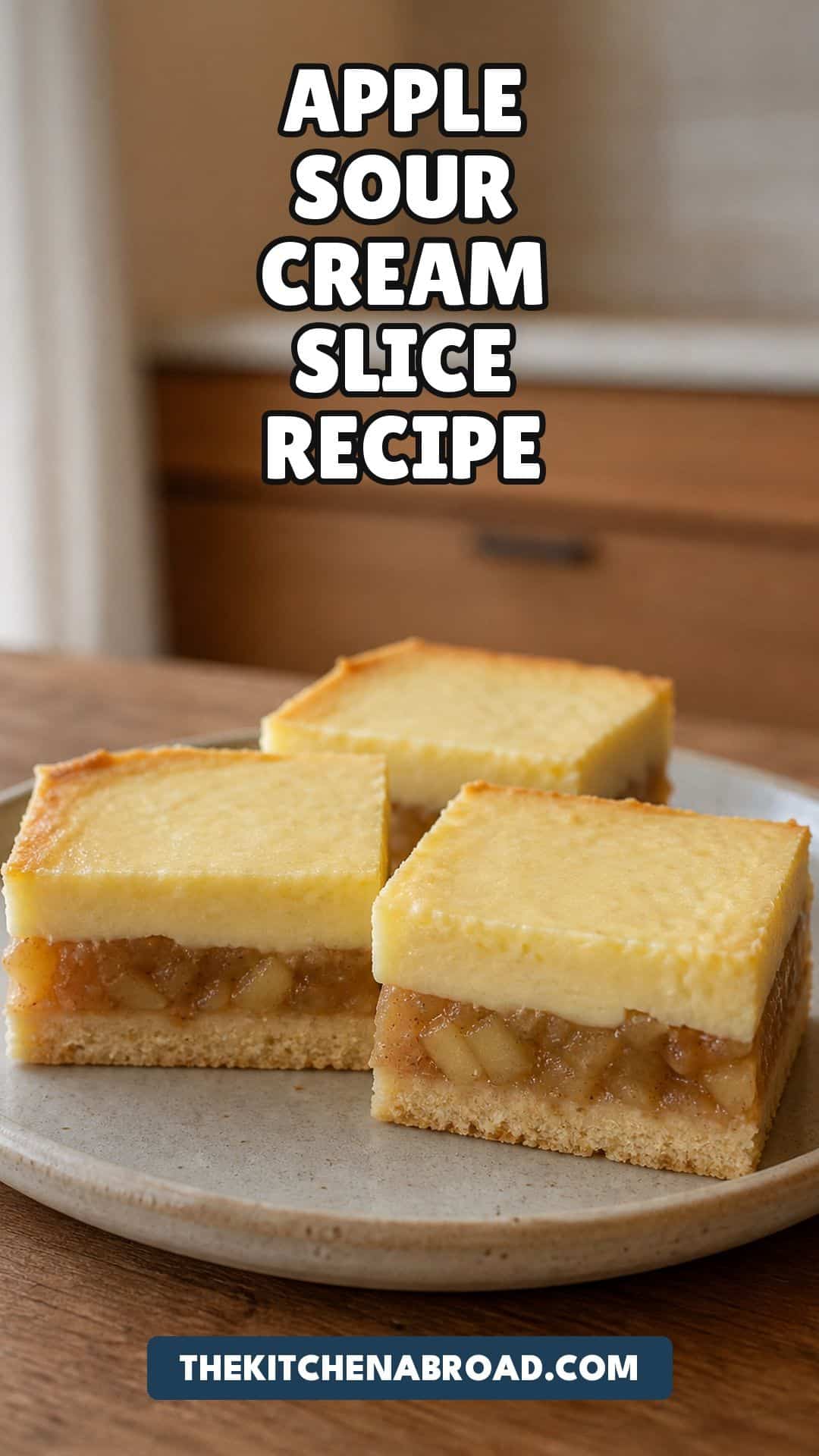
There is a specific kind of slice tin that comes out for afternoon tea in Australia, and the apple sour cream slice is one of the half-dozen recipes that fills it. The base is shortbread, the middle is spiced apple, the top is a pale custard set with sour cream and eggs, and the whole thing cuts cleanly into squares once it has had a few hours in the fridge. It sits next to lamingtons and Anzac biscuits in the canon, and it shows up on country show tables and in church hall fundraisers with a frequency that tells you everything about how Australian home baking actually works. The version below is the one that was printed and reprinted across CWA cookbooks for fifty years before Women’s Weekly carried it into every suburban kitchen in the 1970s. Three layers, one tin, four hours start to finish (most of that cooling). It keeps four days in the fridge, travels well to a picnic, and reads as old-fashioned in all the right ways. If you have made a New York-style sour cream apple pie before, the math is similar; this is the slice version, cut into squares, sized for a teacup beside it.
What You’ll Need
A 9×9-inch ceramic or metal baking dish lined with parchment paper that overhangs on two sides (the overhang is how you lift the cooled slice out cleanly), a set of glass mixing bowls for the base, the apple filling, and the custard topping (three layers, three bowls, no cross-contamination), a pastry cutter or two knives for rubbing the cold butter into the flour for the shortbread base, a Microplane for the lemon zest that goes into the apple filling, and a half-sheet pan with parchment that you set under the dish in the oven to catch any custard drips. None of the equipment is exotic. The dish size matters most: a 9×9 gives you the right ratio of base to filling to topping. An 8×8 over-fills, a 9×13 spreads too thin.


Recommended Reads
Where Apple Sour Cream Slice Came From
The Country Women’s Association of Australia was founded in 1922, eight years after the equivalent organisations in Canada and the United States, in response to the rural isolation that characterised inland Australian farming life in the 1910s and 20s. The CWA cookbooks (the first national edition ran in 1936, and reprints continued through every decade afterwards) became the de facto template for Australian home baking for two generations. They codified the slice as a category: a flat tray bake, cut into squares, sized to share, built around store-cupboard ingredients that travelled well to country shows, church fetes, and CWA branch meetings. Apple sour cream slice belongs to that category, alongside vanilla slice, caramel slice, lemon slice, and the dozen other tray bakes that filled an afternoon tea table.
The Women’s Weekly took the CWA template and broadcast it nationally. From the 1950s through the 1980s, Australian Women’s Weekly published recipe inserts that landed in suburban kitchens from Cairns to Hobart, and apple sour cream slice ran in heavy rotation through the 1970s. The combination of a shortbread base, spiced apple, and a sour cream custard hit a particular Australian sweet spot: less rich than American apple pie, less fussy than a French tarte aux pommes, sized for a slice tin instead of a pie plate, and cuttable into the neat squares that an Australian afternoon-tea table demands. The recipe below is recognisably the Women’s Weekly version, with the proportions tightened slightly and the spice rebalanced toward a touch more nutmeg. The bones are unchanged. This is the slice that fed a generation of Australian children at school fetes, and it still works.
A Few Notes on the Ingredients
- Granny Smith apples: The right apple for this slice because the tartness cuts through the sour cream custard and the flesh holds its shape after thirty minutes in a hot oven. Pink Ladies are the second-best option if Grannies are not available. Avoid Red Delicious, which turns to mush.
- Cold unsalted butter for the base: Straight from the fridge, cut into cubes, rubbed into the flour with a pastry cutter until the texture is coarse sand. Cold butter is what makes the base shortbread-crisp instead of greasy.
- Full-fat sour cream for the topping: Not Greek yogurt, not low-fat sour cream. The fat content (around 14 to 18 percent) is what gives the custard topping its set and its flavour. Bulla is the Australian default; in the US, Daisy or Tillamook full-fat works the same way.
- Caster sugar (superfine sugar): The fine grain dissolves cleanly into both the shortbread base and the sour cream custard. Regular granulated sugar works in a pinch but you get a slightly grittier custard.
- Fresh lemon zest: Goes into the apple filling, not into the topping. Zest brightens the spiced apple layer and keeps the cinnamon and nutmeg from sitting heavy on the tongue. The juice goes in too, a quick squeeze to keep the apples from browning while you build the rest of the slice.
- Ground cinnamon and a small grating of nutmeg: The cinnamon is the foreground spice, the nutmeg sits in the background. Use whole nutmeg grated on a Microplane if you can; ground nutmeg from a jar loses its perfume within six months of opening.
- Vanilla bean paste or extract: Goes into the sour cream topping. Vanilla bean paste gives you visible flecks in the custard, which is the Women’s Weekly look; pure extract works the same way flavour-wise without the visual.
- Eggs at room temperature: Pull them out of the fridge an hour before you bake. Cold eggs whisked into room-temperature sour cream can curdle the topping; matched temperatures whisk to a smooth custard.
Recipe: Apple Sour Cream Slice
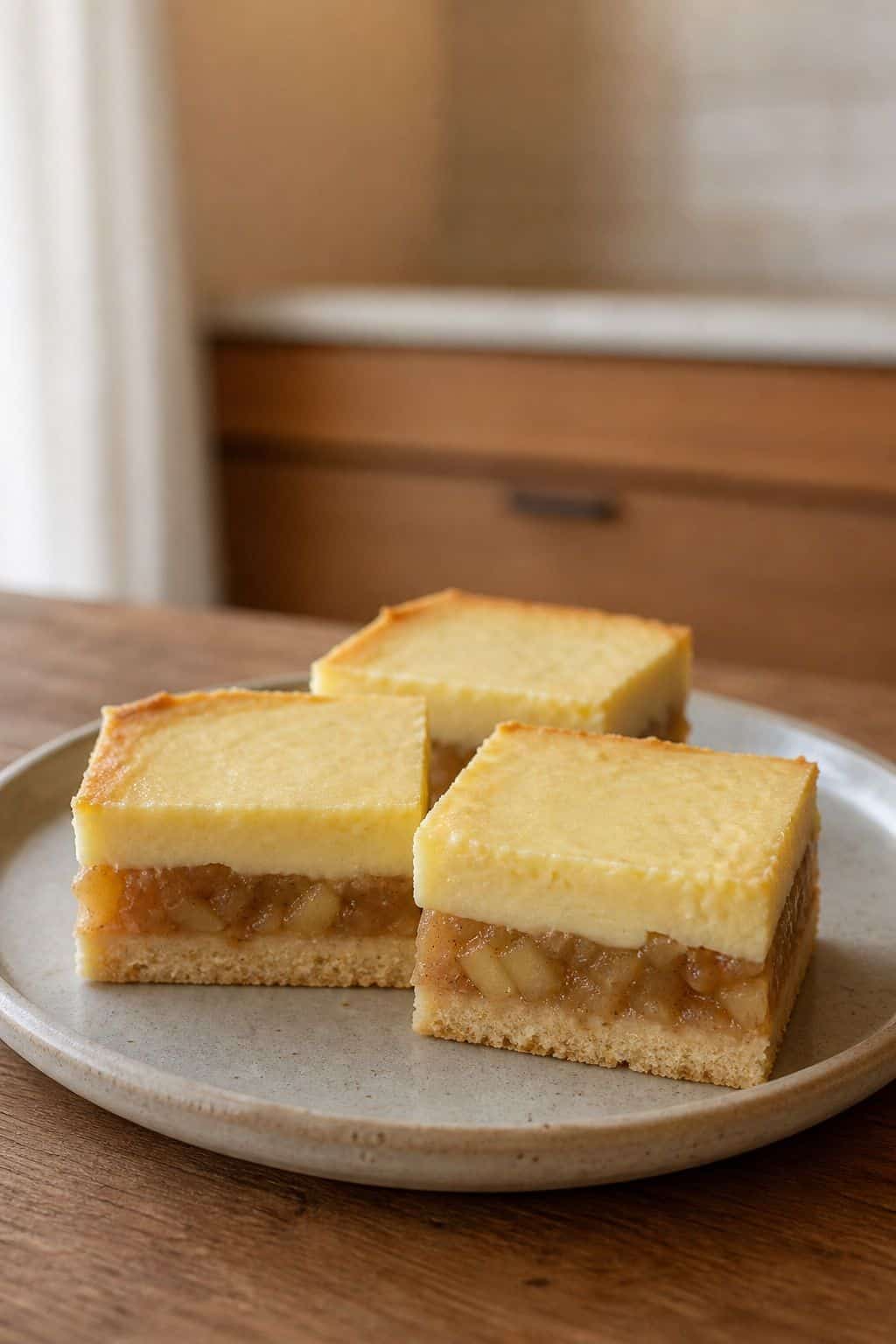
Prep time: 25 minutes | Cook time: 45 minutes | Total time: 1 hour 10 minutes + 3 hours cooling | Serves: 12 to 16 squares
Ingredients
For the shortbread base:
- 1 1/2 cups (190 g) all-purpose flour
- 1/3 cup (70 g) caster sugar
- 1/2 cup (115 g) cold unsalted butter, cubed
- 1/4 tsp fine sea salt
- 1 large egg yolk
For the apple filling:
- 4 medium Granny Smith apples, peeled, cored, and sliced 1/4 inch thick (about 4 cups / 500 g)
- 2 tbsp (25 g) caster sugar
- 1 tsp ground cinnamon
- 1/4 tsp freshly grated nutmeg
- Zest of 1 lemon
- 1 tbsp fresh lemon juice
For the sour cream topping:
- 1 1/4 cups (300 g) full-fat sour cream, room temperature
- 2 large eggs, room temperature
- 1/2 cup (100 g) caster sugar
- 1 tsp vanilla bean paste (or pure vanilla extract)
- 2 tbsp (15 g) all-purpose flour
Instructions
- Heat the oven to 350°F (180°C) with a rack in the centre. Line a 9×9-inch baking dish with parchment paper, leaving an overhang on two opposite sides so you can lift the cooled slice out cleanly.
- Make the shortbread base. In a medium bowl, whisk together the flour, caster sugar, and salt. Add the cubed cold butter and rub it into the flour with a pastry cutter or your fingertips until the mixture looks like coarse sand with pea-sized bits of butter still visible. Add the egg yolk and stir with a fork until the dough just comes together. It will look shaggy, not smooth.
- Tip the dough into the lined dish and press it firmly into an even layer across the base, pushing it into the corners with the back of a spoon or your fingertips. Prick the surface all over with a fork (about a dozen pricks). Bake for 15 minutes, until the base is set, dry on top, and just starting to colour at the edges. Pull from the oven and set aside while you make the filling.
- Make the apple filling. In a large bowl, toss the sliced Granny Smith apples with the caster sugar, cinnamon, nutmeg, lemon zest, and lemon juice until evenly coated. Layer the apples over the par-baked base in overlapping rows, packing them tightly so the whole surface is covered. The apples will slump as they bake, so do not worry about a perfect arrangement.
- Make the sour cream topping. In a clean medium bowl, whisk together the sour cream, eggs, caster sugar, vanilla bean paste, and flour until the mixture is smooth and lump-free. The flour is the stabiliser that keeps the custard from cracking as it sets.
- Pour the sour cream topping evenly over the apple layer, tilting the dish so the topping flows into every gap. The topping should cover the apples by about 1/4 inch.
- Slide the dish back into the oven on the centre rack and bake for 30 to 35 minutes, until the topping is just set, pale gold around the edges, and barely jiggles in the centre when you nudge the dish. Do not overbake; the centre will continue to set as it cools.
- Cool the slice in the dish on a wire rack for 1 hour at room temperature, then transfer to the fridge and chill for at least 2 hours before slicing. The cold set is what gives you clean squares.
- Lift the slice out of the dish using the parchment overhang and transfer to a cutting board. Cut into 12 or 16 squares with a sharp knife, wiping the blade clean between cuts. Serve at room temperature or lightly chilled.
Notes
The blind-bake of the shortbread base is the single step that separates a clean slice from a soggy one. Skipping the par-bake (or shortening it to ten minutes) means the apple juice and the sour cream custard soak into a raw base and you end up with a wet, structureless bottom. Fifteen minutes at 350°F with the surface pricked all over is the answer. The base will look pale and matte when it comes out the first time; that is exactly right.
Apples vary in moisture content. If you are working with apples that have been in cold storage for a while (most US supermarket Grannies in the off-season), they release less juice and the filling comes out drier and firmer. Fresh-season apples from a farmer’s market in autumn release more juice and the filling cooks down softer. Both work. If your apples look very wet after tossing with sugar and lemon, drain off any standing juice before layering them onto the base.
The slice keeps four days in an airtight container in the fridge and is at its best on day two. The sour cream topping firms up overnight, the apple layer settles into the base, and the flavours meld. It does not freeze well; the sour cream custard separates on thaw. Eat it within four days or bake fresh.
Tips and Variations
Why Blind-Bake the Base First
The shortbread base is built from a high-fat, low-liquid dough that needs its own oven time before the wet layers go on. If you press the dough into the dish and immediately load the apples and custard on top, the base steams from underneath and never crisps. Fifteen minutes at 350°F with the dough docked (fork-pricked) sets the structure, drives off the small amount of moisture in the egg yolk, and gives you a base that can take thirty more minutes under a layer of juicy apple and a wet custard topping without going soggy. The visual cue is dry-looking surface and a faint blonde tone at the edges. Pull it earlier and the slice will weep through the base; push it longer and the second bake darkens the shortbread to a too-firm crust. Fifteen minutes is the working number.
Pink Ladies and Other Apple Swaps
Granny Smith is the Australian default for cooked-apple desserts because the tartness balances the sugar and the flesh holds shape. Pink Lady is the next-best swap if you cannot find Grannies; it brings a softer apple flavour and a touch more natural sugar, so cut the filling sugar from 2 tablespoons to 1. Braeburn and Honeycrisp work but lean sweeter and require the sugar reduction. Red Delicious is the apple to avoid here; it cooks to a beige mush and contributes nothing to the texture. If you are in the UK, Bramley apples are the cooking-apple equivalent and work beautifully, though you will want to add an extra tablespoon of sugar to the filling because Bramleys are noticeably more tart than Grannies. For a mixed-apple version, two Grannies and two Pink Ladies gives you a layered flavour without sacrificing structure.
Adding a Crumble Top Instead of Custard
The sour cream topping is the signature of the Women’s Weekly version of this slice, but a crumble top is the Anglo-Australian variation that shows up in older CWA cookbooks from the 1940s. To make the swap, skip the sour cream topping entirely and instead combine 1 cup flour, 1/2 cup brown sugar, 1/2 cup rolled oats, 1/2 teaspoon cinnamon, and 1/2 cup cold cubed butter; rub together until the mixture looks like coarse crumbs and scatter evenly over the apple layer before the second bake. Bake at 350°F for 30 to 35 minutes until the crumble is golden brown. The result is closer to an English apple crumble bar than to a Women’s Weekly slice, and it is its own dessert. Either topping works on the same shortbread base.
Scaling Up to a 9×13 Tray
For a country-show table or a CWA fundraiser where you need to feed twenty-plus, the recipe scales to a 9×13 dish at 1.5x quantities across all three layers. Use 6 medium Granny Smiths instead of 4, 3/4 cup butter in the base, and just shy of 2 cups sour cream in the topping. The bake time extends by about 10 minutes (so 25 minutes blind-bake for the base, no, sorry, 18 to 20 minutes for the larger surface area; and 38 to 42 minutes for the topping bake). Watch for the same visual cues: barely-jiggling centre, pale-gold edges. The cooling time also stretches by an hour because the larger volume holds heat longer. Make it the day before and chill overnight. Cut into 20 squares for a tray that travels.
Slicing Squares Without the Topping Cracking
A long sharp knife and a hot-water dip is the trick. Run the blade under hot tap water for ten seconds, wipe it dry with a tea towel, and cut a single slice. The hot blade melts through the chilled sour cream topping cleanly instead of dragging it sideways and cracking the surface. Wipe and re-heat the blade between every two cuts. The slice should come out with crisp ninety-degree edges and a smooth top. If you try to cut the slice while it is still warm, the topping will tear and the apple layer will smush; chilling for the full two hours is non-negotiable for clean squares. A serrated knife is the wrong tool here, it drags and tears; a smooth blade is the answer.
What to Serve It With
This is an afternoon-tea slice first and a dessert second. The traditional Australian serve is a square on a small plate beside a cup of black tea with milk (English breakfast, Bushells, or Twinings), and that is the move that lands. For a dessert version, a small scoop of vanilla ice cream beside a warmed square works, though the slice is built for room-temperature service. For a tea-table spread, pair it with our lemon drizzle cake for a citrus counterpoint or our coffee cake for the morning-tea version. If you are baking for a holiday table, our Easter cake ideas roundup gives you the full supporting cast. Stored in an airtight container in the fridge, the slice is the leftover that disappears within four days.
Frequently Asked Questions
Can I make apple sour cream slice ahead of time?
Yes, and it is better the next day. Bake the slice fully, cool to room temperature, then cover tightly with plastic wrap and refrigerate overnight. The sour cream topping firms up, the apple layer settles into the base, and the flavours integrate. Cut into squares straight from the fridge for the cleanest edges, and serve at room temperature or lightly chilled. It holds for four days in an airtight container in the fridge.
Can I use Greek yogurt instead of sour cream?
The result is not the same slice. Greek yogurt is thinner, tangier, and lower in fat than full-fat sour cream, and the topping comes out wetter and sharper. If you have only Greek yogurt on hand, drain it for two hours through a coffee filter to thicken it and add an extra egg yolk to the topping for fat. The proper version of this slice uses full-fat sour cream (around 14 to 18 percent fat), and the substitution is a meaningful change. Worth sourcing the right ingredient.
Why is my sour cream topping cracking?
Two reasons. Either the oven is too hot (check with an oven thermometer; 350°F is the working temperature, not 375°F or higher), or you are over-baking. The topping should still wobble slightly in the centre when you pull it from the oven; it will set fully during the cool. A faint crack down the middle is cosmetic and disappears under a square cut; deep cracks across the whole surface mean too-hot oven or too-long bake. Pull at the wobble point.
Can I freeze apple sour cream slice?
Not recommended. The sour cream custard topping separates and weeps on thaw, leaving you with a soggy slice that does not eat the same way. The slice keeps four days in the fridge in an airtight container, which covers most use cases. If you genuinely need a freezer dessert, the crumble-top variation (described under Tips and Variations) freezes well for two months; the custard version does not.
What size baking dish do I need?
A 9×9-inch square baking dish, ceramic or metal, is the right size for this recipe. An 8×8 dish over-fills and the topping spills over the edges in the oven; a 9×13 dish spreads the layers too thin and the slice does not hold its squares cleanly. If you only have an 8×8, reduce the apple filling by one apple and the topping by 1/4 cup of sour cream; if you only have a 9×13, scale the whole recipe by 1.5x (see Tips and Variations).
Where does apple sour cream slice come from?
The recipe is Australian, traced to the Country Women’s Association cookbooks of the 1950s and 60s and broadcast nationally through Australian Women’s Weekly recipe inserts in the 1970s. It belongs to the Australian slice tradition (a flat tray bake cut into squares for afternoon tea) alongside vanilla slice, caramel slice, and lemon slice. The three-layer build (shortbread base, spiced apple middle, sour cream custard top) is a Women’s Weekly signature that drew on older CWA apple-shortcake recipes and added the sour cream topping that became the modern version.
Key Takeaways
- Blind-bake the shortbread base for 15 minutes at 350°F before adding the apple and custard layers. Dock the surface with a fork. This is the structural move.
- Granny Smith apples are the right choice. Pink Lady is the next-best swap; cut the filling sugar by half if you use them.
- Full-fat sour cream (14 to 18 percent fat) for the topping. Greek yogurt is a meaningful downgrade.
- Pull the slice when the topping still wobbles slightly in the centre; carryover heat sets it as it cools.
- Chill for at least 2 hours before slicing. Use a hot, dry knife for clean squares.
- Keeps four days in the fridge in an airtight container; does not freeze well.
Final Thoughts
This is the slice that turns up at every Australian afternoon tea worth attending, and once you have made it a couple of times it goes into the regular rotation. The technique is straightforward (three layers, one tin, no folding or whipping), the ingredients are pantry staples (flour, butter, sugar, sour cream, apples, eggs), and the result keeps for four days in the fridge. The Women’s Weekly recipe was designed to be shareable, transportable, and sized for a slice tin, and those constraints are exactly what makes it good.
The two non-negotiables are the blind-bake of the base and the chill before slicing. Skip the blind-bake and the bottom goes soggy; skip the chill and the squares tear when you cut them. Both steps cost time, not effort. Bake the base, build the layers, finish the bake, cool on the counter for an hour, chill for two more, then cut. The whole project takes four hours and most of it is hands-off.
If you have an Australian grandmother in the family, this slice is probably already a memory you carry. If you do not, this is the recipe that gets you there. Bake it for a Sunday afternoon tea, cut it into squares, and serve it with a cup of black tea with milk. The CWA cookbooks figured this out a hundred years ago and the Women’s Weekly carried it forward; you are just keeping the chain running.
Apple Sour Cream Slice
An apple sour cream slice built on the Australian Country Women's Association template: a shortbread base of butter, flour, and a little sugar pressed into a 9x9 dish and blind-baked for fifteen minutes, a middle layer of Granny Smith apples slumped with.
Ingredients
- 1 1/2 cups (190 g) all-purpose flour
- 1/3 cup (70 g) caster sugar
- 1/2 cup (115 g) cold unsalted butter, cubed
- 1/4 tsp fine sea salt
- 1 large egg yolk
- 4 medium Granny Smith apples, peeled, cored, and sliced 1/4 inch thick (about 4 cups / 500 g)
- 2 tbsp (25 g) caster sugar
- 1 tsp ground cinnamon
- 1/4 tsp freshly grated nutmeg
- Zest of 1 lemon
- 1 tbsp fresh lemon juice
- 1 1/4 cups (300 g) full-fat sour cream, room temperature
- 2 large eggs, room temperature
- 1/2 cup (100 g) caster sugar
- 1 tsp vanilla bean paste (or pure vanilla extract)
- 2 tbsp (15 g) all-purpose flour
Instructions
- Heat the oven to 350°F (180°C) with a rack in the centre. Line a 9x9-inch baking dish with parchment paper, leaving an overhang on two opposite sides so you can lift the cooled slice out cleanly.
- Make the shortbread base. In a medium bowl, whisk together the flour, caster sugar, and salt.
- Tip the dough into the lined dish and press it firmly into an even layer across the base, pushing it into the corners with the back of a spoon or your fingertips. Prick the surface all over with a fork (about a dozen pricks).
- Make the apple filling. In a large bowl, toss the sliced Granny Smith apples with the caster sugar, cinnamon, nutmeg, lemon zest, and lemon juice until evenly coated.
- Make the sour cream topping. In a clean medium bowl, whisk together the sour cream, eggs, caster sugar, vanilla bean paste, and flour until the mixture is smooth and lump-free. The flour is the stabiliser that keeps the custard from cracking as it sets.
- Pour the sour cream topping evenly over the apple layer, tilting the dish so the topping flows into every gap. The topping should cover the apples by about 1/4 inch.
- Slide the dish back into the oven on the centre rack and bake for 30 to 35 minutes, until the topping is just set, pale gold around the edges, and barely jiggles in the centre when you nudge the dish.
- Cool the slice in the dish on a wire rack for 1 hour at room temperature, then transfer to the fridge and chill for at least 2 hours before slicing. The cold set is what gives you clean squares.
- Lift the slice out of the dish using the parchment overhang and transfer to a cutting board. Cut into 12 or 16 squares with a sharp knife, wiping the blade clean between cuts. Serve at room temperature or lightly chilled.
Notes
The blind-bake of the shortbread base is the single step that separates a clean slice from a soggy one. Skipping the par-bake (or shortening it to ten minutes) means the apple juice and the sour cream custard soak into a raw base and you end up with a wet, structureless bottom. Fifteen minutes at 350°F with the surface pricked all over is the answer. The base will look pale and matte when it comes out the first time; that is exactly right.
Apples vary in moisture content. If you are working with apples that have been in cold storage for a while (most US supermarket Grannies in the off-season), they release less juice and the filling comes out drier and firmer. Fresh-season apples from a farmer's market in autumn release more juice and the filling cooks down softer. Both work. If your apples look very wet after tossing with sugar and lemon, drain off any standing juice before layering them onto the base.
Last update on 2026-10-03 / Affiliate links / Images from Amazon Product Advertising API