
A proper lemon drizzle cake recipe is the British teatime loaf: a butter-based pound batter built on Mary Berry’s 4-egg canonical ratio, baked in a 2 lb (900g) loaf pan at 350°F for 45 to 50 minutes, then drizzled within ten minutes of leaving the oven with a gritty slurry of fresh lemon juice and granulated sugar so the crystals re-form on top into an audible crackle. Granulated sugar, never powdered. Warm cake, never cold. The crackly crust is not decorative. It is the whole point of the cake.
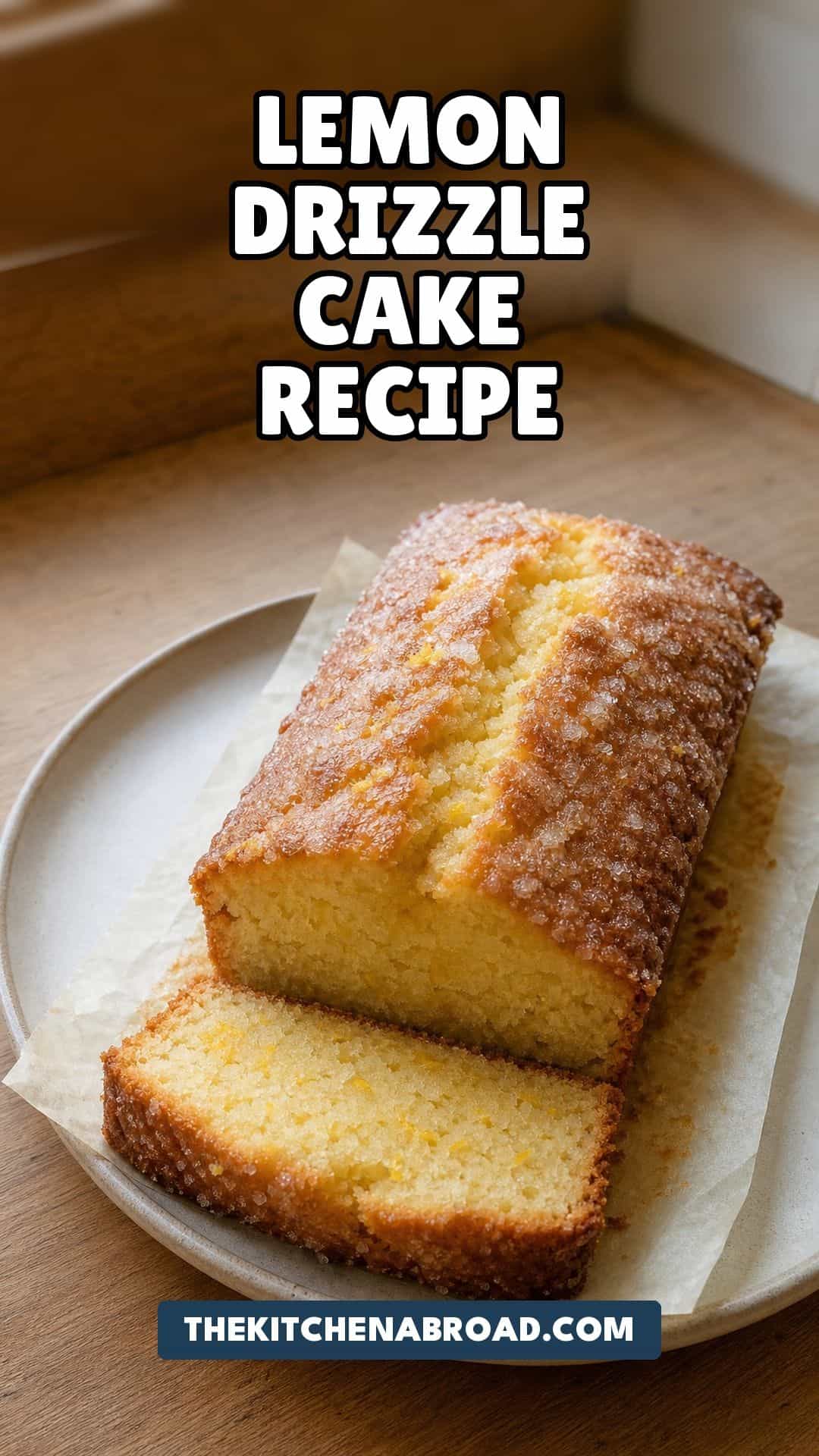
The loaf comes out of the oven smelling like a kitchen that knows what it is doing, and the moment the tin hits the rack the next thirty seconds set the entire cake. A skewer goes in across the top in twenty quick passes, the gritty lemon-sugar slurry is spooned slowly along the surface, and the syrup vanishes into the warm crumb while the sugar stays behind, hardening into pale crystals as the cake cools. Half an hour later the knife goes in with a clean little crackle, the kind British grandmothers built whole afternoon teas around. That sound is not an accident, and it is not a finishing flourish. It is the recipe.
What You’ll Need
A 2 lb (900g) rectangular loaf tin for the canonical British silhouette, a stand mixer with the paddle attachment for the four-minute butter-and-sugar cream, a microplane for fine zest off two lemons, parchment paper to line the pan with an overhang on the long sides for easy lifting, and a stainless steel cooling rack for the final cool once the drizzle has set.


Recommended Reads
Where the Lemon Drizzle Came From
The cake has a documented origin, which is rare for a recipe this woven into British home baking. Evelyn Rose, the food writer best known for her decades-long column in The Jewish Chronicle, published the first recorded UK recipe for a “luscious lemon cake” in the paper’s July 1967 issue. The recipe paired a butter-based sponge with a poured lemon-sugar syrup, and home bakers across the country adopted it almost immediately. Within a generation the technique had spread far enough that the Jewish Chronicle origin was largely forgotten, but the format Rose set down (the warm cake, the poured drizzle, the granulated sugar finish) is the version every British home cook now makes.
Mary Berry codified the modern version. Her traybake recipe, built on a 4-egg canonical ratio of equal weights butter, sugar, and self-raising flour, is the recipe she has said she is most asked for when stopped in the street. The Great British Bake Off mainstreamed lemon drizzle as a technical baseline for the show’s early seasons and pushed it from teatime staple to global recipe-search standard. It is the cake British grandmothers brought to school fetes, the cake on every village hall trestle table, and the cake you can identify by sound alone: the crackle of the sugar crust when the knife goes in.
A Few Notes on the Ingredients
- Butter, not oil: The cake is a butter-based pound batter. Butter holds the citrus oils on the palate and gives the close, tender crumb that says drizzle cake the moment you cut into it. Oil cakes are technically moister but the lemon reads muted and the structure goes flat.
- The four-minute cream: Cream the butter and sugar on medium-high until visibly paler and light. That pre-aeration is where the rise lives, and skipping it gives you a dense brick the baking powder cannot rescue.
- Granulated sugar (not powdered) for the drizzle: This is the load-bearing decision of the whole recipe. Granulated crystals stay intact in the slurry and re-form on top of the warm cake into the pale, crunchy crust. Powdered sugar dissolves on contact and gives you a flat smooth glaze with no crackle.
- Fresh lemon juice: Whisk the juice with the granulated sugar into a gritty slurry. Do not stir to dissolve; the crystals are doing the work on top of the loaf as it cools.
- 2 lb (900g) loaf tin: The British canonical format. Line it with parchment overhang on the two long sides for clean lifting once the drizzle has set.
- Two lemons: Zest both directly into the batter for the floral top notes, then juice both for the drizzle. Microplane the zest before juicing. Use unwaxed lemons if you can find them; if not, scrub the fruit under warm water before zesting.
- Self-rising flour and 4 eggs: Mary Berry’s canonical ratio, with equal weights butter and sugar and a slightly higher weight of self-raising flour. Bring the eggs to room temperature before they hit the bowl so the batter does not curdle.
Recipe: Lemon Drizzle Cake
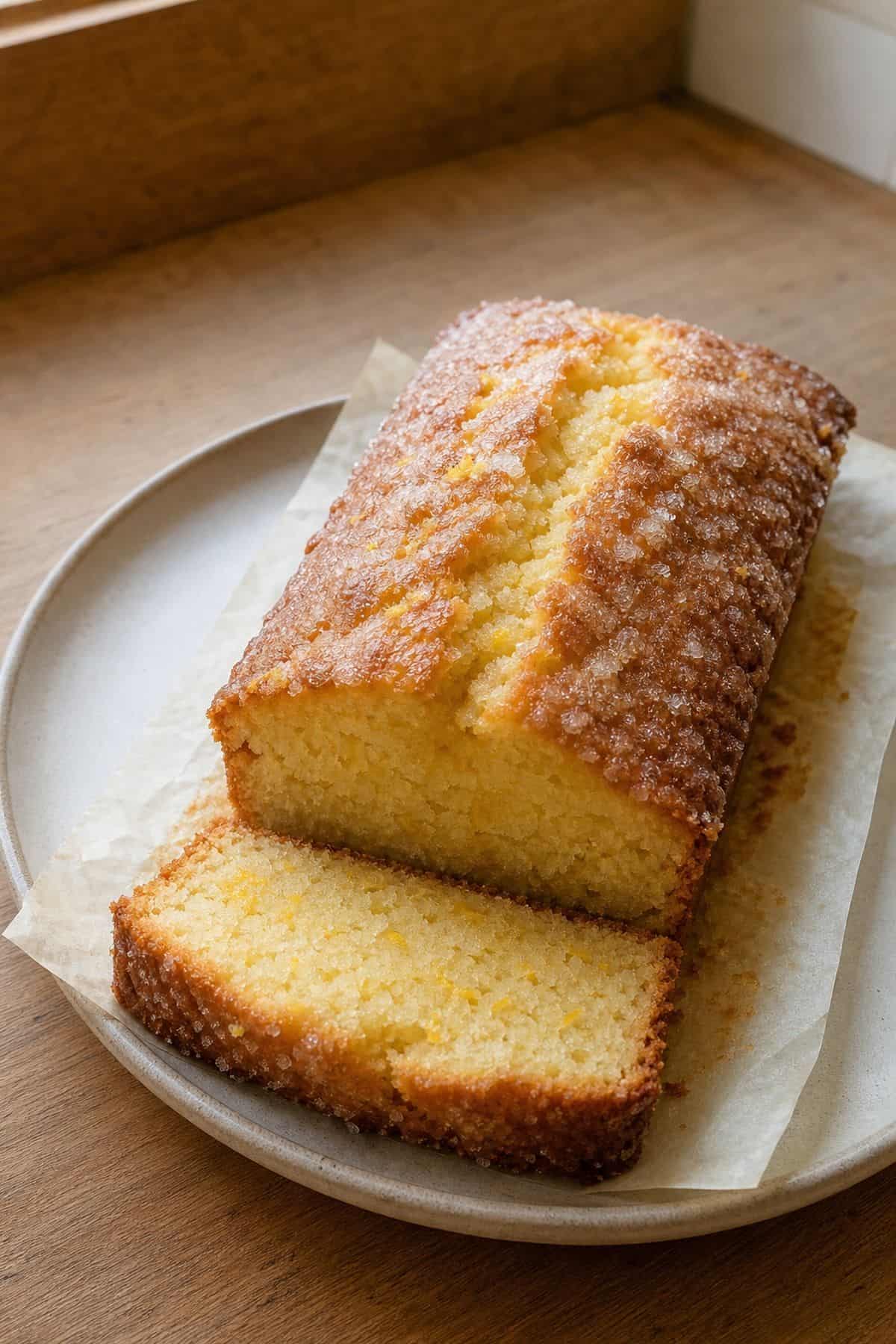
Prep time: 20 minutes | Cook time: 50 minutes | Total time: 1 hour 10 minutes, plus 30 minutes to cool | Serves: 10
Ingredients
For the cake:
- 1 1/2 cups (190 g) self-rising flour (or 1 1/2 cups all-purpose flour plus 1 1/2 tsp baking powder plus 1/4 tsp salt)
- 3/4 cup (170 g) unsalted butter, softened
- 3/4 cup (150 g) granulated sugar
- 4 large eggs, at room temperature
- Zest of 2 lemons
- 1 tsp vanilla extract
- 2 tbsp (30 ml) whole milk
For the drizzle:
- Juice of 2 lemons (about 1/4 cup / 60 ml)
- 1/2 cup (100 g) granulated sugar (NOT powdered)
Instructions
- Heat the oven to 350°F (180°C) with a rack in the middle position. Butter a 2 lb (900g) loaf pan and line it with parchment paper, leaving an overhang on the two long sides for lifting the cake out later.
- In the bowl of a stand mixer fitted with the paddle attachment, cream the softened butter and granulated sugar on medium-high for 4 full minutes, until visibly paler and light. This pre-aeration step is where the rise lives.
- Beat in the eggs one at a time on medium speed, waiting until each is fully incorporated before adding the next. Scrape down the bowl between additions to prevent the batter from curdling.
- Add the lemon zest and vanilla extract and beat briefly to combine, about 10 seconds.
- Add the self-rising flour and the milk and fold gently with a spatula until just combined, with no streaks of flour visible. Stop the moment the batter is uniform; overmixing toughens the crumb.
- Transfer the batter to the prepared loaf pan and smooth the top with a spatula. Tap the pan firmly on the counter twice to release any large air pockets.
- Bake on the middle rack for 45 to 50 minutes, until a skewer inserted in the center comes out clean and the top is evenly golden.
- While the cake bakes, whisk together the lemon juice and 1/2 cup granulated sugar in a small bowl. Do not stir to dissolve the sugar; leave the slurry gritty with crystals intact. This is the entire point of the drizzle.
- Remove the cake from the oven and immediately poke 20 to 30 holes across the top with a skewer, going all the way down into the crumb but not through to the pan.
- Slowly pour the gritty lemon-sugar drizzle evenly over the warm cake in two passes, letting the syrup soak in between pours. Aim for full surface coverage with the sugar crystals settling on top.
- Let the cake rest in the pan on a cooling rack for 30 minutes while the sugar crystallizes on the surface into the crackly crust.
- Lift the cake out of the pan using the parchment overhang and transfer to the cooling rack. Slice with a serrated knife for clean wedges that preserve the crackle.
Notes
Granulated sugar in the drizzle gives the crackly crust; powdered (icing) sugar gives a flat smooth glaze. Never substitute one for the other in this recipe. The two sugars do completely different jobs and produce completely different cakes.
The skewer-poke and warm-cake drizzle timing are non-negotiable. The cake must be hot enough that the lemon juice soaks down into the crumb through the holes, and cool enough (around 10 minutes out of the oven) that the structure does not collapse under the syrup. Drizzle a cold cake and the syrup pools on top and runs off the sides; drizzle a screaming-hot cake and the crumb goes mushy.
The whole loaf freezes well, wrapped tightly in plastic and foil, for up to 2 months. For best results freeze undrizzled and add the drizzle on the day you serve. If you must freeze the finished cake, the crackle softens slightly on thaw but the flavor holds. Sliced and individually wrapped portions also freeze well for lunchbox use up to a month.
Tips and Variations
Why Granulated Sugar Beats Powdered for the Drizzle
The crackly crust on a proper lemon drizzle cake is a sugar crystallization effect, not a frosting effect. When you whisk granulated sugar with fresh lemon juice, the sugar does not fully dissolve , the slurry stays visibly gritty in the bowl. Pour that slurry across a warm cake, and the lemon juice soaks down into the crumb through the skewer holes while the moisture at the surface evaporates. As it evaporates, the granulated sugar crystals re-form into a pale, crunchy layer on top of the loaf. Powdered (icing) sugar is finely milled and dissolves smoothly on contact with even a drop of moisture. Use it in the drizzle and you get a flat, shiny glaze that sits on top of the cake like a thin frosting, with no crackle, no crunch, and no audible knife-going-in moment. Granulated, always. The difference is structural, not stylistic.
How to Hit the Warm-Cake Drizzle Window
Aim for ten minutes out of the oven. Earlier than that, the crumb is too soft and the syrup makes the top of the cake collapse inward. Later than that, the cake has cooled enough that the lemon juice no longer soaks down properly and pools on the surface instead. Mix the drizzle slurry while the cake bakes so it is ready to go the moment the loaf comes out. Have the skewer in your hand. Poke the holes immediately, twenty to thirty across the top, going all the way down into the crumb but not through to the pan. Spoon the drizzle in two passes so the syrup has time to soak in between pours. The whole sequence takes ninety seconds from oven to finished cake, and then you walk away and let the sugar do its work as the loaf cools in the tin.
Swapping Lemon for Orange or Lime
The technique transfers cleanly to other citrus, and the result is the same architecture in a different register. For an orange drizzle loaf, swap the zest and juice of two lemons for the zest and juice of one large orange plus one lemon (oranges are sweeter and need the lemon to keep the drizzle from going cloying). For a lime version, swap in the zest of three limes and the juice of four , limes are smaller and less juice-heavy than lemons, so the ratio shifts. The granulated sugar quantity and the warm-cake timing stay identical across all three. A blood orange drizzle cake in winter, made with the same ratios, is one of the prettiest loaves a kitchen can produce: pale crumb under a faintly pink-tinted crackle.
The Traybake Version for a Crowd
Mary Berry’s original is a traybake, not a loaf, and it remains the right move for any gathering bigger than ten. Double the recipe (8 eggs, 340 g butter, 380 g flour, 300 g sugar in the batter, juice of 4 lemons and 200 g granulated sugar in the drizzle) and bake in a lined 12 x 9 inch traybake tin at 350°F for 35 to 40 minutes. The drizzle technique stays the same: skewer-poke the warm cake all over, spoon the gritty slurry across the surface in two passes, and let the crackle set for 30 minutes in the tin. Cut into squares for buffets, picnics, school fetes, and afternoon teas. The traybake format is what most British home cooks default to when they are making lemon drizzle for more than a Sunday family of four.
Make-Ahead and Freezing Strategy
The cake is at its peak the day it is baked and drizzled, but it holds beautifully for three days at room temperature in an airtight tin (the crackle softens slightly after day one but the flavor improves as the lemon deepens through the crumb). For longer storage, freeze the undrizzled loaf wrapped tightly in plastic and foil for up to two months, thaw at room temperature for three hours, and drizzle the day you serve. The drizzle has to go on warm, which means a quick reheat of the thawed loaf in a 300°F oven for ten minutes before the skewer-poke and pour. This approach is how to bake-ahead for a Mother’s Day brunch or an Easter dessert table without sacrificing the crackly crust.
What to Serve It With
The canonical pairing is afternoon tea, sliced into ten clean wedges and served with a pot of Earl Grey and a small jug of milk on the side. It is also the right cake for a Mother’s Day brunch (thin slices alongside crème fraîche and fresh raspberries), an Easter dessert table (a lighter alternative to a simnel cake or a fruit cake), a mid-morning coffee break (strong black coffee, no sugar, the cake handles it), and a picnic basket (the loaf format travels well, no frosting to melt, no fragile tiers to topple). It is the cake that earns a permanent place in the household repertoire because it requires nothing more than a 2 lb loaf tin and two lemons.
Frequently Asked Questions
Should I use granulated or powdered sugar for the drizzle?
Granulated, always. Powdered (icing) sugar dissolves on contact with the lemon juice and gives a flat, shiny glaze with no texture. Granulated sugar stays in crystal form in the slurry and re-forms on top of the warm cake as the moisture evaporates, giving the audible crackle that defines a proper lemon drizzle. This is not a style preference; it is a structural choice. The two sugars produce two different cakes.
Why didn’t my lemon drizzle cake rise?
Three usual culprits. One, the butter and eggs were too cold to cream properly, so the pre-aeration step at the start of the recipe failed. Pull both out of the fridge an hour before baking. Two, the oven door was opened in the first 25 minutes of baking, which collapses the rise just as it sets. Resist looking. Three, the batter sat on the counter while the oven came up to temperature; the baking powder in self-rising flour activates on contact with wet ingredients and loses lift if it waits. Preheat the oven before mixing the batter, and the loaf goes in within ten minutes of the flour going into the bowl.
Hot or cold cake when you drizzle?
Warm. Roughly ten minutes out of the oven. Not screaming hot (the crumb collapses under the syrup) and not cold (the syrup pools on top and runs off the sides instead of soaking in). The warm cake is what lets the lemon juice travel down through the skewer holes into the crumb while the granulated sugar stays on the surface to crystallize. Get the timing right and the cake does the rest.
Can I use butter or oil for lemon drizzle cake?
Butter. A proper lemon drizzle is a pound-cake-derived loaf, and the butter is what carries the lemon zest on the palate and gives the close, tender crumb that defines the cake. Oil cakes are technically moister but lose the structural integrity and the citrus flavor reads muted and one-dimensional. Use unsalted butter, softened to room temperature, and cream it with the sugar for the full four minutes before adding the eggs.
Can I freeze lemon drizzle cake?
Yes. Freeze the undrizzled loaf wrapped tightly in plastic and foil for up to two months for best results. Thaw at room temperature for three hours, reheat briefly in a 300°F oven to bring the cake back to warm, then skewer-poke and drizzle the day you serve. If you must freeze the finished drizzled cake, it holds for a month but the crackle softens on thaw , the flavor stays intact but the audible crunch is the casualty of the freezer.
Self-raising or all-purpose flour for lemon drizzle?
Either works. Self-rising (or self-raising in British usage) is the canonical British choice and what Mary Berry’s original recipe calls for. If you are working with all-purpose flour, add 1 1/2 teaspoons of baking powder and 1/4 teaspoon of salt to the flour quantity before folding into the batter. The lift and the structure come out identical; self-rising flour is purely a convenience format that pre-mixes the leavener and the salt for you.
Key Takeaways
- Bake in a 2 lb (900g) loaf pan lined with parchment overhang for clean lifting.
- Build on Mary Berry’s 4-egg canonical ratio with butter, not oil, for pound-cake structure.
- Cream the butter and sugar for a full 4 minutes; that pre-aeration is where the rise lives.
- Use granulated sugar in the drizzle, never powdered. Larger crystals re-form on top into the crackly crust.
- Drizzle within 10 minutes of removing the cake from the oven; skewer-poke 20 to 30 holes first.
- Let the loaf rest in the tin for 30 minutes after drizzling while the sugar crystallizes into the audible crackle.
Final Thoughts
Lemon drizzle is one of those cakes that lives or dies on two small decisions made in the ninety seconds after the loaf comes out of the oven. Granulated sugar or powdered. Warm cake or cold. Each call is the difference between a cake with a crackly crust that announces itself when the knife goes in and a cake with a flat citrus glaze that could have come out of any supermarket bakery. Neither call is hard. Both are non-negotiable.
The reward is a tender, butter-rich loaf with a fine pound-cake crumb perfumed with fresh lemon zest, topped by a pale, crunchy sugar crust that snaps under a serrated knife. It is the cake Evelyn Rose set down in 1967, the cake Mary Berry codified for a generation, and the cake the Great British Bake Off mainstreamed across the world. It is also, quietly, one of the easiest cakes a British home kitchen ever made famous.
Bake it on a Sunday afternoon. Drizzle it ten minutes out of the oven. Let it sit in the tin while the sugar crystallizes and the kitchen smells like a 1970s teatime. Slice it into ten clean wedges, pour a pot of Earl Grey, and listen for the crackle.
Lemon Drizzle Cake
A proper lemon drizzle cake recipe is the British teatime loaf: a butter-based pound batter built on Mary Berry's 4-egg canonical ratio, baked in a 2 lb (900g) loaf pan at 350°F for 45 to 50 minutes, then drizzled within ten minutes of leaving the oven with a.
Ingredients
- 1 1/2 cups (190 g) self-rising flour (or 1 1/2 cups all-purpose flour plus 1 1/2 tsp baking powder plus 1/4 tsp salt)
- 3/4 cup (170 g) unsalted butter, softened
- 3/4 cup (150 g) granulated sugar
- 4 large eggs, at room temperature
- Zest of 2 lemons
- 1 tsp vanilla extract
- 2 tbsp (30 ml) whole milk
- Juice of 2 lemons (about 1/4 cup / 60 ml)
- 1/2 cup (100 g) granulated sugar (NOT powdered)
Instructions
- Heat the oven to 350°F (180°C) with a rack in the middle position. Butter a 2 lb (900g) loaf pan and line it with parchment paper, leaving an overhang on the two long sides for lifting the cake out later.
- In the bowl of a stand mixer fitted with the paddle attachment, cream the softened butter and granulated sugar on medium-high for 4 full minutes, until visibly paler and light. This pre-aeration step is where the rise lives.
- Beat in the eggs one at a time on medium speed, waiting until each is fully incorporated before adding the next. Scrape down the bowl between additions to prevent the batter from curdling.
- Add the lemon zest and vanilla extract and beat briefly to combine, about 10 seconds.
- Add the self-rising flour and the milk and fold gently with a spatula until just combined, with no streaks of flour visible. Stop the moment the batter is uniform; overmixing toughens the crumb.
- Transfer the batter to the prepared loaf pan and smooth the top with a spatula. Tap the pan firmly on the counter twice to release any large air pockets.
- Bake on the middle rack for 45 to 50 minutes, until a skewer inserted in the center comes out clean and the top is evenly golden.
- While the cake bakes, whisk together the lemon juice and 1/2 cup granulated sugar in a small bowl. Do not stir to dissolve the sugar; leave the slurry gritty with crystals intact. This is the entire point of the drizzle.
- Remove the cake from the oven and immediately poke 20 to 30 holes across the top with a skewer, going all the way down into the crumb but not through to the pan.
- Slowly pour the gritty lemon-sugar drizzle evenly over the warm cake in two passes, letting the syrup soak in between pours. Aim for full surface coverage with the sugar crystals settling on top.
- Let the cake rest in the pan on a cooling rack for 30 minutes while the sugar crystallizes on the surface into the crackly crust.
- Lift the cake out of the pan using the parchment overhang and transfer to the cooling rack. Slice with a serrated knife for clean wedges that preserve the crackle.
Notes
Granulated sugar in the drizzle gives the crackly crust; powdered (icing) sugar gives a flat smooth glaze. Never substitute one for the other in this recipe. The two sugars do completely different jobs and produce completely different cakes.
The skewer-poke and warm-cake drizzle timing are non-negotiable. The cake must be hot enough that the lemon juice soaks down into the crumb through the holes, and cool enough (around 10 minutes out of the oven) that the structure does not collapse under the syrup. Drizzle a cold cake and the syrup pools on top and runs off the sides; drizzle a screaming-hot cake and the crumb goes mushy.
Last update on 2026-08-08 / Affiliate links / Images from Amazon Product Advertising API