

Roast a 1.4 kg (3 lb) butternut squash at 200°C (400°F), simmer it with shallot-and-thyme stock, crème fraîche and butter, then blend and push it through a fine sieve until it pours like heavy cream. Ladle 60 to 90 ml into small glasses and top each with one brown-butter sage leaf. One batch makes 12 to 16 shooters in about 1 hour 10 minutes.
Guests arrive, coats come off, and for the next half hour everyone stands around holding something. Butternut squash soup shooters fill that gap better than another plate of cold crackers. A warm glass in the hand, two sips, gone.
The catch is texture. Soup that’s lovely in a bowl can turn gluey in a glass, sliding down slowly and leaving half of itself behind. This version fixes that with roasted squash for depth and a fine-mesh strain at the end, so it pours cleanly every time.



Why serve soup in a glass at all?
Because nobody wants to balance a bowl and a spoon while talking. A shooter is a hot appetizer you can hold in one hand, and it doesn’t need a plate, a fork or a seat. In restaurants this is the amuse-bouche idea: one small taste that wakes up the appetite before the real food arrives.
Butternut squash is the obvious choice for it. The butternut variety was developed in Massachusetts in the 1940s, and it has a long, solid neck with very few seeds, which means more smooth flesh per kilo than most winter squash. Roasted, it’s sweet and deep orange. Blended, it goes silky with very little help.
How do you get the texture drinkable?
Two things matter: how you cook the squash and what you do after blending.
Roast it, don’t boil it
Roasting cut-side down at 200°C (400°F) for 35 to 40 minutes browns the surface where it touches the pan. Those dark amber patches carry most of the flavour. Squash simmered straight in stock tastes watery by comparison, and the colour comes out paler, which matters when the whole appetizer is basically colour in a glass.
Strain after blending
Even a powerful blender leaves fine fibres from the neck of the squash. In a bowl you won’t notice them. Sipped from a small glass, they catch in your throat. A fine-mesh sieve and a ladle pressing the soup through takes three minutes and makes the difference between a soup and a shooter.
Then check the thickness. Tilt a spoonful: it should run off like heavy cream. If it ribbons slowly, add a tablespoon or two of warm stock. If it runs like water, simmer it 3 to 4 minutes to reduce. A guest should finish a shooter in two sips with nothing left pooled at the bottom.
Picking the squash and the dairy
Choose a squash of about 1.4 kg (3 lb) with a long neck and a small bulb. The neck is all flesh, the bulb is where the seeds live. The skin should be hard and matte. Shiny skin or soft spots mean it’s past its best.
Crème fraîche finishes the soup. It adds tang and stays smooth in hot liquid, where sour cream tends to split. Heavy cream would work but flattens the squash’s sweetness a little.
Low-sodium chicken or vegetable stock both do the job. The squash has enough flavour that a decent store-bought carton disappears into it, so don’t stress about homemade. For the garnish, pick small sage leaves, no longer than 4 cm (1.5 inches). Big leaves turn bitter when you crisp them.
Recipe: butternut squash soup shooters
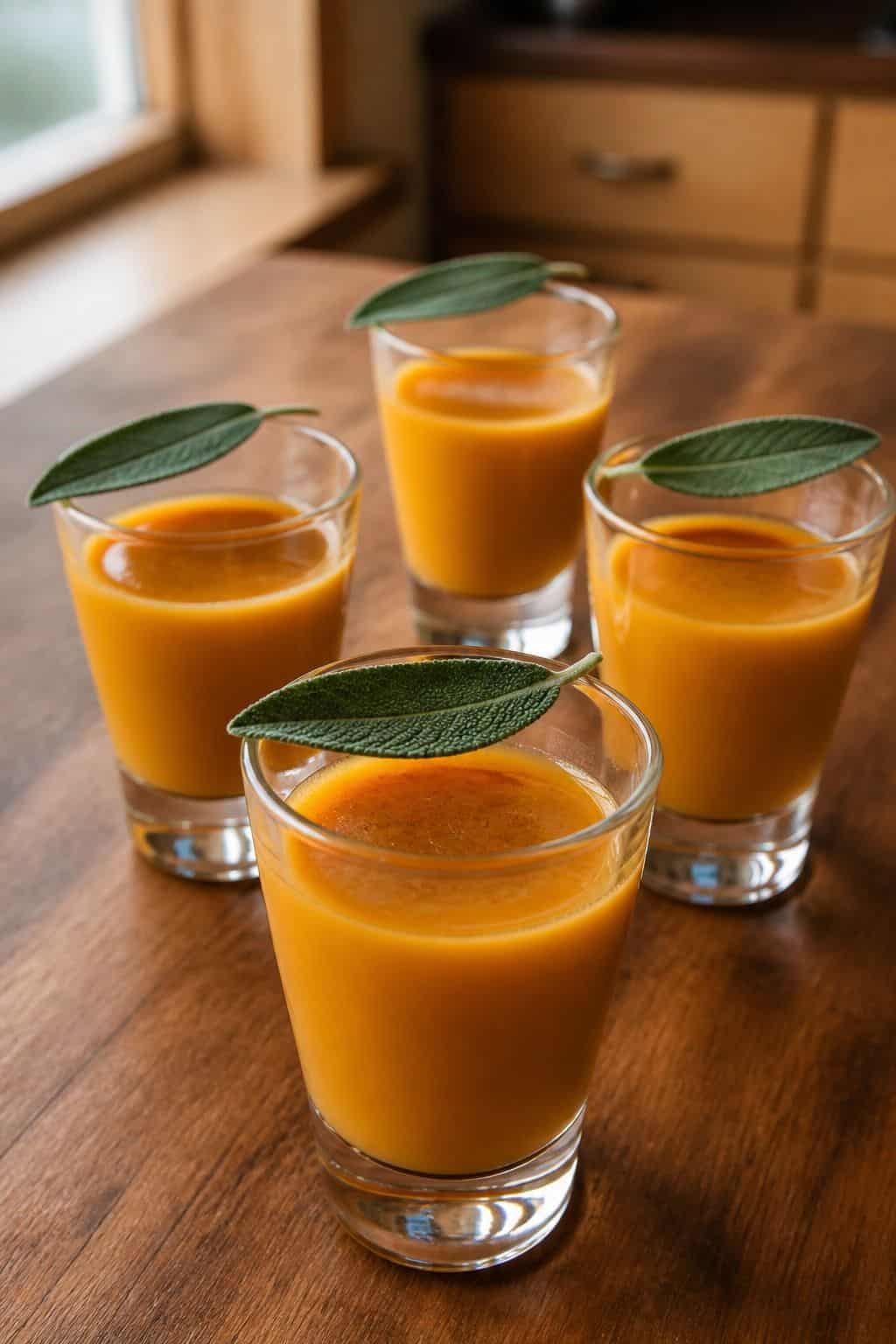
Prep time: 15 minutes. Cook time: 55 minutes. Total time: 1 hour 10 minutes. Servings: 12 to 16 shooters (2 per guest for 6 to 8 people).
Ingredients for the soup
- 1 butternut squash (about 1.4 kg / 3 lb), halved lengthwise and seeded
- 30 ml (2 tablespoons) extra-virgin olive oil
- 1 large shallot, finely diced
- 2 garlic cloves, finely grated
- 4 sprigs fresh thyme
- 700 ml (3 cups) low-sodium chicken or vegetable stock
- 60 g (1/4 cup) crème fraîche, plus extra for finishing
- 30 g (2 tablespoons) unsalted butter
- 1/4 teaspoon freshly grated nutmeg
- 1 teaspoon fine sea salt, or to taste
- Freshly cracked black pepper
Ingredients for the brown-butter sage
- 60 g (4 tablespoons) unsalted butter
- 16 small fresh sage leaves
- Pinch of flaky sea salt
Instructions
- Heat the oven to 200°C (400°F) and line a half sheet pan with parchment.
- Rub the cut sides of the squash with 15 ml (1 tablespoon) of the olive oil and season with a good pinch of salt and pepper. Roast cut-side down for 35 to 40 minutes, until a paring knife slides in with no resistance and the cut faces are dark amber.
- Meanwhile, heat the remaining 15 ml (1 tablespoon) olive oil in a Dutch oven over medium heat. Add the shallot with a small pinch of salt and cook 6 to 7 minutes, stirring now and then, until soft and translucent at the edges. Add the garlic and thyme sprigs and cook 1 minute, until fragrant.
- Pour in the stock, bring to a simmer, then turn the heat to low and let it infuse while the squash finishes.
- Let the roasted squash cool for about 10 minutes, then scoop the flesh from the skin with a metal spoon. You should have about 700 g (3 cups).
- Fish the thyme sprigs out of the stock. Add the squash, crème fraîche, butter, nutmeg and the remaining salt (about 3/4 teaspoon). Simmer gently for 5 minutes.
- Blend until completely smooth: 60 seconds per half batch in a countertop blender (fill it no more than halfway and hold a towel over the lid), or at least 90 seconds with an immersion blender, moving it around the pot.
- Pour the soup through a fine-mesh sieve into a clean pot, pressing it through with the back of a ladle. Discard the fibres left in the sieve.
- Taste for salt and check the thickness. It should pour like heavy cream. Thin with a spoonful or two of warm stock, or simmer 3 to 4 minutes to thicken.
- For the garnish, melt the butter in a small skillet over medium heat. When it foams, add the sage leaves in one layer and cook about 90 seconds, until the butter is pale amber and smells nutty and the leaves are crisp. Lift the leaves onto paper towels and sprinkle with flaky salt. Keep the brown butter.
- Ladle the hot soup into 60 to 90 ml glasses or espresso cups, about three-quarters full. Drizzle about 1/4 teaspoon brown butter on each, lay one sage leaf across the top and serve right away.
Notes
Strain even if you own a high-speed blender. Reheat on the stove, never in the microwave, which heats unevenly and can split the crème fraîche.
Glasses, garnishes and swaps
Which glasses work best?
Small and squat beats tall and narrow. Cordial glasses or espresso cups holding 60 to 90 ml (2 to 3 oz) sit steady on a tray and keep the soup warm longer. Tall shot glasses tip over the moment someone bumps the tray. Espresso cups have one extra advantage: a handle, so nobody burns their fingers. Leave the glasses at room temperature for 10 minutes before pouring hot soup into them, especially if they’ve been in a cold cupboard.
Keep the garnish to one
A 60 ml glass has room for one topping. Choose the brown-butter sage leaf, a swirl of crème fraîche, a few toasted pumpkin seeds or a little crumbled crispy bacon. Pile three on and it looks fussy, and the soup gets lost.
Dairy-free version
Swap the crème fraîche for 60 ml (1/4 cup) full-fat coconut milk, leave out the butter and finish with 30 ml (2 tablespoons) extra olive oil instead. The soup comes out a touch sweeter, and coconut suits squash well. For the garnish, warm olive oil with a pinch of red pepper flakes on low heat for 2 minutes and drizzle that on top.
Making them ahead without losing the crunch
The soup is the part to make early. Cook it up to 2 days ahead, cool it and refrigerate it within 2 hours, covered. When it’s time, reheat it in a saucepan, whisking, until steaming hot. The USDA’s guidance on leftovers says soups should be brought to a rolling boil when reheated, so let it bubble briefly, then lower the heat. Strain it again if a skin has formed.
For longer storage, the soup freezes for 2 months. Thaw it overnight in the fridge. Frozen squash soup can turn a little grainy, and 30 seconds with an immersion blender brings it back.
The garnish can’t wait. Crisp the sage within an hour of serving or the leaves go limp. If you want to get ahead, brown the butter the day before and strain out the solids. That clarified brown butter keeps a week, and the sage takes 90 seconds to fry fresh.
What to pour alongside
Something warm and spiced matches the mood. A chai-spiced rum punch brings cardamom and clove that sit well next to the squash’s sweetness.
Lighter drinkers will be happier with an autumn sangria, where apple and orange fall into the same flavour family as the soup.
If it’s wine only, choose a dry riesling or a lightly oaked chardonnay with enough body to stand up to the crème fraîche.
Soup shooter questions
How thick should soup be for shooters?
Shooter soup should be about as thick as heavy cream. It needs to pour smoothly from a tilted spoon and be drinkable in two small sips. Thicker soup clings to the glass, and thinner soup tastes watered down.
What size glass do you use for soup shooters?
Use 60 to 90 ml (2 to 3 oz) glasses, ideally short cordial glasses or espresso cups. They stay upright on a tray and hold heat better than tall shot glasses, and a cup handle keeps fingers away from hot glass.
Can soup shooters be made ahead?
Yes, the soup can be made up to 2 days ahead and kept covered in the fridge. Reheat it on the stove until it boils briefly, then pour. Make the brown-butter sage garnish within an hour of serving so it stays crisp.
How many soup shooters per person?
Plan 2 shooters per guest, so this batch of 12 to 16 covers 6 to 8 people. Each glass is a few sips meant to start the evening, and many guests will come back for a second.
Can I serve butternut squash soup shooters cold?
You can, but this soup is better hot. The butter and crème fraîche firm up as the soup cools, so a chilled shooter feels thicker and heavier. If you need a cold option, thin it with a little extra stock and taste again for salt.
Key takeaways
- Roast the squash at 200°C (400°F) for 35 to 40 minutes for deeper flavour and colour.
- Strain the blended soup through a fine sieve so no fibres catch in the throat.
- Aim for heavy-cream thickness, adjusting with warm stock or a short simmer.
- Serve in 60 to 90 ml cordial glasses or espresso cups with one garnish each.
- Make the soup up to 2 days ahead; fry the sage within an hour of serving.
Build the rest of your fall menu around it
Shooters work best as the first thing guests get, so plan the hot soup for the half hour before everyone sits. If you’re hosting a holiday meal, this Thanksgiving make-ahead prep timeline shows where a two-day-ahead soup fits into the week.
Serving them at a December party instead? Set the tray next to a Christmas appetizer board so the warm glasses contrast with cold cheese and cured meat.
For a standing crowd, pair the shooters with a couple of the one-bite ideas in these Christmas finger foods, and keep the soup pot on low heat so you can refill the glasses as the first round disappears.
Butternut Squash Soup Shooters
Butternut squash soup shooters are 60 ml (2 oz) servings of roasted butternut squash blended with shallot-thyme stock, crème fraîche, and a small pat of butter, strained to a heavy-cream viscosity that pours cleanly from cordial glasses.
Ingredients
- 1 butternut squash (about 1.4 kg / 3 lb), halved lengthwise and seeded
- 30 ml (2 tablespoons) extra-virgin olive oil
- 1 large shallot, finely diced
- 2 garlic cloves, finely grated
- 4 sprigs fresh thyme
- 700 ml (3 cups) low-sodium chicken or vegetable stock
- 60 g (¼ cup) crème fraîche, plus extra for finishing
- 30 g (2 tablespoons) unsalted butter
- ¼ teaspoon freshly grated nutmeg
- 1 teaspoon fine sea salt, or to taste
- Freshly cracked black pepper
- 60 g (4 tablespoons) unsalted butter
- 16 small fresh sage leaves
- Pinch flaky sea salt
Instructions
- Heat the oven to 200°C (400°F). Line a half sheet pan with parchment.
- Halve the 1.4 kg (3 lb) butternut squash lengthwise and scoop out the seeds. Rub the cut sides with 15 ml (1 tablespoon) of the olive oil and a generous pinch of salt and pepper.
- While the squash roasts, heat the remaining 15 ml (1 tablespoon) olive oil in a Dutch oven over medium heat. Add the diced shallot and a small pinch of salt.
- Pour in the 700 ml (3 cups) stock, bring to a simmer, then reduce the heat to low and let the stock infuse with the thyme and shallot while the squash finishes roasting. This is a 15-minute window where you can clean up.
- When the squash is roasted and cool enough to handle (about 10 minutes), scoop the flesh from the skin in large pieces using a metal spoon. You should yield about 700 g (3 cups) of cooked squash. Discard the skin.
- Add the squash flesh to the simmering stock. Remove the thyme sprigs (some leaves will have fallen off, which is fine). Add 60 g (¼ cup) crème fraîche, 30 g (2 tablespoons) butter, ¼ teaspoon nutmeg, and the remaining ¾ teaspoon salt.
- Blend the soup. For a countertop blender, work in two batches: fill the blender no more than halfway and hold a clean dish towel over the lid as a safety precaution against the steam. Blend on high for 60 seconds per batch until completely smooth.
- Pour the blended soup through a fine-mesh sieve set over a clean pot. Press gently with the back of a ladle to push the soup through; discard the fibrous strands that catch in the sieve. This is the move that gives shooter soup its drinkable texture.
- Taste and adjust. The soup should pour smoothly from a tilted spoon at this point, with a viscosity close to heavy cream. If it feels too thick to drink from a glass, thin with a tablespoon or two of warm stock.
- Make the brown-butter sage garnish. Melt 60 g (4 tablespoons) butter in a small skillet over medium heat. Once the butter foams, add the 16 sage leaves in a single layer.
- To serve, ladle the soup into 60 to 90 ml cordial glasses or espresso cups, filling each about three-quarters full. Drizzle a quarter teaspoon of the brown butter on top of each shooter, then finish each glass with one crispy sage leaf laid across the rim.
Notes
Strain the soup through the fine-mesh sieve even if you have a high-power blender. Blending pulverizes the squash but leaves a small amount of fibrous strand from the squash neck, which catches in the throat on a small sip. The strain removes those strands and gives the soup a satin texture.
Make the soup up to 2 days ahead and store, covered, in the fridge. Reheat in a saucepan over low heat, whisking occasionally; do not use the microwave, which heats unevenly and can break the cream. Re-strain after reheating if any skin forms on the surface.
Last update on 2026-10-03 / Affiliate links / Images from Amazon Product Advertising API
