

Slice firm Persian or Kirby cucumbers, salt them with 3% of their weight in coarse salt for 15 minutes, rinse twice and squeeze dry. Toss with a paste of coarse gochugaru, fish sauce, garlic, ginger, sugar and water plus carrot, onion and Asian chives, then leave the jar at room temperature for 24 hours before refrigerating. It’s ready to eat the next day and tastes best around day 3.
Most cucumber kimchi goes wrong in one of three places. The cucumbers sit in salt too long and come out shrunken and leathery. The chili is fine-ground cooking powder, so the paste turns sandy. Or the jar ferments for a week on the counter, as if cucumber were cabbage, and the whole thing collapses into mush.
Cucumber kimchi (oi kimchi) is a fast kimchi by design. Cucumber is too delicate for a long ferment, so everything about this recipe is short and precise: a 15-minute salt cure, two cold rinses, coarse gochugaru and a single day on the counter. You get about 1 liter, crisp and cold, salty-sweet with a slow chili heat, enough for 4 to 6 people as a banchan.
A scale matters more than anything else here, because the salt is measured as a percentage of the cucumber weight. A wide-mouth jar, ideally with an airlock lid, and a bag of coarse Korean gochugaru cover the rest:



Which cucumbers make the crunchiest kimchi?
Small, thin-skinned ones with dense flesh and few seeds. Persian, Kirby and Korean cucumbers are all built that way, which is exactly what kimchi needs: they absorb the seasoning through the skin and keep their snap for days.
Long English or hothouse cucumbers are the wrong pick. The skin is tough and the flesh holds so much water that they go limp within a day. Overgrown garden cucumbers with big seeds soften fast too. If the seeds are visible and wet when you slice one, use it in a salad instead.
Cut the cucumbers into 5 mm (¼ inch) rounds. Thinner slices go soft, and much thicker ones won’t take on the seasoning in 24 hours.
How much salt, and for how long?
Use 3% of the cucumber weight in coarse sea salt or kosher salt, and cure for 15 minutes. For 700 g of cucumber that’s 21 g of salt, about 4 teaspoons. Weigh it. Spoon measures vary too much between salt brands, and eyeballing is the fastest route to kimchi that tastes like the sea.
Fine table salt is a poor choice for curing because it dissolves instantly and gets absorbed too aggressively. Coarse crystals draw water out more gradually.
Why only 15 minutes? A short cure pulls out enough water to firm the cucumber without collapsing it. Push it to 30 minutes or more and the slices shrink into leathery coins that taste salty no matter how well you rinse them. At the 15-minute mark they should have released a puddle of water and look slightly translucent at the edges.
Then rinse twice under cold running water. One rinse leaves enough salt on the surface to pile up with the salt in the fish sauce, and the finished jar ends up harsh. Two rinses clear the surface while the cucumber keeps the seasoning it has already absorbed. Squeeze gently in your hands or a clean kitchen towel before they meet the paste.
Coarse or fine gochugaru: does the grind matter?
Yes, a lot. Korean cooks use two grinds of gochugaru for two jobs. The coarse flakes, bright red and slightly oily, look like a redder crushed pepper and go into kimchi paste: you want to see the flakes, and you want their color and oil to seep slowly into the paste over the ferment. The fine powder is for stews and sauces, where the chili should disappear.
Fine gochugaru in kimchi gives a gritty paste and a raw, harsh heat. Italian-style crushed red pepper isn’t a good stand-in either, since it’s a different chili with seeds left in and a sharper, less fruity heat.
Give the paste 5 minutes to bloom before the cucumbers go in. The water wakes up the flakes, and you’ll see the paste turn a deeper red.
What about the fish sauce?
Korean anchovy fish sauce (myeolchi aekjeot) is the traditional choice. Thai fish sauce works fine if that’s what your shop has; the flavor is a little different and nobody at the table will complain. Garlic and ginger should be fresh and grated to a paste, roughly three parts garlic to one part ginger. Jarred pre-minced garlic tastes stale in a raw kimchi.
What happens in the jar, day by day?
The 24 hours on the counter are what make this kimchi rather than a spicy cucumber salad. At room temperature, the lactic acid bacteria already present on the vegetables start working, and the first sour, lively notes appear. Refrigerate straight away and they barely get going. If fermentation is new to you, the fermenting section of the National Center for Home Food Preservation is a good plain-language starting point.
Keep the lid loose for that first day, or use an airlock lid, because the ferment gives off gas. Then screw it tight and move the jar to the fridge, where fermentation carries on slowly.
On day 1 the kimchi is crunchy and mild, and the cucumber still tastes mostly raw. Between days 3 and 5 it hits its peak: the chili has fully bloomed and there’s a gentle tang. By days 7 to 10 it’s pleasantly sour, and the texture starts to soften.
Don’t stretch the counter time. Past 48 hours at room temperature, cucumber starts to break down.
Stuffed, milder and fish-free versions
Stuffed cucumber kimchi (oi sobagi)
Instead of rounds, cut each cucumber into 4 cm (1.5 inch) lengths and make a cross-cut down through each piece without slicing all the way through. Salt and rinse as usual, then stuff the paste into the cuts. This is the restaurant-style presentation of oi kimchi, and it ferments a little faster because more cucumber surface touches the paste.
Without fish sauce
Replace the fish sauce with 1 tablespoon of light soy sauce plus 1 teaspoon of white miso, whisked into the paste. The savory note shifts slightly toward soy, and the kimchi is fully plant-based.
Less heat
Cut the gochugaru to 1 tablespoon and add a tablespoon of toasted sesame oil at the end to round it out. It’s a good first jar for kids or anyone wary of chili.
Sugar can be swapped for a spoonful of grated Asian pear, the traditional way to sweeten and feed the ferment. Carrot and onion are optional, though they add color and a little sweetness. If your Asian chives came with flowers attached, leave the flowers out; they turn bitter in the jar.
Cucumber kimchi recipe
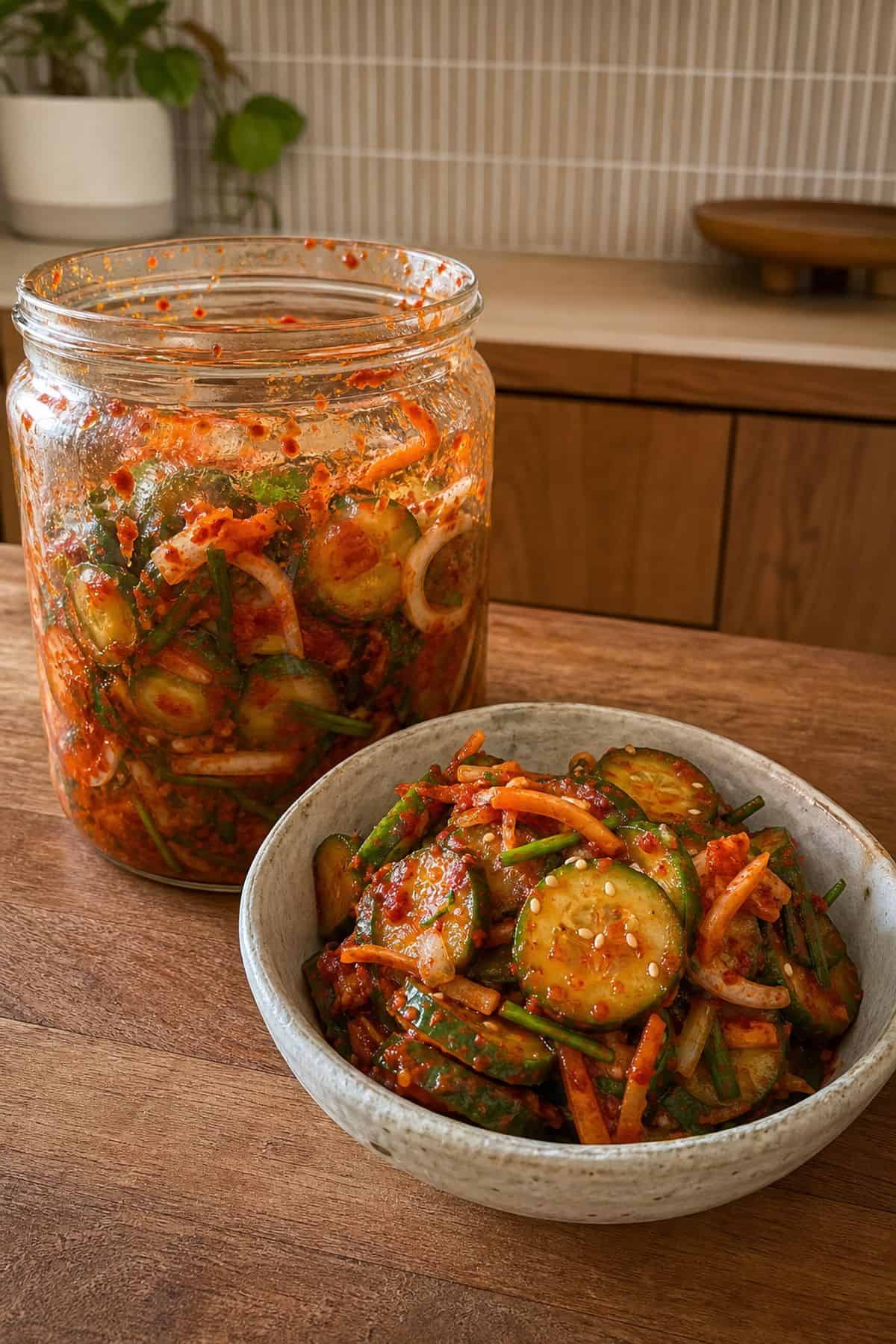
Prep time: 20 minutes. Cure time: 15 minutes. Ferment time: 24 hours at room temperature. Total time: about 24.5 hours from start to first bite. Yield: about 1 liter (1 quart), serving 4 to 6 as a banchan.
Ingredients
For the cucumber cure:
- 700 g (about 1.5 lb) Persian or Kirby cucumbers, sliced into 5 mm (¼ inch) rounds
- 21 g (about 4 tsp / 3% of cucumber weight) coarse sea salt or kosher salt
For the kimchi paste:
- 3 tbsp (about 15 g) coarse Korean gochugaru
- 1 tbsp (15 ml) Korean or Thai fish sauce
- 3 cloves garlic (about 15 g), minced to a paste
- 1 tsp fresh ginger, grated to a paste
- 1 tsp granulated sugar
- 2 tbsp water
For the mix-ins:
- 1 small carrot (about 80 g), cut into fine matchsticks
- ½ small white onion (about 60 g), thinly sliced into half-rings
- 30 g Asian chives or 4 scallions, cut into 5 cm (2 inch) lengths
- 1 tsp toasted sesame seeds, for finishing
Instructions
- Slice the cucumbers into 5 mm rounds and weigh them. Weigh out 3% of that number in salt (21 g for 700 g of cucumber). Toss the cucumbers with the salt in a colander set over a bowl.
- Cure for exactly 15 minutes, tossing once halfway. The cucumbers should release a noticeable amount of water and look slightly translucent at the edges.
- Rinse the cucumbers well under cold running water, drain, then rinse again. Squeeze gently with your hands or a clean kitchen towel to remove excess water and set aside.
- While the cucumbers cure, make the paste. In a medium bowl, whisk the gochugaru, fish sauce, garlic, ginger, sugar and water into a smooth paste. Let it bloom for 5 minutes, until it turns a deeper red.
- Add the drained cucumbers, carrot, onion and chives to the paste. Wearing nitrile gloves, toss until every piece is evenly coated.
- Pack the mixture firmly into a clean 1-liter glass jar, pressing down with a wooden spoon to push out air pockets and release a little liquid. Leave at least 2 cm (1 inch) of headspace.
- Set the lid on loosely so gas can escape, or use an airlock lid. Leave the jar at room temperature in a cool corner of the kitchen for 24 hours.
- After 24 hours, screw the lid down tight and refrigerate. The kimchi is ready to eat now and tastes best from day 3 to day 10.
- Sprinkle with toasted sesame seeds to serve.
Notes
Gloves are worth it. Gochugaru oil hangs around under your fingernails for days and stings if you rub your eyes.
Refrigerated and pressed under its own brine, cucumber kimchi keeps for 2 to 3 weeks. The texture softens in the second week while the flavor deepens.
Cucumber kimchi FAQ
What is the difference between oi kimchi and oi sobagi?
Oi kimchi is any cucumber kimchi, while oi sobagi is the stuffed version. For oi sobagi, whole lengths of cucumber are cross-cut into pockets and filled with the paste. The sliced rounds in this recipe are still oi kimchi, just quicker to make.
Can I use regular chili flakes instead of gochugaru?
Not if you want it to taste like kimchi. Gochugaru is a sun-dried Korean red pepper with a sweeter, fruitier heat, and the coarse grind slowly releases color and oil into the paste. Crushed red pepper flakes are a different chili, often with seeds, and give a sharper heat and a different texture.
Can I ferment cucumber kimchi longer than 24 hours at room temperature?
It is better not to. Cucumber is too delicate for long warm ferments, and past 48 hours on the counter the slices start to break down and go soft. After the first 24 hours, the fridge carries on the fermentation slowly.
How long does cucumber kimchi last in the fridge?
Cucumber kimchi keeps for 2 to 3 weeks in the fridge, pressed under its brine. The first week has the best crunch, the second week is softer with deeper flavor, and by the third week it is sour enough to cook with.
Can I make cucumber kimchi without fish sauce?
Yes, replace the fish sauce with 1 tablespoon of light soy sauce and 1 teaspoon of white miso whisked into the paste. The savory flavor changes slightly, and the kimchi becomes fully plant-based.
Why did my cucumber kimchi turn mushy?
Mushy cucumber kimchi usually comes from salting too long, using the wrong cucumber, or fermenting too long on the counter. Stick to Persian or Kirby cucumbers, a 15-minute salt cure and no more than 24 hours at room temperature.
Key takeaways
- Salt with 3% of the cucumber weight, measured on a scale, for 15 minutes and no longer.
- Rinse twice after curing so leftover surface salt doesn’t make the jar harsh.
- Use coarse Korean gochugaru and give the paste 5 minutes to bloom.
- Ferment 24 hours at room temperature with a loose lid, then refrigerate.
- Eat it from day 1, at its best around day 3, and cook with it once it turns sour.
What to do with the jar once it turns sour
Somewhere past day 10 the kimchi stops being a crunchy side and becomes an ingredient. Chop it and fold it into fried rice with a little of the brine; this brown rice fried rice takes it well, added with the eggs at the end.
Sour kimchi and its juice also belong in pancake batter or a brothy stew with tofu and pork belly. For a spicy bowl on a cold evening, spoon some into this gochujang soup just before serving.
While it’s still fresh and crisp, put it next to grilled meat or fish, toss a few spoonfuls through cold soba, or set out a small dish of it as part of a fermented food board with cheese and pickles.
Curious how cucumber kimchi compares with the classic napa cabbage kind, this guide to what kimchi is and how it is made covers the bigger family.
Last update on 2026-10-04 / Affiliate links / Images from Amazon Product Advertising API
