
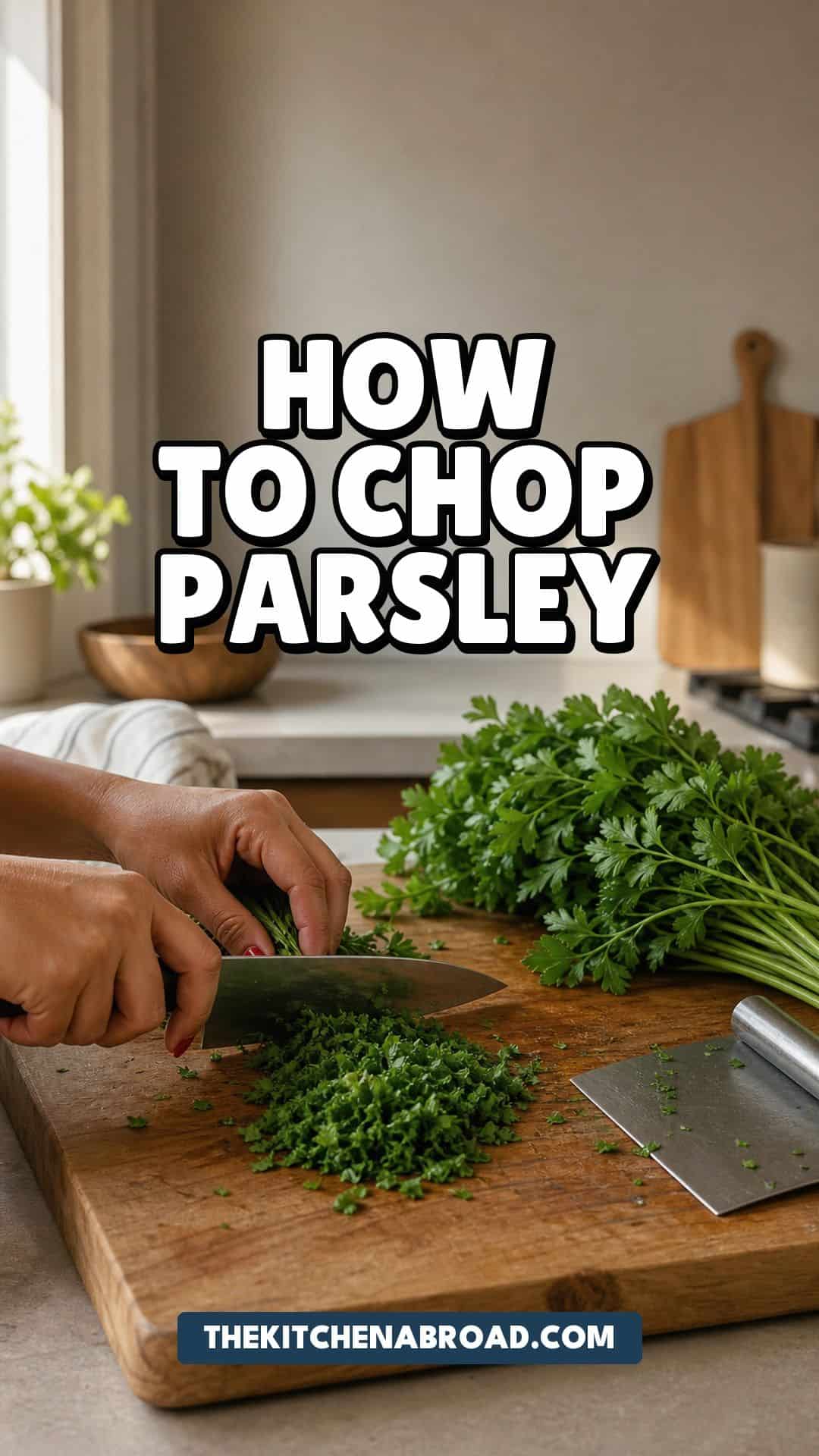
How to chop parsley the right way: spin the washed leaves bone-dry, gather them into a tight ball, and rock-chop with a sharp 8-inch chef’s knife under a claw-gripped guide hand. Pick the cut by the dish: a rough quarter-inch chop for soups and stews, an eighth-inch fine chop for pasta and salads, or a gremolata-fine near-paste for osso buco and tabbouleh. Three cuts, three jobs, one sharp knife.
Watch a line cook chop a bunch of parsley and the whole motion takes about 40 seconds, from the wash to the finished pile on a parchment square. Watch a home cook do it and the same task can stretch to five minutes, with leaves chasing the knife around the board and a chopped pile that is half-crushed paste, half-jagged ribbons. The gap is not knife speed. It is the four small decisions that happen before the blade ever touches the herb. Dry the parsley. Strip the leaves. Pick the cut. Use the claw. The version below is the technique a culinary-school knife-skills instructor would teach in the first week, scaled down for a home cutting board and a single bunch of flat-leaf parsley. Looking for the dried version, oven and dehydrator both? That is our how to make dried parsley at home. This is fresh, just-chopped, on the board.
What You’ll Need
A sharp 8-inch chef’s knife is the non-negotiable; anything shorter forces you to take more strokes, anything duller bruises the leaves and turns them gray instead of cutting them clean. A large wood cutting board gives you enough surface to gather the leaves into a tight bundle without losing them off the edge. A stainless steel bench scraper corrals the chopped pile, scrapes the cutting surface between rough and fine passes, and transfers the chopped herb cleanly into a measuring spoon or onto the dish. A salad spinner dries the bunch in 15 seconds; wet parsley is the single most common reason home chopping turns to mush. A set of small glass storage containers holds the chopped herb in the fridge if you are prepping ahead for the week.



Recommended Reads
- How to Make Dried Parsley at Home
- How to Cook Celeriac
- How to Make Cashew Butter
- Cod in Parsley Sauce
- Lemon Herb Roasted Chicken
Why Knife-Chopped Parsley Beats the Pre-Chopped Tub
Parsley is a knife herb, not a food-processor herb, and the reason has to do with volatile oil chemistry. The flavor molecules that make fresh parsley taste like itself, especially apiole and myristicin, are concentrated in microscopic oil sacs on the leaf surface, and those sacs rupture and release their contents as soon as the leaf is cut. A clean, fast knife stroke cuts most cells cleanly without crushing the leaf body. A food processor bruises and tears the leaves before it ever cuts them, releasing the oils into the air rather than holding them in the chopped pile, and leaving you with a dull, grass-green paste that smells more like lawn clippings than the bright pepper-and-citrus note of properly chopped parsley.
The same logic explains why pre-chopped parsley in plastic tubs is a downgrade no matter what the label promises. Lab studies on cut-and-pre-packaged herbs from the 2010s found that flat-leaf parsley loses about 75 percent of its volatile oil content within the first hour after chopping, even when refrigerated. By the time the tub crosses a warehouse, a truck, a grocery distribution center, and your produce cooler, the leaves are still green, but the flavor they were sold to deliver is largely gone. A whole bunch in the fridge holds its oils until the knife touches it. That is the entire case for knife-chopping at home. The French knife tradition the technique comes from, the move called le hachoir, was built around exactly this insight, codified in the first édition of Escoffier’s Le Guide Culinaire in 1903 and taught the same way at every CIA, Le Cordon Bleu, and Institute of Culinary Education classroom in the United States today.
A Few Notes on the Parsley and the Knife
- Flat-leaf vs curly: Flat-leaf (Italian) parsley is the default for cooking, with a brighter, more peppery flavor and leaves that chop cleanly without curling under the blade. Curly parsley is milder, slightly more decorative, and a touch more bitter; it works for tabbouleh and garnish but the flavor lift on a finished dish is smaller. Buy flat-leaf for everything except a strictly traditional tabbouleh.
- The wash: Submerge the whole bunch in a bowl of cold water, swish for 10 seconds, lift the bunch out (leaving any grit at the bottom of the bowl), and transfer to a salad spinner. Spin in two passes of 10 seconds each, with the lid open between spins to release the water that has pooled. The leaves should feel completely dry to the touch before you chop.
- Strip the leaves: Hold the bunch by the cut ends of the stems with one hand, run the other hand down the bunch in the direction of the stems, and the leaves with their short tender stems pop off cleanly. The thick lower stems go into the freezer bag for stock; do not chop them into the pile.
- The knife edge: A truly sharp 8-inch chef’s knife is the entire ball game. A dull knife crushes the leaf cells before it cuts, releases the oils on the board instead of holding them in the pile, and produces a darker, more bruised final chop. Hone before every session, sharpen every two months on a stone or with a service. If the blade does not slice cleanly through a tomato skin, it is not sharp enough for parsley.
- The cutting board: Wood, edge-grain, large. A 12 by 18 inch board gives you the surface to gather leaves into a tight ball and rock-chop without the pile spilling off the edge. Plastic boards are fine but tend to be smaller; bamboo is hard on knife edges and not recommended.
- The bench scraper: A stainless steel bench scraper is the single most under-bought knife-skills tool in a home kitchen. It corrals the chopped pile back into a tight ball between passes, scrapes the herb cleanly off the board into the measuring spoon, and saves you the finger-pinching transfer of a wet chopped pile. Eight dollars, lasts forever.
- Chop just before use: Parsley begins losing its volatile oils as soon as it is cut. Chop within 30 minutes of when the herb hits the plate; if you are prepping for a dinner party, chop after the first guest arrives, not at noon. Stored chopped, it holds in a covered glass container in the fridge for 24 hours with most of its flavor; past that it is closer to dried parsley than fresh.
Three Ways to Chop Parsley
Most home cooks chop parsley one way and use it for everything, which is part of why the herb earns its reputation as a sad garnish that adds color and nothing else. The truth is that parsley has three working cuts in a professional kitchen, and each one has a job it does cleanly and others where it falls flat. A rough chop in a vinaigrette over-asserts; a gremolata-fine chop in a soup disappears. Pick the cut by the dish. The three sections below are the spine of every cooking-school knife-skills lesson, scaled to a home kitchen and a single bunch of flat-leaf parsley.
The Rough Chop (Garnish-Style for Soups and Stews)
The rough chop is the workhorse cut for dishes where the parsley adds a flash of color and a hint of fresh herb without dominating the bowl. Quarter-inch pieces, leaves and tender upper stems both included, scattered over chicken noodle soup, vegetable stew, or a pot of beans in the last 30 seconds before the bowl hits the table. The stems carry more flavor than the leaves and bring a slightly peppery kick; they belong in this cut. Plan a small handful of leaves with their tender stems for a full pot of soup serving four to six.
Step-by-step: Wash and dry the parsley as above. Strip the leaves with their tender upper stems off the thick lower stems. Gather the loose leaves into a rough pile in the center of the board. Hold the knife handle in your dominant hand and place your guide hand on top of the blade tip, fingers spread to anchor the knife. Rock the blade up and down through the pile in a steady rhythm, pivoting the knife tip on the board, while the heel of the blade lifts and falls through the pile. Move the knife back and forth across the pile until the pieces are roughly quarter-inch. Scoop with the bench scraper and add to the pot in the last 30 seconds of cooking or as a garnish at the table.
The Fine Chop (Finishing Herb for Pasta and Salads)
The fine chop is the cut for dishes where the parsley is a partner, not a garnish, and where you want the herb evenly distributed across the plate rather than landing in clumps. Eighth-inch pieces, leaves only (no stems), folded into a finished pasta or sprinkled over a salad just before serving. This is the cut for spaghetti with garlic and oil, for buttered new potatoes, for a Greek salad with feta and cucumber, for a quick pan sauce over chicken. Plan two to three tablespoons of fine-chopped leaves for a dinner serving four.
Step-by-step: Wash and dry the parsley. Strip the leaves off all the stems; for this cut, no stems at all. Gather the loose leaves into a tight ball in the center of the board, pressing down with your guide hand to compact them. With a claw grip (fingertips curled in, knuckles forward as the guide), rock-chop through the ball in a steady rhythm. Every 10 seconds, stop, scrape the pile back into a tight ball with the bench scraper, and continue. Two to three rounds of chop-and-regather brings the pieces down to a clean eighth-inch. The pile should look uniform, bright green, and feel dry to the touch.
The Gremolata-Fine Chop (For Gremolata, Tabbouleh, and Finishing Oils)
The gremolata-fine chop is the cut for dishes where parsley is the flavor, not the accent, and where the chopped herb is fine enough to almost form a paste. The Milanese gremolata that finishes osso buco is parsley chopped this fine with lemon zest and garlic, spooned over the braised veal at the table. Tabbouleh uses this same cut for the Levantine salad of bulgur, tomato, and a stunning amount of parsley. A finishing oil, parsley chopped to near-paste and stirred into olive oil, is the move for spooning over grilled fish, roasted vegetables, or a wedge of feta. Plan one full bunch of flat-leaf parsley to yield about half a cup of gremolata-fine chop.
Step-by-step: Wash and dry the parsley thoroughly. Strip the leaves off all stems and gather into a tight ball on the board. Begin with a fine-chop pass to bring the pile down to eighth-inch pieces. Then, with the bench scraper, scrape the entire pile into the center of the board and compress into a tight ball again. Chop a second pass, working the knife back and forth across the pile, until the pieces are at sixteenth-inch. Scrape and compress a third time, chop a third pass; by this point the pile should look almost like a coarse damp powder, just shy of a paste. Use immediately; gremolata-fine chop loses flavor faster than coarser cuts because more cell walls are open to the air.
Tips and Variations
The Claw Grip, Explained Without the Diagram
The claw grip is the single biggest safety upgrade in home knife work, and most home cooks have never been shown it properly. The guide hand (the one not holding the knife) curls into a loose fist with the fingertips pointing down at the board, knuckles forward. The flat front of your knuckles becomes the guide surface against which the side of the knife blade slides as it cuts. Your fingertips, tucked under, cannot reach the cutting edge of the blade no matter how fast you chop. The knife itself never lifts higher than the knuckle line, which means the blade is physically blocked from reaching your fingertips. Once the grip becomes automatic, chopping speed roughly doubles and the small kitchen cuts that come from a flat-finger grip stop happening. Practice it the next time you chop an onion; the parsley benefits afterward.
Why a Sharp Knife Cuts Cleaner Than a Dull One
A sharp knife slices through a parsley leaf in a single clean stroke that severs cells without crushing them. A dull knife pushes the leaf forward across the board before it cuts, bruising the cell walls and rupturing the volatile oil sacs onto the board surface rather than holding them inside the chopped pile. The visual difference is striking. Sharp-knife parsley is uniformly bright green, smells aggressively of parsley while you chop, and stays light on the board. Dull-knife parsley turns olive-green at the edges within 30 seconds, smells faintly grassy, and packs into a damp clump. If you do nothing else for your parsley chopping, hone your knife on a steel before every session and have it professionally sharpened every two months. The technique below assumes a sharp blade; with a dull one, nothing else fully compensates.
Storing Chopped Parsley (If You Must Prep Ahead)
The flavor case for chopping just before use is real, but the practical case for prepping ahead is also real, especially for dinner parties or weeknight meal-prep batches. Chopped parsley holds in the fridge for 24 hours with most of its character if you store it correctly. Transfer the chopped pile to a small glass container, press a damp paper towel directly onto the surface of the herb (the moisture slows oxidation), seal the container with a tight lid, and refrigerate. Beyond 24 hours the herb is closer to dried parsley in flavor than fresh, and you might as well use the actual dried version. For prep ahead by more than a day, hold the herb as a whole bunch in the fridge and chop the morning of, or freeze chopped parsley in ice cube trays with olive oil for a stew or pasta sauce additive that holds for three months.
Curly vs Flat-Leaf, and When Each One Earns Its Spot
Flat-leaf (Italian) parsley is the default for nearly every cooking application. The flavor is brighter, more peppery, and more clearly defined than the milder curly version, and the leaves chop cleanly without curling under the blade. Curly parsley, the variety that anchored mid-century American garnish plates for decades, has a milder flavor and a slightly more bitter undertone; it shines in two specific dishes, traditional tabbouleh (where the curl provides texture against the bulgur) and the steakhouse plate garnish that has lived on for so long it almost circles back to being charming. For pasta, soup, sauce, finishing herb, gremolata, and salad work, flat-leaf is the right call. Buy curly only if you specifically want it for tabbouleh or for the visual that comes with it.
Don’t Throw Out the Parsley Stems
The thick lower stems carry more flavor by volume than the leaves themselves, and they belong in two places: a freezer stock bag and a finishing pan sauce. Strip the leaves off your bunch, gather the stems into a small bundle, and drop them into a labeled freezer bag along with onion skins, celery ends, and carrot peels. The next time you build a stock or a soup base, those stems bring a depth of parsley flavor that fresh leaves alone cannot. For a quick alternative, chop the lower stems fine and sweat them in butter or oil at the start of a pan sauce; the flavor blooms into the fat and finishes the sauce with an herbal undertone before the leaves go in at the end. The waste pile from a single bunch of parsley should be the toughest woody bottom inch only.
What to Use Chopped Parsley In
Chopped parsley earns its place in nearly every cuisine in the European canon and in plenty outside of it. The rough chop finishes our cod in parsley sauce at the last minute over the cream sauce, sits on top of a bowl of bean soup or vegetable stew, and scatters across roasted potatoes as soon as they come out of the oven. The fine chop folds into pasta with garlic and oil, finishes a buttered new-potato side, and brightens a salad with feta. The gremolata-fine chop is the Milanese garnish for osso buco, the Levantine backbone of tabbouleh, and the green note in any finishing oil for grilled fish or our lemon herb roasted chicken. For the dried version of the same herb, check our how to make dried parsley piece.
Chopped parsley is the base of cod in parsley sauce.
Frequently Asked Questions
Do you chop parsley stems too?
Tender upper stems, yes. Thick lower stems, no. The narrow tender stems attached to the leaves carry good flavor and are fine to chop along with the leaves for rough cuts in soups and stews. The thick lower stems are stringy, woody, and unpleasant to chew at any cut size, but they pack a concentrated parsley flavor that belongs in a freezer stock bag rather than in the chopped pile. Strip the leaves with their tender stems off the thick lower stems at the wash step and save the lower stems separately.
Should I chop parsley with a knife or a food processor?
Knife, every time. A food processor bruises the leaves before it cuts them, ruptures the volatile oil sacs into the air rather than holding them in the chopped pile, and produces a damp, dull, grass-green paste that smells more like lawn clippings than herb. A sharp 8-inch chef’s knife slices through the leaves cleanly, holds the volatile oils in the chopped pile, and produces a bright, light, aromatic chop in 40 seconds for a full bunch. The food processor saves no real time and noticeably degrades the result. Reserve it for pesto, where the texture is the goal and the oil emulsion holds the flavor.
How long does chopped parsley last in the fridge?
About 24 hours with most of its flavor, after which it is closer to dried parsley than fresh. Store chopped parsley in a small glass container with a damp paper towel pressed onto the surface of the herb to slow oxidation, sealed with a tight lid. Beyond 24 hours, the leaves go limp and the volatile oils have largely dissipated; the herb is still safe to eat but no longer delivers the lift that knife-chopped parsley promises. For longer storage, freeze chopped parsley in ice cube trays with olive oil and pop a cube into pasta sauce or stew as a finishing addition; the frozen version holds for three months.
Why does my chopped parsley turn dark and clumpy?
Two culprits, and both are fixable. The first is wet parsley going into the chop, which packs into a damp clump as soon as the knife passes through. Dry the leaves completely in a salad spinner with two 10-second passes before you chop. The second is a dull knife, which crushes the leaves rather than slicing them and turns the chopped pile olive-green within 30 seconds. Hone your knife on a steel before every session and sharpen on a stone every two months. With a dry herb and a sharp blade, chopped parsley stays bright green for the full prep window before it hits the dish.
What knife is best for chopping herbs?
An 8-inch chef’s knife is the working answer. The length gives you enough blade to cover the herb pile in a single rocking motion, the geometry handles vegetables and proteins just as well, and the weight is heavy enough to chop through soft herbs without forcing the blade. A 6-inch utility knife works in a pinch but requires more strokes per pile. A santoku is fine for slicing but the flat-edged blade is awkward for the rocking motion that fine-chop and gremolata-fine cuts depend on. The mezzaluna, the half-moon double-handled blade marketed specifically for herbs, is fun to use but not faster or more precise than a properly sharpened chef’s knife.
Can I chop other herbs the same way?
Most leafy herbs, yes, with small adjustments. Cilantro, dill, chervil, tarragon, and chives all benefit from the same dry-strip-claw-grip technique. Tougher woody herbs like rosemary and thyme need their leaves stripped from the stems (run a finger backward down the stem to pop off the leaves) before chopping; the woody stems are inedible. Basil should be chiffonaded (rolled into a tight cigar and sliced into thin ribbons) rather than chopped, because the rocking motion bruises basil leaves badly. Mint chops cleanly but loses flavor even faster than parsley; chop within 10 minutes of use.
Key Takeaways
- Dry the parsley completely in a salad spinner before chopping; wet leaves pack into a damp clump no matter how sharp your knife is.
- Use a sharp 8-inch chef’s knife with a claw grip. A dull blade crushes the leaves and releases the volatile oils onto the board instead of holding them in the pile.
- Three cuts, three jobs: rough chop (quarter-inch, leaves and tender stems) for soups and stews; fine chop (eighth-inch, leaves only) for pasta and salads; gremolata-fine for osso buco, tabbouleh, and finishing oils.
- Strip the leaves off the thick lower stems first; the lower stems go into a freezer stock bag, not into the chopped pile.
- Chop within 30 minutes of use; parsley loses about 75 percent of its volatile oils within an hour of chopping, which is why pre-chopped tubs taste flat.
- A stainless bench scraper is the underrated tool that corrals the pile between passes and scrapes the chopped herb cleanly off the board into the dish.
Final Thoughts
Chopping parsley is one of those small kitchen skills that costs almost nothing to learn and pays back every time you cook for the next forty years. The whole technique takes 40 seconds for a full bunch once it becomes automatic. The difference between a properly chopped pile and a sad bruised clump shows up in every dish that asks for fresh herbs, which in any European or Levantine kitchen is most of them.
The non-negotiables are dry leaves, a sharp knife, and the right cut for the dish. Spend 15 minutes practicing the claw grip on a board of onions and parsley before your next dinner party and the skill is yours for life. The other 85 percent of the technique is picking the right cut, which is a five-second decision once you know the three options.
Wash the bunch in cold water. Dry it in the salad spinner. Strip the leaves off the lower stems. Gather into a tight ball. Claw grip the guide hand, rock the blade through the pile, scrape and re-gather between passes. Forty seconds, one bunch, three possible cuts, every job in the European kitchen covered. That is the whole hachoir tradition in three paragraphs, and it is yours from this Tuesday forward.
Last update on 2026-11-19 / Affiliate links / Images from Amazon Product Advertising API