
If you want to know how to cook celeriac, the short answer is this: peel it with a sharp chef’s knife instead of a vegetable peeler, drop the cut pieces into cold lemon water so they don’t brown, and pick one of five honest methods based on how you cut it. One-inch dice goes into a 425°F oven for 30 to 35 minutes. Two-inch chunks go into salted water for 20 minutes and then a food processor with butter and cream. Half-inch slabs sear in cast iron and finish in a 400°F oven for 15 minutes. Chunks of one inch drop into soups and stews with the potatoes for 30 to 40 minutes. And raw, julienned or coarse-grated, it goes straight into a lemon-mustard-mayonnaise dressing for céleri rémoulade. The ugly part is the peel. Everything past that is easier than it looks.
Celeriac is the swollen root of a celery plant, and it looks like a knobby alien softball someone dropped in the dirt and then forgot. The first time you see one in the produce aisle, the temptation is to walk past. The second time, after someone has fed you a bowl of celeriac puree at a good restaurant, you stop and pick one up. It is, quietly, the most underrated root vegetable on the rack , sweeter than a turnip, half the carbs of a potato, and silkier than either one once cooked. Peel it with a knife, cut it five different ways for five different jobs, and the ugly part is over.

What You’ll Need
A sharp 8-inch chef’s knife for the peel-by-knife method, a large stainless stock pot for the puree and soup methods, a Y-shape vegetable peeler for the carrots and parsnips you’ll cook alongside (not for the celeriac itself, more on that below), a wide wood cutting board with room to stand the root upright, and a half-sheet aluminum pan for roasting one-inch dice in a single layer.


Recommended Reads
- Celeriac Puree So smooth You Will Want to Eat It With a Spoon
- Celeriac Steak That Will Make You Forget About Meat
- Roasted Spring Vegetables with Lemon Herb Drizzle
- Best Fall Soups and Stews
- How to Make Cashew Butter
Where Celeriac Comes From and Why It’s Worth Cooking
Celeriac is a Northern European staple with three named identities, depending on which kitchen you’ve eaten it in. In Germany it is Sellerie, the workhorse of Sellerie-Salat and the Sunday roast. In France it is céleri-rave, which has been julienned into céleri rémoulade , a mustardy mayonnaise slaw on every bistro plate of crudités since the mid-1800s. In Italy it is sedano rapa, slipped into winter soups and shaved raw into cold-weather slaws. Same root, three traditions, all centuries deep. The American produce aisle came to celeriac late, and almost never by that name; most US grocery stores still label it “celery root,” which is technically correct and culturally flat.
The shift in the United States happened in the 2010s, riding the farm-to-table movement and the Yotam Ottolenghi canon. Blue Hill, Gramercy Tavern, and a wave of seasonal-menu restaurants put celeriac on plates as a vegetable centerpiece, and Ottolenghi’s whole-roasted celeriac steak , served with a café de Paris sauce or salsa verde , is arguably the single dish that converted American home cooks. The reason it stuck is the math. Celeriac runs around 5.6 grams of net carbs per 100 grams compared to roughly 20 for a baked potato, with a more complex, slightly nutty flavor and a silkier texture once pureed. It is a potato substitute that doesn’t apologize for being one. That’s worth the ugly peel.
A Few Notes on Picking, Storing, and Peeling
Celeriac is the swollen root of a specific celery variety (Apium graveolens var. rapaceum). The plant grows aboveground stalks that look like rough, hollow celery, but the part you cook is the root crown, which can weigh anywhere from one to three pounds. The skin is brown, gnarled, often crusted with dirt, and pocked with hairy little side roots. Taste-wise it lands between celery, parsley, and parsnip, with a hint of nutmeg and a sweetness that deepens with cooking. Raw, it’s crisp and faintly grassy. Roasted, it caramelizes at the edges and goes savory. Pureed, it’s a silk that potato can’t compete with.
Pick small for raw use and large for cooking. A root under 1.5 pounds is sweeter and denser, ideal for rémoulade and shaved salads. Anything 2 to 3 pounds is the puree and soup size, where you want yield. Whatever the size, it should feel heavy for its weight, firm under pressure with no soft spots, and quiet when you tap it , a hollow sound means the inside is woody or starting to dry. The greens, if they’re still attached, should be lively rather than yellowed; the leaves are edible and taste like a milder, sweeter parsley. Storage is easy. Unwashed, in a plastic bag in the crisper drawer, a celeriac keeps for two to three weeks. Once peeled and cut, it goes into a bowl of cold water with the juice of half a lemon and holds for two to three days.
The peeling part is the move every primer fumbles. Do not reach for the Y-peeler. The skin is too knotty, the side roots are too deep, and you will spend ten minutes chasing dirt out of crevices while wrecking the blade. Use a sharp 8-inch chef’s knife instead. Wash the root, slice the top and bottom off completely flat so it stands upright on the cutting board without rocking, and then, working top to bottom in half-inch strips, slice down the sides following the curve of the root. The brown skin, the side-root crevices, and the deep dirt come off in one motion. You’ll lose 20 to 25 percent of the original weight, which is normal. Trim any remaining dark patches, then drop the cleaned root straight into the lemon water until you’re ready to cut to size and cook.
Five Ways to Cook Celeriac
Most blogs treat celeriac as a single trick: peel, dice, roast. That undersells the root. The five methods below each use a different cut, and the cut is the technique. Pick by what you want on the plate, not by what’s in season , celeriac is available October through March in the United States and almost year-round in better grocery stores.
Roast Until Caramelized at the Edges
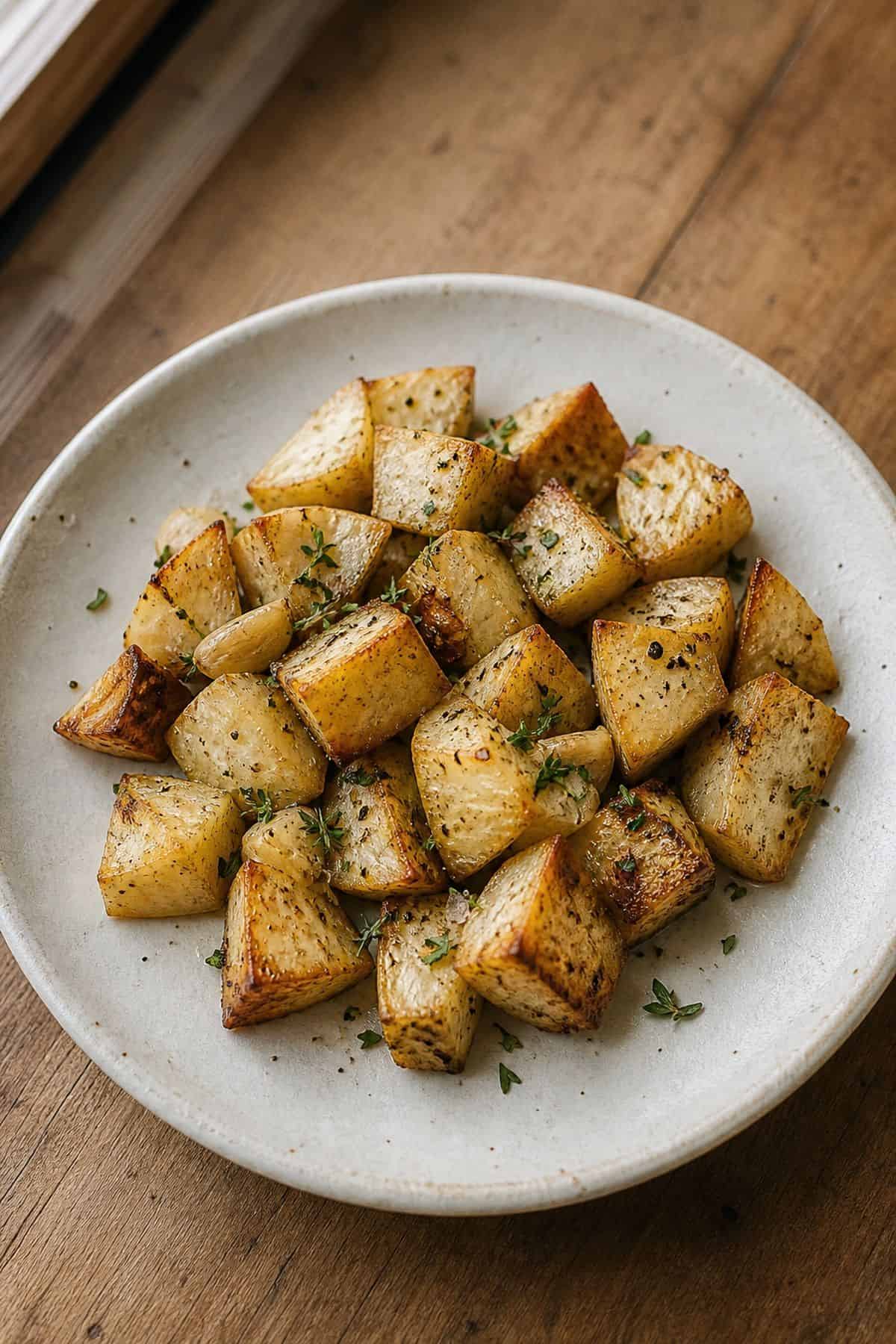
Roasting is the easiest entry point and the method most likely to convert a celeriac skeptic. The cubes turn golden at the corners, sweet at the center, and the texture lands somewhere between a roast potato and a roast parsnip , with a depth neither one quite reaches. Plan for 1.5 to 2 pounds of celeriac (one medium root, peeled weight) to serve four people as a side. Cut into 1-inch dice, toss with 2 tablespoons olive oil, 1 teaspoon kosher salt, and a generous grind of black pepper. Roast at 425°F (220°C) on a half-sheet pan in a single layer for 30 to 35 minutes, flipping halfway. Finish with 1 tablespoon fresh thyme leaves the moment the pan comes out of the oven.
Step-by-step: Heat the oven to 425°F. Peel the celeriac by the knife method above and cut into 1-inch dice. On a half-sheet pan, toss the dice with olive oil, salt, and pepper, spreading them in a single layer with space between pieces. Roast 30 to 35 minutes, flipping at the 15-minute mark. The pieces should be deeply golden at the corners and tender all the way through when poked with a knife. Off the heat, scatter fresh thyme leaves over the top and serve.
Mash and Puree for the Creamiest Side
Puree is the method that converts skeptics into evangelists. Boiled hard, drained dry, then blitzed with butter and cream, celeriac purees into something genuinely silkier than mashed potato , almost waxy in the way it holds a spoonful. It is the dish for a Sunday roast underneath, for a duck breast on top, for a winter dinner party that needs a vegetable that quietly stops the conversation. Use 2 pounds of peeled celeriac, cut into 2-inch chunks. Boil in well-salted water for 20 minutes until a knife slides through with no resistance. Drain hard and let the chunks steam off in the colander for two full minutes , wet celeriac purees into glue. Transfer to a food processor with 4 tablespoons unsalted butter, 1/2 cup heavy cream, and 1 teaspoon salt. Process until smooth.
Step-by-step: Peel and cut 2 pounds of celeriac into 2-inch chunks. Drop into a large pot of well-salted water and bring to a boil. Cook 20 minutes, until completely tender. Drain in a colander and let steam off for 2 minutes , this is the step that separates smooth from gluey. Transfer to a food processor with butter, cream, and salt, and process until smooth, scraping the bowl twice. Taste and adjust salt. For the full recipe with finishing oils, browned butter, and a make-ahead reheat method, see celeriac puree so smooth you will want to eat it with a spoon.
Slice into Celeriac Steaks
This is the Ottolenghi-era method , the one that gave celeriac its second act in the United States. Cut the peeled root into 1-inch-thick slabs, sear hard in a cast-iron pan to build a crust, then transfer the whole pan to a hot oven to finish the inside. The result is a vegetarian centerpiece with the heft and presentation of a piece of meat, golden-crusted on the outside and tender-creamy at the core. Plan one slab per person, salted aggressively. For 4 people, you’ll need a single 2-pound celeriac yielding 4 thick slabs after the rounded ends are trimmed off (save those for soup).
Step-by-step: Heat the oven to 400°F. Peel a 2-pound celeriac, trim the rounded top and bottom flat, and slice horizontally into 1-inch slabs. Pat dry, season both sides with kosher salt and black pepper. Heat 2 tablespoons olive oil in a cast-iron pan over medium-high until shimmering, then sear the slabs 3 to 4 minutes per side until deeply golden. Transfer the pan to the oven and roast 15 minutes, until a knife slides through with no resistance. Serve with salsa verde, café de Paris butter, or a sharp herb sauce. The full recipe with the sauce treatment is the celeriac steak that will make you forget about meat.
Add to Soups and Stews for Body and Depth
Celeriac is the underused secret ingredient in winter soups. Cut into 1-inch chunks and added to the pot alongside potatoes, leeks, and stock, it gives the soup the body that pure potato can’t quite manage and a depth that reads almost meaty. The Yotam move is celeriac-and-apple soup with leeks, blended smooth and finished with brown butter and toasted hazelnuts. The simpler version is to throw a peeled, diced 1-pound celeriac into any potato-and-leek soup base and call it the upgrade. For a 4-quart pot of soup, plan 1 pound peeled celeriac in 1-inch chunks added with the rest of the root vegetables.
Step-by-step: Sweat 2 chopped leeks in 2 tablespoons butter for 5 minutes. Add 1 pound peeled celeriac in 1-inch chunks, 1 pound peeled potatoes in 1-inch chunks, and 4 cups vegetable or chicken stock. Simmer 30 to 40 minutes until everything is tender. Blend smooth with an immersion blender for a pureed soup, or leave chunky for a more rustic stew. Season with salt, pepper, and a splash of cream, and finish with chopped parsley or a drizzle of good olive oil.
Shave Raw for Céleri Rémoulade
Raw is the French answer, and the dish is céleri rémoulade , the bistro slaw that has been a Paris fixture on every assiette de crudités since the 1860s. Julienne or coarse-grate a peeled celeriac, toss immediately with a lemon-Dijon-mayonnaise dressing so it doesn’t brown, and let it sit for 20 minutes to soften slightly and absorb the dressing. The result is crisp, mustardy, faintly nutty, and one of the most reliable cold sides in the European repertoire. Plan 1 pound peeled celeriac to serve 4 as a starter.
Step-by-step: Peel a 1-pound celeriac and julienne fine (a mandoline with the julienne attachment is fastest) or coarse-grate on a box grater. Immediately toss with 1/4 cup mayonnaise, 2 tablespoons Dijon mustard, the juice of 1 lemon, 1 teaspoon salt, and a handful of chopped parsley. Taste and adjust acid and salt. Let sit 20 minutes in the fridge before serving, on its own as a starter or alongside ham, smoked fish, or a wedge of pâté.
Tips and Variations
How to Peel Celeriac Without a Peeler
The knife-peeling method is the single most important technique in celeriac cooking, and it’s the one most home cooks have never been shown. The Y-peeler can’t handle the knotty skin and the deep side-root crevices, and the spiral peelers built for apples and potatoes fare even worse. A sharp 8-inch chef’s knife is the only right tool. Slice the top and bottom flat, stand the root upright on a wide cutting board, and slice down the sides in half-inch strips, following the curve. You will lose 20 to 25 percent of the weight to peel. That’s the cost of doing business. Anyone telling you celeriac is hard to prep has skipped this step.
Why Celeriac Beats Potato for Lower-Carb Roasts
Celeriac runs about 5.6 grams of net carbs per 100 grams, against roughly 20 grams for a baked potato. The math alone makes it a paleo and keto staple, but the better argument is the flavor. Celeriac is more complex , nutty, faintly sweet, with a savory hum that potato simply doesn’t have. Roasted, it caramelizes harder at the edges. Pureed, it goes silkier. Riced or grated raw, it stands in for a cauliflower-rice base with more body. In gratins, sub one for one with potato and use slightly more cream to compensate for the lower starch. The result is not a sad diet swap. It’s a genuinely better dish in a register of its own.
Pairing Celeriac with Other Root Vegetables
Celeriac plays well with carrots, parsnips, potatoes, turnips, and rutabaga in a roasted root-vegetable medley. Cut everything to the same 1-inch dice for even roasting, toss with olive oil and salt, and roast at 425°F for 35 to 40 minutes, flipping halfway. The celeriac brings a nutty undertone that lifts the sweetness of carrots and parsnips and adds depth to the more neutral potato and turnip. Skip beets in the mix , they bleed and stain everything pink. For a one-pan side dish at a Sunday roast, this mix on a half-sheet pan with fresh thyme and rosemary is the workhorse move.
Make-Ahead Strategy for Holiday Sides
For a Thanksgiving or Christmas table, celeriac puree is the make-ahead side that frees up oven space on the day. Make the puree fully the day before, transfer to a buttered baking dish, smooth the top, and refrigerate covered. The day of, bring to room temperature for 30 minutes, dot the surface with another 2 tablespoons butter, and warm in a 350°F oven for 25 minutes, stirring once at the 15-minute mark. The flavor and texture are unchanged from fresh, and the kitchen real estate is reclaimed for the bird. Roasted dice also holds well, reheated at 425°F for 8 minutes to re-crisp the edges.
Using the Celeriac Leaves (Don’t Toss Them)
If your celeriac arrives with the green tops still attached, don’t compost them. The leaves taste like a milder, sweeter parsley, and they finish the same dishes the root anchors. Chop fine and scatter over a bowl of celeriac puree, fold into a remoulade for a second hit of celery flavor, stir into a green salsa with capers and lemon, or sprinkle on top of soup. The stalks themselves are too tough and stringy to eat raw, but they’re useful for stock , chop and freeze them in a zip-top bag with onion ends and parsley stems for the next time you build a vegetable broth.
What to Pair It With
Celeriac is an autumn-and-winter side, full stop. The puree goes underneath a French roast , pork loin, duck breast, roast chicken with crisp skin , and answers the mashed-potato fatigue that sets in by mid-November. The steak is the vegetarian centerpiece at a Sunday roast where one or two guests don’t eat meat, dressed with salsa verde or a café de Paris butter. The roasted dice slips alongside any holiday bird, and the soup base , celeriac with leeks, apples, and brown butter , is the dish that closes out a cold night. As a paleo or keto potato substitute, it stands in across mash, fries, gratin, and rosti without ever feeling like a compromise.
Frequently Asked Questions
What does celeriac taste like?
Celeriac tastes nutty, slightly sweet, and faintly of celery, with a hint of parsley and a register of nutmeg that comes forward as it cooks. Raw, it’s crisp and grassy, the bright clean note that makes céleri rémoulade work. Cooked, it goes smooth and savory, sitting somewhere between a potato, a parsnip, and a Yukon Gold that took a few cooking classes. It is not as sharp as a turnip, not as starchy as a potato, and not as sweet as a parsnip. The middle of that triangle is the celeriac flavor.
Can I substitute celeriac for potato?
Yes, and in most cases it’s an upgrade. Use it one-for-one in mash, puree, soup, gratin, fries, and rosti. The net carbs run about a quarter of what a potato delivers, the flavor is more complex, and the texture pureed is genuinely silkier. The one place to be careful is anywhere you need the starch to bind , a potato gnocchi, for instance, leans on the potato starch and won’t work the same way with celeriac. For everything else, swap and don’t look back.
How do you peel celeriac?
With a sharp 8-inch chef’s knife, not a Y-peeler. Slice the top and bottom flat so the root stands upright on the cutting board, then slice down the sides in half-inch strips, following the curve. The brown skin and the side-root crevices come off together in one motion. Trim any remaining dark patches, then drop the cleaned root into a bowl of cold water with the juice of half a lemon to prevent browning. Expect to lose 20 to 25 percent of the weight to the peel , that’s normal and built into the recipe yields.
How do you store celeriac?
Whole and unwashed, in a plastic bag in the crisper drawer of the fridge, a celeriac keeps for 2 to 3 weeks. The greens, if still attached, should be trimmed off the day you bring the root home, since the leaves pull moisture from the root as they wilt. Cut celeriac holds for 2 to 3 days submerged in cold water with the juice of half a lemon, refrigerated and covered. Cooked celeriac , puree, soup, roasted dice , keeps 3 to 4 days, covered, in the fridge.
Can you eat celeriac raw?
Yes, and the canonical raw dish is céleri rémoulade , julienned or coarse-grated celeriac tossed with mayonnaise, Dijon mustard, lemon juice, salt, and chopped parsley. Raw celeriac is crisp, faintly grassy, and a touch sharp, which is exactly what the mustardy dressing wants. It also shaves thin into winter salads with apple, walnut, and a sharp cheese like aged Gouda. The only rule is to dress it the moment it’s cut, since the cut surfaces brown like apple flesh exposed to air.
What do I do with celeriac leaves?
Treat the tender inner leaves like parsley. Chop fine and scatter on top of the puree, fold into a remoulade or potato salad, stir into a green sauce with capers and lemon, or use as the finishing herb on a bowl of celeriac soup. The outer stalks are too tough and stringy to eat raw, but they go straight into a stock bag in the freezer for the next time you build a vegetable broth , they bring more depth than the celery sticks you’d otherwise reach for.
Key Takeaways
- Peel celeriac with a sharp 8-inch chef’s knife, never a Y-peeler , slice top and bottom flat, stand the root up, and slice down the sides in half-inch strips.
- The cut is the technique: 1-inch dice for roasting, 2-inch chunks for puree, half-inch slabs for steaks, 1-inch chunks for soup, julienned raw for rémoulade.
- Drop cut pieces straight into cold water with the juice of half a lemon to prevent browning , non-negotiable for white puree and clean rémoulade.
- Roast 1-inch dice at 425°F for 30 to 35 minutes; boil 2-inch chunks 20 minutes for puree; sear 1-inch slabs and finish at 400°F for 15 minutes for steak.
- Buy small and dense for raw use, large and heavy-for-size for puree and soup. Stored whole in the crisper drawer, celeriac keeps 2 to 3 weeks.
- The shipped recipes to graduate to are the smooth celeriac puree and the meaty celeriac steak.
Final Thoughts
Celeriac is the produce-aisle gamble that quietly pays off. The peel is ugly, the shape is unhelpful, the name on the sign says “celery root” half the time, and the first one you bring home requires a small leap of faith. None of that survives the first bowl of puree, the first edge of caramelized dice, the first crusted slab fresh from the cast iron. The root earns its place fast.
The five methods above are the spine , roast, puree, steak, soup, rémoulade , and they cover virtually every place celeriac belongs in a home kitchen. Master the knife-peeling technique once and the rest is cutting to size. The two shipped recipes on this site, the smooth puree and the meaty steak, are the next two posts to read; they take the methods here and stretch them into the dishes that became the celeriac canon in the first place.
Buy one this week. Bring it home, slice it flat top and bottom, stand it up on the board, and peel it down with the chef’s knife. Cut to size, drop into lemon water, and pick a method. The ugly root is a 15-minute knife job away from the most underrated side dish on the autumn table.
Last update on 2026-08-08 / Affiliate links / Images from Amazon Product Advertising API