

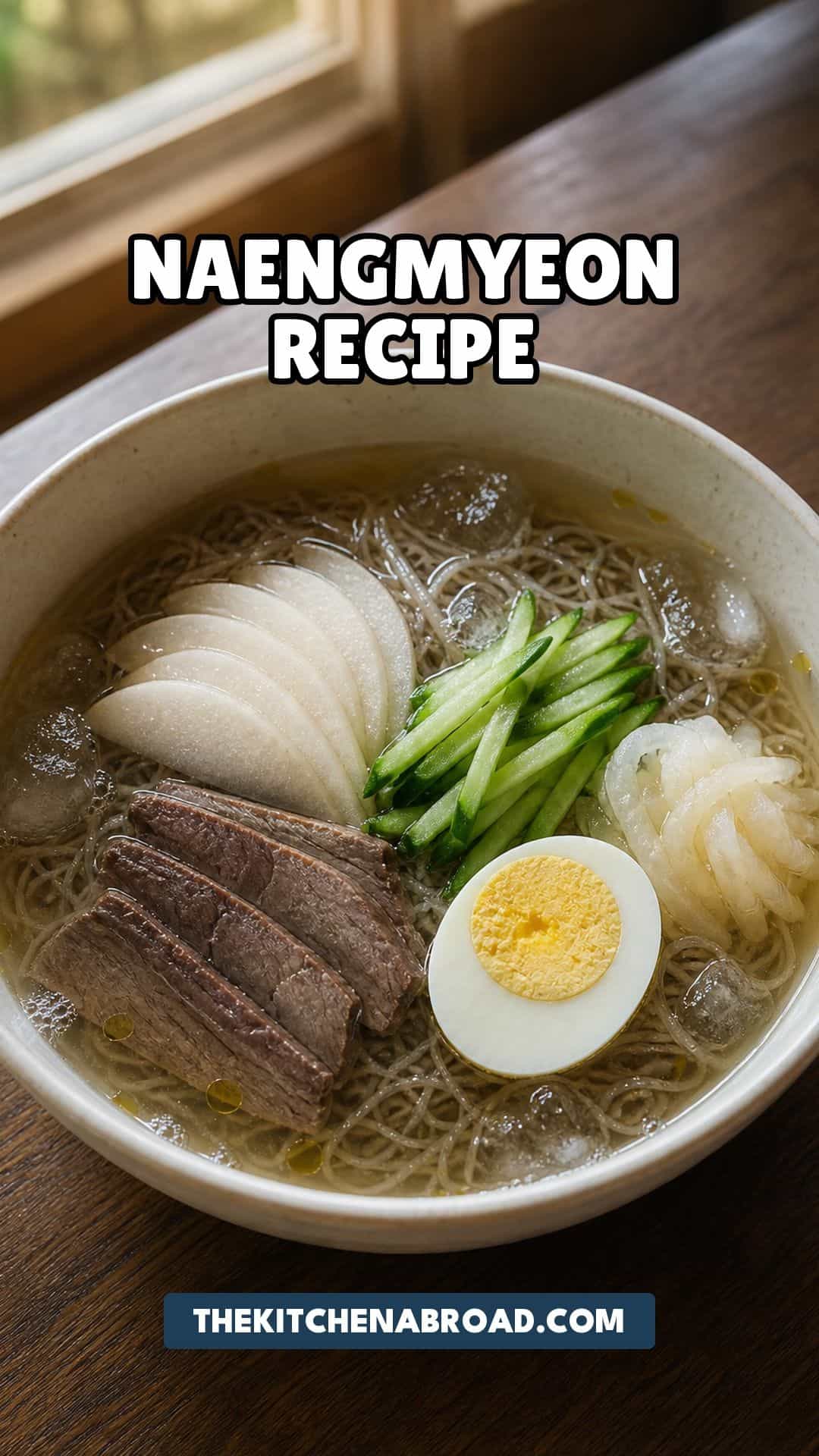
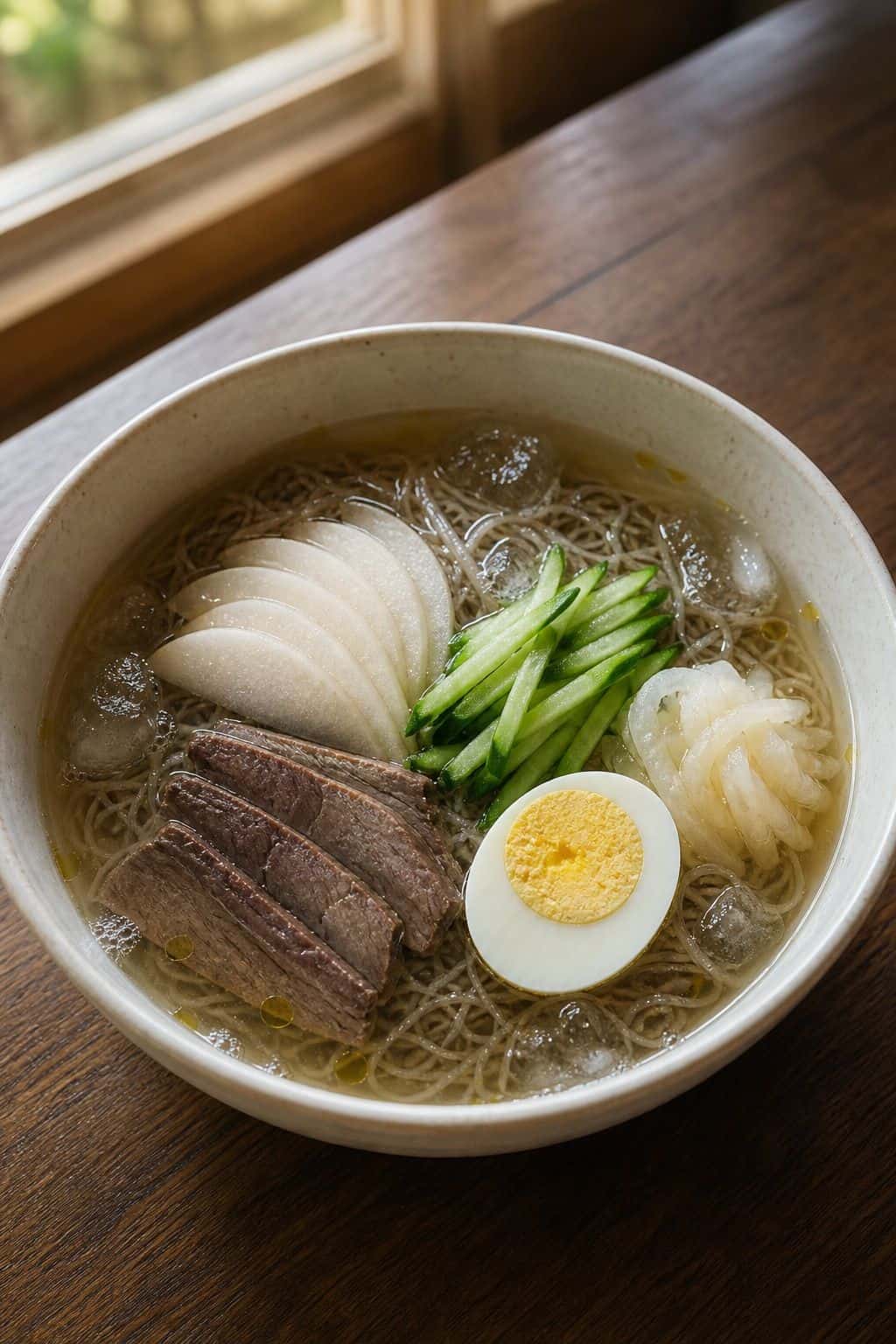
A real-deal naengmyeon recipe: dried Korean buckwheat-and-sweet-potato-starch noodles boiled four minutes, ice-bath shocked and rubbed clean of starch, piled into a wide ceramic bowl, and drowned in a half-frozen beef and Asian-pear broth that goes into the freezer until ice crystals spin on the surface. Six canonical toppings get arranged like spokes around the bowl: thin-sliced brisket from the broth, julienned cucumber, sliced Korean pear, a halved hard-boiled egg, pickled radish, and a drizzle of Korean hot mustard oil at the table. Kitchen scissors come out to cut the noodles before the first bite. Pyongyang origin, Korean War southward migration, modern Seoul summer staple, four servings, thirty minutes of active work plus chill time.
The first time I had naengmyeon in Seoul, the broth was slushy. Half-frozen, in fact, with ice crystals spinning across the surface as the server set the bowl down and handed over a pair of kitchen scissors. I had never had a noodle dish that cold, and I have spent the years since trying to figure out how to make it at home without a commercial freezer or a noodle press. The dish was born in 19th-century Pyongyang as a winter food eaten in ondol-heated homes, carried south by North Korean refugees during the Korean War in the early 1950s, and inverted by South Korea into the canonical summer dish it is today. The answer for the home cook turns out to be simple: you buy the noodles, and you put everything you have into the broth. Looking for the Japanese cousin? Our gluten-free soba noodles recipe is a different broth, a different noodle, and a different mood entirely.
What You’ll Need
A bag of dried naengmyeon noodles from H-Mart or Amazon (Choung Soo, Wang, and Assi are the canonical Korean brands and any of them work), a large stainless steel stockpot big enough to boil four portions of long elastic noodles without crowding, sharp kitchen scissors for the tableside ritual that defines the dish, an 8-inch chef’s knife for slicing brisket and Korean pear thin, and a set of wide ceramic noodle bowls that hold enough icy broth to half-submerge the noodles with room for the six toppings arranged radially. The noodles are the one thing you absolutely cannot make at home, so spend the home-cook energy on the broth and the build.


Recommended Reads
- Gluten-Free Soba Noodles
- Thai Chicken Cashew Nuts
- Easy Chicken Pad Thai
- Quick and Easy Chicken Stir Fry
- Best Fall Soups and Stews
Where Naengmyeon Came From
Naengmyeon literally translates to “cold noodles” (냉면), and the dish was born in 19th-century Pyongyang as a winter food. Joseon-era families in what is now North Korea would eat icy buckwheat noodles inside their ondol-heated homes, the contrast between scalding floors and slushy broth part of the appeal. The dish was codified by the Pyongyang Korean Noodle Association in 1911, when the canonical version was set down in writing for the first time: buckwheat noodles blended with sweet potato or potato starch for elasticity, served in a dongchimi (winter radish water-kimchi) broth, topped with thin-sliced beef, julienned vegetables, and a halved egg.
The Korean War from 1950 to 1953 carried the recipe south. North Korean refugees fleeing during and after the war brought naengmyeon with them and built the Seoul institutions that still operate today, including Woo Lae Oak (founded 1946 in Pyongyang, reopened in Seoul in 1954) and Eulji Myeonok. Modern South Korea then inverted the season. What had been a winter dish in Pyongyang became, in Seoul, the most-ordered cold meal during heat waves, and the canonical chaser after a long Korean BBQ dinner where the icy broth cuts through the richness of grilled meat. Restaurants serve naengmyeon with kitchen scissors at the table because the noodles are deliberately long and elastic, sometimes pulled to nearly two feet in length, and they need to be cut before they can be eaten with chopsticks.
A Few Notes on the Ingredients
- Naengmyeon noodles: Dried, store-bought, no exceptions. The noodles are buckwheat blended with sweet potato or potato starch, extruded through a specialized press, and nearly impossible to replicate at home. H-Mart carries them in the noodle aisle (in person or on hmart.com); Amazon stocks the same canonical brands (Choung Soo, Wang, Assi). A 16- to 25-ounce package usually contains four to six portions plus a soup base packet you can ignore in favor of homemade broth.
- Beef brisket broth (or the shortcut): The traditional broth is brisket and Korean radish simmered for an hour with onion, garlic, and peppercorns, then strained, chilled, and seasoned. The shortcut that gets you 85 percent of the way there is 4 cups of good beef stock plus 2 cups of Asian pear juice, chilled until ice-cold and seasoned at the table. The icy temperature matters more than the depth of the stock.
- Rice vinegar and soy sauce: Two tablespoons of rice vinegar and a tablespoon of soy sauce go into the broth to balance the sweetness from the pear juice. A teaspoon of sugar lifts the whole thing and brings out the umami of the beef.
- Sliced beef brisket, cooked: Topping component one of six. If you made the broth from scratch, the brisket comes out of the pot after an hour, gets chilled, and is sliced paper-thin against the grain. If you used the shortcut, buy 8 ounces of pre-cooked deli brisket or shabu-shabu beef and slice it cold.
- Cucumber, julienned: Topping component two. One large English or Korean cucumber, cut into matchsticks about two inches long. The crunch and clean vegetal note offsets the rich broth.
- Korean pear, sliced: Topping component three. Sweet, crisp, granular, and entirely different from a Bartlett or Bosc, the Korean pear (also called Asian or apple pear) is the canonical naengmyeon topping. Slice it thin and lay the slices in a fan. Bosc pear is the acceptable swap if you cannot find Korean pear.
- Hard-boiled egg, halved (plus pickled radish and mustard oil): Topping component four is a six-minute hard-boiled egg, halved lengthwise, the soft yolk against the icy broth one of the defining pleasures of the dish. Component five is pickled Korean radish (mu-saengchae), a half cup, the bright tang another contrast point. Component six is Korean hot mustard oil (yeongyeoja), drizzled at the table, a teaspoon per bowl, the heat clean and sinus-clearing rather than chile-warm.
Recipe: Naengmyeon (Korean Cold Buckwheat Noodles)
Prep time: 30 minutes | Cook time: 5 minutes | Total time: 35 minutes plus chill time | Serves: 4
Ingredients
- 4 portions (about 12 oz / 340 g) dried naengmyeon noodles
- 6 cups (1.4 L) icy beef-radish broth, or the shortcut: 4 cups (960 ml) beef stock + 2 cups (480 ml) Asian pear juice + 2 tbsp rice vinegar + 1 tbsp soy sauce + 1 tsp sugar, whisked together and chilled until ice-cold
- 8 oz (225 g) cooked beef brisket, thinly sliced against the grain
- 1 large cucumber, julienned into 2-inch matchsticks
- 1 Korean pear, peeled and sliced thin
- 4 hard-boiled eggs, halved lengthwise
- 1/2 cup (60 g) pickled Korean radish (mu), drained and julienned
- Korean hot mustard oil (yeongyeoja), for drizzling at the table
- 1 cup (about 8 oz) ice cubes, for the bowls
Instructions
- Several hours before serving, whisk together the broth ingredients in a large bowl or pitcher. Taste and adjust: another splash of rice vinegar if it reads flat, a pinch of salt if it reads thin, a touch more sugar if the pear juice is on the tart side. Transfer the seasoned broth to the fridge for at least four hours, or the freezer for thirty minutes if you are short on time. The goal is ice-cold to slushy, with ice crystals starting to form on the surface. If the broth is not cold enough to give you a chill when you taste it, it is not ready.
- Set the stockpot of water on the stove and bring it to a rolling boil. Drop the dried noodles in and stir immediately so they do not clump. Boil four to five minutes per the package instructions, watching closely because naengmyeon noodles cook faster than wheat pasta and go from chewy to mushy in under a minute.
- Drain the noodles into a colander and rinse under cold running water for thirty seconds, rubbing the noodles between your hands as the water runs. This removes the surface starch that would otherwise make the broth cloudy and the noodles gummy. Move the rinsed noodles into a large bowl of ice water and let them sit for at least one minute to shock them all the way cold. Drain again and divide the noodles into four wide ceramic bowls, nesting them loosely in the bottom of each bowl.
- Pour the icy broth over the noodles, about a cup and a half per bowl, until the noodles are nearly submerged. Drop two to three ice cubes into each bowl for extra chill, and if the broth is not slushy enough, scrape a few ice crystals off the surface of the chilled liquid as you pour.
- Arrange the toppings in segments around the rim of each bowl: a small pile of sliced brisket at twelve o’clock, julienned cucumber at three, Korean pear slices at six, a halved egg at nine, and pickled radish tucked into the gaps. The visual of color and contrast against the clear icy broth is half the dish.
- Bring the bottle of Korean hot mustard oil to the table along with a pair of kitchen scissors. Drizzle a teaspoon of mustard oil over each bowl at the moment of serving, then use the scissors to cut the noodles into manageable lengths before the first bite. Serve immediately, because the noodles continue to absorb broth and lose their bite if they sit.
Notes
Store-bought noodles are the only realistic source. Naengmyeon noodles are extruded buckwheat-starch dough pressed through specialized machines under high pressure, and the recipe simply does not work with regular soba, rice noodles, or anything else from the Asian aisle. Buy the dried Korean noodles or do not make the dish, full stop. Choung Soo, Wang, and Assi are the three brands you will see on H-Mart shelves and on Amazon, and any of them work.
Ice-cold broth is non-negotiable. This is not a dish where slightly cool is fine. The broth needs to be slushy, ideally with ice crystals on the surface, because the cold is the entire point of the recipe. Plan ahead and put the broth in the freezer the morning of, or transfer it from the fridge to the freezer for the last thirty minutes before serving. If the broth is just refrigerator-cold when you pour it, you have a fine bowl of cold beef noodle soup. You do not have naengmyeon.
Kitchen scissors at the table is traditional, and it is also functional. The noodles are pulled long and elastic by design, often reaching close to two feet in length, and chopsticks cannot manage them without the cut. Real Korean restaurants bring scissors out with every order. Do the same at home.
Tips and Variations
Where to Find Naengmyeon Noodles (H-Mart vs Amazon)
If you have an H-Mart within driving distance, that is the first stop. Walk to the noodle aisle and look for the blue, red, or green bags labeled “naengmyeon” or “Korean cold noodles” in English and 냉면 in Korean. A 16- to 25-ounce package runs five to seven dollars and contains four to six portions. Most packages also include a powdered or liquid soup base packet you can save for an emergency lazy bowl but should ignore for the home-cooked version. If H-Mart is not local, Amazon stocks Choung Soo, Wang, and Assi at slightly higher prices but with two-day shipping, and any Korean grocer in a major US city will carry at least one of the three brands. The packaging is intentionally graphic and easy to spot once you know what to look for.
Why Ice-Cold Broth Is Non-Negotiable
The temperature is the texture, and the texture is the dish. Naengmyeon broth at fridge temperature reads thin and watery; the same broth at slushy near-freezing reads bright, concentrated, and clean. Cold dulls sweetness, which is why the broth gets a teaspoon of sugar and the pear juice does not feel cloying once chilled, and cold sharpens acidity, which is why the rice vinegar pops the way it does. The freezer trick most Korean cooks use is to start chilling the broth in the morning, then transfer it to the freezer for the last thirty to sixty minutes before serving. If you see ice crystals forming on the surface as you pour, you have it right. If the broth is liquid all the way through with no chill, put it back and wait.
The 6-Topping Lineup That Defines Mul-Naengmyeon
The six toppings are canonical: thin-sliced brisket, julienned cucumber, sliced Korean pear, halved hard-boiled egg, pickled radish, and a drizzle of Korean hot mustard oil. Each one does a specific job. Brisket carries the protein and the cross-link back to the broth. Cucumber adds clean vegetal crunch. Korean pear brings the sweet contrast that defines the dish (and is the secret ingredient in the broth, doubled at the bowl). The hard-boiled egg gives you the soft yolk against the icy broth. Pickled radish is the tangy palate-reset that punctuates each bite. Mustard oil at the table is the heat that makes the cold register more sharply. Drop any one and the bowl loses a register. Add anything else and the dish drifts away from canon.
Mul vs Bibim (Broth vs Spicy-Dry)
Naengmyeon comes in two styles. Mul-naengmyeon, the version above, is the broth bowl with icy beef-and-pear stock and six radial toppings. Bibim-naengmyeon is the dry-mixed version: the same noodles, no broth, tossed with a fiery gochujang-vinegar sauce, hard-boiled egg, cucumber, and pickled radish. Bibim is hotter, redder, and more aggressive on the palate; mul is cleaner, colder, and more nuanced. North Korean restaurants in Seoul like Woo Lae Oak built their reputation on mul. South Korean food courts run bibim because it travels better on a takeout tray. For a first home attempt, mul is the cleaner shot at canonical naengmyeon. Once you have the technique down, bibim is a thirty-minute riff using the same noodle technique and a sauce that mixes gochujang, gochugaru, sugar, vinegar, soy sauce, sesame oil, and garlic in roughly equal proportions.
Adapting for After Korean BBQ (Palate Cleanser)
The canonical naengmyeon moment in Seoul is not lunch on a hot day. It is the bowl that arrives after a long Korean BBQ dinner, when the table is heavy with the smoke of grilled brisket and pork belly and the rich punch of doenjang stew, and the icy broth comes in to reset the palate before the bill arrives. To set the dish up for this role at home, halve the portion size (a third of a pack per person rather than a full one), skip the brisket topping since you have just eaten an hour of grilled beef, and lean harder on the cucumber, pear, and pickled radish for the cooling contrast. A small bowl of mul-naengmyeon at the tail end of a Korean BBQ night is the closest you will get to the Seoul experience from a home kitchen, and it is the move that turns a good barbecue dinner into a great one.
What to Serve It With
Naengmyeon is engineered for hot weather and for the tail end of a Korean BBQ meal, and the side dish strategy bends to whichever role it is playing. As a hot-weather lunch on its own, the bowl is enough. The six toppings cover protein, vegetable, starch, fat, and acid, and the icy broth is its own beverage. As a summer dinner, set it next to a few small bowls of banchan (kimchi, seasoned spinach, pickled cucumber, marinated bean sprouts) and a glass of barley tea served cold; the meal carries itself. As the closer to a Korean BBQ night, naengmyeon comes out at the very end after the grill has been cleared, halved in portion size, and treated as the palate cleanser the dish was historically built to be. For a non-BBQ pairing, our best fall soups and stews roundup leans warmer, but if you are looking for the broader Asian-cuisine reading list, our Thai chicken cashew nuts and easy chicken pad Thai belong in the same rotation.
Frequently Asked Questions
Where do I buy naengmyeon noodles?
H-Mart (in store or at hmart.com) is the most reliable source for dried naengmyeon noodles in the US, and any Korean grocer in a major city will stock at least one of the three canonical brands: Choung Soo, Wang, or Assi. Amazon carries the same brands at slightly higher prices but with two-day shipping. A 16- to 25-ounce package usually contains four to six portions and runs five to seven dollars. Look for the words “naengmyeon” or “Korean cold noodles” on the package, plus 냉면 in Korean script.
What is the difference between mul and bibim naengmyeon?
Mul-naengmyeon is the broth version, which is what the recipe above is. The same chewy buckwheat noodles get drowned in an icy beef-and-pear stock with six canonical toppings arranged radially. Bibim-naengmyeon is the dry-mixed version: same noodles, no broth, tossed instead with a fiery gochujang-vinegar sauce. Mul is cleaner and more delicate; bibim is hotter and more aggressive. North Korean expat restaurants in Seoul are mul institutions; bibim shows up more often at South Korean food courts and casual lunch spots.
Is naengmyeon gluten free?
Buckwheat itself is naturally gluten free, but most commercial naengmyeon noodles contain wheat starch or wheat flour blended in for elasticity, so the noodles as sold are generally not gluten free. Check the package ingredient list if you need a strict GF version. If you cannot find a 100 percent buckwheat naengmyeon (rare in US stores), our gluten-free soba noodles made with 100 percent buckwheat are the closest reliable substitute, though the texture and the cultural context are both different.
Can I make the broth ahead?
Yes, and the broth actually benefits from at least four hours in the fridge to let the flavors settle. Make it the morning of, or up to two days ahead. Move the broth to the freezer for the last thirty to sixty minutes before serving so it goes from refrigerator-cold to slushy. If you make it more than two days ahead, store it in the fridge and skim any fat that solidifies on the surface before pouring.
What if I can’t find Korean radish or Asian pear?
Daikon radish is the acceptable swap for Korean radish (mu); it is slightly milder and a little less dense, but the role in the dish is the same and most US shoppers will recognize it. For Asian pear, a Bosc pear is the next-best option since it shares the granular crispness, and a Bartlett works in a pinch though it is softer. The Korean pear is sweeter and crunchier than either Western pear, so if you can find it (most H-Marts and many Whole Foods stores carry them seasonally), it is worth the search.
Do I have to cut the noodles with scissors?
Yes, in the sense that every traditional Korean restaurant does it and the noodles are difficult to eat otherwise. Naengmyeon noodles are pulled deliberately long, sometimes reaching two feet in length, because the elasticity is part of the appeal. Chopsticks cannot manage them at full length. A pair of clean kitchen scissors comes to the table with the bowl, the noodles get cut twice across the bowl to break them into manageable lengths, and only then does eating begin. The ritual is not optional in any meaningful sense.
Key Takeaways
- Buy the noodles. Dried naengmyeon from H-Mart, Amazon, or any Korean grocer (Choung Soo, Wang, Assi) is the only realistic source. Homemade is not a practical option.
- The broth has to be ice-cold to slushy. Refrigerate at least four hours, then move to the freezer for the last thirty to sixty minutes. Ice crystals on the surface mean you have it right.
- Boil the noodles four to five minutes, rinse under cold water while rubbing them between your hands to remove starch, then ice-bath shock until completely cold before bowling.
- The six canonical toppings are non-negotiable for mul-naengmyeon: sliced brisket, julienned cucumber, Korean pear, halved hard-boiled egg, pickled radish, and a drizzle of Korean hot mustard oil at the table.
- Bring kitchen scissors to the table. The noodles are pulled deliberately long and must be cut before eating. Real Korean restaurants do this with every order.
- Serve naengmyeon as a hot-weather lunch, a summer dinner with banchan, or as the canonical palate cleanser at the tail end of a Korean BBQ night.
Final Thoughts
This is a dish where the home-cook permission slip is the whole game. Naengmyeon noodles are not something you make. They are something you buy, in a bag, from H-Mart or Amazon, the same way Italian cooks buy dried pasta and Japanese cooks buy soba. The home-cook energy goes into the broth, the chill, the toppings, and the ritual at the table. Get those four right and you have the bowl Koreans line up for.
The two non-negotiables are the temperature and the scissors. Naengmyeon at fridge-cold is a fine bowl of cold beef noodle soup; naengmyeon at slushy is the dish. The broth needs to be in the freezer for the last hour, and ice cubes go in the bowl at service. The scissors come to the table with the noodles because the noodles are long by design and chopsticks cannot manage them. Skip either step and the dish loses its identity.
If you have just spent a Friday night at a Korean BBQ joint and the meal closed with a small bowl of naengmyeon, the bowl above is the version that brings that moment home. Make the broth in the morning, freeze it through the afternoon, boil the noodles in five minutes, arrange the toppings in five more, and bring the bottle of mustard oil and the scissors to the table. The dish was carried south by refugees seventy years ago and inverted by South Korea into the canonical summer ritual. Carry it forward into your kitchen on the hottest day of the year.
Naengmyeon (Korean Cold Buckwheat Noodles)
A real-deal naengmyeon recipe : dried Korean buckwheat-and-sweet-potato-starch noodles boiled four minutes, ice-bath shocked and rubbed clean of starch, piled into a wide ceramic bowl, and drowned in a half-frozen beef and Asian-pear broth that goes into the.
Ingredients
- 4 portions (about 12 oz / 340 g) dried naengmyeon noodles
- 6 cups (1.4 L) icy beef-radish broth, or the shortcut: 4 cups (960 ml) beef stock + 2 cups (480 ml) Asian pear juice + 2 tbsp rice vinegar + 1 tbsp soy sauce + 1 tsp sugar,.
- 8 oz (225 g) cooked beef brisket, thinly sliced against the grain
- 1 large cucumber, julienned into 2-inch matchsticks
- 1 Korean pear, peeled and sliced thin
- 4 hard-boiled eggs, halved lengthwise
- 1/2 cup (60 g) pickled Korean radish (mu), drained and julienned
- Korean hot mustard oil (yeongyeoja), for drizzling at the table
- 1 cup (about 8 oz) ice cubes, for the bowls
Instructions
- Several hours before serving, whisk together the broth ingredients in a large bowl or pitcher. Taste and adjust: another splash of rice vinegar if it reads flat, a pinch of salt if it reads thin, a touch more sugar if the pear juice is on the tart side.
- Set the stockpot of water on the stove and bring it to a rolling boil. Drop the dried noodles in and stir immediately so they do not clump.
- Drain the noodles into a colander and rinse under cold running water for thirty seconds, rubbing the noodles between your hands as the water runs. This removes the surface starch that would otherwise make the broth cloudy and the noodles gummy.
- Pour the icy broth over the noodles, about a cup and a half per bowl, until the noodles are nearly submerged.
- Arrange the toppings in segments around the rim of each bowl: a small pile of sliced brisket at twelve o'clock, julienned cucumber at three, Korean pear slices at six, a halved egg at nine, and pickled radish tucked into the gaps.
- Bring the bottle of Korean hot mustard oil to the table along with a pair of kitchen scissors. Drizzle a teaspoon of mustard oil over each bowl at the moment of serving, then use the scissors to cut the noodles into manageable lengths before the first bite.
Notes
Store-bought noodles are the only realistic source. Naengmyeon noodles are extruded buckwheat-starch dough pressed through specialized machines under high pressure, and the recipe simply does not work with regular soba, rice noodles, or anything else from the Asian aisle. Buy the dried Korean noodles or do not make the dish, full stop. Choung Soo, Wang, and Assi are the three brands you will see on H-Mart shelves and on Amazon, and any of them work.
Ice-cold broth is non-negotiable. This is not a dish where slightly cool is fine. The broth needs to be slushy, ideally with ice crystals on the surface, because the cold is the entire point of the recipe. Plan ahead and put the broth in the freezer the morning of, or transfer it from the fridge to the freezer for the last thirty minutes before serving. If the broth is just refrigerator-cold when you pour it, you have a fine bowl of cold beef noodle soup. You do not have naengmyeon.
Last update on 2026-10-03 / Affiliate links / Images from Amazon Product Advertising API
