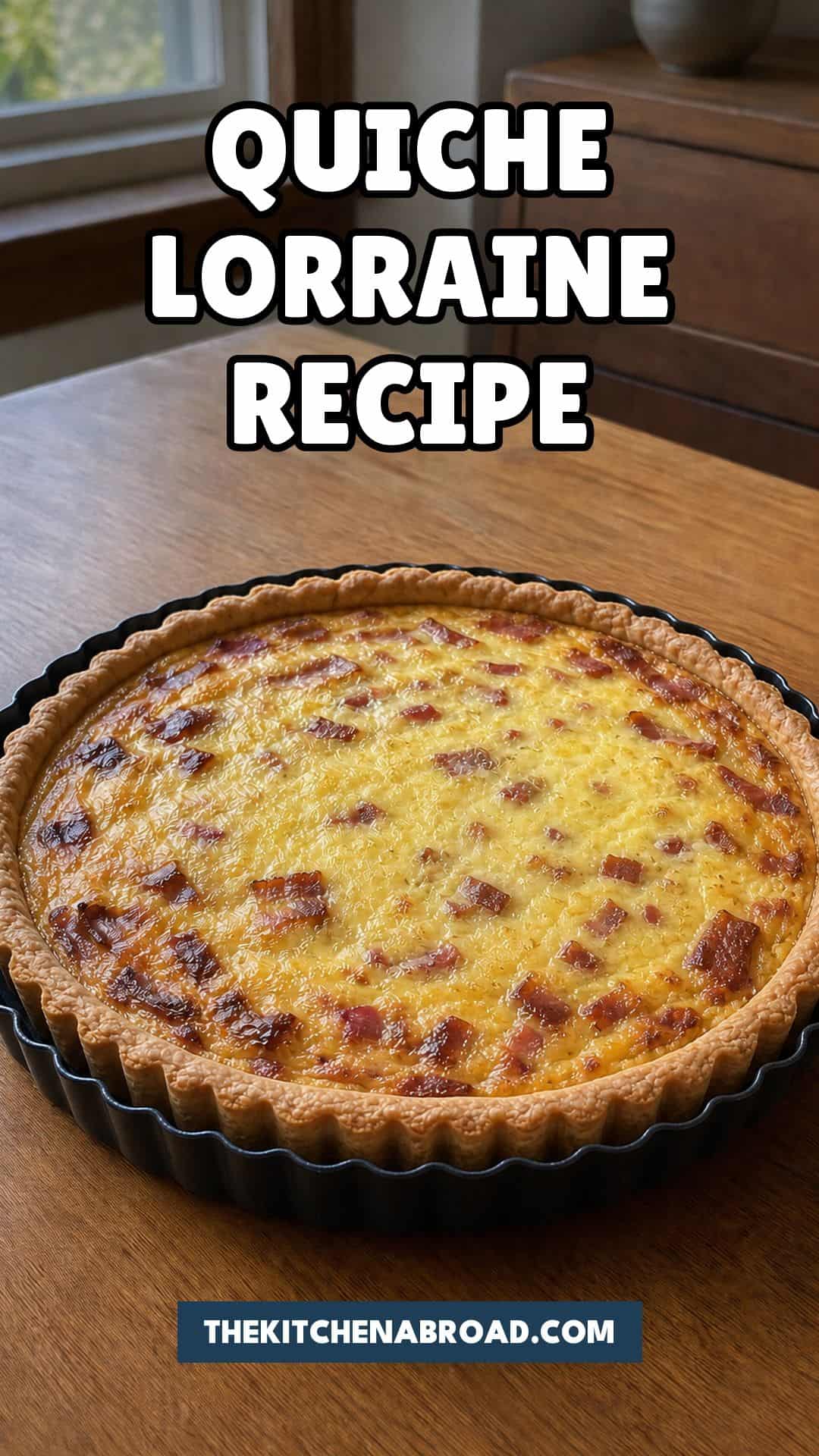
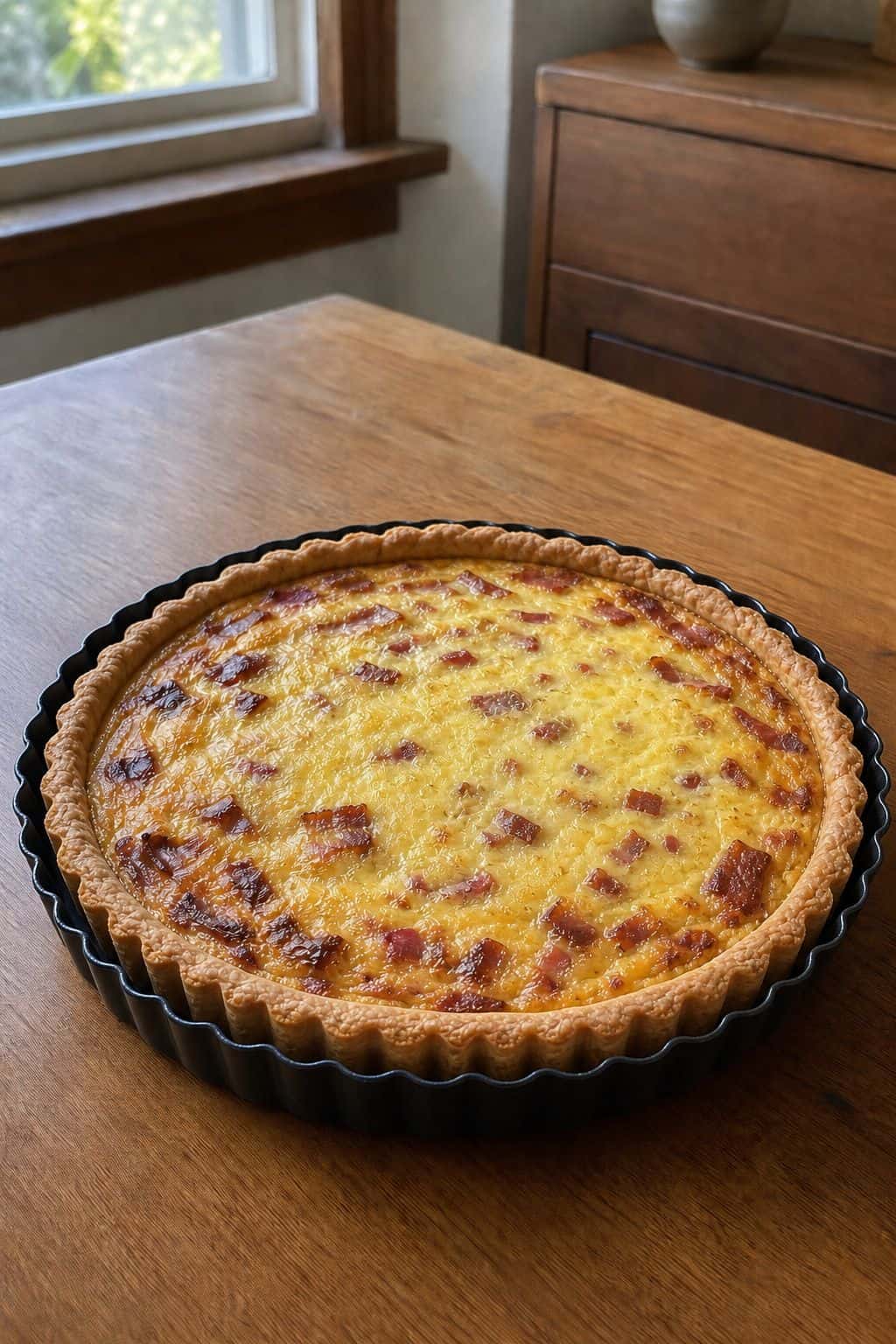
A canonical quiche lorraine recipe is the brunch centerpiece worth getting right: an all-butter blind-baked pâte brisée shell, thick-cut bacon cut into half-inch lardons and rendered slow, freshly grated Gruyère, and a custard built on the Julia Child ratio of 3 large eggs to 1 1/2 cups heavy cream. No onion. No leeks. No vegetables of any kind. Bake at 350°F for 35 to 40 minutes until the center barely jiggles, rest 15 minutes before slicing, and serve at room temperature with a sharp green salad. That is the dish that came out of the Lorraine duchy and the dish you put on the table.
Quiche Lorraine is a 16th-century dish from the duchy of Lorraine, a wedge of northeastern France that spent most of its history as an independent territory before being absorbed by the French crown in the 1700s. The original was a rustic thing for cold winters: bread dough rolled into a tin, topped with a migaine of beaten eggs and cream, baked in a hearth oven until set. No cheese. No bacon. Just the bread, the eggs, and the cream. Everything we now think of as Lorraine, including the smoked lardons and the modern American addition of Gruyère, came later. The version on the brunch table today is the canonical one, and it earns the name on the strength of four ingredients done correctly.
Recommended Reads
- Quiche Chèvre Recipe (Goat Cheese)
- Spring Vegetable Frittata Recipe
- Mother’s Day Brunch Ideas
- Christmas Brunch Ideas
- Best Easter Lunch Ideas
Where Quiche Lorraine Came From
The duchy of Lorraine sat on the eastern edge of what is now France, bordering the German-speaking lands to the north and east, and the word quiche itself derives from the Lorraine dialect küchen, a cousin of the German Kuchen, meaning cake. In the 1500s the dish was a thrift bake for cold months. A round of bread dough was pressed into a tin and topped with a simple migaine of beaten eggs and heavy cream, baked until the custard set into the crumb. Lardons of cured pork were the regional protein and entered the recipe in the 19th century. Cheese came later still.
The traditional French version of quiche Lorraine, by strict regional definition, contains no cheese. The cheese-topped version that everyone now calls Lorraine is the modern, internationally adopted form, and Gruyère became the universal cheese for it as the recipe traveled through the 20th century. The pastry base also evolved from bread dough to pâte brisée, the all-butter short crust that holds the custard cleanly and slices into wedges without collapsing. Both versions are valid. The cheese version is what most readers came here looking for, and it is the version this recipe builds.
A Few Notes on the Ingredients
- All-butter pâte brisée: Half a cup of cold cubed butter to 1 1/4 cups of flour, bound with 3 to 4 tablespoons of ice water and chilled 30 minutes before rolling. Press into the tart pan with a tall lip above the rim to account for shrink, prick the base with a fork, and chill again before blind-baking.
- Blind-baking, non-negotiable: Line the shell with parchment, fill with ceramic pie weights mounded up the sides, and bake at 425°F for 15 minutes. Remove the weights, drop the oven to 350°F, and bake another 10 minutes until the base is dry and pale gold. Without a pre-set crust the bottom never crisps and the quiche turns out with a raw, gummy base.
- Thick-cut bacon, cut into half-inch lardons: The cut matters. Crumbled bacon disappears into the custard as gritty flecks; half-inch batons hold their shape, render their fat without crisping to gravel, and give the dish the chewy meaty presence Lorraine is built around.
- Render the lardons slow: Start in a cold skillet over medium heat for 8 to 10 minutes, stirring occasionally, until the fat has released and the edges are golden but the centers still chewy. Drain on paper towels before they hit the shell.
- Gruyère, freshly grated: Grate on the large holes of a box grater. Skip the bagged pre-shredded product, which is coated in cellulose powder to prevent clumping and never melts cleanly. Comté is the most traditional French swap and works equally well.
- The custard ratio, 3 eggs to 1 1/2 cups heavy cream: Julia Child’s canonical Lorraine framework from Mastering the Art of French Cooking. No milk. No half-and-half. Heavy cream is what gives the custard its silken set and the rich tongue feel that separates a magazine-quality quiche from a school-cafeteria one.
- Seasoning the custard: Half a teaspoon of salt, a quarter teaspoon of white pepper, and a pinch of freshly grated nutmeg whisked in with the eggs and cream. Whisk only enough to combine; aerating the custard causes it to puff and collapse on the bake.
- The bake, 350°F for 35 to 40 minutes: Low and slow until the outer two inches are firmly set and the center two-inch circle barely jiggles. The custard continues setting during the 15-minute rest before slicing.
Recipe: Quiche Lorraine
Prep time: 30 minutes | Cook time: 50 minutes | Total time: 1 hour 20 minutes, plus 15 minutes to rest | Serves: 8
Ingredients
For the crust:
- 1 1/4 cups (160 g) all-purpose flour
- 1/2 tsp salt
- 1/2 cup (113 g) unsalted butter, cold and cubed
- 3 to 4 tbsp (45 to 60 ml) ice water
For the filling:
- 8 oz (225 g) thick-cut bacon, cut into 1/2-inch lardons
- 1 1/2 cups (150 g) Gruyère, freshly grated
- 3 large eggs
- 1 1/2 cups (360 ml) heavy cream
- 1/2 tsp salt
- 1/4 tsp white pepper
- pinch freshly grated nutmeg
Instructions
- Make the crust. Whisk the flour and salt in a large bowl. Add the cold cubed butter and cut it in with a pastry blender or your fingertips until the mixture looks like coarse meal with pea-sized butter pieces still visible. Drizzle in the ice water one tablespoon at a time, tossing with a fork after each addition, until the dough just holds together when pinched. Turn out onto plastic wrap, press into a flat disc, and chill 30 minutes.
- Heat the oven to 425°F (220°C) with a rack in the middle position. Roll the chilled dough on a lightly floured surface to a round about 12 inches across and 1/8 inch thick. Lift the dough into a 9-inch fluted tart pan with a removable bottom, press it into the corners and up the sides, and trim the overhang flush with the rim. Prick the base all over with a fork.
- Line the shell with a sheet of parchment paper and fill with ceramic pie weights or dried beans, mounded up the sides to support the wall. Blind-bake for 15 minutes, then lift out the parchment and weights. Reduce the oven to 350°F (175°C) and bake the shell another 10 minutes, until the base is dry and pale gold. Set the par-baked shell on a rack while you build the filling. Leave the oven at 350°F.
- Render the bacon lardons. Put the lardons in a cold skillet and set over medium heat. Cook for 8 to 10 minutes, stirring occasionally, until the fat has rendered and the edges are golden but the centers still chewy. Drain the lardons on paper towels and discard the rendered fat or reserve for another use.
- Whisk the custard. In a large glass mixing bowl, whisk the eggs, heavy cream, salt, white pepper, and nutmeg until combined. Whisk only enough to break up the eggs and incorporate the cream. Do not aerate; air bubbles cause the custard to puff and collapse on the bake.
- Assemble the quiche. Scatter the grated Gruyère evenly across the base of the par-baked shell, then scatter the drained bacon lardons over the cheese. Place the tart pan on a rimmed baking sheet to catch any drips, then slowly pour the custard over the cheese and bacon, filling to within 1/4 inch of the rim.
- Bake at 350°F (175°C) for 35 to 40 minutes, rotating the pan front-to-back at minute 20, until the edges are set and lightly puffed and the center barely jiggles when the pan is nudged. The custard will continue setting as it rests.
- Rest the quiche on a wire rack for at least 15 minutes before slicing. Cutting too early lets the custard weep and the slice slumps. Serve warm or at room temperature in eight wedges.
Notes
The doneness call is the barely-jiggle test. Nudge the tart pan at minute 35. The outer two inches should be firmly set; the center two-inch circle should wobble like a soft set custard, not slosh like liquid. If it slosh-wobbles, give it 5 more minutes and test again. If the whole surface is solid, you have overbaked it and the texture will read grainy on the slice. The window is real and worth watching for.
The 3 eggs to 1 1/2 cups heavy cream ratio is the canonical Julia Child framework and the reason a quiche Lorraine sets to silken rather than scrambled or runny. Cutting the cream with milk thins the custard and pushes the bake toward weeping. Adding a fourth egg tightens the set toward rubbery. Trust the ratio. It is the ratio a French kitchen has been using for a century, and it is the ratio the dish needs.
Reheating from the fridge is straightforward. Wrap leftover slices loosely in foil and warm at 325°F (165°C) for 10 to 12 minutes, until the custard is just heated through. Quiche is also excellent at room temperature straight from the counter, and many French households eat it that way on purpose for picnics and lunches.
Tips and Variations
Why Heavy Cream Beats Half-Milk for Custard Set
Heavy cream is 36 to 40 percent fat. Whole milk is 3 to 4 percent fat. That ten-times-fat difference is the entire reason a quiche Lorraine sets to a silken, sliceable custard rather than a watery curdled one. Fat suspends the egg proteins as the quiche bakes, slowing the rate at which they tighten into a network, and the result is the smooth set the dish is known for. Replace half the cream with milk and the custard tightens faster, weeps a thin layer of liquid onto the plate, and slices into a curdled, school-cafeteria texture. Julia Child specified heavy cream in Mastering the Art of French Cooking for exactly this reason, and a half-century of French kitchens have followed her. Use the full 1 1/2 cups of heavy cream. The bake holds; the slice holds; the dish reads correct.
How to Blind-Bake Without Shrinkage
Crust shrinkage is the single most common blind-bake failure, and it traces to three preventable steps. One, chill the dough 30 minutes after pressing it into the tart pan, not just after mixing. The second rest sets the gluten and locks the shape. Two, leave a small lip of dough above the rim of the pan to account for the half-inch the shell will inevitably pull down as it bakes. Trim flush only if you are using a deeper pan or a recipe that accounts for it. Three, weight the shell properly. Mound the ceramic pie weights up the sides of the parchment, not just in the base. The wall is where shrinkage happens, and a flat layer of weights in the bottom does nothing to hold it. Done correctly, the par-baked shell holds a tall, even rim with a clean fluted edge, ready to receive the custard.
The Traditional No-Cheese Lorraine Variation
By strict regional French definition, an authentic quiche Lorraine contains no cheese. The version with Gruyère is the modern, internationally adopted form, and it is the version most readers came here for. But the original is worth knowing and worth making at least once. Omit the cheese entirely. Build the filling on bacon lardons and the egg-and-cream custard alone. The result is leaner, eggier, and more openly about the smoked pork and the cream itself, with no melted cheese layer to share the spotlight. The dish reads quieter and more elemental, closer to what a 19th-century kitchen in Nancy or Metz would have plated. Serve with the same green salad. It is a different, older dish, and it is legitimately Lorraine.
Make-Ahead Strategy for Easter Brunch
Quiche Lorraine is the rare brunch dish that genuinely benefits from being made ahead. Bake the quiche fully the day before, cool to room temperature, and refrigerate covered for up to 3 days. The custard tightens slightly in the fridge and the bacon-and-Gruyère flavors deepen overnight. The morning of, pull the quiche an hour before serving and warm at 325°F for 10 to 12 minutes, or serve at room temperature straight from the counter. For a longer lead time, blind-bake the crust 2 days ahead and store it wrapped in plastic at room temperature, then build the filling the morning of. This is the way most French households actually serve quiche, and it is the way to put a magazine-quality version on an Easter brunch table without losing the morning to a custard you are watching from the counter.
Swapping Bacon for Pancetta or Smoked Ham
Thick-cut smoked bacon is the standard, but two swaps work cleanly within the Lorraine lane. Pancetta, the Italian cured pork belly, cubes into half-inch dice and renders much like bacon but without the smoke; the result is leaner and reads more openly cured-pork. Smoked ham, cubed to half-inch pieces, skips the rendering step and goes straight into the shell with the cheese; the result is closer to what The Modern Proper puts on Lorraine and reads slightly meatier and less crisp. Both honor the canonical bacon-and-cream framework. What does not belong in Lorraine: prosciutto (too thin, dissolves into the custard), guanciale (too fatty for the bake), or onion of any kind. Lorraine is meat, cream, and egg. The other quiches you might know are something else.
What to Serve It With
The default occasion is brunch, plated with a green salad in sharp vinaigrette to cut the cream. The dish holds beautifully on an Easter lunch buffet at room temperature, slices cleanly for a Mother’s Day brunch alongside a bowl of berries and a pot of strong coffee, and reads as a complete light dinner with a frisée salad and a glass of Riesling or Pinot Gris from Alsace. Quiche Lorraine also travels well: a slice eats just as well cold from a picnic basket as it does warm from the oven, which is exactly why French households have been packing it into lunch bags for a hundred years.
FAQ
What is the difference between a quiche and a quiche Lorraine?
Quiche is the umbrella term for any savory custard tart in the French tradition: an egg-and-cream filling baked in a pastry shell with any number of added ingredients, from leeks to spinach to smoked salmon to goat cheese. Quiche Lorraine is one specific quiche from the duchy of Lorraine, defined by exactly three filling ingredients: bacon lardons, an egg-and-cream custard, and (in the modern version) Gruyère. No onion, no leeks, no vegetables of any kind. Add onion and you are eating a quiche. Hold the onion and the vegetables and you are eating Lorraine.
Should you use milk or cream in quiche Lorraine?
Heavy cream. Full stop. The canonical Julia Child ratio is 3 large eggs to 1 1/2 cups heavy cream, with no milk involved. Heavy cream’s fat content (36 to 40 percent) is what gives the custard its silken set; whole milk (3 to 4 percent fat) thins the custard and pushes the bake toward weeping and curdling. If you need to lighten the dish for dietary reasons, swap no more than 1/2 cup of the cream for whole milk. Any further than that and the custard fails to set cleanly.
Do you have to blind bake the crust for quiche?
Yes. The custard filling is wet and bakes at low heat (350°F), which means the base of the crust never gets the heat it needs to crisp on its own. Skip the blind bake and the bottom of the quiche turns out raw, gummy, and pale. Line the shell with parchment, fill with ceramic pie weights mounded up the sides, blind-bake at 425°F for 15 minutes, then remove the weights and bake another 10 minutes at 350°F until the base is dry and pale gold. This is the single most important technique step in the entire recipe.
Why did my quiche sink in the middle?
Two usual causes. One, the eggs were over-whisked. Aerated custard puffs in the oven like a soufflé and collapses as it cools. Whisk only enough to break up the eggs and combine them with the cream. Two, the quiche was overbaked. A properly baked Lorraine comes out of the oven with the outer two inches firmly set and the center two-inch circle still wobbling like a soft custard. If you bake until the whole surface is solid, the eggs tighten too far, the custard contracts as it cools, and the center sinks.
What cheese is traditionally used in quiche Lorraine?
By strict French tradition, no cheese at all. The original Lorraine recipe from the 1500s was bacon, eggs, and cream in a bread-dough shell, with cheese added much later as the dish traveled internationally. The modern universal cheese for Lorraine is Gruyère, freshly grated. Comté, the most traditional French swap, works equally well and is arguably closer to the regional terroir. Emmental works in a pinch. Sharp cheddar is not Lorraine; it is a generic quiche. If you want the lighter herbal variant with goat cheese instead of Gruyère, see our quiche chèvre.
Can you make quiche the day before?
Yes, and the dish actually improves overnight. Bake the quiche fully, cool to room temperature, cover, and refrigerate up to 3 days. Reheat at 325°F for 10 to 12 minutes the day of serving, or eat at room temperature straight from the fridge. Quiche Lorraine also freezes well: wrap tightly in plastic and foil, freeze up to 2 months, thaw overnight in the refrigerator, then reheat at 325°F. The make-ahead window is one of the reasons the dish has lived on French brunch tables for four hundred years.
Key Takeaways
- Lock the canonical Julia Child ratio: 3 large eggs to 1 1/2 cups heavy cream. No milk.
- Cut the bacon into 1/2-inch lardons and render slow; never crumble.
- Blind-bake the crust at 425°F for 15 minutes with ceramic weights, then 10 more minutes at 350°F without.
- Freshly grate the Gruyère on a box grater; pre-shredded bagged cheese does not melt cleanly.
- Bake at 350°F for 35 to 40 minutes until the center barely jiggles. Rest 15 minutes before slicing.
- Lorraine is bacon, cheese, cream, and eggs only. No onion, no leeks, no vegetables of any kind.
Final Thoughts
Quiche Lorraine is a dish that earns its name on the strength of restraint. A 16th-century duchy worked out the framework with bread, eggs, and cream; the 19th century added bacon; the 20th century added cheese; and that was enough. Every modern attempt to improve the recipe by adding onion, leeks, spinach, mushrooms, or tomato moves the dish out of the Lorraine lane and into the generic quiche lane. The discipline is in not adding anything.
The reward for that restraint is a slice of custard tart that does exactly what it is meant to do: silken, just-set, rich with cream and smoked pork and nutty Gruyère, anchored by an all-butter crust that holds its shape under the fork. Bake it the day before. Serve it warm or at room temperature, on a brunch table, an Easter buffet, or a Sunday lunch with a green salad and a glass of Alsatian white. The dish has been doing the same job in French kitchens for four hundred years, and it does the same job in yours.
Lock the ratio, blind-bake the crust, render the lardons, and pull the quiche when the center barely jiggles. That is the recipe a duchy in the 1500s arrived at, and that is the recipe a 9-inch fluted tart pan in your kitchen will reproduce on a Sunday morning when you want one good thing in the center of the table.