
Salmon burgers come out chunky and tender when you pulse fresh salmon in two stages: a small portion to fine crumbs first as the binder, then the rest folded in as larger pieces for texture. Pan-fry three minutes per side in olive oil to 120°F internal. The sauce is half Greek yogurt and half mayo with fresh dill, lemon, and a microplaned garlic clove. Twenty minutes total.
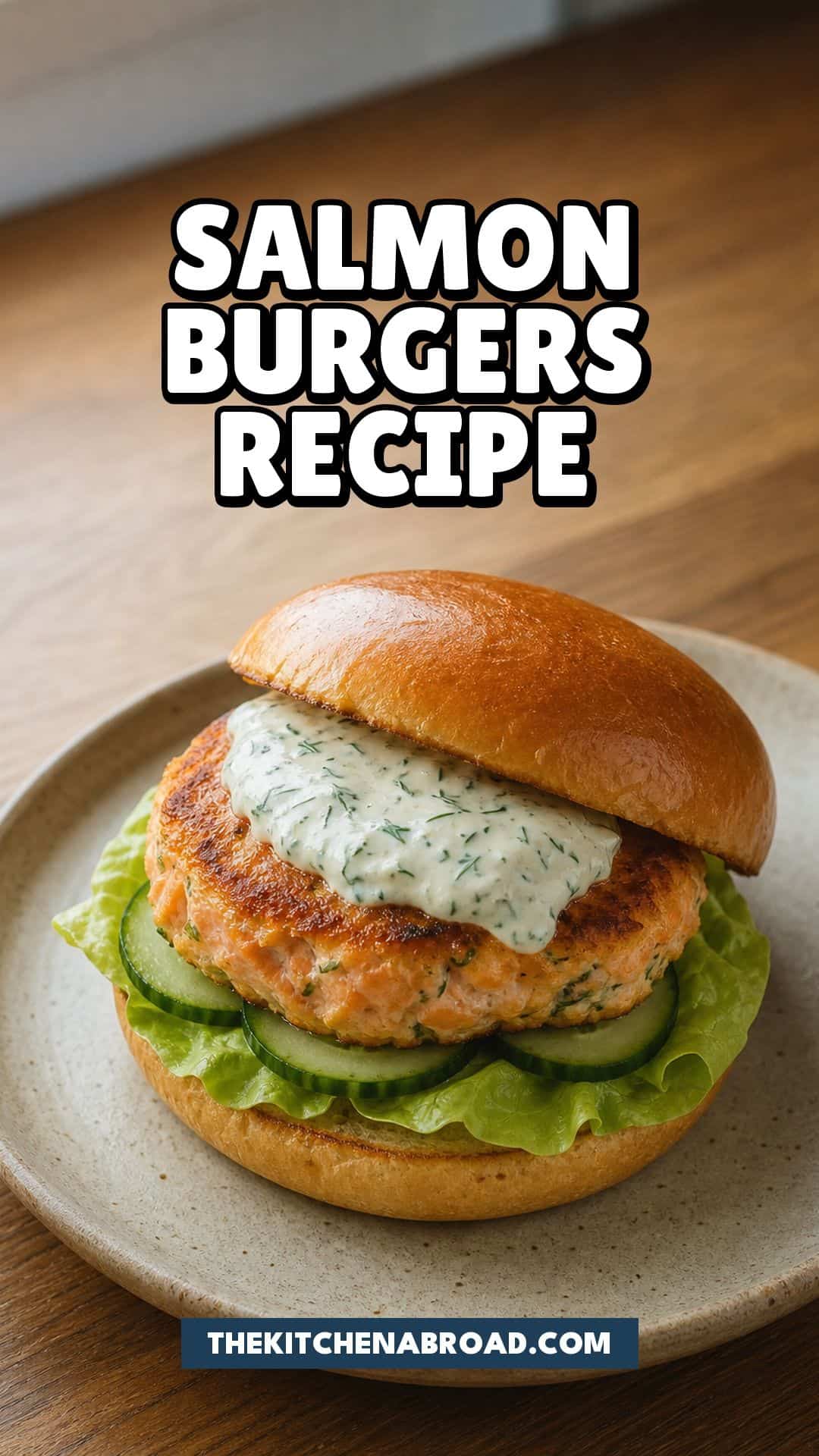
Most home salmon burgers use canned salmon, which gives a different texture and a stronger fish flavor than fresh. The recipe below uses fresh skinless fillet pulsed in stages, which is the move that keeps the patty chunky rather than pasty.
The two-stage pulse goes like this: about a quarter of the salmon gets pulsed in the food processor to nearly a paste, which becomes the binder. The rest gets pulsed briefly into rough quarter-inch pieces, then folded in by hand with egg, dijon, panko, and capers. The result reads as fresh fish, not as fish purée.
Tools on the Counter
A heavy cast iron or carbon steel skillet for the sear; the steady heat is what gives the patty its golden crust. A fish spatula for flipping fragile patties. An instant-read thermometer to hit 120°F internal exactly. A microplane for the garlic clove that goes into the sauce. A citrus juicer for the lemon (and one for the squeeze on the patty at the table).


Recommended Reads
- Homemade Black Bean Burgers (That Hold Together)
- Sheet Pan Salmon with Roasted Vegetables
- Creamy Tuscan Shrimp
- Lohikeitto (Finnish Salmon Soup)
- Tahini Sauce
How Fish Burgers Became a Thing
The fish burger as a category has two parallel histories. One is the Nordic-Scandinavian fish cake (Norwegian fiskekaker, Swedish fiskbullar, Finnish kalapullat), which dates back centuries and uses cod, pollock, or salmon ground with potato starch as the binder. The other is the American fish sandwich, born at McDonald’s in 1962 (the Filet-O-Fish), built around white fish fillets in batter. The fresh salmon burger that lives on food blogs and gastropub menus today is a 2000s American invention that sits between those traditions: Nordic-style fresh-fish patty, American bun-and-toppings format. The Greek yogurt-mayo dill sauce is the part that ties it together.
A Few Notes on the Ingredients
Fresh salmon (not canned): About 600 g (1.3 lb) of skinless fillet, pin-bones removed. Wild-caught (sockeye, king) has a stronger flavor; farmed Atlantic is milder. Either works. The two-stage food processor pulse is what keeps the patty chunky rather than pasty.
Panko: 1/4 cup. Absorbs the liquid the salmon releases and keeps the patty from being mushy.
Egg: 1 large egg, beaten. The binder that holds the chunks together once they hit the pan.
Dijon mustard: 2 tsp. Adds a low background note that complements salmon specifically.
Capers: 2 Tbsp drained and roughly chopped. Small bursts of salty acidity inside each bite.
Fresh dill: 2 Tbsp chopped fresh dill in the patty, more for the sauce. Dried dill is too dusty for this.
Greek yogurt and mayo (50/50 for the sauce): 1/2 cup each, full-fat Greek yogurt and a quality mayo (Hellmann’s, Duke’s, or homemade). The 50-50 split gives a sauce that’s bright from the yogurt but rich enough to coat the burger.
Microplaned garlic and lemon: 1 garlic clove microplaned, plus 1 Tbsp fresh lemon juice. Finishes the sauce.
Brioche buns and toppings: Toasted brioche, butter lettuce, thin-sliced cucumber. The assembly.
Recipe: Salmon Burgers with Lemon Dill Sauce
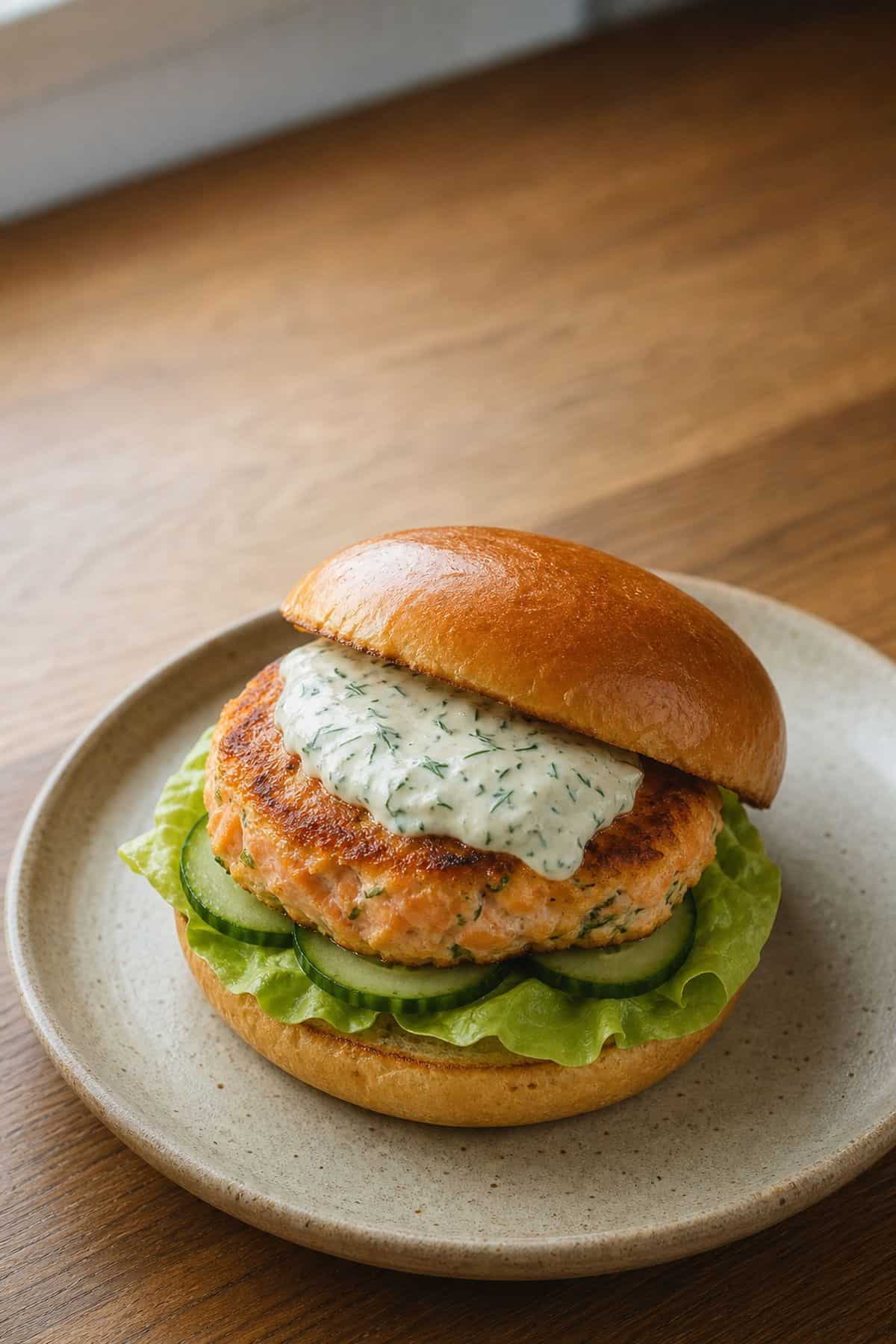
Prep time: 15 minutes | Cook time: 6 minutes | Total time: 21 minutes | Serves: 4 burgers
For the Patties
- 600 g (1.3 lb) skinless fresh salmon fillet, pin-bones removed
- 1 large egg, beaten
- 2 tsp Dijon mustard
- ¼ cup (15 g) panko breadcrumbs
- 2 Tbsp capers, drained and roughly chopped
- 2 Tbsp fresh dill, chopped
- 1 tsp kosher salt
- Freshly ground black pepper
- 2 Tbsp olive oil for pan-frying
- 4 brioche buns, lightly toasted
- Butter lettuce and thin-sliced cucumber, for serving
For the Sauce
- ½ cup (120 g) full-fat Greek yogurt
- ½ cup (120 g) mayonnaise
- 2 Tbsp fresh dill, finely chopped
- 1 Tbsp fresh lemon juice
- 1 garlic clove, microplaned
- ½ tsp kosher salt
- Pinch of black pepper
Instructions: Make the Patties
- Two-stage pulse. Cut the salmon into 1-inch chunks. Set aside about 150 g (roughly a quarter of the fish). Add the larger portion to a food processor and pulse 4-5 times, you want rough quarter-inch pieces, not a paste. Transfer to a large bowl. Add the reserved 150 g of salmon to the food processor and pulse 8-10 times until nearly smooth (this becomes the binder). Add to the bowl with the chunky salmon.
- Mix. Add the beaten egg, Dijon, panko, chopped capers, fresh dill, salt, and pepper. Fold gently with a rubber spatula until just combined. Do not overmix; the chunks should stay visible.
- Form patties. Divide the mixture into 4 portions (about 170 g each). Shape each into a patty about 4 inches wide and ¾ inch thick. Refrigerate 10 minutes while you make the sauce.
- Pan-fry. Heat a cast iron or heavy skillet over medium-high heat. Add 2 Tbsp olive oil and swirl. When the oil shimmers, add the patties (work in batches if needed). Cook 3 minutes on the first side without disturbing, a golden crust forms. Flip carefully with a fish spatula and cook 3 minutes on the second side, or until an instant-read thermometer inserted into the side reads 120°F internal.
- Serve. Stack each patty on a toasted brioche bun with a leaf of butter lettuce, a few slices of cucumber, and a generous spoon of the lemon dill sauce. Serve immediately.
Instructions: Make the Sauce
- Whisk the Greek yogurt and mayonnaise in a small bowl until smooth.
- Add the chopped dill, lemon juice, microplaned garlic, salt, and pepper. Whisk to combine.
- Taste and adjust: add more lemon if you want more brightness, more salt if it tastes flat. Refrigerate while you cook the patties.
Notes
If the food processor is making the salmon pasty: You’re overpulsing. Stop earlier. Pulse, check, pulse again. The chunky portion should look like the texture of coarse hand-chopped meat.
The patty seems wet: Add 1 more Tbsp of panko. Salmon varies in moisture content from cut to cut.
Don’t crowd the pan. Salmon needs space to crust. Two patties at a time if your pan can’t fit four with room.
Tips and Variations
Why You Pull the Salmon at 120°F
Salmon goes from buttery to chalky fast in the temperature window between 125°F and 135°F. Ground salmon (the form it takes in the patty) cooks faster than a whole fillet because of the increased surface area. Pulling the patty at 120°F internal gives you medium with the right buttery texture; the carryover heat pushes it to 122-125°F by the time it reaches the bun. An instant-read thermometer slipped into the side of the patty is the only reliable way to hit this.
What Fish and Topping Swaps Work
Steelhead trout swaps in 1-to-1 for salmon and behaves identically. Arctic char works the same way. Tuna (sushi-grade ahi) makes a different but excellent burger, pulse the same way but cook to 110°F internal for rare to medium-rare. Canned salmon works in a pinch but produces a fishier, denser patty; drain it thoroughly and reduce the panko to 2 Tbsp because canned salmon is wetter. For toppings beyond the standard, pickled red onion is a great upgrade, as is a slice of avocado.
How to Make This Dairy-Free
Skip the Greek yogurt in the sauce and double the mayo to 1 cup. Add an extra Tbsp of lemon juice to compensate for the missing tang. The patty itself is naturally dairy-free. Use a brioche bun made without milk or swap to a potato bun (most are dairy-free). Read labels carefully if dairy is a strict avoidance.
How Long These Keep and Whether They Freeze
Uncooked patties hold 1 day in the fridge on a parchment-lined tray, covered. Cooked patties keep 2 days but reheat poorly (salmon overcooks fast on reheat); eat them within 24 hours of cooking for best results. Uncooked patties freeze well: lay on a parchment-lined sheet pan, freeze hard for 2 hours, transfer to a zip-top bag with parchment between each. Hold 2 months frozen, cook from frozen in 5 minutes per side over medium heat. The sauce keeps 4 days in the fridge in an airtight container.
The Pickled Onion Move That Cuts the Richness
Thinly slice half a red onion and pickle it 15 minutes in ½ cup white vinegar + 1 tsp sugar + 1 tsp salt while you make the patties. The acid and snap on top of the rich salmon and dill sauce balances the whole bite. This works for both salmon burgers and the chicken pad thai, salmon enchiladas, and a dozen other dishes where you need an acid hit on a soft, rich base.
Frequently Asked Questions
Can I use canned salmon for these?
Yes, but the patty is denser and fishier than the fresh version. Use 2 cans (15 oz each) wild-caught canned salmon, drained very thoroughly (squeeze out the excess liquid). Skip the two-stage pulse, canned salmon is already shredded. Reduce the panko to 2 Tbsp because canned salmon is wetter than fresh.
What if I don’t have a food processor?
Hand-chop the salmon with a sharp knife. Chop most of it into quarter-inch pieces, then mince about a quarter of it very fine to act as the binder. The texture will be slightly different but the patty works. A heavy chef’s knife and 10 minutes of patience.
Can I grill these instead of pan-frying?
Yes, but they need help to not fall through the grates. Use a grill basket, a perforated grill pan, or a sheet of heavy-duty foil with holes poked in it. Cook 3 minutes per side over medium-high direct heat. The patty is delicate; treat it that way.
What sides go with salmon burgers?
Crispy oven fries, a simple green salad with a sharp vinaigrette, or grilled asparagus. The salmon and the dill sauce are rich enough that you want something light, acidic, or crunchy on the side to balance. Coleslaw also works well; the cabbage crunch contrasts the soft patty.
Can I make the sauce ahead?
Yes, and you should, it gets better as it sits. Make the sauce up to 4 days ahead and store in an airtight container in the fridge. The garlic flavor mellows and integrates, the dill bleeds its color into the sauce slightly, and the whole thing reads more cohesive after a day.
One last note: the salmon burger sits in a specific genre of weeknight cooking where fresh ingredient quality carries the whole dish. Buy the best salmon you can afford from a fishmonger you trust, and the patty does itself. The recipe is a small support system around a good piece of fish.
Key Takeaways
- Two-stage food processor pulse: small portion to nearly-smooth binder, rest to rough quarter-inch chunks.
- Pull the patty at 120°F internal for medium texture; the carryover finishes the cooking.
- The lemon dill sauce is half Greek yogurt and half mayo, the split gives brightness and body.
- Don’t crowd the pan; salmon needs space to crust. Two patties at a time.
- Fresh salmon, not canned. The whole dish depends on it.
Final Thoughts
Salmon burgers are the lighter, faster cousin of the beef burger, and the fresh-salmon version eats nothing like the canned-salmon one. Twenty minutes total, including the prep, and you have a dinner that feels considered.
The two-stage food processor pulse is the technique that makes the patty work. Some salmon to nearly-smooth (the binder), the rest in rough chunks (the texture). Combined, they form a patty that stays chunky and tender at the same time.
Make this for a fast weeknight dinner, a casual lunch, or as the protein in a salad bowl. The lemon dill sauce is excellent on more than just the burgers; it pairs with grilled vegetables, roasted potatoes, and any other fish.
Salmon Burgers with Lemon Dill Sauce
Salmon burgers come out chunky and tender when you pulse fresh salmon in two stages: a small portion to fine crumbs first as the binder, then the rest folded in as larger pieces for texture. Pan-fry three minutes per side in olive oil to 120°F internal.
Ingredients
- 600 g skinless fresh salmon fillet, pin-bones removed
- 1 large egg, beaten
- 2 tsp Dijon mustard
- 1/4 cup panko breadcrumbs
- 2 Tbsp capers, drained and chopped
- 2 Tbsp fresh dill, chopped
- 1 tsp kosher salt
- Freshly ground black pepper
- 2 Tbsp olive oil for pan-frying
- 4 brioche buns, lightly toasted
- Butter lettuce and cucumber slices, for serving
- 1/2 cup full-fat Greek yogurt (sauce)
- 1/2 cup mayonnaise (sauce)
- 2 Tbsp fresh dill, finely chopped (sauce)
- 1 Tbsp fresh lemon juice (sauce)
- 1 garlic clove, microplaned (sauce)
- 1/2 tsp kosher salt (sauce)
Instructions
- Cut salmon into 1-inch chunks. Set aside 150 g. Pulse the larger portion 4-5 times to rough quarter-inch pieces. Pulse the reserved 150 g 8-10 times to nearly smooth.
- Combine both portions in a bowl with egg, Dijon, panko, capers, dill, salt, and pepper. Fold gently.
- Form into 4 patties, about 4 inches wide. Refrigerate 10 minutes.
- Heat 2 Tbsp olive oil in a cast iron skillet over medium-high. Cook patties 3 minutes per side, until 120°F internal.
- For the sauce: whisk Greek yogurt, mayo, dill, lemon juice, garlic, salt, and pepper until smooth.
- Serve patties on toasted brioche buns with butter lettuce, cucumber, and a spoon of sauce.
Notes
If the food processor is making the salmon pasty: You're overpulsing. Stop earlier. Pulse, check, pulse again. The chunky portion should look like the texture of coarse hand-chopped meat.
The patty seems wet: Add 1 more Tbsp of panko. Salmon varies in moisture content from cut to cut.
Last update on 2026-10-03 / Affiliate links / Images from Amazon Product Advertising API