
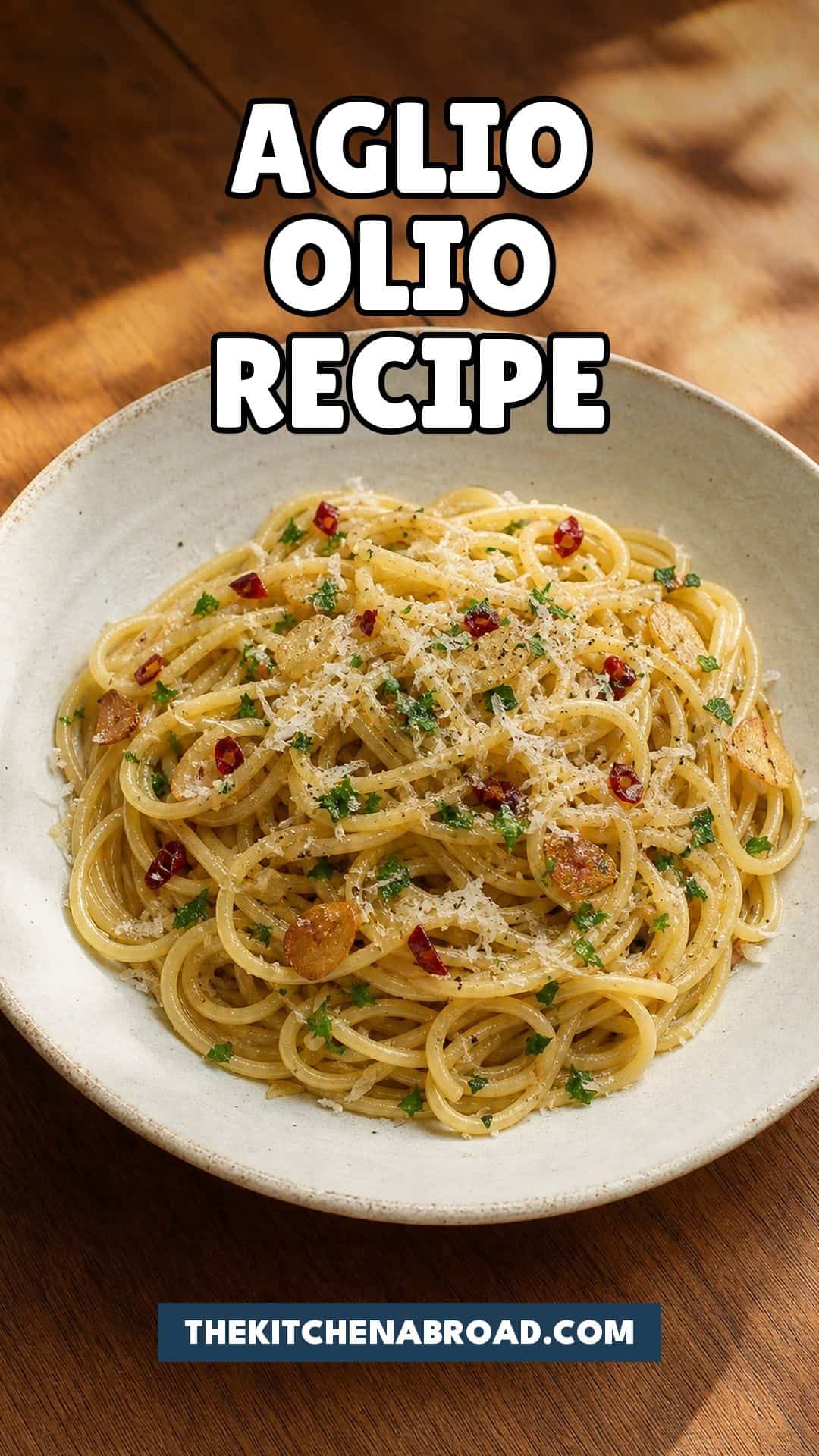
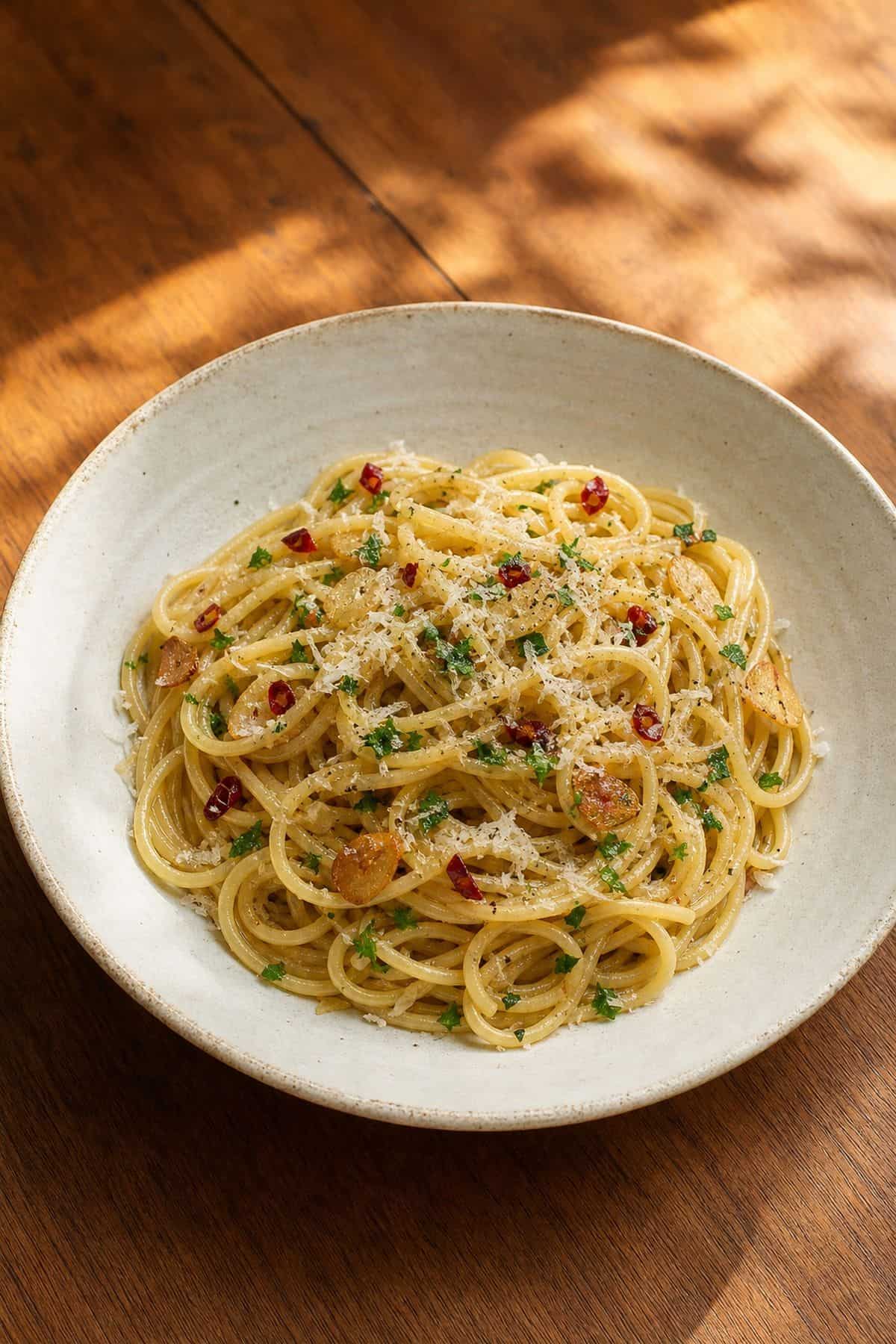
Spaghetti aglio e olio is the classic Italian garlic and olive oil pasta of Naples and Rome, made with thinly sliced garlic started in cold olive oil and brought slowly to golden, finished with Calabrian chili flakes, parsley, and a generous emulsion of pasta water. Optional anchovies for southern Italian depth. Ready in 15 minutes, serves 4.
Italians cook aglio e olio when there is nothing else in the house. Spaghetti, garlic, olive oil, chili flakes, salt, water. Six ingredients, ten minutes of work. The dish is the original midnight pasta, the post-shift staff meal, the I-just-got-home-and-need-dinner standby. It also happens to be one of the hardest pasta dishes to make properly, precisely because there is nowhere to hide. Every ingredient is in front of you on the plate.
The garlic is the entire dish. Burnt garlic ruins the pan and turns the oil bitter. Pale soft garlic gives you the flavor of raw allium in oil, which is not what you want. The narrow window between those two states is what separates great aglio e olio from mediocre. Italian grandmothers know the window by smell, the rest of us need a technique. The technique is starting the garlic in cold oil and bringing the heat up slowly.
The cold-oil start changes everything. Sliced garlic added to already-hot oil sears the outside while leaving the inside raw. The result is uneven cooking, sometimes burnt edges, sometimes underdone center. Garlic started in cold oil and brought up over three minutes cooks evenly all the way through, and you can stop the heat at exactly the moment the garlic hits a uniform pale gold. From cold-oil start to perfect golden takes about three minutes on medium heat. Time it to land at exactly the moment your pasta finishes cooking. Metric and imperial throughout.
What You’ll Need to Make This Recipe
A large pasta pot for plenty of salted water (the pasta should swim, not crowd). A heavy sauté pan for the garlic and the emulsion. A microplane for grating parmesan over the bowl. Good locking tongs for transferring pasta directly from pot to pan with starchy water still clinging to it. Quality extra-virgin olive oil. Real Calabrian or Italian chili flakes if you can find them.


Recommended Reads
- Gochujang Pasta Recipe (Creamy, Spicy, 20 Minutes)
- Greek Pasta Salad Recipe with Lettuce, Feta, and Olives
- Watermelon Feta Salad Recipe with Mint and Lime
- Tomato-Based Chicken and Dumpling Soup Recipe
- Finnish Pulla Bread Recipe (Braided Cardamom Bread)
Why This Aglio e Olio Works
The cold-oil garlic start is the technique that pushes this dish from kitchen staple to restaurant-grade. Garlic sliced paper-thin and added to cold olive oil in a cold pan, then brought up over medium heat for 3 to 4 minutes, cooks evenly throughout. The starches gelatinize, the sugars caramelize lightly, and the flavor compounds infuse into the oil rather than burning off. The garlic ends up golden, uniformly cooked, with a sweet-savory profile that infuses every drop of the oil. Hot-pan-then-add-garlic gives you uneven cooking and a much harder window to hit. The cold-oil start is the move every Italian nonna learned at the stove and that most online recipes still miss.
The pasta water emulsion is the second piece. Aglio e olio is fundamentally an emulsion of olive oil, garlic oil, and starchy pasta water. The starch in the pasta water acts as the emulsifier that binds the oil to the spaghetti, instead of letting the oil pool at the bottom of the bowl. The right amount of pasta water (about ⅓ cup for 4 servings) creates a glossy sauce that coats every strand. Too little water and the oil separates. Too much and the dish turns soupy. The Italian phrase for the right consistency is “il sugo” (the sauce), and it should pool slightly at the bottom of the bowl when you twist a forkful out.
The optional anchovy is the third move that takes this from good to memorable. Three anchovy fillets melted in the warm olive oil before the garlic adds an unmistakable umami depth that you cannot achieve any other way. The anchovies dissolve completely into the oil and you cannot taste them as anchovies in the finished dish, only as a deeper savoriness. This is the southern Italian variation that most traditional cooks in Naples use as a default. American home cooks often skip it because anchovies sound aggressive. Make the dish once with anchovies and once without, and you will never go back.
Aglio e Olio Ingredients, Briefly
Spaghetti. The traditional choice. Bucatini and linguine work as substitutes. Avoid short pasta shapes here, the dish wants long strands that can be twisted onto a fork. Use a quality dried pasta brand like De Cecco, Rummo, or Barilla.
Garlic. Lots. Eight to ten cloves for 4 servings. Sliced paper-thin (a mandoline is ideal but a sharp chef knife works). Do not mince, do not crush, slice cleanly into thin coins so each piece browns evenly.
Extra-virgin olive oil. Generous amount. Half a cup for 4 servings. Use the best quality olive oil you can afford, a Tuscan or Sicilian extra-virgin with a balanced peppery finish. Cheap blended oils have no flavor and you will taste the difference in a dish this simple.
Calabrian or Italian chili flakes. Real Italian peperoncino chili flakes if you can find them at specialty stores. Generic crushed red pepper from the supermarket works as a substitute. The dish wants gentle warmth, not aggressive heat. About a teaspoon for 4 servings.
Anchovy fillets (optional but recommended). Three good-quality oil-packed anchovies. Look for Spanish or Sicilian anchovies in glass jars or tins. The cheap thin anchovies on supermarket pizza counters work in a pinch.
Italian flat-leaf parsley. A generous handful, finely chopped, added off-heat at the end. Curly parsley is wrong for this dish, the flavor profile is grassier and the texture chewier.
Sea salt. For salting the pasta water and for finishing. The water should taste like the Mediterranean, generously seasoned. One tablespoon of fine salt per liter of water is about right.
Parmigiano-Reggiano (optional and slightly controversial). Some Italians grate parmesan over the finished dish. Others insist that grated cheese has no place in aglio e olio. Both camps are correct. Use parmesan if you like cheese on pasta, skip it if you want the dish in its purest form.
Tips and Variations
The cold-oil garlic timing. Slice the garlic before you start anything else. Pour the olive oil into a wide cold sauté pan. Add the sliced garlic to the cold oil. Turn the heat on to medium. Listen and watch. The garlic will start to sizzle gently around minute two. By minute three to four, the slices will be pale gold and the kitchen will smell unmistakably of cooked garlic. That is the moment. Turn off the heat. Add the chili flakes.
Pasta water reserve. Always reserve at least 1 cup before draining the pasta. You will likely only need ⅓ cup, but having the extra in case the emulsion gets tight is essential. Without pasta water, you cannot make pasta water.
Lemon zest variation. A pinch of lemon zest off-heat at the end brightens the dish without taking it out of Italy. Some Roman cooks do this, some find it heretical.
Toasted breadcrumb topping (pangrattato). Sicilian variation. Toast ½ cup of panko breadcrumbs in 2 tbsp of olive oil over medium heat until deeply golden. Sprinkle on top of the finished pasta as “the poor man’s parmesan.” Excellent textural contrast.
The post-shift kitchen version. Cook a single portion at a time, hot and fast, eat it standing at the stove with a glass of white wine. This is how Italian cooks eat aglio e olio at midnight after their shift ends. The dish is small enough and simple enough to make that this is the natural mode for it.
What to drink with aglio e olio. A cold dry white wine. Vermentino, Fiano di Avellino, Greco di Tufo. A glass of cold prosecco. A negroni if you are feeling cinematic. Heavy reds clash with the garlicky lightness.
Recipe: Spaghetti Aglio e Olio (Italian Garlic Pasta)
Prep Time: 5 minutes | Cook Time: 10 minutes | Total Time: 15 minutes | Servings: 4
Ingredients
- 340 g (12 oz) dried spaghetti
- 120 ml (½ cup) good extra-virgin olive oil
- 8 to 10 cloves garlic, sliced paper-thin (about 50 g)
- 3 anchovy fillets in olive oil (optional but recommended)
- 1 tsp Calabrian or Italian chili flakes (peperoncino), or substitute crushed red pepper
- 3 tbsp finely chopped fresh flat-leaf parsley
- 1 tbsp fine sea salt for the pasta water (more if your pot is large)
- Flaky sea salt and freshly cracked black pepper for finishing
- Parmigiano-Reggiano (optional), grated, for serving
Instructions
- Bring a large pot of water to a boil. Add 1 tablespoon of fine sea salt per liter of water (the water should taste like the sea).
- While the water heats, slice the garlic paper-thin and finely chop the parsley. Have all ingredients prepped before the pasta hits the water.
- Add the spaghetti to the boiling water. Stir to prevent sticking. Cook to one minute less than the package’s al dente time (the pasta will finish in the sauce).
- Pour the olive oil into a cold, wide sauté pan. Add the sliced garlic and the anchovy fillets (if using). Turn the heat on to medium. As the oil warms over the next 3 to 4 minutes, the anchovies will dissolve and the garlic will start to sizzle gently and turn pale gold.
- When the garlic is uniformly pale gold (about 4 minutes in), turn off the heat. Add the chili flakes and stir into the warm oil. The residual heat will release the chili oils.
- When the pasta is one minute from done, reserve 1 cup of the starchy pasta water. Drain the pasta but do not rinse.
- Turn the heat back on to medium under the garlic pan. Transfer the drained pasta directly into the pan along with ⅓ cup (80 ml) of the reserved pasta water. Toss the pasta vigorously with tongs for 60 to 90 seconds, until the oil and water emulsify into a glossy sauce that coats every strand. Add more pasta water by the tablespoon if the sauce looks tight.
- Off the heat, add the chopped parsley and toss to combine. Taste and adjust salt and black pepper.
- Plate immediately into warm pasta bowls. Drizzle with another teaspoon of fresh olive oil per bowl. Top with grated parmesan if using. Serve right away.
Notes
The cold-oil garlic start is the entire technique. Do not skip it. Hot pan, hot oil, dropped garlic, equals burnt edges and raw centers. Cold pan, cold oil, garlic in from the start, brought up to medium together, equals uniformly golden garlic that you cannot mess up.
Reserve more pasta water than you think you need. A full cup minimum. The starch is what creates the emulsion. You can always pour the extra down the drain after you finish.
The anchovy is optional but transformative. Three small fillets dissolved in the oil add umami depth that no other ingredient can deliver. You will not taste anchovy. You will taste better pasta.
Storage. This is a dish to eat fresh. Leftovers hold a day in the fridge but the texture of the pasta deteriorates significantly. Reheat in a hot pan with a splash of water and a fresh drizzle of olive oil to refresh the emulsion.
Frequently Asked Questions
What does aglio e olio mean?
Aglio e olio is Italian for “garlic and oil”. The full name of the dish is “spaghetti aglio e olio” (spaghetti with garlic and oil) and sometimes “spaghetti aglio, olio e peperoncino” (with chili). It originated in southern Italy, particularly in Naples and Rome, as a simple and inexpensive everyday pasta.
Why start the garlic in cold oil?
Starting sliced garlic in cold olive oil and bringing the heat up slowly (over 3 to 4 minutes on medium) cooks the garlic evenly throughout. The slow temperature rise lets the garlic infuse the oil with flavor, brown gently, and reach a uniform pale gold without burning. Adding garlic to already-hot oil sears the outside while leaving the inside raw, which gives uneven flavor and risks burning some pieces.
Do I need anchovies in aglio e olio?
No, anchovies are optional. The classic recipe in Rome is just spaghetti, garlic, olive oil, chili, and parsley. Naples and other southern Italian variations often include 2 to 3 anchovy fillets melted into the warm oil before the garlic. The anchovies dissolve completely and add umami depth without making the dish taste fishy. Try both versions.
Why is my aglio e olio oily?
The emulsion did not form. Two likely causes. You used too little pasta water (start with ⅓ cup and add more as needed). Or you did not toss the pasta vigorously enough in the pan with the water to create the emulsion. Use tongs and toss with energy for at least 60 seconds. The oil and water should bind into a creamy, glossy sauce that coats every strand. If you see a pool of oil at the bottom of the pan, add more pasta water and keep tossing.
Can I add parmesan to aglio e olio?
Yes, though some Italian purists will tell you not to. Adding a sprinkle of freshly grated Parmigiano-Reggiano at serving is common in modern Italian-American kitchens and increasingly seen on Italian menus too. The cheese adds a savory depth that some find essential, while others insist the dish should stand on the garlic-oil flavor alone. Both camps are correct, do what tastes right to you.
What pasta shape works for aglio e olio?
Spaghetti is the traditional and best choice. Bucatini (hollow spaghetti) is an excellent alternative that holds extra sauce. Linguine works too. Avoid short pasta shapes like penne or rigatoni for this dish, the long strands are essential because the dish is built on the act of twisting pasta around a fork through the garlic-oil emulsion.
Key Takeaways
- Start the garlic in cold oil and bring the heat up over 3 to 4 minutes. The single move that separates great aglio e olio from mediocre.
- Reserve at least 1 cup of starchy pasta water before draining. The starch is the emulsion that binds oil to spaghetti.
- Three anchovy fillets melted in the warm oil add umami depth. You will not taste anchovy, you will taste better pasta.
- Slice the garlic paper-thin, never mince or crush. Each slice should brown evenly into a uniform coin.
- Toss the pasta vigorously in the pan with the water for 60 to 90 seconds. The emulsion needs energy and time.
Final Thoughts
Aglio e olio is the kind of dish that gets harder the simpler you try to make it. There is nowhere to hide six ingredients. The garlic technique, the pasta water emulsion, and the optional anchovy are the three things that separate a good plate from a forgettable one. Master those and the dish becomes something you can put on the table any night of the week without thinking.
Make it the way the Italians do, late at night, with a glass of cold white wine, while standing at the stove. That is the right context for this pasta. The rest is just dinner.
Spaghetti Aglio e Olio Recipe (Italian Garlic Pasta)
Spaghetti aglio e olio is the classic Italian garlic and olive oil pasta of Naples and Rome, made with thinly sliced garlic started in cold olive oil and brought slowly to golden, finished with Calabrian chili flakes, parsley, and a generous emulsion of pasta.
Ingredients
- 340 g (12 oz) dried spaghetti
- 120 ml (½ cup) good extra-virgin olive oil
- 8 to 10 cloves garlic, sliced paper-thin (about 50 g)
- 3 anchovy fillets in olive oil (optional but recommended)
- 1 tsp Calabrian or Italian chili flakes (peperoncino), or substitute crushed red pepper
- 3 tbsp finely chopped fresh flat-leaf parsley
- 1 tbsp fine sea salt for the pasta water (more if your pot is large)
- Flaky sea salt and freshly cracked black pepper for finishing
- Parmigiano-Reggiano (optional), grated, for serving
Instructions
- Bring a large pot of water to a boil. Add 1 tablespoon of fine sea salt per liter of water (the water should taste like the sea).
- While the water heats, slice the garlic paper-thin and finely chop the parsley. Have all ingredients prepped before the pasta hits the water.
- Add the spaghetti to the boiling water. Stir to prevent sticking. Cook to one minute less than the package's al dente time (the pasta will finish in the sauce).
- Pour the olive oil into a cold, wide sauté pan. Add the sliced garlic and the anchovy fillets (if using). Turn the heat on to medium.
- When the garlic is uniformly pale gold (about 4 minutes in), turn off the heat. Add the chili flakes and stir into the warm oil. The residual heat will release the chili oils.
- When the pasta is one minute from done, reserve 1 cup of the starchy pasta water. Drain the pasta but do not rinse.
- Turn the heat back on to medium under the garlic pan. Transfer the drained pasta directly into the pan along with ⅓ cup (80 ml) of the reserved pasta water.
- Off the heat, add the chopped parsley and toss to combine. Taste and adjust salt and black pepper.
- Plate immediately into warm pasta bowls. Drizzle with another teaspoon of fresh olive oil per bowl. Top with grated parmesan if using. Serve right away.
Notes
The cold-oil garlic start is the entire technique. Do not skip it. Hot pan, hot oil, dropped garlic, equals burnt edges and raw centers. Cold pan, cold oil, garlic in from the start, brought up to medium together, equals uniformly golden garlic that you cannot mess up.
Reserve more pasta water than you think you need. A full cup minimum. The starch is what creates the emulsion. You can always pour the extra down the drain after you finish.
Last update on 2026-08-08 / Affiliate links / Images from Amazon Product Advertising API