
A one-bowl banana buckwheat pancakes recipe built on 100% buckwheat flour (no gluten-free blend, no xanthan gum, no mixer), three brown-spotted bananas mashed with a fork to about one cup, eggs and whole milk for structure, and baking powder as the sole leavening. The whole batter comes together in one bowl with a 10-second fold, rests five minutes while the griddle heats to 350°F, and cooks in 3 minutes on the first side and 2 on the second. Makes about 12 pancakes, serves four, naturally gluten-free, and from the moment you reach for the bananas to the first plate hitting the table is under twenty minutes.
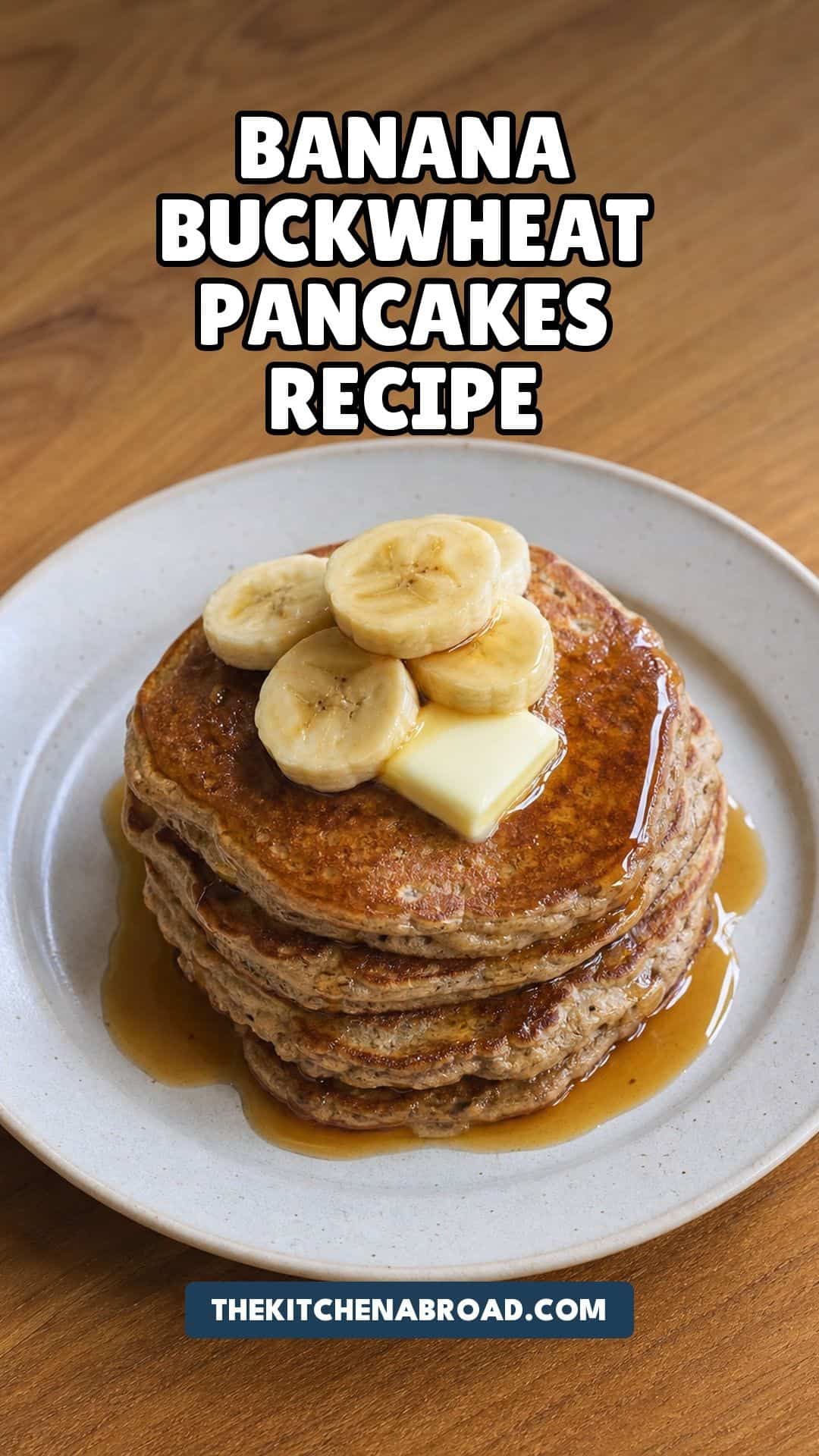
The bananas have been sitting on the counter since Wednesday, and by Sunday morning they have done what bananas do when you leave them alone: gone soft, gone fragrant, gone brown-spotted in the way that says cook me now. A medium glass bowl, a fork, a whisk, and a single griddle is the entire kitchen footprint. The bananas mash in the bowl, the dry ingredients go in over them, ten seconds of folding pulls it all together, and the first pancake hits the pan before the coffee is done brewing. This is a one-bowl Sunday morning recipe that happens to be naturally gluten-free, and it is the buckwheat pancake that converts the people who said they didn’t like buckwheat.
What You’ll Need
A bag of 100% buckwheat flour (Bob’s Red Mill, Anthony’s, or Arrowhead Mills , certified gluten-free on the label if anyone at the table is celiac), a non-stick griddle pan or a heavy non-stick skillet that holds an even 350°F across the surface, one medium glass mixing bowl big enough to hold the mashed bananas and the dry ingredients together (the entire batter lives in this bowl), a heat-resistant silicone spatula for the 10-second fold and the flip, and a bottle of pure Grade A maple syrup for serving. A fork from the drawer does the banana mash, a whisk handles the dry ingredients, and a quarter-cup measure portions the batter onto the griddle. That is the whole kit.


Recommended Reads
- Gluten-Free Soba Noodles
- Korean Buckwheat Noodles
- Buckwheat Cookies
- Mother’s Day Brunch Ideas
- Christmas Brunch Ideas
Where Buckwheat Pancakes Come From
Buckwheat in pancake form is older than the United States. In Brittany, on the western Atlantic edge of France, large-scale buckwheat cultivation began in the late 13th to early 14th century, on land where wheat refused to grow. By the 19th century, galettes de sarrasin , large, thin buckwheat crêpes folded around eggs, ham, or cheese , were the staple food of the region, ground from a seed that the locals called blé noir (black wheat) even though it is not wheat at all. The grain traveled with French settlers, German immigrants, and Russian peasants to the American colonies, where buckwheat pancakes became the heartland breakfast of the 18th and 19th centuries, cooked on cast-iron griddles in farmhouse kitchens from Pennsylvania to the upper Midwest.
White wheat flour displaced buckwheat in American breakfasts through the early 20th century, and the grain spent fifty years in the regional-curiosity wilderness. It came back twice. The first revival was the gluten-free wave of the 2010s, when celiac diagnoses tripled and naturally gluten-free whole grains got their second life on the cookbook shelf. The second was the ancient-grain superfood trend that rebranded buckwheat as a high-protein, high-fiber seed rich in rutin and magnesium. Despite the name, buckwheat is not a wheat at all , it is the seed of a flowering plant in the same family as rhubarb and sorrel, and it contains zero gluten by chemistry, not by processing. The pancakes below are a 700-year-old recipe in modern clothes.
A Few Notes on the Ingredients
- 100% buckwheat flour: Not a gluten-free flour blend, not a buckwheat-plus-rice mix, not a hybrid. One and a half cups (180 g) of pure buckwheat flour is the entire dry base of this recipe. Bob’s Red Mill, Anthony’s, and Arrowhead Mills all sell certified gluten-free single-ingredient buckwheat flour; check the bag if anyone at the table is celiac, since buckwheat is often processed in shared facilities with wheat.
- Very ripe bananas: Three medium bananas mashed to about one cup. Brown spots on the peel are required, not optional. The dark spots signal that the starches have converted to sugar (sweetness without added sugar) and the flesh has softened to the texture that mashes smoothly with a fork (mash-binding to compensate for the absence of gluten). A yellow banana with no spots is too firm and too starchy for this batter.
- Eggs: Two large eggs at room temperature. Cold eggs from the fridge will firm up the melted butter when they hit the bowl and you will end up with butter pebbles in the batter; pull the eggs out fifteen minutes before you mix.
- Whole milk: One cup (240 ml) for the wet base. Whole milk gives the batter the fat it needs to balance the buckwheat’s lean, earthy flavor. For dairy-free, swap one-to-one with unsweetened oat milk; almond and soy work too, but oat is the closest match for body.
- Baking powder: Two teaspoons, and this is the sole leavening for a gluten-free batter. Buckwheat has no gluten to trap steam, so the lift comes entirely from the baking-powder bubbles. Check the date on the can , old baking powder is the most common reason a gluten-free pancake comes out flat.
- Melted butter: Three tablespoons (42 g) of unsalted butter, melted and slightly cooled before it meets the eggs. For dairy-free, swap one-to-one with melted coconut oil; the pancakes are a touch less rich but still tender. Avoid olive oil, which competes with the buckwheat flavor.
- Pure maple syrup: Grade A for serving, not pancake syrup. Real maple syrup is a single ingredient with the depth and acidity to balance the banana and buckwheat; the bottled corn-syrup-with-maple-flavoring version flattens everything it touches. A small bottle is a year-long investment.
Recipe: Banana Buckwheat Pancakes
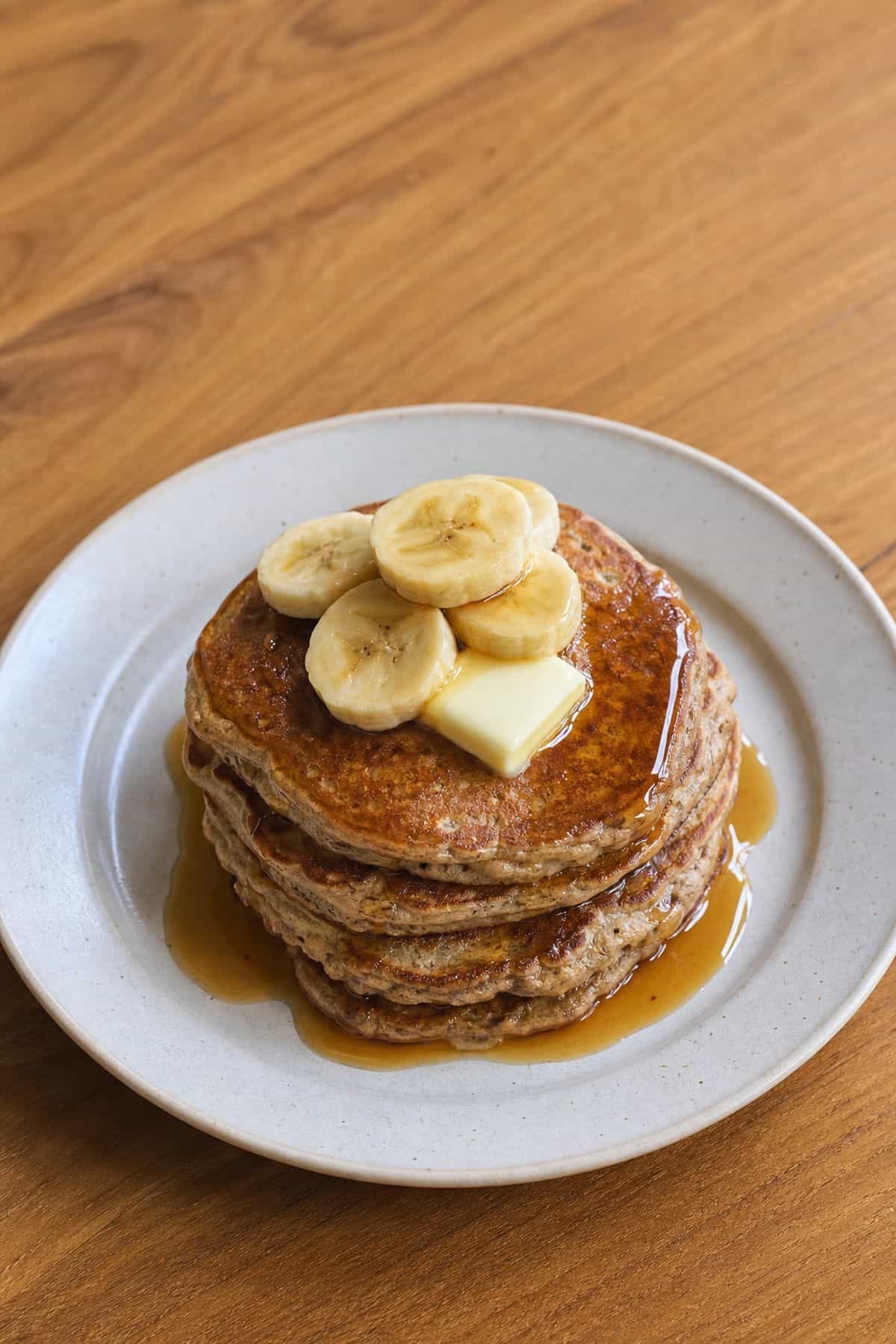
Prep time: 5 minutes | Cook time: 12 minutes | Total time: 17 minutes | Serves: 4 (about 12 pancakes)
Ingredients
- 1 1/2 cups (180 g) 100% buckwheat flour
- 2 tsp baking powder
- 1/2 tsp ground cinnamon
- 1/2 tsp fine sea salt
- 3 medium very ripe bananas (brown-spotted), mashed to about 1 cup
- 2 large eggs, room temperature
- 1 cup (240 ml) whole milk
- 3 tbsp (42 g) unsalted butter, melted and slightly cooled
- 1 tsp pure vanilla extract
- Butter or neutral oil, for greasing the griddle
- Pure Grade A maple syrup and extra banana slices, for serving
Instructions
- Whisk the dry ingredients in a large bowl: buckwheat flour, baking powder, cinnamon, and salt. Whisking the leavening through the flour before any liquid joins is the only way to guarantee an even rise across the stack, so give it a full ten seconds of circular whisking and break up any clumps of baking powder you see on the surface.
- In a second medium bowl, mash the bananas with a fork until nearly smooth. Small chunks are welcome , they melt into pockets of sweetness during the cook , but you do not want long fibrous strands of unmashed banana. Pour in the eggs, milk, melted butter, and vanilla, and whisk the wet ingredients together until the banana is fully incorporated and the mixture looks uniformly pale.
- Pour the wet into the dry and fold with a silicone spatula for ten seconds exactly. Do not overmix. A few streaks of dry buckwheat flour on the surface are fine and expected. Buckwheat has no gluten to toughen, so overmixing will not make the pancakes chewy , but it will collapse the baking-powder bubbles you just activated, and a collapsed bubble is a flat pancake. Ten seconds, no more.
- Let the batter rest for 5 minutes while the griddle heats. The rest hydrates the buckwheat flour fully (it absorbs liquid more slowly than wheat) and gives the leavening time to activate, which is the difference between a dense pancake and a tender one.
- Heat a non-stick griddle or heavy non-stick skillet over medium heat until the surface reads 350°F (175°C). If you do not have an infrared thermometer, a drop of water should sizzle and skitter, not evaporate instantly. Grease the surface lightly with butter or a thin coat of neutral oil , too much fat and the pancakes fry instead of griddle.
- Portion the batter onto the griddle in 1/4-cup pours, leaving space between each pancake for spread. Cook 3 minutes on the first side, until bubbles cover the surface from edge to center and the edges have set into a matte ring. Flip with the spatula in one confident motion.
- Cook 2 minutes on the second side, until the bottom is a deep golden brown and the pancake springs back lightly when pressed. Buckwheat browns faster than wheat, so trust the timer more than the color and pull the first one a touch early if you are unsure , adjust the heat down if the second side is darker than the first.
- Transfer the cooked pancakes to a plate in a 200°F (95°C) oven to stay warm while you cook the remaining batches. Serve in stacks of three with butter, a generous pour of pure maple syrup, and a handful of fresh banana slices over the top.
Notes
The 10-second fold is non-negotiable. Buckwheat has no gluten to toughen, which is the half of the story most recipes lead with, but it is also a flour with no gluten network to trap steam , which is the half of the story that decides whether your pancake rises or sits flat. Two teaspoons of baking powder is the only leavening you have, and the bubbles it produces deflate every additional second you stir. Ten seconds, a few streaks of dry flour visible, the batter looking lumpy and homemade. That is the correct state.
The griddle runs at 350°F, not 375°F. Buckwheat browns faster than wheat because of the higher protein and the residual sugars from the bananas, and the standard pancake temperature of 375°F is a touch too hot for this batter , the outside hits done before the inside finishes cooking through. Drop to 350°F (a medium burner setting on most home stoves) and the timing of 3 minutes first side and 2 minutes second side lands cleanly every time.
Pancakes freeze beautifully. Cool them fully on a wire rack, stack with squares of parchment between each one, and freeze flat in a zip-top bag for up to two months. Reheat straight from frozen in a toaster on a medium setting , two passes for a soft middle, three for crisper edges. This is the weeknight breakfast move: cook one Sunday batch, eat for ten days.
Tips and Variations
Why 100% Buckwheat Beats a Gluten-Free Blend
Most “buckwheat banana pancake” recipes online use a flour blend , buckwheat plus oat plus sweet rice plus tapioca , and the result is a pancake that tastes vaguely earthy and largely neutral. The buckwheat flavor lives in the first 25% of the ingredient list and dilutes from there. Committing to 100% buckwheat does two things at once: it carries the toasty, nutty, almost-grassy buckwheat character all the way through the bite, and it lets the ripe banana sweetness do the balancing work without competing notes from rice or oat in the background. The trade is a slightly denser crumb than a hybrid recipe would give you, which is what the baking powder and the 10-second fold are calibrated to solve. Do not split the difference. Either lean into buckwheat or use a different flour entirely.
The 10-Second Fold That Preserves the Rise
Wheat pancake recipes warn against overmixing because wheat flour develops gluten when agitated and gluten is what makes a pancake tough. Buckwheat has no gluten, so you cannot toughen these pancakes by mixing , but the warning still applies, for a different reason. Baking powder is a chemical leavener that releases carbon dioxide bubbles the moment it hits liquid, and those bubbles are what lift the pancake. Every additional stroke of the spatula past the 10-second mark is a bubble you just destroyed. Count to ten in your head while you fold, stop when you hit ten, and accept that the batter looks under-mixed. A flat pancake comes from an over-stirred batter. A risen pancake comes from a batter that still has flour streaks when it hits the pan.
Brown-Spotted Bananas Are Not Optional
The difference between a yellow banana and a brown-spotted one is about four days on the counter and the entire success of this recipe. As bananas ripen, the starches break down into simple sugars (fructose, glucose, and sucrose), the cell walls soften, and the fruit picks up the floral, custardy notes that read as banana flavor in a baked good. Yellow bananas are too starchy, too firm to mash smooth, and too neutral to sweeten the batter without adding sugar. Brown-spotted bananas mash to a near-puree with a fork in thirty seconds, sweeten the pancakes from the inside, and contribute the structural binding that compensates for the missing gluten. If you have only yellow bananas on hand, the fix is the oven: bake them in the peel on a sheet pan at 300°F for 15 minutes until the skin blackens, cool, then mash. The starch converts in the oven what it would convert on the counter.
Dairy-Free Swap with Oat Milk and Coconut Oil
The recipe converts cleanly to dairy-free with two swaps. Replace the whole milk one-to-one with unsweetened oat milk (oat is the closest match for body and fat content; almond runs thinner, soy runs heavier). Replace the melted butter one-to-one with melted refined coconut oil (refined, so you do not get a coconut flavor pushing into the buckwheat). The pancakes are a touch less rich than the butter-and-milk version, but the texture holds and the flavor profile stays clean. The recipe is then naturally gluten-free and dairy-free, which is useful for brunch tables with mixed dietary needs. Skip almond milk if you can , it adds an almond note that competes with the banana, and the lower fat content can leave the pancakes a touch dry.
Freezing Batches for Weekday Breakfast
Cook a double batch on a Sunday morning and you have breakfast for the week. Let the pancakes cool fully on a wire rack , stacking warm pancakes traps steam and the bottoms turn gummy , then stack them with squares of parchment paper between each one and slide the stack into a zip-top freezer bag. They keep for two months at zero degrees. Reheat straight from frozen in a toaster on a medium setting; two passes gives you a soft middle, three gives you crisper edges. The microwave works in a pinch (30 seconds on a plate), but the toaster produces a noticeably better texture. For a school-morning breakfast, pop two in the toaster while you pour coffee and the kids are eating before the school bus arrives.
What to Serve It With
The stack carries Sunday brunch on its own with a pour of maple syrup, a pat of butter, fresh banana slices, and a strong cup of coffee , that is the default move and most weeks it is the whole meal. For a kids’ breakfast, the bananas sweeten the batter enough that picky eaters can skip the syrup entirely; serve with a glass of cold milk and a handful of berries on the side. For a post-workout breakfast, the protein from eggs and milk, the complex carbs from buckwheat, and the potassium from the bananas land in the right ratio for a Sunday-morning recovery plate , top with a spoonful of Greek yogurt and a drizzle of honey for an extra protein push. For a holiday brunch spread, the pancakes fit alongside the rest of our Mother’s Day brunch ideas and Christmas brunch ideas. For weekday meal prep, freeze the batch and the morning question of what to eat is already answered.
Frequently Asked Questions
Is buckwheat gluten-free?
Yes, naturally. Despite the name, buckwheat is not a wheat at all , it is the seed of a flowering plant in the same family as rhubarb and sorrel, and it contains zero gluten by chemistry. For celiac safety, buy a bag labeled “certified gluten-free” because buckwheat is often processed in shared facilities with wheat, which can lead to cross-contamination above the FDA threshold of 20 parts per million. Bob’s Red Mill, Anthony’s, and Arrowhead Mills all sell certified gluten-free 100% buckwheat flour. If you are cooking for a celiac household, the certification on the bag matters more than the brand.
Can I substitute buckwheat flour for regular flour in pancakes?
You can swap one-to-one by volume, but the recipe needs a few adjustments to land. Buckwheat has no gluten, so the structure that wheat normally provides has to come from somewhere else , in this case, the mashed bananas, the eggs, and a higher baking-powder ratio than a wheat pancake would use. If you take a wheat-flour pancake recipe and simply swap in buckwheat flour, you will get a dense, flat pancake. Use a recipe like this one that is calibrated for 100% buckwheat from the start, or if you want a hybrid, swap half the buckwheat for oat flour (still gluten-free) for a fluffier crumb.
Why are my buckwheat pancakes dense?
Two usual suspects. The first is overmixing , buckwheat has no gluten to toughen, but the baking-powder bubbles that lift the pancake collapse every additional stroke past 10 seconds. The second is old baking powder. The can in your pantry has an expiration date, and once it is past that date the rising power drops sharply. To test it, drop a teaspoon into a half cup of hot water , fresh baking powder fizzes vigorously, expired baking powder produces a few weak bubbles or nothing. A third, less common culprit is yellow bananas; brown-spotted bananas mash to a smoother puree and contribute the moisture and binding that a firm yellow banana does not.
Does buckwheat flour taste good in pancakes?
Yes, when it is paired correctly. Buckwheat has a toasty, nutty, slightly earthy flavor with a faint grassy edge , on its own it is an acquired taste, but paired with ripe bananas and maple syrup the earthiness becomes the savory backbone that keeps the pancakes from being one-note sweet. The flavor profile is closer to a buckwheat galette from Brittany than a wheat pancake from a diner, and that is the point. If you have only ever had buckwheat in a hybrid blend, the pure version is a different (and better) experience. Try one pancake plain before you reach for the syrup.
Can I make pancakes without baking powder?
Not these. In a wheat-flour pancake, the gluten network traps steam from the wet batter as it cooks and provides some of the lift on its own. Buckwheat has no gluten, which means baking powder is the only thing standing between you and a flat pancake. If you are out of baking powder, you can substitute 1/2 teaspoon of baking soda plus 1 teaspoon of cream of tartar for every 2 teaspoons of baking powder called for. Skipping the leavening entirely produces a buckwheat crêpe rather than a pancake, which is a different dish from Brittany and worth making , but it is not what this recipe is.
Are banana pancakes healthy?
Healthier than most pancake options on the breakfast table. A serving of three pancakes from this recipe runs about 320 calories, 11 grams of protein, 7 grams of fiber, and naturally sweetens from the bananas without added sugar in the batter. Buckwheat is a complete protein (it contains all nine essential amino acids, which is rare among plant-based foods), high in magnesium, and a good source of rutin, a flavonoid linked to cardiovascular health. The recipe is naturally gluten-free, easily made dairy-free with the oat-milk swap, and the bananas push the potassium content above 400 mg per serving. That said, the maple syrup is added sugar , pour modestly if calorie load is a concern, or skip it entirely and let the bananas do the sweetening.
Key Takeaways
- Use 100% buckwheat flour, not a gluten-free blend. Bob’s Red Mill, Anthony’s, or Arrowhead Mills certified gluten-free is the answer; 1 1/2 cups (180 g) is the entire dry base.
- Three medium very ripe bananas with brown spots, mashed to about 1 cup. Yellow bananas are too starchy and too firm; brown spots signal converted sugars and proper mashing texture.
- Fold wet into dry for 10 seconds exactly. Buckwheat has no gluten to toughen, but overmixing collapses the baking-powder bubbles that are the sole leavening for a gluten-free batter.
- Rest the batter 5 minutes while the griddle heats. The buckwheat hydrates and the leavening activates, which is the difference between a dense pancake and a tender one.
- Griddle at 350°F (medium), not 375°F. Buckwheat browns faster than wheat , drop the heat, cook 3 minutes first side and 2 minutes second side, and trust the timer over the color.
- Cool fully and freeze with parchment between each pancake. Reheat from frozen in a toaster on medium for the cleanest texture.
Final Thoughts
This is the one-bowl Sunday morning recipe that earns the spot on the rotation. Three brown-spotted bananas on the counter, a bag of buckwheat flour in the pantry, eggs and milk in the fridge, and twenty minutes of attention is the entire ask. The bananas do the sweetening, the buckwheat does the toasty-nutty thing that no other flour does, and the whole stack comes together with a fork and a spatula in a single glass bowl.
The two non-negotiables are the 10-second fold and the brown-spotted bananas. The fold is the difference between a risen pancake and a flat one; the bananas are the difference between sweet and bland. Everything else in the recipe is calibrated around those two moves , the 350°F griddle, the 5-minute rest, the baking-powder ratio. Skip either one and the recipe falls apart. Honor both and the rest takes care of itself.
If you cook this once and it lands, it tends to become the breakfast you cook every other Sunday. That is how it works with one-bowl recipes , the friction is so low that the only question on a slow morning is whether the bananas on the counter are ripe enough yet, and by Sunday they always are. The pancakes are naturally gluten-free, freezer-friendly, kid-approved, and based on a recipe that has been cooked in Brittany kitchens for 700 years. Pour the coffee. Heat the griddle. The bananas have been waiting all week.
Banana Buckwheat Pancakes
A one-bowl banana buckwheat pancakes recipe built on 100% buckwheat flour (no gluten-free blend, no xanthan gum, no mixer), three brown-spotted bananas mashed with a fork to about one cup, eggs and whole milk for structure, and baking powder as the sole.
Ingredients
- 1 1/2 cups (180 g) 100% buckwheat flour
- 2 tsp baking powder
- 1/2 tsp ground cinnamon
- 1/2 tsp fine sea salt
- 3 medium very ripe bananas (brown-spotted), mashed to about 1 cup
- 2 large eggs, room temperature
- 1 cup (240 ml) whole milk
- 3 tbsp (42 g) unsalted butter, melted and slightly cooled
- 1 tsp pure vanilla extract
- Butter or neutral oil, for greasing the griddle
- Pure Grade A maple syrup and extra banana slices, for serving
Instructions
- Whisk the dry ingredients in a large bowl: buckwheat flour, baking powder, cinnamon, and salt.
- In a second medium bowl, mash the bananas with a fork until nearly smooth. Small chunks are welcome , they melt into pockets of sweetness during the cook , but you do not want long fibrous strands of unmashed banana.
- Pour the wet into the dry and fold with a silicone spatula for ten seconds exactly. Do not overmix. A few streaks of dry buckwheat flour on the surface are fine and expected.
- Let the batter rest for 5 minutes while the griddle heats. The rest hydrates the buckwheat flour fully (it absorbs liquid more slowly than wheat) and gives the leavening time to activate, which is the difference between a dense pancake and a tender one.
- Heat a non-stick griddle or heavy non-stick skillet over medium heat until the surface reads 350°F (175°C). If you do not have an infrared thermometer, a drop of water should sizzle and skitter, not evaporate instantly.
- Portion the batter onto the griddle in 1/4-cup pours, leaving space between each pancake for spread. Cook 3 minutes on the first side, until bubbles cover the surface from edge to center and the edges have set into a matte ring.
- Cook 2 minutes on the second side, until the bottom is a deep golden brown and the pancake springs back lightly when pressed.
- Transfer the cooked pancakes to a plate in a 200°F (95°C) oven to stay warm while you cook the remaining batches. Serve in stacks of three with butter, a generous pour of pure maple syrup, and a handful of fresh banana slices over the top.
Notes
The 10-second fold is non-negotiable. Buckwheat has no gluten to toughen, which is the half of the story most recipes lead with, but it is also a flour with no gluten network to trap steam , which is the half of the story that decides whether your pancake rises or sits flat. Two teaspoons of baking powder is the only leavening you have, and the bubbles it produces deflate every additional second you stir. Ten seconds, a few streaks of dry flour visible, the batter looking lumpy and homemade. That is the correct state.
The griddle runs at 350°F, not 375°F. Buckwheat browns faster than wheat because of the higher protein and the residual sugars from the bananas, and the standard pancake temperature of 375°F is a touch too hot for this batter , the outside hits done before the inside finishes cooking through. Drop to 350°F (a medium burner setting on most home stoves) and the timing of 3 minutes first side and 2 minutes second side lands cleanly every time.
Last update on 2026-08-08 / Affiliate links / Images from Amazon Product Advertising API