

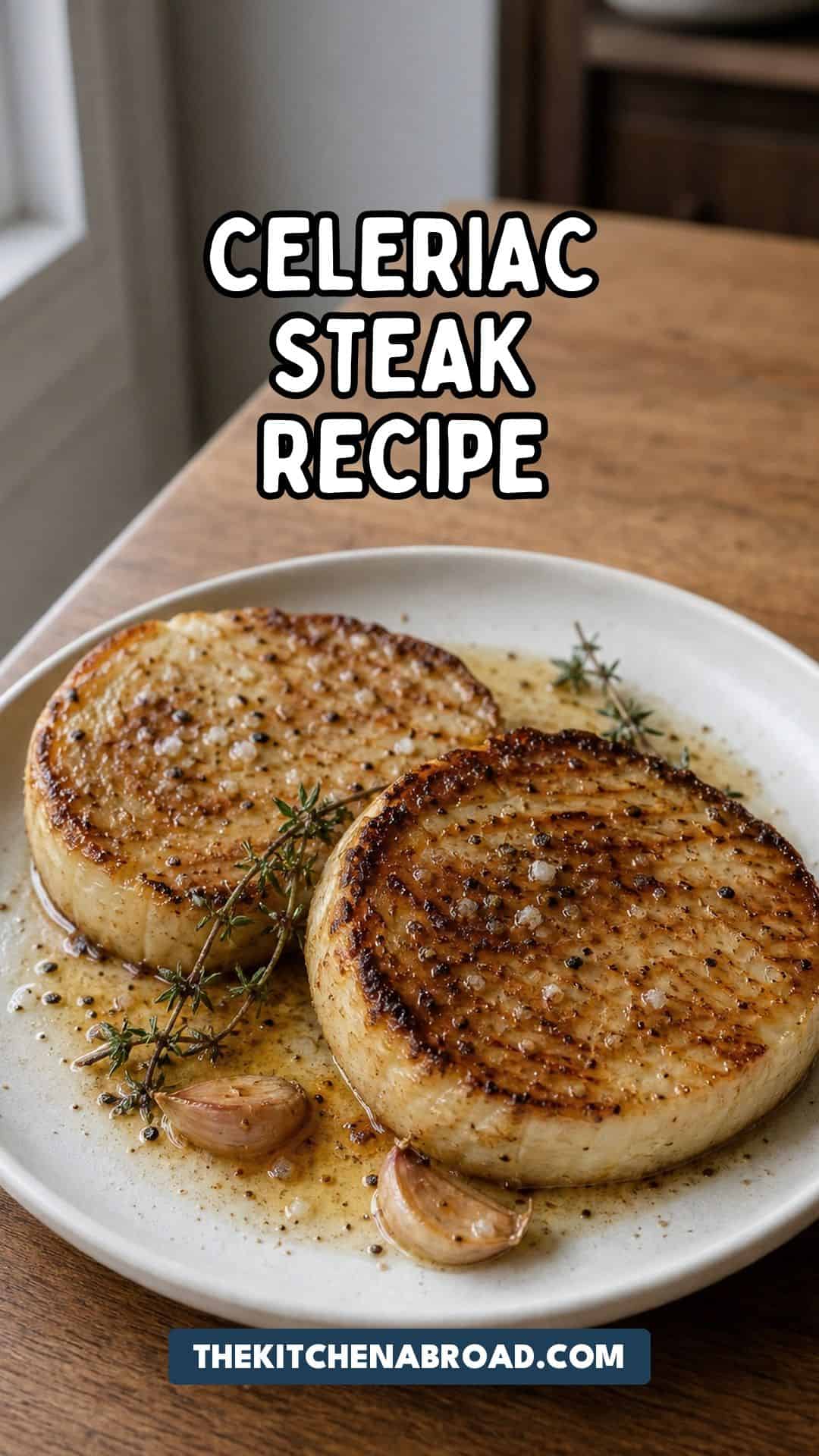
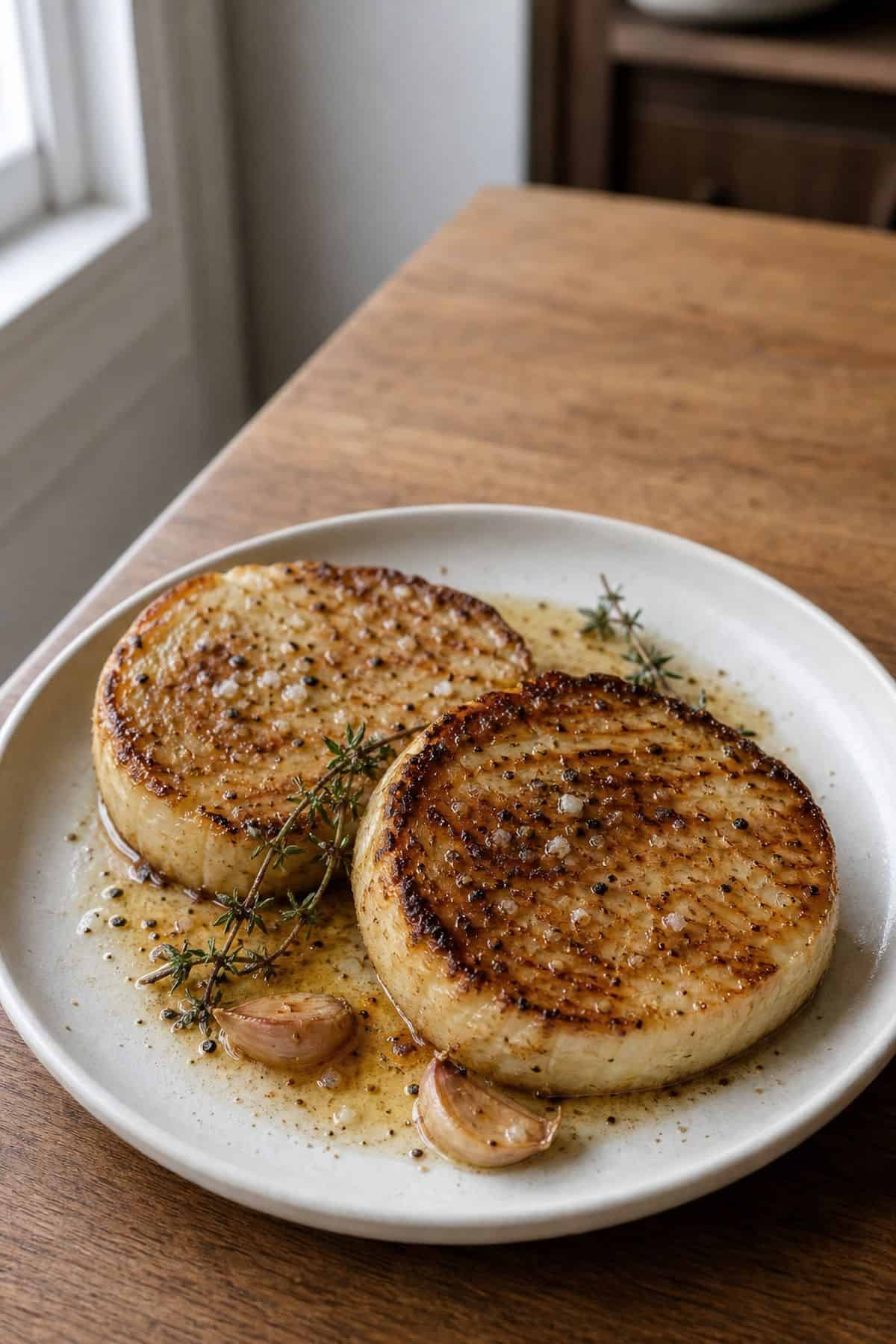
Celeriac steak is a thick slab of peeled celery root, parboiled in salted water until barely tender, then seared hard in a hot pan and basted with brown butter, thyme, and garlic the same way a cook would treat a ribeye. The parboil cooks the dense interior; the sear builds the Maillard crust. A miso, anchovy, or Marmite glaze brushed on at the end is what makes guests say it eats like meat.
Celeriac steak belongs to the small category of restaurant vegetarian dishes that actually eat better at home than at a bistro charging forty pounds for a root vegetable. A 1-inch slab under brown butter delivers something close to a ribeye for half the price, with honest chemistry doing the work rather than marketing. Maillard browning, savory umami built into the flesh, a basting technique borrowed straight from the steakhouse.
Tools You’ll Want
A heavy cast-iron skillet for the sear, a sharp chef’s knife for slabbing the root, a slotted spatula or fish spatula for the flip, a pair of kitchen tongs for the baste, and an instant-read thermometer if you want to know exactly when the interior hits done. Cast iron is the non-negotiable one. The pan needs to hold its temperature when a wet slab of celeriac lands on it, and a thin nonstick will not.


Recommended Reads
- Celeriac Puree So Silky You Will Want to Eat It With a Spoon
- How to Cook Celeriac
- Roast Celeriac With Caramelized Edges and a Creamy Center
- Celeriac Salad That Proves Raw Is Sometimes Better
- Classic Sherry Vinaigrette Recipe, Ready in 5 Minutes
Why Celeriac Eats Like Steak
The honest version of the meat comparison is this: celeriac will never taste exactly like beef, but it can deliver the same eating experience if the cook treats it like a steak. The eating experience comes from two pieces of chemistry. Maillard browning on the surface is the same set of reactions that builds the crust on a seared ribeye, where amino acids and sugars rearrange into hundreds of new aroma compounds above about 140°C (285°F). Celeriac has enough of both to brown deeply when the pan is hot and the slab is dry.
The second piece is umami. Celery root carries a natural glutamate load that intensifies as it cooks, which is the same savory backbone that makes mushrooms, tomatoes, and aged cheese taste meaty. Brushing on a miso glaze, an anchovy butter, or a thin layer of Marmite at the end stacks more glutamate on top of what is already there, and the brain reads the combination as savory in the same register as a piece of beef. The dish is not pretending to be meat. It is using the same flavor levers that make meat taste good.
How to Cut and Trim a Celeriac
This is the step most beginners skip past too fast, and a thin slab or a poorly trimmed one is the difference between a steak that holds together in the pan and a wedge that crumbles on the flip. Start with the largest celeriac you can find, a kilo or more, since the slabs come from the widest middle section of the root.
Set the celeriac on a stable cutting board. Slice off the top and the bottom to give yourself two flat surfaces, then stand the root upright on one of them. Use a heavy chef’s knife as a peeler and run it down the curved sides in long strokes, removing the skin and any soil pockets in one pass. Trim until the surface is creamy white with no brown showing. Lay the trimmed root on its side and cut horizontal slabs about 2.5 cm (1 inch) thick from the widest middle section. A large celeriac yields two to three slabs from the center plus a few smaller end pieces you can save for puree or a salad.
Recipe: Celeriac Steak
Ingredients
- 1 large celeriac, about 1 kg (2.2 lb) whole. Yields 2 to 3 thick slabs from the middle plus end pieces. Choose one that feels heavy for its size with no soft spots.
- 2 tablespoons coarse sea salt for the parboil water, plus more for seasoning the slabs.
- 2 tablespoons neutral oil for the sear. Grapeseed, avocado, or refined sunflower; anything with a high smoke point.
- 60 g (4 tablespoons) unsalted butter for the baste.
- 3 cloves garlic, lightly smashed with the side of a knife.
- 4 to 5 sprigs fresh thyme, left on the stem.
- 1 tablespoon white miso, or 1 teaspoon anchovy paste, or 1 teaspoon Marmite. The umami glaze brushed on at the end. Pick one.
- Freshly cracked black pepper, to taste.
- Flaky sea salt, for finishing.
Instructions
- Bring a large pot of water to a rolling boil and salt it heavily, about 2 tablespoons of coarse salt per 2 liters. Slide the celeriac slabs in carefully and cook at a steady simmer for 8 to 10 minutes, until a thin knife slides into the center of a slab with a little resistance left in the middle. The slabs should be cooked through enough that the dense interior is no longer raw, but firm enough to hold their shape when you lift them.
- Lift the slabs out with a slotted spatula and lay them on a wire rack or a tea towel. Pat the surfaces completely dry on both sides. This step is the one cooks often rush and the one that decides whether you get a real crust or a steamy gray sear. Wet celeriac will not brown. Give it at least five minutes of air-drying while you heat the pan, and pat once more before it goes in.
- Set a heavy cast-iron skillet over medium-high heat and add the neutral oil. Let the oil get hot enough that it shimmers and a drop of water flicks off and skips across the surface, about 2 to 3 minutes. Season the dry slabs generously with salt and black pepper on both sides. Lay them in the pan away from you and leave them alone for 3 to 4 minutes without moving them, until the underside is a deep golden brown and releases easily from the pan.
- Flip the slabs with a slotted spatula and add the butter, smashed garlic, and thyme sprigs to the pan. As the butter foams and starts to smell nutty, tilt the pan toward you so the butter pools on one side, and use a spoon or tongs to baste the slabs continuously for the next 2 to 3 minutes. The basting is the move that drives flavor and color into the second side without overcooking it. Aim for an interior of about 80°C (175°F) when probed in the center; the slab should yield to gentle pressure but still feel firm.
- Pull the slabs onto a warm plate and rest them for 2 to 3 minutes. While they rest, whisk the miso, anchovy paste, or Marmite into a tablespoon of the warm pan butter to make a quick glaze. Brush the glaze over the top of each slab, then finish with a pinch of flaky sea salt and a fresh crack of pepper. Serve immediately.
- Yield: 2 to 3 main-course slabs. Active time: 10 minutes prep, 10 minutes parboiling, 10 minutes searing and basting.
Sauce Options
Brown Butter with Capers and Lemon
The simplest option and the one that flatters the celeriac most. Wipe out the pan after the sear, melt 60 g (4 tbsp) of butter over medium heat until the milk solids turn a deep amber, then off-heat add a tablespoon of capers and a generous squeeze of lemon. Spoon over the slabs at the table. The acidity is what keeps a rich plate from feeling heavy.
Cafe de Paris Butter
The Ottolenghi pairing, taken from the FLAVOUR cookbook. A compound butter blended with anchovy, capers, parsley, tarragon, mustard, garlic, and a few drops of Worcestershire. Make a log a day ahead, refrigerate, and slice a coin onto each hot slab right before serving so it melts into a green herb sauce on contact. Steakhouse logic applied to a root vegetable.
Salsa Verde with Sherry Vinegar
A bright Italian-style green sauce of parsley, capers, anchovy, garlic, mustard, and olive oil, sharpened with sherry vinegar instead of the usual red wine. Spoon it across the slab right before serving. A drizzle of our classic sherry vinaigrette works the same brightening trick if you want something faster.
Miso Glaze
A spoonful of white miso whisked with a tablespoon of the warm pan butter, a teaspoon of mirin, and a small squeeze of lime. Brush it on the seared slabs right before serving for a shiny savory glaze. This is the sauce that leans hardest into the umami stack and the one most likely to make a meat eater do a double take.
What to Serve It With
The double-celeriac plate is the move that turns this into a proper restaurant main: spoon a wide swoosh of celeriac puree onto a warm plate, lay the seared slab on top, and finish with the brown butter or salsa verde. Same root, two textures, one plate. Bitter greens like radicchio or escarole dressed in something sharp work as a counterweight, and a small pile of black or green lentils gives the plate a hearty base.
For wine, a medium red works better than the white most people reach for with vegetables. Pinot Noir or Gamay both have enough earth and acid to handle the umami without bullying the dish. Beaujolais is the easy crowd-pleaser; a village-level Burgundy is the upgrade.
Frequently Asked Questions
What does celeriac steak taste like?
Celeriac steak tastes earthy and savory with a faintly celery, faintly nutty backbone. With a hard sear and a brown butter baste, the surface develops a Maillard crust that registers in the same flavor register as a piece of meat, and a miso or anchovy glaze pushes that even further. It does not taste exactly like beef, but it eats like a main course rather than a side.
Do you need to boil celeriac before roasting or searing?
For a thick steak-cut slab, yes. Celeriac is dense, and a raw 1-inch slab will burn on the outside before the middle softens. An 8 to 10 minute parboil in salted water cooks the interior to barely tender so the pan only has to focus on building the crust. For thinner slices or smaller chunks, parboiling is optional.
How thick should celeriac steaks be cut?
About 2.5 cm (1 inch) is the sweet spot. Thinner than that and the slab cooks through too fast to build a real crust; thicker and the center stays raw even after a generous parboil. Cut the slabs from the widest middle section of the root for the largest surface area in the pan.
What sauce goes best with celeriac steak?
Brown butter with capers and lemon is the simplest and the most flattering. Cafe de Paris butter is the restaurant move borrowed from Ottolenghi. Salsa verde adds bright herb and acid for a lighter plate, and a miso glaze pushes hardest into the meaty umami direction. Pick one to match the rest of the meal rather than serving all of them.
Can you make celeriac steak in advance?
The parboil can be done up to a day ahead. Cool the slabs on a rack, pat dry, wrap loosely, and refrigerate. Pat dry again before searing so the crust still forms properly. The final sear and baste need to happen right before serving; reheating a finished slab gives up most of the crust.
Is celeriac steak healthy?
Celeriac itself is low in calories, high in fiber, and a decent source of potassium and vitamin K, with about a third of the carbohydrates of potato by weight. The recipe above uses butter and oil for the sear and baste, so the finished dish is not a low-fat one, but it is naturally gluten-free and considerably lighter than a comparable serving of beef. For a leaner version, baste with olive oil instead of butter.
Key Takeaways
- Cut 2.5 cm (1 inch) slabs from the widest middle section of a peeled celeriac for the largest pan surface and a strong ratio of crust to interior.
- Parboil in heavily salted water for 8 to 10 minutes to cook the dense center before the pan touches the outside.
- Pat the slabs bone-dry before searing; wet celeriac steams instead of browning and never builds a real crust.
- Sear hard in a cast-iron skillet, then baste with foaming butter, garlic, and thyme for 2 to 3 minutes on the second side.
- Brush on a miso, anchovy, or Marmite glaze at the end to stack umami on top of the Maillard crust.
- Serve over celeriac puree with brown butter, salsa verde, or Cafe de Paris butter and a medium red.
Final Thoughts
Celeriac steak is the kind of vegetarian dish that earns a place on a dinner table where most of the eaters are not vegetarian. The parboil-then-sear method is the difference between a slab of root vegetable and something a guest will actually finish, and the technique transfers straight from the steakhouse playbook: dry surface, hot pan, butter baste, rest.
Build the plate around it the way a restaurant would. A spoon of celeriac puree underneath, a sharp green sauce or a coin of compound butter on top, a glass of Pinot Noir, and a small pile of bitter greens on the side. The plate costs a fraction of a steak dinner and reads as restaurant cooking in a way few vegetable mains manage.
Last update on 2026-10-05 / Affiliate links / Images from Amazon Product Advertising API