
A cheese and charcuterie board for 8 people takes 16 to 24 ounces of cheese, the same of cured meats, 4 to 6 accompaniments (honey, jam, mustard, olives, pickles, dried fruit), and 12 to 16 ounces of bread and crackers. Build around the cheese triangle rule (one soft, one semi-firm, one hard or blue) and a salt-progression meat sequence. Pull everything from the fridge one hour before serving.
Charcuterie is 15th-century French butcher shop on a slab of wood. The Paris guilds of charcutiers built reputations on rillettes, saucissons, pâtés, and the cooked-and-cured pork products that gave the trade its name (chair cuite, cooked flesh). The board below uses the cheese-triangle rule, a salt-progression meat sequence, and a ratio math you can scale from four guests to sixteen. Pull everything from the fridge an hour before guests arrive, pour a glass of cava while you arrange, and let the board do the talking.
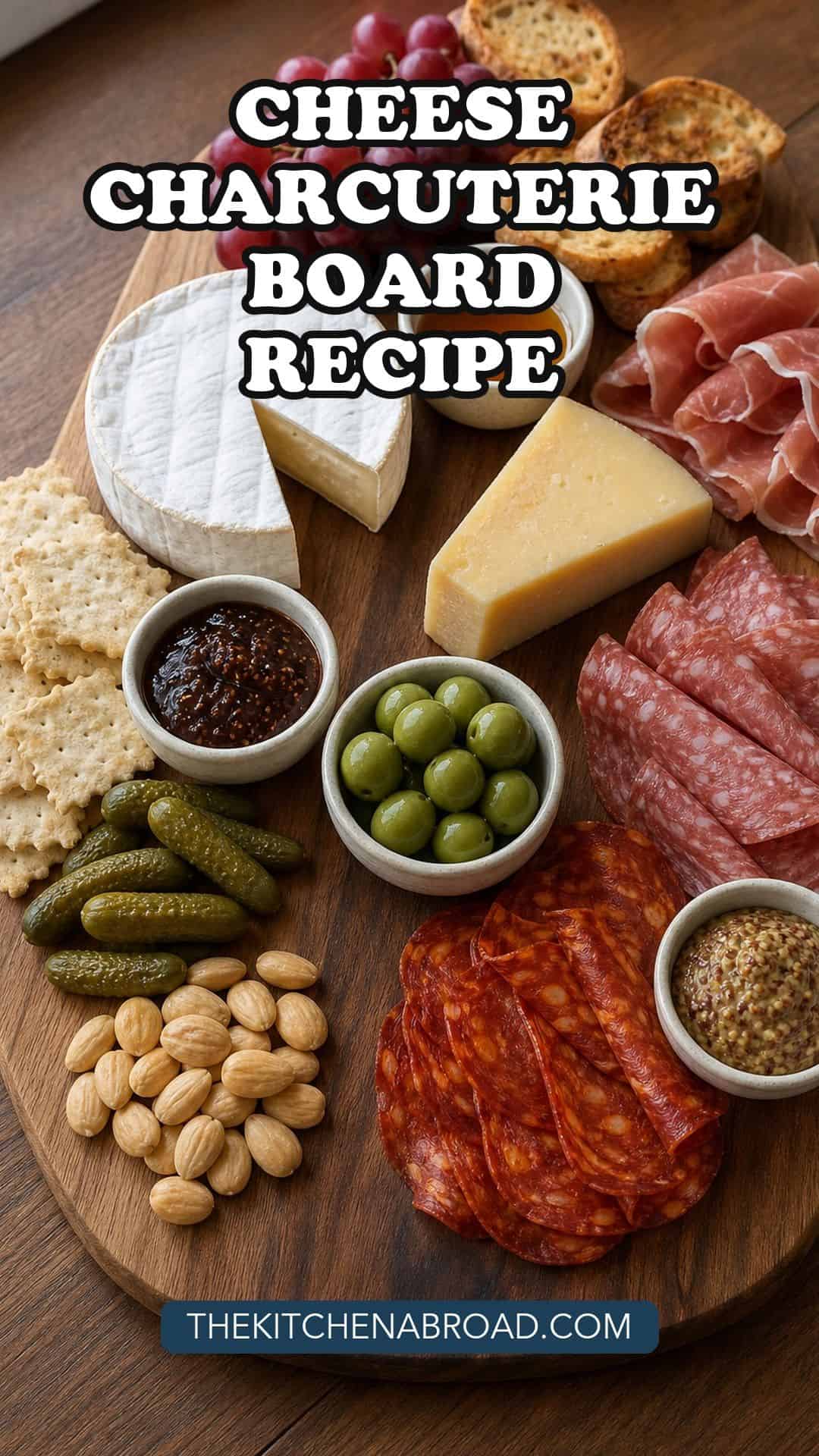
What’s on the Counter for the Board
A board is the centerpiece, but the supporting cast is small. One large wood or marble board (45 to 60 cm / 18 to 24 inches across), a set of cheese knives (one for soft, one for semi-firm, one for hard or blue), and small ramekins for the wet accompaniments (honey, mustard, jam, olives). A sharp chef’s knife handles the prep for fruit and any cheese that needs pre-slicing. Two boards is the move for a gathering of 12 or more so guests can flank both sides.


Recommended Reads
- Best Christmas Finger Foods
- Christmas Snack Ideas
- Christmas Lunch Ideas
- Friendsgiving Food Ideas
- Easy Galentine’s Party Food Ideas
Where the Charcuterie Idea Came From
The word charcuterie comes from the 15th-century Paris butcher trade. By the 1470s, charcutiers were a separate guild from regular butchers, specializing in cooked and cured pork products: rillettes (slow-cooked shredded pork preserved in fat), saucissons (dry-cured sausages), pâtés, jambon (cured ham). The trade was practical: a way to preserve pork before refrigeration, sold in small shops where the meats hung from hooks in glass cases.
The board-and-spread format, on the other hand, is a 21st-century American restaurant invention. Wine bars and small plates restaurants in the late 2000s popularized the assembled board as a menu item, borrowing the cheese course from French after-dinner tradition and the cured meats from the butcher shop. Mashed together, the modern charcuterie and cheese board is essentially a French butcher shop on a slab of wood, set up for a home dinner party.
A cheese board, strictly, is just the cheese half. A charcuterie board is just the meat half. The two-in-one is what most home cooks actually mean when they say “charcuterie board,” and the version below assembles both on a single surface.
A Few Notes on the Cheeses and Meats
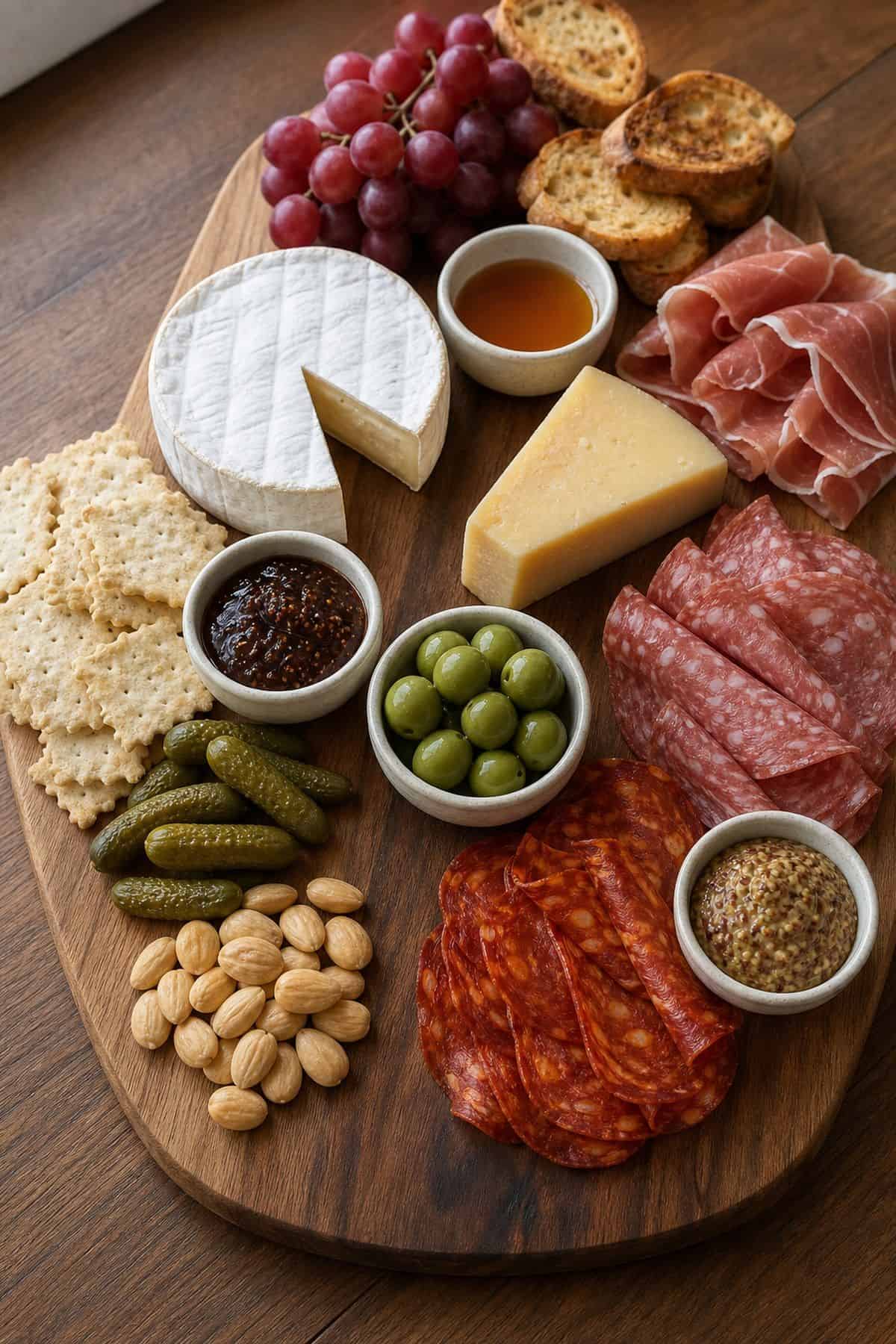
The cheese triangle is the simplest system that produces a balanced board. Pick one soft cheese (brie, camembert, burrata, fresh goat), one semi-firm (manchego, gouda, gruyère, comté), and one hard or blue (parmigiano-reggiano, aged cheddar, stilton, gorgonzola). Each plays a different role on the bite: the soft spreads on bread, the semi-firm slices into bite-sized wedges, the hard breaks into shards or sits next to a jar of honey for drizzling. Three cheeses across the triangle gives a board variety without overwhelming the palate.
For the meats, work in a salt progression from lightest to richest. Start with prosciutto di Parma or San Daniele (the lightest cured ham, sliced paper-thin), move to a salami like sopressata or finocchiona (medium-cured, slightly spiced), and finish with something richer or spiced like chorizo (Spanish, picante or dulce) or coppa. Three meats across the salt progression is the standard for a board for 8; bigger gatherings get a fourth like mortadella for variety.
The accompaniments are where the board lifts from solid to memorable. A small jar of local honey, a spoonful of fig jam, a ramekin of whole-grain mustard, Castelvetrano olives (the bright green, mild ones), cornichons, and a handful of dried apricots or fresh red grapes. Four to six accompaniments is the sweet spot; more clutters the board and confuses the bite.
For the bread and crackers, two types is enough: sliced toasted baguette (warmed in the oven just before serving) and water crackers or sturdy seeded crackers. Add breadsticks if you want vertical visual interest at the edges.
Recipe: Cheese and Charcuterie Board
Prep time: 25 minutes | Cook time: 0 minutes (1-hour fridge rest required) | Total time: 25 minutes active, 1 hour 25 minutes total | Serves: 8 as cocktail-hour appetizer
Ingredients
For the cheeses (about 600 g / 20 oz total)
- 200 g (7 oz) double-cream brie or camembert wheel, soft
- 200 g (7 oz) wedge of manchego, gouda, or gruyère, semi-firm
- 200 g (7 oz) wedge of aged cheddar, parmigiano-reggiano, or stilton, hard or blue
For the cured meats (about 340 g / 12 oz total)
- 115 g (4 oz) prosciutto di Parma or San Daniele, sliced paper-thin
- 115 g (4 oz) sopressata or finocchiona salami, sliced
- 115 g (4 oz) Spanish chorizo or coppa, sliced
For the accompaniments
- 2 tablespoons local honey, in a small ramekin
- 3 tablespoons fig jam or quince paste, in a small ramekin
- 2 tablespoons whole-grain mustard, in a small ramekin
- 120 g (½ cup) Castelvetrano olives, in a small ramekin
- 60 g (¼ cup) cornichons
- 80 g (½ cup) dried apricots or fresh red grapes
- 50 g (heaping ¼ cup) marcona almonds or candied walnuts
For the bread and crackers
- 1 baguette, sliced on a bias into 1.5 cm (½ inch) pieces and lightly toasted
- 1 box (about 200 g / 7 oz) water crackers or sturdy seeded crackers
- Optional: 8 to 10 breadsticks for vertical interest
Instructions
- Pull the cheeses and meats from the fridge one hour before serving. Cold cheese tastes muted; an hour at room temperature lets the lactic notes and the meat’s spices come through. Set them on the counter, still wrapped, while you set up the board.
- Place the board on the table where it will serve; once it’s loaded, it’s heavy. Choose a wood board for a forgiving surface that hides knife marks, a marble board for a warm room (marble stays cool and slows the cheese softening), or a slate board if you want visual drama and don’t mind olive-brine stains.
- Anchor the board with the cheeses first. Position the three cheeses in a wide triangle pattern across the board, spaced so each has elbow room. Cut the wedges of semi-firm and hard cheese into two or three large pieces (not bite-sized; let guests slice their own with the cheese knife). Leave the soft cheese intact with a small wedge already cut at the edge to invite the first slice.
- Place a labeled cheese knife next to each cheese: a wide flat-blade for the soft cheese, a narrow blade for the semi-firm, and a small blade or shaver for the hard or blue. The knives signal which cheese is which without needing labels.
- Fan the prosciutto first, in loose ribbons or roses. Roll a slice of prosciutto loosely on itself, then place; the open coils catch the light. Set 6 to 8 rolls in a curved line near the soft cheese.
- Fold the salami slices into quarters and fan them in a wide arc. Folded salami stacks cleanly and looks more arranged than flat-laid slices. Place in a separate zone of the board.
- Arrange the chorizo or coppa in a shingled line near the harder cheese. The bolder meat pairs naturally with the bolder cheese; the visual logic mirrors the flavor logic.
- Set the four small ramekins of honey, fig jam, whole-grain mustard, and Castelvetrano olives in a loose grid across the board. The ramekins anchor the wet accompaniments so they don’t slide and pool onto the cheese.
- Scatter the cornichons in a small cluster near the mustard, the marcona almonds in a loose pile near the honey, and the dried apricots or grapes in two corners of the board for color. Fresh grapes go in the corners closest to the cheese; the cluster shape echoes the round shape of the brie.
- Fan the toasted baguette slices and crackers around the edges of the board, with the breadsticks (if using) standing in a small glass or laid flat near the cured meats. The bread is the last thing you place; it stays crisp longer at the edges than buried under cheese.
- Stand back, check the board for empty spots, fill any gaps with extra grapes, nuts, or a sprig of rosemary or thyme. Serve immediately, with a stack of small plates and cocktail napkins nearby.
Notes
The math scales cleanly. For 4 guests: halve every quantity. For 12 guests: increase cheeses and meats to 900 g (32 oz) of each and add a fourth meat (mortadella works) and a fourth cheese (a fresh goat or burrata adds a fresh-dairy note). For 16 guests, run two boards rather than one; a single huge board crowds and guests struggle to reach the center.
Wood boards (acacia, walnut, maple) forgive knife marks and look warm against the cheese; this is the safest default. Marble boards keep cheese cool in a warm room, which matters in summer or a heated dining room; the trade-off is weight and a colder visual register. Slate boards look dramatic but stain from olive brine and mustard; reserve them for short-service occasions where the brine won’t sit.
Build the board no more than 2 hours before serving. Beyond that, the soft cheese begins to sweat, the cured meats dry at the edges, and the crackers absorb moisture from the air. If you’re prepping for an evening party, prepare the components in the afternoon (sliced cheese covered with parchment, meats wrapped, ramekins filled and chilled) and assemble in the final 25 minutes.
Tips and Variations
The one-hour-out rule
Cheese is the single ingredient on the board that changes the most with temperature. Pulled straight from the fridge at 4°C, cheese tastes flat and the fats sit dormant. Sit at room temperature (around 18 to 20°C) for an hour, the fats soften and the lactic and ammonia notes come through. Set a timer when guests are coming so the cheese hits the board cold and arrives at the table room-temperate.
Add a warm element
A cold board benefits from one warm element on the table. Cranberry brie bites straight from the oven, a small bowl of warmed almonds, or a tray of bacon-wrapped dates work; the temperature contrast adds dimension to a spread that would otherwise read uniformly chilled.
Vary the board for the season
In autumn, lean into figs, dried apricots, candied walnuts, and a stronger cheese like a blue or aged gouda. In summer, swap to fresh stone fruit (sliced peaches or apricots), prosciutto, mozzarella di bufala, and lighter olives. In winter, the classic spread above is the right call; in spring, add fresh radishes with butter or asparagus tips for a green note.
Plan two boards for big gatherings
One huge board for 16 guests rarely works in practice; people crowd in the middle and can’t reach the cheese on the far end. Two medium boards flanked at opposite ends of the table or one in the kitchen and one in the living room solve the traffic problem. Each board carries its own complete set: three cheeses, three meats, four accompaniments, and a bread basket.
Storage
Leftover cheese and meats keep 3 to 5 days in the fridge, individually wrapped in parchment then foil (plastic wrap suffocates cheese and changes the flavor). Wet accompaniments keep in their ramekins, sealed with plastic, for a week. Olives last indefinitely in their brine. Toasted baguette goes stale within a day; freeze leftover slices for soup or panzanella the following week.
What to Pour Alongside
A board this varied wants three wines on offer: a sparkling, a medium-bodied red, and an off-dry white. Cava or prosecco does the sparkling work and pairs especially with the prosciutto. A pinot noir or gamay handles the salami and the chorizo. An off-dry riesling balances the blue cheese against the honey and the dried fruit. Pour the sparkling first, the white second, the red third.
For cocktail-hour service, a French 75 or an autumn sangria is the lead drink, with cava as the backup pour. The acid in both cuts through the cheeses and the cured meats in the same way the wines would.
Frequently Asked Questions
How much cheese and meat per person for a charcuterie board?
Plan 60 to 85 g (2 to 3 oz) of cheese and the same of cured meats per guest for a cocktail-hour appetizer. For 8 guests, that works out to 16 to 24 oz of cheese and 16 to 24 oz of meats, plus 4 to 6 accompaniments and 12 to 16 oz of bread and crackers. If the board is replacing dinner, double the cheese and meat quantities.
What cheeses go best on a charcuterie board?
Build around the cheese triangle: one soft (brie, camembert, burrata, fresh goat), one semi-firm (manchego, gouda, gruyère, comté), and one hard or blue (aged cheddar, parmigiano-reggiano, stilton, gorgonzola). Three cheeses across the triangle is the standard. A fourth cheese can be added for 12 or more guests.
How do you build a charcuterie board for beginners?
Start with the board and the cheeses, placed in a wide triangle. Fold or roll the cured meats into ribbons and place them between the cheeses. Add small ramekins of wet accompaniments (honey, mustard, jam, olives). Scatter nuts and dried fruit in the gaps. Fan bread and crackers around the edges. The whole process takes about 20 minutes once the ingredients are at room temperature.
Can I make a charcuterie board the night before?
Not the assembled board. The cheese sweats, the meats dry, and the crackers go soft. You can prep the components the night before (slice the cheese and store wrapped in parchment, slice the meats and refrigerate, fill the ramekins with the wet accompaniments), then assemble in 25 minutes the day of. Build no more than 2 hours before guests arrive.
What’s the difference between a charcuterie board and a cheese board?
Strictly, a charcuterie board is just the cured meats (charcuterie literally means “cooked flesh”). A cheese board is just the cheese. The two-in-one assembled spread most people call a “charcuterie board” today is technically a cheese-and-charcuterie board. The combination is a 21st-century American restaurant invention, but the components come from centuries of French butcher and cheese-course tradition.
Key Takeaways
- Plan 60 to 85 g (2 to 3 oz) cheese and the same of cured meats per guest.
- Use the cheese triangle: one soft, one semi-firm, one hard or blue.
- Build the meat sequence from lightest cured (prosciutto) to richest (chorizo or coppa).
- Pull all cheeses and meats from the fridge 1 hour before serving; cold cheese tastes muted.
- Wood is forgiving, marble keeps cheese cool, slate stains from olive brine.
- Build the board no more than 2 hours before guests arrive.
Final Thoughts
A board for eight is a half-hour of work and an hour of holding still. The ratio math takes the guesswork out of the shopping, the cheese triangle takes the guesswork out of the cheese counter, and the salt-progression meat sequence takes the guesswork out of the deli case. After that, it’s just placement: cheeses first, meats fanned between them, ramekins anchoring the wet ingredients, fruit and nuts filling the gaps, bread fanning the edges.
Serve with a cold cava, a glass of autumn sangria, and a tray of cranberry brie bites warm from the oven for the temperature contrast. The board is the centerpiece of the cocktail hour; everything else fills in around it.
Cheese and Charcuterie Board
A cheese and charcuterie board for 8 people takes 16 to 24 ounces of cheese, the same of cured meats, 4 to 6 accompaniments (honey, jam, mustard, olives, pickles, dried fruit), and 12 to 16 ounces of bread and crackers.
Ingredients
- 200 g (7 oz) double-cream brie or camembert wheel, soft
- 200 g (7 oz) wedge of manchego, gouda, or gruyère, semi-firm
- 200 g (7 oz) wedge of aged cheddar, parmigiano-reggiano, or stilton, hard or blue
- 115 g (4 oz) prosciutto di Parma or San Daniele, sliced paper-thin
- 115 g (4 oz) sopressata or finocchiona salami, sliced
- 115 g (4 oz) Spanish chorizo or coppa, sliced
- 2 tablespoons local honey, in a small ramekin
- 3 tablespoons fig jam or quince paste, in a small ramekin
- 2 tablespoons whole-grain mustard, in a small ramekin
- 120 g (½ cup) Castelvetrano olives, in a small ramekin
- 60 g (¼ cup) cornichons
- 80 g (½ cup) dried apricots or fresh red grapes
- 50 g (heaping ¼ cup) marcona almonds or candied walnuts
- 1 baguette, sliced on a bias into 1.5 cm (½ inch) pieces and lightly toasted
- 1 box (about 200 g / 7 oz) water crackers or sturdy seeded crackers
- Optional: 8 to 10 breadsticks for vertical interest
Instructions
- Pull the cheeses and meats from the fridge one hour before serving. Cold cheese tastes muted; an hour at room temperature lets the lactic notes and the meat's spices come through. Set them on the counter, still wrapped, while you set up the board.
- Place the board on the table where it will serve; once it's loaded, it's heavy.
- Anchor the board with the cheeses first. Position the three cheeses in a wide triangle pattern across the board, spaced so each has elbow room.
- Place a labeled cheese knife next to each cheese: a wide flat-blade for the soft cheese, a narrow blade for the semi-firm, and a small blade or shaver for the hard or blue. The knives signal which cheese is which without needing labels.
- Fan the prosciutto first, in loose ribbons or roses. Roll a slice of prosciutto loosely on itself, then place; the open coils catch the light. Set 6 to 8 rolls in a curved line near the soft cheese.
- Fold the salami slices into quarters and fan them in a wide arc. Folded salami stacks cleanly and looks more arranged than flat-laid slices. Place in a separate zone of the board.
- Arrange the chorizo or coppa in a shingled line near the harder cheese. The bolder meat pairs naturally with the bolder cheese; the visual logic mirrors the flavor logic.
- Set the four small ramekins of honey, fig jam, whole-grain mustard, and Castelvetrano olives in a loose grid across the board. The ramekins anchor the wet accompaniments so they don't slide and pool onto the cheese.
- Scatter the cornichons in a small cluster near the mustard, the marcona almonds in a loose pile near the honey, and the dried apricots or grapes in two corners of the board for color.
- Fan the toasted baguette slices and crackers around the edges of the board, with the breadsticks (if using) standing in a small glass or laid flat near the cured meats.
- Stand back, check the board for empty spots, fill any gaps with extra grapes, nuts, or a sprig of rosemary or thyme. Serve immediately, with a stack of small plates and cocktail napkins nearby.
Notes
The math scales cleanly. For 4 guests: halve every quantity. For 12 guests: increase cheeses and meats to 900 g (32 oz) of each and add a fourth meat (mortadella works) and a fourth cheese (a fresh goat or burrata adds a fresh-dairy note). For 16 guests, run two boards rather than one; a single huge board crowds and guests struggle to reach the center.
Wood boards (acacia, walnut, maple) forgive knife marks and look warm against the cheese; this is the safest default. Marble boards keep cheese cool in a warm room, which matters in summer or a heated dining room; the trade-off is weight and a colder visual register. Slate boards look dramatic but stain from olive brine and mustard; reserve them for short-service occasions where the brine won't sit.
Last update on 2026-08-08 / Affiliate links / Images from Amazon Product Advertising API