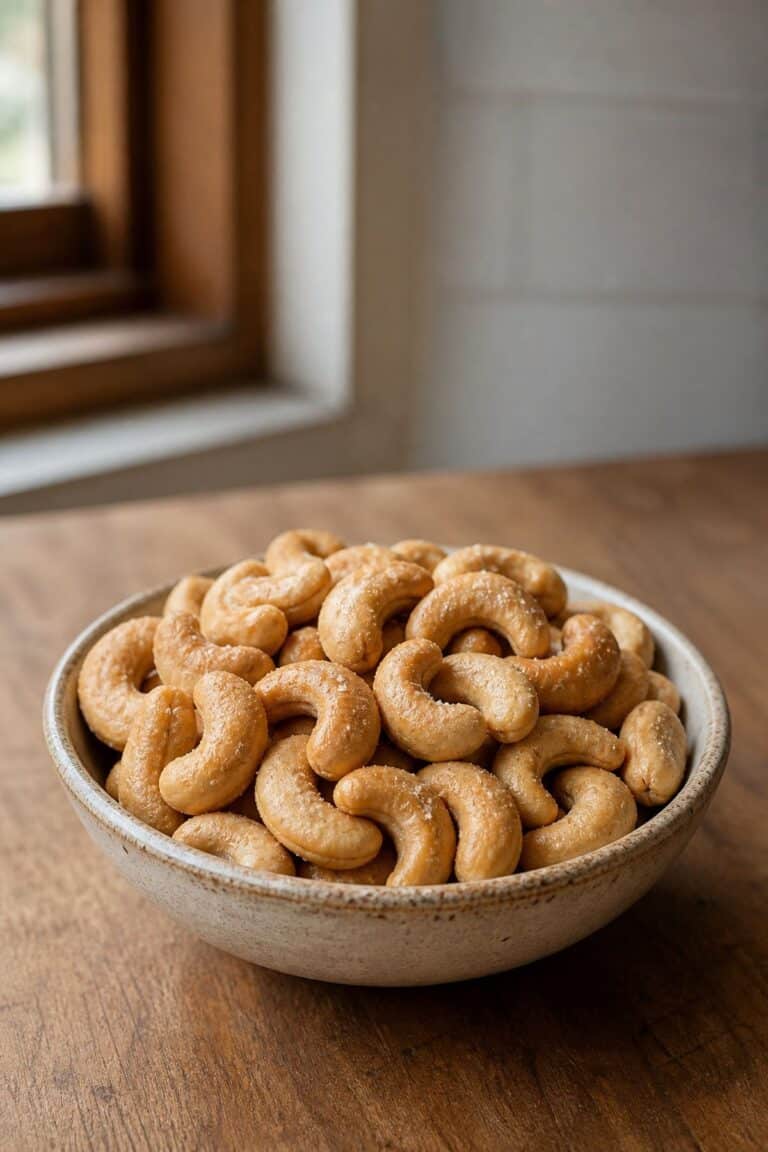
Soak 2 cups of raw cashews in a brine of 4 tablespoons salt and 2 cups water for 30 minutes, drain and pat them dry, toss with 2 tablespoons oil and a little fine salt, then roast at 350°F (175°C) for 10 to 12 minutes. Finish with flaky salt while warm, and the seasoning stays on the nut.
The most common salted cashew mistake is roasting the nuts plain and throwing a handful of coarse salt over them at the end. It looks fine for about an hour, and the next day you open the jar to find a little drift of salt at the bottom and a pile of cashews that taste like they forgot to show up to the party.
Salted cashew nuts that taste like the good ones from a fancy tin need the salt inside the nut as well as on top, and the easiest way to get it there is a quick saltwater brine before roasting. This post covers why that works, the full recipe with the original amounts, a faster egg-white method, which salt to finish with, flavor ideas and how to scale it up for a holiday bowl.
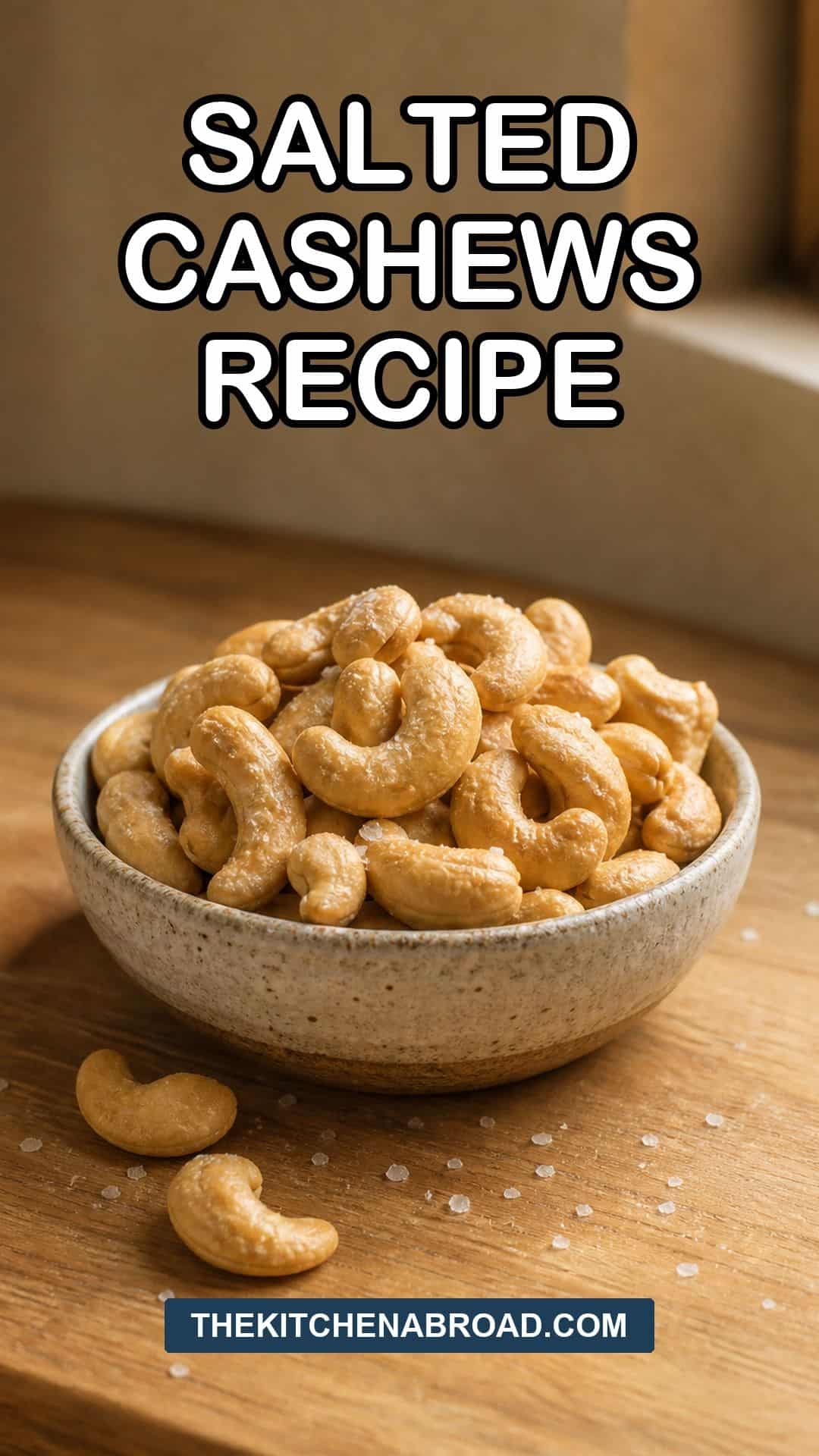
What You’ll Need to Make This Recipe


A heavy half sheet pan roasts the nuts evenly, a fine-mesh strainer makes draining the brine quick, and an airtight jar keeps them crunchy for two weeks.
Recommended Reads
- Roasted Cashew Nuts
- Thai Chicken Cashew Nuts
- Air Fryer Chestnuts
- Cheese and Charcuterie Board
- Homemade Chili Oil
The Salt-Stickiness Problem
Most homemade salted cashews fail at the very last step. You roast raw cashews with a little oil, sprinkle coarse kosher salt over them while they’re warm, give them a toss and pour them into a jar. By the next day half the salt has slid to the bottom, and the cashews themselves taste flat.
Large, smooth salt crystals simply can’t grip a dry nut. Fine sea salt clings a bit better because the small grains catch on the surface, but it still only seasons the outside. There are two fixes that work. A brine of salted water before roasting lets the salt soak into the nut and dry there, and an egg-white wash gives the salt something sticky to hold on to. The brine is my pick, because it’s simple, it’s mostly waiting and it gives you the closest thing to a shop-bought cocktail nut.
And it’s worth getting right, because a small bowl of salted cashews next to a drink is one of the most universal snacks there is, from an airport lounge to someone’s living room on a Friday night.
A Few Notes on the Ingredients
Start with raw cashews. Nuts that are already roasted won’t work here, because the brine can’t get into them and they’ll burn before the second roast is done. You’ll find raw cashews in most big grocery stores, in bulk bins and in Asian or Indian shops, and whole ones look the nicest, though halves and pieces work too (they just soak up the brine a little faster).
For the brine, any salt is fine, fine sea salt or kosher, because it dissolves in the water anyway. For finishing, use fine sea salt in the oil coating and a flaky salt over the warm nuts right after roasting.
The oil should be neutral with a high smoke point: refined avocado, peanut, grapeseed or canola. Extra-virgin olive oil tastes slightly bitter at 350°F (175°C), so save it for salads. A light coat is all you need to help the finishing salt stick.
Recipe: Salted Cashew Nuts
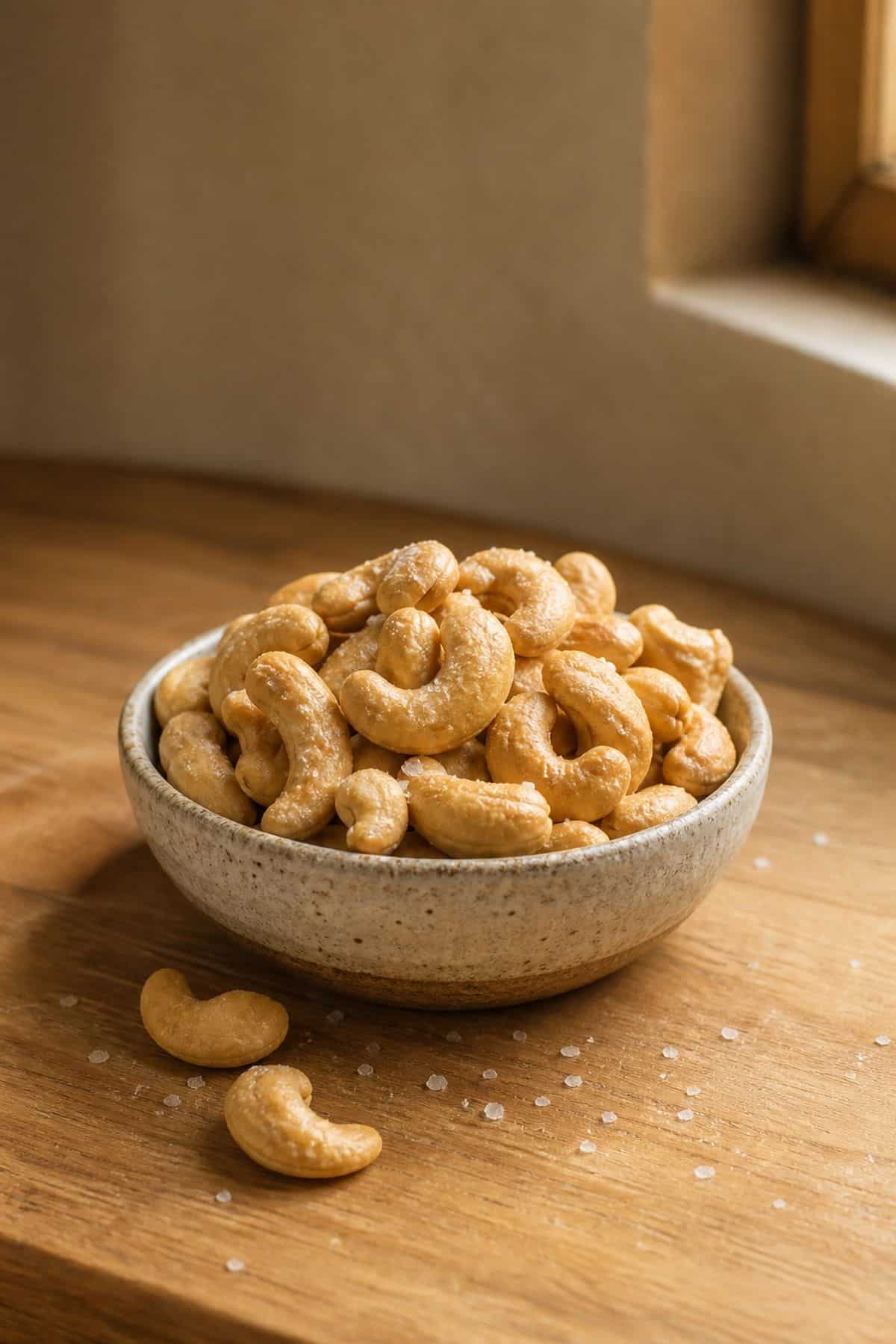
Prep time: 5 minutes | Brine time: 30 minutes | Cook time: 12 minutes | Total time: 47 minutes | Serves: 4 (makes about 2 cups)
Ingredients
- 280 g (2 cups) raw cashews, whole
- 4 Tbsp fine sea salt or kosher salt, for the brine
- 480 ml (2 cups) cool water, for the brine
- 2 Tbsp neutral oil (refined avocado, peanut, or canola)
- 1/2 tsp fine sea salt, for finishing
- Flaky sea salt, to taste
Instructions
- Make the brine. In a medium bowl, stir 4 Tbsp salt into 480 ml (2 cups) cool water until the salt fully dissolves. Add the raw cashews and stir to submerge. Let sit at room temperature for 30 minutes.
- Preheat the oven to 175°C (350°F) about halfway through the brine. Position a rack in the middle of the oven.
- Drain the cashews through a fine-mesh strainer. Discard the brine. Spread the cashews on a clean kitchen towel and gently pat dry on all sides. The nuts do not need to be bone-dry, just no longer dripping.
- Transfer the cashews to a medium bowl. Drizzle with 2 Tbsp neutral oil and 1/2 tsp fine sea salt. Toss until every nut is evenly coated.
- Spread the cashews in a single layer on a heavy half-sheet pan. Do not crowd; aim for nuts that are touching at most one or two neighbors.
- Roast for 5 minutes. Pull the pan from the oven and stir with a silicone spatula, redistributing so the previously-down sides face up. Spread back into a single layer.
- Return to the oven and roast for another 5 to 7 minutes. Start checking at 10 minutes total. The cashews are done when they are a uniform light golden brown and the kitchen smells of toasted butter. They will look slightly underdone when you pull them; carryover heat finishes the job.
- Slide the cashews onto a sheet of parchment paper. While still warm, sprinkle generously with flaky sea salt and toss once. Let cool completely before storing in an airtight jar.
Notes
The 30-minute brine is flexible. Twenty minutes gives a lighter salt level, 45 minutes gives a deeper, almost too-salty bite, and an hour is the limit before the nuts soften too much to roast crisp.
Don’t skip patting them dry. Wet cashews steam before they roast and come out soft instead of crunchy, but they don’t need to be bone dry, just no longer dripping.
Once cooled, the cashews keep for 2 weeks in a sealed jar on the counter or in the freezer for 3 months. The fridge isn’t a good idea, because the moisture in there softens them.
Tips and Variations
Why the Brine Beats Post-Roast Salting
Why bother with a brine when you could just salt them afterwards? Because the brine seasons the inside of the nut. While the cashews sit in salty water, a little of that water and salt soaks in, and when they go into the oven the water dries off and the salt stays put, spread through the nut. The flaky salt you add at the end then sits on the outside, so every bite is salty on the surface and seasoned all the way through. Skip the brine and you get a plain roasted cashew with a salty coat, which is fine, but it’s the difference between a homemade snack and the kind people keep reaching for even after they said they were full. That double layer of salt is the whole point of the recipe.
Egg-White Wash Method (Faster, Slightly Different Texture)
No time for a 30-minute soak? The egg-white wash is your shortcut. It works because the egg white acts like glue, so even fine salt sticks to the nut instead of falling off.
- Whisk 1 egg white until frothy.
- Toss it with 2 cups raw cashews and 1 teaspoon fine salt.
- Spread on a sheet pan and roast at 350°F (175°C) for 12 to 14 minutes.
- Stir once at the 6-minute mark.
The finish is a little crackly, almost like a candied nut without the sugar, while the brined cashews look smooth and clean. Which one is better depends on who’s eating them.
Use Fine Salt for Finishing, Not Kosher
Kosher salt is great in the brine and the wrong choice on top. The flakes are big and smooth, so without something sticky to hold them, most of the salt ends up in the bottom of the jar instead of on the cashews.
For the finish you’ve got two good options. Fine sea salt grips the warm, lightly oiled surface, and a flaky finishing salt softens a little when it touches the hot nuts, so it sticks and still gives you a small crunch when you bite in.
So the rule is simple: kosher salt in the water, fine or flaky salt on the nuts. Once you get the hang of it, you’ll never go back to the salt drift at the bottom of the jar.
Flavor Variations on the Brined Base
Once the brine-and-roast method feels easy, the flavors are where it gets fun. Add these to the oil before tossing:
- Salt and pepper: 1 teaspoon coarsely cracked black pepper.
- Smoky: ½ teaspoon smoked paprika and ¼ teaspoon garlic powder.
- Chili-lime: ½ teaspoon chili powder, then the zest of half a lime over the nuts right after roasting.
- Sweet and salty: 1 tablespoon maple syrup tossed in with the oil, which caramelizes against the salt into a brittle-style coating.
Keep an eye on the sweet version in the last few minutes, because maple goes from golden to burnt quickly.
Scaling Up for a Holiday Bowl
Holiday parties are where a bowl of salted cashews disappears first, so making a double batch is worth it. Use 4 cups (560 g) raw cashews with 1 liter of water and 8 tablespoons of salt for the brine, then roast on two half sheet pans, swapping them top to bottom when you stir. You can even triple it, the brine works the same way and the oven time only goes up by 2 to 3 minutes. For a party of 8 or more, roast the double batch in the morning, let it cool completely and keep it in an airtight container until guests arrive. They taste their best within 48 hours, which won’t be a problem, trust me.
What to Serve Them With
Drinks, first of all. A dry martini, an old fashioned, a cold beer or a glass of very dry sherry are all great next to a bowl of salted cashews. They also belong on a cheese board next to a sharp aged cheddar and a small bowl of chili oil for the brave ones, and chopped, they’re a nice crunchy topping for a green salad or a winter grain bowl.
Are Homemade Salted Cashews Healthier Than Store-Bought?
A little, mostly because you decide how much salt and oil go in. This recipe uses a light coat of oil and you can shorten the brine for a less salty nut. Cashews are still rich and calorie-dense either way, so the bigger difference comes from how many handfuls you eat, not where they came from.
Can You Brine Other Nuts the Same Way?
Yes, almonds, peanuts and pecans all work with the same brine and roast. Harder nuts like almonds can soak longer, and softer pecans need less time, so start checking them earlier in the oven and taste one before you pull the pan.
Frequently Asked Questions
How do you get salt to stick to cashews?
Brine the raw cashews in salted water for 30 minutes before roasting, so the salt dries into the nut. An egg-white wash also works, because it glues fine salt to the surface. Coarse salt sprinkled on dry, cooled nuts mostly falls off.
Can you salt cashews after roasting?
Yes, but use fine sea salt or a flaky salt, and add it while the nuts are still warm and lightly oiled. Coarse kosher salt on cooled cashews ends up at the bottom of the bowl.
Should I use kosher salt or sea salt for cashews?
Use either one for the brine, since it dissolves in the water. For finishing, fine sea salt or flaky salt sticks much better than kosher salt.
How long do homemade salted cashews last?
About 2 weeks in an airtight jar at room temperature, or 3 months in the freezer. Keep them out of the fridge, because the moisture softens them.
Key Takeaways
- Brine raw cashews for 30 minutes so the salt seasons the inside of the nut.
- Pat them dry before roasting, or they steam and go soft.
- Roast at 350°F (175°C) for 10 to 12 minutes, stirring once.
- Finish with fine or flaky salt while they’re still warm.
- Use kosher salt in the brine, not on top.
- Store in an airtight jar at room temperature, never in the fridge.
Start a Jar This Weekend, Before the Holiday Party Rush
Buy a bag of raw cashews on your next grocery run and do one batch this weekend, start to finish, so the method is in your hands before the holiday parties start. It’s 30 minutes of waiting and 12 minutes of roasting, and you’ll have a jar ready for Friday drinks, a cheese board or a handful straight from the counter (we both know that’s where most of them go).
Last update on 2026-11-19 / Affiliate links / Images from Amazon Product Advertising API