
A cloudberry jam recipe built the Nordic way: 1.5 pounds of frozen cloudberries thawed and cooked down with an equal weight of granulated sugar (the traditional 1:1 ratio that defines Finnish lakka and Norwegian multebær preserves), three tablespoons of fresh lemon juice for brightness, and an optional split vanilla bean for the home-kitchen lakka profile. No commercial pectin, because cloudberries are naturally pectin-rich in their seeds. The jam is cooked in a heavy stainless stock pot to 220°F (104°C) on an instant-read thermometer, the universal gel point, then ladled hot into sterilized half-pint Mason jars and either water-bath processed for shelf-stable storage or refrigerated for up to three weeks. Yields three half-pint jars; takes 40 minutes start to finish; tastes like Arctic gold on toast.
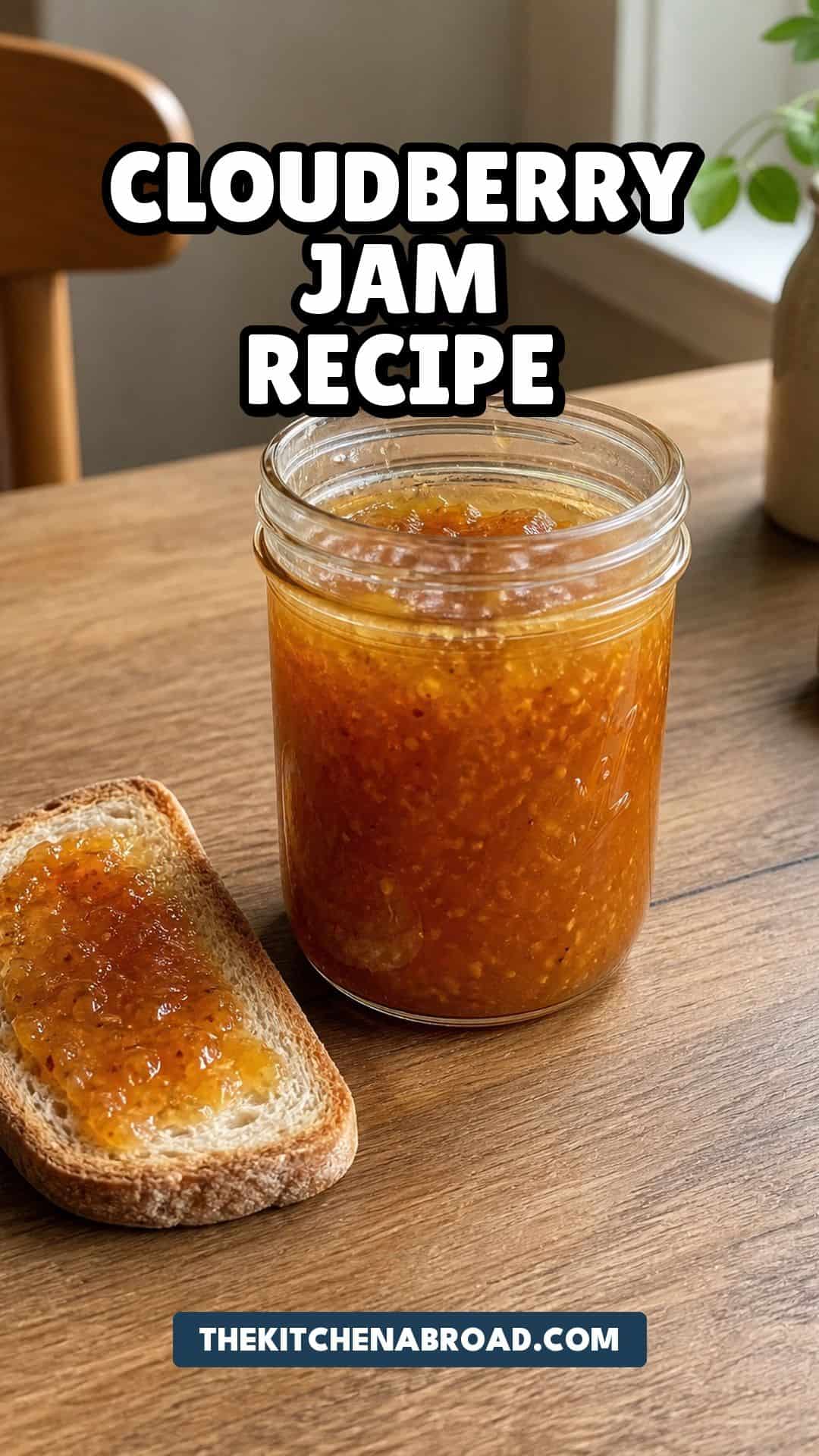
In Finland they call it lakka, Arctic gold, and it is the most prized berry in the Nordic pantry. The Sami have foraged cloudberries from sub-arctic peat bogs for centuries, preserving them in fat or snow against the long winters and offering them to honored guests as a gesture of welcome. Norwegians know the same fruit as multebær and fold it into whipped cream for multekrem, the traditional Christmas Eve dessert. Swedes call it hjortron and serve it spooned over warm brunost. The harvest window is two to three weeks in July and August, the bogs are remote, and commercial cultivation has never worked, which is why a pound of dried cloudberries can run sixty dollars at retail and why most of the world meets this berry through a jar of jam rather than a bowl of fresh fruit. The recipe below is the home-kitchen version of a preserve that has anchored Nordic kitchens for centuries, built around the realistic American sourcing path (frozen) and the traditional Nordic ratio (1:1 berries to sugar by weight), with no commercial pectin because the berries do not need it.
What You’ll Need
A heavy stainless steel stock pot deep enough to hold a rolling boil without splatter, an instant-read thermometer that pulls a reading in under three seconds (the 220°F gel point is the entire success metric for this jam), a long wooden cooking spoon for stirring through hot fruit without scorching the bottom, a stainless canning funnel for clean fills with no rim drips, and three eight-ounce half-pint Mason jars with new two-piece lids for the finished preserve. If you plan to water-bath process for shelf-stable storage, the stock pot needs to be tall enough to submerge the sealed jars by an inch of boiling water. None of these are optional. The thermometer in particular is what replaces guesswork with a reliable set.


Recommended Reads
- Finnish Pulla Bread
- Finnish Salmon Soup (Lohikeitto)
- Almond Buttermilk
- How to Make Cashew Butter
- Christmas Breakfast Ideas
Where Cloudberries Come From
Cloudberries (Rubus chamaemorus) grow wild in the peat bogs of the Arctic Circle: northern Finland, Sweden, Norway, parts of Russia, Alaska, and Newfoundland. The plant is low and creeping, the fruit is amber-orange and looks like a translucent raspberry, and the harvest is a two-to-three-week window in late July and early August. Sami foragers have gathered them for centuries on the open bogs of Lapland, working in family groups across landscape that is impassable for half the year and waterlogged for the other half. Cloudberries were historically a critical winter food in the far north, preserved in fat or under snow, valued for their high vitamin C content (early Sami used them medicinally against scurvy long before the vitamin had a name), and given as gifts to honored guests in a culture where a jar of lakka carried real weight.
The fruit has resisted commercial cultivation. The plant is dioecious, the bogs are slow-growing, and every attempt to farm it at scale has produced lower yields than wild foraging. That is why the Finns call it Arctic gold and why a bottle of lakkalikööri (Finnish cloudberry liqueur) is the gift you bring back from Helsinki. For American cooks the practical sourcing path is frozen berries from a Scandinavian importer (Nordic Temptations, First Choice Produce, and a handful of specialty Amazon sellers stock them), because fresh cloudberries are functionally impossible to buy outside Alaska or Newfoundland during the brief summer harvest. Frozen is not a compromise here. The berries are flash-frozen at the bog, the texture holds up through thawing because the fruit is going into a jam pot anyway, and the flavor is identical to fresh. This recipe is written for frozen cloudberries because that is what an American home cook can actually buy.
A Few Notes on the Ingredients
- Frozen cloudberries: 1.5 pounds (680 g) thawed at room temperature for two to three hours, juice and all. Fresh cloudberries are unavailable outside the two-week Nordic harvest in late July; frozen is the realistic sourcing path for American cooks. Look for Nordic Temptations, First Choice Produce, or specialty Scandinavian importers; the berries should be amber-orange and intact.
- Granulated sugar: 1.5 pounds (680 g), a 1:1 ratio with the berries by weight. This is the traditional Nordic set for cloudberry jam and the entire reason it preserves without commercial pectin. Lower sugar ratios fail to set and shorten shelf life; resist the urge to reduce it.
- Fresh lemon juice: 3 tablespoons (45 ml), squeezed from one large lemon. The acid brightens the flavor, lifts the slight muskiness that some palates pick up in cooked cloudberries, and assists the natural pectin in setting. Bottled juice works in a pinch; fresh is meaningfully better.
- No commercial pectin: Cloudberries are naturally high in pectin, with the highest concentration in the seeds. Combined with a 1:1 sugar ratio and a 220°F finish, the jam sets on its own. Adding Sure-Jell or liquid pectin to this recipe will turn the jam stiff and rubbery; the urge to reach for it is the urge to fight.
- Vanilla bean: 1 pod, split lengthwise and scraped (optional). This is the Finnish home-kitchen move that produces the lakka profile, adding warmth and floral depth without overpowering the berry. Skip it if you want the pure-berry version; include it if you want the version your Finnish grandmother would have made.
- Sterilized jars: Three 8-oz half-pint Mason jars with new two-piece lids. Sterilize by boiling jars and lids for ten minutes in a stock pot of water; pull them out with tongs and let them air-dry on a clean towel. Reusing old flat lids is the most common cause of failed seals.
Recipe: Cloudberry Jam
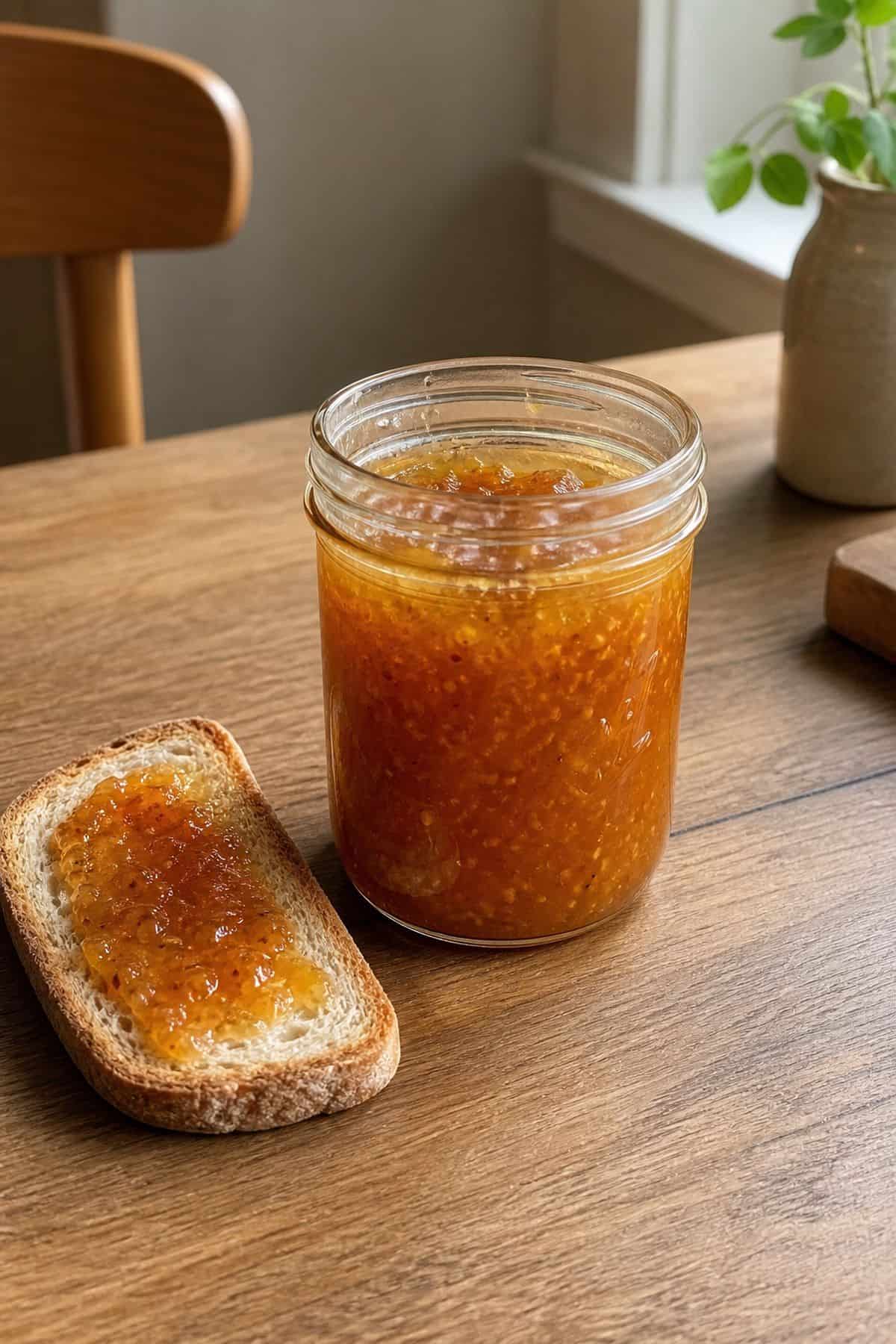
Prep time: 10 minutes | Cook time: 30 minutes | Total time: 40 minutes | Makes: 3 half-pint jars
Ingredients
- 1.5 lb (680 g) frozen cloudberries, thawed
- 1.5 lb (680 g) granulated sugar (1:1 by weight)
- 3 tbsp (45 ml) fresh lemon juice
- 1 vanilla bean, split lengthwise (optional)
Instructions
- Sterilize three 8-oz half-pint Mason jars and their two-piece lids by submerging them in a stock pot of boiling water for ten minutes. Pull them out with tongs and set them upside-down on a clean kitchen towel to air-dry while you cook the jam. Keep the lids in warm water until you are ready to seal.
- Combine the thawed cloudberries (juice and all) with the granulated sugar in a heavy stainless stock pot. Set the heat to medium and stir slowly with a wooden spoon until the sugar dissolves into the berry juice, about five minutes. The mixture will look loose and syrupy at this stage; that is correct.
- Add the fresh lemon juice and the split vanilla bean if you are using one. Stir to combine, then bring the mixture to a rolling boil over medium-high heat. Skim any foam from the surface with a slotted spoon as it rises; the foam is harmless but cloudy and skimming gives you a clearer finished jam.
- Reduce the heat slightly to maintain a steady boil and cook, stirring frequently to prevent scorching on the bottom, for 18 to 22 minutes. The jam will thicken visibly and the bubbles will go from large and loose to small and tight as the temperature climbs.
- Begin checking the temperature at the 15-minute mark with an instant-read thermometer. The gel point is 220°F (104°C); the jam is finished the moment the thermometer reads 220°F in the center of the pot. Confirm with the cold-plate test: drop a teaspoon of jam onto a chilled saucer, wait 30 seconds, then push it with your finger. If the surface wrinkles, the jam is set.
- Pull the pot off the heat. Fish out the vanilla bean if you used one (scrape any remaining seeds back into the jam with the tip of a paring knife). Ladle the hot jam into the sterilized jars through a stainless canning funnel, leaving 1/4 inch of headspace at the top of each jar.
- Wipe the rims of the jars with a clean damp cloth to remove any sticky residue, set the flat lids on top, and screw the bands on fingertip-tight. Do not overtighten; the air needs to escape during processing.
- For shelf-stable storage, process the sealed jars in a boiling water bath for ten minutes, with the jars submerged by at least one inch of water. Pull the jars out with a jar lifter and set them on a towel to cool undisturbed for 12 hours; you will hear the lids pop as they seal. For refrigerator-only storage, skip the water bath and refrigerate the cooled jars for up to three weeks.
Notes
The 1:1 sugar ratio is the traditional Nordic set for cloudberry jam and the reason the preserve has anchored Arctic kitchens for centuries. The high sugar concentration prevents microbial growth, draws moisture out of the fruit through osmosis, and produces a jam that sets cleanly at 220°F without help. Reducing the sugar to 3/4 or 1/2 sounds reasonable on paper and will give you a jam that does not set, ferments within a week, and tastes thinner than the original. The math has been worked out across centuries of home preservation. Trust it.
No pectin is needed because cloudberries carry their own. The pectin is concentrated in the seeds, which is why this recipe does not strain the berries before cooking; the whole fruit goes into the pot. Adding commercial pectin (Sure-Jell, Certo, liquid or powdered) to a jam that already has natural pectin produces a stiff, rubbery texture that is closer to gelatin than preserve. If your jam does not set after 22 minutes at 220°F, give it another two minutes; the gel point is reliable.
The water-bath processing step is optional but recommended if you want shelf-stable storage. Sealed and processed jars keep in a cool pantry for up to 12 months; refrigerator-only jars keep for three weeks once cooled. Once a jar is opened, refrigerate and use within three weeks regardless of how it was originally stored.
Tips and Variations
Why Frozen Cloudberries Are the Realistic Sourcing
Fresh cloudberries are functionally unavailable to American home cooks. The harvest window is two to three weeks in late July, the bogs are concentrated in the Arctic Circle (with smaller populations in Alaska and Newfoundland), and the fruit does not ship well at retail. The realistic sourcing path is frozen berries from a Scandinavian importer, and the good news is that frozen cloudberries are not a compromise for jam-making. The berries are flash-frozen at the source within hours of harvest, the cell structure is going to break down in the jam pot anyway, and the flavor difference between fresh and frozen for a cooked preserve is negligible. Nordic Temptations, First Choice Produce, and a handful of specialty Amazon sellers carry frozen cloudberries year-round at roughly $25 to $35 per pound. Plan to buy three pounds: 1.5 for this batch, 1.5 in the freezer for the next one.
The Nordic 1:1 Sugar Ratio (Don’t Reduce It)
Every Nordic cloudberry jam recipe of any seriousness uses a 1:1 ratio of berries to sugar by weight. This is not a sweetness preference; it is the preservation chemistry. Sugar at that concentration binds water, prevents microbial growth, and works with the berry’s natural pectin to produce a clean set at the gel point. Modern low-sugar jam recipes work around this by adding commercial pectin formulated for reduced sugar (Sure-Jell makes a low-sugar version), but those recipes do not taste like Nordic cloudberry jam, and the texture is wrong. If you want a less-sweet preserve, the move is not to reduce the sugar in this recipe; it is to spread less of the finished jam on your toast. The 1:1 ratio is non-negotiable for the traditional set.
The 220°F Gel Point Without Pectin
220°F (104°C) is the universal gel point for jam at sea level, the temperature at which sugar concentration in the boiling fruit reaches the level that produces a firm set on cooling. It is the same temperature professional jam-makers target and the same temperature you find in every serious preservation cookbook from The Joy of Cooking to Christine Ferber’s Mes Confitures. Without a thermometer you are guessing, and the difference between underset (runny syrup) and overset (rubber) is about 90 seconds at the end of the cook. An instant-read thermometer takes the guesswork out and pays for itself the first time it saves a batch. The cold-plate test is the backup confirmation: drop a teaspoon of jam onto a chilled saucer, wait 30 seconds, push it with your finger; if the surface wrinkles, the jam is set. Use both methods together.
Adding Cardamom or Vanilla for the Lakka Profile
The pure-berry version of cloudberry jam is the Norwegian and Swedish standard. The Finnish home-kitchen version often includes a split vanilla bean or a few cracked cardamom pods in the pot, reflecting the warmer aromatic palette of Finnish baking and the connection to lakkalikööri, the cloudberry liqueur that is the most famous Finnish use of the fruit. To add cardamom, crack three or four green pods with the side of a knife and drop them into the pot along with the lemon juice; fish them out with the vanilla bean before jarring. The result is a jam that reads as Finnish rather than Norwegian, with a slightly more complex profile that pairs particularly well with cardamom-spiced pulla bread and Scandinavian rye. Pick one direction or the other; do not use both vanilla and cardamom in the same batch.
Pairing Cloudberry Jam with Cheese and Toast
The single best use of cloudberry jam is on a Nordic cheese board. A spoonful next to a wedge of Norwegian brunost (the caramelized brown whey cheese) is a pairing that has anchored Norwegian breakfast tables for generations; the salty-sweet whey cheese and the floral acidity of the cloudberry are made for each other. Aged Gouda, a soft Camembert, or a sharp aged cheddar all work in the same register. For breakfast, the jam belongs on buttered Finnish pulla, on dark Nordic rye, or folded into a quarter-cup of whipped cream with a splash of vanilla to make instant multekrem, the Norwegian Christmas Eve dessert. A teaspoon swirled into Greek yogurt is the simplest use; a tablespoon on a slice of toasted sourdough with salted butter is the second-simplest. Save it for the moments that matter.
What to Serve It With
The natural home for cloudberry jam is the Nordic breakfast spread. Spoon it onto warm Finnish pulla bread, fresh from the oven and split with salted butter, or onto dark rye toast alongside a wedge of soft cheese. Build a Nordic cheese board with brunost, aged Gouda, and a sharp cheddar, and let the jam anchor the sweet corner of the plate. Fold it into whipped cream for multekrem, the Norwegian Christmas Eve dessert, or spoon it warm over vanilla ice cream for the simplest possible finish to a winter dinner. Our Christmas breakfast ideas roundup is the natural home for this jam in December; the rest of the year it belongs in a jar at the back of the fridge, pulled out on the mornings that deserve it.
Frequently Asked Questions
Where can I buy cloudberries in the US?
Frozen cloudberries are the realistic American sourcing path. Nordic Temptations, First Choice Produce, and a handful of specialty Scandinavian importers stock them year-round at roughly $25 to $35 per pound. Amazon carries cloudberry preserves and the occasional bag of frozen fruit, though stock varies. Fresh cloudberries are functionally impossible to buy outside Alaska or Newfoundland during the brief July-August harvest window; the berries do not ship at retail scale. Plan to order frozen, and order enough for two batches because the shipping is the same.
What does cloudberry jam taste like?
Cloudberry jam tastes like nothing else in the berry world. The flavor is floral and slightly tart, with notes of apricot, baked apple, and a faint honey roundness, and an aromatic complexity that no other berry approaches. Some palates pick up a slight muskiness that the lemon juice in this recipe lifts and balances. Texture-wise, the seeds add a subtle crunch that you do not get from strawberry or raspberry jam. The closest flavor analog is a 50/50 mix of golden raspberries and apricot preserves, but the comparison is more about register than identity; cloudberry is its own thing.
Can I make cloudberry jam without pectin?
Yes, and you should. Cloudberries are naturally high in pectin, with the highest concentration in the seeds, which is why traditional Nordic recipes never call for commercial pectin. Combined with a 1:1 sugar ratio and a 220°F gel point, the jam sets cleanly on its own. Adding Sure-Jell or liquid pectin to a recipe that already has natural pectin produces a stiff, rubbery texture closer to gelatin than preserve. If you have ever bought a jar of European cloudberry jam from IKEA or a Nordic importer, you have eaten a no-pectin preserve.
Why is cloudberry jam so expensive?
Cloudberries cannot be commercially cultivated at scale. The plant is dioecious, the bogs are slow-growing, and every attempt to farm Rubus chamaemorus has produced lower yields than wild foraging. The fruit grows wild only in Arctic peat bogs, the harvest window is two to three weeks in July and August, and the berries must be hand-picked from terrain that is impassable for half the year. A pound of dried cloudberries can run sixty dollars at US retail; frozen runs $25 to $35 per pound; a small jar of imported preserves runs $12 to $18. The economics reflect the labor and the geography, not a markup.
How long does cloudberry jam last?
Water-bath processed and sealed jars keep in a cool pantry for up to 12 months. Refrigerator-only jars (skipping the water-bath step) keep for three weeks once cooled. Once a jar is opened, refrigerate and use within three weeks regardless of how it was originally stored. Watch for any signs of mold, off smells, or a popped seal that should be popped (a properly sealed jar has a concave center that does not flex; if the center pops up and down when pressed, the seal failed and the jam should go in the fridge to be eaten within the next three weeks).
Can I use cloudberry jam to make multekrem?
Yes, and it is the easiest Norwegian dessert in the canon. Fold 1/2 cup of cloudberry jam into 1 cup of cold heavy cream whipped to soft peaks with a tablespoon of sugar and a splash of vanilla extract. The result is multekrem, the traditional Norwegian Christmas Eve dessert, served in small bowls with a buttery cookie on the side. It takes five minutes, looks like a cloud of Arctic gold, and tastes like the Nordic winter holidays distilled into a spoonful.
Key Takeaways
- Lock to frozen cloudberries. Fresh is functionally impossible outside the two-week Nordic harvest in late July; frozen from a Scandinavian importer is the realistic American sourcing path and not a compromise for jam-making.
- Use a 1:1 ratio of berries to sugar by weight (1.5 lb each). This is the traditional Nordic set and the reason the jam preserves without commercial pectin. Do not reduce the sugar.
- Skip the commercial pectin. Cloudberries are naturally high-pectin, especially in their seeds; the jam sets on its own at the gel point.
- Cook to 220°F (104°C) on an instant-read thermometer, confirmed with the cold-plate wrinkle test. This is the universal jam gel point and the entire success metric for the recipe.
- Ladle into sterilized half-pint Mason jars with 1/4-inch headspace. Water-bath process 10 minutes for shelf-stable storage up to 12 months, or refrigerate for up to 3 weeks.
- Serve with Finnish pulla, Norwegian brunost, vanilla ice cream, or folded into whipped cream for instant multekrem.
Final Thoughts
This is the rare recipe where the constraints are the recipe. You cannot buy fresh cloudberries, so you cook with frozen. You cannot reduce the sugar without breaking the preserve, so you commit to the 1:1 ratio. You cannot improve the set with commercial pectin, so you trust the seeds and the thermometer. What you are left with is a jam that has anchored Nordic kitchens for centuries, made the way the Sami and the Finns and the Norwegians have made it for as long as anyone has been writing it down, with a single instant-read thermometer doing the work that intuition used to do.
The non-negotiables are the frozen sourcing, the 1:1 ratio, and the 220°F gel point. Skip the lemon juice and the jam still works, just a touch flatter. Skip the vanilla bean and you get the Norwegian version instead of the Finnish version, which is a choice rather than a mistake. Reduce the sugar and the jam will not set. Add Sure-Jell and the texture turns rubbery. Cook past 220°F and the set turns to glue. The recipe is forgiving in a few places and unforgiving in three, and the thermometer takes the guesswork out of the three that matter.
If you make this once, you tend to make it every year. Three jars is enough to put one in the fridge for Christmas morning, give one to the person in your life who would understand what a jar of lakka means, and water-bath process the third for a pantry shelf where it will keep for a year. Arctic gold on toast, on cheese, on ice cream, folded into cream for multekrem. The Sami have been doing this for centuries. Carry it forward.
Cloudberry Jam
A cloudberry jam recipe built the Nordic way: 1.5 pounds of frozen cloudberries thawed and cooked down with an equal weight of granulated sugar (the traditional 1:1 ratio that defines Finnish lakka and Norwegian multebær preserves), three tablespoons of fresh.
Ingredients
- 1.5 lb (680 g) frozen cloudberries, thawed
- 1.5 lb (680 g) granulated sugar (1:1 by weight)
- 3 tbsp (45 ml) fresh lemon juice
- 1 vanilla bean, split lengthwise (optional)
Instructions
- Sterilize three 8-oz half-pint Mason jars and their two-piece lids by submerging them in a stock pot of boiling water for ten minutes. Pull them out with tongs and set them upside-down on a clean kitchen towel to air-dry while you cook the jam.
- Combine the thawed cloudberries (juice and all) with the granulated sugar in a heavy stainless stock pot. Set the heat to medium and stir slowly with a wooden spoon until the sugar dissolves into the berry juice, about five minutes.
- Add the fresh lemon juice and the split vanilla bean if you are using one. Stir to combine, then bring the mixture to a rolling boil over medium-high heat.
- Reduce the heat slightly to maintain a steady boil and cook, stirring frequently to prevent scorching on the bottom, for 18 to 22 minutes. The jam will thicken visibly and the bubbles will go from large and loose to small and tight as the temperature climbs.
- Begin checking the temperature at the 15-minute mark with an instant-read thermometer. The gel point is 220°F (104°C); the jam is finished the moment the thermometer reads 220°F in the center of the pot.
- Pull the pot off the heat. Fish out the vanilla bean if you used one (scrape any remaining seeds back into the jam with the tip of a paring knife).
- Wipe the rims of the jars with a clean damp cloth to remove any sticky residue, set the flat lids on top, and screw the bands on fingertip-tight. Do not overtighten; the air needs to escape during processing.
- For shelf-stable storage, process the sealed jars in a boiling water bath for ten minutes, with the jars submerged by at least one inch of water.
Notes
The 1:1 sugar ratio is the traditional Nordic set for cloudberry jam and the reason the preserve has anchored Arctic kitchens for centuries. The high sugar concentration prevents microbial growth, draws moisture out of the fruit through osmosis, and produces a jam that sets cleanly at 220°F without help. Reducing the sugar to 3/4 or 1/2 sounds reasonable on paper and will give you a jam that does not set, ferments within a week, and tastes thinner than the original. The math has been worked out across centuries of home preservation. Trust it.
No pectin is needed because cloudberries carry their own. The pectin is concentrated in the seeds, which is why this recipe does not strain the berries before cooking; the whole fruit goes into the pot. Adding commercial pectin (Sure-Jell, Certo, liquid or powdered) to a jam that already has natural pectin produces a stiff, rubbery texture that is closer to gelatin than preserve. If your jam does not set after 22 minutes at 220°F, give it another two minutes; the gel point is reliable.
Last update on 2026-08-24 / Affiliate links / Images from Amazon Product Advertising API