
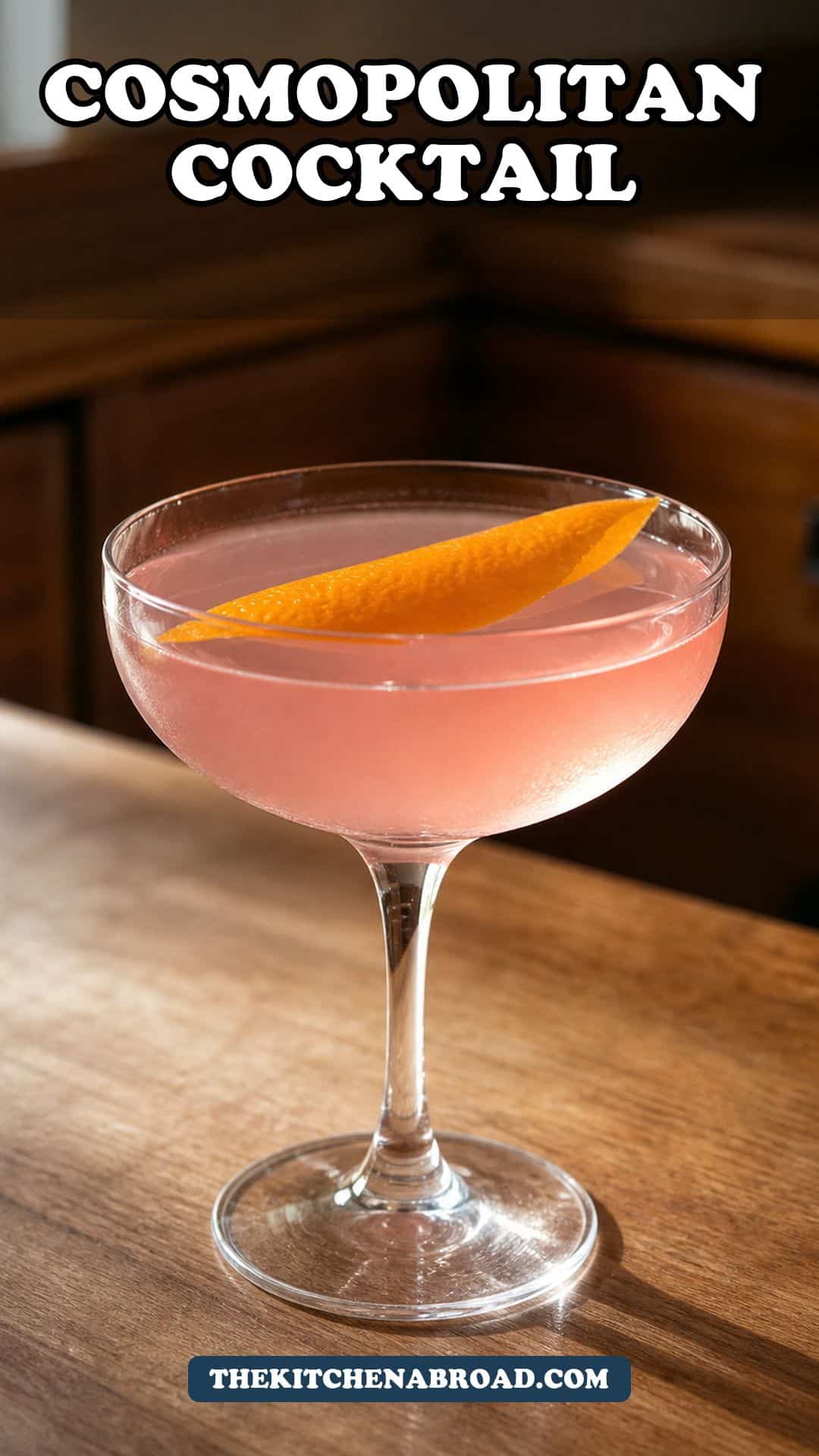
A proper cosmopolitan is 1.5 oz Absolut Citron, 1 oz Cointreau, 0.75 oz fresh lime juice, and 0.5 oz cranberry juice cocktail, shaken hard with ice and double-strained into a chilled coupe with a flamed orange peel. The 1988 spec from Toby Cecchini at the Odeon in Tribeca is a balanced sour with citrus and bitter notes, not the syrupy pink drink the 1990s turned it into. Active time is under three minutes once the glass is chilled.
The cosmopolitan has spent the last twenty years getting the punchline treatment: Carrie Bradshaw’s pink prop, the drink your aunt orders, shorthand for a certain kind of late-1990s glamour that has not aged kindly. The original 1988 build at the Odeon is a different drink entirely. Toby Cecchini’s spec uses Absolut Citron (then a brand-new product), Cointreau, fresh lime, and a small splash of cranberry juice cocktail. The result is a balanced sour with citrus structure and a hint of bitter orange. Built right, it earns its phenomenon status all over again.
Gear That Helps Here
A two-piece Boston shaker (tin and pint glass), a Hawthorne strainer, a fine-mesh strainer for the double-strain, and a jigger marked in quarter-ounce increments. The shake is hard and short, so a heavy tin matters.
Glassware is doing real work here. A chilled coupe or Nick and Nora glass holds the drink and keeps the surface oils from the flamed orange peel intact. Cool the glass in the freezer for ten minutes before you start, or fill it with ice and water while you build the drink.


Recommended Reads
Where the Cosmo Actually Came From

The version of the cosmopolitan that the world knows was built in 1988 by Toby Cecchini, a young bartender working the upstairs bar at the Odeon in Tribeca. Cecchini had been shown a sweet, neon-pink pink concoction by a waitress who had tasted something similar in San Francisco, and he set out to reverse-engineer it into something that drank like an actual cocktail. Absolut Citron had launched that same year, and Cecchini built the drink around it: citrus vodka, Cointreau, fresh lime juice, and a small pour of Ocean Spray cranberry juice cocktail for color and a thread of tart sweetness. The shake was hard, the strain was clean, the garnish was a lemon twist. That spec is the canonical one.
A bartender named Cheryl Cook has also claimed to have invented an earlier version in Miami in 1985 or 1986, using Absolut Citron, triple sec, lime, and a splash of cranberry. The Cook claim has supporters and the timing is plausible, but the Cecchini version at the Odeon is the one that spread north through the downtown Manhattan bar scene, then crossed the country, then crossed the Atlantic. By the early 1990s it was the drink to order if you were a certain kind of person in a certain kind of bar in New York.
Then Sex and the City picked it up in 1998 and the cosmopolitan became a cultural object rather than a cocktail. Carrie ordered them by the dozen across six seasons. By 2004, every chain restaurant in America was selling a magenta facsimile sweetened with grenadine and sour mix. The original Cecchini spec quietly stayed where it had always been: balanced, citrus-forward, pale pink rather than fire-engine red, drinking like the sour it actually is.
A Few Notes on the Ingredients
Absolut Citron is the vodka the drink was built around, and the lemon infusion does meaningful work. The Cecchini spec assumes that lemon note as part of the structure; plain vodka leaves a hole the lime and Cointreau cannot quite cover. If Absolut Citron is not in the cabinet, plain vodka plus an extra quarter-ounce of fresh lemon juice will get you close. Any other citrus-flavored vodka (Stoli Citros, Ketel One Citroen, Tito’s plus a lemon peel expressed over the shaker) also works.
Cointreau is not interchangeable with generic triple sec. Cointreau is a higher-proof orange liqueur made from sweet and bitter orange peels in Angers, France, and it brings a clean citrus bitterness that cheap triple sec simply does not have. If you only have triple sec, the drink will read as flat and oversweet. Grand Marnier is too heavy and oak-tinted for a cosmo. Combier or Pierre Ferrand Dry Curacao are acceptable substitutes if Cointreau is not on hand.
Fresh lime juice, squeezed within an hour of building the drink, is the structural acid. Bottled lime juice has a metallic note that fights with the cranberry. Rose’s lime cordial is sometimes called for in older cosmo recipes; it produces a different drink (sweeter, flatter) and is not what Cecchini built. Buy a bag of limes and squeeze them.
The cranberry juice is the one ingredient that surprises people: it is supposed to be the sweetened red Ocean Spray cranberry juice cocktail, not pure unsweetened cranberry juice. Pure cranberry juice is brutally tart and the wrong color; it will throw the balance and turn the drink dark maroon. The cocktail-grade juice is what gives a proper cosmo its pale pink hue and just enough sweetness to round out the lime.
Recipe: Cosmopolitan
Prep time: 2 minutes | Chill time: 10 minutes (glass) | Active time: 30 seconds | Total time: 12 minutes | Serves: 1
Ingredients

- 45 ml (1.5 oz) Absolut Citron vodka
- 30 ml (1 oz) Cointreau
- 22 ml (0.75 oz) fresh lime juice, squeezed within the hour
- 15 ml (0.5 oz) Ocean Spray cranberry juice cocktail
- 1 large strip of orange peel, for the flamed garnish
- Ice, enough to fill the shaker tin two-thirds full
Instructions
- Chill a coupe or Nick and Nora glass. Either place it in the freezer for 10 minutes before you start, or fill it with ice and cold water and let it sit on the counter while you build the drink.
- Squeeze the lime. You want 22 ml (0.75 oz) of fresh juice, which is roughly half a medium lime. Set the juice aside in the jigger so you can pour it cleanly.
- Cut a strip of orange peel about 4 cm (1.5 inches) long and 2 cm (0.75 inch) wide, using a sharp paring knife or a Y-peeler. Take as little of the white pith as possible. Set the strip aside, peel side up.
- Fill the larger tin of the shaker two-thirds full with fresh ice. Add 45 ml (1.5 oz) Absolut Citron, 30 ml (1 oz) Cointreau, 22 ml (0.75 oz) fresh lime juice, and 15 ml (0.5 oz) cranberry juice cocktail.
- Seal the shaker by setting the smaller tin or pint glass on top and tapping firmly to lock. Shake hard for 10 to 12 seconds. The shaker should frost on the outside and you should hear the ice break down into smaller pieces.
- Empty the ice and water from the chilled glass. Tap the shaker on the heel of your hand to break the seal, lift off the smaller tin, and fit a Hawthorne strainer over the larger tin.
- Double-strain the drink into the chilled glass by pouring through the Hawthorne strainer and a fine-mesh strainer held over the rim. The double-strain catches the small ice shards and pulp that would otherwise float on top.
- Hold the orange peel about 8 cm (3 inches) above the surface of the drink, peel side facing down. Light a match and hold the flame between the peel and the glass. Squeeze the peel firmly so the citrus oils spray through the flame and onto the surface of the drink. You should see a brief flash and smell caramelized orange. Drop the peel into the glass or rest it on the rim.
- Serve immediately. The drink is at its peak in the first three minutes; the second sip should taste exactly like the first.
Notes
Glass temperature is the most underrated variable in cocktail making at home. A room-temperature glass dulls the drink within seconds of pouring. Freeze the glass or chill it with ice water before you start. This is not optional.
The 10-second shake is harder than the shake most people instinctively give a cocktail. The goal is full dilution and aeration in a short window. A timid shake produces an under-diluted drink that reads as sharp and boozy; a hard shake produces the rounded, slightly chilled-foam texture the cosmo is supposed to have.
If the flamed orange peel feels like too much, a plain expressed orange twist (squeezed over the drink and dropped in, no flame) is the safe alternative. The flame caramelizes the citrus oils and adds a slight bitter-sweet aroma; it is the showpiece move, not a requirement.
Tips and Variations
The White Cosmopolitan for a Dinner Party Look
Swap the red Ocean Spray cranberry juice cocktail for white cranberry juice. Everything else stays the same: 45 ml Absolut Citron, 30 ml Cointreau, 22 ml fresh lime, 15 ml white cranberry juice. The drink comes out a pale gold rather than pink, which photographs beautifully and reads as more grown-up at a sit-down dinner.
Garnish with a lemon twist instead of orange for a tighter citrus profile. This variation became popular in higher-end New York bars in the mid-2000s when bartenders were trying to escape the SATC association.
Raspberry Cosmopolitan for Summer
Muddle 4 fresh raspberries in the bottom of the shaker before adding ice and the standard build. The raspberry adds a softer fruit note and deepens the color slightly. Double-strain extra carefully to catch the raspberry seeds.
Garnish with a fresh raspberry threaded onto the rim of the glass alongside the orange peel. This is the version to make in July when raspberries are at the farmers market and cranberry feels out of season.
Holiday Cranberry-Rosemary Cosmopolitan
For Thanksgiving or Christmas, swap the standard cranberry juice cocktail for a homemade cranberry-rosemary syrup. Simmer 240 ml (1 cup) cranberry juice, 100 g (1/2 cup) sugar, and 2 sprigs of fresh rosemary for 10 minutes. Strain and cool. Use 15 ml of this syrup in place of the standard cranberry juice.
Garnish with a rosemary sprig and a few fresh cranberries skewered on a cocktail pick. The result tastes like the cranberry sauce on the holiday table in liquid form, with the citrus and Cointreau keeping it from going saccharine.
Batch Pitcher Cosmopolitan for Eight
For a party, multiply the build by eight: 360 ml (12 oz) Absolut Citron, 240 ml (8 oz) Cointreau, 180 ml (6 oz) fresh lime juice, 120 ml (4 oz) cranberry juice cocktail. Combine in a pitcher and refrigerate for at least one hour, ideally two, before serving. Add 240 ml (1 cup) of cold filtered water to the pitcher to mimic the dilution that shaking would have provided.
To serve, pour from the pitcher directly into pre-chilled coupes. The flamed orange peel garnish per glass is the right move; do it in front of guests if you want the showpiece moment, or do it ahead and rest the peels on the rims.
Zero-Proof Cosmopolitan
For a non-alcoholic version, swap the Absolut Citron for 45 ml of a citrus-forward non-alcoholic spirit (Lyre’s White Cane Spirit or Seedlip Grove 42 both work) and the Cointreau for 30 ml of orange juice plus 5 ml of orange blossom water. Everything else stays the same. The result is more juice-forward than the original, but the structure holds.
Garnish identically: chilled coupe, flamed orange peel. The flame still works on the peel even with the zero-proof build, and the visual move sells the drink as a proper cocktail.
What to Serve It With
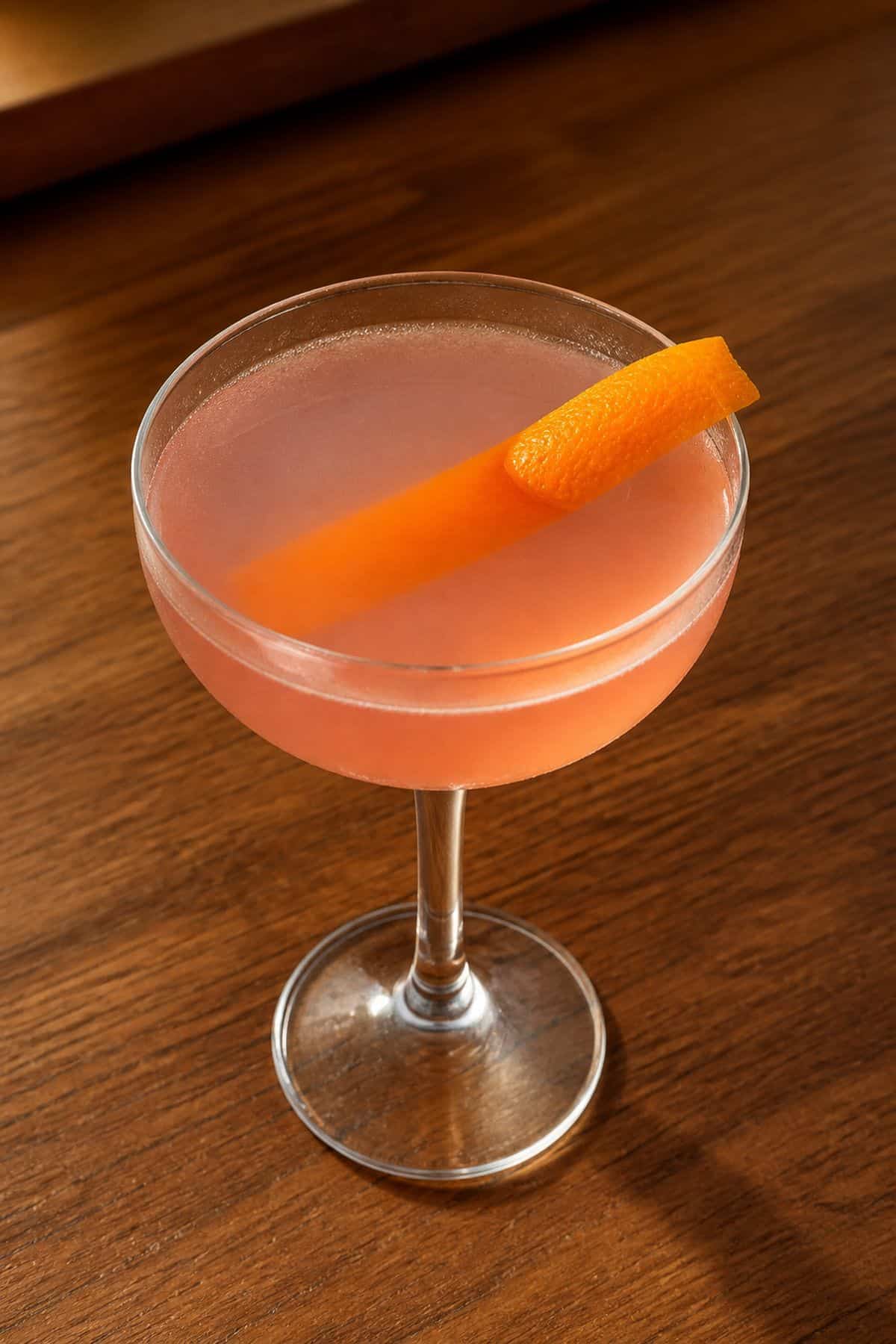
The cosmopolitan drinks like a pre-dinner aperitif more than a main-course companion. The acid wakes up the palate; the small touch of sweetness keeps it from being aggressive. Serve it before a meal of seared scallops, a charcuterie board with sharp cheeses and quince paste, or a salmon crudo with citrus. The drink pairs well with anything that can stand up to its acidity without competing.
For a cocktail-hour spread, a cosmopolitan goes alongside salty bites: marcona almonds, oil-cured olives, a wedge of aged manchego, prosciutto-wrapped melon. Avoid pairing with anything sweet or anything in a heavy cream sauce; the cranberry sweetness compounds and the dairy clashes with the citrus. This is a cold-drink, light-snacks moment, not a dessert cocktail.
Frequently Asked Questions
What is in a cosmopolitan?
The canonical Toby Cecchini build is 1.5 oz Absolut Citron vodka, 1 oz Cointreau, 0.75 oz fresh lime juice, and 0.5 oz Ocean Spray cranberry juice cocktail, shaken hard with ice and double-strained into a chilled coupe with a flamed orange peel garnish.
What is the difference between a cosmo and a martini?
A martini is vodka or gin with dry vermouth, stirred (or shaken) with ice and strained, garnished with an olive or a lemon twist. A cosmopolitan adds Cointreau, fresh lime juice, and cranberry juice cocktail, and is always shaken. The cosmo is a sour-style cocktail; the martini is spirit-forward.
Should I use Cointreau or triple sec in a cosmopolitan?
Cointreau, every time. Cointreau is a higher-proof orange liqueur with a cleaner citrus bitterness; generic triple sec is sweeter and flatter and produces a less balanced drink. Combier or Pierre Ferrand Dry Curacao are acceptable substitutes; standard triple sec is the bottom of the list.
Who invented the cosmopolitan?
The modern cosmopolitan was built in 1988 by Toby Cecchini at the Odeon in Tribeca, New York City. An earlier version was claimed by Cheryl Cook in Miami around 1985 or 1986, but the Cecchini spec is the one that spread and became the canonical drink. Sex and the City popularized it for a mass audience starting in 1998.
Can I make a cosmopolitan without cranberry juice?
Not really. The cranberry juice cocktail provides the signature pink color, a thread of tart sweetness, and the rounding note that balances the lime. White cranberry juice produces the White Cosmo variation. Without any cranberry the drink reads as a citrus vodka sour with Cointreau, which is a fine drink but not a cosmopolitan.
Key Takeaways
- The canonical spec is 1.5 oz Absolut Citron, 1 oz Cointreau, 0.75 oz fresh lime, 0.5 oz cranberry juice cocktail.
- Toby Cecchini built the modern version at the Odeon in Tribeca in 1988; Sex and the City popularized it from 1998 onward.
- Absolut Citron is part of the structure; plain vodka leaves a hole the other ingredients cannot cover.
- Cointreau is not interchangeable with generic triple sec.
- The cranberry juice should be Ocean Spray cocktail-grade, not pure unsweetened cranberry juice.
- Shake hard for 10 to 12 seconds, double-strain, and garnish with a flamed orange peel over a chilled coupe.
Final Thoughts
The cosmopolitan is one of those drinks that suffered from its own success. The 1988 build was a quietly excellent sour; the 2004 chain-restaurant version was a sugary tribute act. Making the original spec at home is the easiest way to see why the drink became a phenomenon in the first place.
The flamed orange peel garnish is the move that separates a home cosmo from a bar cosmo. It takes ten seconds, costs nothing if you already have an orange in the kitchen, and gives the finished drink a caramelized aroma that the basic twist cannot match. Practice the squeeze a few times over the sink before you do it in front of guests.
Make this for a cocktail hour before dinner, a small Friday-night gathering, or any time the request is for “something pink, but make it good.” The batch pitcher version scales the recipe up for a party without losing the structure of the original.
Cosmopolitan
A proper cosmopolitan is 1.5 oz Absolut Citron, 1 oz Cointreau, 0.75 oz fresh lime juice, and 0.5 oz cranberry juice cocktail, shaken hard with ice and double-strained into a chilled coupe with a flamed orange peel.
Ingredients
- 45 ml (1.5 oz) Absolut Citron vodka
- 30 ml (1 oz) Cointreau
- 22 ml (0.75 oz) fresh lime juice, squeezed within the hour
- 15 ml (0.5 oz) Ocean Spray cranberry juice cocktail
- 1 large strip of orange peel, for the flamed garnish
- Ice, enough to fill the shaker tin two-thirds full
Instructions
- Chill a coupe or Nick and Nora glass. Either place it in the freezer for 10 minutes before you start, or fill it with ice and cold water and let it sit on the counter while you build the drink.
- Squeeze the lime. You want 22 ml (0.75 oz) of fresh juice, which is roughly half a medium lime. Set the juice aside in the jigger so you can pour it cleanly.
- Cut a strip of orange peel about 4 cm (1.5 inches) long and 2 cm (0.75 inch) wide, using a sharp paring knife or a Y-peeler. Take as little of the white pith as possible. Set the strip aside, peel side up.
- Fill the larger tin of the shaker two-thirds full with fresh ice. Add 45 ml (1.5 oz) Absolut Citron, 30 ml (1 oz) Cointreau, 22 ml (0.75 oz) fresh lime juice, and 15 ml (0.5 oz) cranberry juice cocktail.
- Seal the shaker by setting the smaller tin or pint glass on top and tapping firmly to lock. Shake hard for 10 to 12 seconds. The shaker should frost on the outside and you should hear the ice break down into smaller pieces.
- Empty the ice and water from the chilled glass. Tap the shaker on the heel of your hand to break the seal, lift off the smaller tin, and fit a Hawthorne strainer over the larger tin.
- Double-strain the drink into the chilled glass by pouring through the Hawthorne strainer and a fine-mesh strainer held over the rim. The double-strain catches the small ice shards and pulp that would otherwise float on top.
- Hold the orange peel about 8 cm (3 inches) above the surface of the drink, peel side facing down. Light a match and hold the flame between the peel and the glass.
- Serve immediately. The drink is at its peak in the first three minutes; the second sip should taste exactly like the first.
Notes
Glass temperature is the most underrated variable in cocktail making at home. A room-temperature glass dulls the drink within seconds of pouring. Freeze the glass or chill it with ice water before you start. This is not optional.
The 10-second shake is harder than the shake most people instinctively give a cocktail. The goal is full dilution and aeration in a short window. A timid shake produces an under-diluted drink that reads as sharp and boozy; a hard shake produces the rounded, slightly chilled-foam texture the cosmo is supposed to have.
Last update on 2026-10-03 / Affiliate links / Images from Amazon Product Advertising API