

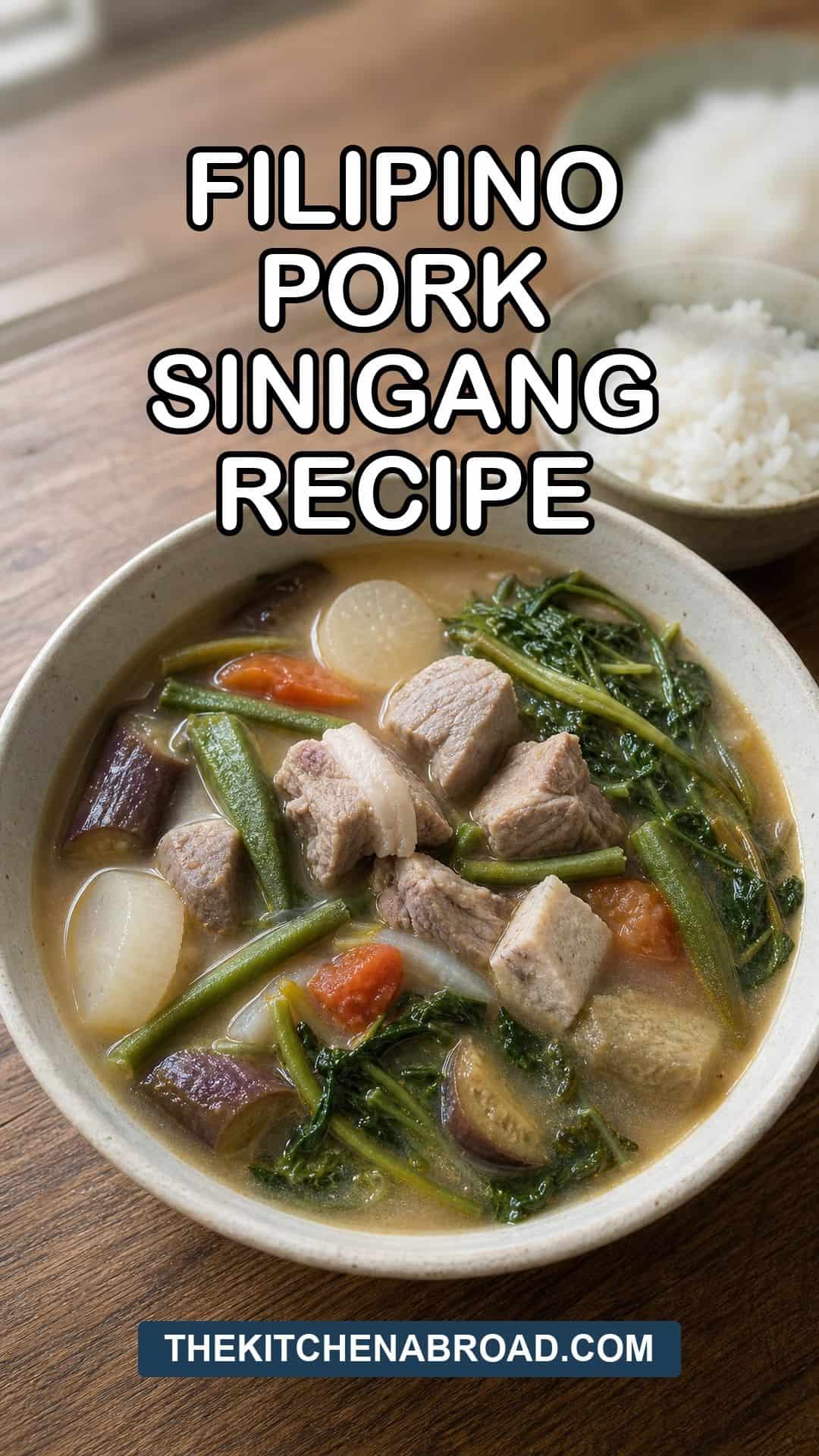
Pork sinigang (sinigang na baboy) is a sour Filipino soup of pork simmered with onion, tomato and taro until fork-tender, then soured with tamarind and finished with vegetables added one by one. Parboil the pork first for a clean broth, and plan on about 1 hour 45 minutes. Serve it over hot rice.
Bad sinigang usually fails in one of two places. Either the broth smells faintly of raw pork, or the vegetables arrive at the table as a gray, collapsed mess. Both are easy to fix, and once you know how, Filipino pork sinigang becomes one of the most forgiving soups you can cook.
It’s sour first, savory second. Tamarind gives the broth a sharp, mouth-watering tang, the pork and fish sauce bring depth, and the vegetables keep it fresh. In the Philippines it’s everyday food. Here in Finland, where it gets dark at three in the afternoon for half the year, a pot of it on a Sunday feels close to medicine.


What kind of dish is sinigang?
Sinigang is the Filipino family of sour soups, and sinigang na baboy is the pork version, soured with tamarind. The word comes from the verb for stewing, which tells you how it’s cooked: slowly, in plenty of liquid, until the meat gives way.
Tamarind is the most common souring agent, but cooks across the islands also use kamias (bilimbi), batuan or green mango. The protein changes too. Shrimp, fish and beef all get the sinigang treatment. What stays constant is that clear, sharp, savory broth and a pile of vegetables.
Compare it to classic chicken adobo, which changes from one household to the next. Sinigang is much more consistent. Order it at a Filipino restaurant almost anywhere and you’ll recognize it from the first spoonful.
Which cut of pork works best?
Pick something with fat and connective tissue. Pork shoulder and pork belly are the usual choices, and bone-in ribs are even better if your butcher has them. The fat renders into the broth, the bones release gelatin, and the result is a soup with body that clings to rice.
Lean cuts like loin dry out during a long simmer and leave the broth thin. Skip them here.
Cut the pork into large chunks, roughly the size of a golf ball or a bit bigger. Small pieces shrink and toughen before the broth has time to develop.
Why you parboil the pork and pour the water away
This is the step that separates a clean, clear broth from a murky one. Put the pork in a pot of cold water with a couple of slices of ginger, crushed garlic and salt. Bring it to a boil, let it bubble for five minutes while you skim the gray foam, then drain everything and rinse the pork under cold water.
Filipino cooks call that raw, slightly gamey smell lansa, and this quick blanch removes it. Restaurant kitchens do the same with bones before making a white stock. Clean the pot before you start the real simmer, or the scum stuck to the sides ends up back in your soup.
Taro is the secret to a thicker broth
Taro (gabi) is easy to overlook in the ingredient list, and it does a lot of work. As it simmers with the pork, it softens and starts to break down, turning the broth slightly cloudy and silky.
Push it further. Once the pork is tender, scoop out a few chunks of taro, mash them with a spoonful of broth and stir that paste back in. The broth thickens just enough to coat the rice instead of running straight to the bottom of the bowl.
No taro at your shop? A floury potato is a fair stand-in, though the broth comes out a little thinner.
Sinigang mix or fresh tamarind?
Use the packet without guilt. Sinigang mix (Mama Sita and Knorr are the two you’ll find in most Asian shops in Europe) gives a reliable, bright sourness, and it’s what a lot of Filipino households use day to day. Fresh tamarind pods are hard to find in Northern Europe and vary a lot in sourness.
If you do get fresh pods, boil about 200 g in 2 cups of water, mash them, strain through a sieve and add the liquid to the pot. The sourness is a little rounder and less uniform than the packet. Tamarind paste works as well; the recipe below gives the amount.
Whichever you use, add it gradually. Start with half, taste, then keep going. Sourness is personal, and you can always add more but you can’t take it back out.
Add the vegetables in this order
Vegetables go in from firmest to most delicate, and the broth comes back to a boil between each addition. Get this right and everything lands at the table cooked through but still bright.
The order runs daikon first, then eggplant with the string beans, then okra, and the leafy greens last. Morning glory (kangkong) needs nothing more than the heat left in the pot after you switch it off. If you’ve never cooked with it, our guide to daikon radish explains how it softens and sweetens in a long-simmered broth.
Swaps are fine. Baby spinach replaces kangkong easily, and Chinese cabbage or bok choy hold up well. Add them at the very end and barely let them wilt.
Filipino pork sinigang (sinigang na baboy) recipe
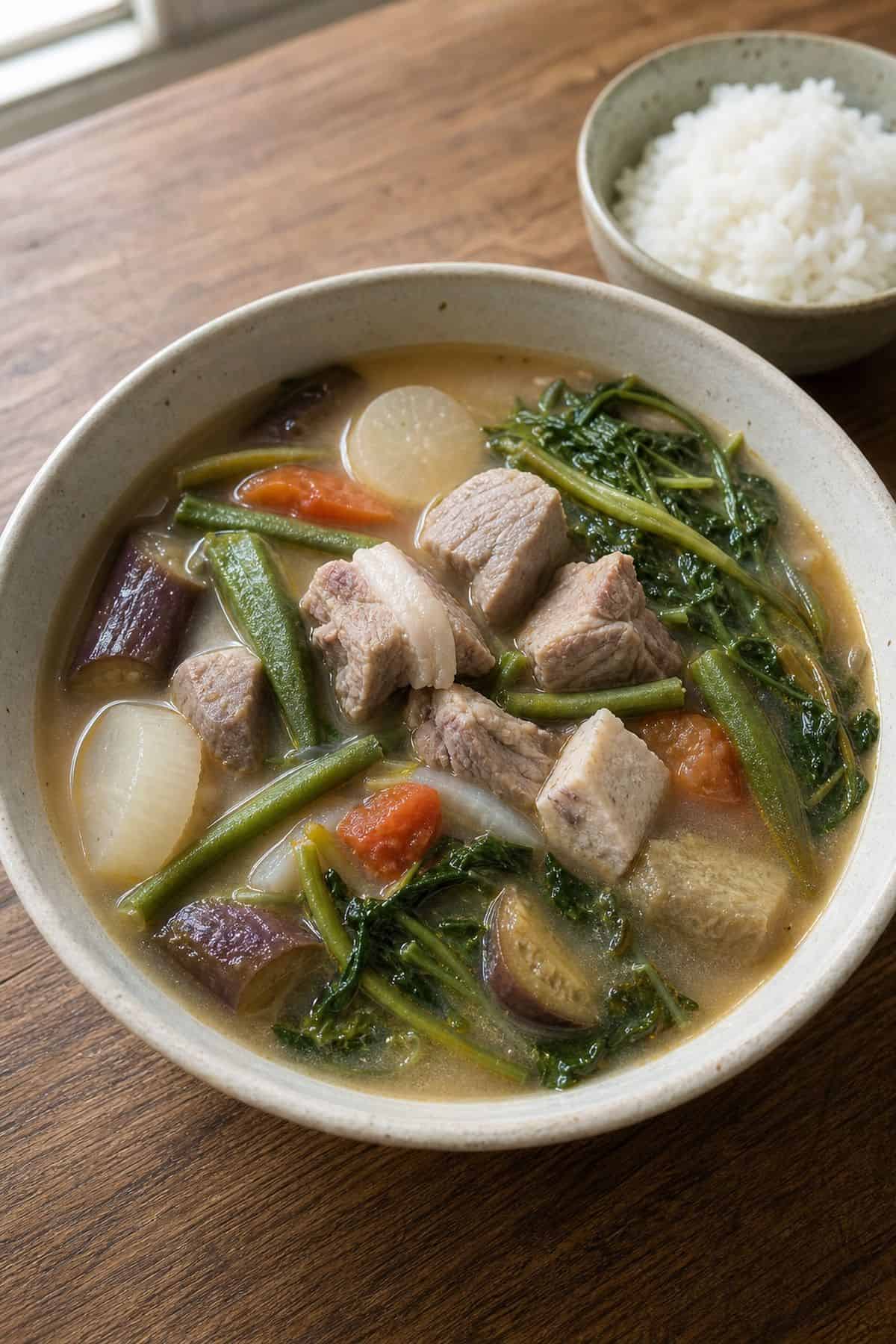
Prep time: 15 minutes. Cook time: 1 hour 30 minutes. Total time: 1 hour 45 minutes. Servings: 4 to 6.
Ingredients
For the parboil:
- 1 kg (2.2 lb) pork shoulder or belly, cut into large chunks
- 2 slices fresh ginger
- 3 garlic cloves, crushed
- 1 teaspoon salt
- Water to cover
For the stew:
- 1 medium onion, quartered
- 2 medium tomatoes, quartered
- 1 medium taro root (gabi), peeled and cut into chunks
- 2 tablespoons fish sauce, plus more to taste
- 1 packet sinigang mix (Mama Sita or Knorr, 40 g), or 1 cup tamarind paste
- 1 to 2 pork bouillon cubes (optional, for depth)
- 1 small daikon radish, sliced into rounds
- 1 small eggplant, cut into chunks
- 100 g string beans (sitaw), trimmed and cut into thirds
- 6 to 8 okra pods
- 2 large handfuls morning glory (kangkong), or baby spinach
Instructions
- Parboil the pork. Put the pork in a pot with the ginger, garlic, salt and enough cold water to cover. Bring to a boil over high heat and cook for 5 minutes, skimming the foam as it rises. Drain, discard the ginger and garlic, and rinse the pork under cold running water. Clean the pot.
- Build the stew. Return the pork to the clean pot with the onion, tomatoes, taro and fish sauce. Add about 1.5 litres of water and bring to a boil. Lower to a gentle simmer, partly cover and cook for 1 to 1.5 hours, until the pork is completely fork-tender.
- Mash the taro. Scoop out a few cooked pieces of taro, mash them with a spoonful of broth in a small bowl, and stir the mash back into the pot. The broth should turn slightly thick and cloudy.
- Season with tamarind. Stir in the sinigang mix, and the bouillon cubes if using. Simmer for 3 minutes, then taste and adjust the sourness and salt.
- Add the vegetables in stages. Add the daikon and simmer 3 minutes. Add the eggplant and string beans and simmer 3 minutes more. Add the okra and cook 2 minutes. Add the morning glory, stir once and turn off the heat; the residual heat wilts it.
- Serve right away over steamed jasmine rice.
Notes
Sinigang keeps in the fridge for 2 to 3 days, and the broth often tastes better the next day. Reheat gently over medium-low heat; a hard boil breaks up the vegetables. To make ahead, finish steps 1 to 4 up to a day early and add the vegetables fresh when you reheat.
Pork sinigang questions, answered
What is the difference between sinigang and tinola?
Sinigang is sour and tamarind-based, while tinola is a mild, ginger-forward chicken soup with green papaya and chili leaves. They sit on opposite ends of Filipino comfort food: sinigang wakes you up, tinola calms you down.
Can I use beef instead of pork?
Yes, beef sinigang uses brisket or short ribs and follows the same method. Plan on 2 to 2.5 hours of simmering for the beef to turn properly tender; the broth comes out richer and darker.
Do I have to use a sinigang mix packet?
No, fresh tamarind works well. Boil about 200 g of pods in 2 cups of water, mash, strain and add the liquid to the soup. It gives a slightly more complex sourness than the packet.
Can I make pork sinigang in an Instant Pot?
Yes. Cook the pork on high pressure for 35 minutes, add the taro and cook on high pressure for another 5 minutes, then switch to sauté to add the sinigang mix and vegetables. The broth is a little lighter in color but still very good.
Is pork sinigang gluten-free?
This recipe is naturally gluten-free as long as your sinigang mix and bouillon cubes are. Formulations differ between countries, so read the label on the packet you buy.
How do I reheat leftover sinigang safely?
Bring it back to a steady simmer until it’s steaming hot all the way through, which is 74°C (165°F) for leftovers according to the safe minimum temperature chart. Keep the heat moderate so the vegetables don’t fall apart.
Key takeaways
- Parboil the pork for 5 minutes, then drain and rinse for a clean, clear broth.
- Choose fatty, bone-in cuts like shoulder, belly or ribs.
- Mash some cooked taro back into the pot to thicken the broth.
- Add the tamarind gradually and taste as you go.
- Add vegetables from firmest to softest so nothing overcooks.
- Leftovers keep 2 to 3 days in the fridge.
What to cook with your next bag of rice
Sinigang is the sour corner of Filipino cooking. For the salty, garlicky, crispy corner, make this sizzling tuna sisig next; it’s on the table in a fraction of the time.
Cooking meat-free for some of the week? The Filipino-style sizzling tofu sits nicely next to a bowl of sinigang too.
FILIPINO PORK SINIGANG (SINIGANG NA BABOY)
Filipino pork sinigang is a sour tamarind-based pork soup loaded with vegetables. It's one of the most beloved dishes in the Philippines.
Ingredients
- 1 kg (2.2 lb) pork shoulder or belly, cut into large chunks
- 2 slices fresh ginger
- 3 garlic cloves, crushed
- 1 teaspoon salt
- Water to cover
- 1 medium onion, quartered
- 2 medium tomatoes, quartered
- 1 medium taro root (gabi), peeled and cut into chunks
- 2 tablespoons fish sauce, plus more to taste
- 1 packet sinigang mix (Mama Sita or Knorr, 40g), or 1 cup tamarind paste
- 1–2 pork bouillon cubes (optional, for depth)
- 1 small daikon radish, sliced into rounds
- 1 small eggplant, cut into chunks
- 100g string beans (sitaw), trimmed and cut into thirds
- 6–8 okra pods
- 2 large handfuls morning glory (kangkong), or baby spinach
Instructions
- Parboil the pork. Place the pork in a pot with the ginger, garlic, salt, and enough cold water to cover. Bring to a boil over high heat and cook for 5 minutes, skimming foam as it rises.
- Build the stew. Return the pork to the clean pot. Add the onion, tomatoes, taro, and fish sauce. Cover with about 1.5 litres of water and bring to a boil.
- Mash the taro. Scoop out a few cooked pieces of taro, mash them with a spoonful of broth in a small bowl, and stir the mash back into the pot. This thickens the broth and gives it the creamy, cloudy texture.
- Season with tamarind. Stir in the sinigang mix and bouillon cubes if using. Simmer for 3 minutes. Taste and adjust sourness and saltiness to your preference.
- Add vegetables in stages. Add daikon first and simmer 3 minutes. Add eggplant and string beans and simmer 3 more minutes. Add okra and cook 2 minutes. Finally, add the morning glory, stir once, and turn off the heat. The residual heat will wilt it perfectly.
- Serve immediately over steamed jasmine rice.
Notes
Storage: Sinigang keeps in the fridge for 2–3 days. The broth intensifies overnight and often tastes even better the next day. Reheating: Warm gently over medium-low heat, do not boil hard or the vegetables will fall apart. Make-ahead: Complete steps 1–4 up to a day ahead and add the vegetables fresh when you reheat and serve.
Last update on 2026-10-03 / Affiliate links / Images from Amazon Product Advertising API
