
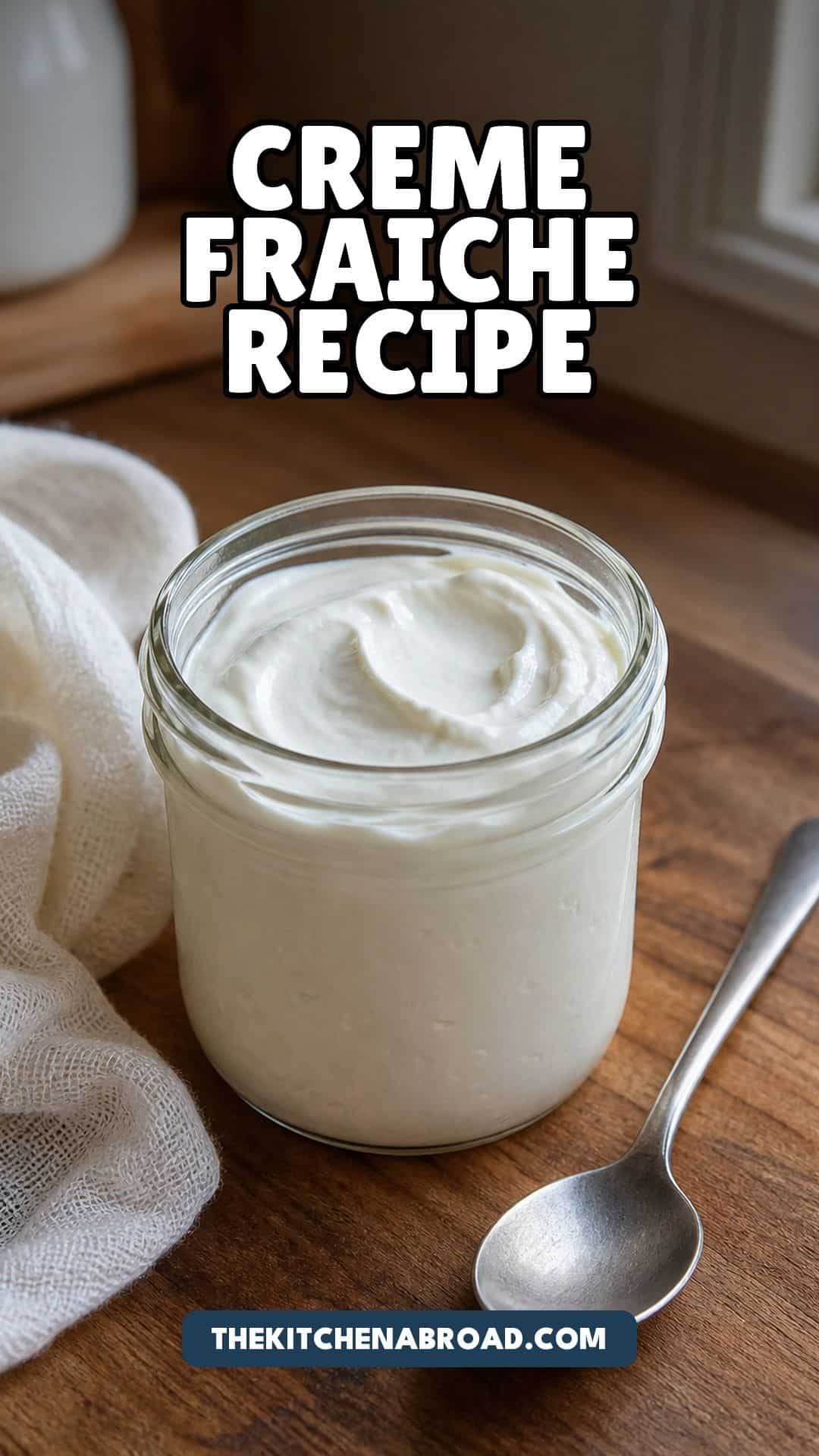
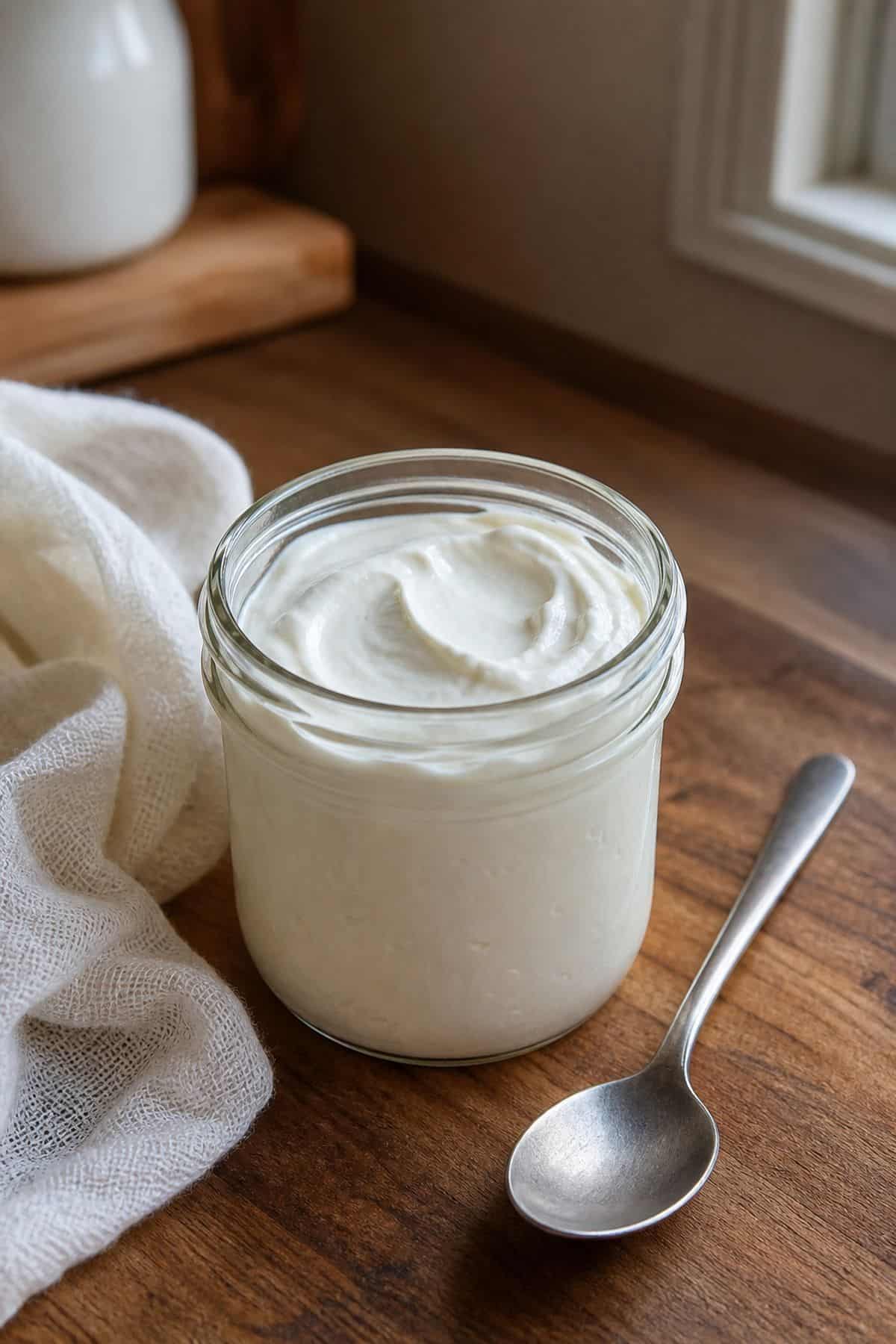
Crème fraîche at home is heavy cream cultured with a tablespoon of buttermilk and left to ferment at room temperature for 8 to 24 hours. The dairy thickens, the flavor turns mildly tangy, and the result is the French cultured cream used as a finishing dollop on soups, a base for sauces, and a garnish for desserts. Total active time about 2 minutes. Yields 1 cup (235 ml).
French home cooks have kept jars of crème fraîche going on the counter for centuries, well before specialty grocers figured out how to charge seven dollars for a small tub. It is two ingredients. Heavy cream and a tablespoon of cultured buttermilk left to ferment overnight. A small spoonful finishes a potato soup, lightens a pan sauce, or sits next to ripe strawberries in late June.
What You’ll Need to Make This Recipe
A clean glass mason jar with a lid is the right vessel. Glass does not react with the acidic cultured dairy, and the lid can be loose or replaced with cheesecloth depending on the ferment day. Cheesecloth (one square folded into quarters) for covering the jar during fermentation. A kitchen thermometer if you want to confirm the ambient temperature is in the right range. An angled 2-cup measuring cup for pouring the cream cleanly into the jar. Refrigerator-safe glass containers for storing finished crème fraîche, which keeps 2 weeks once the ferment is done.
![SEWANTA Wide Mouth Mason Jars 32 oz [4 Pack] With Mason Jar Lids and Bands,...](https://www.thekitchenabroad.com/wp-content/plugins/aawp/public/image.php?url=YUhSMGNITTZMeTl0TG0xbFpHbGhMV0Z0WVhwdmJpNWpiMjB2YVcxaFoyVnpMMGt2TkRFd04zQk5NbWhaUzB3dVgxTk1NVFl3WHk1cWNHYz18MTc4NjUwNDg2OA= "How to Make Crème Fraîche at Home (2 Ingredients)")


Recommended Reads
- Tahini Sauce Recipe (Lemon-Garlic, 5 Minutes)
- Lohikeitto Recipe: Creamy Finnish Salmon Soup with Dill
- Gochujang Pasta Recipe (Creamy, Spicy, 20 Minutes)
- Puolukkahillo: Finnish Lingonberry Jam Recipe
- Aglio Olio Pasta Recipe
Why Cultured Buttermilk Is the Only Right Starter
Cultured buttermilk carries the bacterial strains that originally evolved to transform milk into yogurt, sour cream, kefir, and crème fraîche: mostly Lactococcus lactis, Lactococcus cremoris, and Leuconostoc cremoris. These cultures consume the milk sugar (lactose) in the cream and produce lactic acid as a byproduct, which is what gives crème fraîche its tangy flavor and thicker texture. Cultured buttermilk from the dairy aisle (the kind sold for baking) has all three cultures alive in the carton. A tablespoon of it carries enough bacteria to colonize a full cup of cream within hours.
Vinegar-acidified buttermilk (the homemade kind made by adding vinegar or lemon juice to milk) has the acidic taste of cultured buttermilk but none of the live cultures, which means it cannot ferment cream. Buttermilk powder is dehydrated and may have lost most of the active cultures. Greek yogurt has different cultures that produce a different end product (more like a thickened yogurt than crème fraîche). Sour cream is the closest substitute (its cultures overlap with crème fraîche cultures) but produces a slightly tangier, less rich result. If you must substitute, sour cream works. Vinegar buttermilk and Greek yogurt do not.
The heavy cream choice matters as much as the buttermilk. Heavy cream (also labeled “heavy whipping cream”) is at least 36% butterfat. The high fat content is what gives crème fraîche its silky texture and rich mouthfeel. Whipping cream (30% butterfat) lacks the fat needed for proper thickening and produces a thinner crème fraîche. Light cream, half and half, and milk all have too little fat to work. Pasteurized cream (heated to 71°C / 161°F briefly) is the standard supermarket variety and works perfectly. Ultra-pasteurized cream (heated to 138°C / 280°F) has had more of the natural enzymes denatured by the high heat, which sometimes makes fermentation slightly slower but does not prevent it.
Crème Fraîche Ingredients, Briefly
Heavy cream. Also labeled “heavy whipping cream” in the US. Look for at least 36% butterfat on the carton. Pasteurized (regular shelf life) or ultra-pasteurized (longer shelf life) both work. Avoid whipping cream (30% fat), light cream, and half and half, which lack the fat needed to thicken properly.
Cultured buttermilk. Look for “cultured” on the label and live cultures listed in the ingredients. The kind sold for baking. Do not substitute homemade vinegar-acidified buttermilk, which lacks the live cultures. Sour cream is the closest acceptable substitute if you cannot find cultured buttermilk.
That is the entire ingredient list. Two items. No starter cultures to buy separately, no special equipment, no sterilization required beyond a clean jar. The simplicity is the point.
Tips and Variations
The ferment-time thickness chart. At 22°C (72°F) ambient temperature: 8 hours gives you pourable crème fraîche (about the thickness of yogurt). 12 hours gives you spoonable, scooping consistency similar to thick sour cream. 16 hours gives you sour-cream-thickness, the European standard. 24 hours gives you scoopable, almost set, where a spoon dragged through it leaves a visible trough that holds for a few seconds. Stop the ferment at the thickness you want by transferring the jar to the refrigerator.
The right ambient temperature. 21 to 24°C (70 to 75°F) is the sweet spot. Cooler than 19°C (66°F) and the ferment slows dramatically, sometimes failing altogether. Warmer than 27°C (80°F) and the ferment goes too fast, sometimes turning sour or breaking. A kitchen counter on a normal day is usually within range. In winter, place the jar near (not on) a warm appliance like a kettle or a stove pilot light.
The reuse trick. Once you have a batch of homemade crème fraîche, save 2 tablespoons of it as the starter for the next batch. Skip the cultured buttermilk for batches 2 onward. The cultures self-renew, and you can carry a single starter through 5 or 6 batches before flavor drift makes you want to reset with fresh buttermilk.
Sweet versus savory applications. Whip the finished crème fraîche to thicken further and use it as a topping on berries, fruit pies, or chocolate desserts (a touch of sugar can be added during the whip). For savory applications, fold a dollop into soups (especially mushroom or potato), use as a base for cream-of-anything sauces, or drizzle over roasted vegetables. The mild tang cuts through richness in a way plain cream cannot.
What to do if it does not thicken. Three causes: ambient temperature too low (move to a warmer spot, add another 12 hours), the buttermilk was not cultured (the label check), or the cream was the wrong fat content. If you suspect cold, give the jar another 12 hours in a warmer location. If it still has not thickened after 36 hours, the cream is wasted.
Storage. Finished crème fraîche keeps refrigerated in a glass jar for 2 weeks. It will continue to thicken slightly in the refrigerator and may turn slightly more tangy over time. Stir before each use to redistribute any whey that has separated.
Recipe: Crème Fraîche at Home (2 Ingredients)
Prep Time: 2 minutes | Ferment Time: 8 to 24 hours | Total Time: About 1 day | Yield: 1 cup (235 ml)
Ingredients
- 235 ml (1 cup) heavy cream (at least 36% butterfat)
- 1 tbsp cultured buttermilk (must have live cultures)
Instructions
- Pour the heavy cream into a clean glass mason jar (a pint-sized jar leaves enough headroom).
- Add the cultured buttermilk. Stir gently with a clean spoon for 10 seconds to distribute.
- Cover the mouth of the jar with a piece of cheesecloth folded into 4 layers and secured with a rubber band. (Alternative: place the metal lid on loosely without screwing the band tight, allowing air exchange.)
- Place the jar on a kitchen counter at room temperature, ideally 21 to 24°C (70 to 75°F). Avoid direct sunlight and drafty windows.
- Let ferment undisturbed: 8 hours for pourable consistency, 12 to 16 hours for sour-cream thickness, 24 hours for scoopable. Check periodically by tilting the jar gently and observing how the cream moves.
- When the crème fraîche reaches your preferred thickness, remove the cheesecloth, screw on the metal lid, and refrigerate. The crème fraîche continues to firm up slightly during the first 24 hours in the refrigerator.
- Stir gently before each use. Use as a finishing dollop on soups, a base for sauces, a topping for desserts, or a whipped accompaniment to fruit.
Notes
Cultured buttermilk is the only acceptable starter. Vinegar-acidified buttermilk substitute, Greek yogurt, and sour cream all have wrong (or absent) cultures for this process. Buy cultured buttermilk from the dairy aisle, the kind sold for baking, with live cultures listed in the ingredients.
Heavy cream means 36% butterfat or higher. Whipping cream (30%) lacks the fat to thicken properly. Half and half is too dilute. Read the label, look for “heavy” or “heavy whipping” cream.
Ambient temperature matters. 21 to 24°C (70 to 75°F) is the sweet spot. Cooler rooms slow or stop fermentation. Warmer rooms speed it up and can produce a sour, broken result.
Storage. Finished crème fraîche keeps refrigerated in a sealed glass jar for 2 weeks. Stir before each use to redistribute any whey that has separated.
Frequently Asked Questions
What is the difference between crème fraîche and sour cream?
Crème fraîche has a higher butterfat content (around 30 to 40 percent in finished product) than sour cream (about 18 to 20 percent). The higher fat gives crème fraîche a richer mouthfeel and the ability to be heated without curdling, which makes it the right ingredient for soups and pan sauces. Sour cream curdles when heated and is better for cold applications like dips, baked potato toppings, and stirring into chilled soups. Crème fraîche also has a milder, less tangy flavor than sour cream.
Can I use Greek yogurt instead of cultured buttermilk?
No. Greek yogurt cultures (mostly Lactobacillus bulgaricus and Streptococcus thermophilus) are different from crème fraîche cultures (Lactococcus lactis, Lactococcus cremoris, Leuconostoc cremoris). Using Greek yogurt to ferment cream produces a thickened yogurt-like product, not crème fraîche. If you cannot find cultured buttermilk, sour cream is the only acceptable substitute (its cultures overlap with crème fraîche cultures).
How long does homemade crème fraîche last?
Refrigerated in a sealed glass jar, homemade crème fraîche keeps for 2 weeks. The flavor continues to develop and may become slightly more tangy over time. Some whey may separate during storage; just stir before each use. After 2 weeks, the cream is more likely to taste off or develop unwanted bacterial growth, so use it up before then.
Why is my crème fraîche not thickening?
Three likely causes. The ambient temperature was too low (move the jar to a warmer location, add another 12 hours). The buttermilk did not contain live cultures (check the label). The cream was the wrong fat content (must be at least 36% butterfat). Ultra-pasteurized cream ferments more slowly than regular pasteurized cream but still works; give it extra time.
Can I use crème fraîche in hot sauces and soups?
Yes. Crème fraîche is stable when heated (unlike sour cream, which curdles) because of its higher fat content. Add it at the end of cooking to finish a soup or pan sauce, off heat or over very low heat. It thickens slightly when warmed and adds richness without dominating the dish.
Can I make a larger batch?
Yes. The ratio is 1 tablespoon of cultured buttermilk per cup of heavy cream. Scale up linearly: 2 tablespoons buttermilk plus 2 cups cream, 4 tablespoons plus 4 cups, and so on. Use a larger jar with enough headroom for stirring. Fermentation time is roughly the same regardless of batch size since the depth of the cream layer affects the ferment more than the total volume.
Key Takeaways
- Two ingredients: heavy cream (at least 36% butterfat) and cultured buttermilk with live cultures. No substitutes for either one.
- Cover the jar with cheesecloth or a loose lid during fermentation. Air exchange is required for the bacteria to work.
- Ferment at 21 to 24°C (70 to 75°F) for 8 to 24 hours depending on the thickness you want.
- Ferment-time chart: 8 hours pourable, 12 to 16 hours sour-cream thick, 24 hours scoopable.
- Save 2 tablespoons of finished crème fraîche to start the next batch. The cultures self-renew for 5 or 6 generations.
Final Thoughts
Crème fraîche is one of those ingredients that looks specialty-store-priced but takes a tablespoon of buttermilk and a jar on the counter to make at home. The technique is short. The wait is overnight. The result is the same cultured cream French cooks finish soups with, that pastry chefs whip onto desserts, and that any home cook can have in the refrigerator for the cost of a carton of cream.
Make a batch on a Friday night and you have crème fraîche for the weekend’s cooking. Once you have the technique down, the next batch starts itself from the last one. The two-ingredient simplicity is the point.
How to Make Creme Fraiche at Home (2 Ingredients)
Crème fraîche at home is heavy cream cultured with a tablespoon of buttermilk and left to ferment at room temperature for 8 to 24 hours.
Ingredients
- 235 ml (1 cup) heavy cream (at least 36% butterfat)
- 1 tbsp cultured buttermilk (must have live cultures)
Instructions
- Pour the heavy cream into a clean glass mason jar (a pint-sized jar leaves enough headroom).
- Add the cultured buttermilk. Stir gently with a clean spoon for 10 seconds to distribute.
- Cover the mouth of the jar with a piece of cheesecloth folded into 4 layers and secured with a rubber band. (Alternative: place the metal lid on loosely without screwing the band tight, allowing air exchange.)
- Place the jar on a kitchen counter at room temperature, ideally 21 to 24°C (70 to 75°F). Avoid direct sunlight and drafty windows.
- Let ferment undisturbed: 8 hours for pourable consistency, 12 to 16 hours for sour-cream thickness, 24 hours for scoopable. Check periodically by tilting the jar gently and observing how the cream moves.
- When the crème fraîche reaches your preferred thickness, remove the cheesecloth, screw on the metal lid, and refrigerate. The crème fraîche continues to firm up slightly during the first 24 hours in the refrigerator.
- Stir gently before each use. Use as a finishing dollop on soups, a base for sauces, a topping for desserts, or a whipped accompaniment to fruit.
Notes
Cultured buttermilk is the only acceptable starter. Vinegar-acidified buttermilk substitute, Greek yogurt, and sour cream all have wrong (or absent) cultures for this process. Buy cultured buttermilk from the dairy aisle, the kind sold for baking, with live cultures listed in the ingredients.
Heavy cream means 36% butterfat or higher. Whipping cream (30%) lacks the fat to thicken properly. Half and half is too dilute. Read the label, look for "heavy" or "heavy whipping" cream.
Last update on 2026-08-09 / Affiliate links / Images from Amazon Product Advertising API