
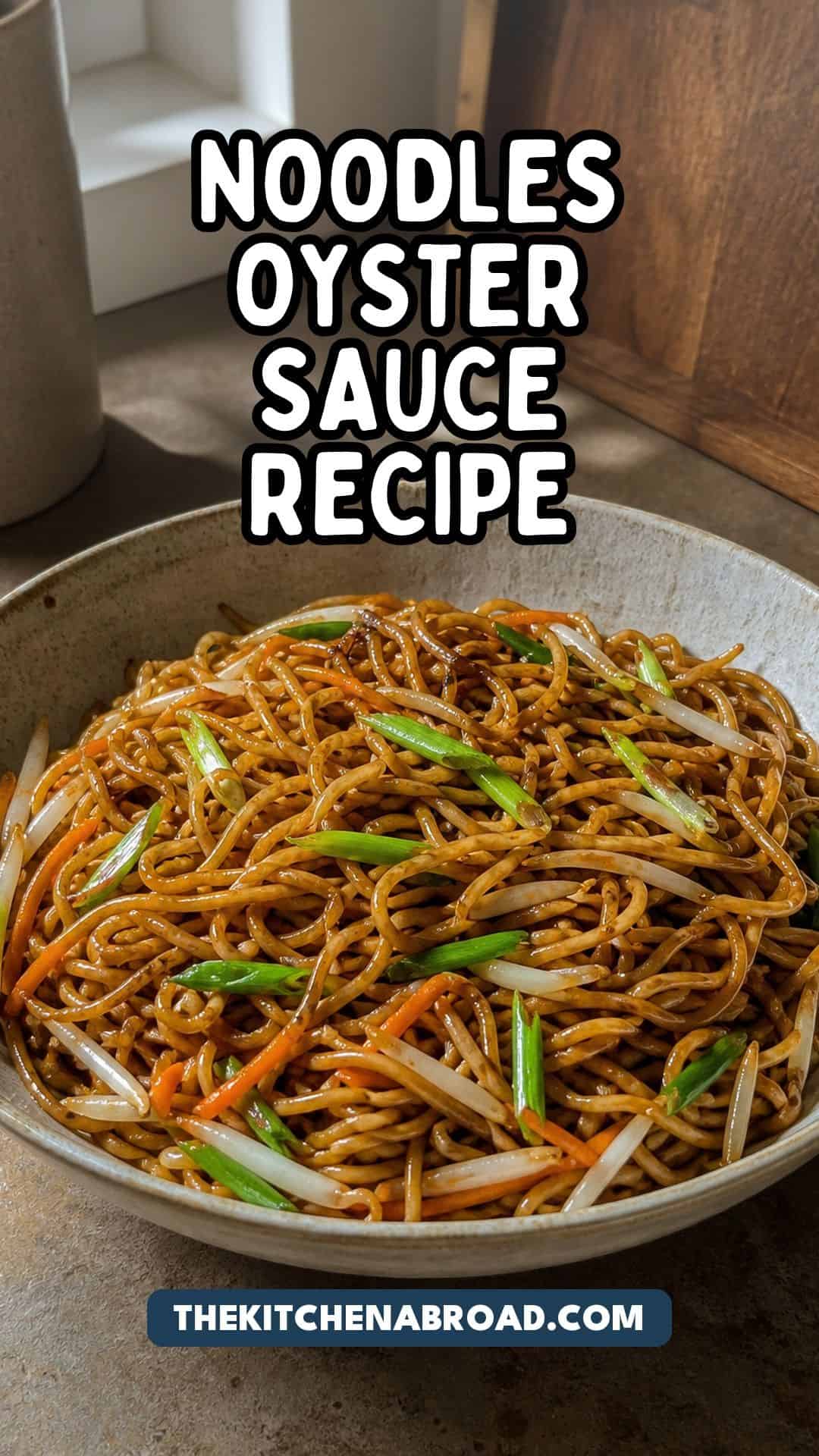
A weeknight bowl of noodles with oyster sauce built on the Cantonese sizzle method: 10 ounces of dried Hong-Kong-style chow mein egg noodles, parboiled three to four minutes until just under al dente, drained, rinsed cold, and tossed with a teaspoon of oil so the strands separate. A 14-inch carbon-steel wok ripped to smoking over high heat. Garlic, ginger, and scallion whites bloomed in neutral oil for thirty seconds, bean sprouts and shredded carrot tossed in for ninety more, then the noodles spread in a single layer and left undisturbed for the wok-hei char. A splash of Shaoxing wine, the pre-mixed sauce of Lee Kum Kee oyster sauce, dark soy, sugar, and stock , and the moment the sauce hits the screaming pan it sizzles and steams around the noodles, lacquering each strand in a shiny mahogany glaze. Off heat, toasted sesame oil and scallion greens. Ten minutes start to finish. Four servings. Chinese takeout night, at home.
Chinese takeout night used to mean a paper bag of slightly soggy chow mein on the counter at 7:42 p.m. and a small pang of regret at the bottom of the container. The version below is what happens when you keep the spirit of that meal and lose the bag , a 10-minute weeknight wok dish that does what the takeout container only gestures at, which is noodles that come out of the pan shiny and slightly charred instead of steamed into submission. The whole thing pivots on one technique that the top recipes online tend to skip: the sizzle moment, when the sauce hits a smoking-hot wok and steam-sizzles around the noodles for sixty seconds until the strands are lacquered. That is the dish. Everything else is timing. If you want the rest of the menu, the mushroom with oyster sauce just shipped, and the chicken, beef, and bok choy versions round out the spread. This one is the noodle lane, and it’s the carb the rest of them want to sit next to.
What You’ll Need
A 14-inch carbon-steel wok is the engine of this recipe , the metal heats faster, holds heat longer, and develops the slight char on the noodles that the dish is named for. A jar of Lee Kum Kee Premium oyster sauce (Panda brand) is the historical anchor: the same recipe Lee Kum Sheung over-reduced into a thick mahogany gravy in 1888. Dried chow mein noodles, thin and Hong-Kong-style, are non-negotiable , spaghetti will not give you the egg flavor or the slight chew, and udon will turn into a different dish entirely. A long-handled stainless-steel wok spatula moves the noodles through the sauce in the sixty-second window where everything matters. And a bottle of premium dark soy sauce, not the regular kind, is what gives the noodles their deep brown lacquer instead of pale, flat color. Five pieces. All of them earn their slot.


Recommended Reads
- Mushroom with Oyster Sauce
- Chicken with Oyster Sauce
- Beef in Oyster Sauce
- Bok Choy with Oyster Sauce
- Easy Chicken Pad Thai
Where Cantonese Chow Mein Came From
Chow mein is one of those phrases that has been bent so far out of shape by American takeout menus that the literal translation comes as a surprise to a lot of cooks. In Cantonese, chow means stir-fried and mein means noodles , so the dish, plainly, is “stir-fried noodles.” Not the soft, soupy lo mein the diaspora menu often serves under the same name, but a wok-tossed plate of thin egg noodles cooked over screaming heat until the strands pick up a little color and the sauce reduces to a glaze. The technique traces back to Cantonese culinary tradition in Guangdong province, where wok cookery and high-heat noodle dishes had been refined for centuries before they ever crossed an ocean.
The oyster sauce in the bowl has its own founding story. In 1888, a Cantonese cook named Lee Kum Sheung accidentally over-reduced a pot of oyster broth in his small Nanshui village restaurant in Zhuhai. What was left in the pot was thick, dark, and tasted like the sea pressed into a sauce , and he founded the Lee Kum Kee company the same year to bottle it. Within decades, oyster sauce had become the umami backbone of Hong Kong’s dai pai dong culture , the green-roofed open-air food carts that exploded after WWII when licenses were issued to widows and families of civil servants. A dai pai dong cook tossing noodles in a screaming wok with a splash of oyster sauce is the direct spiritual parent of this recipe. As of July 2024, only 17 licensed dai pai dong remain in Hong Kong, which makes the home-kitchen version of the technique worth keeping alive.
A Few Notes on the Ingredients
- Chow mein egg noodles: Dried, thin, Hong-Kong-style egg noodles labeled “chow mein” or “lo mein” on the package , Twin Marquis or a similar Asian-market brand. NOT spaghetti, NOT udon, NOT ramen. The egg in the dough gives the noodles a subtle yellow color and a chew that holds up to the wok toss; spaghetti is too dense and udon is too thick. Fresh thin wonton noodles work if you can find them.
- Oyster sauce: Lee Kum Kee Premium (Panda brand) is the historical anchor and the cleanest-tasting jar on the shelf , thicker, less salty, more oyster-forward than the cheaper labels. Budget brands lean watery and overly sweet; pay the extra two dollars.
- Dark soy sauce: This is the one most American pantries skip, and it’s the difference between shiny mahogany noodles and pale, flat ones. Dark soy provides color and a malty, slightly sweet savory base , it’s almost no salt, all depth. Different from regular (light) soy, which is the salt driver. You need both; do not substitute one for the other.
- Shaoxing wine: Real Chinese rice wine, sold in the Asian aisle in a yellow-labeled bottle. The splash that deglazes the wok and adds a fermented depth no other ingredient gives you. Dry sherry is the closest Western substitute if your store does not stock it; do not use mirin or cooking wine, which are too sweet.
- Neutral high-heat oil: Peanut oil is the traditional choice , high smoke point, slightly nutty, the standard in Cantonese wok cooking. Grapeseed is the clean substitute if peanut is off the table for allergies. Olive oil and butter are wrong for this dish; their smoke points are too low and the flavors are too European.
- Aromatics trinity: Garlic, ginger, and scallions , the Cantonese stir-fry equivalent of the French mirepoix. Fresh, all three, minced fine for the garlic and ginger and sliced on the bias for the scallions. The whites go in early to bloom in the oil; the greens go in at the end for color and bite.
- Bean sprouts and shredded carrot: Optional but traditional , the vegetable element that turns the noodles into something closer to a complete bowl. Mung bean sprouts add a fresh crunch that survives the wok toss; shredded carrot brings color and a touch of sweetness. Skip them if you are going pure-noodle, but the dish reads more like takeout with them in.
Recipe: Noodles with Oyster Sauce

Prep time: 10 minutes | Cook time: 10 minutes | Total time: 20 minutes | Serves: 4
Ingredients
- 10 oz (280 g) dried chow mein egg noodles
- 3 tbsp neutral high-heat oil (peanut or grapeseed), divided
- 3 garlic cloves, minced
- 1-inch piece fresh ginger, minced
- 4 scallions, sliced on the bias (whites and greens separated)
- 2 cups (150 g) fresh bean sprouts
- 1 cup (90 g) shredded carrots
- 2 tbsp Shaoxing wine
- 4 tbsp oyster sauce (Lee Kum Kee Premium)
- 1 tbsp dark soy sauce
- 1 tsp sugar
- 1/4 cup (60 ml) chicken stock (or water)
- 1 tsp toasted sesame oil
Instructions
- Bring a large pot of water to a boil. Add the dried chow mein noodles and cook per package directions, about 3 to 4 minutes, until just al dente , slightly under, since they’ll finish in the wok. Drain in a colander and rinse immediately under cold running water to stop the cooking. Shake the colander dry, transfer the noodles to a bowl, and toss with 1 teaspoon of the oil to prevent sticking. Set aside.
- In a small bowl, whisk together the oyster sauce, dark soy sauce, sugar, and chicken stock until the sugar dissolves. This is the sizzle sauce , pre-mixed so you can pour it in one motion when the moment comes.
- Heat the wok over high heat until it begins to smoke , you want to see the first thread of smoke rise off the dry metal, about 30 seconds on a hot burner. Add 2 tablespoons of the oil and swirl it around the rim to coat the surface.
- Add the minced garlic, minced ginger, and scallion whites. Stir-fry for 30 seconds until fragrant , do not let them brown.
- Add the bean sprouts and shredded carrots. Stir-fry for 90 seconds, tossing constantly, until the vegetables are just-tender but still have a snap. Push everything to the side of the wok to clear a hot zone.
- Add the drained noodles to the cleared side of the wok along with the remaining 1 tablespoon of oil. Spread the noodles in a single layer against the hot metal and leave them undisturbed for 90 seconds , this is where the wok-hei char develops, the faintly smoky flavor that defines Cantonese stir-fry noodles.
- Deglaze the wok with the Shaoxing wine, letting it hiss and steam off the metal for a few seconds. Then pour the sauce mixture directly over the noodles. This is the sizzle moment , the sauce should hit the smoking pan and immediately steam-sizzle around the noodles. Listen for it. If it doesn’t sizzle aggressively, the wok wasn’t hot enough.
- Toss everything together vigorously for 60 seconds, using the spatula to lift the noodles up through the sauce and let the glaze coat every strand. The noodles should turn shiny and mahogany-brown, slick with sauce but not swimming in it.
- Off the heat, drizzle with the toasted sesame oil and scatter the scallion greens over the top. Toss once more to combine. Serve immediately, straight from the wok onto plates or into shallow bowls.
Notes
The sizzle moment is the whole technique. Every other step is prep for the sixty seconds when the sauce hits the smoking metal and the noodles glaze in real time. If you take one thing from this recipe, take that , the sound of an aggressive sizzle is the only proof you need that your wok was hot enough. A meek hiss means a meek finish.
Smoking-hot wok is non-negotiable. Carbon steel preheats faster and holds heat better than stainless, which is why it’s the wok of choice for this technique. If you’re working with a nonstick pan you will not get the same char and the sauce will steam instead of sizzle , the dish is still good, but it’s not the same dish. Crank the burner to its highest setting and give the empty wok thirty seconds before any oil goes in.
Scaling down for two: halve everything except the oil for the wok preheat (still use 2 tablespoons there , you want the heat coverage) and the cook times stay the same. Scaling up for six or eight: don’t. Work in two batches with a clean, re-heated wok between them. A wok overloaded past four servings drops in temperature, steams the noodles instead of searing them, and loses the entire point.
Tips and Variations
The Sizzle Method That Builds Wok-Hei at Home
Wok-hei , literally “wok air” or “breath of the wok” , is the smoky, slightly charred flavor that defines Cantonese stir-fry and that home cooks usually accept they cannot reproduce. The pros do it on jet-engine restaurant burners that put out 125,000 BTUs; a residential gas range maxes out around 17,000. You cannot beat the BTU gap, but you can work around it, and the sizzle method is how. The trick is layering: get a carbon-steel wok ripped to smoking-empty over a high-heat burner, develop a brief direct char by leaving the noodles undisturbed for ninety seconds in a single layer, and finish with the sauce-on-hot-metal sizzle that introduces the second layer of charred-aromatic flavor. The combination of those two moves gets you ninety percent of the way to a dai pai dong noodle. It will never be a restaurant wok, but it’ll close the distance enough that you stop ordering takeout.
Why Chow Mein Egg Noodles Beat Spaghetti
Every search for oyster sauce noodles eventually turns up the suggestion to use spaghetti in a pinch. It is the wrong answer, and the difference is bigger than the substitution looks on paper. Chow mein egg noodles are made with wheat flour plus egg, which gives them a slight yellow color, a subtle eggy flavor, and a chew that comes from the protein structure of the dough. Spaghetti is wheat and water; it is denser, blander, and overcooks into mush the moment you toss it into a hot wok with sauce. Angel hair is closer than spaghetti, since it’s thinner and absorbs sauce more like the chow mein it’s pretending to be , but it’s still a compromise. The right answer is twelve ounces of dried Hong-Kong-style egg noodles from the Asian aisle of a decent grocery store, which costs about three dollars and lasts six months in the pantry. Buy them once, and never use spaghetti for this again.
Adding Chicken or Beef to Make It a Main
The recipe above keeps the noodles as the hero so the technique stays clean, but a Tuesday-night version with protein is a simple add. For chicken, slice 8 ounces of boneless thigh into thin strips, toss with a teaspoon each of soy sauce and cornstarch (a quick velvet), and stir-fry it in the wok first , about 90 seconds until just cooked through , before pulling it out and proceeding with the recipe as written. Fold the cooked chicken back in during the final 60-second sauce toss. For beef, slice 8 ounces of flank steak across the grain into thin strips, toss with a quarter-teaspoon of baking soda and a teaspoon of soy and cornstarch, rest 15 minutes for the baking soda to tenderize, then sear the same way. The full deep-dive on each protein lives in the chicken with oyster sauce and beef in oyster sauce recipes , toss the cooked protein with these noodles and you’ve built a one-bowl meal out of two posts.
The Vegan Adaptation with Mushroom-Flavored Sauce
Oyster sauce is not vegetarian , actual oyster extract is in the jar , and there’s no clean substitute that gives you the same body and umami without ingredient gymnastics. The exception is mushroom-flavored “vegetarian oyster sauce,” which Lee Kum Kee also makes, built around dried shiitake instead of oysters. It is the only swap that keeps the dish recognizably the same. Substitute it one-for-one in the recipe above, and replace the chicken stock with a quarter-cup of mushroom stock or water. The noodles still sizzle, the glaze still lacquers, and the flavor lands within five percent of the original. While you’re at it, add a handful of sliced shiitakes to the wok with the bean sprouts , the mushroom version of the side dish that just shipped covers the technique in more detail.
Make-Ahead Sauce (Whisk and Refrigerate)
The single best move for a weeknight version of this dish is whisking the sauce ahead. Combine the oyster sauce, dark soy, sugar, and stock in a small jar, shake until the sugar dissolves, and store it in the fridge for up to a week. Then when noodle night arrives, you boil the pasta and the sauce is already in the door. The whole recipe collapses to about seven minutes of active time at that point , which is the territory where this beats the takeout container without question. Double or triple the sauce if you are running through it; the ratio works at any scale, and the jar will tell you exactly how much to pour when you want a single-serving bowl on a Wednesday.
What to Serve It With
Chinese takeout night at home is the natural home for this bowl, and the rest of the menu is mostly a matter of how many sides you want to commit to on a weeknight. The leanest version is the noodles plus a quick smashed cucumber salad with rice vinegar, garlic, and a drizzle of chili oil , five minutes, no extra burner, and the cold-crunchy element the noodles want against them. For a fuller spread, the rest of the oyster-sauce series is built to plate together: the chicken with oyster sauce and these noodles is the canonical weeknight pair, the beef in oyster sauce is the slightly more dressed-up version of the same plate, and the bok choy with oyster sauce is the green that goes alongside any of them. The mushroom with oyster sauce rounds out a vegetarian spread if that’s the room you’re cooking for. A pot of jasmine rice plus any two of these is the family dinner; all four plus the noodles is the weekend dinner-party version of Chinese takeout night, and it lands.
FAQ
What’s the most reliable noodle for oyster sauce noodles?
Dried thin Hong-Kong-style egg noodles labeled “chow mein” or “lo mein” on the package , Twin Marquis is the common Asian-market brand. The egg in the dough gives the noodles a subtle yellow color and a chew that holds up to the wok toss, and the thin gauge means each strand picks up a heavy coat of sauce. Fresh thin wonton noodles work if you can find them. Avoid wide udon, ramen, and anything labeled “stir-fry rice noodles” , those are different dishes built around different sauces.
Can I use spaghetti instead of chow mein noodles?
In a pinch, yes , but you’ll lose the egg flavor and the slight chew that define the dish, and the spaghetti tends to overcook in the wok toss into something closer to American-Italian pasta. Angel hair is closer to chow mein than spaghetti because the thinner gauge soaks up sauce more like the original. The real answer is to keep a bag of dried chow mein noodles in the pantry. They cost three dollars, last six months, and the substitution stops being a question.
Dark soy vs. regular soy , which one for oyster sauce noodles?
Both, but they do different jobs. Dark soy sauce is the color and depth driver , it’s thicker, slightly sweeter, almost no salt to speak of, and it’s what makes the noodles look shiny mahogany instead of pale. Regular (light) soy sauce is the salt driver and the everyday seasoning. This recipe leans on dark soy because the oyster sauce already brings the salt, and dark soy fills in the depth and color without making the dish too salty. Skip the dark soy and your noodles will look anemic , the difference is more visible than tasted, but it’s a visible difference you’ll notice on the plate.
Is oyster sauce vegetarian? What’s the substitute?
Standard oyster sauce is not vegetarian , actual oyster extract is in the jar, which is the whole reason for the body and umami it brings. The clean substitute is vegetarian “oyster” sauce made from shiitake mushrooms, which Lee Kum Kee bottles in a clearly marked green-cap jar that sits next to the regular oyster sauce on the shelf. Same swap ratio, same recipe, lands within five percent of the original. Hoisin and soy mixtures don’t get there; the mushroom version does.
How do I reheat oyster sauce noodles without drying them out?
In a hot pan with a tablespoon of water , never the microwave. The noodles hold up airtight in the fridge for up to three days, and the right reheat is a quick toss in a nonstick pan or wok over medium-high heat with a splash of water to re-steam the sauce back into glaze. Sixty to ninety seconds, just until everything’s hot and shiny again. The microwave turns the noodles gummy, dries out the sauce, and ruins the dish , it’s the single mistake that takes leftover chow mein from “as good as last night” to “I should have ordered fresh.”
Why are my sauce noodles gluey instead of shiny?
Two likely culprits, and both go back to heat. The first is the wok wasn’t hot enough , if the sauce didn’t aggressively sizzle when it hit the pan, you ended up with steamed noodles in sauce instead of glazed noodles. Crank the burner higher next time, and give the empty wok a full thirty seconds of preheat before any oil goes in. The second is overcooking the sauce. The sixty-second toss is the whole reduce window; let it cook longer and the sauce turns paste-y and gluey. The fix on both is the same , high heat, fast toss, plate immediately.
Key Takeaways
- The sizzle method is the whole technique , sauce hits a smoking-hot carbon-steel wok and steam-sizzles around the noodles for sixty seconds until each strand is lacquered in a shiny mahogany glaze.
- Use dried Hong-Kong-style chow mein egg noodles, not spaghetti and not udon. The egg in the dough gives the chew and color the dish is built around.
- Boil the noodles to just under al dente, drain, rinse cold, and toss with a teaspoon of oil , they finish cooking in the sauce sizzle.
- Pre-mix the sauce: Lee Kum Kee oyster sauce, dark soy, sugar, and stock whisked together so you can pour in one motion when the moment comes. Dark soy is the color and depth; do not skip it.
- Smoking-hot wok is non-negotiable. Carbon steel preheats faster and holds heat better than nonstick , if the sauce doesn’t aggressively sizzle on contact, the dish lost its defining move.
- Ten minutes start to finish for a four-person bowl. Pair with the chicken, beef, bok choy, and mushroom versions for a full Chinese takeout night at home.
Final Thoughts
This is the recipe that turns the takeout container into the takeout-quality bowl, and the work is smaller than most home cooks expect. The sauce takes ninety seconds to whisk together. The noodles take three minutes to boil. The wok takes thirty seconds to rip to smoking. The whole sequence collapses into ten minutes from the moment you turn the burner on, and the result is a plate of shiny mahogany noodles that taste like dai pai dong and not like the sad cousin in the bottom of a paper bag.
The two non-negotiables are the chow mein egg noodles and the smoking-hot wok. Skip the right noodle and you are cooking a different dish; skip the smoking wok and you are steaming noodles instead of glazing them. Everything else , the bean sprouts, the carrots, the Shaoxing splash, the sesame oil at the end , is dressing, and the dressing only works because the foundation is right. Pay attention to those two, and the dish lands every time.
This noodle bowl is part two of the five-post oyster sauce series at TKA, sitting between the mushroom with oyster sauce that just shipped and the chicken, beef, and bok choy versions still to come. Together they make Chinese takeout night at home , the noodles in the middle, a protein on one side, a green on the other, jasmine rice if you want it. Cook this one once and the wok stays out for the next weeknight. That is the whole shape of the project.
Noodles with Oyster Sauce
A weeknight bowl of noodles with oyster sauce built on the Cantonese sizzle method: 10 ounces of dried Hong-Kong-style chow mein egg noodles, parboiled three to four minutes until just under al dente, drained, rinsed cold, and tossed with a teaspoon of oil so.
Ingredients
- 10 oz (280 g) dried chow mein egg noodles
- 3 tbsp neutral high-heat oil (peanut or grapeseed), divided
- 3 garlic cloves, minced
- 1-inch piece fresh ginger, minced
- 4 scallions, sliced on the bias (whites and greens separated)
- 2 cups (150 g) fresh bean sprouts
- 1 cup (90 g) shredded carrots
- 2 tbsp Shaoxing wine
- 4 tbsp oyster sauce (Lee Kum Kee Premium)
- 1 tbsp dark soy sauce
- 1 tsp sugar
- 1/4 cup (60 ml) chicken stock (or water)
- 1 tsp toasted sesame oil
Instructions
- Bring a large pot of water to a boil. Add the dried chow mein noodles and cook per package directions, about 3 to 4 minutes, until just al dente , slightly under, since they'll finish in the wok.
- In a small bowl, whisk together the oyster sauce, dark soy sauce, sugar, and chicken stock until the sugar dissolves. This is the sizzle sauce , pre-mixed so you can pour it in one motion when the moment comes.
- Heat the wok over high heat until it begins to smoke , you want to see the first thread of smoke rise off the dry metal, about 30 seconds on a hot burner. Add 2 tablespoons of the oil and swirl it around the rim to coat the surface.
- Add the minced garlic, minced ginger, and scallion whites. Stir-fry for 30 seconds until fragrant , do not let them brown.
- Add the bean sprouts and shredded carrots. Stir-fry for 90 seconds, tossing constantly, until the vegetables are just-tender but still have a snap. Push everything to the side of the wok to clear a hot zone.
- Add the drained noodles to the cleared side of the wok along with the remaining 1 tablespoon of oil.
- Deglaze the wok with the Shaoxing wine, letting it hiss and steam off the metal for a few seconds. Then pour the sauce mixture directly over the noodles.
- Toss everything together vigorously for 60 seconds, using the spatula to lift the noodles up through the sauce and let the glaze coat every strand. The noodles should turn shiny and mahogany-brown, slick with sauce but not swimming in it.
- Off the heat, drizzle with the toasted sesame oil and scatter the scallion greens over the top. Toss once more to combine. Serve immediately, straight from the wok onto plates or into shallow bowls.
Notes
The sizzle moment is the whole technique. Every other step is prep for the sixty seconds when the sauce hits the smoking metal and the noodles glaze in real time. If you take one thing from this recipe, take that , the sound of an aggressive sizzle is the only proof you need that your wok was hot enough. A meek hiss means a meek finish.
Smoking-hot wok is non-negotiable. Carbon steel preheats faster and holds heat better than stainless, which is why it's the wok of choice for this technique. If you're working with a nonstick pan you will not get the same char and the sauce will steam instead of sizzle , the dish is still good, but it's not the same dish. Crank the burner to its highest setting and give the empty wok thirty seconds before any oil goes in.
Last update on 2026-08-08 / Affiliate links / Images from Amazon Product Advertising API