

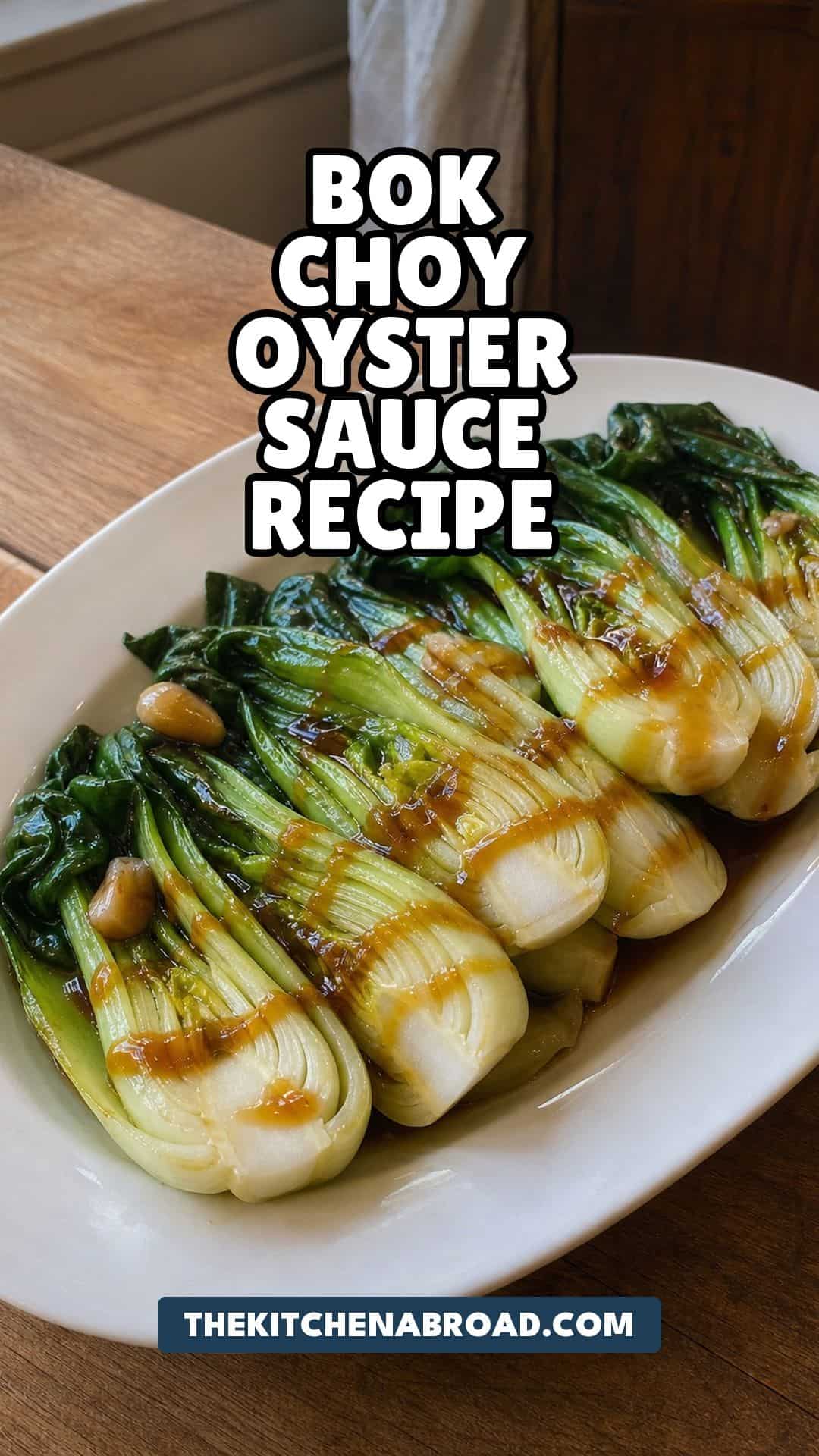
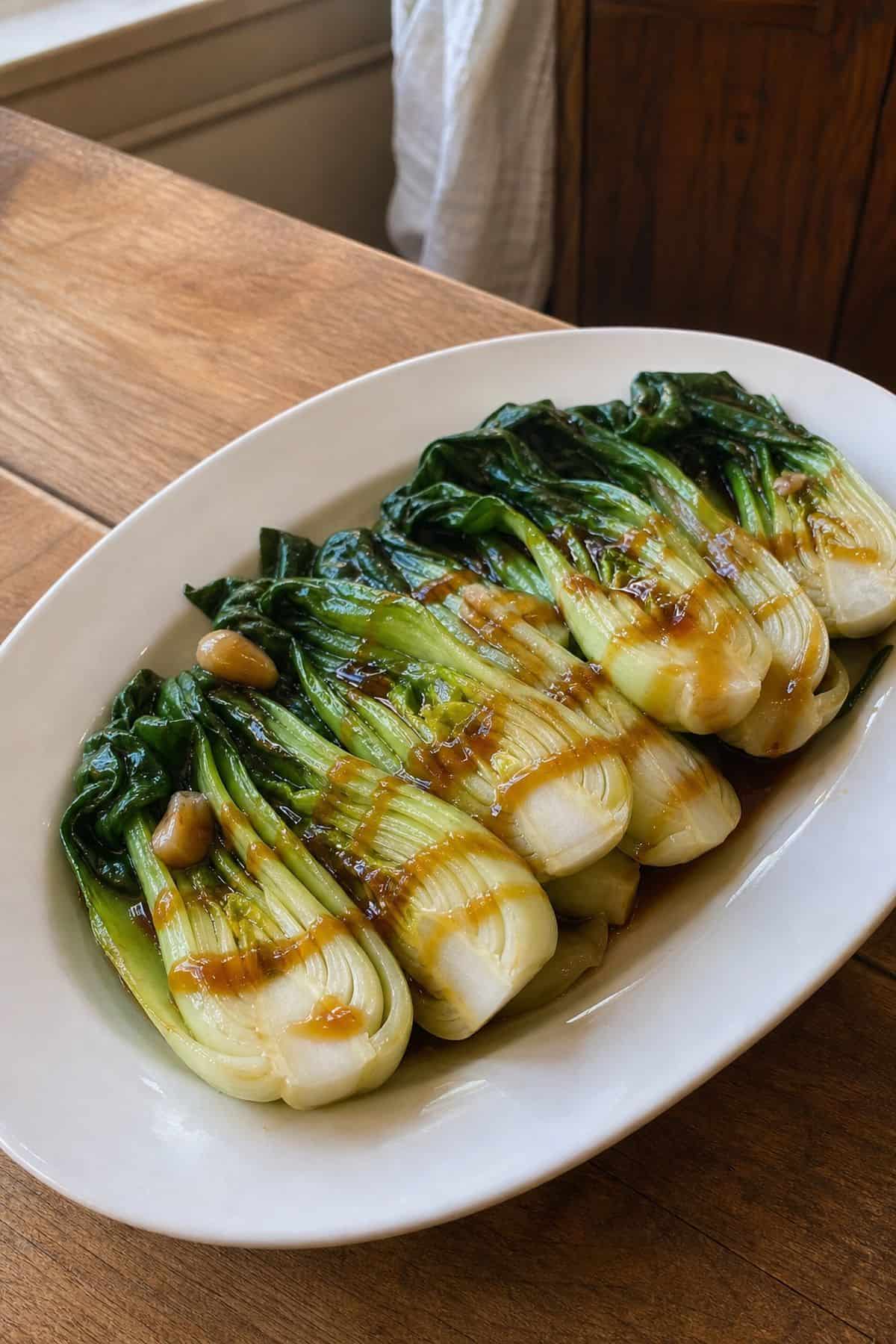
Bok choy with oyster sauce built the Cantonese way: 8 small heads of baby bok choy halved lengthwise, blanched 30 seconds in heavily salted boiling water, shocked in an ice bath to lock the jade-green color, dried hard between paper towels, then finished in a screaming-hot 14-inch carbon-steel wok with smashed garlic, a splash of Shaoxing wine, and Lee Kum Kee Premium oyster sauce drizzled over the top in a zigzag at the end. Total stir-fry time: 60 seconds. Plated cut-side-up in a fan on a white oval platter with toasted sesame oil. Serves 4 as a side, finishes in under 10 minutes start to finish, and pairs with anything on a Cantonese table.
This is the dim sum side dish that closes out every Cantonese meal, the bright-green plate of shiny halved bok choy fanned across a white oval platter at the end of the dumpling cart. Hong Kong tea houses fire it the same way every restaurant on the mainland does, which is to blanch the bok choy hours ahead and finish it in a screaming-hot wok the moment the ticket comes in. Home cooks almost universally skip the blanch and try to stir-fry the bok choy raw, which is why the bok choy at the restaurant looks jade green and snappy and the version at home goes a little limp. The fix is two stages and 10 minutes. Looking for the protein pairing? That is beef in oyster sauce. This is the green that finishes the meal.
What You’ll Need
A 14-inch carbon-steel wok seasoned hard enough to ride high heat without sticking, a large stainless stock pot for the 30-second blanch (the bok choy needs room to swim in the salted water), a wok spatula long enough to keep your hand away from the smoking oil, a large ceramic serving platter (the Cantonese plating move is cut-side-up arranged in a fan), and a bottle of Lee Kum Kee Premium oyster sauce as the canonical brand for this dish. The wok is the entire reason this finishes in 60 seconds, and the stock pot is the reason the blanch happens fast enough that the bok choy never has time to overcook.


Recommended Reads
- Mushroom with Oyster Sauce
- Noodles with Oyster Sauce
- Chicken with Oyster Sauce
- Beef in Oyster Sauce
- Korean Buckwheat Noodles
Where Bok Choy with Oyster Sauce Came From
Bok choy with oyster sauce is a Cantonese restaurant dish, plain and simple. It belongs to the dim sum tradition that runs through Guangzhou, Hong Kong, and the tea-house culture of the Pearl River Delta, where green vegetables are the palate cleanser between siu mai and char siu bao, the bright-green pause between dumpling rounds. On a banquet menu it shows up plated cut-side-up in a fan on a white oval platter with the oyster sauce glaze drizzled over the leaves, served as a course in its own right alongside the steamed fish and the soy-braised chicken. At home in a Cantonese kitchen it is the green that finishes the family dinner, cooked in 10 minutes after everything else has been simmered for an hour.
The two-stage technique is what makes this a restaurant dish and not a home stir-fry. Cantonese restaurants pre-blanch trays of bok choy in the morning, 30 seconds in heavily salted boiling water, ice bath, then drained dry and held in the walk-in for service. When the order fires, the bok choy hits a smoking wok with garlic and oil for 60 seconds total, the oyster sauce gets drizzled over the top, and the plate leaves the pass. The reason is operational: you cannot stir-fry raw bok choy in 60 seconds and have it come out evenly cooked. The blanch evens out the cook between stem and leaf so the finish in the wok is just about heat, color, and the gloss of the oyster sauce. Bringing that technique home is the entire difference between bok choy and Cantonese bok choy.
A Few Notes on the Ingredients
- Baby bok choy: 8 small heads halved lengthwise. Full-size bok choy has fibrous white stems that cook at a different rate than the leaves and need more time in the wok than this method allows. Baby bok choy is tender stem to tip, sweeter, halves cleanly down the middle, and finishes evenly in the same 60 seconds. The pale-green variety with small dark leaves is the one to grab.
- Oyster sauce: Lee Kum Kee Premium is the canonical bottle for this dish and the one Cantonese kitchens reach for. The technique move is to drizzle it over the bok choy at the end, after the wok comes off the heat, not during the stir-fry. Oyster sauce burns and turns bitter when it hits a screaming-hot wok directly, and the finish-at-the-end drizzle is how restaurants keep the glaze shiny instead of scorched.
- Neutral high-heat oil: Peanut, grapeseed, or refined avocado oil for the wok. Smoke point above 400°F is the only requirement. Olive oil scorches, sesame oil burns, butter has no place here. The wok needs to be smoking when the oil goes in, and the oil needs to handle that without breaking down.
- Aromatics: 4 garlic cloves smashed flat with the side of a knife, not minced. Smashed garlic releases its oil into the wok over 30 seconds without burning the way minced garlic does in 10. The cloves come out at the end of the stir-fry or stay in the pan as a flavor signal; either way the bok choy carries the garlic perfume without the harsh edge of charred bits.
- Shaoxing wine: The deglaze splash, 1 tablespoon poured down the side of the smoking wok the moment the bok choy is ready. The wine hits the metal, vaporizes instantly, and carries the aroma up into the bok choy. Dry sherry is the closest pantry substitute if Shaoxing is not in the cupboard.
- Salt for the blanch water: Heavily salted, the way an Italian salts pasta water. The phrase to remember is salted like the sea: 1 tablespoon of kosher salt per quart of water, minimum. Under-salted blanch water leaches color and flavor out of the bok choy; properly salted water seasons the bok choy from the inside while it blanches and keeps the green bright.
Recipe: Bok Choy with Oyster Sauce
Prep time: 5 minutes | Cook time: 5 minutes | Total time: 10 minutes | Serves: 4 as a side
Ingredients
- 8 small heads baby bok choy, halved lengthwise and rinsed
- 1 tbsp kosher salt, for the blanching water
- 2 tbsp neutral oil (peanut, grapeseed, or refined avocado)
- 4 garlic cloves, smashed flat with the side of a knife
- 1 tbsp Shaoxing wine
- 3 tbsp oyster sauce (Lee Kum Kee Premium)
- 1 tsp toasted sesame oil
Instructions
- Bring a large pot of heavily salted water to a rolling boil. The salt level should taste like the sea: about 1 tablespoon of kosher salt per quart of water, minimum. While the water heats, rinse the halved baby bok choy under cold running water, paying attention to the grit that hides between the inner stems, and set it aside on a towel.
- Blanch the halved baby bok choy in the boiling water for 30 seconds. Do not overcook. Thirty seconds is the line between bright jade green and army green, and the bok choy will keep cooking from residual heat the moment it leaves the pot. Set a timer if you need to.
- Immediately scoop the bok choy out of the boiling water with a spider or slotted spoon and plunge it into a large bowl of ice water. Leave it in the ice bath for 30 seconds. The shock locks the chlorophyll and stops the cook dead, which is the entire reason restaurant bok choy stays bright green from the kitchen to the table.
- Drain the bok choy hard on paper towels, pressing a second towel down on top to wick the surface water. Wet bok choy going into a hot wok steams instead of stir-frying, and steamed bok choy is exactly what you are trying to avoid. The drier the bok choy, the cleaner the finish.
- Heat the wok over high heat until it begins to smoke. Add the 2 tablespoons of neutral oil and swirl to coat the metal. The wok should be hot enough that the oil shimmers and smokes faintly the second it hits the pan.
- Add the smashed garlic cloves and stir for 30 seconds until fragrant and golden at the edges. Watch the cloves closely so they do not burn; smashed garlic releases its oil slower than minced and gives you the full 30 seconds before it tips into bitter territory.
- Add the blanched bok choy to the wok cut-side-down and stir-fry for 60 seconds. The cut side caramelizes against the hot metal in those few seconds, which is the wok-hei finish that takes the dish from blanched bok choy to restaurant bok choy.
- Deglaze with the Shaoxing wine poured down the side of the wok, let it vaporize for two seconds, and immediately transfer the bok choy to a large ceramic serving platter, arranging the halves cut-side-up in a fan across the plate.
- Drizzle the oyster sauce and toasted sesame oil over the top in a zigzag pattern across the bok choy and serve immediately while the platter is still warm.
Notes
The blanch, the ice bath, and the 60-second wok finish is restaurant prep. Every Cantonese kitchen runs a version of this two-stage method during service, and the reason it works at home is the same reason it works on the line: the blanch evens out the cook between stem and leaf, and the wok finish is short enough that nothing overcooks.
Oyster sauce gets drizzled at the end, off the heat, after the bok choy is plated. Cooking oyster sauce in a screaming-hot wok caramelizes the sugar and breaks the gloss, and you end up with a brown sticky bok choy instead of a bright-green glazed one. Drizzle at the table, in a zigzag, over the cut sides.
Use baby bok choy and not the full-size variety. Mature bok choy has fibrous white stems that do not cook through in 60 seconds, and the leaves wilt before the stems are tender. Baby bok choy is the cleaner halve, the more even cook, and the variety every Cantonese restaurant uses for this dish.
Tips and Variations
The Blanch-and-Shock That Locks Bright Green
The 30-second blanch in heavily salted boiling water plus the 30-second ice bath is the single most important step in this recipe and the one home cooks skip most often. The blanch sets the chlorophyll in the leaves and stems by a quick burst of heat, then the ice bath stops the cook the moment the color is set. Without the ice bath, residual heat keeps cooking the bok choy from the inside, and the bright jade green you saw in the boiling water turns to a dull army green by the time the bok choy hits the wok. Restaurants do this in trays in the morning and hold the blanched bok choy in the walk-in until service. At home you can do it 30 seconds before the wok comes out. Either way, the two-stage move is the difference between restaurant color and home color.
Why Baby Bok Choy Beats Full-Size
Baby bok choy is the variety this dish was built around, and full-size mature bok choy is a different vegetable that needs a different method. The baby variety has tender pale-green stems that cook through in the same time as the small dark leaves, which is the entire reason a 30-second blanch and a 60-second stir-fry work. Mature bok choy has thick fibrous white stems that need three to four minutes to cook through, by which point the leaves have wilted into a sad pile. If your market only has mature bok choy, separate the stems from the leaves, blanch the stems for 90 seconds and the leaves for 30, and adjust the wok finish accordingly. But the baby variety is what Cantonese restaurants use, and it is the variety that delivers the dim sum side you remember.
Drizzling Oyster Sauce at the End (Not During)
This is the move that separates Cantonese restaurant bok choy from a home stir-fry that tries to fold oyster sauce into the wok. Oyster sauce is roughly 30 percent sugar, and sugar at wok temperature caramelizes in seconds. Pour the oyster sauce into a hot wok and you get a dark, sticky, slightly burnt glaze that coats the bok choy in a brown film. Drizzle the oyster sauce over the top of the plated bok choy after it comes off the heat, and the sauce stays shiny, bright, and the color of fresh shellfish stock. The sesame oil goes in the same drizzle for the same reason: it has a low smoke point and belongs at the end, not in the wok.
Adding Garlic Without Burning It
Smashed garlic cloves, not minced. Smashing a garlic clove with the flat of a knife cracks it open without cutting it apart, which releases the oil and the perfume into the wok slowly over 30 seconds as the clove cooks. Minced garlic in a hot wok burns in 10 seconds flat, turns bitter, and you cannot un-burn it once it is in the pan. Smashed cloves give you a 30-second window where the garlic is fragrant and golden but not yet bitter, which is exactly the window you need before the bok choy goes in. Some Cantonese cooks pull the cloves out before plating; others leave them in as a visual cue that the bok choy was cooked with whole garlic. Both are fine.
Pairing as a Side with Other Oyster-Sauce Dishes
This is the side dish that closes out the oyster sauce series, and the natural pairing is to plate it alongside one of the four protein or carb dishes in the lineup. Bok choy with oyster sauce next to beef in oyster sauce, with a bowl of rice and the green vegetable on the table, is the canonical Cantonese family-dinner spread. Add mushroom with oyster sauce and you have the vegetarian-leaning option that doubles down on the umami glaze. Or skip the side-by-side and let the bok choy ride alone alongside a steamed fish, a bowl of jasmine rice, and a pot of jasmine tea, which is the way Hong Kong tea houses serve it.
What to Serve It With
This is a side dish and it plays that role beautifully. A homemade dim sum spread is the canonical home: siu mai, har gow, char siu bao, and a platter of this bok choy fanned out as the green course between rounds. A Cantonese family dinner runs the same way, with the bok choy plated next to steamed fish, soy-braised chicken, and a bowl of jasmine rice. The full oyster sauce series plates side by side as a Chinese-takeout-at-home spread: bok choy with oyster sauce next to chicken with oyster sauce, noodles with oyster sauce, and a pile of rice. For a weeknight stir-fry plate where the bok choy is the green next to whatever protein is on hand, this finishes in 10 minutes and rounds out the meal. And for a cross-cuisine combo, the cold-and-hot move pairs hot bok choy with a chilled bowl of Korean buckwheat noodles.
Frequently Asked Questions
Baby bok choy or full-size bok choy, which should I use?
Baby bok choy, every time, for this dish. The tender pale-green stems and small dark leaves of the baby variety cook through evenly in the 30-second blanch and 60-second stir-fry that defines this recipe. Full-size mature bok choy has thick fibrous white stems that need three to four minutes to cook through, by which point the leaves wilt into mush. If you can only find mature bok choy, separate stems from leaves and blanch the stems 90 seconds and the leaves 30, then proceed with the stir-fry. But the baby variety is the variety this restaurant dish was built around and the one Cantonese kitchens use.
Can I skip the blanch and just stir-fry the bok choy raw?
You can, and the result is a fine stir-fry. But the blanch is what makes this restaurant bok choy and not home bok choy. The two-stage method gives you bright jade color, evenly cooked stems and leaves, and a 60-second wok finish that captures wok-hei without any risk of overcooking. Stir-frying raw bok choy at home takes about three minutes, by which point the leaves have wilted and the stems are still a little crunchy. The blanch is 30 seconds of work and the upgrade is real. Every Cantonese restaurant blanches first for a reason.
Why an ice bath after blanching?
The ice bath locks the bright green color and stops the cook dead the moment the bok choy comes out of the boiling water. Without the ice bath, the residual heat trapped in the bok choy keeps cooking it from the inside, and the jade green you saw in the boiling water dulls to army green by the time the bok choy hits the wok. The ice bath is 30 seconds of work and the color difference is night and day on the plate. This is the same technique that keeps green beans, broccoli, and asparagus bright after blanching, and it works on bok choy for the same reason.
Is there a vegetarian or vegan oyster sauce substitute?
Yes, and it works as a one-to-one swap. Vegetarian and vegan mushroom oyster sauce is made from shiitake mushroom extract instead of oyster extract, and it carries the same gloss, the same depth, and a similar savory finish. Lee Kum Kee makes a vegetarian mushroom-flavored sauce, and Wan Ja Shan is the other widely available brand. Swap one for one in the recipe above and the dish reads identically. The technique stays the same: drizzle at the end, off the heat, over the plated bok choy.
Why is my bok choy turning out watery?
Two culprits, both fixable. First, the bok choy was not dried hard enough between the ice bath and the wok. Wet bok choy going into a hot wok steams instead of stir-frying, and steamed bok choy releases its water into the pan and dilutes everything. Press the bok choy hard between paper towels until the surface looks dry, not damp. Second, the wok was not hot enough. The wok should be smoking when the oil goes in and the bok choy should sizzle audibly the moment it hits the pan. A lukewarm wok steams bok choy; a screaming-hot wok sears it.
How do I store and reheat leftover bok choy with oyster sauce?
Up to two days, refrigerated in a shallow container. Bok choy releases water as it sits in the fridge, so the sauce thins out and the leaves soften slightly. To reheat, run the bok choy through a hot wok or skillet for 30 seconds with a splash of fresh oil, off the microwave entirely. Microwave reheating turns the bok choy soggy and the sauce sticky; a quick pass through a hot pan brings the gloss back and freshens the texture. Honestly, this dish is best made fresh in 10 minutes, so the leftover question is more theoretical than practical.
Key Takeaways
- Use baby bok choy, 8 small heads halved lengthwise. Full-size mature bok choy is a different vegetable with a different cook time.
- Blanch 30 seconds in heavily salted boiling water, then ice bath 30 seconds. The two-stage move locks the bright green color and evens out the cook.
- Dry the bok choy hard between paper towels before it hits the wok. Wet bok choy steams instead of stir-frying.
- Smash the garlic cloves with the flat of a knife instead of mincing. Smashed garlic releases oil over 30 seconds without burning the way minced does in 10.
- Drizzle the oyster sauce at the end, over the plated bok choy, off the heat. Cooking oyster sauce in a hot wok caramelizes the sugar and dulls the gloss.
- Total time from start to plate is 10 minutes, and the dish belongs on any Cantonese table next to rice, steamed fish, or the rest of the oyster sauce series.
Final Thoughts
This is the dim sum side that closes out the meal, and the version above is the home-kitchen translation of a dish every Cantonese restaurant fires the same way. The 30-second blanch, the ice bath, the dry-hard step, and the 60-second wok finish add up to 10 minutes of work and a plate that looks like the one you remember from the dim sum cart. The reason restaurants always nail this dish is not skill, it is sequence: blanch first, dry hard, finish fast, drizzle at the end.
Skip the blanch and you have a stir-fry that is fine. Commit to it and you have restaurant bok choy. The two-stage move is the difference between a green vegetable that comes out of the wok pretty good and a green vegetable that comes out jade-bright, evenly cooked, and shiny under a final drizzle of oyster sauce. None of this is hard. It is just the order of operations that Cantonese kitchens have been running for a century and home cooks have been skipping since the moment they tried to do it in one pan.
This post closes out the five-part oyster sauce series. The beef, the chicken, the noodles, the mushrooms, and now the green that finishes the meal. Plate any two of them on the same table with a bowl of jasmine rice and you have a Cantonese family dinner. Plate all five and you have a banquet. The oyster sauce does the heavy lifting across every dish; this one is the green that ties the table together.
Last update on 2026-10-04 / Affiliate links / Images from Amazon Product Advertising API