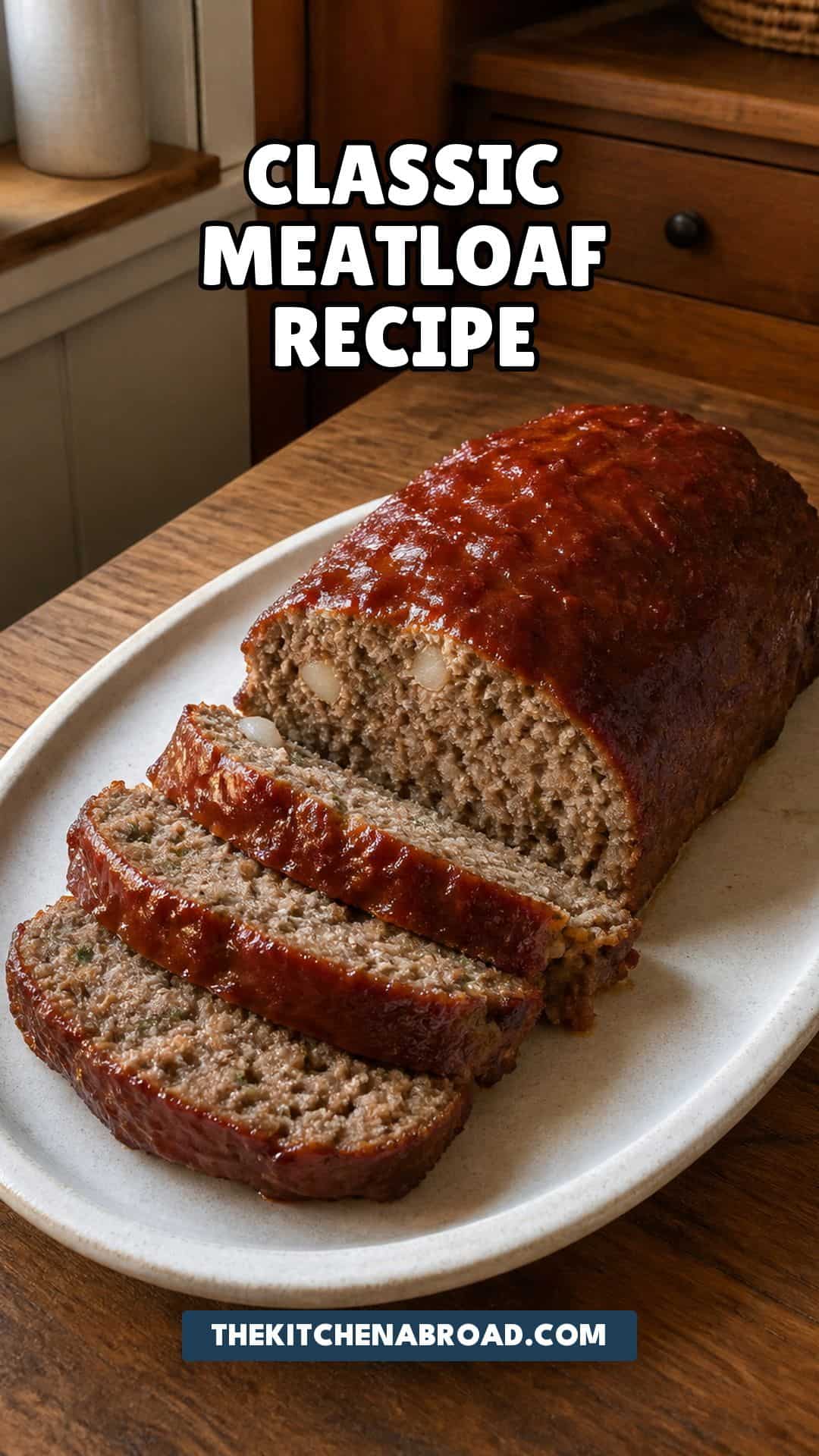
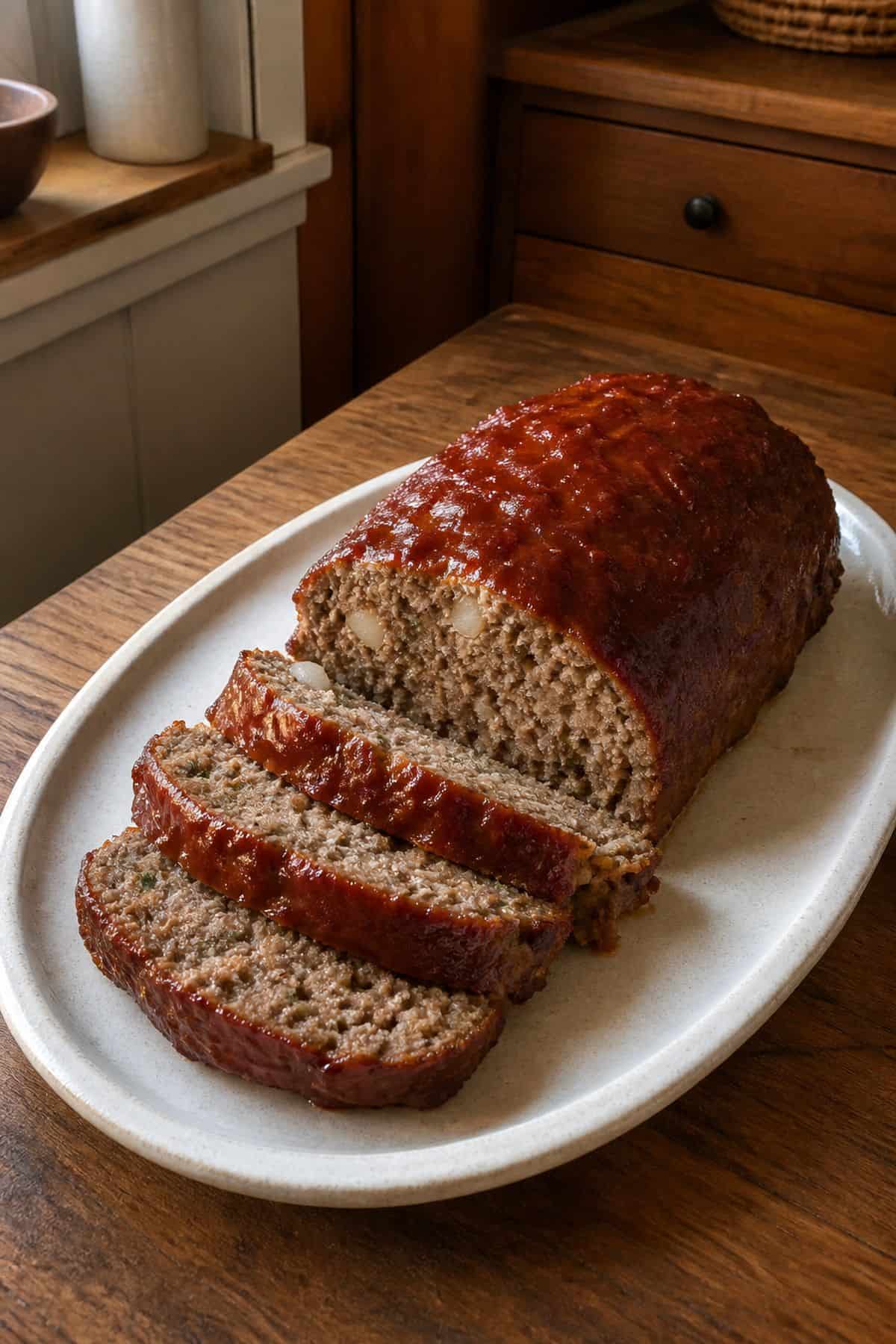
For a classic homemade meatloaf that stays tender, soak torn white bread in milk before mixing it into 80/20 ground beef, and shape the loaf free-form on a sheet pan instead of in a loaf pan. Bake at 175°C (350°F) until the center reads 71°C (160°F), glazing twice with ketchup, brown sugar, Dijon and Worcestershire. Rest it 10 minutes before slicing.
Dry breadcrumbs are why most meatloaf is dense. Swap them for two slices of white bread soaked in milk and the loaf changes completely: tender, sliceable, juicy enough that the next-day sandwich is half the reason to make it.
This classic homemade meatloaf keeps the diner flavor you expect, with a tangy ketchup glaze and plenty of onion, and fixes the two habits that ruin it at home. Breadcrumbs, and the loaf pan.


Why does meatloaf turn out dry or dense?
Two reasons, almost always. The binder, and the mixing.
Dried breadcrumbs soak up liquid and hold on to it, so the loaf bakes up tight and dry. A panade works the other way. Bread torn small and soaked in milk turns to a wet pulp, and that pulp spreads through the meat, keeping moisture in and physically getting between the meat proteins so they can’t bind into one rubbery mass. It’s the same reason Nordic cooks soak breadcrumbs in milk or cream for Finnish meatballs (lihapullat). Five extra minutes, completely different texture.
Overmixing is the other culprit. Ground meat worked too long turns sticky and springy, closer to sausage than meatloaf. Use your hands, mix until you can’t see streaks of panade, and stop there.
One more small habit: cook the onion and garlic first. Raw onion stays sharp and crunchy through the bake, and it leaks water into the loaf. Five minutes in a skillet sorts both problems.
Sheet pan or loaf pan?
Sheet pan, every time. A loaf pan traps the fat and juices around the meat, so the sides steam instead of browning and the glaze only ever touches the top. The meat also has nowhere to go, which makes it denser.
Shaped free-form on parchment, the fat runs off, all four sides take on glaze and color, and the bake is 10 to 15 minutes shorter. Slicing is easier too, because you’re not prying the first piece out of a tin.
Aim for a loaf about 25 cm (10 inches) long, 12 cm (5 inches) wide and 5 cm (2 inches) tall. Taller and the outside overcooks before the center is done.
Which ground meat makes the best meatloaf?
Use 80/20 ground beef. Lean 90/10 dries out in the oven, and 70/30 makes a greasy loaf that slumps as it bakes.
For something richer, use half beef and half ground pork. The traditional American meatloaf mix of beef, pork and veal also works well if your butcher sells it.
Ground turkey or chicken make a lighter loaf but need more help. Raise the Worcestershire to 2 Tbsp and add 1 tsp smoked paprika. Poultry also needs a higher finishing temperature, which is covered below.
Recipe: classic homemade meatloaf
Prep time: 15 minutes. Cook time: 55 minutes. Rest time: 10 minutes. Total time: 1 hour 20 minutes. Serves: 6.
For the meatloaf
- 1 kg (2.2 lb) ground beef, 80/20
- 2 slices white sandwich bread (about 60 g), crusts removed, torn small
- 120 ml (1/2 cup) whole milk
- 1 large yellow onion (about 200 g), finely diced
- 4 cloves garlic, minced
- 1 Tbsp olive oil
- 1 large egg, beaten
- 2 Tbsp chopped fresh flat-leaf parsley
- 1 Tbsp Worcestershire sauce
- 1 tsp Dijon mustard
- 1.5 tsp kosher salt (about 9 g)
- 1 tsp freshly cracked black pepper
For the glaze
- 120 ml (1/2 cup) ketchup
- 15 g (1 Tbsp) brown sugar
- 1 tsp Dijon mustard
- 1 Tbsp Worcestershire sauce
Instructions
- Heat the oven to 175°C (350°F) with a rack in the middle. Line a half-sheet pan with parchment.
- Put the torn bread in a small bowl, pour over the milk and soak 5 minutes, until it collapses into a wet pulp.
- Meanwhile, heat the olive oil in a small skillet over medium heat. Cook the onion 5 to 6 minutes until soft and translucent, add the garlic for 1 minute more, then take it off the heat and let it cool for 5 minutes.
- In a large bowl, combine the beef, panade, cooled onion and garlic, egg, parsley, Worcestershire, Dijon, salt and pepper.
- Mix with your hands until just combined. Stop as soon as everything looks evenly spread through the meat.
- Tip the mixture onto the sheet pan and shape a free-form loaf about 25 cm (10 inches) long, 12 cm (5 inches) wide and 5 cm (2 inches) tall.
- Whisk the glaze ingredients together. Brush about a third over the top of the loaf.
- Bake 45 minutes. Brush on a second layer of glaze and bake 10 to 15 minutes more, until an instant-read thermometer in the center reads 71°C (160°F).
- Brush the remaining glaze over the hot loaf. Rest 10 minutes so the juices settle back into the meat.
- Slice 2 cm (3/4 inch) thick and serve.
Notes
If you don’t have white sandwich bread, brioche or challah work. Sourdough and whole wheat taste too strong here. Mix gently, and don’t skip the rest; cut too early and the juices run out onto the board.
What temperature should meatloaf reach?
Ground beef and pork meatloaf is done at 71°C (160°F) in the center, which is the minimum for ground meat on the FoodSafety.gov safe temperature chart. Turkey or chicken meatloaf needs 74°C (165°F), the poultry minimum.
Don’t trust color. The center of a properly cooked meatloaf can still look slightly pink, and a gray one can be undercooked. An instant-read thermometer pushed into the thickest part is the only reliable check, and it’s the one tool in this recipe I’d call essential. Pull the beef loaf as soon as it hits 71°C; the rest keeps it juicy instead of pushing it into dry territory.
Can you change the glaze?
The classic ketchup, brown sugar, Dijon and Worcestershire glaze is tangier than most, which is the point. Plenty of versions are basically candy on top.
Small tweaks that work: 1 Tbsp bourbon for a smoky sweetness, 1 tsp smoked paprika for depth, or a dash of hot sauce. For a barbecue-style loaf, use a thick Kansas City-style BBQ sauce in place of ketchup. For a sharper glaze, replace 2 Tbsp of the ketchup with apple cider vinegar.
No ketchup at all? A homemade tomato glaze of tomato paste, brown sugar, Dijon and Worcestershire does the job, and so does brown gravy spooned over the slices at the table.
Storing leftovers and the next-day sandwich
Leftover meatloaf keeps 4 days in the fridge in an airtight container, and the general rules in this guide to storing leftovers safely apply here too. Reheat slices in a covered skillet over medium-low heat with a splash of beef stock or water, 3 to 4 minutes. The microwave dries them out.
To freeze, wrap individual slices in plastic and then foil. They keep 3 months. Thaw overnight in the fridge and reheat the same way.
Then there’s the sandwich. Cold meatloaf, soft white bread, a smear of mustard. Some people make meatloaf mainly for this, and they have a point.
Meatloaf questions answered
Why is my meatloaf dense?
Dense meatloaf usually comes from overmixing or from using dry breadcrumbs instead of a milk-soaked bread panade. Mix only until combined and soak real bread in milk first.
Can I bake meatloaf in a loaf pan?
Yes, but it will be denser and only browned on top, and it needs 10 to 15 minutes longer, about 75 minutes in total. Check the center with a thermometer rather than going by time.
What internal temperature is meatloaf done?
Beef or pork meatloaf is done at 71°C (160°F) in the center. Turkey or chicken meatloaf needs 74°C (165°F).
Can I make meatloaf without ketchup?
Yes, swap the ketchup glaze for BBQ sauce, brown gravy or a homemade tomato glaze made with tomato paste, brown sugar, Dijon and Worcestershire. The flavor shifts but the loaf still works.
Can I make meatloaf ahead?
You can shape the raw loaf, cover it and refrigerate it for up to a day before baking, then add a few minutes to the bake. Cooked meatloaf also reheats well, so baking a day ahead is fine.
Key takeaways
- Soak white bread in milk for a panade; dry breadcrumbs make a dense loaf.
- Shape the meatloaf free-form on a sheet pan so every side browns and takes glaze.
- Mix the meat only until just combined.
- Bake beef meatloaf to 71°C (160°F) in the center; poultry needs 74°C (165°F).
- Rest 10 minutes before slicing.
What to serve next to it
Meatloaf wants something soft and buttery on the plate to catch the glaze. Smooth Finnish mashed potatoes (perunamuusi) are my pick, with green beans or a sharp green salad to cut the richness.
Feeding a crowd on a cold weekend instead? A slow-braised old-fashioned beef stew with red wine is the other comfort classic worth having in your rotation.
Last update on 2026-10-14 / Affiliate links / Images from Amazon Product Advertising API