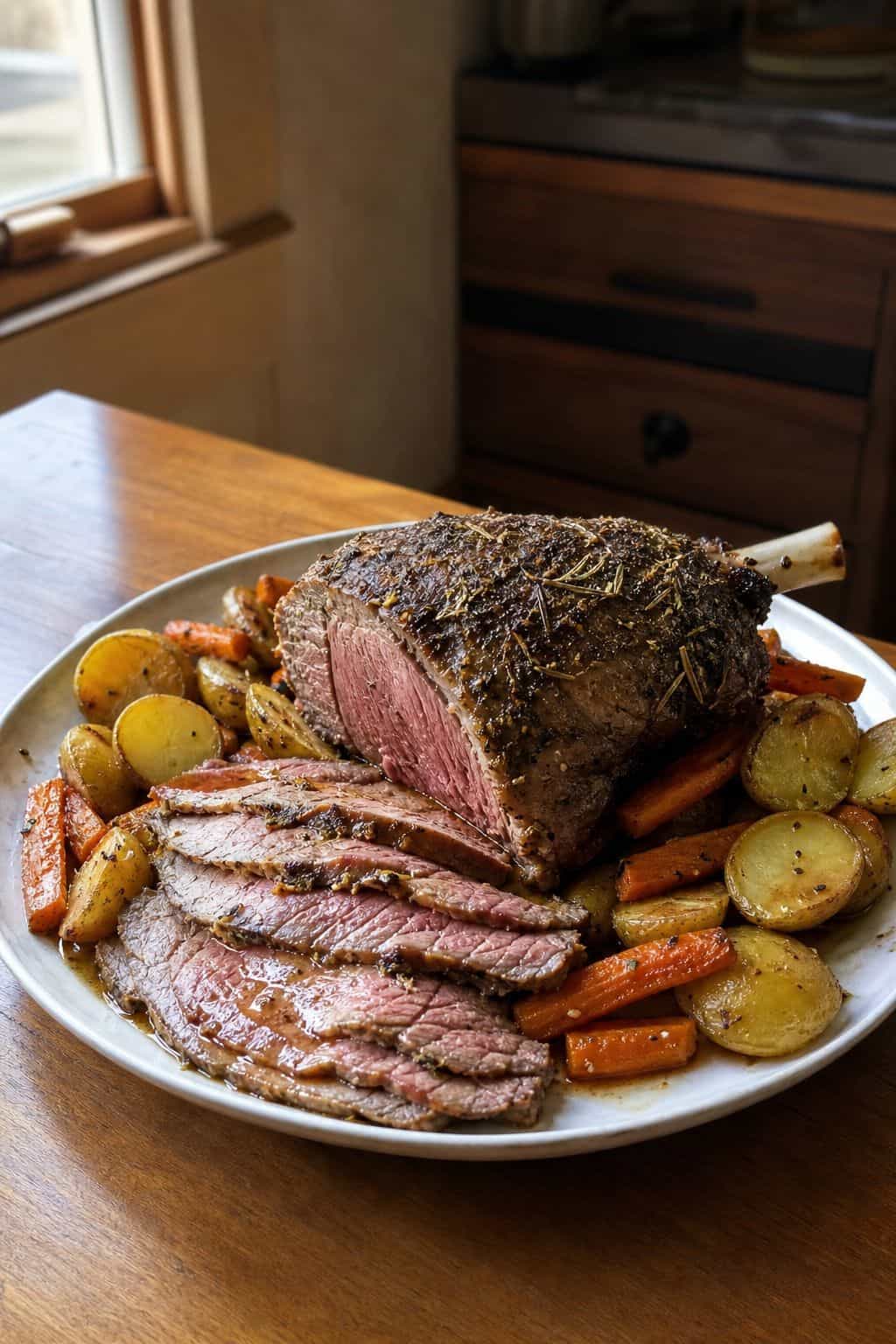
A roast leg of lamb recipe built for the Easter table: a bone-in 6-pound leg, slit-and-studded with a paste of garlic, anchovy, rosemary, and lemon zest, then seared at 425°F (220°C) and dropped to 325°F (165°C) to finish on a rack above halved Yukons and carrots. Pulled at 135°F internal, tented loosely with foil for 15 minutes, and carved tableside so the carryover heat lands the meat at the USDA-safe 145°F. Eight generous servings, one centerpiece, and the side dish builds itself in the pan underneath.
There is a particular kind of Easter table built around one cut of meat, and the leg of lamb is the cut that earns it. The Mediterranean has been making this argument for two thousand years: Greek Pascha lamb pulled off the spit at midnight, Sicilian agnello pasquale rubbed with wild fennel and roasted slow, French gigot d’agneau carved at the table on Easter Sunday. The technique below is the home-oven version of that lineage, and it leans on one move most American recipes skip , a paste of anchovy, garlic, and rosemary pushed deep into slits cut across the leg. The anchovy melts during the roast. There is no fishy taste left, only depth. The sides cook in the same pan. The lamb rests while the table sits down.

What You’ll Need
A heavy roasting pan large enough to fit a 6-pound leg of lamb on a rack with potatoes and carrots underneath, an instant-read thermometer that gives a reading in under three seconds (the difference between medium-rare and medium-well is twenty seconds with the probe in the wrong place), a long carving knife with a matching fork for the tableside slice, a serving platter wide enough to hold the carved lamb plus its drippings, and a length of cotton kitchen twine to tie the shank end if your butcher has not already done it.


Recommended Reads
- Best Easter Dinner Ideas
- Best Easter Food Ideas
- Best Easter Lunch Ideas
- Roasted Garlic Parmesan Baby Potatoes
- Creamy Potatoes Au Gratin
Where Easter Lamb Came From
The lamb at Easter is not a stylistic choice. It is a thread that runs through the entire Christian and pre-Christian Mediterranean calendar. The Greek Orthodox Pascha centers a whole spit-roasted lamb on Easter Sunday, eaten in the courtyard after the midnight Resurrection liturgy. In Sicily and southern Italy it shows up as agnello pasquale, slow-roasted with wild herbs and lemon. In southern France the gigot d’agneau hits the table on Easter Sunday afternoon, carved in front of the family. The thread underneath all of it is the Agnus Dei , the Lamb of God , which pulled the cut onto the Christian Easter table in the first century and never left.
The same animal anchors Middle Eastern Eid celebrations and Jewish Passover, both rooted in older sacrifice traditions where lamb was the meat reserved for the most important meal of the year. The reason a leg of lamb feels like a centerpiece even when you have never cooked one is that it has been one for roughly two thousand springs running. The recipe below is not an invention. It is the home-oven, U.S.-butcher version of a dish the Mediterranean has been refining since before our calendar started counting.
A Few Notes on the Ingredients
- Bone-in leg of lamb: Take the bone-in for Easter. The bone conducts heat into the center for a more even cook, the meat around the bone develops deeper flavor as connective tissue breaks down, and the carved leg presents as a centerpiece. Plan three-quarters of a pound per adult; a 6-pound leg feeds eight.
- Garlic and anchovy: Six cloves of garlic to six anchovy fillets is the working ratio. The anchovy is the part people resist and the part that defines the dish. It does not read as fish in the finished lamb; it melts during the long roast and leaves only umami depth.
- Fresh rosemary and thyme: Chopped and mashed into the paste with the garlic, anchovy, lemon zest, and olive oil. The herbs carry the Mediterranean flavor through every cross-section of the carved leg.
- Lemon zest: Goes into the paste alongside the herbs. The zest brightens the depth that the anchovy and garlic build, and keeps the seasoning from reading one-note.
- The slit-and-stud method: Cut twelve to fifteen one-inch-deep slits across the leg with a paring knife. Push paste deep into each slit with your finger. Surface rubs season only the crust; slits push seasoning into every slice.
- Baby Yukon Gold potatoes and carrots: Halved potatoes and fat carrot batons go on the floor of the roasting pan with a splash of white wine or stock. The lamb sits on a rack above; every drip of fat lands on the vegetables underneath, which finish as the side dish.
- Overnight dry brine: If you have the planning bandwidth, salt the leg with kosher salt and leave it uncovered on a rack in the fridge overnight. It pulls surface moisture out, lets the seasoning penetrate deeper, and gives you a measurably better crust. Not required. Worth it if you remember.
Recipe: Roast Leg of Lamb
Prep time: 30 minutes | Cook time: 75 minutes | Total time: 1 hour 45 minutes + 15 minutes rest | Serves: 8
Ingredients
- 1 bone-in leg of lamb, 6 lb (2.7 kg), trimmed of silver skin
- 6 cloves garlic, minced
- 6 anchovy fillets, minced
- 3 tbsp (8 g) fresh rosemary, chopped
- 1 tbsp (3 g) fresh thyme, chopped
- Zest of 1 lemon
- 2 tbsp (30 ml) olive oil
- 2 tsp kosher salt
- 1 tsp black pepper
- 2 lb (900 g) baby Yukon Gold potatoes, halved (for rack-on-roast)
- 4 carrots, cut in batons
- 1 cup (240 ml) dry white wine or chicken stock, for the pan
Instructions
- The night before if you can, pat the leg dry with paper towels and rub it all over with 1 teaspoon of the kosher salt. Set it on a rack over a sheet pan, leave it uncovered in the fridge overnight, and pull it out an hour before you plan to roast. If you are doing this same day, season the leg with the salt and leave it on the counter for 30 minutes while you build the paste.
- In a small bowl, mash the minced garlic, anchovy fillets, rosemary, thyme, lemon zest, and olive oil into a rough paste with the back of a spoon. Season with the black pepper and the remaining 1 teaspoon kosher salt (skip this if you dry-brined the night before). The paste should hold together when you pinch it.
- With a sharp paring knife, cut 12 to 15 slits across the lamb, each about 1 inch deep, spaced roughly 2 inches apart over the surface of the leg. Push paste deep into each slit with your finger, then rub any remaining paste across the surface of the leg. Set the lamb on a rack at room temperature for 30 minutes while the oven heats.
- Heat the oven to 425°F (220°C) with a rack in the lower-middle position. Scatter the halved potatoes and carrot batons across the floor of a heavy roasting pan, pour the wine or stock over them, and toss to coat. Set a rack inside the pan and place the prepared lamb fat-side-up on the rack. The vegetables sit underneath; the lamb drips onto them as it roasts.
- Roast at 425°F (220°C) for 20 minutes to sear the fat cap and start the crust. Then, without opening the door longer than necessary, drop the oven to 325°F (165°C) and continue roasting until an instant-read thermometer pushed into the thickest part of the leg (avoiding the bone) reads 135°F (57°C) for medium-rare, about 50 to 60 minutes more. Total cook time will land around 75 minutes for a 6-pound bone-in leg.
- Transfer the lamb to a carving board or warm platter and tent loosely with foil , loose, not sealed; sealed foil traps steam and softens the crust. Let it rest for a full 15 minutes. The internal temperature will climb 7 to 10°F during the rest, landing at the USDA-safe 145°F (63°C) for medium-rare. Carve against the grain into thin slices, plate with the potatoes and carrots from underneath, and spoon any pan jus over the top.
Notes
Plan ¾ pound of bone-in leg per adult. An 8-guest table wants the 6-pound leg in this recipe; for 12 guests, go to a 9-pound leg and add 25 to 30 minutes to the low-heat finish. For 16, run two smaller legs (5 to 6 pounds each) on two oven racks, swapping their positions halfway through.
Doneness temperatures, pulled-from-oven (carryover adds 7 to 10°F during the rest): 130°F for rare, 135°F for medium-rare (the right answer for lamb), 140°F for medium, 150°F for medium-well. Use an instant-read in the thickest part of the leg, never touching the bone , the bone reads hotter than the meat and will tell you a lie.
The dry-brine option (salting the leg uncovered in the fridge the night before) is the single biggest upgrade you can make to this recipe. It pulls surface moisture out, lets the salt penetrate deeper than a same-day rub can, and gives you a measurably better crust. If you remember, do it. If you forget, the same-day version is still very good.
Tips and Variations
The Slit-and-Stud Method with Anchovy-Garlic-Rosemary Paste
Cut deep, not shallow. The slits need to be a full inch into the meat so the paste travels with the slice when you carve , a surface rub flavors the crust only, but slits push seasoning into every cross-section. Twelve to fifteen slits is the working number for a 6-pound leg, spaced roughly two inches apart on a grid across the surface. Push the paste in with your index finger; the tip will tell you when you have packed it deep enough. The anchovy is the part most American cooks skip and the part that defines the dish. Six fillets in a 6-pound leg dissolves to nothing visible during the roast, but the umami it leaves behind is the difference between good lamb and the lamb that earns its place on next year’s table. If you cannot find anchovy fillets, two teaspoons of anchovy paste from a tube does the same job.
Bone-In vs Boneless Decision for Centerpiece Drama
Bone-in is the right answer for Easter and for any meal where the lamb is the visual anchor of the table. The bone conducts heat into the center for a more even cook, the meat around the bone develops deeper flavor as connective tissue breaks down, and the carved leg presents as a centerpiece rather than a tray of slices. The cost is a slightly trickier carve and an extra ten minutes in the oven. Boneless rolled (your butcher will tie it for you) is faster at about 15 minutes per pound, carves into neat rounds, and is the right call if you want easy portions or if the bone-in legs at your market look small. Either way, ask your butcher to French the shank end (trim the meat off the last two inches of bone for a clean handle) , it makes for an easier carve and a better photo.
The Rack-on-Roast Move That Builds the Side Dish In
The vegetables underneath the rack are not a garnish; they are the whole side dish, cooked by the lamb. Halved baby Yukons and fat carrot batons are the default, but the move scales , shallots, fennel wedges, garlic heads cut in half across the equator, parsnip batons, and even halved lemons all work. The wine or stock on the floor of the pan does two jobs: it keeps the vegetables from scorching, and it deglazes into a built-in pan jus you can spoon over the carved lamb at the end. The fat cap on the leg renders during the long roast and drips straight onto the potatoes underneath, which is why those potatoes will taste like the most reliable version of themselves you have ever made. One pan, two dishes, no second oven.
Scaling for 12 or 16 Guests (Per-Person Math)
The working ratio is ¾ pound of bone-in leg per adult, ½ pound of boneless. For 8 guests, the 6-pound leg in this recipe is the answer. For 12, jump to a 9-pound bone-in leg and add roughly 25 to 30 minutes at 325°F , same paste, same technique, just more meat to push the thermometer through. For 16, run two 5-to-6-pound legs on two oven racks, swapping their positions front-to-back and top-to-bottom at the halfway point so they cook evenly. Two smaller legs hit temp more reliably than one giant one, and they give you twice the surface area for the paste, which means twice the flavor. If half your table is kids, you can scale down to ½ pound per adult; leftovers shred beautifully for sandwiches the next day, which is a feature, not a bug.
How to Carve a Bone-In Leg of Lamb
Carve at the table if you can; this is the part the centerpiece is for. Set the rested leg on a cutting board with a moat for the juices, shank bone facing your non-dominant hand. Steady the leg with a carving fork pushed into the thick end. With the carving knife held parallel to the bone, slice down through the meat to the bone in thin, even slices, working from the thick end toward the shank. When the slices stop releasing freely, turn the leg 90 degrees and run the knife along the bone to free the slab on that side, then slice that piece against the grain on the board. Repeat until the bone is clean. Total time: about five minutes, most of it spent slicing rather than figuring out the geometry. The trick is to start by slicing down to the bone, not by cutting across the leg.
What to Serve It With
The lamb anchors the Easter spread; the sides build the meal around it. The potatoes and carrots from underneath the rack are the built-in default. From there, the table wants something creamy, something green, and something acidic. Our creamy potatoes au gratin is the richer alternative if you want a separate potato dish, and roasted garlic parmesan baby potatoes is the weekday workhorse if you want a second starch. For green, asparagus or a spring vegetable salad cuts the richness. For acid, the classic move is a mint sauce (fresh mint, white wine vinegar, a teaspoon of sugar) or a quick pan jus made from the drippings in the roasting pan , both work, and a table that has both on offer always uses both. For the full menu treatment, our Easter dinner ideas and Easter lunch ideas roundups give you the full supporting cast.
Frequently Asked Questions
How long do you cook a leg of lamb per pound?
About 18 minutes per pound at 325°F (165°C) after a 20-minute sear at 425°F (220°C) for a bone-in leg cooked to medium-rare. A 6-pound bone-in leg lands around 75 minutes total; an 8-pound leg around 100 minutes. Boneless rolled legs run faster at about 15 minutes per pound. Time is the rough guide; pull at temperature, not at the clock.
What temperature should a leg of lamb be cooked to?
Pull at 135°F (57°C) internal for medium-rare; rest 15 minutes loosely tented in foil, and carryover heat brings the meat to the USDA-safe 145°F (63°C). For medium, pull at 140°F (60°C); for medium-well, pull at 150°F (66°C). Push the instant-read probe into the thickest part of the leg and avoid the bone , the bone runs hotter than the meat and will give you a misleading reading.
Should you cook leg of lamb bone-in or boneless?
Bone-in for flavor and presentation; the bone conducts heat for a more even roast and the carved leg looks like a centerpiece. Boneless rolled if you want easier carving, faster cook time (about 15 minutes per pound), or tidier slices for a buffet. For Easter dinner, bone-in is the working default. For a weeknight family meal or a buffet line, boneless makes more sense.
Do you cover leg of lamb when roasting?
No. Roast uncovered the entire time so the fat cap browns and the surface develops a crust. Cover only during the rest, and only with a loose foil tent , sealed foil traps steam and softens the crust you just spent an hour and a half building. If the surface is browning faster than the interior is cooking (rare on a 6-pound leg, more likely on a 9-pound one), drop the oven 25°F rather than reaching for foil.
How much leg of lamb do I need per person?
Three-quarters of a pound (about 12 oz) of bone-in leg per adult, or half a pound (8 oz) of boneless. Eight adults wants a 6-pound bone-in leg. Twelve adults wants a 9-pound leg or two smaller legs. Add a pound to the total if your table is heavy on big eaters or you want leftovers , shaved cold lamb on toasted bread with mustard and arugula is the second-best meal of the holiday weekend.
Why do you put slits in leg of lamb?
Surface rubs season only the crust; the inside stays plain. Slits cut an inch deep let you push the garlic-anchovy-rosemary paste into the meat itself, so every slice carries flavor from edge to edge. The slit-and-stud method is standard practice across the Mediterranean , Italian, Greek, and French Sunday cooks all do some version of it , and almost no American recipes bother. Twelve to fifteen slits across a 6-pound leg, paste pushed deep with a finger, is the whole technique.
Key Takeaways
- Bone-in 6-pound leg for 8 guests; the working ratio is ¾ pound bone-in per adult.
- Slit-and-stud is the whole technique: 12 to 15 one-inch-deep slits, paste of garlic, anchovy, rosemary, and lemon zest pushed deep into each one.
- Anchovy melts to umami during the roast , there is no fishy taste left, only depth.
- Sear at 425°F (220°C) for 20 minutes, finish at 325°F (165°C) until the thermometer reads 135°F internal for medium-rare.
- Rest 15 minutes tented loosely in foil; carryover brings the meat to 145°F.
- Halved Yukons and carrots under the rack catch the drippings and finish as the side dish.
Final Thoughts
This is the one Easter recipe that earns the fuss, and the fuss is smaller than it looks. The paste takes ten minutes. The slits take five. The oven does the rest. What you are paying for is a centerpiece that does the work of the meal , guests carve from it, the sides cook underneath it, and the leftovers feed Easter Monday lunch without an extra thought.
The two non-negotiables are the anchovy in the paste and the thermometer in the meat. Skip the anchovy and the dish drops a full grade. Skip the thermometer and you are guessing your way to medium-well lamb, which is a particular tragedy. A 25-dollar instant-read pays for itself the first time it saves a holiday roast, and the anchovy is a 4-dollar tin from the same shelf as the canned tomatoes. Both belong in the drawer.
If you cook this once on an Easter Sunday and it lands, it tends to become the thing you cook every Easter. That is how it works across the Mediterranean , the leg of lamb is not a recipe you collect, it is one you keep. The version above is the home-oven version of a meal the Greek, Italian, and French Easter tables have been refining for two thousand years. Carry that forward. Carve it at the table. Pour a glass of something red. The lamb earns the day.
Last update on 2026-10-14 / Affiliate links / Images from Amazon Product Advertising API