
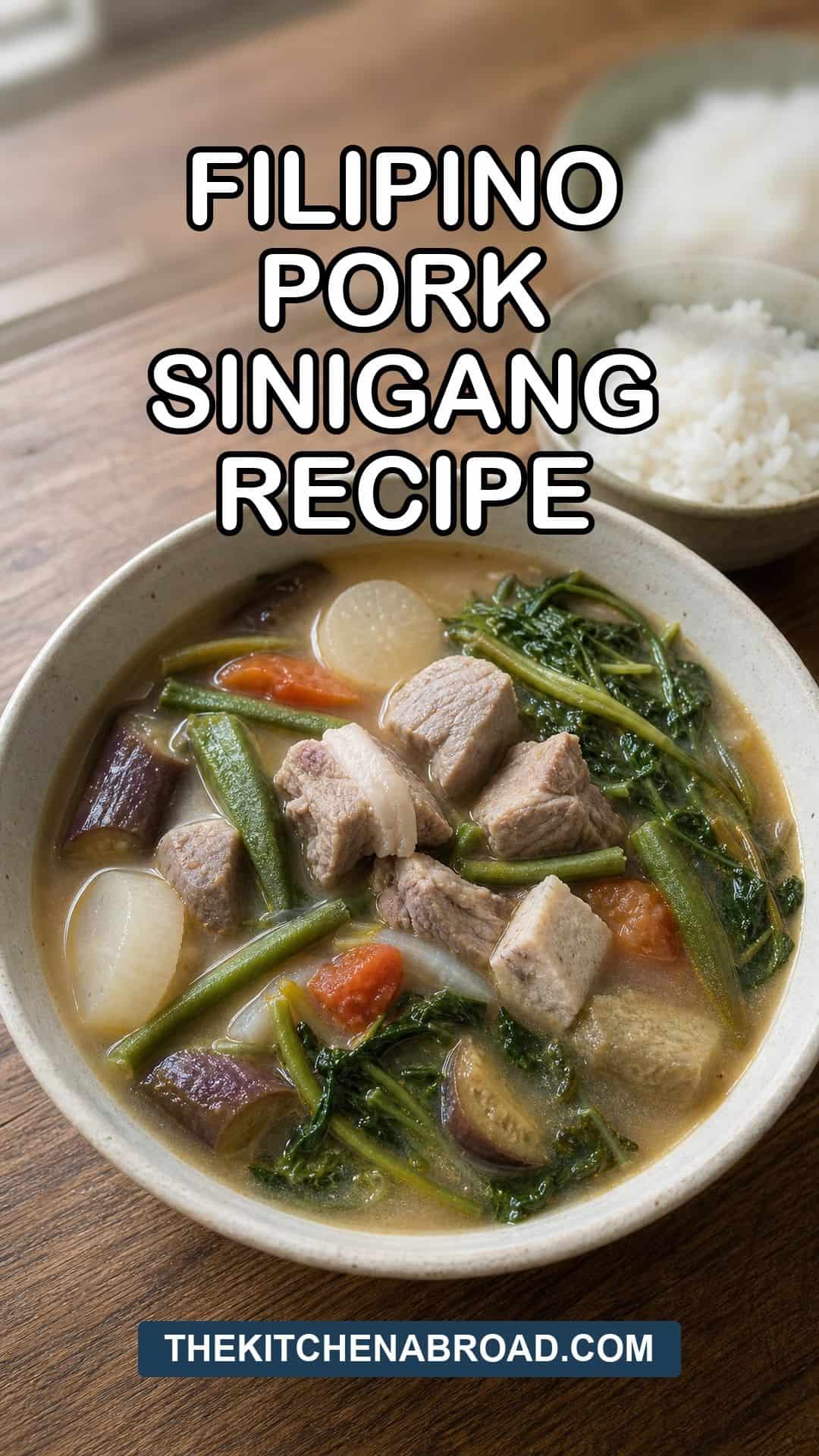
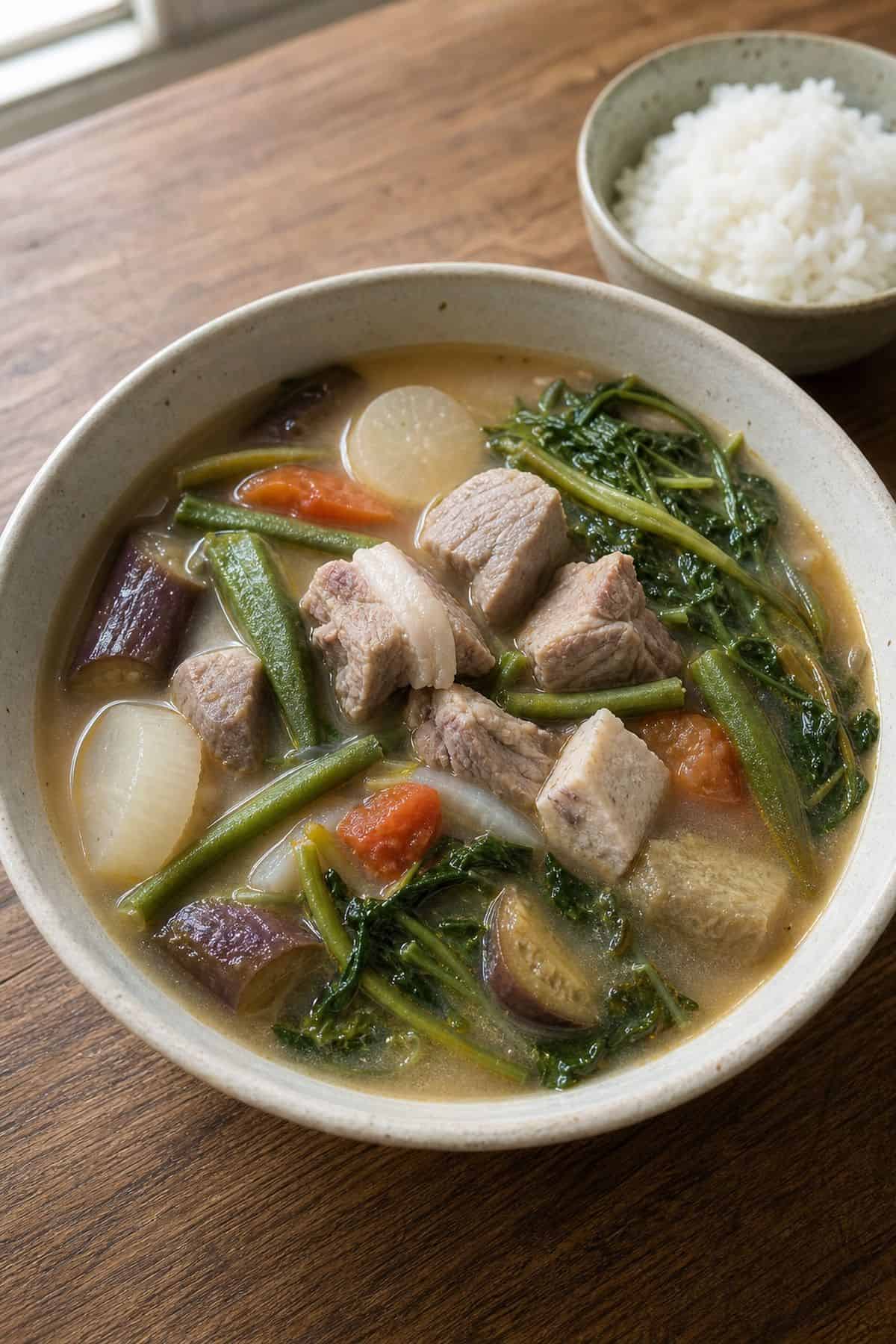
Filipino pork sinigang is a sour tamarind-based pork soup loaded with vegetables. It’s one of the most beloved dishes in the Philippines. You parboil the pork first to remove impurities, then simmer it low and slow with onions, tomatoes, and taro until fork-tender, before adding the tamarind seasoning and fresh vegetables. The whole thing takes about 1.5 hours and is always served over steaming white rice.
Filipino pork sinigang is the kind of dish that makes you pause on the first sip of broth. It’s sour, savory, and comforting. This tamarind-based pork soup with vegetables manages to be bold and soothing at once. This is my family version, passed down from my mom and grandmom in Laguna. I make it at least once a month, whether I’m home in the Philippines or in Helsinki.
I am Tagalog, grew up in Laguna, and this is my version of sinigang na baboy, exactly the way my family made it. There are regional variations across the Philippines, but the soul of the dish stays the same: sour, savory broth, tender pork, and vegetables cooked just right.
WHAT YOU’LL NEED FOR PORK SINIGANG
These are the kitchen tools and pantry staples that make cooking sinigang easier. A proper stockpot and good fish sauce are the two things you really cannot skip.


THE STORY BEHIND SINIGANG
Sinigang means “to stew” in Filipino, and sinigang na baboy specifically means tamarind pork stew. It is one of the few Filipino dishes that has stayed remarkably consistent across regions. I have eaten sinigang at Filipino restaurants in Finland, London, Los Angeles, and Manila, and it is always recognizable, that sour-savory broth, the tender pork, the bright greens. Unlike chicken adobo, which every region and family cooks quite differently, sinigang has a consistency that makes it feel like something the whole country agrees on.
Sour fruit is the backbone of the dish. Tamarind is the most common, but in different parts of the Philippines, people use kamias (bilimbi), batuan, or green mango to get that characteristic sourness. I grew up eating the tamarind version and it is always what I make. You can cook down fresh tamarind pods, or use a sinigang mix packet, I do this regularly because good fresh tamarind is not easy to find in Northern Europe.
The pork belly or shoulder is traditional, but any cut with some fat and connective tissue works well. The fat renders into the broth during the long simmer and gives it richness that lean cuts just do not have. Bone-in pieces add even more depth. For something much faster with similar Southeast Asian flavors, my Thai basil shrimp stir fry takes about 15 minutes, a useful weeknight option when you want bold flavors without the slow cook.
What I love most about sinigang is how it rewards patience. You do not need many ingredients or fancy technique, just time. The pork simmers until completely fall-apart tender, the taro dissolves slightly into the broth giving it body and creaminess, and the vegetables go in at the very end so they keep their color. Get the timing right and the result is genuinely special. If you love sour, broth-forward cooking, my Finnish salmon soup (lohikeitto) is a completely different cultural tradition but has the same warm energy.
TIPS, SWAPS, AND INGREDIENT NOTES
Parboil the pork first. Starting the pork in cold water with ginger and garlic, boiling for five minutes, then draining and rinsing removes the foam and the “lansa” (raw meat smell) completely. It gives you a clean, clear broth that tastes noticeably better. If you have ever had sinigang that tasted slightly off, this step was skipped.
Use bone-in pork if you can. Bone-in shoulder or ribs add a gelatin richness to the broth that boneless pork just cannot replicate. The fat renders beautifully during the long simmer and gives the broth body that makes it exceptional over rice. Pork ribs are also a great choice and add even more depth from the bones.
Mash some of the taro into the broth. Taro (gabi) is not just a vegetable in this soup, it dissolves slightly as it cooks and gives the broth that signature thick, creamy, cloudy texture. Scoop out a few cooked pieces, mash them with a spoonful of broth, and stir the mash back in. This is the step that transforms good sinigang into great sinigang. If taro is unavailable, potato works as a substitute, though the broth will be slightly thinner.
Add vegetables in stages. Daikon takes the longest; eggplant and string beans are medium speed; okra is fast; morning glory wilts in under a minute. Add from firmest to most delicate and let the broth return to a boil between each addition. Rush this step and some will be overcooked while others are still raw. I made this mistake repeatedly when I first started cooking sinigang on my own.
Adjust the sourness gradually. Add the sinigang mix slowly and taste as you go. The level of sourness is personal (start with half a packet, taste, and add from there. If morning glory is unavailable, baby spinach works) add it right at the end and barely wilt it. Chinese cabbage and bok choy also hold up well. If you enjoy vegetable-loaded, low-effort soups, my Finnish pea soup (hernekeitto) follows the same relaxed approach, add everything to the pot and let time do the work.
RECIPE : FILIPINO PORK SINIGANG (SINIGANG NA BABOY)
Prep Time: 15 minutes
Cook Time: 1 hour 30 minutes
Total Time: 1 hour 45 minutes
Servings: 4–6
Ingredients
For the parboil:
- 1 kg (2.2 lb) pork shoulder or belly, cut into large chunks
- 2 slices fresh ginger
- 3 garlic cloves, crushed
- 1 teaspoon salt
- Water to cover
For the stew:
- 1 medium onion, quartered
- 2 medium tomatoes, quartered
- 1 medium taro root (gabi), peeled and cut into chunks
- 2 tablespoons fish sauce, plus more to taste
- 1 packet sinigang mix (Mama Sita or Knorr, 40g), or 1 cup tamarind paste
- 1–2 pork bouillon cubes (optional, for depth)
- 1 small daikon radish, sliced into rounds
- 1 small eggplant, cut into chunks
- 100g string beans (sitaw), trimmed and cut into thirds
- 6–8 okra pods
- 2 large handfuls morning glory (kangkong), or baby spinach
Instructions
- Parboil the pork. Place the pork in a pot with the ginger, garlic, salt, and enough cold water to cover. Bring to a boil over high heat and cook for 5 minutes, skimming foam as it rises. Drain, discard the ginger and garlic, and rinse the pork under cold running water. Clean the pot.
- Build the stew. Return the pork to the clean pot. Add the onion, tomatoes, taro, and fish sauce. Cover with about 1.5 litres of water and bring to a boil. Reduce to a gentle simmer, cover partially, and cook for 1 to 1.5 hours until the pork is completely fork-tender.
- Mash the taro. Scoop out a few cooked pieces of taro, mash them with a spoonful of broth in a small bowl, and stir the mash back into the pot. This thickens the broth and gives it the creamy, cloudy texture.
- Season with tamarind. Stir in the sinigang mix and bouillon cubes if using. Simmer for 3 minutes. Taste and adjust sourness and saltiness to your preference.
- Add vegetables in stages. Add daikon first and simmer 3 minutes. Add eggplant and string beans and simmer 3 more minutes. Add okra and cook 2 minutes. Finally, add the morning glory, stir once, and turn off the heat. The residual heat will wilt it perfectly.
- Serve immediately over steamed jasmine rice.
Notes
Storage: Sinigang keeps in the fridge for 2–3 days. The broth intensifies overnight and often tastes even better the next day. Reheating: Warm gently over medium-low heat, do not boil hard or the vegetables will fall apart. Make-ahead: Complete steps 1–4 up to a day ahead and add the vegetables fresh when you reheat and serve.
FREQUENTLY ASKED QUESTIONS
What is the difference between sinigang and tinola?
Both are beloved Filipino soups but they taste completely different. Sinigang is sour and tamarind-based, bold and tangy. Tinola is gentle and ginger-forward with green papaya and chili leaves, a milder, restorative broth. Both are deeply comforting, but they satisfy different cravings.
Can I use beef instead of pork?
Yes. Beef sinigang uses brisket or short ribs and follows the same method. Expect 2 to 2.5 hours of simmering for the beef to become properly tender. The broth will be richer and deeper in flavor.
Do I have to use a sinigang mix packet?
No. You can use fresh tamarind pods: boil about 200g in 2 cups of water, mash them, strain through a sieve, and add the liquid to the soup. Fresh tamarind gives a slightly more complex, less uniform sourness than the packet mix. Both produce excellent results.
Can I make pork sinigang in an Instant Pot?
Yes. Cook the pork on high pressure for 35 minutes, then add taro and cook on high pressure for another 5 minutes. Use the sauté function to add the sinigang mix and vegetables at the end. The broth will be slightly lighter in color but the result is still excellent.
Is pork sinigang gluten-free?
Yes, this recipe is naturally gluten-free as long as you use a gluten-free sinigang mix. Both Mama Sita and Knorr sinigang mixes are naturally gluten-free, but always check the label as formulations can vary by region.
What vegetables can I add to sinigang?
The classic additions are taro, daikon, eggplant, string beans, okra, and morning glory. You can also add water spinach, banana flower, asparagus, or bok choy depending on what is available. The vegetables vary by region and season across the Philippines, the dish adapts well to what you have.
Key Takeaways
- Parboil the pork before making the stew to remove foam and “lansa” for a clean, clear broth
- Taro is essential for the broth’s creamy, cloudy texture, mash some pieces and stir them back in
- Add vegetables in stages from firmest to most delicate so nothing overcooks
- Season the tamarind sourness gradually and taste as you go, the level is entirely personal
- This recipe is naturally gluten-free, dairy-free, and egg-free
Filipino pork sinigang becomes a household staple once you learn to make it. The method is simple, the ingredients are straightforward, and it scales easily. Once you have the technique down, you will adjust the sourness to your exact preference and add whatever vegetables are in the fridge. If you want to explore more Filipino comfort food, my classic chicken adobo and sizzling tuna sisig are both worth bookmarking. This is the food I grew up eating, and I hope it becomes something you return to often.
FILIPINO PORK SINIGANG (SINIGANG NA BABOY)
Filipino pork sinigang is a sour tamarind-based pork soup loaded with vegetables. It's one of the most beloved dishes in the Philippines.
Ingredients
- 1 kg (2.2 lb) pork shoulder or belly, cut into large chunks
- 2 slices fresh ginger
- 3 garlic cloves, crushed
- 1 teaspoon salt
- Water to cover
- 1 medium onion, quartered
- 2 medium tomatoes, quartered
- 1 medium taro root (gabi), peeled and cut into chunks
- 2 tablespoons fish sauce, plus more to taste
- 1 packet sinigang mix (Mama Sita or Knorr, 40g), or 1 cup tamarind paste
- 1–2 pork bouillon cubes (optional, for depth)
- 1 small daikon radish, sliced into rounds
- 1 small eggplant, cut into chunks
- 100g string beans (sitaw), trimmed and cut into thirds
- 6–8 okra pods
- 2 large handfuls morning glory (kangkong), or baby spinach
Instructions
- Parboil the pork. Place the pork in a pot with the ginger, garlic, salt, and enough cold water to cover. Bring to a boil over high heat and cook for 5 minutes, skimming foam as it rises.
- Build the stew. Return the pork to the clean pot. Add the onion, tomatoes, taro, and fish sauce. Cover with about 1.5 litres of water and bring to a boil.
- Mash the taro. Scoop out a few cooked pieces of taro, mash them with a spoonful of broth in a small bowl, and stir the mash back into the pot. This thickens the broth and gives it the creamy, cloudy texture.
- Season with tamarind. Stir in the sinigang mix and bouillon cubes if using. Simmer for 3 minutes. Taste and adjust sourness and saltiness to your preference.
- Add vegetables in stages. Add daikon first and simmer 3 minutes. Add eggplant and string beans and simmer 3 more minutes. Add okra and cook 2 minutes. Finally, add the morning glory, stir once, and turn off the heat. The residual heat will wilt it perfectly.
- Serve immediately over steamed jasmine rice.
Notes
Storage: Sinigang keeps in the fridge for 2–3 days. The broth intensifies overnight and often tastes even better the next day. Reheating: Warm gently over medium-low heat, do not boil hard or the vegetables will fall apart. Make-ahead: Complete steps 1–4 up to a day ahead and add the vegetables fresh when you reheat and serve.
Last update on 2026-08-08 / Affiliate links / Images from Amazon Product Advertising API
Parboiling the pork is new to me. Trying it now. Thank you!
They do it a lot in Chinese cuisine. It takes away a lot of that “porky” flavor and leaves you with clean pork taste.