

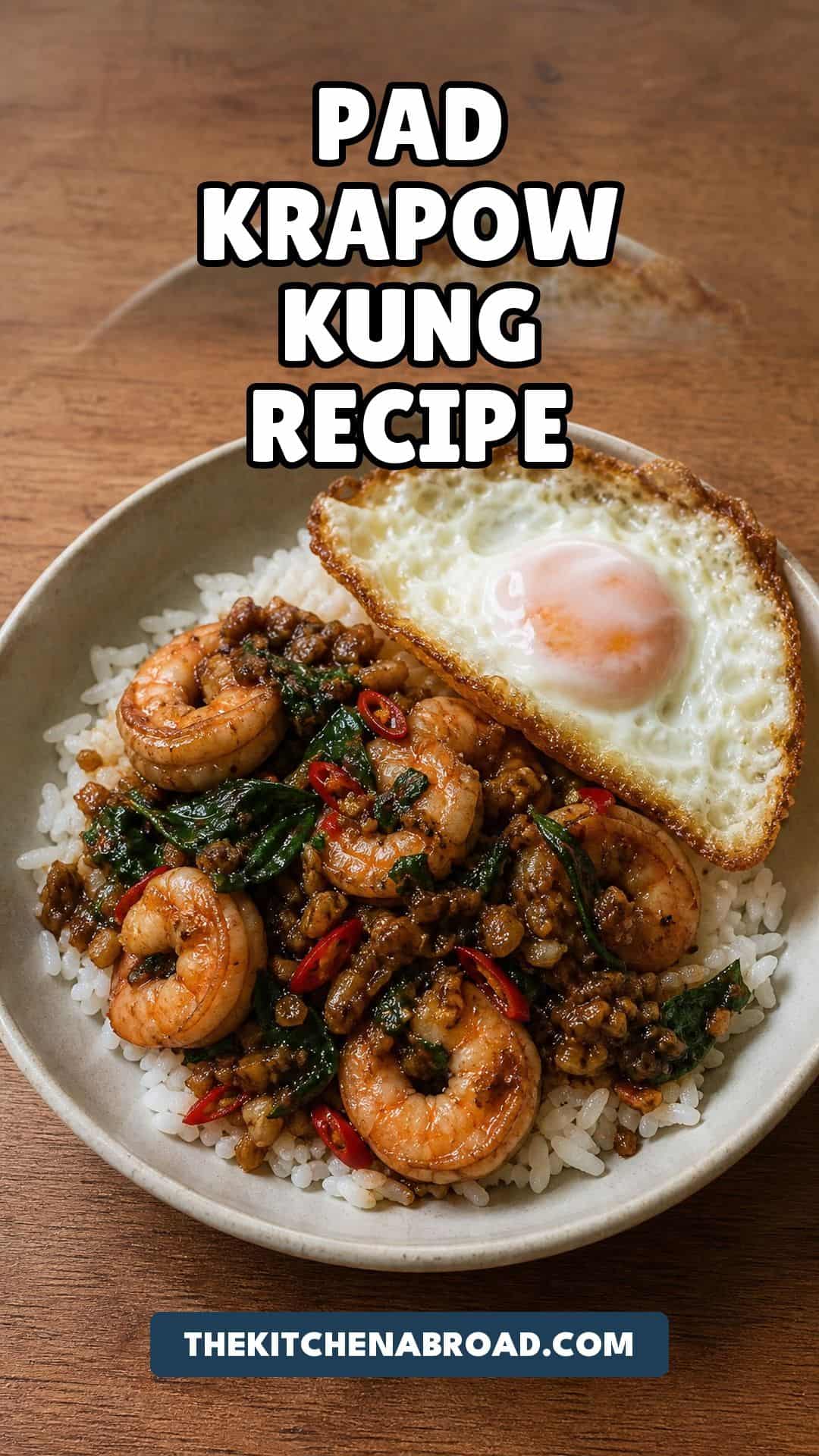
Pad kra pao shrimp (pad krapow kung, also spelled goong) is a Thai holy basil stir fry: shrimp seared fast with garlic and bird’s eye chilies, glazed in oyster, fish and soy sauce, then tossed with basil off the heat. It takes 20 minutes for two and goes over jasmine rice with a crispy fried egg.
A large peeled shrimp needs about 90 seconds in a smoking hot wok, which is less time than it takes most of us to find the fish sauce in the back of the cupboard. That tiny window is the whole challenge of pad kra pao shrimp, and it’s why I cook it a little differently from pad kra pao gai, the chicken version, even though the sauce is the same. Chicken gives you a minute of slack. Shrimp give you none.
So if your shrimp stir fries come out rubbery or swimming in liquid, this one’s for you. Below I’ll go through the basil question, why the sauce needs three salty bottles, the timing that keeps shrimp juicy and the egg that goes on top, and then the full recipe with exact amounts, so dinner is on the table before the rice cooker clicks off.
What I’d keep next to the stove for this


A carbon steel wok gets you closest to those smoky, slightly scorched street-stall edges, but any big heavy skillet does the job, and decent fish sauce and oyster sauce will do more for this dish than any pan (sorry, wok people).
What is pad krapow, and what does kung mean?
Pad krapow means “stir-fried holy basil,” and kung (also written goong) is the Thai word for shrimp or prawn, so pad krapow kung is the shrimp version of one of Thailand’s most ordered one-plate lunches. Menus spell it pad kra pao, pad gaprao or pad ka prao, and they all mean the same plate.
The other versions just swap the protein: gai is chicken, moo is pork, neua is beef and talay is mixed seafood. The sauce and the method barely change between them, which is good news for you, because once you can make this one you can make all of them. Shrimp is the fastest of the bunch by a mile.
Holy basil, Thai basil or Italian basil?
Holy basil is the right one, because krapow literally is holy basil, a peppery, clove-scented leaf and a different plant from the sweet, anise-heavy Thai basil (horapa) that most Asian shops stock. The second it hits the hot pan it softens and spreads that peppery smell through the whole dish, and that smell is pretty much the point.
Check Thai or Southeast Asian grocery stores first, and look in the freezer too, since frozen holy basil beats no holy basil. Only finding Thai sweet basil? Use it, and Italian basil after that, with a bigger handful to make up for the milder leaf. It still tastes great, just like a slightly different dish.
Dried basil? No. Please. It has nothing left to give.
How do you keep the shrimp from going rubbery?
Pat them very dry and take them off the heat a little early, since they keep cooking in the sauce. Frozen shrimp are completely fine here as long as they’re fully thawed, because the real enemy is water: wet shrimp cool the pan down and then simmer in their own liquid, and that’s how you end up with gray, bouncy shrimp sitting in a puddle.
This is where my years on a restaurant line come in handy. In a professional kitchen you cook shrimp by color and treat the timer as a rough guide. Lay them in the hot oil in one layer, leave them alone for about a minute, flip, and give them 30 seconds more. The FoodSafety.gov temperature chart describes cooked shrimp as pearly or white and opaque, so the moment the gray is gone, the sauce goes in.
Bigger shrimp give you more wiggle room. Tiny ones go from raw to chewy in about one blink, so if that’s all you can find, shorten the sear and add the sauce sooner.
Why does the sauce use fish sauce and two soy sauces?
Each bottle does a different job: fish sauce brings the savory salt that makes it taste Thai, oyster sauce adds body and a touch of sweetness, light soy adds clean salt and dark soy sauce is there mostly for that glossy brown coat. The teaspoon of sugar just rounds off all that salt.
Fish sauce is the one people want to skip because of the smell from the bottle. Don’t. In a hot wok it cooks down into something round and savory, and without it you get a generic brown stir fry. (Cooking for someone who avoids fish sauce? This vegan pad thai with tofu is built without it from the start.)
Mix every sauce in a small bowl before you turn the stove on. Once the garlic is in the oil there is ZERO time to measure, which is why chefs are so obsessed with mise en place, the fancy kitchen way of saying all those little bowls. Taste once, at the end, and adjust then.
How spicy is pad krapow kung?
With 4 bird’s eye chilies it lands at a solid medium for most people, and street versions in Thailand often go a lot hotter.
Want it milder? Use one or two chilies, or slice them open and scrape out the seeds. I wouldn’t drop them completely, though, because the chilies bring a fruity smell along with the heat, and the sauce tastes flat without them. Out of fresh chilies? A spoonful of chili paste works in a pinch, and these sambal oelek substitutes cover what else you can grab from the fridge door.
The egg on top: kai dao
Kai dao is the Thai fried egg that sits on almost every plate of pad krapow, fried in plenty of very hot oil so the white puffs up with crisp, lacy brown edges while the yolk stays runny.
Fry it in a small separate pan while the rice finishes, before you start the stir fry. The egg can wait a couple of minutes and the shrimp can’t. Then break the yolk over everything and let it run into the rice, which is the best bite on the plate (fight me).
Why is my pad krapow watery or bland?
Watery pad krapow nearly always comes from wet shrimp or a crowded pan, and bland pad krapow comes from going easy on the fish sauce or the chilies.
If the pan goes quiet when the shrimp go in, it’s either too full or not hot enough. Cook in two batches, or grab a bigger pan, and wait until the oil just starts to smoke. A sauce that still looks thin at the end only needs another 30 seconds of tossing over high heat, it reduces fast.
Bland is the easier fix. Add fish sauce a few drops at a time right at the end, plus a pinch of sugar if it tastes sharp, and you’ll taste the moment it clicks.
Can you make pad kra pao with prawns or mixed seafood?
Yes, prawn pad kra pao is the exact same dish, since prawn is what shrimp are called in the UK and Australia, and seafood pad kra pao (pad krapow talay) uses the same sauce with squid, mussels or firm fish.
Squid cooks even faster than shrimp, so add it when you flip the shrimp, and fold firm fish in gently at the end so it doesn’t fall apart. Some Thai cooks also chop the shrimp roughly so they cook like minced meat and grab more sauce, which is a nice trick when your shrimp are on the small side.
Want something cold next to all that heat? A spicy watermelon salad with Thai prik glua takes ten minutes and cools the table down.
Pad krapow kung recipe
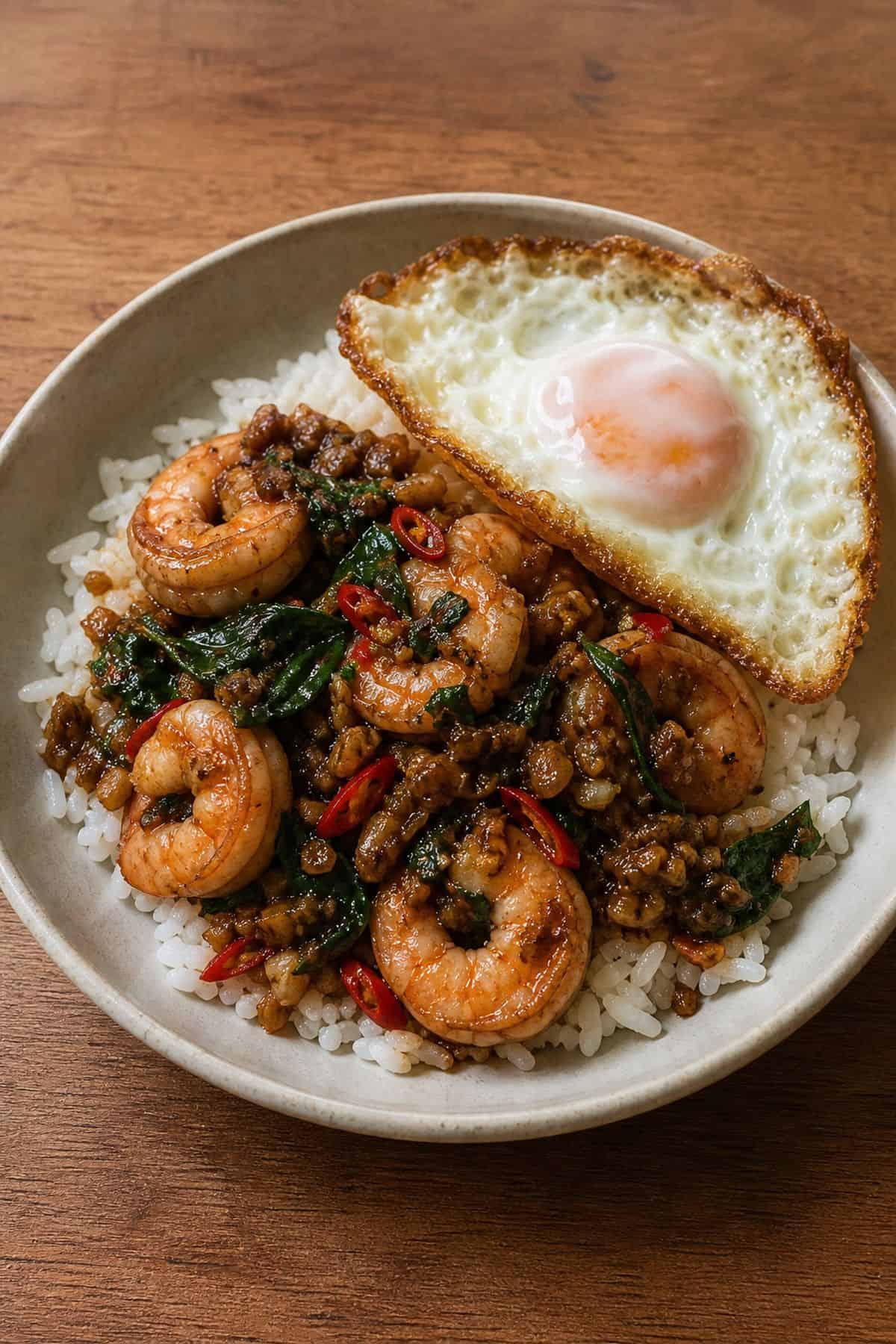
This is what you’re aiming for: shrimp in a dark, sticky glaze with wilted basil and thin slivers of red chili over white rice, and the fried egg on the side with crispy brown edges and a still-runny orange yolk.
Prep time: 10 minutes. Cook time: 10 minutes. Total time: 20 minutes. Servings: 2.
Ingredients
- 300 g (10 oz) large shrimp, peeled and deveined
- 4 cloves garlic, minced
- 4 bird’s eye chilies, thinly sliced (adjust to taste)
- 1 generous handful fresh Thai holy basil leaves
- 2 tbsp oyster sauce
- 1 tbsp fish sauce
- 1 tsp light soy sauce
- 1 tsp dark soy sauce
- 1 tsp sugar
- 2 tbsp vegetable oil
- Steamed jasmine rice and fried eggs, to serve
Instructions
- Mix the oyster sauce, fish sauce, light soy sauce, dark soy sauce and sugar in a small bowl. Set aside.
- Heat 1 tablespoon of the oil in a wok or large skillet over very high heat until it just starts to smoke.
- Add the garlic and chilies and stir fry for 30 seconds, until fragrant. Watch closely so the garlic doesn’t burn.
- Add the shrimp in a single layer and cook undisturbed for 1 minute. Flip and cook about 30 seconds more, until just pink throughout.
- Pour in the sauce and toss everything over high heat for 1 minute, until the shrimp are coated and the sauce has reduced slightly.
- Add the basil and toss once or twice, then take the pan off the heat right away. The leaves will finish wilting in the residual heat.
- Serve immediately over steamed jasmine rice with a fried egg on top.
Notes
Basil: Thai sweet basil or Italian basil can stand in for holy basil; the flavor will be milder.
Chilies: if you can’t find bird’s eye chilies, use 1 or 2 fresh red chilies and add more to taste. Bird’s eye chilies freeze well, so buy a bag when you see them.
Make ahead: mix the sauce up to 3 days in advance and keep it in a sealed jar in the fridge. Mince the garlic and slice the chilies a few hours before, and the cooking takes about 8 minutes.
Storage and reheating: this is best eaten fresh. Leftovers keep for 1 day in the fridge, but the shrimp firm up and the basil darkens. Reheat for a minute in a hot pan rather than the microwave, which turns shrimp rubbery fast.
Gluten-free: use tamari in place of the soy sauces and choose a certified gluten-free oyster sauce.
Pad krapow kung FAQ
When do you add Thai basil to a stir fry?
Add it at the very end, as you take the pan off the heat. The leaves only need a few seconds to wilt, and any longer turns them dark and cooks off the smell you added them for.
What are common mistakes when stir frying shrimp?
Wet shrimp and a crowded pan are the usual ones, since both make the shrimp steam in their own water instead of searing. The other is cooking them too long: pull them as soon as the gray turns opaque, because they keep cooking in the sauce.
Do shrimp and basil go well together?
Yes, the sweetness of shrimp works really well with peppery holy basil and with anise-sweet Thai basil. Thai and Italian cooks both figured that out a long time ago.
What is the difference between pad krapow and pad krapow kung?
Pad krapow is the whole family of Thai holy basil stir fries, and pad krapow kung is the shrimp version. Gai (chicken), moo (pork) and neua (beef) use the same sauce, so you can swap the protein freely.
Can I use frozen shrimp for pad kra pao?
Yes, frozen shrimp work fine once they’re fully thawed and patted very dry. Thaw them overnight in the fridge or in a sealed bag under cold running water, and never put them in the pan icy or wet.
What can I use instead of fish sauce?
Light soy sauce is the easiest swap, with a small squeeze of lime to bring back some brightness. It tastes less deep, so add a little more chili and garlic to make up for it.
Key takeaways
- Pad krapow kung is the shrimp version of Thailand’s holy basil stir fry, ready in about 20 minutes.
- Dry shrimp, one layer and a smoking pan keep them juicy; pull them the moment the gray is gone.
- Holy basil goes in last, off the heat. Thai or Italian basil works if that’s what you’ve got.
- Mix the four sauces and sugar before cooking and taste only at the end.
- Fry the kai dao first so the shrimp never have to wait.
Make the chicken version next
Once those 90-second shrimp feel easy, cook the same sauce with chicken, which forgives a slow hand a lot more, and if you’re feeding four, put the shrimp next to a pot of chicken panang curry and one big pot of jasmine rice for a full Thai dinner without much extra work.
Last update on 2026-10-05 / Affiliate links / Images from Amazon Product Advertising API