French country kitchen ideas come down to warm, worn materials that are used every day: terracotta or stone floors, cream or faded blue cabinets, a freestanding armoire, copper pans by the stove, honed marble for baking and linen at the windows. Keep counters clear and skip the rooster figurines.
A farmhouse kitchen looks like it was built last year inside a barn. A French country kitchen looks like it has been cooked in for eighty years by someone who never threw away a good pan, and that difference is the whole style. Most French country kitchen ideas online miss it and go straight for the toile wallpaper and the decorative lavender.
So every idea here comes with the question I’d ask in any kitchen: does it work while you cook, and does it look better with wear? Floors, cabinets and storage come first, then the soft layers, then the small daily things that make it feel lived in. Use as many or as few as your kitchen (and your budget) can take.

You Might Also Like These Blog Posts
- European Kitchen Ideas
- Cottage Kitchen Ideas
- Farmhouse Kitchen Ideas
- Mediterranean Kitchen Ideas
- Cream Kitchen Ideas
French Country Kitchen Ideas for Rustic Elegance
Twenty-five ideas, grouped by the job they do in the room, from the floor up.
What Gives a French Country Kitchen Its Bones?
The materials. Get the floor, the cabinet color and one big piece of furniture right, and the rest of the style falls into place around them.
1. Terracotta or Limestone Underfoot

Start with the floor, because nothing else in a French country kitchen looks right on top of shiny gray porcelain. The terracotta here is uneven in color, with orange, red and almost brown squares next to each other, and that variation is exactly what makes it feel old. Real terracotta needs sealing and gets a patina where you walk most, which is the point, while limestone is calmer and cooler underfoot. If replacing the floor isn’t happening, terracotta-look porcelain gets you close and laughs at spilled red wine. Either way, a warm floor makes even plain cream cabinets look French. One honest warning: terracotta is softer than porcelain, so a dropped cast-iron pan can chip it, and the cold of stone underfoot is real in winter (a washable flatweave runner by the sink helps). Grout color matters too, a warm sandy grout keeps the floor looking old, while bright white grout makes it look like new tile pretending.
2. Cream, Putty, or Faded Blue Cabinets
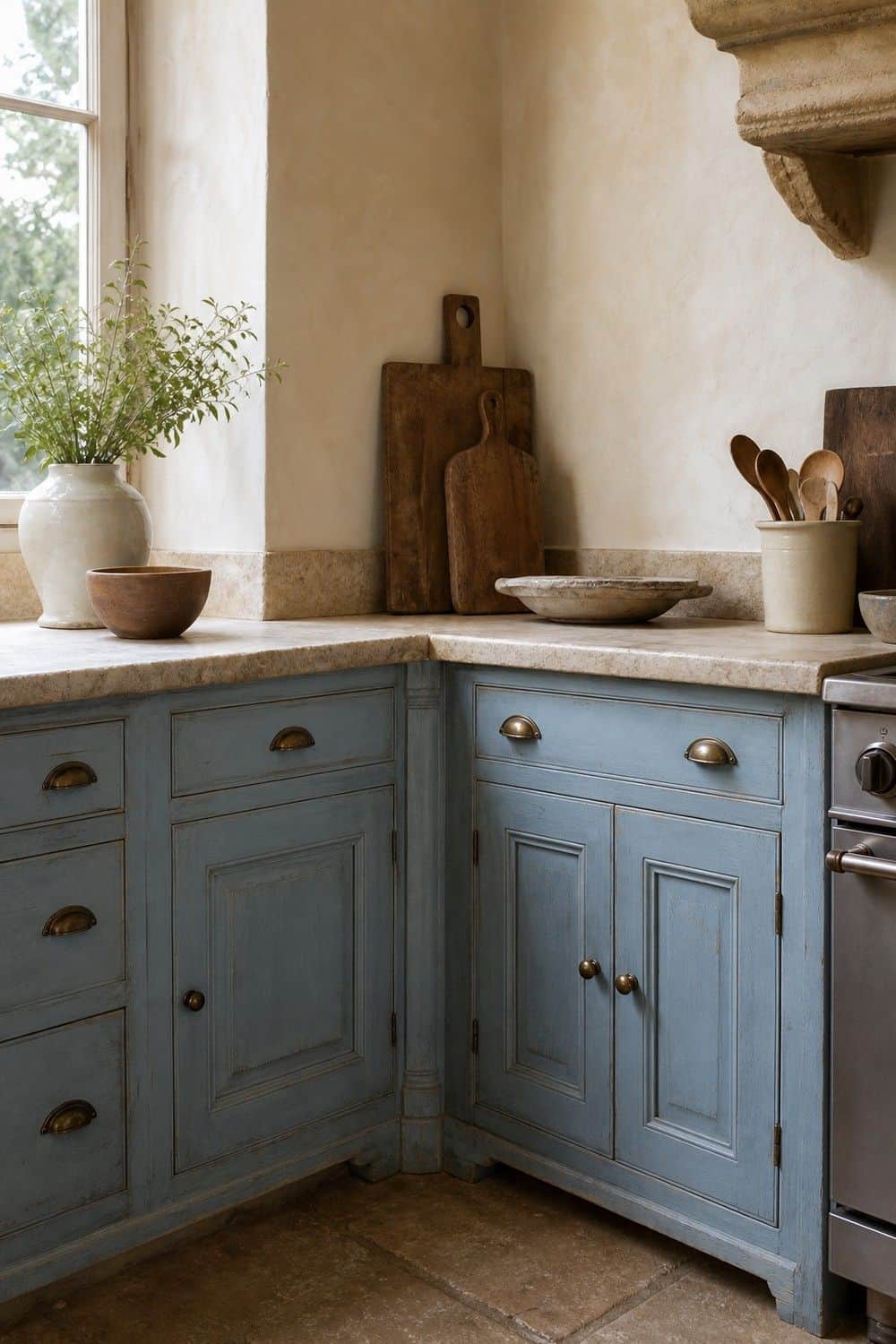
If one cabinet color says French country, it’s faded blue, and the word that matters most there is faded. The blue lowers in this kitchen are soft and a little gray, closer to old denim than to a bright navy, so they sit happily next to the warm stone counter and brass knobs.
Cream, putty, mushroom and sage work the same way: muted, a bit dusty and never stark white. Paint the lowers in the color and keep the uppers or walls cream, which keeps the room light and makes a small kitchen feel bigger.
3. Freestanding Armoire for Kitchen Storage
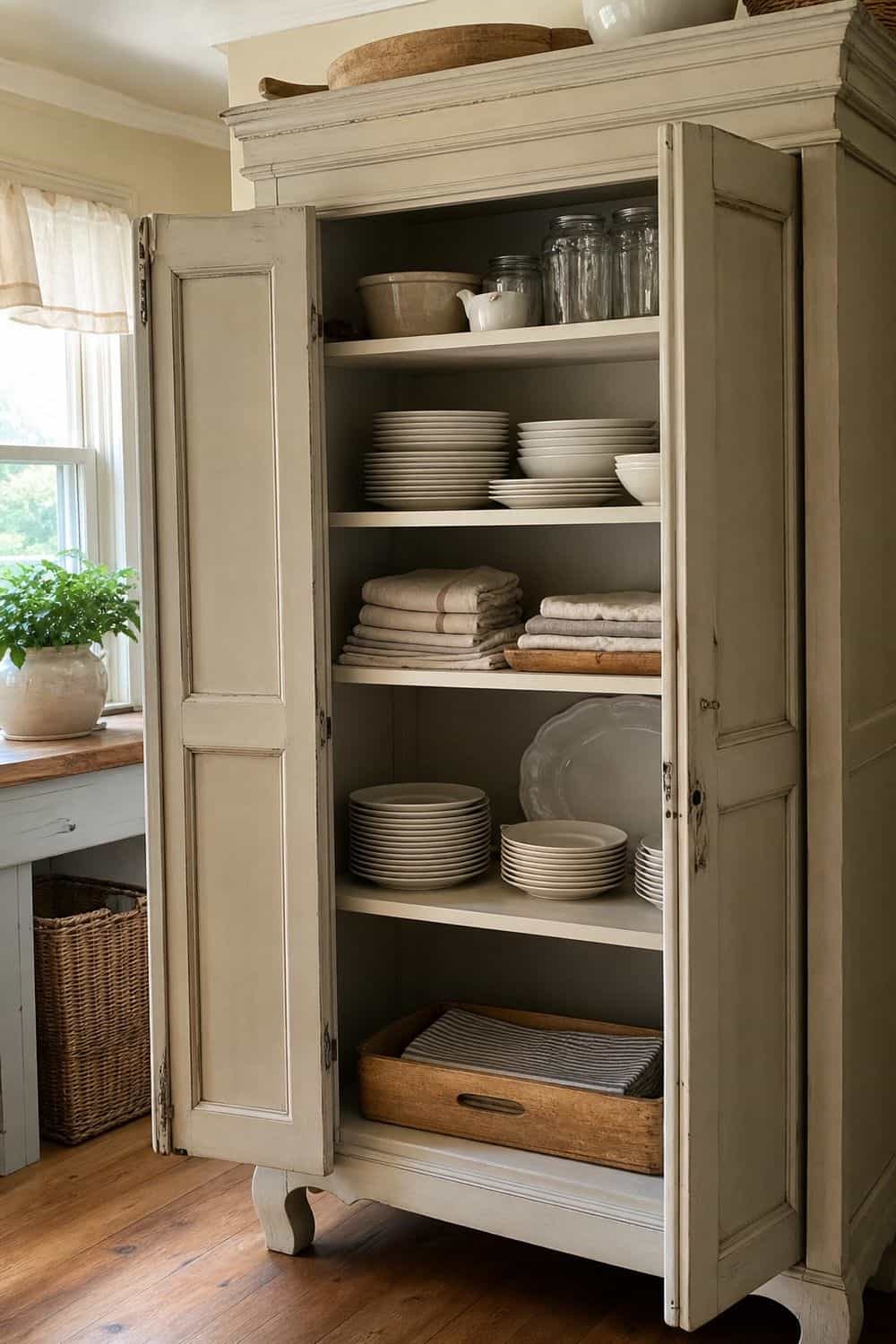
Nothing tells people this kitchen grew over time (instead of arriving from one catalog) like a freestanding armoire. A painted cream one like this, doors open and stacked with plates, linens and jars, does the job of a pantry while looking like furniture. Before you buy one, check a few practical things:
- Measure the door swing, because tall armoire doors need room to open fully.
- Look for shelves no deeper than about 16 inches, so nothing gets lost at the back.
- Anchor it to the wall, since a heavy, tall piece full of plates can tip.
Secondhand ones are easy to find, and a scuffed edge only helps. If the inside smells musty, a coat of shellac on the shelves and a few days with the doors open usually sorts it out.
4. Copper Pans Where They Are Used

Copper is the cliche that earns its spot, but only if it lives near the stove and gets used. The three copper pans hanging from a black rail here sit right next to the range, which is where a cook would want them.
The pans worth hanging are the ones you actually reach for (a sauté pan, a small saucier), while the dusty decorative ones belong in a cupboard. Copper darkens with use, and you can polish it or let it go warm and brown, both look right in a French kitchen as long as the pans are clearly working pans.
5. Curved or Plaster Range Hood
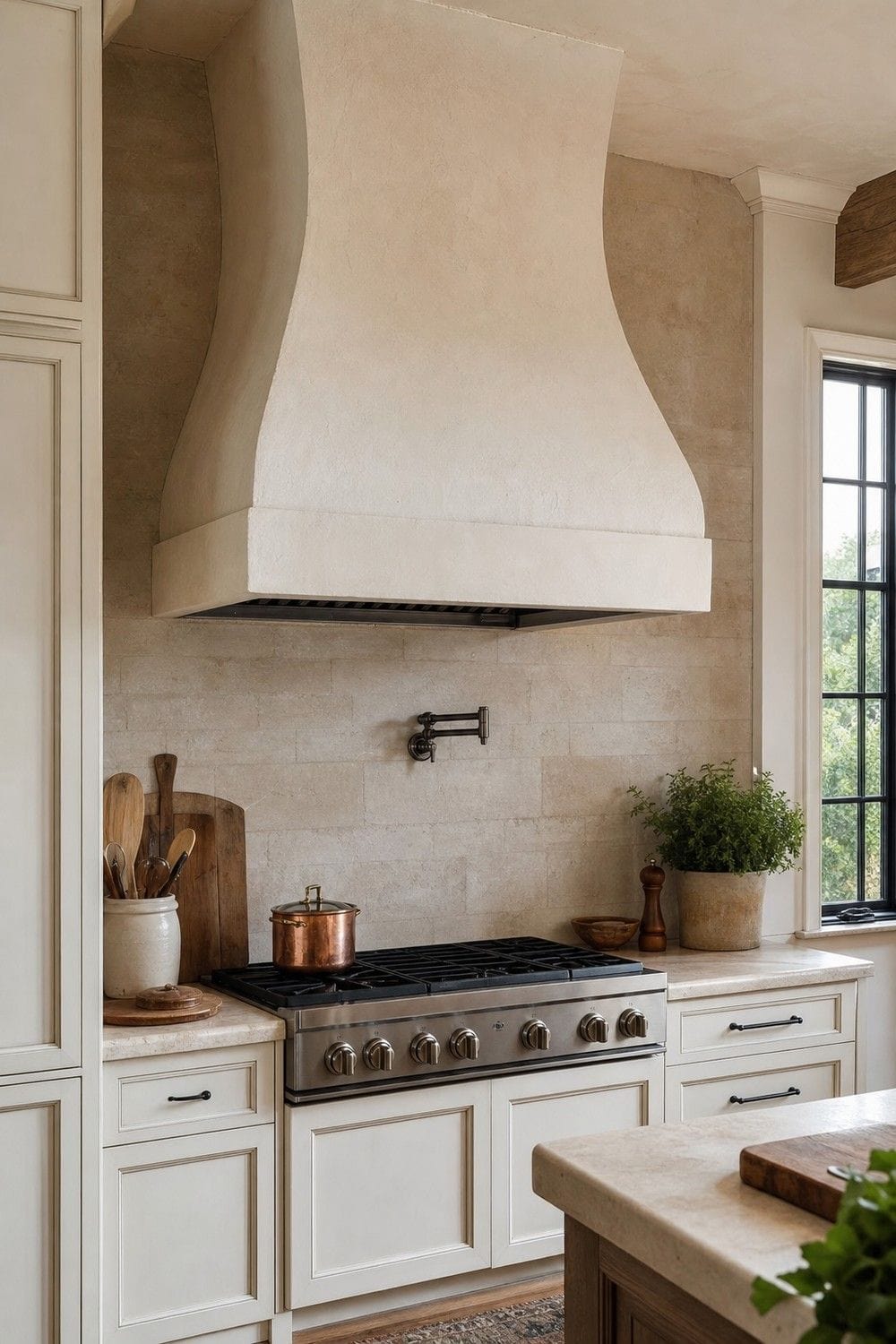
A curved plaster hood turns the cooking wall into the main event without a single decoration, and it’s one of the details people remember most about a French kitchen. The cream bell-shaped hood here is the same color as the walls, so it looks carved out of the room rather than bolted on. The shape matters more than the size, but proportion does too: a hood that’s too wide looks heavy, and one that’s too narrow looks like an afterthought, so line its edges up with the range or a little wider. Underneath, you still need a proper fan that’s vented outside, because pretty plaster doesn’t pull steam out of a room.
6. Honed Marble for a Soft Prep Surface

Honed marble is the baker’s counter, and that’s why it belongs in a French country kitchen. Cool stone keeps pastry and bread dough from getting warm and sticky, which you can see with the dough ball and wooden rolling pin on this one.
Honed means the polish is sanded down, so etching from lemon or wine shows less than on shiny marble. It still marks over time, and in this style that’s fine, those marks are the kitchen’s history.
Don’t want marble counters everywhere? Put one slab on a baking zone or the island, or get a big marble pastry board and keep the rest of the counters in something tougher.
How Do You Add French Country Softness Without Going Overboard?
Use one soft touch per surface. Fabric, mesh and cane add the softness, and a little of each goes a long way.
7. Chicken Wire or Mesh Cabinet Inserts
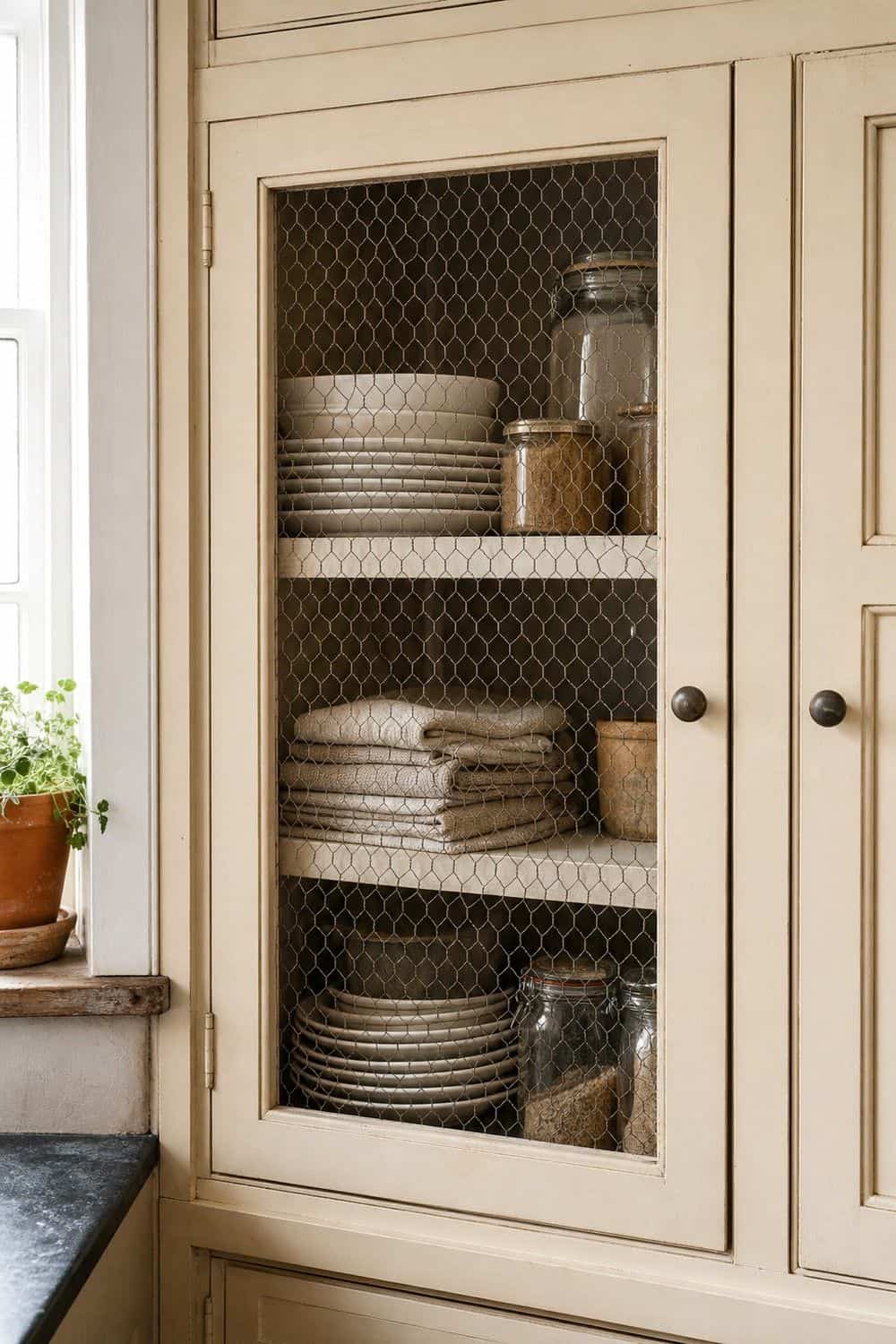
Chicken wire in a cabinet door gives you the look of an old French dresser for very little money, and it works best on one hutch or one upper cabinet, not every door. You still see what’s inside, so it also helps you find things faster than solid doors.
The catch is that everything behind the mesh is on display. In this cream cabinet it’s white plates, folded linens and glass jars, which looks calm. Put cereal boxes and colorful packaging back there and the whole effect falls apart, so save it for the pretty stuff.
8. Linen Cafe Curtains for Soft Light

Cafe curtains cover only the lower half of the window, so you get privacy at the sink and still keep the daylight coming in above. The cream linen ones over this fireclay sink are sheer enough to glow when the sun hits them, which is what makes the corner feel French rather than just pretty. Hang them on a thin rod inside the window frame, use washable linen or cotton, and keep the color plain or with a small check. They’re also one of the cheapest ways to change a kitchen in an afternoon, perfect for renters who can’t touch the cabinets.
9. Toile or Ticking in Small Doses

Toile and ticking are French country classics, and they’re also the fastest way to make a kitchen look like a theme park version of France. The fix is size. A ticking stripe runner on a wood table, like the blue and white one here, adds the pattern in one place you can wash or swap.
One pattern per room is my rule, in a color you already have. Blue ticking with faded blue cabinets, or a red toile on a single chair cushion, feels collected, while toile wallpaper, toile curtains and a toile tablecloth all together feels like someone bought the whole collection.
10. Trestle Table for Daily Kitchen Life
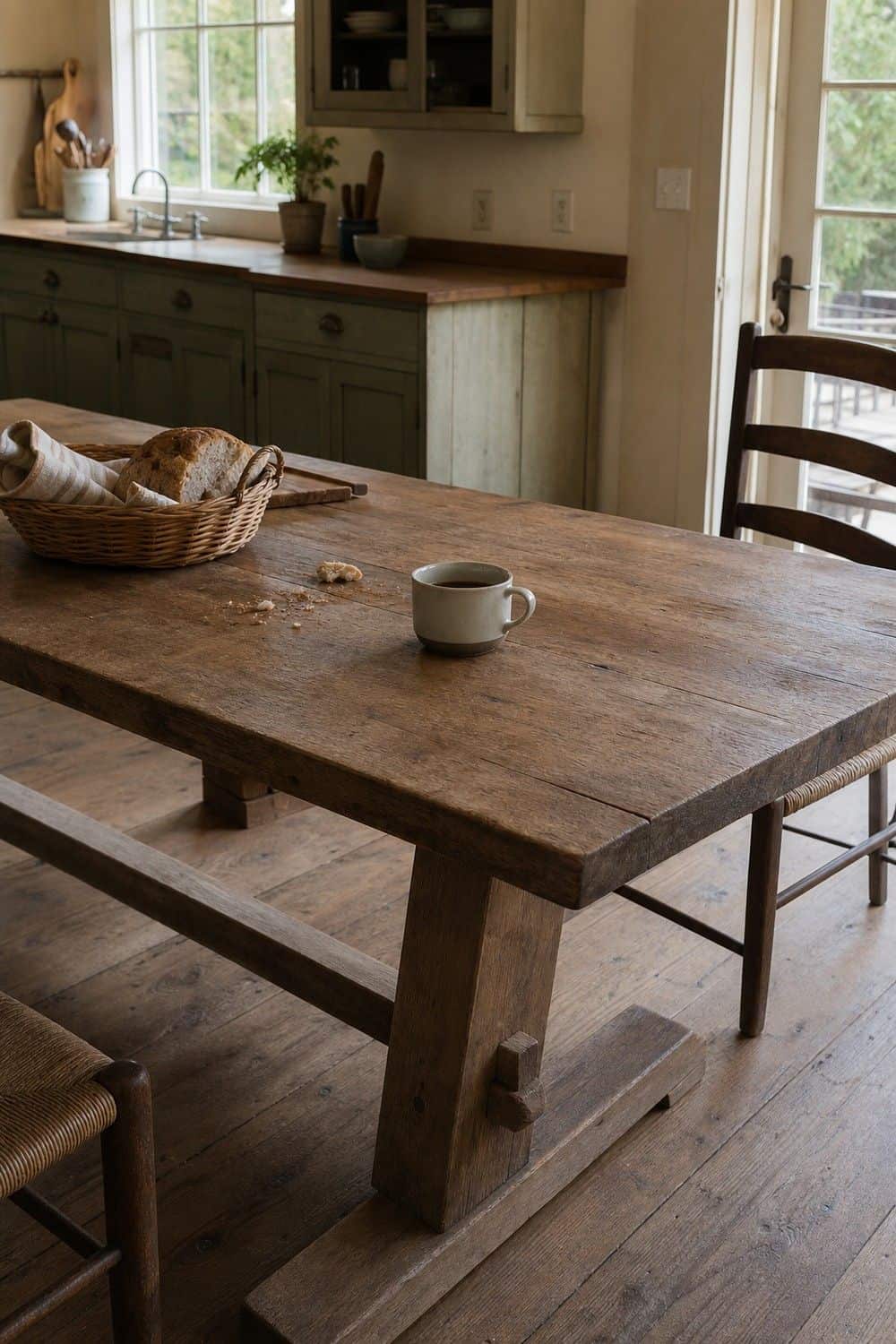
A trestle table is where French country kitchens actually live, because it’s used for everything: breakfast, homework, rolling dough, folding laundry, and dinner for eight. The long rustic one here has a bread basket and a coffee mug on it, which is about as honest as kitchen styling gets.
Look for thick, worn wood that can take knife marks, spilled coffee and hot pans, and skip anything with a glossy finish. A trestle base also gives more legroom than four corner legs, so you can squeeze more people around it.
If your kitchen has no room for a table, a narrow trestle-style console against a wall still works for serving and prep. It’s the material and the shape that matter, more than the size. Pair it with a long bench on one side and you can seat more people in less space, plus a bench tucks fully under the table when you need the floor for something else, like a big batch of jam cooling on trays.
11. Louis-Style or Bistro Chairs

Want French character without touching a single cabinet? Change the chairs. Bentwood bistro chairs with cane seats, like the pair here on the stone floor, feel like a Paris cafe, while a carved Louis-style chair feels more formal and country house. Mixing the two around one table looks collected rather than matchy. Think about real use, too: cane can stretch over time, so add a linen cushion if the chairs see daily meals, and choose finishes you can wipe, since kitchen chairs collect more sticky fingerprints than any other furniture in the house.
Which Details Make It Feel Old in a Good Way?
The ones you touch every day. Shelves, sinks, hardware and light fittings all age, and in this style that’s a feature.
12. Open Shelves for Everyday Ceramics

Open shelves in a French country kitchen should look like a working cupboard without doors, holding the dishes you use most, not a styled display. The thick reclaimed wood shelves here hold stacked plates, mugs and a blue and white pitcher, all things that come down and go back up daily. A few habits keep them looking good:
- Group by type, plates with plates and mugs with mugs.
- Leave a little space at each end of a shelf.
- Keep shelves away from the range, where grease settles on everything.
A weekly wipe keeps them charming instead of sticky.
13. Blue-and-White Platters in One Place

Blue and white platters look best grouped together in one spot, like the three standing on this cream hutch shelf, rather than scattered across every wall in the kitchen. Gathered, they read as a small collection someone cared about, and spread out they start to look like clutter. Mix sizes and patterns (florals, country scenes, borders) but keep to the same blue, and stand the biggest one at the back. The best part is that they’re still usable, so when you host, the platter comes off the shelf and the cheese goes on it, which is exactly how a French country kitchen should work.
14. Fireclay Farmhouse Sink With French Details

A fireclay farmhouse sink is deep, sturdy and big enough for a roasting pan, so it’s as practical as it is pretty. The fluted white front on this one, paired with a brass faucet and taupe cabinets, makes it feel more French than a plain apron front.
Faucet reach matters more than people expect, because a deep bowl with a short spout means splashing all over the counter. The sink is also heavy, so the cabinet underneath needs proper support, which is a conversation for your installer, not a weekend DIY.
15. Aged Brass or Bronze Hardware

Swapping cabinet hardware is one of the cheapest French country updates there is, and one of the most noticeable. The aged brass cup pulls and the little brass slide latch on this cream pantry door look like they’ve been opened thousands of times, which is the whole effect. Choose unlacquered or antique finishes that darken where hands touch them, and stick to one metal for most of the kitchen so it looks deliberate. A full set for a small kitchen can be changed in an afternoon with a screwdriver, and if you rent, keep the old knobs in a labeled bag to put back when you leave.
16. French Country Chandelier Over the Table

A chandelier adds the elegant half of rustic elegance, and it looks most natural over a table rather than over an island. The small brass one with candle-style arms here hangs above a trestle table with cross-back chairs, and the contrast between the rough wood and the delicate metal is what makes it work.
Keep it smaller than you think, since a huge chandelier in a kitchen looks like it wandered in from a hotel lobby, and put it on a dimmer. Use warm bulbs, around 2700K, so dinner looks golden instead of like an office.
What Small Things Finish the Look?
Things you use: bags, bread, spoons, herbs and fruit. If it doesn’t do a job, it’s probably decor you don’t need.
17. Wrought Iron Hooks for Market Bags

Got a drawer stuffed with tote bags? Wrought iron hooks by the door or pantry fix that, French country style, and they cost very little. Three black hooks like these hold a mesh market bag, a linen apron and a small drawstring bag, everything you grab on the way to the market. A few ways to keep it useful:
- Hang only what you use weekly, so the hooks don’t become a pile.
- Space them far enough apart that each item hangs flat.
- Put them near the door or the fridge, where you actually unload.
- Use screws into a stud or proper wall anchors, since a full market bag is heavy.
18. Linen Bread Bag or Basket

Bread has its own spot in a French kitchen, and a linen-lined basket like this one, with a baguette and two crusty rolls, makes the whole table look like a bakery delivery just arrived. It’s useful too: linen lets the crust breathe, so it stays crisper than in a plastic bag.
Keep the basket away from the sink and the stove, where steam softens the crust, and shake the cloth out every day or two. Day-old baguette still makes great toast or croutons, so nothing has to go to waste. A linen bread bag hanging on a hook does the same job as the basket if counter space is tight.
19. Crocks for Utensils and Wooden Spoons

Of everything on this list, a stoneware crock by the stove is the smallest change and probably the one you’ll use the most. The cream crock in this kitchen holds wooden spoons and a whisk right next to the range, exactly where your hand goes mid-stir. Use one crock for the tools you cook with every day and move the rest into a drawer, because an overstuffed crock is impossible to pull one spoon out of. Wooden spoons look warmer than plastic ones, and a heavy crock won’t tip over when you yank a ladle out in a hurry, which is more important than it sounds.
20. Dried Herbs Without Overdecorating

Nothing says Provence faster than a bundle of dried herbs on the wall, and one is plenty. The rosemary and thyme here hang from a single iron hook next to a linen towel, which looks natural rather than staged.
The best bundle is one you’ll cook with, pulling sprigs off as you need them. Rosemary, thyme, bay and oregano dry well this way, while basil and parsley turn sad and brown.
Keep the bundle away from the stove, because steam and grease make dried herbs dusty and sticky fast. Replace it every few months, and if you can’t remember when you hung it, that’s your sign. Lavender is the exception to the cooking rule: a small bunch by the window smells lovely, just keep it out of the food (lavender in a stew is a mistake you only make once).
21. Market Produce Bowl
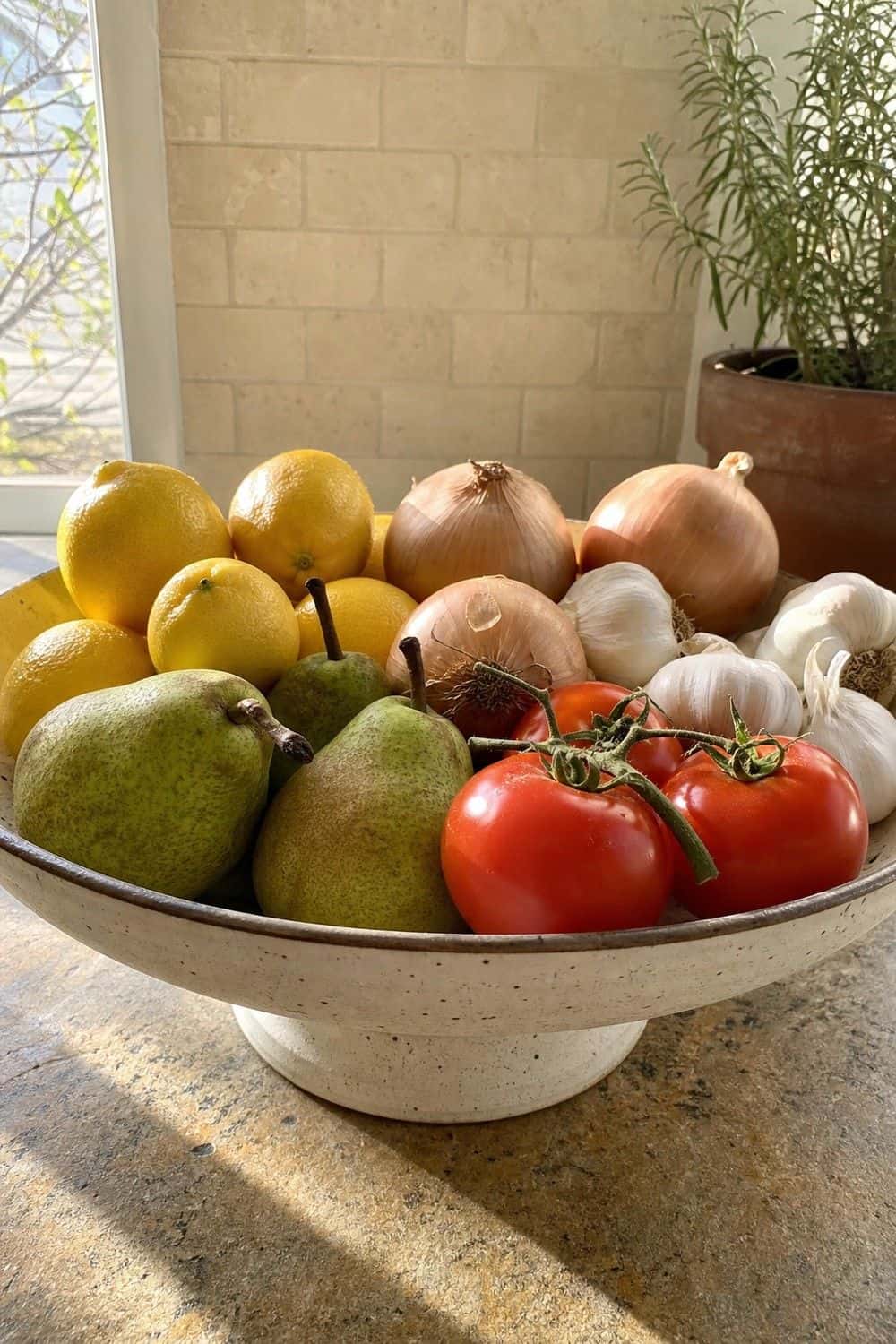
A big bowl of fresh produce is decor you can eat, which makes it the most practical styling trick in any kitchen. The footed speckled bowl here holds lemons, pears, onions, garlic and tomatoes, all things that are happier on the counter than in the fridge. Keep potatoes out of it, since they want a dark spot, and swap fruits with the seasons (apples and pears now, cherries in summer). A raised, footed bowl looks more French than a flat one and keeps fruit from bruising against each other. And when the bowl is empty, that’s your reminder to go to the market.
How Do You Keep It From Looking Like a Theme?
Walls and surfaces should stay quiet. Let the materials carry the style, and edit anything that’s only there to say “France.”
22. Plaster or Limewash-Look Walls
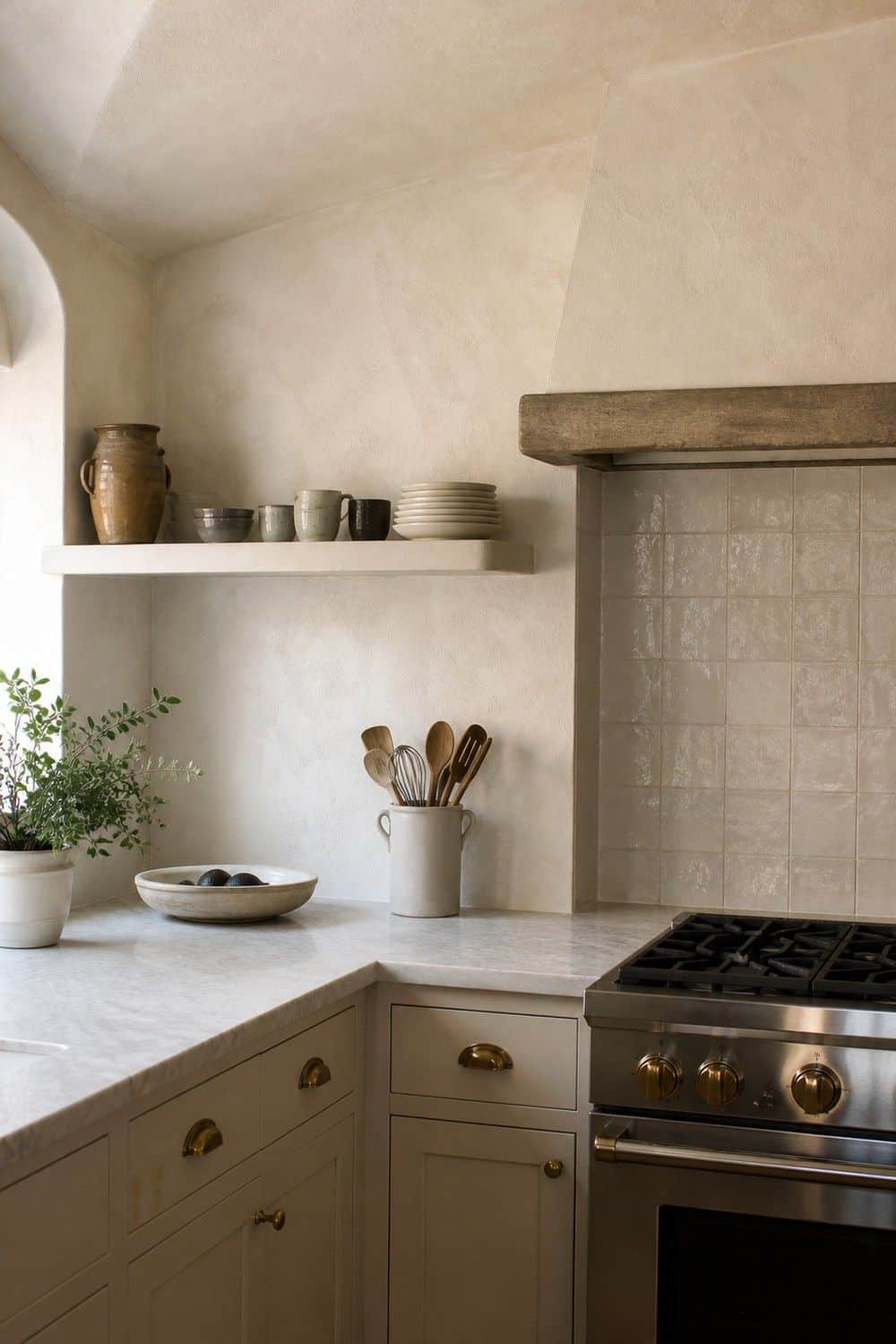
Limewash or plaster walls give a French country kitchen the soft, slightly cloudy look of old stone houses. The cream walls here, with an arched niche and a shelf of pottery, look gently uneven, and that movement is what flat paint can’t give you.
Real limewash isn’t very washable, so keep it to walls away from splashes and use tile behind the range, the way this kitchen does with its small tile panel. Limewash-look paints are an easier option for renters or anyone who wants to wipe the walls, and they still give you that soft, brushed look if you apply them with a big brush in crisscross strokes.
23. Vintage Art or Engravings
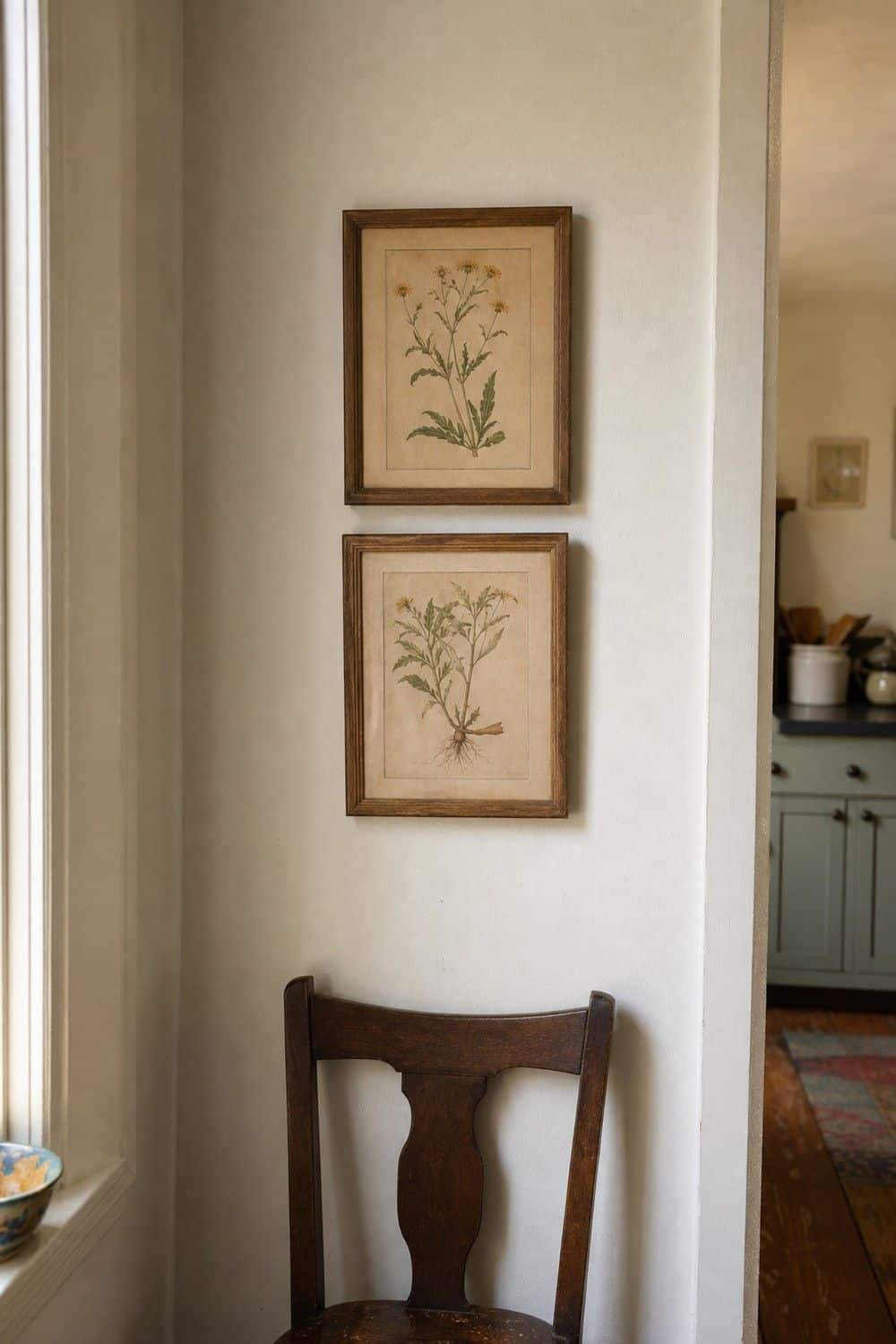
Art in a French country kitchen should look like it came from a flea market, not from a home store’s France section. Two framed botanical prints, hung one above the other over a dark wooden chair like here, are enough for a whole wall. Old botanical engravings, small countryside scenes, market scenes and still lifes all fit, and slightly faded frames are better than shiny new ones. Hang art away from the stove and sink, where steam can warp paper, and keep it at eye level when you’re sitting at the table, not standing. Skip the word art entirely (no “Bon Appétit” signs, please).
24. Linen Runner for Everyday Texture

A linen runner softens a long wooden table without hiding it, and that’s why it beats a full tablecloth in this style. The natural one here runs down a rustic table with a mug, a bread basket and a jar of branches, the kind of setup that looks good at breakfast and still works at dinner.
Pick washable linen in natural, oatmeal or a faded stripe, and accept that it’ll wrinkle (that’s the charm). Take it off for messy meals, toss it in the wash and put it back on, slightly crumpled and still nice.
25. Clear Counters With Rustic Elegance

Clear counters are what separate a French country kitchen from a cluttered one, and that comes down to giving the everyday things one home. The small marble tray here holds olive oil, a pepper mill, a salt cellar and a little vase of herbs, and the rest of the stone counter stays bare. A quick edit for your own counters:
- Take everything off one counter.
- Put back only what you use daily, grouped on a tray or board.
- Find a cupboard for the rest, including the decorative roosters.
What stays out should look useful, because in this style, useful is the pretty part. Repeat the edit every season, since counters fill up again quietly, one jar and one gadget at a time, and the tray is what keeps it from happening.
How To Keep French Country Style Useful
Treat every item as a tool first. A French country kitchen is lighter and more European than an American farmhouse kitchen, with terracotta, plaster, copper and linen instead of shiplap and galvanized metal, but both fall apart when decor takes over the counters.
Plan for upkeep from day one: terracotta and marble need sealing, copper changes color, linen needs washing and open shelves need dusting. If that sounds like a lot, start with the no-renovation swaps (cafe curtains, brass hardware, a utensil crock, a market bowl, blue and white platters) and see how the room feels. For a grander, more formal take on the same roots, see these French Provincial kitchen ideas.
Can a Small Kitchen Be French Country?
Yes, and small kitchens often do it better, because there’s less room for clutter. Pick two or three anchors instead of all 25: a warm floor or rug, one painted cabinet color and one piece with character, like a small armoire, a plate rack or a single open shelf. Keep the walls cream, use linen at the window and let a crock, a bread basket and a produce bowl do the styling. In a tight galley, hang copper on a short rail by the stove instead of a big pot rack, and skip the chandelier in favor of one warm pendant.
Frequently Asked Questions
What makes a kitchen French country style?
A French country kitchen mixes rustic natural materials with a few elegant details. Think terracotta or stone floors, cream or faded blue cabinets, a freestanding armoire, copper pans, honed marble, linen and aged brass, all used every day.
What colors are used in French country kitchens?
The main French country kitchen colors are cream, putty, faded blue, sage and soft clay. They’re all muted and slightly dusty, and they sit well next to terracotta, limestone, wood and copper.
How is French country different from farmhouse style?
French country is lighter and more European, while farmhouse is more American and rustic. French country leans on terracotta, plaster, copper, toile and armoires, and farmhouse leans on shiplap, galvanized metal and painted wood.
How do I make a French country kitchen without renovating?
Start with the things you can swap in a weekend. Linen cafe curtains, aged brass hardware, a utensil crock, a copper pan rail, blue and white platters, a market bowl and a linen runner change the feel of a kitchen without touching the cabinets.
Key Takeaways
- Build the look from materials: terracotta or stone, cream or faded blue paint, copper and marble.
- One big piece of furniture, like an armoire or a trestle table, does more than ten small decor items.
- Use pattern (toile, ticking) in one place only.
- Hang copper and herbs where you cook, not where they look pretty.
- Keep counters clear, with daily things grouped on a tray.
- Expect patina, and plan for sealing, polishing and washing.
So, Would This Kitchen Pass the Eighty-Year Test?
Remember that kitchen cooked in for eighty years by someone who never threw away a good pan? That’s your filter for every French country idea. Before you buy anything, ask whether it’ll still be useful and still look good after years of steam, spills and hands, and whether it does a job while you cook. Terracotta, copper, marble, linen and a solid old table all pass easily. A rooster clock and toile-covered everything won’t, so leave those in the shop and put the money toward one great piece you’ll actually use.