

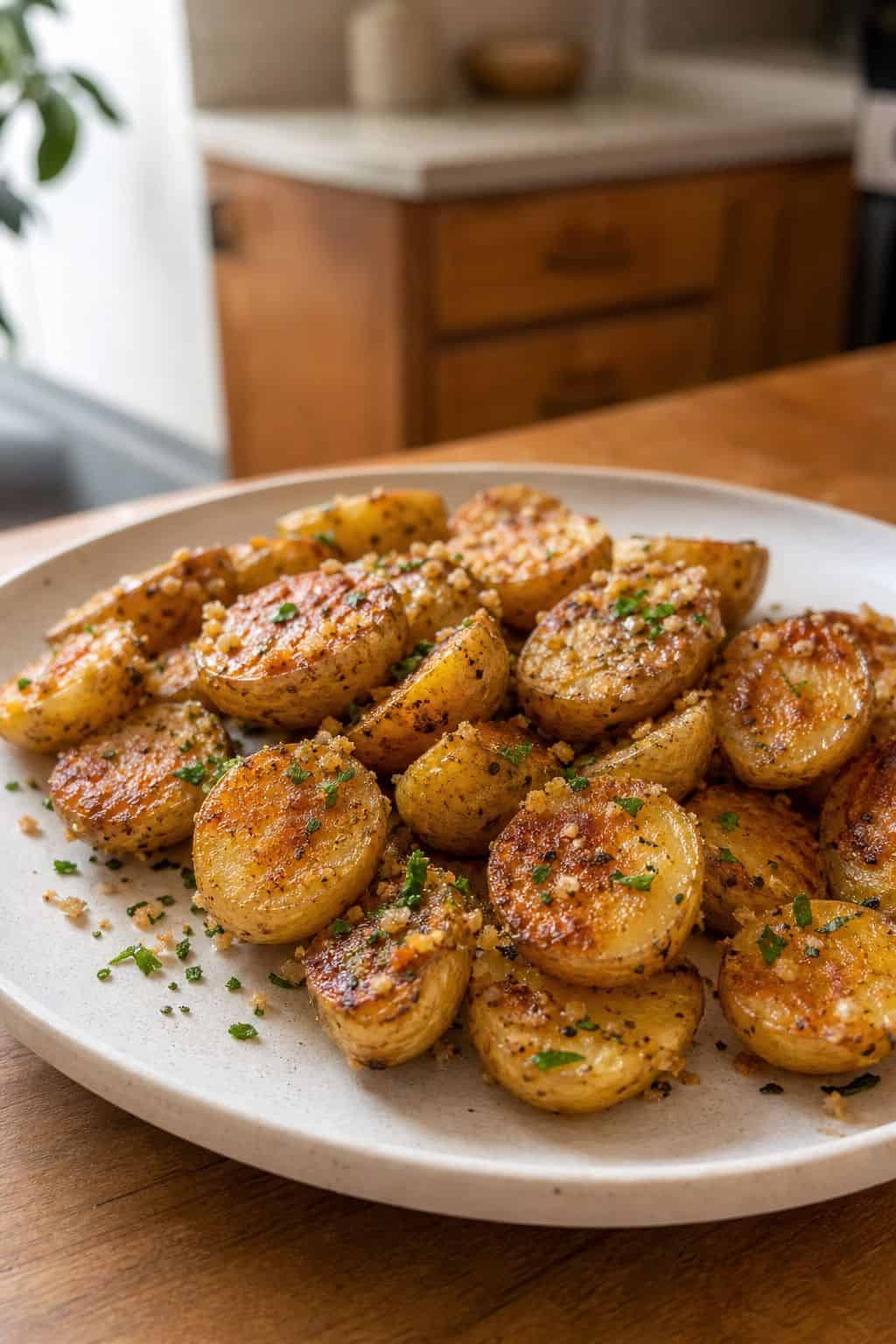
Garlic parmesan roasted potatoes are halved baby potatoes tossed with olive oil and fresh garlic, roasted cut-side-down at 425°F (220°C) on a preheated sheet pan until the flat faces go deep gold, then finished with freshly grated Parmigiano-Reggiano in the last 10 minutes so the cheese fuses to the surface instead of burning to bitter dust. One pan, 35 minutes, six side servings. The version below is the weeknight workhorse, not the holiday production.
These are the potatoes you make Tuesday night when the chicken thighs are already in the oven and the side has to earn its place without much thought. Halved baby Yukons, oil, fresh garlic, a hot sheet pan, parmesan dropped on at the right moment. Thirty-five minutes start to finish, most of it hands-off, and the protein on the plate next to them suddenly has something to push against. This sits in our weeknight lane on purpose: if you want the creamy holiday version, our creamy potatoes au gratin is the Sunday dinner answer, and for a more textural dinner-party potato with torn craggy edges, our crispy smashed potatoes is the boil-then-roast play. This one is the everyday workhorse.

Equipment Notes
A half-sheet pan that fits a single layer of halved potatoes without crowding, a stainless garlic press for fast mincing, a microplane for the parmesan (the snow-fine grate fuses better than coarse shreds), an olive oil dispenser for a controlled drizzle when tossing, and a thin fish spatula to lift the cut-side-down halves off the pan without tearing the lacquered face.


Recommended Reads
- Creamy Potatoes Au Gratin
- Crispy Smashed Potatoes
- Best Easter Dinner Ideas
- Best Thanksgiving Side Dishes
- Roasted Spring Vegetables with Lemon Herb Drizzle
Where Garlic Parmesan Potatoes Come From
The bones of this recipe are Italian. Patate al forno is peasant cooking from Campania, born from the same logic as most southern Italian food: take what is local and cheap (potatoes, olive oil, garlic, rosemary), put it in a hot oven, and let the ingredients do the work. The yellow patate gialle grown in the volcanic soil around Vesuvius are particularly buttery, and the classic version skips cheese entirely. Olive oil, garlic, rosemary, salt, hot oven, done.
The American steakhouse adaptation arrived mid-twentieth century and pushed the cheese to the front of the line. Parmesan replaced (or joined) the rosemary, and the dish became the side that anchored a plate of grilled meat. What both versions get right is the physics: when a halved potato sits cut-face-down on a hot sheet pan, the flat exposed surface hits the metal at maximum contact, and the Maillard reaction (the browning chemistry of proteins and sugars under high heat) develops a deep gold lacquered crust in roughly 20 to 25 minutes. Skin-side-down gives you steamed potato. Cut-side-down gives you the crust. That is the whole hinge of the recipe.
A Few Notes on the Ingredients
- Baby Yukon Gold: The first choice. Thin gold skin, buttery yellow flesh, naturally creamy on the inside, and small enough that you can halve them and call it done without further cutting.
- Baby red potatoes: The second choice. Firmer, waxier, slightly more bite, with a thin red skin that crisps cleanly. Keep the skin on either variety so it holds the half together as the cut face crusts. Skip russets; they are too starchy for this method at this size.
- Parmigiano-Reggiano: Real Parmigiano-Reggiano or a good Grana Padano, finely grated on a microplane just before sprinkling. The pre-grated cheese in green canisters contains cellulose anti-caking agents that block the melt and never form a crust.
- Parmesan timing: The last 10 minutes at 425°F (220°C) is the window. Long enough for the milk fats and proteins to brown and bond to the potato surface, short enough to stop before bitterness. Earlier burns; later never crisps.
- Fresh garlic, not powder: Fresh garlic carries moisture, which lets it adhere to the oiled potato surface and roast into something sweet and golden. Powder burns and reads as bitter at this temperature. Mince or press four cloves into the oil before tossing.
- Olive oil: Extra-virgin, three tablespoons for two pounds of potatoes. Whisk it with the garlic, salt, pepper, and dried herbs before tossing the halves so every cut face is glossed evenly.
- Dried Italian herbs in the oil: Half a teaspoon of dried herbs, or a teaspoon each of fresh rosemary and thyme finely chopped, can go into the oil because they hold up to the heat. Save the delicate ones for the finish.
- Fresh herbs at the end: Parsley, chives, lemon zest stay off the pan until the potatoes come out. Heat kills the green flavor and turns parsley to khaki. Sprinkle at the table, not on the sheet pan.
Recipe: Roasted Garlic Parmesan Baby Potatoes
Prep time: 10 minutes | Cook time: 35 minutes | Total time: 45 minutes | Serves: 6 as a side
Ingredients
- 2 lb (900 g) baby Yukon Gold or baby red potatoes, halved lengthwise
- 3 tbsp (45 ml) extra-virgin olive oil
- 4 cloves garlic, minced or pressed
- 1 tsp fine sea salt
- 1/2 tsp freshly ground black pepper
- 1/2 tsp dried Italian herbs (or 1 tsp fresh rosemary plus 1 tsp fresh thyme, chopped)
- 1/2 cup (50 g) freshly grated Parmigiano-Reggiano, on a microplane
- 2 tbsp (8 g) fresh flat-leaf parsley, chopped, to finish
- Lemon wedges, optional, for serving
Instructions
- Place a half-sheet pan on the middle rack and heat the oven to 425°F (220°C). The pan needs to be hot when the potatoes go on; this is how the cut faces start browning immediately instead of steaming.
- While the oven heats, halve the potatoes lengthwise and pat them dry on a clean kitchen towel. Surface moisture is the enemy of browning, so do not skip this. In a large bowl, whisk the olive oil with the minced garlic, salt, pepper, and dried Italian herbs. Add the potato halves and toss until every cut face is glossed with oil.
- Carefully pull the hot sheet pan from the oven. Working quickly, place each potato half cut-side-down on the pan in a single layer, leaving roughly a centimeter between them so steam can escape. Scrape any garlic and oil left in the bowl over the rounded tops. Do not crowd; if you have to, use two pans.
- Roast undisturbed for 25 minutes. Do not flip, do not poke, do not open the oven. The cut faces are forming a deep gold to mahogany lacquered crust against the pan, and lifting them mid-roast tears that crust off.
- Pull the pan from the oven. The cut sides should be bronzed and the potatoes tender when pressed lightly with a spatula. Sprinkle the freshly grated parmesan evenly over the rounded tops, letting some of it land on the pan between the potatoes (those bits crisp into cheese chips, which is a feature, not a bug).
- Return to the oven for 8 to 10 more minutes, until the cheese is melted, lightly golden, and bonded to the potato tops. If you want a deeper crust, switch on the broiler for the final 60 to 90 seconds, but watch closely; parmesan turns from gold to bitter in about 30 seconds under direct broil.
- Lift the potatoes off the pan with a thin fish spatula, sliding flat under the cut face to keep the crust intact. Pile onto a serving platter, scatter the fresh parsley over the top, add lemon wedges if using, and serve immediately while the cheese crust is still crisp.
Notes
The parmesan timing is the whole point. Sprinkled too early, the cheese burns black and goes bitter; sprinkled after the oven is off, it never crisps into a crust. The 10-minute window at the end is non-negotiable.
Leftovers keep 3 days in an airtight container in the fridge. To revive, spread them on a sheet pan and reheat in a 425°F (220°C) oven for about 5 minutes; the microwave will warm them but turns the crust to leather. Skip the microwave.
To scale for a crowd of 12, double everything and use two half-sheet pans on two racks, swapping the pans top and bottom at the 15-minute mark for even browning. Add the cheese to both pans at the 25-minute mark and finish together.
Tips and Variations
The Cut-Side-Down Trick for Maximum Browning
The single biggest variable in this recipe is whether the cut face touches the hot pan first. A halved potato placed cut-side-up steams from the bottom (skin-side traps moisture against the pan) and the top stays pale. Placed cut-side-down, the flat exposed flesh hits hot metal at maximum surface area, releases its surface starch, and develops a Maillard crust within the first 10 minutes. Preheating the sheet pan in the oven (not just hot-from-the-cabinet) accelerates this by another 30%. Two non-negotiables, then: dry the potatoes thoroughly before tossing in oil, and place them face-down on a pan that has been heating for at least 15 minutes.
How to Pick Baby Potatoes at the Market
Look for potatoes roughly the size of a large walnut, firm to the touch, with taut unblemished skin and no green spots (green means solanine, which is bitter). Uniformity matters more than variety: a bag where every potato is roughly the same size will cook evenly. If the bag mixes golf balls with ping-pong balls, halve the larger ones into quarters so everything finishes at the same time. Avoid potatoes with sprouts or soft spots, and skip the pre-washed plastic clamshells when you can; loose potatoes store better and dry off more reliably before roasting.
Making This Without a Sheet Pan (Cast-Iron Method)
A 12-inch cast-iron skillet works beautifully for a smaller batch (about 1 lb / 450 g of potatoes). Preheat the skillet in the 425°F (220°C) oven for 15 minutes, then add the oiled potatoes cut-side-down in a single layer. The thermal mass of cast iron drives an even deeper crust than aluminum, and the rounded sides hold heat well during the cheese-melt step. Same timing: 25 minutes face-down, then parmesan, then 8 to 10 more minutes. Use a fish spatula to lift; the crust on cast iron is exceptionally tight.
Doubling for a Crowd of 12
Double the ingredients and split across two half-sheet pans on two racks. Crowding is the enemy of crisp, so resist the temptation to pile everything onto one pan. Rotate the pans top-to-bottom and front-to-back at the 15-minute mark to even out hot spots, and add the cheese to both pans simultaneously at the 25-minute mark. The bottom-rack pan will brown slightly less; if you want symmetry, give it an extra 2 minutes after the top pan comes out. For an even larger crowd (20 to 24), make two staggered batches rather than going to three pans; ovens lose too much heat with too much mass inside.
The Lemon-Zest Finish Upgrade
For a brighter version that leans more Italian than steakhouse, zest one lemon directly over the platter just before serving (after the parsley). The acid lifts the parmesan and garlic, the floral oil from the zest carries through the dish, and the potatoes suddenly read as a complete plate rather than a heavy side. A squeeze of the zested lemon over the top works too, but apply lightly; too much juice softens the crust. This upgrade pairs especially well with roast chicken or grilled fish, where the lemon ties the side directly to the protein.
What to Serve It With
This is a side that flexes wide. Weeknight: roast chicken thighs, pan-seared steak, baked salmon, lemon-pepper cod. Sunday roast: standing rib, leg of lamb, roast pork loin. Holiday spread: Easter ham, Thanksgiving turkey, the supporting cast of a larger table. Vegetarian: a big arugula salad with shaved parmesan and lemon, or white beans with garlic and olive oil. For something lighter on the plate, pair with our roasted spring vegetables with lemon herb drizzle, which echoes the herb finish without doubling the starch.
Frequently Asked Questions
Do I need to par-boil baby potatoes before roasting?
No. Baby potatoes are small enough that they cook through completely at 425°F (220°C) in about 30 to 35 minutes. Par-boiling is a workaround for larger potatoes that need a head start to cook before the outside burns. With baby potatoes halved cut-side-down, the high heat handles both the interior cook and the exterior crust in one step.
When do I add the parmesan?
With 10 minutes left on the cook (so at the 25-minute mark of a 35-minute roast). Earlier than that and the cheese burns to bitter brown dust; later than that and it never gets the heat exposure to crisp into a crust. The 10-minute window is the entire technique. Set a timer.
Yukon Gold or red baby potatoes; which is better?
Yukon Gold for a buttery, slightly creamy interior with thin gold skin. Red baby potatoes for a firmer, waxier bite with thin red skin. Both work beautifully. Yukon is the slight default if you have a choice at the market, but use whatever is freshest. Avoid russets entirely; they are too starchy for this method and at this size.
Can I use pre-grated parmesan from a can?
Use real Parmigiano-Reggiano (or Grana Padano), grated finely on a microplane just before sprinkling. The pre-grated cheese in green canisters contains cellulose powder as an anti-caking agent, and that cellulose blocks the melt-and-bond reaction that creates the crust. The canister cheese will sit on top of the potatoes as a dry crumble. Real parmesan fuses into a thin lacquered sheet.
Why aren’t my potatoes crispy?
Three common causes: the pan was crowded (potatoes touching each other steam instead of roast), the potato halves went onto the pan wet (surface moisture has to evaporate before browning starts), or the oven was not fully preheated when the pan went in. Fix: single layer with a centimeter between each piece, dry the potatoes thoroughly on a towel after halving, and preheat both the oven and the sheet pan for at least 15 minutes before the potatoes go on.
Can I make these ahead and reheat?
They are best fresh from the oven. To make ahead, roast through the parmesan step, cool, and store airtight in the fridge for up to 3 days. To revive, spread on a sheet pan and reheat at 425°F (220°C) for about 5 minutes, until the crust crisps back up. The microwave warms them through but turns the crust to leather; the oven is worth the extra time. Do not freeze; the crust and the cheese both suffer.
Key Takeaways
- Cut-side-down on a preheated 425°F (220°C) sheet pan is the entire technique; it is how the Maillard crust forms.
- Add the parmesan in the last 10 minutes only. Earlier burns; later never crisps.
- Baby Yukon Gold or baby red potatoes, skin-on, halved. Skip russets.
- Fresh garlic, not powder. Powder burns at this heat; fresh adheres in the oil.
- Real Parmigiano-Reggiano on a microplane. Pre-grated canister cheese will not bond.
- Fresh herbs (parsley, lemon zest, chives) at the end, never on the pan.
Final Thoughts
The whole recipe rests on two moves. Cut-side-down on a preheated pan is the first; the parmesan-timing window is the second. Get those right and everything else (the herbs, the oil, the lemon at the end) is a flourish. Get either one wrong and the potatoes are fine but unremarkable, which is most of the roasted potatoes most people eat most of the time.
This is the weeknight anchor side. It does not need a holiday. It does not need a centerpiece. It needs a hot oven, a sheet pan, and a piece of protein on the same plate. Chicken thighs and these potatoes is a Tuesday-night dinner that requires almost no decision-making and lands like you tried harder than you did. That is the entire utility of having a recipe like this in rotation.
If the occasion shifts, the technique scales: double for twelve, halve for two, swap the parsley for rosemary in winter, add lemon zest in spring. The Italians have been doing some version of this for centuries because it works. The American steakhouse pushed the cheese forward because cheese is good. Both moves earned their place. Make these once and the lacquered cut-side and the parmesan crust will write themselves into your weeknight grammar.
Roasted Garlic Parmesan Baby Potatoes
Garlic parmesan roasted potatoes are halved baby potatoes tossed with olive oil and fresh garlic, roasted cut-side-down at 425°F (220°C) on a preheated sheet pan until the flat faces go deep gold, then finished with freshly grated Parmigiano-Reggiano in the.
Ingredients
- 2 lb (900 g) baby Yukon Gold or baby red potatoes, halved lengthwise
- 3 tbsp (45 ml) extra-virgin olive oil
- 4 cloves garlic, minced or pressed
- 1 tsp fine sea salt
- 1/2 tsp freshly ground black pepper
- 1/2 tsp dried Italian herbs (or 1 tsp fresh rosemary plus 1 tsp fresh thyme, chopped)
- 1/2 cup (50 g) freshly grated Parmigiano-Reggiano, on a microplane
- 2 tbsp (8 g) fresh flat-leaf parsley, chopped, to finish
- Lemon wedges, optional, for serving
Instructions
- Place a half-sheet pan on the middle rack and heat the oven to 425°F (220°C). The pan needs to be hot when the potatoes go on; this is how the cut faces start browning immediately instead of steaming.
- While the oven heats, halve the potatoes lengthwise and pat them dry on a clean kitchen towel. Surface moisture is the enemy of browning, so do not skip this. In a large bowl, whisk the olive oil with the minced garlic, salt, pepper, and dried Italian herbs.
- Carefully pull the hot sheet pan from the oven. Working quickly, place each potato half cut-side-down on the pan in a single layer, leaving roughly a centimeter between them so steam can escape. Scrape any garlic and oil left in the bowl over the rounded tops.
- Roast undisturbed for 25 minutes. Do not flip, do not poke, do not open the oven. The cut faces are forming a deep gold to mahogany lacquered crust against the pan, and lifting them mid-roast tears that crust off.
- Pull the pan from the oven. The cut sides should be bronzed and the potatoes tender when pressed lightly with a spatula.
- Return to the oven for 8 to 10 more minutes, until the cheese is melted, lightly golden, and bonded to the potato tops.
- Lift the potatoes off the pan with a thin fish spatula, sliding flat under the cut face to keep the crust intact.
Notes
The parmesan timing is the whole point. Sprinkled too early, the cheese burns black and goes bitter; sprinkled after the oven is off, it never crisps into a crust. The 10-minute window at the end is non-negotiable.
Leftovers keep 3 days in an airtight container in the fridge. To revive, spread them on a sheet pan and reheat in a 425°F (220°C) oven for about 5 minutes; the microwave will warm them but turns the crust to leather. Skip the microwave.
Last update on 2026-10-03 / Affiliate links / Images from Amazon Product Advertising API
