
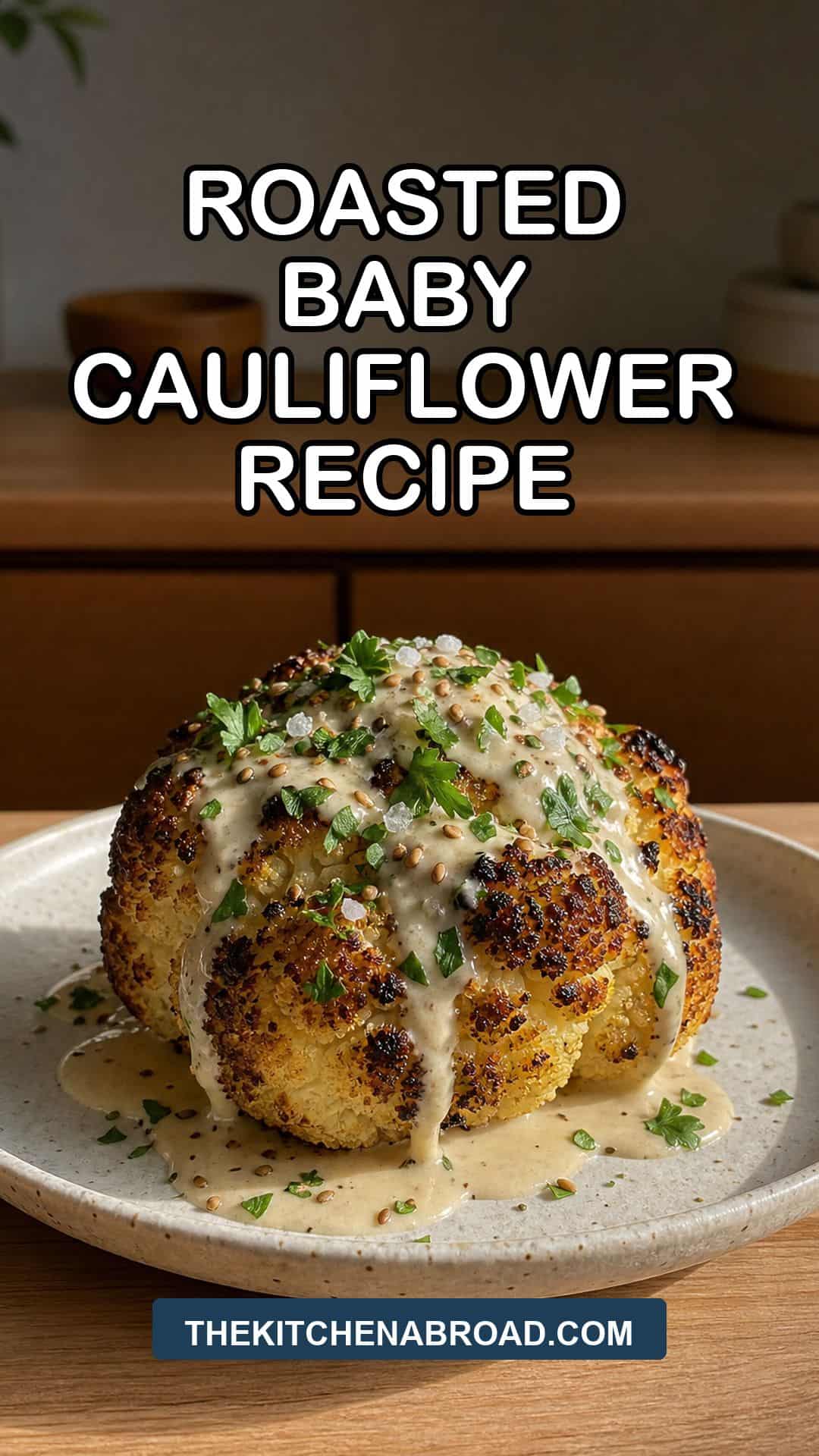
For deeply browned roasted baby cauliflower with a tender interior, par-blanch the whole head in salted water for 8 to 10 minutes, pat dry, then roast at 220°C (425°F) for 25 to 30 minutes with olive oil, cumin, and salt. Finish with a lemon-tahini drizzle and chopped parsley. The par-blanch is what cooks the inside through; the high heat is what browns the outside.
Roasted baby cauliflower is a Sunday-night dinner dressed up as a sheet-pan side. The whole head goes into salted water for ten minutes, then onto a sheet pan with cumin and olive oil, then under a high oven until the edges char and the kitchen smells of toasted spice. Lemon-tahini and parsley at the table. Eat it with a spoon from the same pan if you want.
What You’ll Want in the Kitchen
A large pot deep enough to submerge a whole head of cauliflower (around 5 to 6 quarts) for the par-blanch. A heavy sheet pan or a cast-iron skillet for the roast; the heavier the pan, the better the browning. A microplane for grating the garlic into the tahini sauce so it disappears into the dressing instead of giving you raw garlic hits.
A pair of sturdy tongs makes lifting the par-blanched head out of the pot easier than trying to drain it whole. A small whisk or a fork for the tahini sauce.


Recommended Reads
Why Par-Blanch and Then Roast
A whole cauliflower head is a dense object. If you put it straight into a hot oven, the outside burns long before the interior comes up to tender, and you end up with a half-cooked center under a charred crust. The fix is to cook the inside first in salted water, then dry it off and use a hot oven for the browning step only.
The par-blanch does a second job too. Salted water seasons the cauliflower from the inside out, which dry roasting alone cannot replicate. Eight to ten minutes in heavily salted water is closer to how you would treat pasta or potatoes than a vegetable side, and the seasoning carries through the rest of the cook.
The dish has Middle Eastern roots that London restaurants (Ottolenghi’s, in particular) turned into a Western dinner-party centerpiece a decade ago. The technique below is the home-cook version of what those restaurant kitchens do, minus the hour-long roast.
A Few Notes on the Ingredients
Baby cauliflower, 1 head, about 700 g to 1 kg (1.5 to 2.2 lb), leaves trimmed and stem cut flat so it sits upright on a sheet pan. A regular small cauliflower works the same way; baby heads just look better on a plate and cook through faster. Caulilini (the long-stemmed cousin sold at Trader Joe’s) cooks faster still and wants 20 minutes total in the oven rather than 25 to 30.
Olive oil, 45 ml (3 Tbsp). A good fruity extra-virgin for finishing; a less expensive olive oil for the roast itself, since the high heat will burn off the more delicate notes. Use the same oil for both if you only have one bottle.
Whole cumin seed, 1 tsp, lightly crushed in a mortar or under the flat of a knife. Pre-ground cumin works in a pinch but loses its top notes within months. Whole seeds toasted briefly in the hot oil release more aroma.
Kosher salt, generous amounts for the blanching water (it should taste like seawater) plus a teaspoon for the roast and a final pinch of flaky sea salt at the end.
Tahini, 60 g (1/4 cup), well-stirred. Choose a quality brand from Israel, Lebanon, or Palestine (Soom, Seed + Mill, Karawan, Al Wadi). Stale supermarket tahini is bitter and the dressing suffers.
Fresh lemon juice, 30 ml (2 Tbsp), plus the zest of half a lemon. Bottled lemon juice will not work here; the tahini-and-acid balance is too delicate.
Garlic, 1 clove, grated on a microplane into the tahini sauce. A small clove. Tahini sauce can turn aggressively garlic-forward in an hour as it sits, and one clove is plenty.
Fresh flat-leaf parsley, a small handful, chopped, for finishing. A few pomegranate seeds if they are in season and you have them.
Recipe: Whole Roasted Baby Cauliflower with Tahini
Prep time: 10 minutes | Cook time: 40 minutes | Total time: 50 minutes | Serves: 4 as a side, 2 as a main
Ingredients
- 1 head baby cauliflower, 700 g to 1 kg (1.5 to 2.2 lb), trimmed
- 45 ml (3 Tbsp) olive oil
- 1 tsp whole cumin seed, lightly crushed
- 1 tsp kosher salt, plus more for the blanching water
- Freshly cracked black pepper
- 60 g (1/4 cup) tahini, well-stirred
- 30 ml (2 Tbsp) fresh lemon juice
- Zest of 1/2 lemon
- 1 small clove garlic, grated on a microplane
- 2 to 3 Tbsp cold water, for thinning the tahini
- Small handful flat-leaf parsley, chopped
- Flaky sea salt, to finish
- Pomegranate seeds (optional)
Instructions
- Bring a large pot of heavily salted water to a boil (it should taste like seawater). Trim the cauliflower: pull off the outer leaves, then cut the stem flat so the head sits upright. Use a paring knife to score a shallow X into the base of the stem, about 1 cm (1/2 inch) deep. This helps the heat penetrate through the densest part of the head.
- Lower the whole cauliflower into the boiling water, stem-side down. Simmer for 8 to 10 minutes, until a paring knife slides into the stem with light resistance. The head should be tender but still hold its shape.
- Lift the cauliflower out with tongs and a slotted spoon and set it on a clean kitchen towel. Pat it dry on all sides; surface water will steam in the oven and stop the browning. Let it sit for 2 to 3 minutes to keep drying while you heat the oven.
- Heat the oven to 220°C (425°F). Place the cauliflower stem-side down on a heavy sheet pan or in a cast-iron skillet. Drizzle the olive oil over the top and sides, rotating the head so the oil runs into the crevices. Sprinkle the crushed cumin seed, kosher salt, and a few grinds of black pepper evenly over the surface.
- Roast for 25 to 30 minutes, until the top is deeply browned and the edges of the florets have charred slightly. The cauliflower should look like it has been hit by a flame; a few black tips are exactly right. If the top is browning faster than you want, tent loosely with foil for the last 5 minutes.
- While the cauliflower roasts, make the tahini sauce. In a small bowl, whisk the tahini with the lemon juice and grated garlic. The mixture will seize and look broken; that is normal. Whisk in cold water one tablespoon at a time until the sauce loosens into a pourable consistency, about 2 to 3 tablespoons total. Stir in the lemon zest and season with salt to taste.
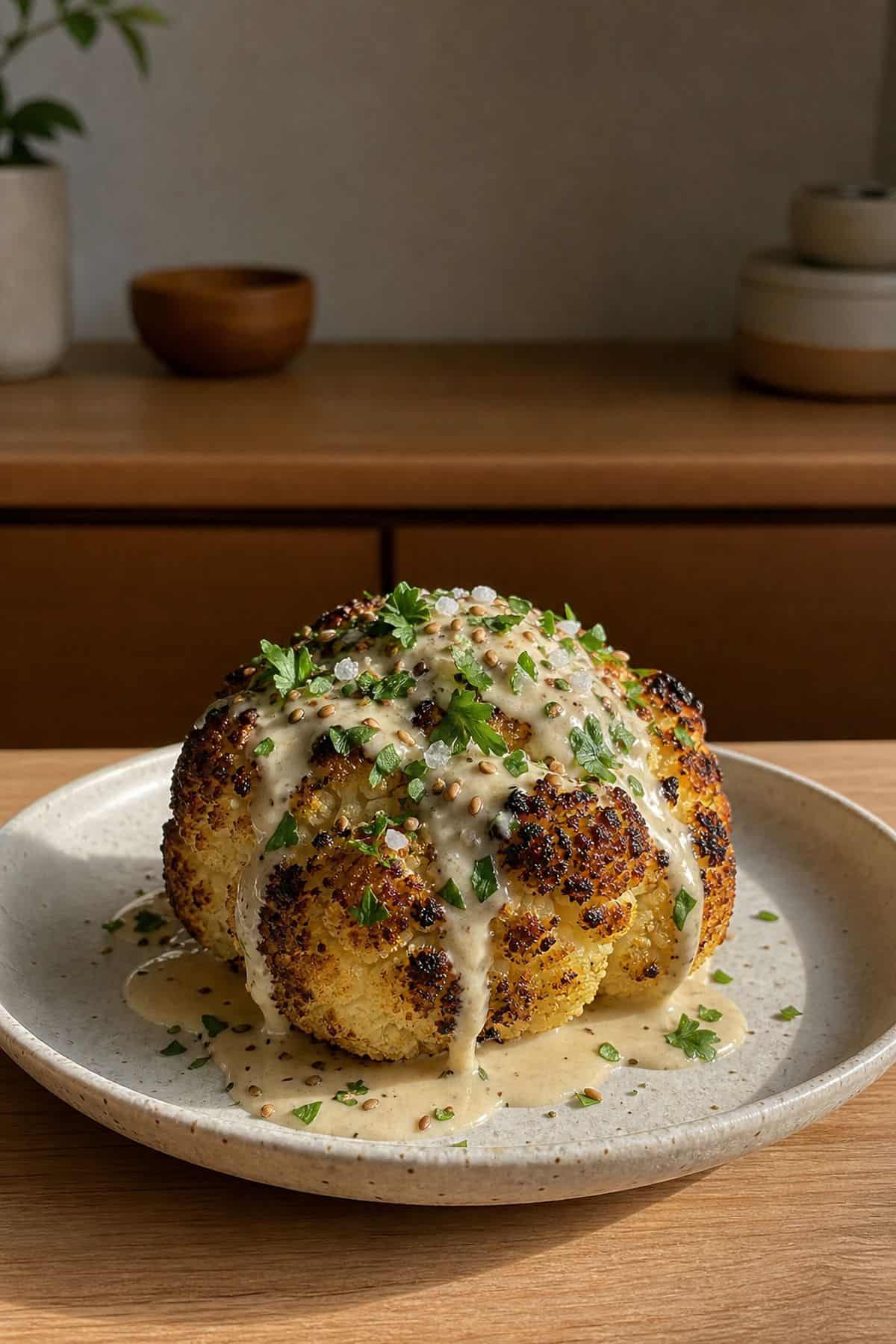
- Transfer the cauliflower to a serving plate or bring the whole sheet pan to the table. Spoon the tahini sauce generously over the top, letting it pool around the base. Scatter chopped parsley, a pinch of flaky sea salt, and pomegranate seeds (if using) over everything.
- Serve immediately while the cauliflower is hot. Cut into wedges at the table with a sharp knife, or break apart into florets with a spoon.
Notes
The par-blanch is the single move that separates this from the disappointing whole-roast version many home kitchens have produced at least once. Skip it and the center will be chalky no matter how long you roast.
The tahini sauce thickens as it sits. If you make it ahead, whisk in another splash of cold water just before serving to bring it back to pourable.
Leftovers keep 3 days in an airtight container in the fridge. Reheat in a 175°C (350°F) oven for 8 minutes; the microwave makes the cauliflower watery.
Tips and Variations
Baby Cauliflower vs. Caulilini vs. Regular Heads
Baby cauliflower is a small, compact head about the size of a softball, with the same dense floret structure as a full-sized head. Caulilini is a different cultivar entirely: longer stems, looser florets, more like a cross between cauliflower and broccolini. Regular cauliflower is the standard supermarket head.
The recipe works for all three. Baby cauliflower is the right size for two people as a main or four as a side. A regular head needs an extra 5 to 10 minutes of roasting. Caulilini cooks faster and wants only 15 to 20 minutes in the oven; the par-blanch can be shortened to 5 minutes.
How to Tell When Cauliflower Is Truly Done
A paring knife should slide into the thickest part of the stem with almost no resistance. The florets on the outside should be deeply browned, with a few charred edges. If the knife meets a chalky resistance in the middle, the head went into the oven undercooked from the par-blanch.
Better to par-blanch a minute too long than too short. The oven is where the browning happens, not where the interior cooking happens.
A Harissa-Honey Variation
For a different finish, skip the tahini and whisk 1 tablespoon harissa paste with 1 tablespoon honey and 1 tablespoon olive oil. Brush this over the cauliflower in the last 10 minutes of roasting, then reapply a fresh coat as soon as it comes out of the oven. Finish with chopped mint and toasted pine nuts.
Sweet and spicy in place of nutty and tart. Same par-blanch, same oven temperature, same dish.
Anchovy Butter Finish (Milk Street-Style)
Mash 3 anchovy fillets into 30 g (2 Tbsp) softened butter with a small grated garlic clove and a squeeze of lemon. Smear this over the par-blanched cauliflower instead of the plain olive oil before roasting. The anchovy melts into the head and adds a deep umami backbone without tasting fishy.
This version skips the tahini and finishes with capers, lemon zest, and parsley. Closer to a Sicilian profile than a Levantine one.
Make-Ahead Strategy for a Dinner Party
You can par-blanch the cauliflower up to a day ahead. Cool it on a rack, then store wrapped loosely in the fridge. Bring it back to room temperature for 20 minutes before roasting, then pick up at step 4.
The tahini sauce holds in the fridge for 3 to 4 days. Whisk in cold water to loosen it back to pourable just before serving.
What to Serve With It
As a mezze-style centerpiece, this wants hummus, warm pita, a chopped salad with cucumber and tomato, and a bowl of olives. A small dish of pickled turnips or pickled red onions cuts the richness of the tahini.
As a vegetarian main, serve over rice pilaf, freekeh, or buttered couscous. As a side, it sits comfortably next to roast chicken, grilled lamb, or a piece of pan-seared fish. Pour a chilled rosé or a dry Riesling. For a Christmas spread, slot it into the lineup from our Christmas side dishes roundup.
Frequently Asked Questions
What’s the difference between baby cauliflower and regular cauliflower?
Baby cauliflower is a smaller cultivar, about the size of a softball, with the same compact head structure as a full-sized cauliflower. Regular cauliflower is roughly twice the weight. Both roast the same way; the baby head just cooks faster and looks neater on the plate.
Do you have to boil cauliflower before roasting?
For a whole head, yes. The par-blanch in salted water is what cooks the interior; the oven only browns the outside. Skip it and you will end up with a charred crust over a chalky middle. For florets, you can skip the boil and roast directly.
What temperature is best for roasting cauliflower?
220°C (425°F) for a whole head after par-blanching. Hot enough to brown deeply in 25 to 30 minutes without burning the surface before the inside has finished cooking. For florets without a par-blanch, the same temperature works for 20 to 25 minutes.
How do you keep roasted cauliflower from getting soggy?
Pat the par-blanched head very dry before it goes into the oven. Surface water steams in the heat and prevents browning. A heavy sheet pan or a cast-iron skillet retains heat better and helps the bottom crisp instead of stew.
What does tahini sauce taste like with cauliflower?
Nutty, slightly bitter, brightened by lemon and softened by water. It plays against the deep roasted-cauliflower flavor the way a good pesto plays against pasta. The combination is the foundation of half the cauliflower dishes on Levantine restaurant menus.
Can you roast cauliflower whole or does it have to be in florets?
Both work, but whole-roasted is the more impressive presentation and the better technique for a centerpiece dish. The par-blanch is the trade-off; in exchange for an extra ten minutes of prep, you get a head that holds together on the plate and slices into wedges at the table.
Key Takeaways
- Par-blanch the whole head in heavily salted water 8 to 10 minutes; this cooks and seasons the interior.
- Pat very dry before roasting so the surface browns instead of steaming.
- Roast at 220°C (425°F) for 25 to 30 minutes until deeply browned with charred edges.
- Tahini sauce: tahini + lemon + garlic + cold water, whisked until pourable.
- Works as a mezze centerpiece, vegetarian main, or holiday side dish.
Final Thoughts
Whole-roasted cauliflower is the rare vegetable preparation that actually anchors a table. The head looks like something; the smell of cumin and roasted cauliflower fills the kitchen; the tahini sauce makes it feel finished rather than improvised.
It is also a flexible dish. The same par-blanch-and-roast method takes a harissa-honey glaze, an anchovy butter, a green tahini, a romesco. Pick one, change it next time, and the technique still holds.
For a weeknight, halve the recipe and use a small head. For a dinner party, scale up to a full-sized cauliflower and let the centerpiece do the talking.
Whole Roasted Baby Cauliflower with Tahini
For deeply browned roasted baby cauliflower with a tender interior, par-blanch the whole head in salted water for 8 to 10 minutes, pat dry, then roast at 220°C (425°F) for 25 to 30 minutes with olive oil, cumin, and salt.
Ingredients
- 1 head baby cauliflower, 700 g to 1 kg (1.5 to 2.2 lb), trimmed
- 45 ml (3 Tbsp) olive oil
- 1 tsp whole cumin seed, lightly crushed
- 1 tsp kosher salt, plus more for the blanching water
- Freshly cracked black pepper
- 60 g (1/4 cup) tahini, well-stirred
- 30 ml (2 Tbsp) fresh lemon juice
- Zest of 1/2 lemon
- 1 small clove garlic, grated on a microplane
- 2 to 3 Tbsp cold water, for thinning the tahini
- Small handful flat-leaf parsley, chopped
- Flaky sea salt, to finish
- Pomegranate seeds (optional)
Instructions
- Bring a large pot of heavily salted water to a boil (it should taste like seawater). Trim the cauliflower: pull off the outer leaves, then cut the stem flat so the head sits upright.
- Lower the whole cauliflower into the boiling water, stem-side down. Simmer for 8 to 10 minutes, until a paring knife slides into the stem with light resistance. The head should be tender but still hold its shape.
- Lift the cauliflower out with tongs and a slotted spoon and set it on a clean kitchen towel. Pat it dry on all sides; surface water will steam in the oven and stop the browning. Let it sit for 2 to 3 minutes to keep drying while you heat the oven.
- Heat the oven to 220°C (425°F). Place the cauliflower stem-side down on a heavy sheet pan or in a cast-iron skillet. Drizzle the olive oil over the top and sides, rotating the head so the oil runs into the crevices.
- Roast for 25 to 30 minutes, until the top is deeply browned and the edges of the florets have charred slightly. The cauliflower should look like it has been hit by a flame; a few black tips are exactly right.
- While the cauliflower roasts, make the tahini sauce. In a small bowl, whisk the tahini with the lemon juice and grated garlic. The mixture will seize and look broken; that is normal.
- Transfer the cauliflower to a serving plate or bring the whole sheet pan to the table. Spoon the tahini sauce generously over the top, letting it pool around the base.
- Serve immediately while the cauliflower is hot. Cut into wedges at the table with a sharp knife, or break apart into florets with a spoon.
Notes
The par-blanch is the single move that separates this from the disappointing whole-roast version many home kitchens have produced at least once. Skip it and the center will be chalky no matter how long you roast.
The tahini sauce thickens as it sits. If you make it ahead, whisk in another splash of cold water just before serving to bring it back to pourable.
Last update on 2026-08-08 / Affiliate links / Images from Amazon Product Advertising API