Pick Scandinavian kitchen decor that you’ll use every single day: pale wood shelves and boards, linen towels, simple stoneware, clear glass, and warm lamps for the dark half of the year. Keep the counters mostly bare, repeat two or three materials, and let one muted color, like soft blue, do the decorating for you.
It’s early November here in Finland, the sun gives up somewhere around four in the afternoon, and half the kitchen windows you walk past have a lamp glowing in them. After about 20 years of Finnish winters, I can tell you that’s the real reason Nordic kitchens look the way they do. Pale wood and white walls bounce back every bit of light there is, and lamps and candles fill in the rest, so the style started as survival and only later turned into a Pinterest board.
That’s the test I used for the Scandinavian kitchen decor finds below. Each one has to do a job you’ll notice every day, from holding the plates to drying your hands, and it has to make the room feel brighter or softer when it’s dark outside by dinner. Anything that just sits there looking Nordic didn’t make the list.
Top Recommended Products
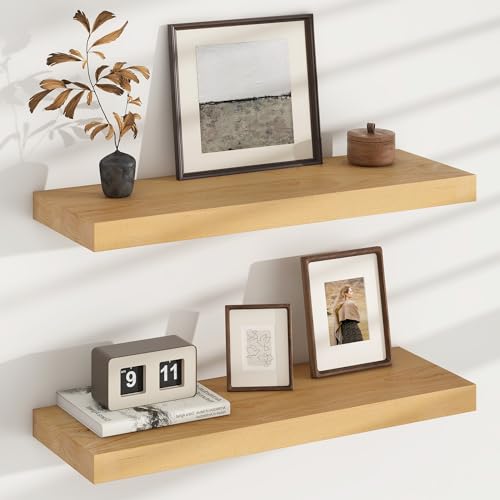


These five cover the shelves, the counter, the towels, the light and the floor, which is most of what makes a kitchen feel Nordic.
You Might Also Like These Blog Posts
- Scandinavian Kitchen Ideas
- Minimalist Kitchen Ideas
- Japandi Kitchen Ideas
- Natural Wood Kitchen Ideas
- Warm Neutral Kitchen Ideas
Scandinavian Kitchen Decor Finds That Add Warmth Without Clutter
Everything below is grouped by where it lives in the kitchen, from the shelves you look at all day to the small corners you finish last.
What Should You Buy First for a Scandinavian Kitchen?
Start with what you touch every morning: the shelf your dishes live on, a tray by the sink, linen towels, a runner underfoot and the plates, mugs and glasses you actually use.
1. Birch Floating Shelves for Airy Dish Display
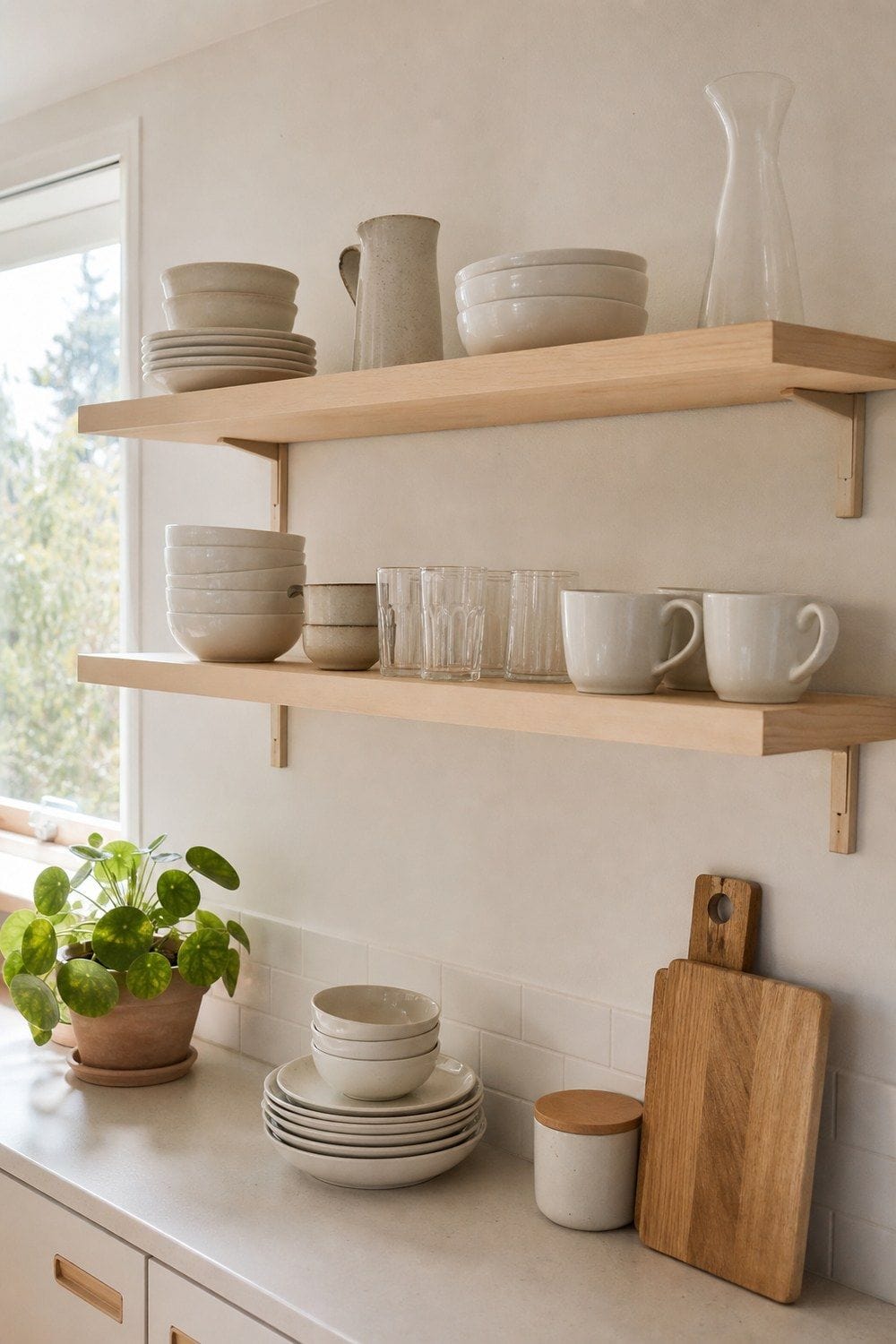
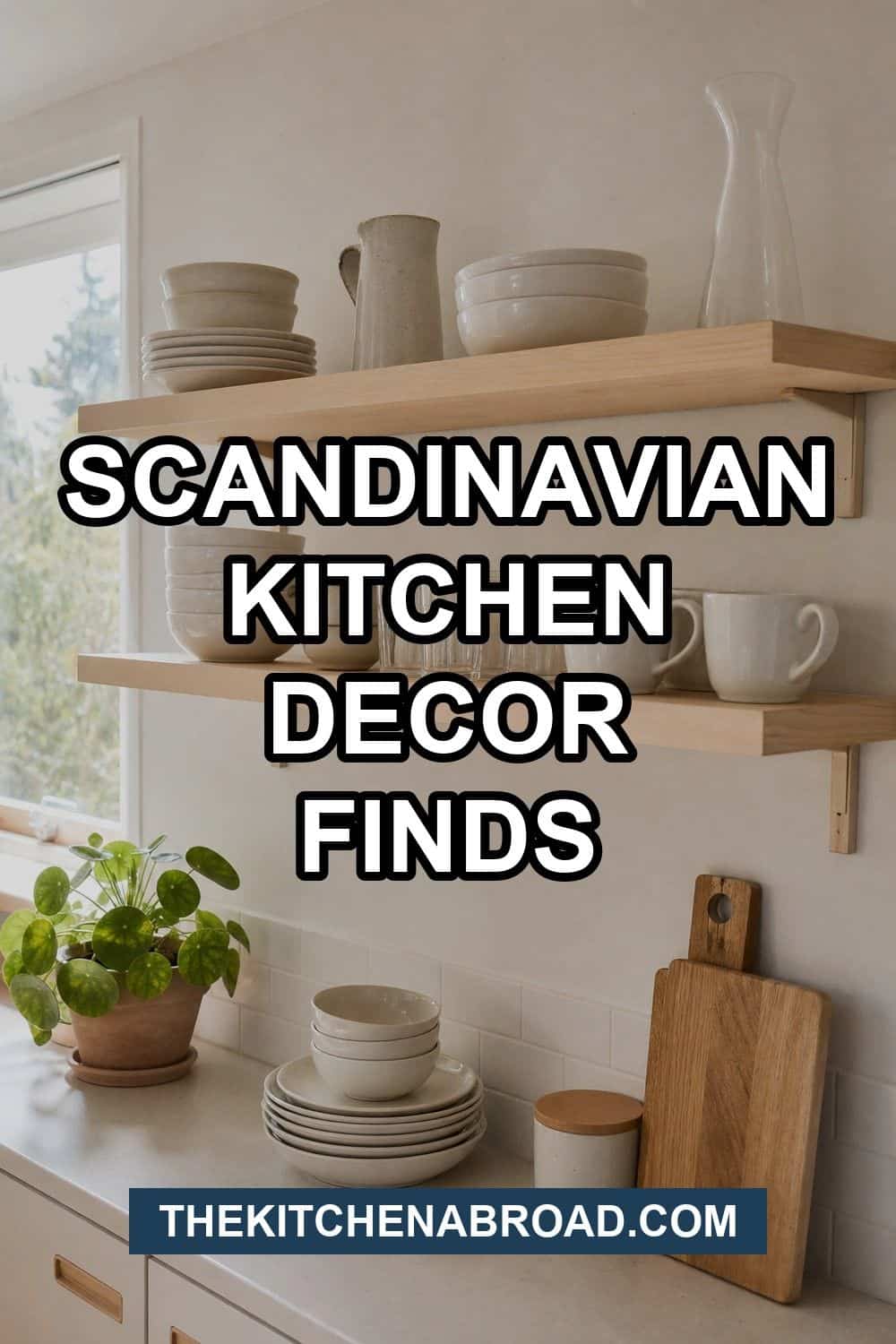
Open shelves are the heart of most Scandinavian kitchens, because they replace heavy upper cabinets with a few pale planks that let the wall and the light breathe. Birch or light oak keeps the shelf almost the same tone as the wall, so the dishes on it become the decor and the wood just quietly holds them up. The pale shelves above this counter carry nothing but cream bowls, a few mugs and one glass carafe, and that restraint is exactly why it looks calm.
Before you buy, check the depth against your plates and look up the weight rating, because a shelf full of stoneware is heavier than you think. Stack the heavy plates near the brackets and the lighter mugs toward the ends, and leave a hand’s width of empty wood between groups so the shelf doesn’t turn into a dish rack with a view.
2. Light Oak Counter Tray for Daily Essentials
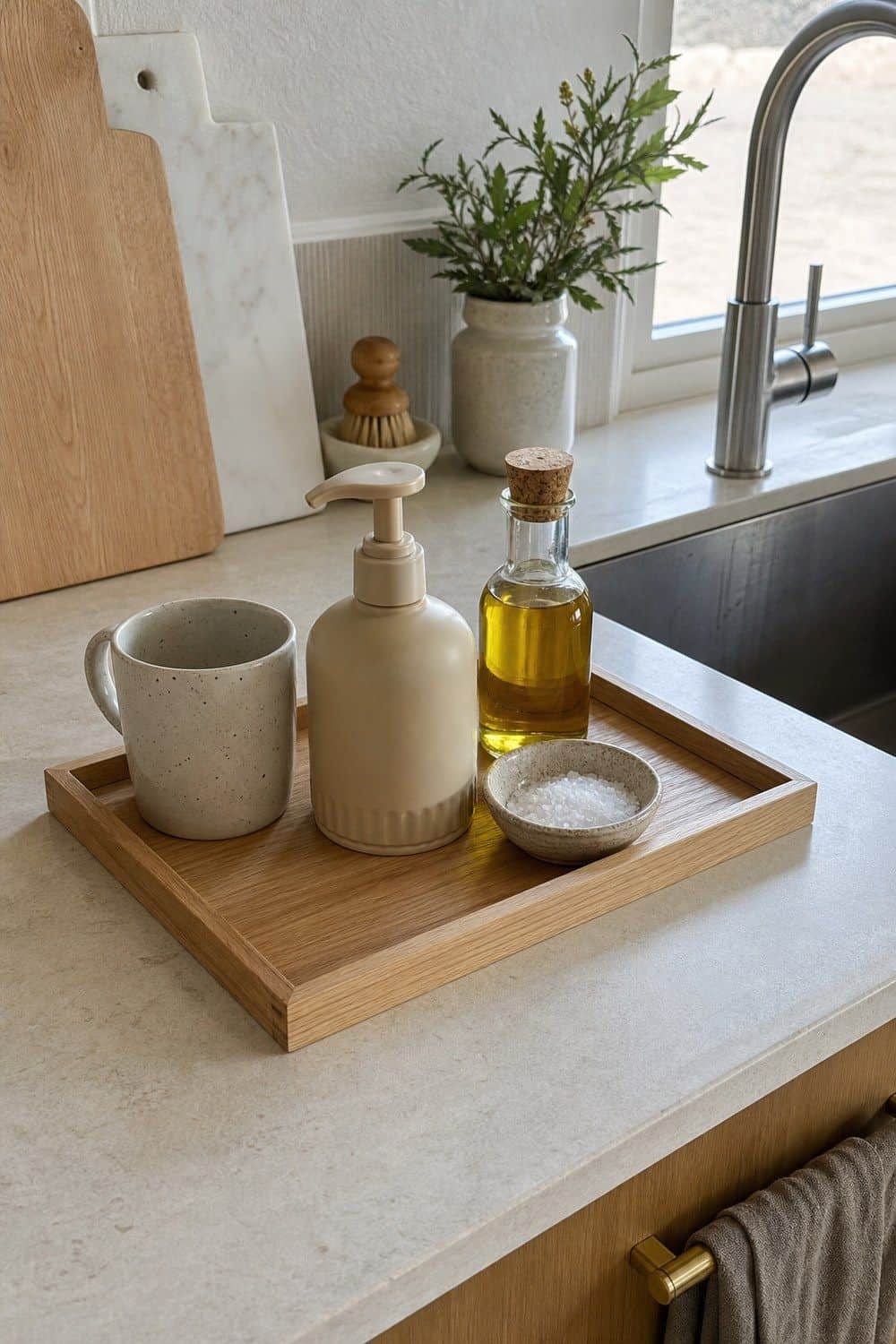
Want a busy counter to look like someone planned it? Get a tray. In a Nordic kitchen where counters stay mostly bare, it does a lot of quiet work. The idea is simple: everything that lives next to the sink or stove goes on one low wooden tray, so instead of six loose bottles you see one tidy group. The oak tray by this sink holds a soap pump, a speckled mug, olive oil and a little salt dish, all things that get used daily, and wiping the counter around it takes seconds because you lift one object instead of five. Look for a tray with a low rim and an oiled or lacquered finish that shrugs off water, and resist the urge to add a candle, a plant and a tiny sign to it (that’s how trays become clutter with edges).
3. Linen Kitchen Towels for Soft Texture
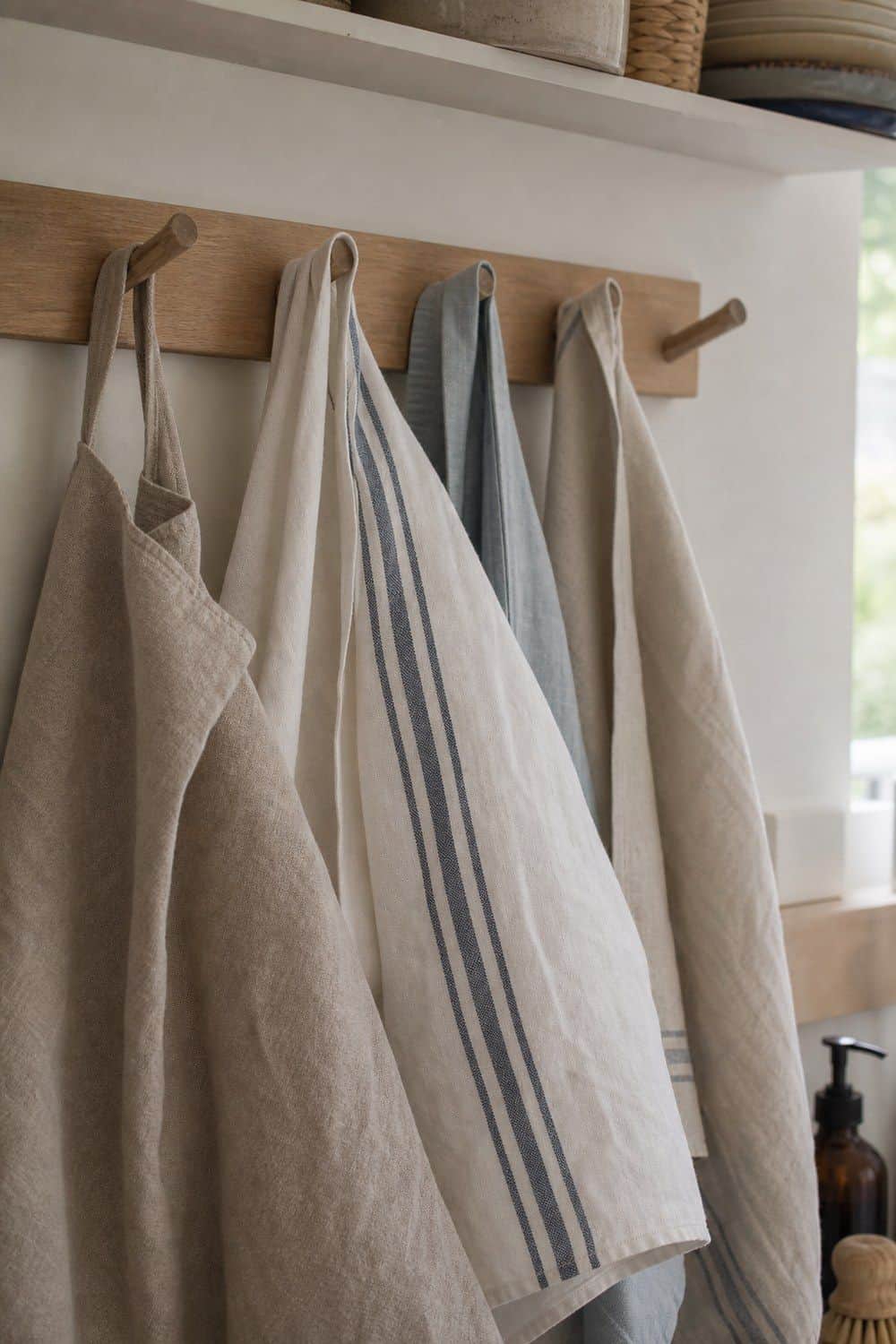
Linen towels are one of those small things that make a kitchen feel softer without adding a single object to the counter. They hang, they get used, they get washed and they come back, and in a room full of hard surfaces like stone, tile and steel, a bit of crumpled flax by the sink changes the whole mood.
The set hanging from this wooden peg rail mixes plain natural linen with a blue stripe and a gray stripe, which is about as much pattern as a Scandi kitchen needs. Stripes in faded blue are a classic Nordic look for a reason: they read as color without shouting.
Buy linen or a linen-cotton blend, wash it a few times before you judge it, and don’t panic about the wrinkles. Linen dries fast, gets softer every wash and looks better slightly rumpled than ironed flat (which is great news if, like me, you have zero interest in ironing towels).
4. Scandinavian Kitchen Runner for a Warmer Work Aisle
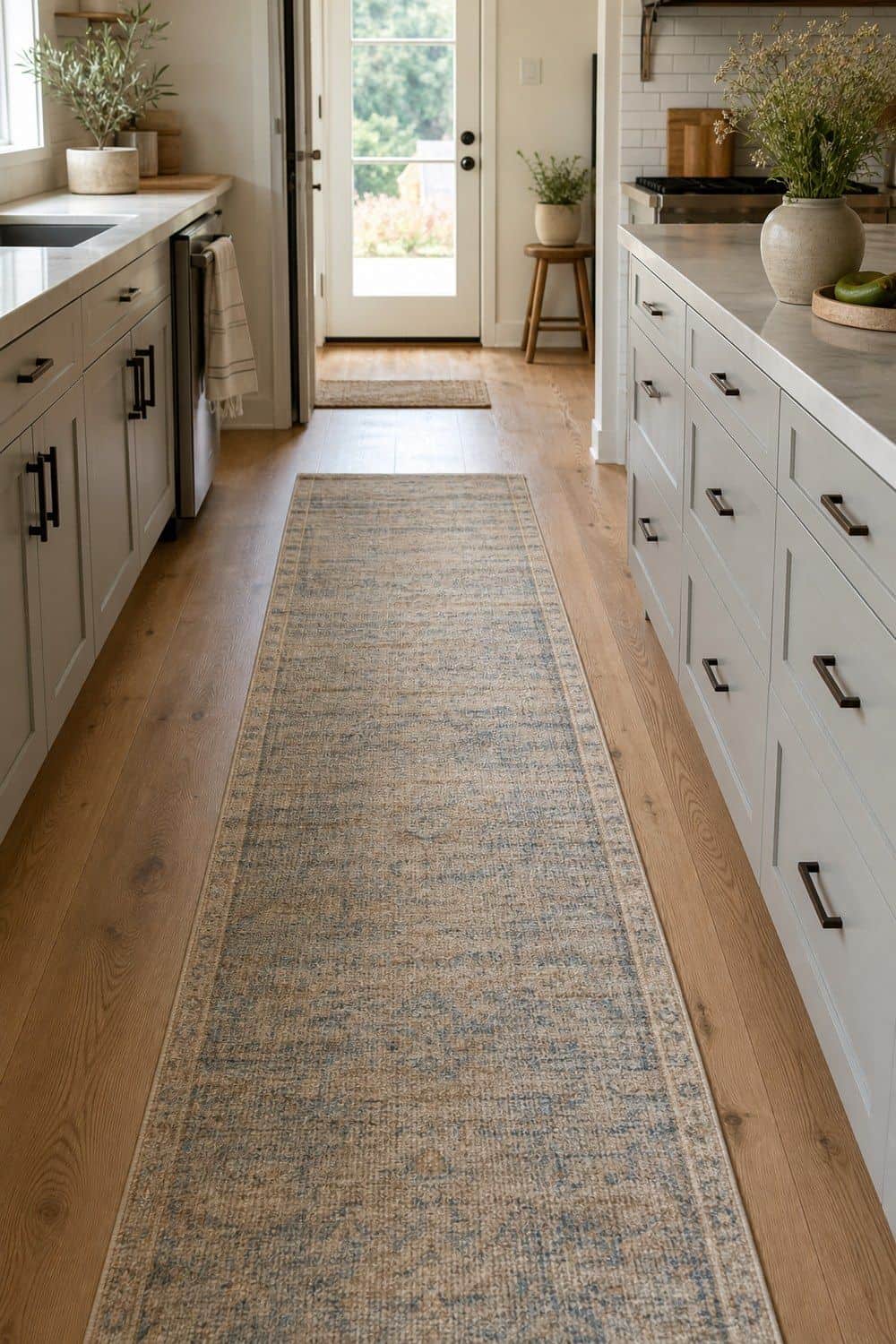
In winter you feel a cold tile or pale wood floor right through your socks, so in a Nordic kitchen a runner is as much about comfort as looks. The faded blue and beige runner down this galley adds warmth and a soft pattern to the one spot where you stand the longest.
What to check before you buy:
- Washable, low pile that won’t catch the dishwasher door or the cabinet doors when they swing open
- A non-slip pad underneath, especially near the sink where the floor gets wet
- A faded or low-contrast pattern, which hides crumbs and looks more Nordic than a bold graphic print
- Length that leaves a bit of floor showing at both ends, so the aisle still looks long
5. White Stoneware Dinnerware Set for Open Shelves
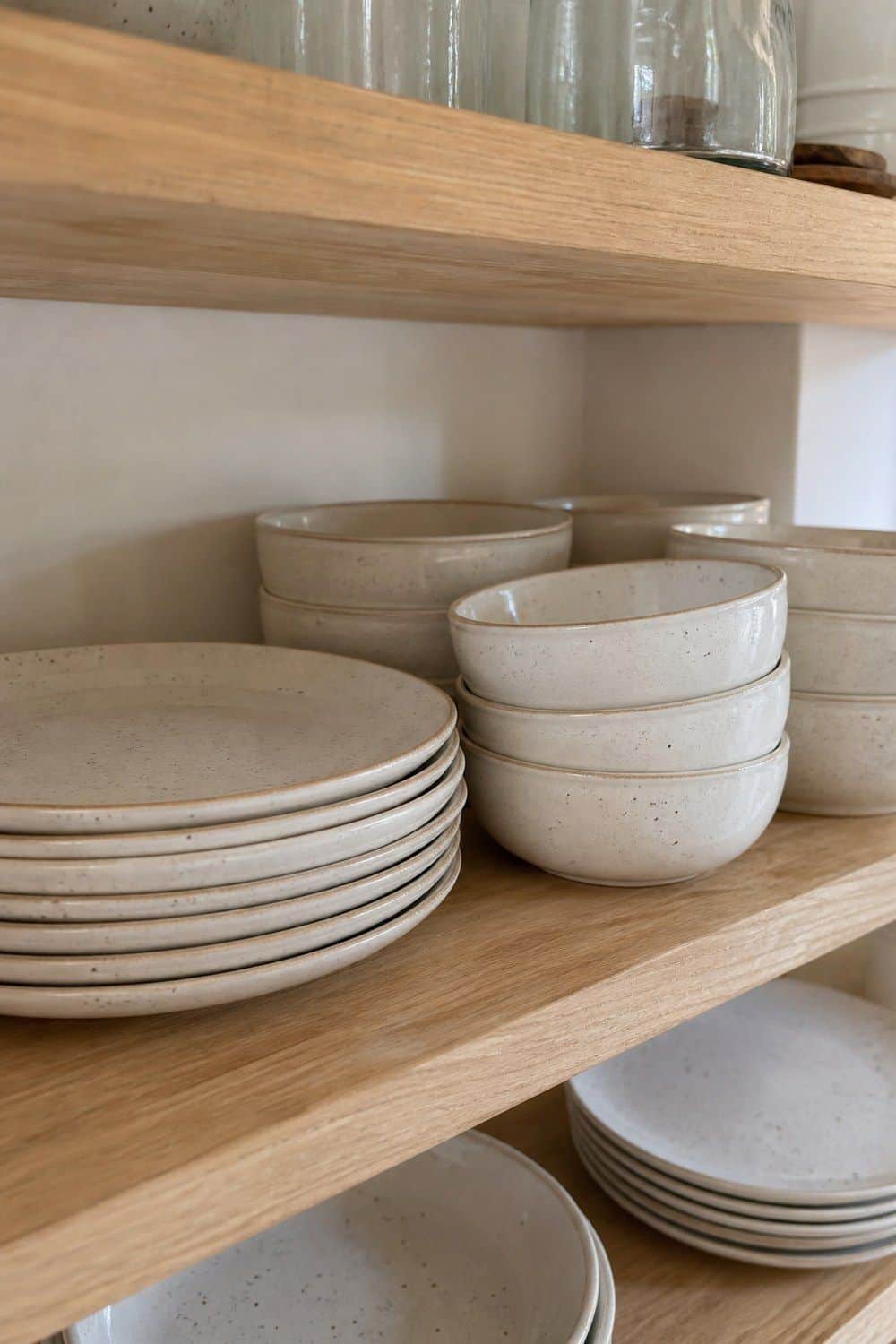
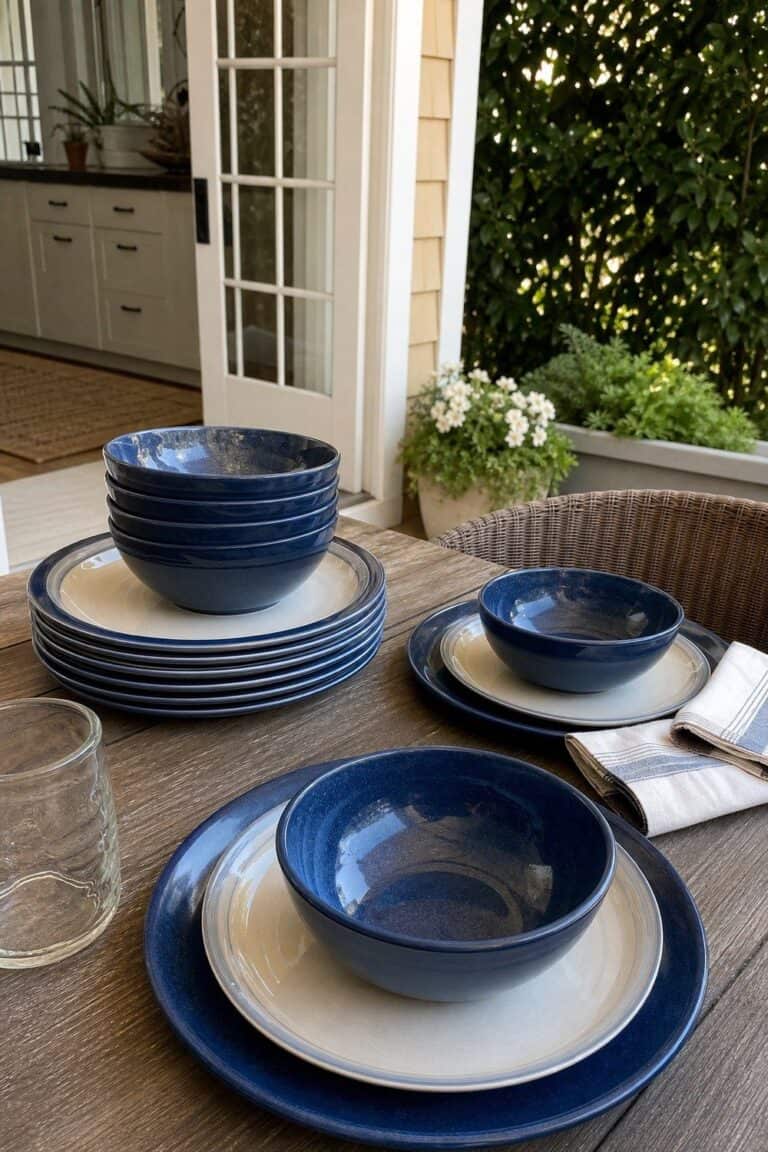
If your dishes live on open shelves, they are the decor, so it’s worth choosing them with that in mind instead of buying a random mix one sale at a time. Speckled cream stoneware like the stacks on this oak shelf is a good fit for Nordic style because it looks handmade, hides small chips and water marks better than glossy white porcelain, and goes with pale wood without any effort. Pick one set and stick with it, in shapes that stack neatly, since a tidy pile of matching plates looks calm while five different patterns look like a yard sale. Plates with a soft rim and bowls on the shallow side also take up less visual space on the shelf than deep, heavy shapes, and they still work for oatmeal in the morning and soup at night.
6. Speckled Ceramic Mugs for a Cozy Coffee Shelf

Finland drinks more coffee per person than almost anywhere (we are not shy about it), so in a Nordic home the mug shelf often ends up being the most used corner of the kitchen. That’s a good reason to make it look nice.
Speckled mugs in soft cream, sage, gray and clay, hanging from wooden pegs or stacked by the coffee maker, give the corner color and a handmade feel while still matching each other. A small set in three or four muted shades looks more planned than a cupboard of souvenir mugs with jokes printed on them, and you’ll want the handles chunky enough to wrap your whole hand around on a cold morning.
7. Ribbed Glass Tumblers for Subtle Shelf Texture
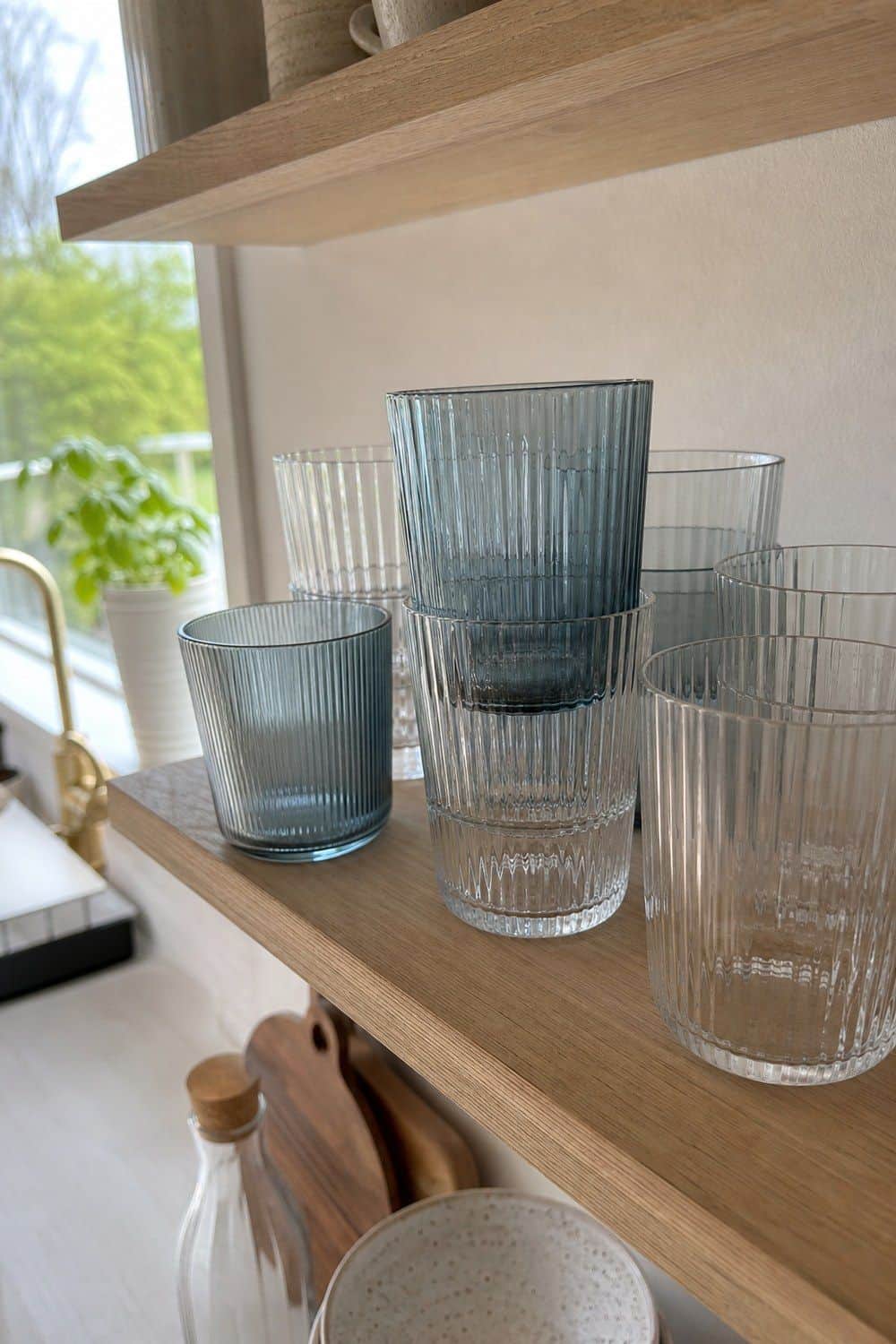
On open shelves, clear glass practically disappears, letting the light from the window come through instead of blocking it. Ribbed glass goes one step further: the vertical lines catch the light and give the shelf a little texture, even when there’s nothing in the glasses.
The tumblers on this oak shelf mix clear glass with a few in smoky blue-gray, which is a nice way to sneak in color without buying a single new decor object. Glassware you drink water from every day doubles as shelf styling, and that’s the kind of double duty this style loves.
Before buying, check that they’re dishwasher safe and that they stack or at least sit together without wobbling. Thin, fragile rims look lovely in shop photos, but everyday glasses need a sturdier edge, especially if they live on an open shelf where a careless elbow can reach them.
How Do You Add Light and Order Without Losing the Calm?
With soft lamps you can switch on at four o’clock, and with storage that keeps tools, food and drying dishes out of sight or neatly grouped.
8. Paper Pendant Light for Gentle Nordic Glow
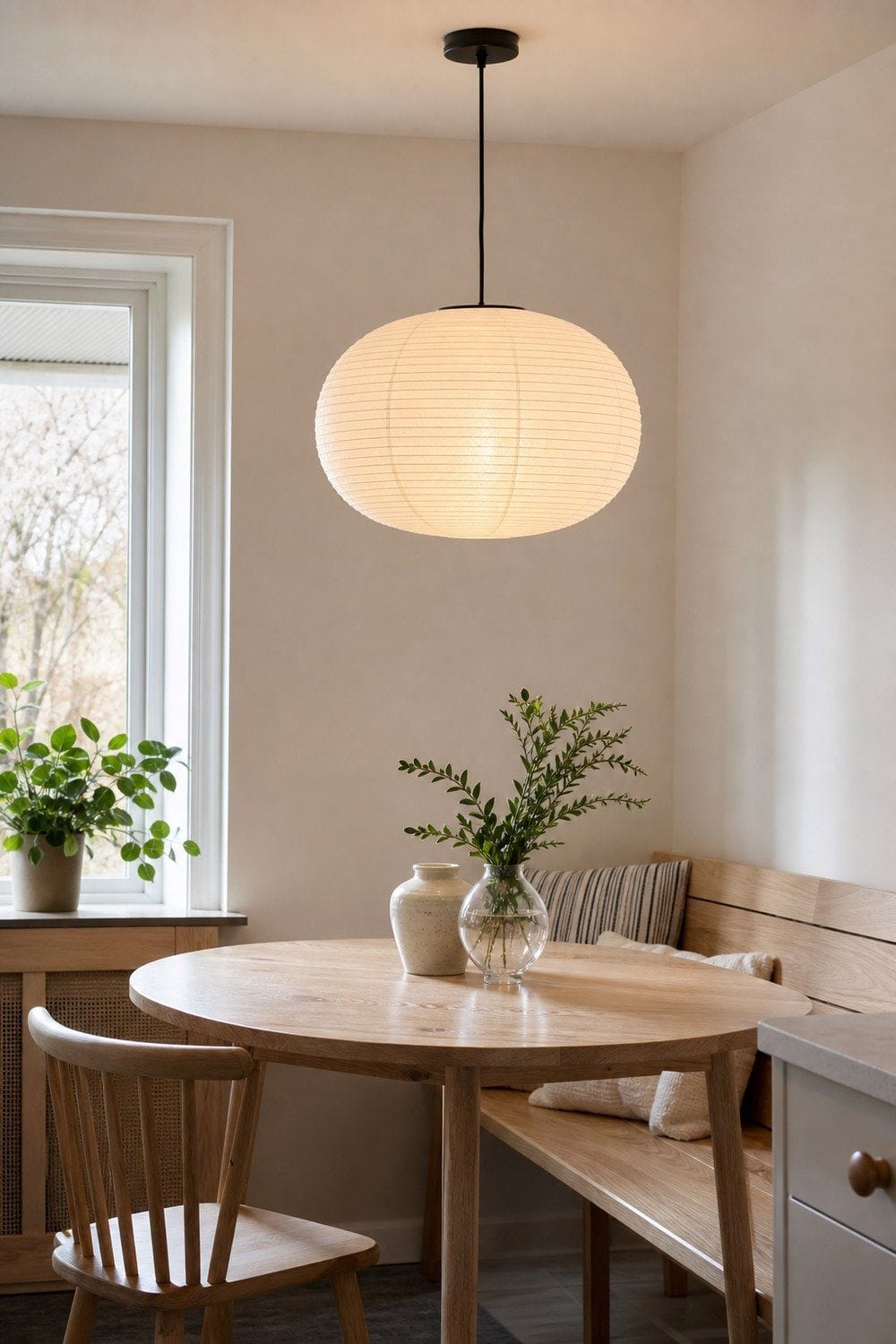
Ask anyone who lives this far north what makes a kitchen cozy, and they’ll say the light before they say anything about furniture. When it’s dark by late afternoon, a soft lamp over the table is what makes the kitchen somewhere you want to sit, and a round paper pendant like the one over this little breakfast nook spreads warm, even light without any harsh spots.
Hang it over the table rather than the stove (steam and grease aren’t friends with paper), use a warm white bulb and add a dimmer if you can. The bottom of the shade should sit well above head height when you’re sitting, so nobody gets blinded during breakfast. Measure the cord length and the table width before ordering, because a shade that’s too small for the table looks lost and one that’s too big takes over the whole corner.
9. Wood Peg Rail for Aprons and Towels
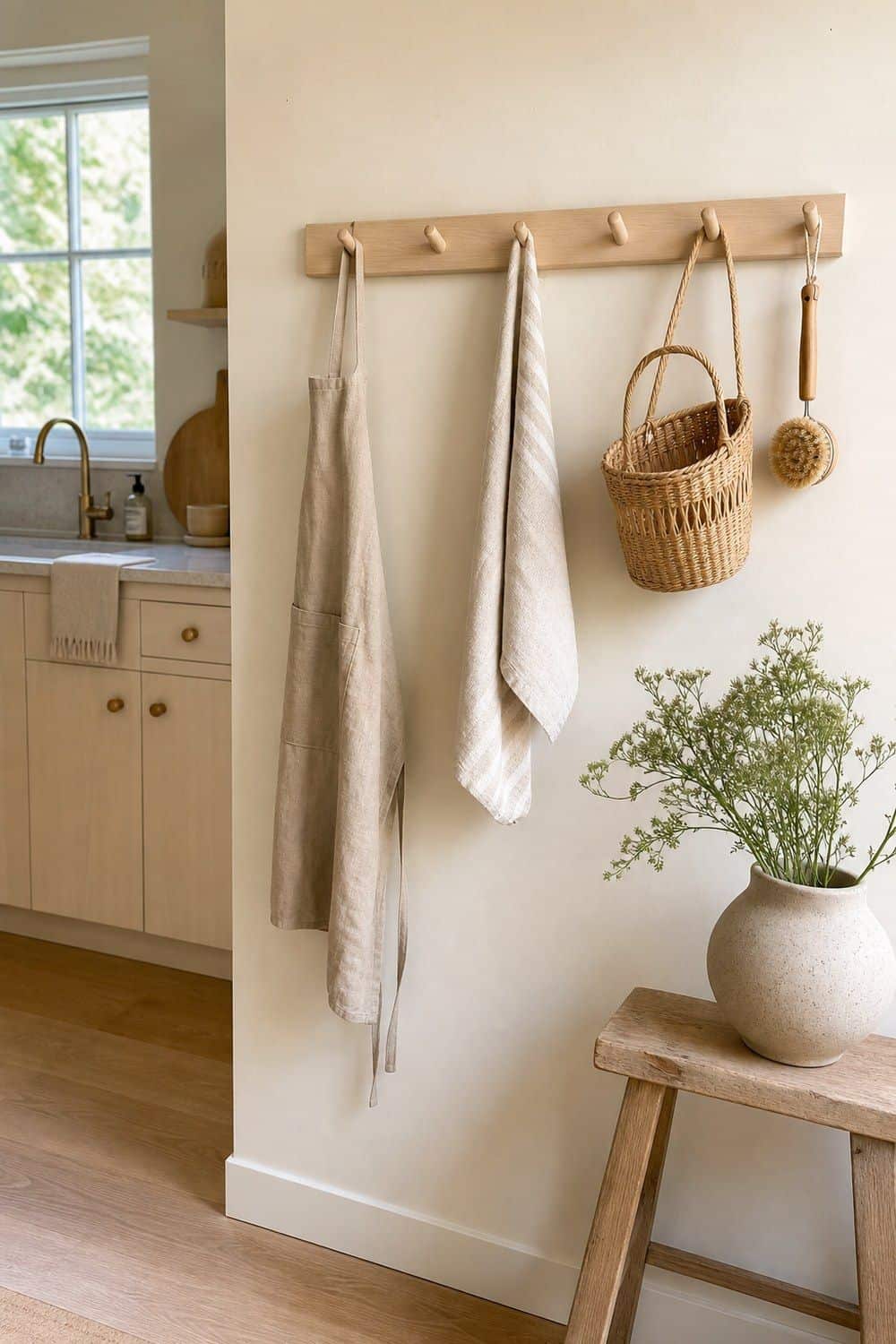
Long before anyone called it Scandi style, Nordic and Shaker homes hung everyday things on a peg rail, and it still makes sense: a plain strip of wood with pegs that holds the things you grab all the time and gets them off chairs and door handles. On this one, a linen apron, a towel, a small basket and a dish brush hang side by side.
Good things to hang on a peg rail:
- Aprons and spare linen towels
- A small basket for dish cloths or clothespins
- Market bags or tote bags
- A dish brush or broom on a loop
Mount it near the spot where you actually use those things, like the sink or the back door, and keep every peg to one item.
10. Round Wood Cutting Board for Counter Display
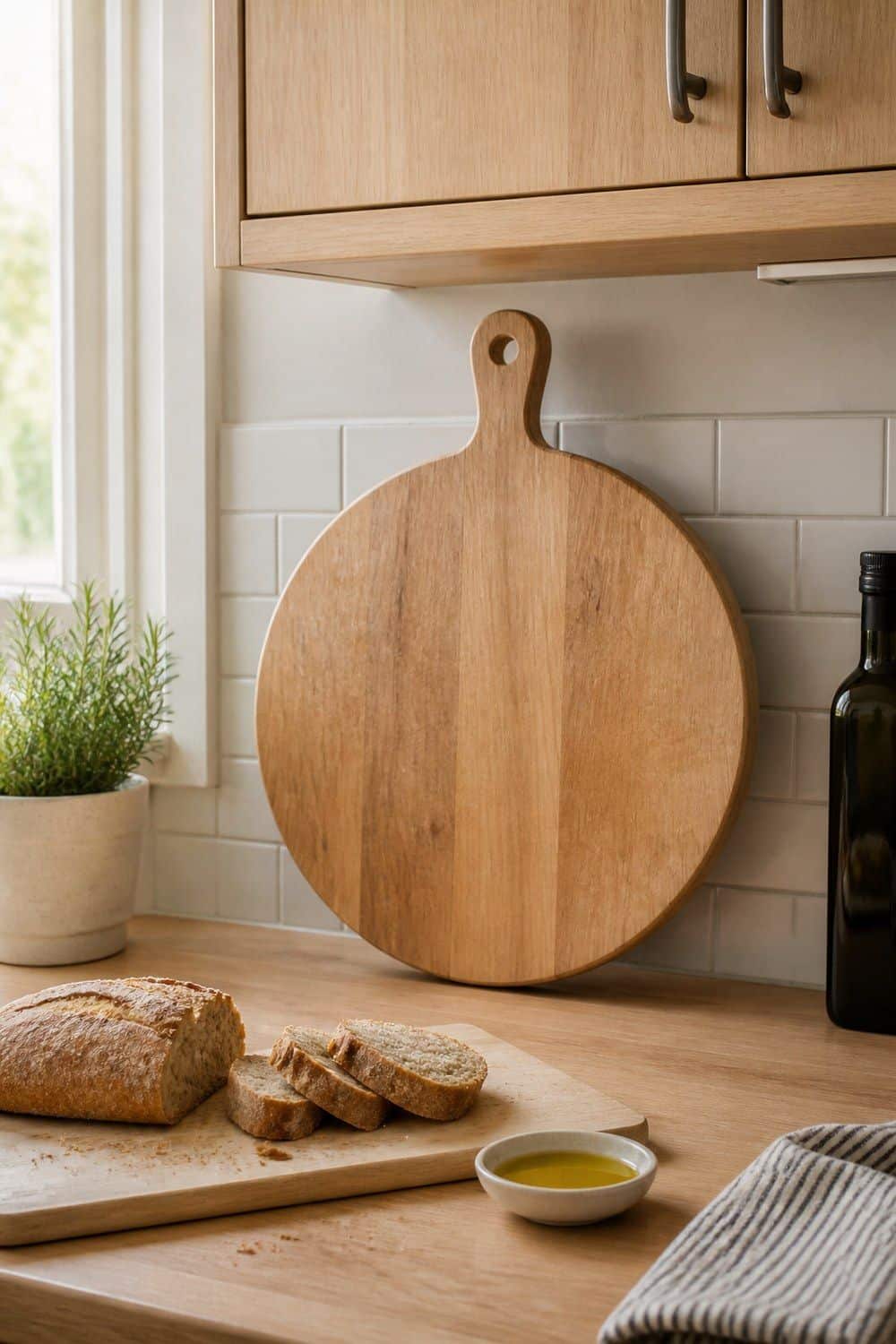
A round wooden board leaning against the backsplash is about the most Scandinavian piece of counter decor there is, mainly because it isn’t decor at all. It’s the board you slice bread on, carry cheese to the table on and wipe down after dinner, and when it’s not working it leans against the tile and adds a warm, round shape to a kitchen full of straight lines.
This one sits behind a smaller board with sliced bread and a little dish of olive oil, which is honest-looking styling because it’s what the board is for. Hand-wash it, dry it standing up and rub in some food-safe board oil every few weeks so it doesn’t crack in the dry indoor air of winter (radiators are hard on wood).
11. Bamboo Drawer Organizer for Hidden Order

Calm counters in a Nordic kitchen only happen because the drawers are doing their job, so this is the least photogenic find on the list and also one of the most important. A bamboo organizer gives every spoon, whisk, peeler and measuring spoon its own slot, which means you stop leaving tools on the counter because the drawer is a mess you don’t want to dig through. Bamboo also keeps the inside of the drawer in the same warm, natural material family as the rest of the kitchen, so opening it feels nice instead of chaotic. Measure the drawer’s inside width, depth and height before you buy, choose a model with an expandable side if your drawer is an odd size, and keep the long wooden spoons in the long slots at the back.
12. Clear Glass Canisters with Wood Lids for Pantry Calm

Decanting gets a bad reputation online, and some of it is fair, because nobody needs to pour every single packet into a jar. But for the dry goods you use every week, a row of matching glass canisters with wooden lids is calmer to look at than a pile of half-open bags with loud printing on them.
On this shelf, oats, pasta, rice, flour and coffee beans all sit in the same type of jar, and the repetition is what makes it look neat, not the food inside. Glass also lets you see when you’re running low, which saves a few annoying “wait, we’re out of rice?” moments.
Pick two or three sizes at most, buy them with a seal that actually closes airtight, and only decant what you go through quickly. Anything that sits for months is better left in its original packaging in a closed cupboard, where it won’t fade or go stale in the light.
13. Minimalist Dish Rack for a Cleaner Sink Zone

Most Finnish kitchens have a drying cabinet above the sink (the astiankuivauskaappi, a brilliant invention nobody outside the Nordics seems to know about), so dishes drip-dry behind a cabinet door. If your kitchen doesn’t have one, a simple rack on the counter is the next best thing, and it can look surprisingly tidy.
Look for these details:
- A slim wire frame in white or steel, which looks lighter than chunky plastic
- A drip tray that drains toward the sink instead of onto the counter
- A separate cup for cutlery
- A removable tray you can wash, because grimy racks ruin the whole calm look
14. Rattan Pendant Light for Natural Woven Texture
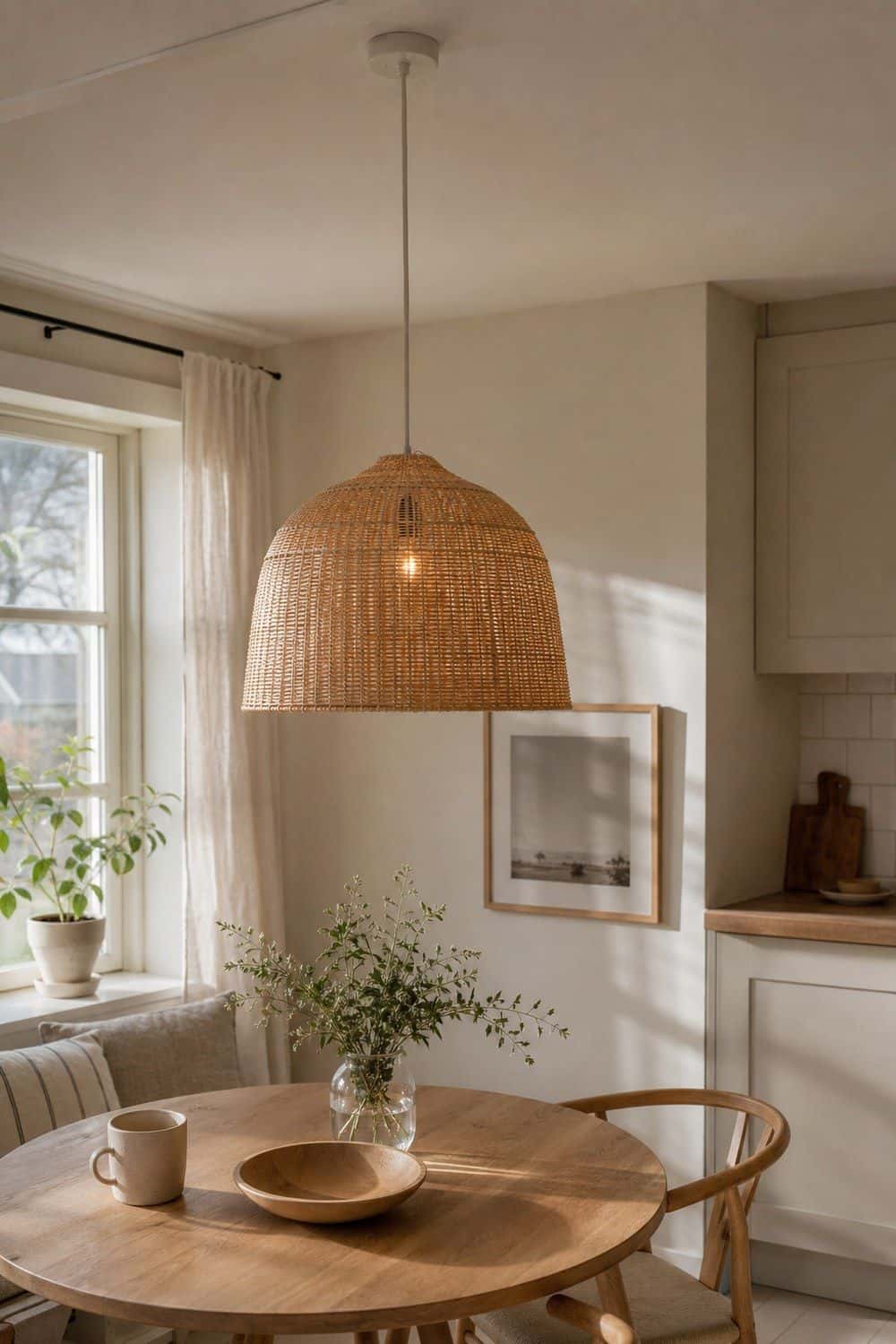
A rattan pendant does the same job as a paper one, but it brings texture and pattern with it. When the bulb is on, the woven shade throws a soft pattern of light and shadow onto the table and walls, and on a dark winter evening that’s half the coziness right there (okay, the cinnamon buns help too).
The bell-shaped shade over this round table works because the rest of the corner stays simple, with pale walls, linen curtains and a wooden table. Keep the shape plain and the color natural, because a rattan lamp with lots of fringe or a very wide brim starts to look tropical instead of Nordic, and hang it over a dining or breakfast spot rather than the prep area, where it’ll collect grease.
Where Does the Cozy Part of Scandinavian Style Come From?
Mostly from textiles, wood and the small rituals of the kitchen: a runner on the table, a salt cellar by the stove, herbs on the sill and something soft to sit on.
15. Muted Stripe Table Runner for Breakfast Nooks
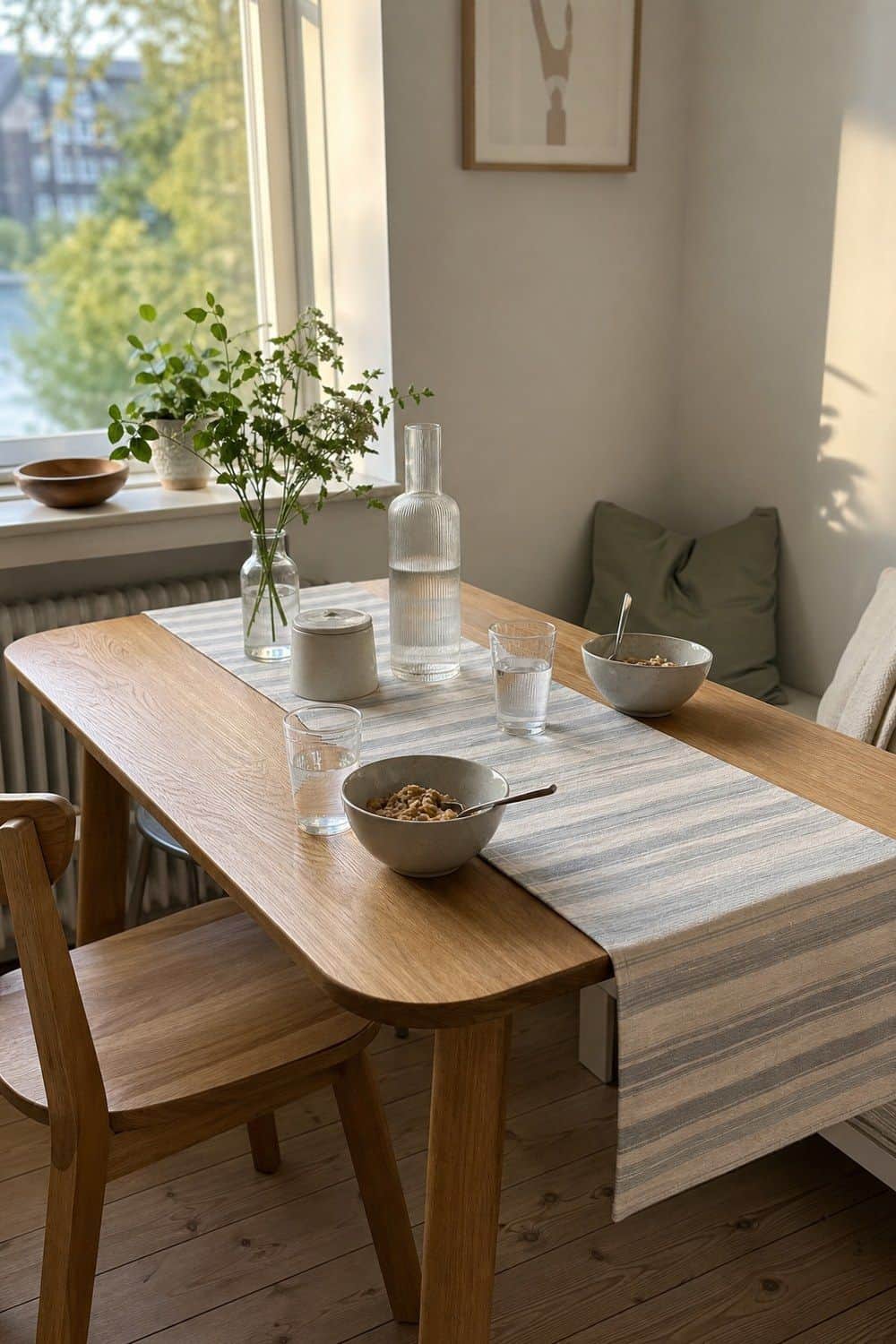
For a small, cheap way to make the kitchen table feel set even when it’s just Tuesday breakfast, lay a striped runner down the middle, because that small daily comfort is pretty much the point of Scandinavian decor. The gray and beige stripes running across this narrow wooden table add a little pattern without fighting the pale wood, and they frame the bowls and glasses instead of competing with them. Pick a washable linen or cotton runner that’s narrower than you think, since a runner on a small table should leave room on both sides for plates, and choose stripes in two quiet colors rather than a bold pattern. It’s also one of the easiest things to swap with the seasons, so a lighter one in summer and a warmer one in the dark months gives the kitchen a fresh feel without buying anything bigger.
16. Wooden Salt Cellar for Cooking Ritual
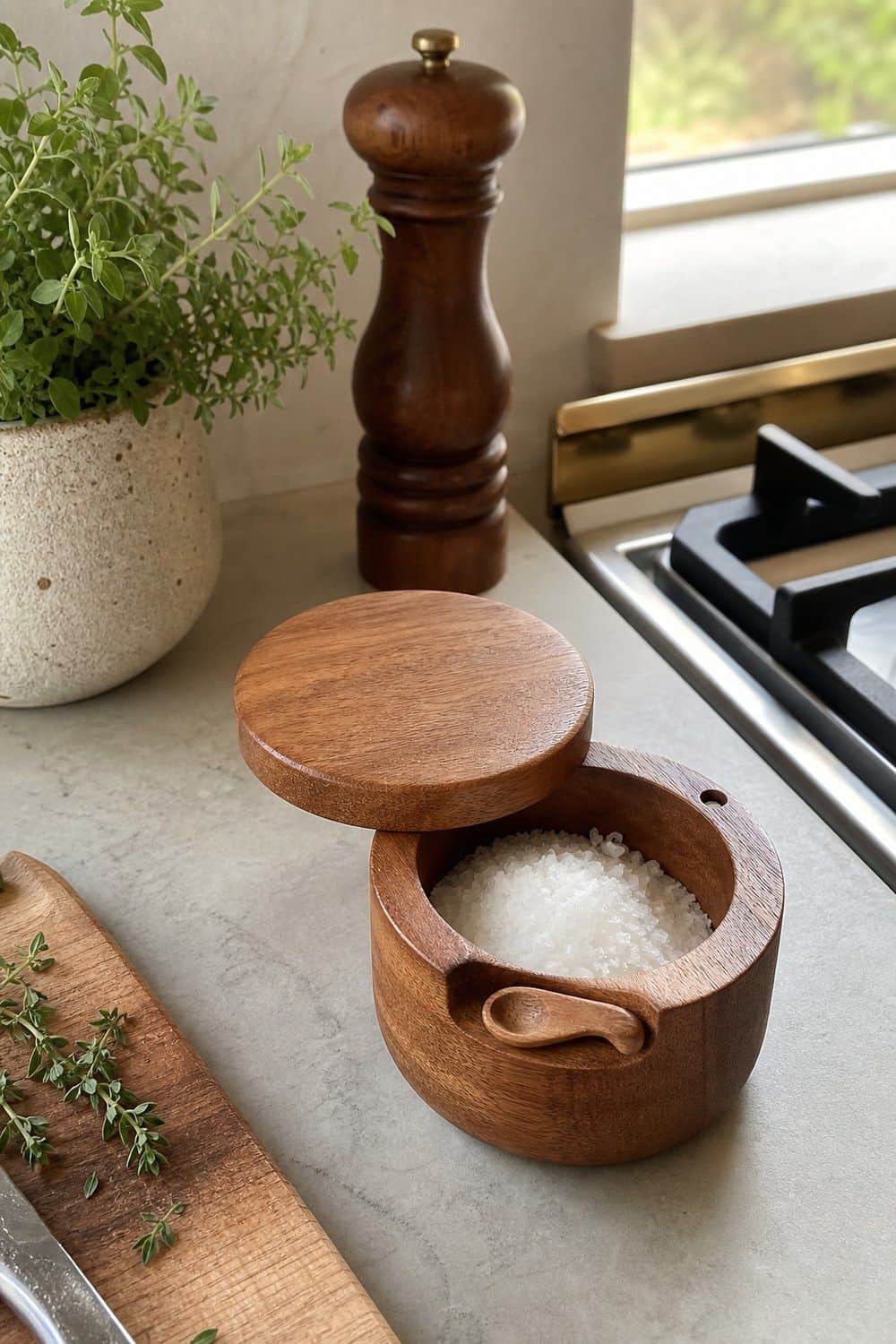
Every serious cook keeps salt within reach of the stove, and a wooden salt cellar makes that habit look good on the counter. It’s an object you’ll touch dozens of times a week, which is why it’s worth having a nice one.
The round cellar next to this gas stove has a swivel lid and a tiny wooden spoon tucked inside, so you can pinch or scoop without opening a cupboard or wrestling with a cardboard box. In a professional kitchen, salt sits right next to the stove in an open container for exactly that reason, and it’s one restaurant habit that translates perfectly to a home kitchen.
Choose a cellar with a lid (it keeps out steam and splatters) and fill it with flaky or coarse salt you can pinch. Wipe it out and refill it every month or so, and keep it a little away from the burners so the wood doesn’t scorch.
17. Indoor Herb Planter for a Window Green Moment
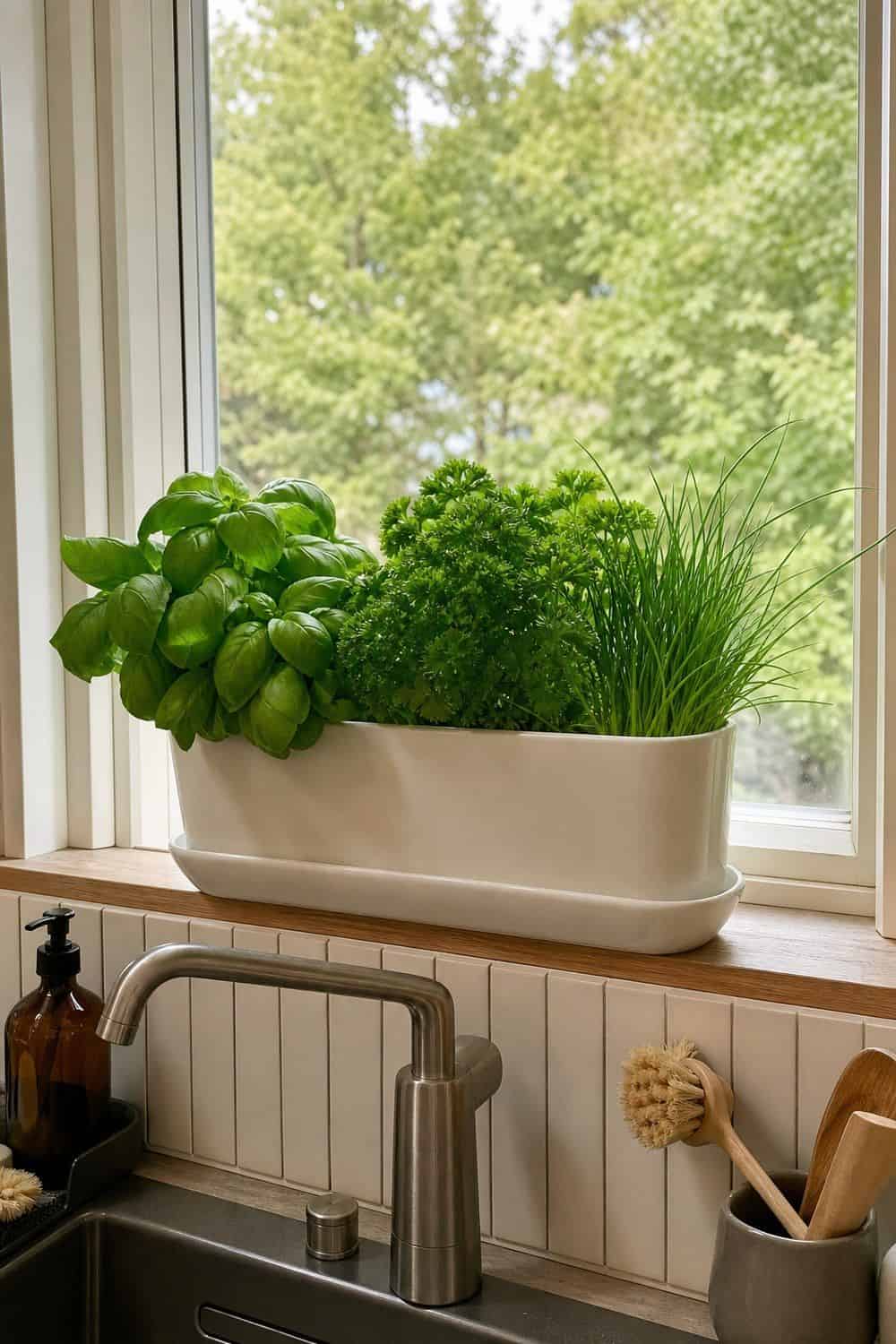
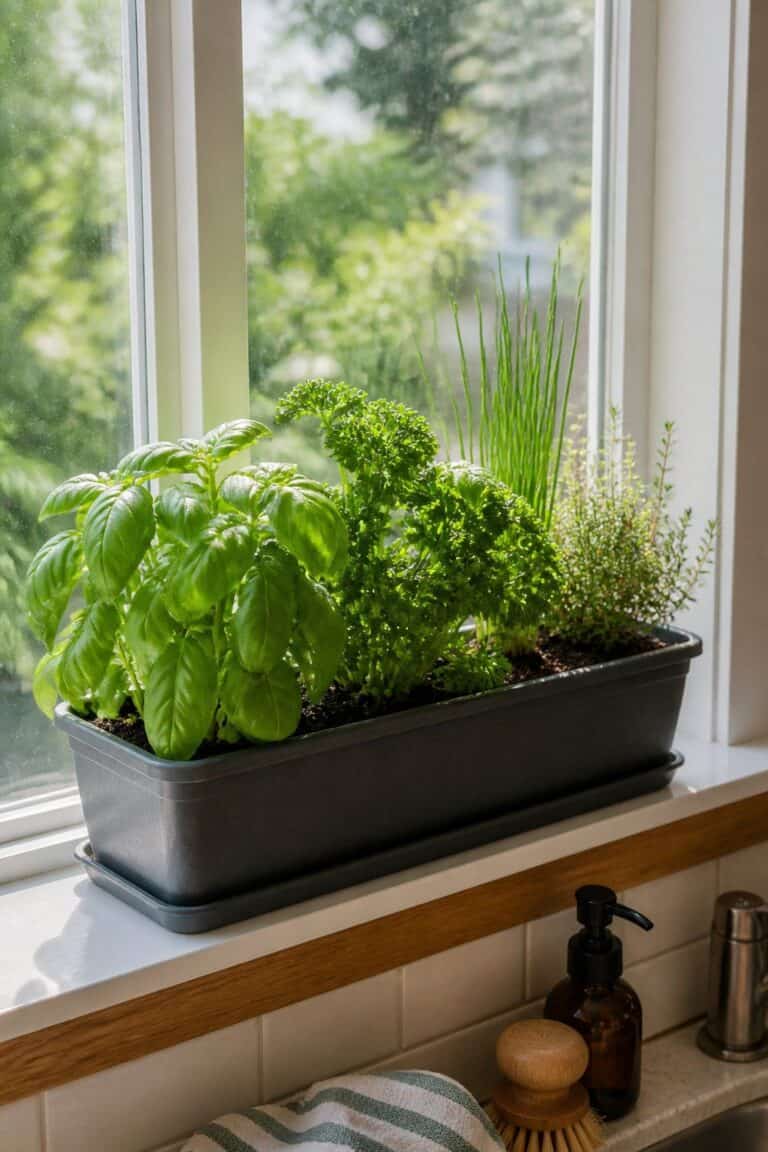
One planter of herbs on a kitchen windowsill gives you a bit of green in the darkest months and fresh flavor for dinner. Basil, parsley and chives in one long white planter, like the one on this sill above the sink, look tidier than three different pots and are easier to water in one go.
Be realistic about the light, though. In a Nordic winter, a north window gives herbs almost nothing to work with, and basil in particular sulks without sun, so a south or west window (or a small grow light) is your best friend from November to February. Chives and parsley are tougher and keep going in less light, so start with those if your windowsill isn’t sunny.
18. Scandinavian Wall Clock for Functional Wall Decor
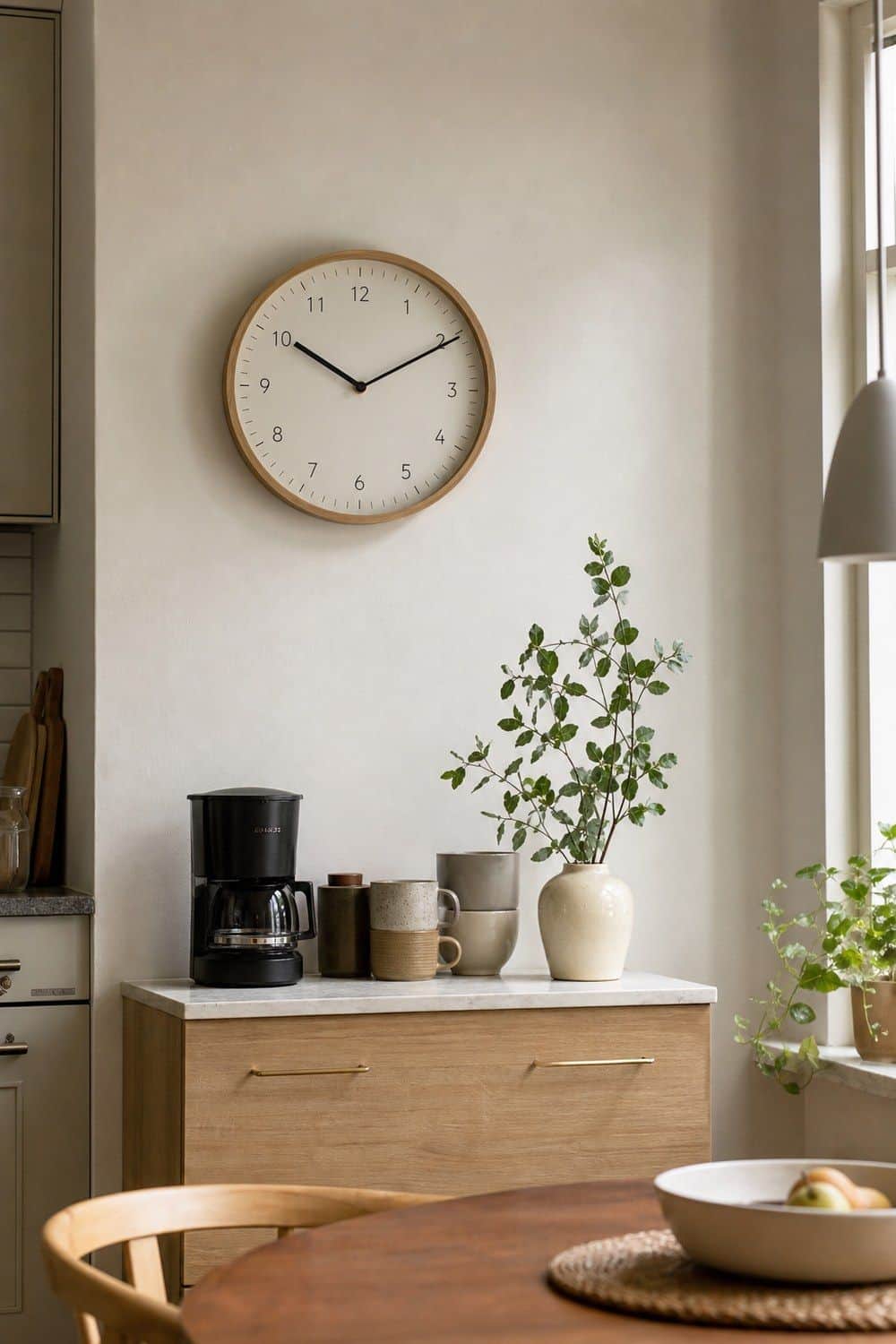
Hanging a clock is one of the few ways to put something on a kitchen wall that’s useful and decorative at once, which makes it a natural fit for a style that doesn’t love decoration for its own sake. The round clock with a pale wood frame and simple white face above this coffee corner fills a blank wall, matches the oak sideboard below it and tells you whether you’ve got time for one more coffee before you leave. Pick one with clear numbers you can read from across the room or from the stove, and listen for a silent sweep movement if the kitchen is open to the living room, because a loud tick at night gets old very fast. Hang it at eye level when standing, not up near the ceiling, so you don’t have to tilt your head every time you check the oven timer against it.
19. Light Wood Bar Stools for Island Seating
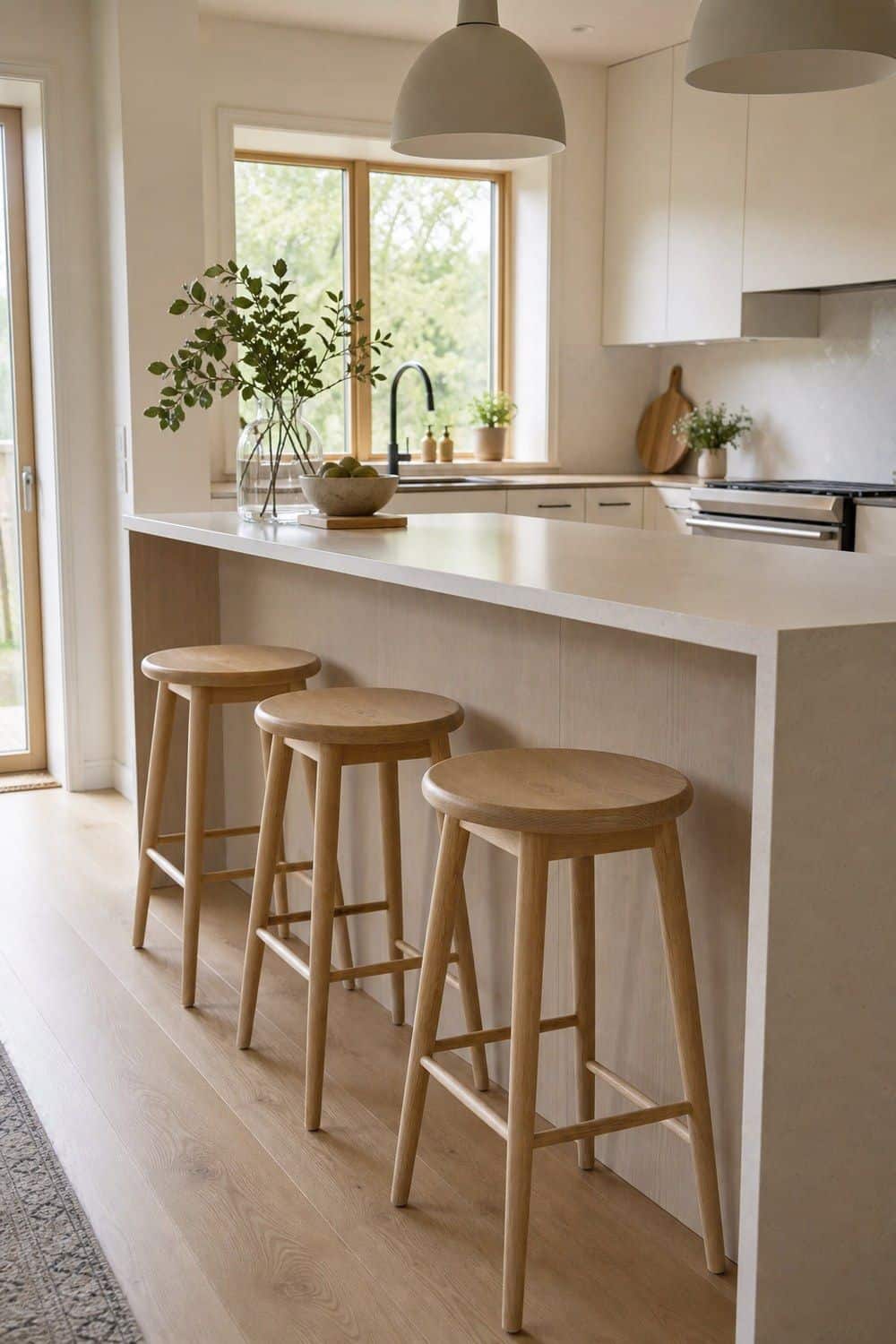
Walk into any open-plan kitchen and the stools are the furniture you notice first, so they set the tone more than you’d expect. Light wood stools with round seats and slim legs, like the three lined up at this white island, look airy because you can see through them, and that keeps the island from looking heavy.
Measure before you order:
- Seat height: about 10 to 12 inches (25 to 30 cm) lower than the counter
- Space per stool: roughly 24 inches (60 cm) so nobody bumps elbows
- Footrest height that suits the people who actually sit there
Backless stools tuck all the way under the overhang when you’re cooking, which is a big plus in smaller kitchens. If people tend to linger, add a low back or a felt pad for comfort.
20. Wool Seat Cushions for Dining Chairs

Ever sat on a spindle-back wooden chair for a long Sunday breakfast? Beautiful, very Nordic, and after half an hour pretty hard on your behind. Wool cushions are the fix, and they’re one of the easiest ways to make a dining corner feel warm in winter.
The gray felted cushions tied onto these spindle chairs are about as simple as it gets: one soft color, no pattern, and fabric ties at the back legs so they stay put when you slide the chair in and out. Wool is naturally a bit dirt- and stain-resistant and doesn’t feel cold to sit on, which matters in a kitchen where a cushion will meet the occasional crumb or spilled coffee.
Get cushions with ties or a non-slip underside, keep them thin enough that the seat height still works with the table, and choose a removable cover if you have kids or cats (or a partner who eats toast over the chair).
What Small Finds Finish a Scandinavian Kitchen?
Five of them, and each one has a job: holding fruit, holding a recipe, holding branches, hiding small stuff and lighting the coffee corner.
21. Ceramic Fruit Bowl for a Simple Island Centerpiece
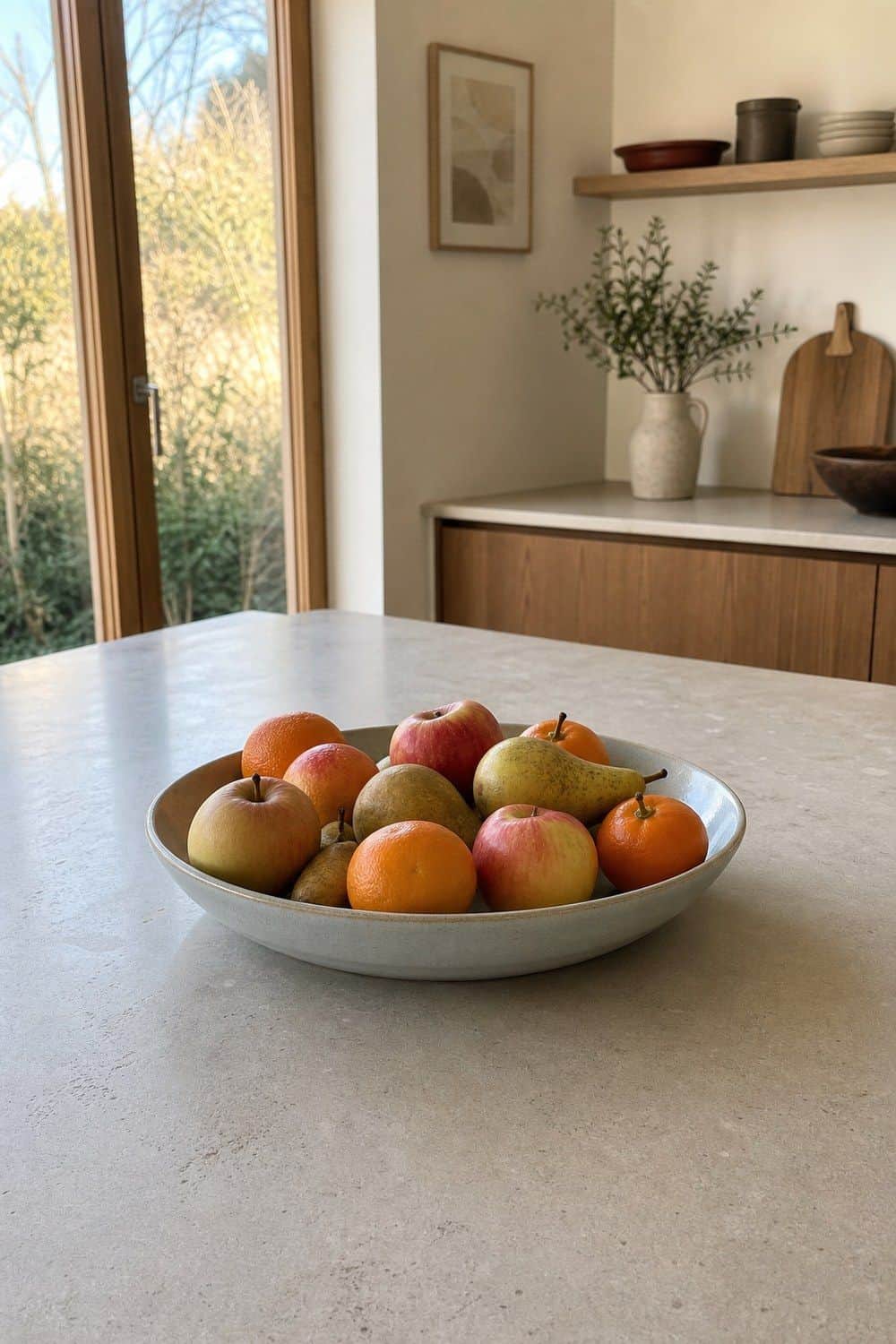
The only centerpiece most Scandinavian kitchens need is a big, wide bowl of fruit, because it’s colorful, it changes every week and it reminds you to eat the apples before they go soft. A wide, shallow bowl in pale ceramic, like the one on this gray stone island, gives the fruit room to spread out so nothing bruises at the bottom, and the oranges and red apples supply all the color the island needs without a single decorative object. Pick a bowl that suits the size of the island, not the fruit, since a tiny bowl looks lost on a big surface, and leave it in one spot so it becomes the natural place everyone drops the shopping. Keep bananas in a separate spot if you can, because they make other fruit ripen faster, and nobody wants a bowl of brown pears on Thursday.
22. Light Wood Cookbook Stand for Recipe Prep
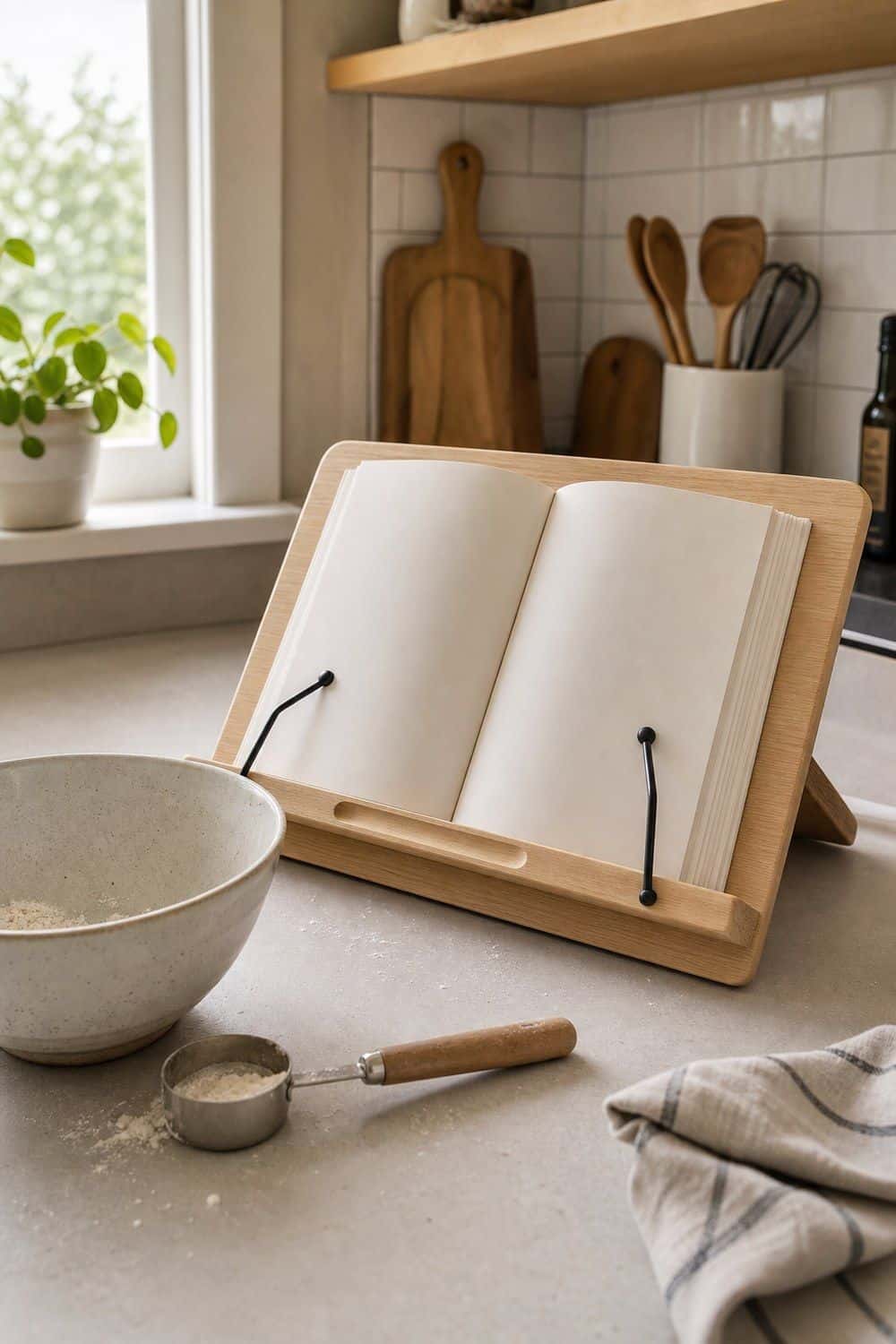
A cookbook stand sounds a bit fussy until you’ve tried to follow a recipe with flour on your hands while the book keeps flipping shut. The light wood stand on this counter holds the book open at a readable angle, keeps the pages out of the mixing bowl and looks good enough to leave out between uses.
Look for a stand with a deep ledge, page holders that work with thick cookbooks and a folding back if counter space is tight. It’s equally handy for a tablet, so you can scroll a recipe on a screen without propping your phone against the coffee maker, and a wooden one wipes clean easily after the inevitable splatter.
23. Blue Ceramic Vase for a Restrained Color Accent
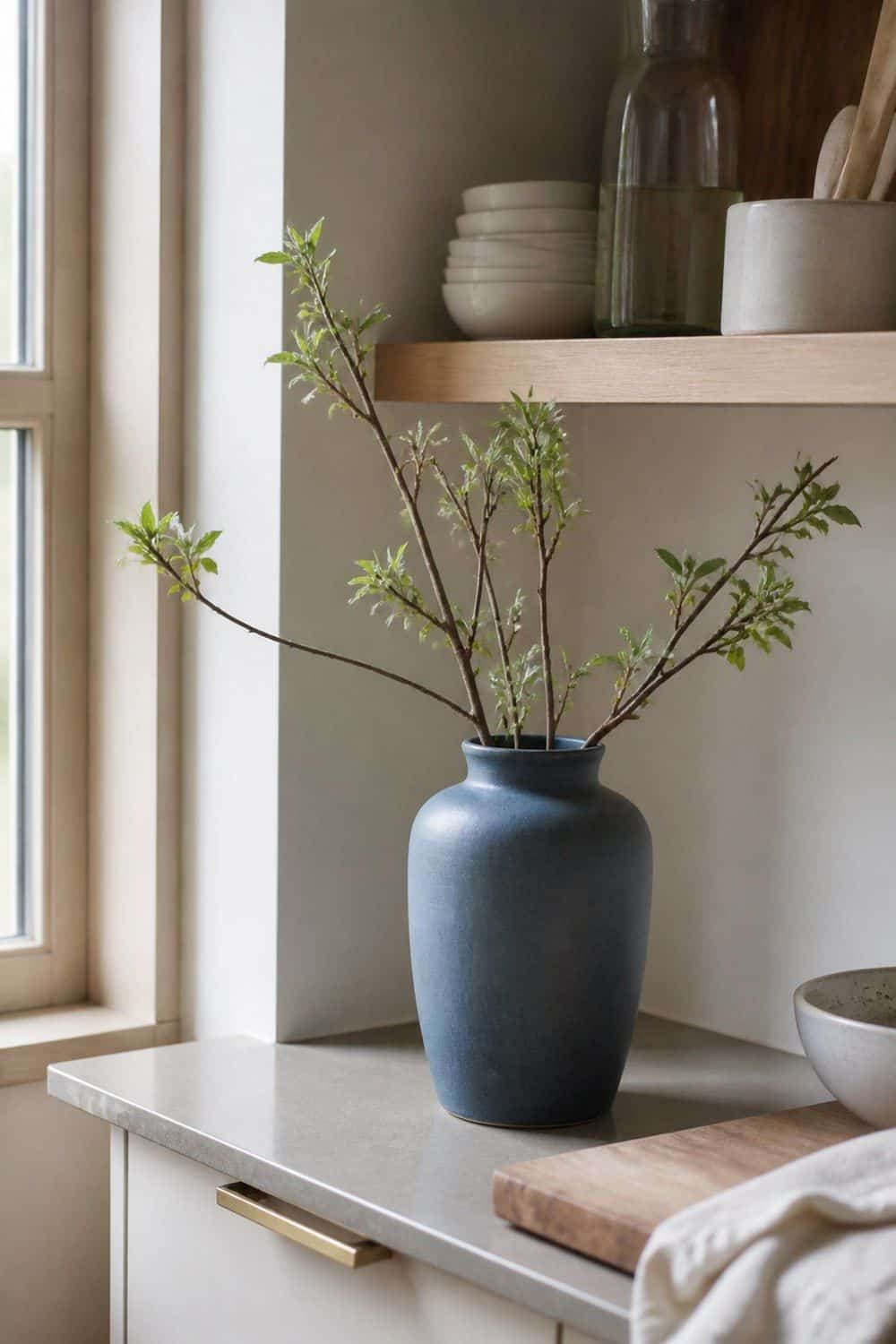
Scandinavian kitchens use color like seasoning, a little at a time, and a single blue vase is a great example. One matte vase in a deep, dusty blue on a pale counter is enough to give the whole room a point of focus.
The vase by this window holds a few budding branches instead of a bouquet, and that’s a very Nordic move: cut some birch or willow twigs from outside, put them in water and watch them sprout leaves indoors over a couple of weeks. It costs nothing, lasts much longer than flowers and looks right in a kitchen full of pale wood.
Stick to muted blues, sage, clay or charcoal rather than bright, glossy colors, and keep it to one vase. Two or three vases in different colors starts to look like a gift shop, while one just looks deliberate.
24. Woven Storage Baskets for Open Shelf Softness
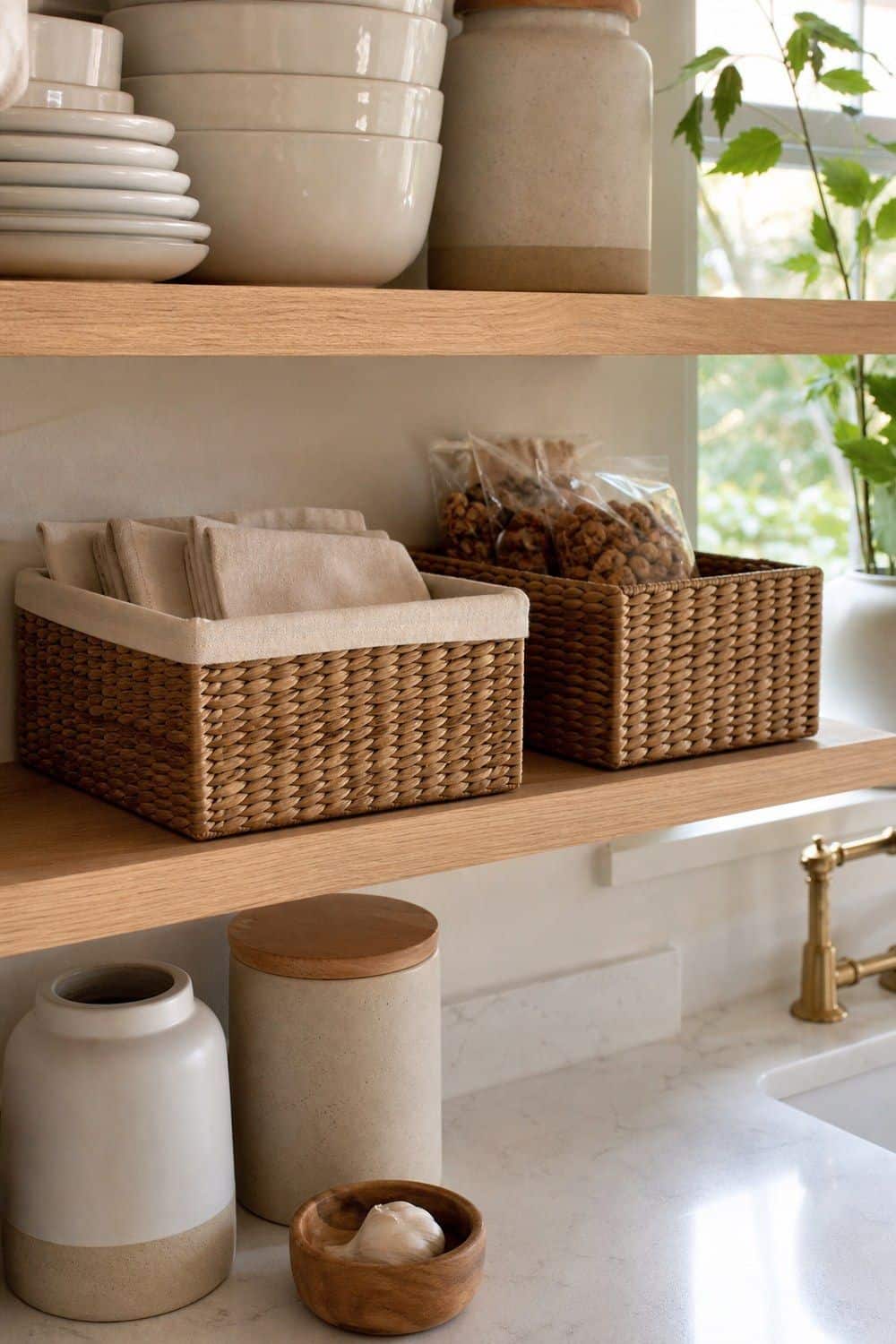
Not everything in a kitchen deserves to be on display, and baskets are how open shelving stays tidy in real life. Napkins, snack bags, tea packets and those random small things with no home all disappear into a woven basket, and the shelf still looks calm.
On these oak shelves, two woven baskets sit under a row of cream dishes, one lined with linen napkins and one holding a bag of nuts. A few basket rules that keep them useful:
- One category per basket, so you know what’s inside without digging
- Straight sides, which fit shelves better than round, floppy shapes
- A fabric liner if crumbs are involved
- No more than two or three per shelf wall, or the shelves start to look heavy
25. Plug In Wall Sconce for a Cozy Coffee Corner
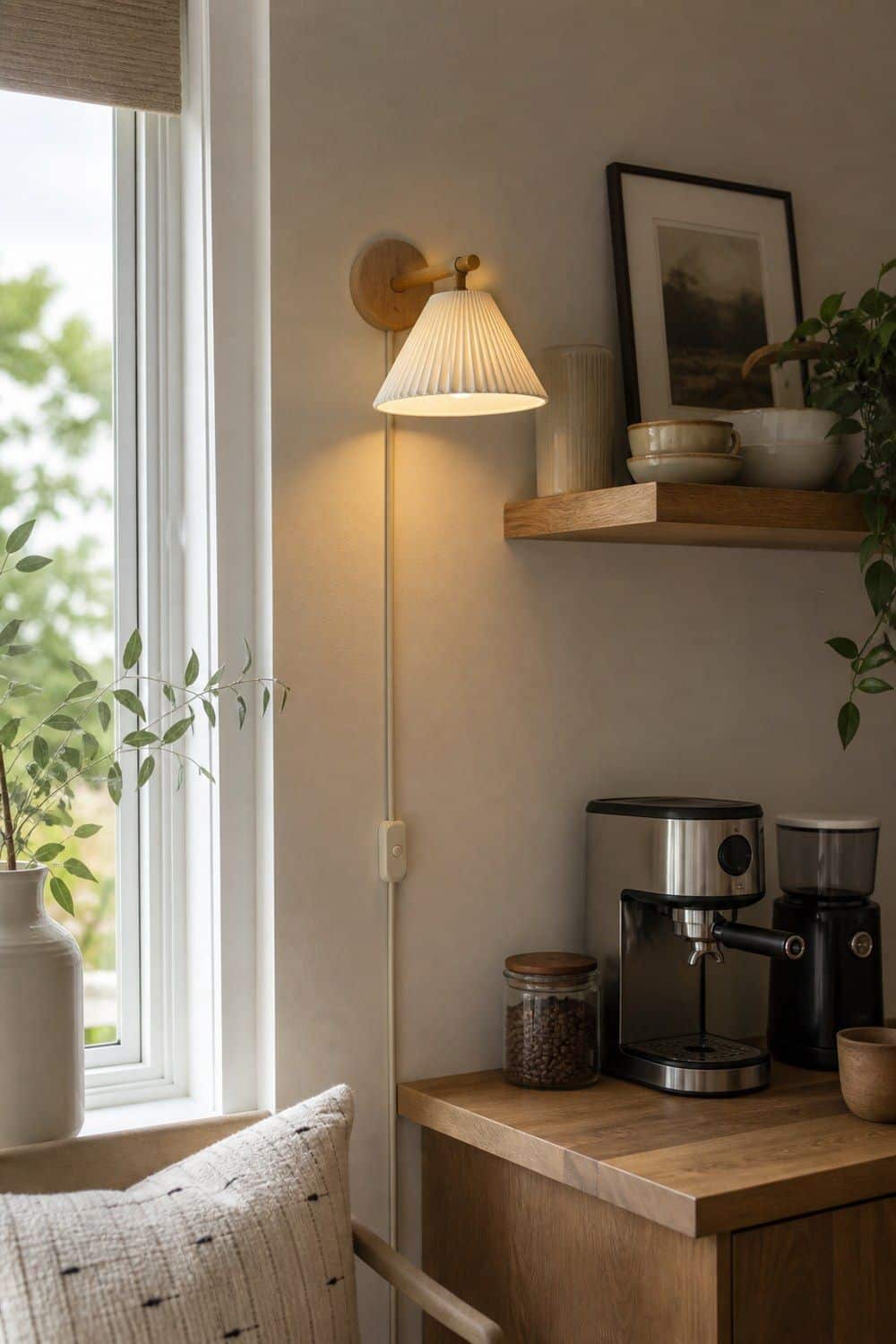
Renting, or just not keen on calling an electrician? A plug-in wall sconce gets you proper mood lighting in the kitchen, and in a Nordic winter that matters more than any other decor choice. The pleated cream shade on a wooden arm above this coffee corner gives a warm pool of light right where you’ll be standing at 7 am when it’s still pitch black outside, so the overhead light can stay off and the room feels calm instead of like an office. Mount it high enough that the shade is above eye level, run the cord neatly down the wall with a cord cover in the wall color, and use a warm white bulb, ideally with a switch on the cord. Keep it a little away from the espresso machine’s steam wand, and you’ve got the coziest spot in the kitchen.
Other Scandinavian Kitchen Decor Tips Worth Knowing
Scandinavian kitchen decor is warmer and more lived-in than strict minimalism, because it keeps the useful things out and puts away almost everything else. These habits make the finds above work together:
- Repeat two or three materials (pale wood, white ceramic and linen is a classic trio) across the whole kitchen.
- Keep at least half of every counter completely empty.
- Use one muted accent color and repeat it two or three times, for example in a vase, a towel stripe and a few mugs.
- Plan lighting in layers: a pendant over the table, a sconce or lamp in one corner and soft light under the cabinets.
- Change textiles with the seasons instead of buying new decor.
For a warmer look, see rustic kitchen decor finds.
Is Scandinavian Decor the Same as Minimalism?
No. Scandinavian decor shares minimalism’s clear counters and simple shapes, but it adds warmth on purpose with wood, wool, linen, plants and soft light, so the room feels lived in. Minimalism removes things, while Scandinavian style removes things and then makes what’s left cozy.
How Do You Make a Scandinavian Kitchen Feel Warm in Winter?
Layer light and texture. Switch to warm white bulbs, add one table lamp or plug-in sconce that you turn on in the afternoon, put a wool cushion on the chairs and a runner on the floor, and keep a candle on the table for dinner. Pale walls stay bright, and the textiles stop the room from feeling cold.
Frequently Asked Questions
What colors are used in Scandinavian kitchens?
White, warm white, pale gray and light wood tones make up most of the palette. Accent colors are muted, like dusty blue, sage, clay, oatmeal and soft charcoal, usually in small doses on towels, mugs, vases and textiles.
What materials are typical for Scandinavian kitchen decor?
Pale woods like birch, oak and pine are the base, along with linen, wool, stoneware, clear glass and natural fibers like rattan or paper. The materials are simple, tactile and meant for everyday use rather than display.
How do I make my kitchen look Scandinavian without renovating?
Clear the counters, swap plastic and printed items for wood, glass and plain ceramic, and add linen towels, a runner and warm lighting. A couple of floating shelves and a set of matching dishes change the look a lot without touching the cabinets.
Do Scandinavian kitchens work in small spaces?
Yes, they suit small kitchens very well because light colors, open shelves and bare counters make a room feel bigger. Choose compact pieces like a narrow runner, wall rails and a slim dish rack so you don’t eat up floor or counter space.
Key Takeaways
- Choose finds you’ll use every day, since that’s what makes the style work.
- Pale wood, linen, stoneware and clear glass do most of the decorating.
- Soft, warm lighting matters more than any object, especially in dark months.
- Keep counters at least half empty and group daily items on a tray.
- Use one muted color and repeat it a few times around the room.
- Hide the small stuff in drawers and baskets so open shelves stay calm.
So, Which Corner of Your Kitchen Gets the Nordic Treatment First?
If I had to pick for you, I’d start with the light, because a soft lamp over the table changes how the whole kitchen feels from the first dark evening. But maybe your counters are the real problem, and a tray and a drawer organizer would make a bigger difference this week. Look around tonight when the lights are on and ask yourself which corner you’d most like to sit in, and which one you’d rather not look at at all, and start with that one.
Last update on 2026-11-26 / Affiliate links / Images from Amazon Product Advertising API