
This easy vegetable curry simmers sweet potato and chickpeas in full-fat coconut milk with crushed tomatoes, then wilts in spinach at the end. The flavor comes from blooming cumin, coriander, turmeric and garam masala in coconut oil for about a minute before any liquid goes in. Plan on 35 minutes from chopping board to bowl, rice included.
The rice goes on first. By the time it’s steaming under its lid, the onion is soft, the spices have bloomed and the pot smells like a curry house. That’s the rhythm of this easy vegetable curry: one wide pot, sweet potato and chickpeas in coconut milk, a fistful of spinach at the end and a squeeze of lime.
It’s vegan without trying, it feeds four, and it tastes better on day two. Here’s how to make it properly, plus the Thai-style version for nights when you have a jar of red curry paste open.



Indian or Thai? Pick one before you start
“Curry” is an English catch-all for spiced sauce dishes, and it hides two very different methods. Indian-style curries are built on ground spices like cumin, coriander, turmeric and cardamom, fried in fat. Thai curries start from a wet paste of fresh chiles, lemongrass, galangal and usually shrimp paste, pounded together.
The grocery-store jar labeled curry powder belongs to neither kitchen. It’s a British-era blend, and it makes everything taste the same. Flat, a bit dusty, vaguely yellow.
This recipe is Indian-style, with four separate ground spices. You probably own three of them already, and the ones you don’t are worth buying. If your spice shelf is a jumble, these spice drawer organization ideas make weeknight curries a lot faster.
Why do you bloom the spices in oil?
Most of the flavor in dried ground spices is fat-soluble. Heat them in oil and those compounds move into the fat, which then coats every chickpea and cube of sweet potato. Dump the same spices straight into tomatoes or coconut milk and much of that flavor stays locked in the powder.
In a restaurant kitchen this is the step nobody rushes. Medium heat, constant stirring, 60 to 90 seconds. You’re looking for a darker color and a smell that jumps out of the pot. Then the tomatoes go in, which drops the temperature and stops anything from burning.
The one thing that ruins it is high heat. Ground spices go from fragrant to bitter in seconds, and there’s no fixing a scorched base. If you smell anything acrid, start again. It costs you a few spoons of spice and saves the whole dinner.
Which vegetables work in a coconut curry?
Sweet potato is the backbone here because it holds its shape and adds a little sweetness against the tomato. You can swap it 1-to-1 for cauliflower florets (cook 8 to 10 minutes instead of 12 to 15) or butternut squash on the same timing. Peeled, cubed eggplant is my favorite upgrade; give it 10 minutes covered and it turns silky.
For the spinach, chopped kale needs 2 to 3 minutes and Swiss chard about 2. Frozen peas work too: 1 cup, stirred in off the heat.
Want more protein than the chickpeas? Add 225 g (8 oz) extra-firm tofu, pressed, cubed and pan-fried until golden, along with the chickpeas. Or stir in 1 cup cooked lentils. If not everyone at the table is vegetarian, 250 g (8 oz) cooked shrimp or chicken can go in at the end just to heat through.
For a richer vegan pot, stir in 60 ml (1/4 cup) cashew cream at the end: soaked cashews blended with water. It makes the sauce silkier without changing the flavor much.
The Thai-style version
Skip the four ground spices and fry 2 to 3 Tbsp Thai red curry paste in the coconut oil for 60 seconds, then add the coconut milk. Swap the spinach for Thai basil, use 1 Tbsp fish sauce in place of the kosher salt, and leave out the cilantro in favor of more basil. The lime still goes in at the end. Brands like Maesri and Mae Ploy are widely sold and reliable.
Recipe: easy vegetable curry with sweet potato and chickpeas
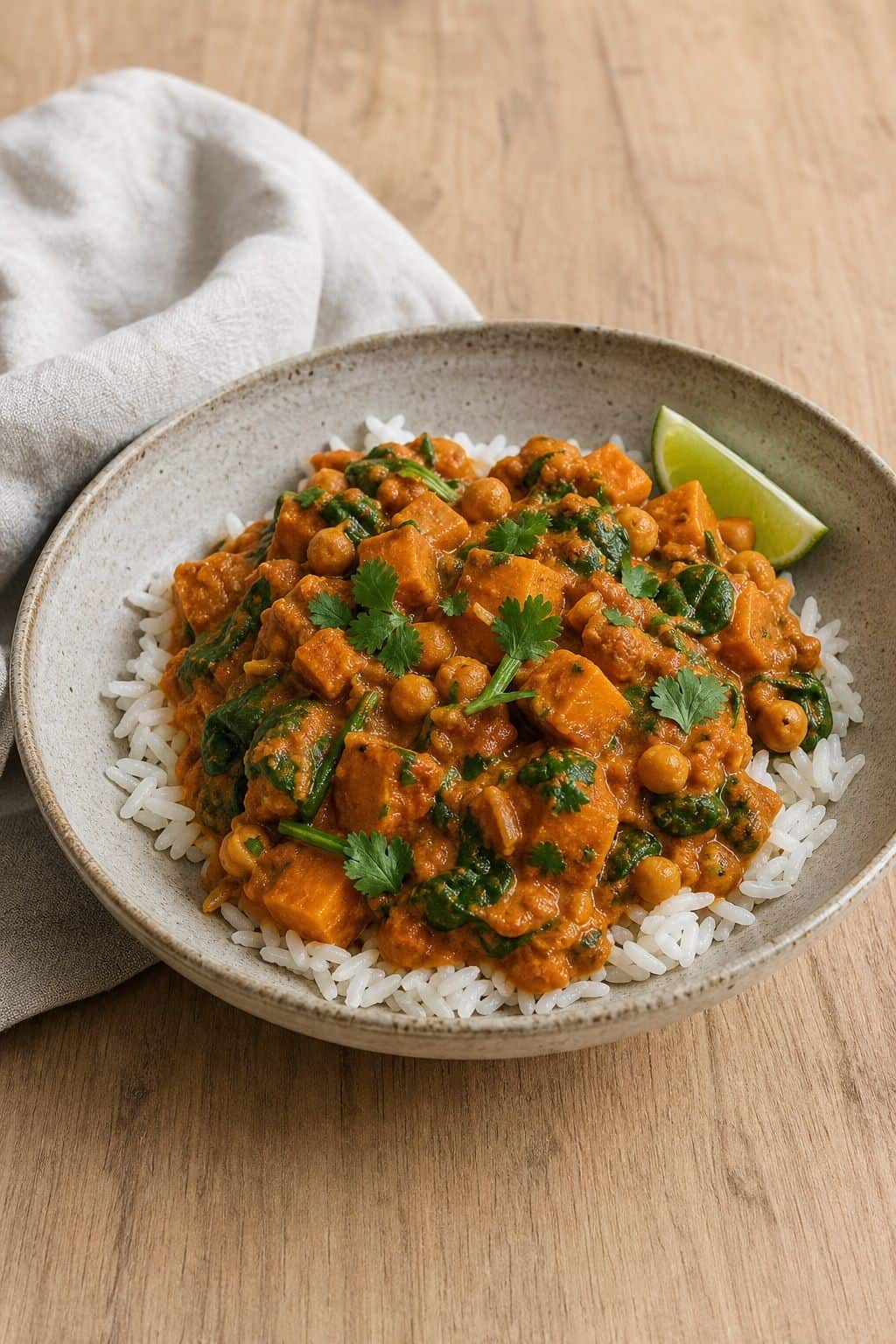
Prep time: 10 minutes. Cook time: 25 minutes. Total time: 35 minutes. Serves: 4.
Ingredients
- 30 ml (2 Tbsp) coconut oil
- 1 large yellow onion (about 200 g), diced
- 4 cloves garlic, minced
- 1 Tbsp fresh ginger, grated
- 2 tsp ground cumin
- 2 tsp ground coriander
- 1 tsp ground turmeric
- 1 tsp garam masala
- 1/2 tsp cayenne (optional)
- 1 can (425 g / 15 oz) crushed tomatoes
- 1 can (400 ml / 14 oz) full-fat coconut milk
- 1 large sweet potato (about 500 g / 1.1 lb), peeled and cut into 2 cm (3/4 inch) cubes
- 1 can (425 g / 15 oz) chickpeas, drained and rinsed
- 120 g (4 cups) baby spinach
- Juice of 1/2 lime
- 1/4 cup chopped fresh cilantro
- 1 tsp kosher salt (about 6 g), or to taste
- Basmati rice for serving (300 g / 1.5 cups uncooked for 4 people)
Instructions
- Cook the basmati rice according to the package directions while you make the curry. Keep it covered when done.
- Heat the coconut oil in a wide pot or Dutch oven over medium heat. When it shimmers, add the onion and a pinch of salt. Cook 5 to 6 minutes, stirring now and then, until soft and translucent.
- Add the garlic and ginger. Cook 1 minute more, stirring constantly.
- Add the cumin, coriander, turmeric, garam masala and cayenne if using. Stir constantly for 60 to 90 seconds, until the spices darken slightly and smell strongly fragrant. Don’t walk away; ground spices burn fast.
- Pour in the crushed tomatoes. Simmer 3 to 4 minutes, until the tomatoes reduce slightly and oil starts to separate at the edges.
- Add the coconut milk, sweet potato and 1 tsp kosher salt. Bring to a gentle simmer, lower the heat to medium-low, cover, and cook 12 to 15 minutes, until a fork slides easily into the sweet potato.
- Stir in the chickpeas. Cook uncovered 3 to 4 minutes, until heated through.
- Add the spinach by the handful, stirring after each addition. It all wilts in 60 to 90 seconds.
- Take the pot off the heat. Stir in the lime juice and cilantro. Taste and adjust the salt.
- Serve over basmati rice in shallow bowls, with extra cilantro and a lime wedge.
Notes
Keep the heat at medium and stir the whole time while the spices bloom. Use full-fat coconut milk; light coconut milk makes a thin, watery sauce. Lime and cilantro go in off the heat, because both lose their brightness if they cook.
How long does vegetable curry keep?
Four days in the fridge, in a covered container. The FoodSafety.gov cold storage chart gives 3 to 4 days for soups and stews, so eat it within that window. The spices settle overnight, and day-two curry tastes rounder than day one. Reheat it gently on the stove with a splash of water if the sauce has tightened up.
It freezes well in 2-cup portions for up to 3 months. Coconut milk can split a little after thawing. Whisk hard while it reheats and it comes back together.
Making a double batch on Sunday is the move here. Lunches for half the week, sorted.
Vegetable curry questions
Can I use curry powder instead of individual spices?
Yes, use 1 Tbsp good Madras or mild curry powder in place of the four ground spices, though the curry will taste flatter. Stir in 1 tsp garam masala at the end to bring back some of the depth.
What’s the difference between curry paste and curry powder?
Curry paste is a wet blend of fresh ingredients like chiles, lemongrass and galangal, used in Thai cooking. Curry powder is a dry ground spice mix. They behave differently in the pot and aren’t interchangeable spoon for spoon.
Can I use light coconut milk?
You can, but the curry will be thinner and less rich, because the fat is what gives the sauce its body. Stick with full-fat unless you have a specific reason not to.
How spicy is this vegetable curry?
With 1/2 tsp cayenne it’s mild. For more heat, raise it to 1 tsp or add 1 to 2 finely chopped green chiles with the garlic, and for no heat at all, leave the cayenne out.
What should I serve with vegetable curry?
Basmati rice is the classic, and naan is the upgrade. A quick cucumber raita (yogurt, cucumber, mint and salt) cools things down, and mango chutney adds a sweet-sour edge.
Key takeaways
- Cook one style of curry, Indian or Thai, rather than leaning on generic curry powder.
- Bloom the ground spices in oil for 60 to 90 seconds over medium heat.
- Full-fat coconut milk gives the sauce its body.
- Lime juice and cilantro go in off the heat.
- Leftovers keep 4 days in the fridge and up to 3 months frozen.
Ready for a curry with chicken?
Once the spice-blooming step feels natural, the same technique carries straight into a yogurt-marinated chicken tikka masala for nights you want meat in the pot.
Or stay meat-free with this one-pot capsicum curry, built around sweet peppers.
Easy Vegetable Curry
The vegetable curry that works at home commits to one cuisine instead of mashing Indian and Thai together with generic "curry powder." This version is Indian-style: bloomed whole spices (cumin, coriander, turmeric, garam masala) in coconut oil, plus coconut.
Ingredients
- 30 ml (2 Tbsp) coconut oil
- 1 large yellow onion (about 200 g), diced
- 4 cloves garlic, minced
- 1 Tbsp fresh ginger, grated
- 2 tsp ground cumin
- 2 tsp ground coriander
- 1 tsp ground turmeric
- 1 tsp garam masala
- 1/2 tsp cayenne (optional)
- 1 can (425 g / 15 oz) crushed tomatoes
- 1 can (400 ml / 14 oz) full-fat coconut milk
- 1 large sweet potato (about 500 g / 1.1 lb), peeled and cubed
- 1 can (425 g / 15 oz) chickpeas, drained and rinsed
- 120 g (4 cups) baby spinach
- Juice of 1/2 lime
- 1/4 cup chopped fresh cilantro
- 1 tsp kosher salt (about 6 g), or to taste
- Basmati rice, for serving
Instructions
- Cook the basmati rice according to package directions while you make the curry. Set aside, covered, when done.
- Heat 30 ml (2 Tbsp) coconut oil in a wide pot or Dutch oven over medium heat. When the oil shimmers, add the diced onion and a pinch of salt. Cook for 5 to 6 minutes, stirring occasionally, until soft and translucent.
- Add the minced garlic and grated ginger. Cook for 1 minute more, stirring constantly.
- Add 2 tsp ground cumin, 2 tsp ground coriander, 1 tsp ground turmeric, 1 tsp garam masala, and 1/2 tsp cayenne if using. Stir constantly for 60 to 90 seconds. The spices should bloom in the oil and become very fragrant. Watch closely; ground spices burn fast.
- Pour in 1 can (425 g) crushed tomatoes. Stir to combine and let it simmer for 3 to 4 minutes, until the tomatoes reduce slightly and the oil starts to separate at the edges.
- Pour in 1 can (400 ml) full-fat coconut milk. Add the cubed sweet potato and 1 tsp kosher salt. Stir to combine. Bring to a gentle simmer, reduce the heat to medium-low, cover, and cook for 12 to 15 minutes, until the sweet potato is fork-tender.
- Stir in the drained chickpeas. Cook uncovered for 3 to 4 minutes more, until the chickpeas are warmed through.
- Add the baby spinach in handfuls, stirring after each addition to wilt. The spinach wilts down quickly; the whole 4 cups will incorporate in 60 to 90 seconds.
- Remove the pot from the heat. Stir in the juice of 1/2 lime and the chopped cilantro. Taste and adjust salt.
- Serve over basmati rice in shallow bowls, with extra cilantro and a lime wedge.
Notes
The ground spices burn in seconds at the wrong temperature. Keep the heat at medium and stir constantly during the 60 to 90 seconds of blooming.
Full-fat coconut milk gives the curry body. Light coconut milk produces a thin, watery dish.
Last update on 2026-10-03 / Affiliate links / Images from Amazon Product Advertising API