
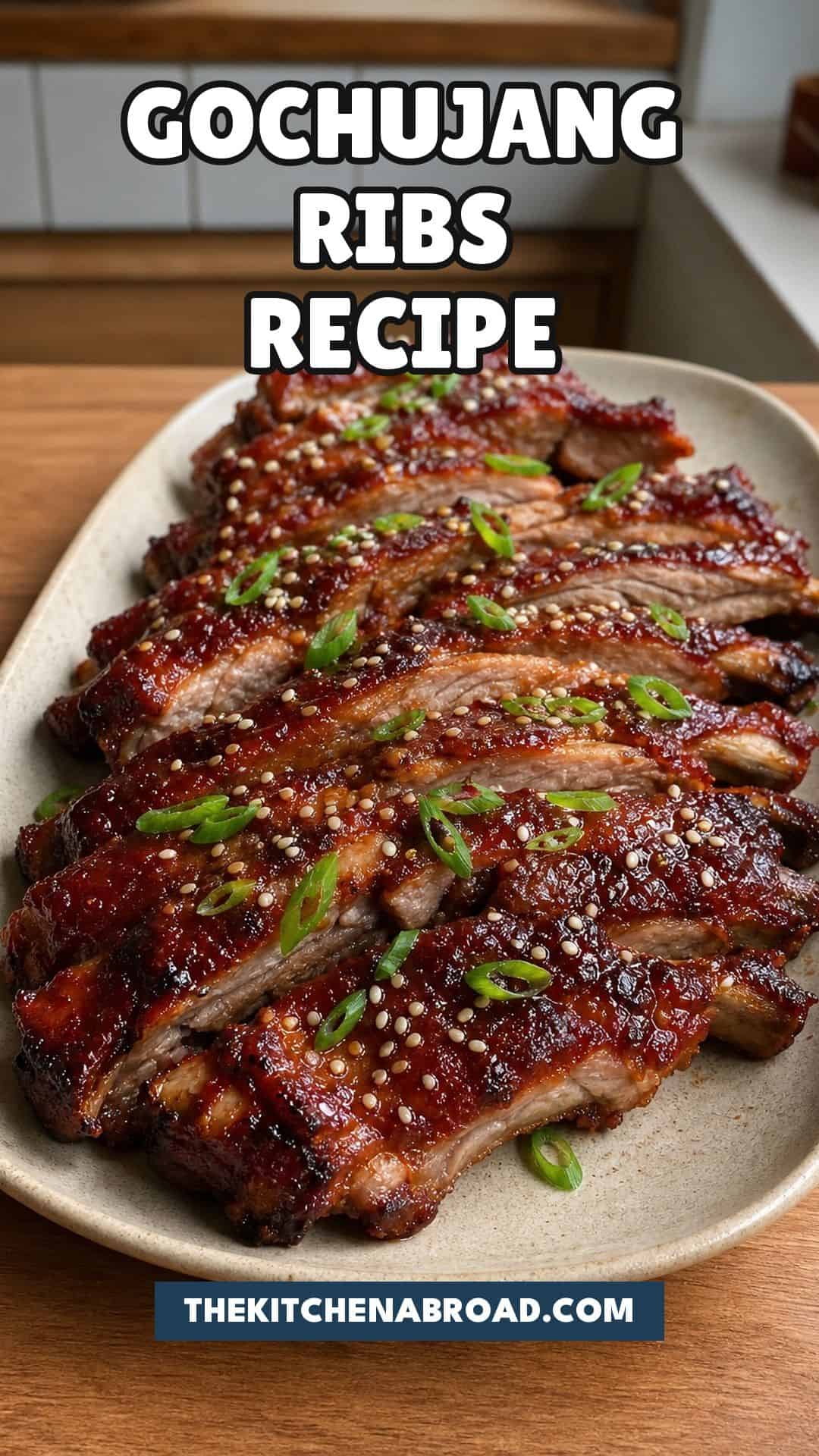
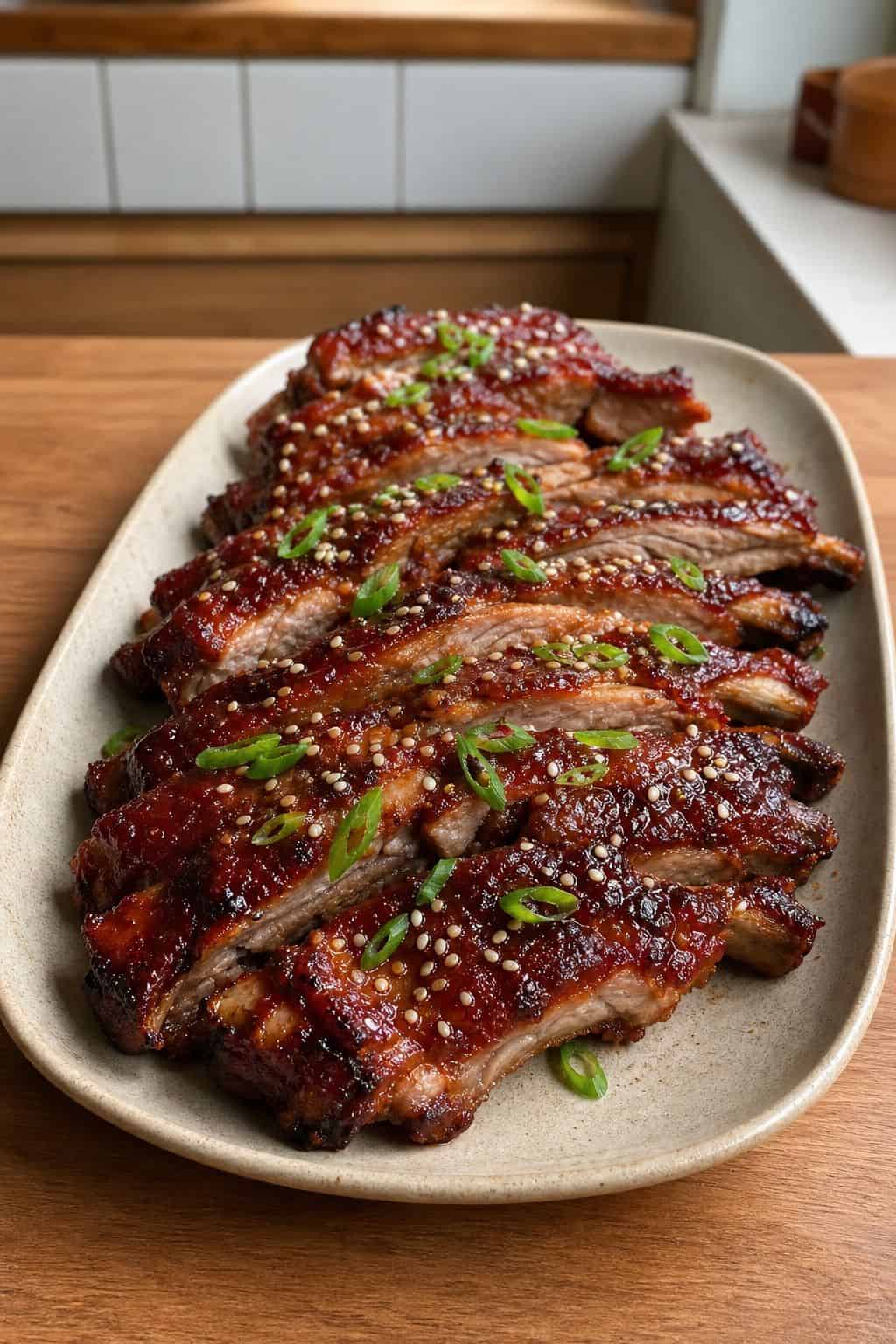
Gochujang pork ribs are oven-baked low and slow with a dry rub, foil-wrapped at 275°F for 2.5 hours, then unwrapped, glazed with a sticky Korean sauce, and finished at 425°F for 10 minutes to caramelize. Two-zone heat is the entire trick. Fall-off-the-bone tender with restaurant lacquer. Total time about 3 hours.
Restaurant ribs and home ribs differ on exactly one variable: the second oven temperature. Home cooks bake ribs at one temperature, usually 350°F, for two hours. The result is fine. Pulled meat, faint glaze, no real lacquer. Restaurants use two temperatures. Low and slow at 275°F (foil-wrapped) until the meat collapses off the bone, then high and fast at 425°F (unwrapped, with the glaze) until the surface caramelizes into something that looks like it belongs on the cover of a Korean BBQ cookbook.
The 275°F-then-425°F method is borrowed from American BBQ pitmasters who learned it on stick-burner smokers and brought it back into ovens. The chemistry is straightforward. Low heat over a long time breaks down the collagen in the rib meat into gelatin, which is what creates that fall-off-the-bone texture. High heat with sugar-heavy glaze creates a Maillard caramelization on the surface that you cannot get any other way. Combine the two and home ribs become restaurant ribs.
The Asian pear in the glaze is the third detail most recipes skip. Asian pears contain enzymes (calcium activated proteases) that gently tenderize meat, the same way pineapple does but without the aggressive sourness. Grated Asian pear added to the glaze does two things: adds sweetness, and helps the surface meat stay tender while the glaze caramelizes on top. The brand-name Asian pear in the grocery store. If you cannot find Asian pear, sub a regular Bartlett pear or skip it, the ribs are still excellent. Metric and imperial throughout.
What You’ll Need to Make This Recipe
A heavy half sheet pan with high sides catches the rendered fat without overflowing. Heavy-duty aluminum foil for the wrap step. A silicone basting brush for applying the glaze in even layers. An instant-read thermometer for verifying doneness. Real Korean gochujang in the red tub. A Dutch oven works as a backup if you do not have a pan large enough for full racks.


![Gochujang – Premium Korean Red Chili Paste [ Medium | 1.1 lb (500g) ] – 0...](https://www.thekitchenabroad.com/wp-content/plugins/aawp/public/image.php?url=YUhSMGNITTZMeTl0TG0xbFpHbGhMV0Z0WVhwdmJpNWpiMjB2YVcxaFoyVnpMMGt2TkRFd2FUUnFhR2gyZUV3dVgxTk1NVFl3WHk1cWNHYz18MTc4NjM5OTQ4OQ= "Gochujang Pork Ribs Recipe (Oven-Baked, Korean Glaze)")

Recommended Reads
- Gochujang Chicken Wings Recipe (Sticky Korean Glaze)
- Gochujang Pasta Recipe (Creamy, Spicy, 20 Minutes)
- Crispy Gochujang Tofu Recipe (Baked)
- Gochujang Aioli Recipe (Spicy Korean Garlic Mayo)
- Tomato-Based Chicken and Dumpling Soup Recipe
Why These Gochujang Ribs Work
The two-zone oven method is the most important variable in this recipe. Ribs cooked at a single high temperature dry out before the connective tissue has time to break down. Ribs cooked at a single low temperature stay pale and never develop the caramelized lacquer that makes restaurant ribs look restaurant. Two zones gives you both. Low (275°F) for 2.5 hours wrapped in foil traps moisture, slowly breaks down collagen, and renders fat without drying. High (425°F) for 10 minutes unwrapped lets the glaze caramelize on the surface without overcooking the meat. Two phases, two completely different chemistries, one perfect rib.
The foil wrap is the second essential element. Wrapping the ribs tightly in heavy-duty foil creates a steam environment around the meat that helps the collagen break down faster than dry heat would. The texture transformation from raw-tough to fork-tender happens around 90°C (195°F) internal temperature, and the foil-wrapped low-heat method gets there reliably in 2.5 hours. Without the foil, the ribs would dry out before the collagen broke down.
The dry rub before the wrap is the third detail. Most home recipes glaze immediately. The dry rub (salt, brown sugar, smoked paprika, garlic powder, onion powder, black pepper) lays a foundation of seasoning that penetrates the meat during the long low cook. The glaze comes on at the end and adds a sticky-spicy layer on top of an already deeply seasoned rib. Skipping the dry rub gives you ribs that taste mostly of glaze and not much of seasoned meat underneath.
Gochujang Ribs Ingredients, Briefly
St. Louis cut spare ribs. St. Louis cut (rectangular slabs, trimmed) has more meat than baby back ribs and is more forgiving of long cooks. About 1.4 to 1.8 kg (3 to 4 lb) feeds 4 generously. Baby backs work as a substitute, reduce the low-cook time to 2 hours.
Dry rub. Kosher salt, brown sugar, smoked paprika, garlic powder, onion powder, black pepper. Mix in advance. The ratio is roughly 2 parts brown sugar to 1 part salt to 1 part smoked paprika to ½ part each of garlic powder, onion powder, and black pepper.
Gochujang. Korean fermented chili paste, medium heat. Chung Jung One red tub. The depth of the glaze comes from real Korean gochujang.
Asian pear. Grated on a box grater. Adds sweetness and gentle enzymatic tenderizing. Bartlett pear works as a substitute, less authentic but the dish still works. Apple is the third-best substitute.
Soy sauce and rice vinegar. Salt and acid for the glaze.
Honey and brown sugar. The two sweeteners. Honey for sticky body, brown sugar for caramel notes.
Garlic and ginger. Both fresh, grated. Aromatic base of the glaze.
Toasted sesame oil and seeds. Sesame oil swirled into the glaze, seeds sprinkled on at the end.
Scallions. Thinly sliced for finishing.
Tips and Variations
Remove the silver skin. The thin connective membrane on the back of the ribs prevents seasoning penetration and stays chewy after the long cook. Slide a butter knife under one corner, grab with a paper towel, and peel off. Takes 60 seconds. Skip this step and the ribs are less than they could be.
Baby back rib timing. Baby backs are smaller and cook faster. Reduce the foil-wrapped low cook to 2 hours instead of 2.5. The final 425°F caramelization is still 10 minutes.
Smoker version. If you have a smoker, run it at 110°C (225°F) with hickory or apple wood for 4 hours unwrapped, then wrap in foil for the last hour, then unwrap and glaze on a hot grill for 5 minutes. The smoker version is genuinely transcendent.
What to serve with gochujang ribs. Steamed jasmine rice. Quick-pickled cucumbers. Kimchi. A simple cabbage slaw. Grilled corn brushed with gochujang mayo. Cold lager or makgeolli.
Make-ahead strategy. Do the dry rub the night before for deeper seasoning. The low foil-wrap stage can be done up to a day ahead, then refrigerated wrapped. Reheat the wrapped ribs in a 350°F oven for 30 minutes, then unwrap, glaze, and finish at 425°F.
The double-glaze trick. For extra-thick lacquer, brush the ribs with glaze and bake at 425°F for 5 minutes, then brush again with a second layer of glaze and bake another 5 minutes. The double layer gives a deep, glossy crust that looks restaurant-pro.
Recipe: Gochujang Pork Ribs (Oven-Baked, Korean Glaze)
Prep Time: 15 minutes | Cook Time: 2 hours 40 minutes | Total Time: About 3 hours | Servings: 4
Ingredients
For the ribs and dry rub:
- 1 rack St. Louis cut spare ribs (about 1.6 kg / 3.5 lb)
- 2 tbsp brown sugar
- 1 tbsp kosher salt
- 1 tbsp smoked paprika
- 1 tsp garlic powder
- 1 tsp onion powder
- 1 tsp coarse black pepper
For the gochujang glaze:
- 4 tbsp gochujang (medium heat)
- 3 tbsp soy sauce
- 3 tbsp honey
- 2 tbsp brown sugar
- 2 tbsp rice vinegar
- 1 tbsp toasted sesame oil
- 4 cloves garlic, grated
- 1 tbsp fresh ginger, grated
- ½ Asian pear (about 100 g), peeled and grated (or substitute Bartlett pear)
For garnish:
- 2 scallions, thinly sliced
- 1 tbsp toasted sesame seeds
Instructions
- Preheat the oven to 135°C (275°F). Place a sheet of heavy-duty aluminum foil large enough to wrap the ribs on a half sheet pan.
- Remove the silver skin from the back of the ribs. Slide a butter knife under one corner of the membrane, grab with a paper towel, and peel it off in one piece. Pat the ribs dry with paper towels.
- Combine the brown sugar, kosher salt, smoked paprika, garlic powder, onion powder, and black pepper in a small bowl. Rub the mixture generously into both sides of the ribs.
- Place the seasoned ribs bone-side down on the foil. Wrap the foil tightly around the ribs, sealing all edges. Set on the sheet pan and bake for 2.5 hours at 275°F (135°C). The ribs are done when the meat has shrunk back from the bone tips and the internal temperature reads 90°C (195°F).
- While the ribs cook, make the glaze. Whisk together the gochujang, soy sauce, honey, brown sugar, rice vinegar, toasted sesame oil, garlic, ginger, and grated Asian pear in a small saucepan. Simmer over medium heat for 5 minutes, stirring occasionally, until the glaze has thickened to a spoon-coating consistency.
- Remove the ribs from the oven. Increase the oven temperature to 220°C (425°F). Carefully unwrap the foil (steam will release).
- Brush the ribs generously with about half of the gochujang glaze. Return to the oven, unwrapped, for 5 minutes.
- Brush the ribs with a second layer of glaze. Return to the oven for another 5 minutes, until the glaze is bubbling and beginning to caramelize at the edges.
- Remove the ribs from the oven. Let rest for 10 minutes (cutting into them too soon spills the juices). Slice between the bones into individual ribs.
- Plate the ribs. Drizzle with any remaining glaze. Sprinkle with sliced scallions and toasted sesame seeds. Serve immediately with steamed rice and pickled vegetables.
Notes
The silver skin removal matters. The membrane on the back of the ribs stays chewy after the long cook and prevents the seasoning from penetrating. Spend the 60 seconds to peel it off, the difference in finished texture is significant.
The two-zone temperature is the entire trick. Skip the second high-heat phase and the ribs taste like steamed pork. Skip the first low-heat phase and the ribs are tough and dry. Both phases are non-negotiable.
Storage. Cooked ribs hold for 3 days refrigerated. Reheat at 350°F wrapped in foil for 15 minutes, then unwrap and brush with extra glaze for 5 minutes at 425°F. The reheated version is nearly as good as fresh.
Asian pear is the upgrade. If you can find one (most large grocery stores carry them in the produce section near the apples), use it. The enzymatic tenderizing plus the floral sweetness is worth the search. Bartlett pear or even an apple is the next-best substitute.
Frequently Asked Questions
What ribs are best for gochujang ribs?
St. Louis cut spare ribs are the recommended choice. They have more meat than baby back ribs, more connective tissue (which becomes gelatin during the slow cook), and are more forgiving of timing. Baby back ribs work as a substitute, reduce the low-cook time to 2 hours instead of 2.5. Country-style ribs are not actually ribs and should not be used in this recipe.
Do I have to use a two-zone temperature method?
Yes, the two-zone method (275°F low-and-slow, then 425°F high-and-fast) is what makes these ribs restaurant-quality. Single-temperature ribs at 350°F for 2 hours are fine but they will not have the lacquered, caramelized crust that the high-heat finish provides. The 10 minutes at 425°F is the entire visual and textural difference between home and restaurant.
Can I make gochujang ribs in a slow cooker?
Yes, with one caveat. Slow cook on low for 6 hours covered. Then transfer the ribs to a sheet pan, brush with glaze, and finish at 425°F in the oven for 10 minutes for the caramelized crust. Slow cookers cannot do the high-heat finish, so the oven step is still necessary. Without it, the ribs will be tender but pale.
Why is my rib meat tough?
The most common cause is undercooking. The collagen in rib meat breaks down at 90°C (195°F) internal temperature, and that breakdown is what gives the fall-off-the-bone texture. If your ribs were pulled from the oven at 75 or 80°C, they would test “done” by safety standards but still be tough. Always pull at 90°C internal, or test by bending the rack: when the meat starts to crack along the surface, the ribs are ready.
Can I make these ribs ahead of time?
Yes, with great results. Do the dry rub the day before. Complete the foil-wrapped low cook (the 2.5 hours at 275°F), then cool the still-wrapped ribs and refrigerate up to 24 hours. When ready to serve, reheat the wrapped ribs at 175°C (350°F) for 30 minutes, then unwrap, glaze, and finish at 425°F as in the recipe. The make-ahead version is actually slightly better because the seasoning has more time to penetrate.
How spicy are gochujang ribs?
Moderate with medium gochujang. The heat builds across the meal rather than punching at the front because the honey and brown sugar balance the chili. Use mild gochujang for a kid-friendly version, or hot gochujang plus a teaspoon of crushed Korean chili flakes for a serious-burn version.
Key Takeaways
- Two-zone oven method: 275°F low-and-slow for 2.5 hours wrapped in foil, then 425°F high-and-fast for 10 minutes unwrapped with glaze. The entire trick.
- Remove the silver skin from the back of the ribs before seasoning. Sixty seconds of work, measurable improvement.
- Pull ribs at 90°C (195°F) internal temperature, when the collagen has fully broken down. Underdone ribs are tough ribs.
- Grated Asian pear in the glaze adds gentle enzymatic tenderizing and floral sweetness. Bartlett pear or apple as substitutes.
- The double-glaze trick gets you thick lacquer. Brush, bake 5 min, brush again, bake 5 more.
Final Thoughts
Restaurant ribs at home are not magic. They are just two temperatures, three hours, and a quality gochujang glaze. The two-zone method is the answer most home cooks never learn, and once you know it, ribs become one of the easier things in your repertoire to do at a restaurant level.
Make these on a slow Sunday afternoon. Start at 1 PM, eat at 4. The smell will draw the entire house into the kitchen by 3:30. That is how ribs are supposed to work.
Gochujang Pork Ribs Recipe (Oven-Baked, Korean Glaze)
Gochujang pork ribs are oven-baked low and slow with a dry rub, foil-wrapped at 275°F for 2.5 hours, then unwrapped, glazed with a sticky Korean sauce, and finished at 425°F for 10 minutes to caramelize. Two-zone heat is the entire trick.
Ingredients
- 1 rack St
- 2 tbsp brown sugar
- 1 tbsp kosher salt
- 1 tbsp smoked paprika
- 1 tsp garlic powder
- 1 tsp onion powder
- 1 tsp coarse black pepper
- 4 tbsp gochujang (medium heat)
- 3 tbsp soy sauce
- 3 tbsp honey
- 2 tbsp rice vinegar
- 1 tbsp toasted sesame oil
- 4 cloves garlic, grated
- 1 tbsp fresh ginger, grated
- ½ Asian pear (about 100 g), peeled and grated (or substitute Bartlett pear)
- 2 scallions, thinly sliced
- 1 tbsp toasted sesame seeds
Instructions
- Preheat the oven to 135°C (275°F). Place a sheet of heavy-duty aluminum foil large enough to wrap the ribs on a half sheet pan.
- Remove the silver skin from the back of the ribs. Slide a butter knife under one corner of the membrane, grab with a paper towel, and peel it off in one piece. Pat the ribs dry with paper towels.
- Combine the brown sugar, kosher salt, smoked paprika, garlic powder, onion powder, and black pepper in a small bowl. Rub the mixture generously into both sides of the ribs.
- Place the seasoned ribs bone-side down on the foil. Wrap the foil tightly around the ribs, sealing all edges. Set on the sheet pan and bake for 2.5 hours at 275°F (135°C).
- While the ribs cook, make the glaze. Whisk together the gochujang, soy sauce, honey, brown sugar, rice vinegar, toasted sesame oil, garlic, ginger, and grated Asian pear in a small saucepan.
- Remove the ribs from the oven. Increase the oven temperature to 220°C (425°F). Carefully unwrap the foil (steam will release).
- Brush the ribs generously with about half of the gochujang glaze. Return to the oven, unwrapped, for 5 minutes.
- Brush the ribs with a second layer of glaze. Return to the oven for another 5 minutes, until the glaze is bubbling and beginning to caramelize at the edges.
- Remove the ribs from the oven. Let rest for 10 minutes (cutting into them too soon spills the juices). Slice between the bones into individual ribs.
- Plate the ribs. Drizzle with any remaining glaze. Sprinkle with sliced scallions and toasted sesame seeds. Serve immediately with steamed rice and pickled vegetables.
Notes
The silver skin removal matters. The membrane on the back of the ribs stays chewy after the long cook and prevents the seasoning from penetrating. Spend the 60 seconds to peel it off, the difference in finished texture is significant.
The two-zone temperature is the entire trick. Skip the second high-heat phase and the ribs taste like steamed pork. Skip the first low-heat phase and the ribs are tough and dry. Both phases are non-negotiable.
Last update on 2026-08-08 / Affiliate links / Images from Amazon Product Advertising API