

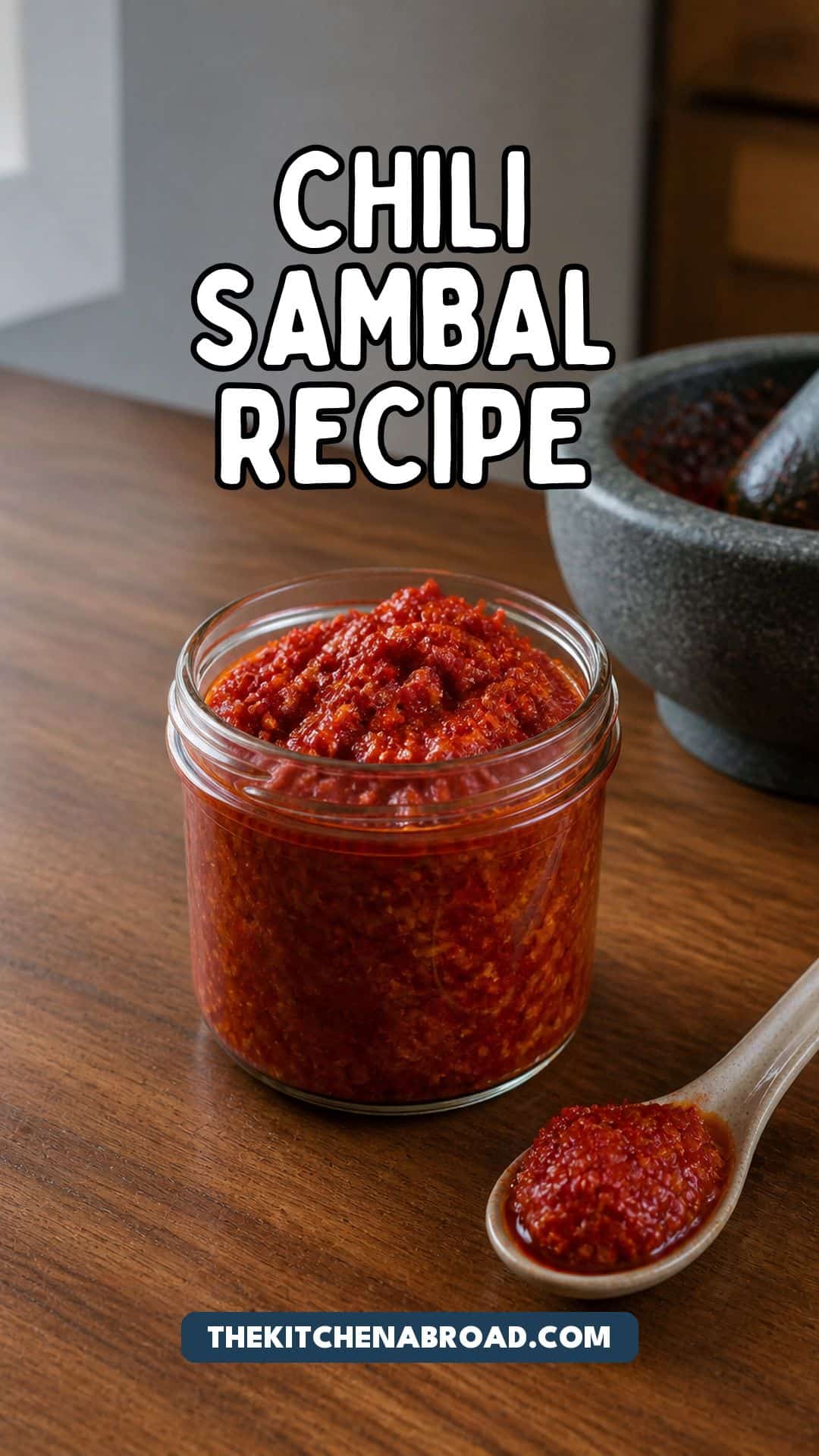
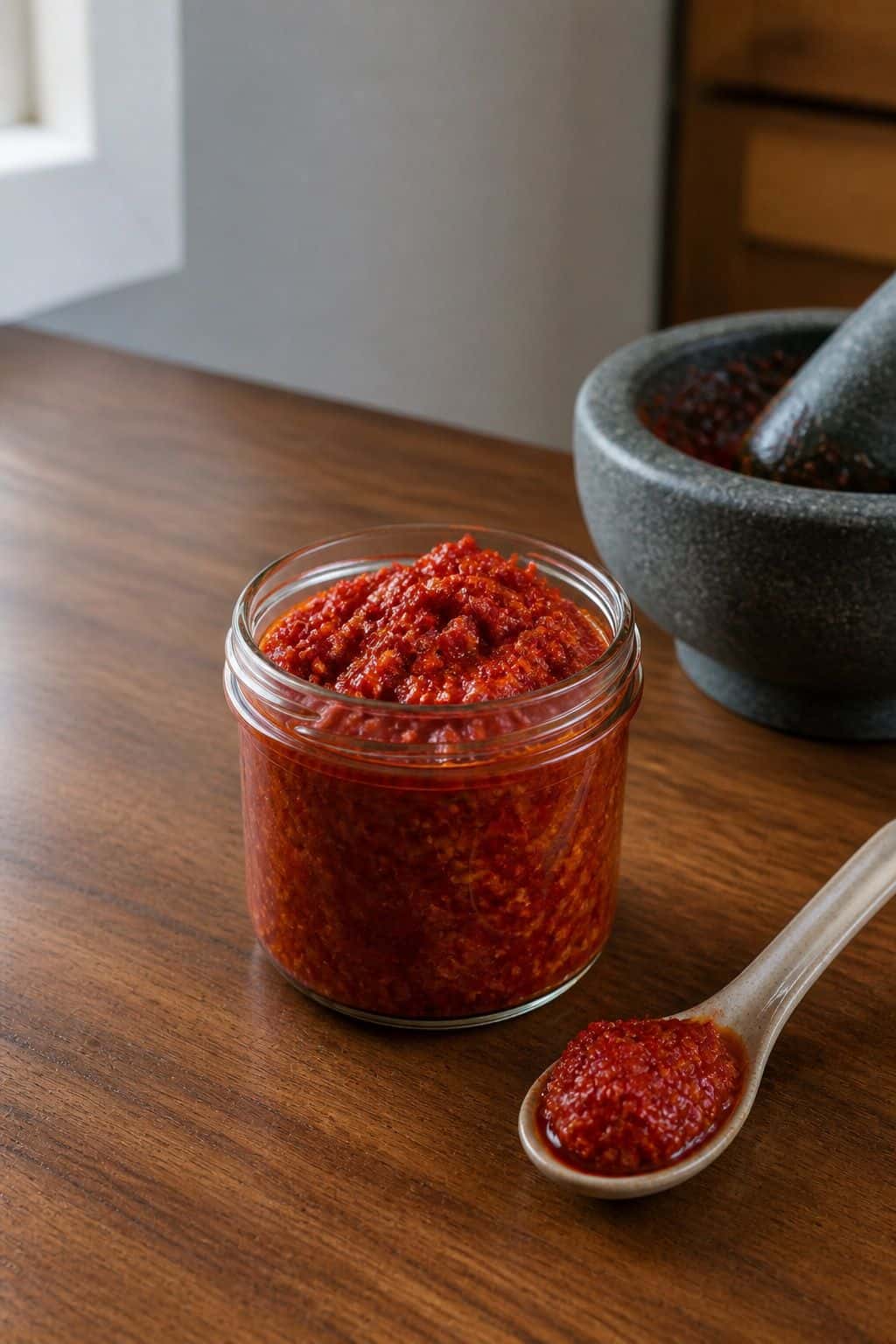
Sambal oelek is fresh Indonesian chili paste made by grinding fresh red chilies with salt, rice vinegar, and a touch of palm sugar in a mortar and pestle (or food processor). A chili-blend chart lets you dial heat exactly: mild (90% Fresno + 10% Thai bird), medium (50/50), hot (90% Thai bird). Sterilized glass jar storage holds 3 weeks. Ready in 15 minutes.
Sambal is to Indonesia what salsa is to Mexico. There are dozens of regional versions, a fistful of common rules, and infinite room to riff. The base recipe,fresh chilies, salt, an acidic component, a touch of sweetness,is universal across the archipelago. From there, every island, town, family, and grandmother adds something different. Garlic, shallots, shrimp paste, lime, tamarind, palm sugar, kaffir lime leaves, candlenuts. The result is hundreds of sambals, each with its own personality.
This recipe is the most foundational version, sambal oelek, which is the workhorse chili paste of Indonesian cooking. The word “oelek” (also spelled “ulek”) refers to the mortar and pestle traditionally used to grind the chilies. The texture should be coarse and slightly chunky, with visible chili seeds and broken pieces of skin. Smooth processed sambal oelek looks fancier on a spoon but loses the textural character of the original.
The chili-blend chart is the move that lets you make sambal oelek for any palate. Pure Thai bird chilies are appropriate for Indonesian heat tolerance but punishing for most American kitchens. Pure Fresno chilies are approachable but too mild for the dish to taste like real sambal. The blend ratio in the chart below gives you a way to land exactly where you want, every time. Metric and imperial throughout.
What You’ll Need to Make This Recipe
A large granite or marble mortar and pestle is the traditional and best tool. A mini food processor works as a faster substitute that gives a slightly more uniform texture. Disposable nitrile gloves keep capsaicin off your skin for the next two days. Sterilized glass jars for storage. A microplane handles the optional garlic.


![SEWANTA Wide Mouth Mason Jars 32 oz [4 Pack] With Mason Jar Lids and Bands,...](https://www.thekitchenabroad.com/wp-content/plugins/aawp/public/image.php?url=YUhSMGNITTZMeTl0TG0xbFpHbGhMV0Z0WVhwdmJpNWpiMjB2YVcxaFoyVnpMMGt2TkRFd04zQk5NbWhaUzB3dVgxTk1NVFl3WHk1cWNHYz18MTc5MTIyNTQyMA= "Sambal Oelek Recipe (Indonesian Chili Paste)")


Recommended Reads
- Cucumber Kimchi Recipe (Oi Kimchi) with Gochugaru
- Gochujang Pasta Recipe (Creamy, Spicy, 20 Minutes)
- Gochujang Chicken Wings Recipe (Sticky Korean Glaze)
- Spaghetti Aglio e Olio Recipe (Italian Garlic Pasta)
- Nakkikastike Recipe: Finnish Hot Dog Sauce in Creamy Mustard Gravy
Why This Sambal Oelek Works
The chili-blend chart is the most useful thing in this recipe. Indonesian sambal traditionally uses cabe rawit (a small fierce chili similar to Thai bird) for serious heat. American palates need help getting there. The blend approach (Fresno for sweetness and color, Thai bird for heat) lets you build sambal oelek at any heat level without losing the fundamental character of the dish. Mild blend gives you approachable warmth for the chili-averse. Medium is the sweet spot for most American kitchens. Hot is restaurant-Indonesian level.
The mortar-and-pestle texture is the second move. A food processor pulses the chilies into uniform paste, which is fine for texture but loses the visual character of real sambal. Hand-ground sambal has variation in the size of chili pieces, visible seeds, broken skins. The texture is part of the dish. If you have a mortar and pestle, use it. If you only have a food processor, pulse in short bursts rather than running it continuously, and stop when you still see visible chili pieces.
The salt-and-acid is the preservation chemistry. Salt draws moisture out of the chilies, which concentrates the flavor and inhibits bacterial growth. Rice vinegar lowers the pH below 4.5, which is the threshold for most foodborne pathogens. Combined, salt and acid let homemade sambal oelek keep safely in the fridge for 3 weeks. Skip the salt or skip the vinegar and the safe storage window shrinks to days.
Sambal Oelek Ingredients, Briefly
Fresh red chilies. The chili-blend matters more than the absolute number. The classic Indonesian choice is cabe rawit (small red bird’s-eye chilies, very hot). Outside Indonesia, the closest match is Thai bird chilies. Fresno chilies are milder, sweeter, and more available, perfect for blending. Red jalapeños work as a third option.
Coarse sea salt or kosher salt. About 1 teaspoon per cup of chilies. The salt acts as both seasoning and preservative.
Rice vinegar. Unseasoned rice vinegar is the traditional acidic component in many sambal recipes. Apple cider vinegar or distilled white vinegar work as substitutes.
Palm sugar or brown sugar. A small amount, about ¼ teaspoon per cup of chilies. The sugar balances the chili heat and adds a subtle background sweetness. Palm sugar is more authentic but brown sugar is a fine substitute.
Optional garlic and shallot. Three garlic cloves and one small shallot, finely minced or grated. Not in classic sambal oelek but common in many regional variations. Adds depth without overpowering the chili.
Optional terasi (shrimp paste). Half a teaspoon of toasted Indonesian shrimp paste. This shifts the sambal from oelek to terasi style, which is the most popular variation in Indonesia. Look for terasi in Indonesian or Southeast Asian groceries, or substitute Thai shrimp paste (kapi). Skip for vegan.
Optional lime juice. A teaspoon of fresh lime juice at the end brightens the sambal. Some Indonesian regions use this, others do not. Worth experimenting.
Tips and Variations
The chili blend chart. For mild sambal: 90% Fresno chilies + 10% Thai bird (about 1 Thai bird per cup of Fresnos). For medium: 50% Fresno + 50% Thai bird. For hot: 90% Thai bird + 10% Fresno. For nuclear: pure Thai bird, no blend. Choose your level once and write it down.
Wear gloves. Capsaicin (the heat compound in chilies) gets on your hands and lingers under your fingernails for 48 hours. Touching your eyes or face will hurt. Disposable nitrile gloves are 30 cents of insurance against a painful day.
Sterilize the storage jar. Wash a glass jar in hot soapy water. Rinse. Place upside-down in a 110°C (225°F) oven for 10 minutes to dry and sterilize. Cool before adding the sambal. Sterilized jars extend the safe storage window to 3 weeks refrigerated.
Sambal terasi variation. Toast ½ teaspoon of terasi (shrimp paste) wrapped in foil over a low flame for 2 minutes per side until fragrant. Crumble into the sambal during the grind. This is the most popular variation across Java and Sumatra.
Sambal matah variation. Skip the grind entirely. Finely chop fresh chilies, shallots, lemongrass, and kaffir lime leaves. Toss with lime juice, salt, and coconut oil. This is the raw Balinese cousin of sambal oelek, served alongside grilled fish.
What to serve sambal oelek with. Nasi goreng (Indonesian fried rice). Mie goreng (Indonesian fried noodles). Grilled fish or chicken sate. Roasted vegetables. As a condiment alongside eggs or rice. As a flavor boost for soups, stews, marinades, and stir-fries.
Freezing for long-term storage. Sambal freezes beautifully. Portion into ice cube trays, freeze, then transfer the cubes to a freezer bag. Pop a cube into stir-fries or soups as needed. Keeps 6 months frozen.
Recipe: Sambal Oelek (Indonesian Chili Paste)
Prep Time: 5 minutes | Cook Time: 10 minutes | Total Time: 15 minutes | Yield: About 240 ml (1 cup), serves 12 to 16 as a condiment
Ingredients
- 250 g (about 2 cups packed) fresh red chilies, mix per the blend chart (stems removed)
- 1 tsp coarse sea salt or kosher salt
- 1 tbsp (15 ml) unseasoned rice vinegar
- ¼ tsp palm sugar (or brown sugar)
- 2 tbsp (30 ml) water
Optional add-ins (choose any combination):
- 3 cloves garlic, peeled
- 1 small shallot (about 30 g), peeled and roughly chopped
- ½ tsp toasted terasi (Indonesian shrimp paste)
- 1 tsp fresh lime juice
Instructions
- Put on nitrile gloves before handling the chilies. Wash and dry the chilies, then remove the stems. Leave the seeds in for full heat, or remove them for a milder sambal.
- Sterilize your storage jar. Wash a glass jar in hot soapy water, rinse, and place upside-down in a 110°C (225°F) oven for 10 minutes. Cool before using.
- Method 1 (mortar and pestle, traditional): Add the chilies, salt, and palm sugar to a large mortar. Grind in slow circular motions for 4 to 5 minutes, until the chilies break down into a coarse paste with visible bits of skin and seeds. Add the optional garlic, shallot, and terasi if using, and continue grinding for 2 more minutes. Stir in the rice vinegar, water, and optional lime juice with a spoon to combine.
- Method 2 (food processor, faster): Add all ingredients (including the optional add-ins) to a mini food processor. Pulse in short bursts of 2 to 3 seconds, stopping to scrape down the sides, until you have a coarse paste with visible chili pieces. Do not run the processor continuously, you want texture, not smoothie.
- Transfer the sambal to your sterilized glass jar. Press down gently with a spoon to remove air pockets. The chilies should be submerged in their own liquid plus the vinegar and water.
- Optional cooking step: For deeper, more developed flavor and longer shelf life, transfer the finished sambal to a small saucepan and cook over medium-low heat for 5 minutes, stirring constantly. This drives off some of the raw chili harshness and mellows the sambal. Let cool before transferring to the jar.
- Seal the jar and refrigerate. The sambal is ready to use immediately, but the flavor improves over the first 24 hours as everything integrates. Keeps refrigerated for 3 weeks in a sterilized jar.
Notes
Always wear gloves. Capsaicin on bare hands transfers to everything you touch for the next 48 hours, including your eyes if you happen to rub them. The gloves are the cheapest insurance in this recipe.
The chili blend chart is the takeaway. Mild 90/10, medium 50/50, hot 10/90 (Fresno/Thai bird). Make the same sambal every time without thinking.
Sterilization extends shelf life. Properly sterilized jars + salt + acid + refrigeration = 3 weeks of safe storage. Skipping any of those steps shortens the window significantly.
The cooked version stores longer. The optional 5-minute cook step develops deeper flavor and kills any surface bacteria. Cooked sambal keeps closer to 4 weeks. Raw sambal keeps 3 weeks. Both work.
Frequently Asked Questions
What is sambal oelek?
Sambal oelek is the most foundational chili paste in Indonesian cooking, made from fresh red chilies ground with salt, vinegar, and a touch of sweetener. The name comes from “oelek” (or “ulek”), the Indonesian word for the mortar and pestle traditionally used to grind the chilies. It is used as a condiment alongside meals and as a flavor base for hundreds of Indonesian dishes.
What chilies should I use for sambal oelek?
Traditional Indonesian sambal uses cabe rawit (small red bird’s-eye chilies). Outside Indonesia, the closest match is Thai bird chilies, which are very hot. For American palates, blend Thai bird with milder Fresno chilies according to your heat tolerance. The chart in the Tips section gives exact ratios for mild, medium, and hot versions.
How long does homemade sambal oelek last?
Three weeks refrigerated in a properly sterilized glass jar. The salt and vinegar inhibit bacterial growth, and the sterilized jar prevents contamination. For longer storage, freeze portions in ice cube trays and transfer to a freezer bag. Frozen sambal keeps 6 months without quality loss.
What is the difference between sambal oelek and sriracha?
Sambal oelek is Indonesian, coarse-textured, primarily salt and vinegar based. Sriracha is Thai-American, smooth-textured, garlic-forward, with significantly more sugar. Sriracha is sweeter, smoother, and more processed. Sambal oelek is brighter, hotter, with the texture of fresh chilies. The two are not interchangeable in most recipes.
Can I make sambal oelek without a mortar and pestle?
Yes. A mini food processor works well, just pulse in short bursts rather than running it continuously, to preserve the textural character. The result is slightly more uniform than mortar-ground sambal but the flavor is identical. A regular full-size food processor also works, just be careful not to over-process into a smooth puree.
What can I substitute for sambal oelek in a recipe?
Best substitutes are other coarse-textured chili pastes like Thai chili paste (nam prik) or Vietnamese sa-té. Sriracha works in a pinch but is sweeter and smoother, so reduce other sugar in the recipe to compensate. Crushed red pepper flakes mixed with a bit of vinegar and salt is a passable emergency substitute. Real sambal oelek is genuinely worth making or buying for the dishes that call for it.
Key Takeaways
- Use the chili-blend chart. Mild 90/10 (Fresno/Thai bird), medium 50/50, hot 10/90, nuclear pure Thai bird.
- Always wear nitrile gloves. Capsaicin lingers on bare hands for 48 hours and stings when you touch your eyes.
- Mortar and pestle gives the traditional coarse texture. Food processor works with short pulses, not continuous running.
- Sterilize the glass storage jar. Sterilized + salt + vinegar + refrigeration = 3 weeks of safe storage.
- Freeze portions in ice cube trays for long-term storage. Frozen sambal keeps 6 months.
Final Thoughts
Sambal oelek is the kind of pantry condiment that quietly changes how you cook for the next month. A spoonful into stir-fries, a dollop alongside grilled meats, a half-teaspoon into marinades and dressings. Once a jar is in your fridge, the question becomes what to put it on. The answer is almost everything that needs lifting.
Make a batch on a quiet weekend afternoon. Bring it out at dinner that night next to whatever you are cooking. Watch what happens to the table.
Sambal Oelek Recipe (Indonesian Chili Paste)
Sambal oelek is fresh Indonesian chili paste made by grinding fresh red chilies with salt, rice vinegar, and a touch of palm sugar in a mortar and pestle (or food processor).
Ingredients
- 250 g (about 2 cups packed) fresh red chilies, mix per the blend chart (stems removed)
- 1 tsp coarse sea salt or kosher salt
- 1 tbsp (15 ml) unseasoned rice vinegar
- ¼ tsp palm sugar (or brown sugar)
- 2 tbsp (30 ml) water
- 3 cloves garlic, peeled
- 1 small shallot (about 30 g), peeled and roughly chopped
- ½ tsp toasted terasi (Indonesian shrimp paste)
- 1 tsp fresh lime juice
Instructions
- Put on nitrile gloves before handling the chilies. Wash and dry the chilies, then remove the stems. Leave the seeds in for full heat, or remove them for a milder sambal.
- Sterilize your storage jar. Wash a glass jar in hot soapy water, rinse, and place upside-down in a 110°C (225°F) oven for 10 minutes. Cool before using.
- Method 1 (mortar and pestle, traditional): Add the chilies, salt, and palm sugar to a large mortar. Grind in slow circular motions for 4 to 5 minutes, until the chilies break down into a coarse paste with visible bits of skin and seeds.
- Method 2 (food processor, faster): Add all ingredients (including the optional add-ins) to a mini food processor. Pulse in short bursts of 2 to 3 seconds, stopping to scrape down the sides, until you have a coarse paste with visible chili pieces.
- Transfer the sambal to your sterilized glass jar. Press down gently with a spoon to remove air pockets. The chilies should be submerged in their own liquid plus the vinegar and water.
- Optional cooking step: For deeper, more developed flavor and longer shelf life, transfer the finished sambal to a small saucepan and cook over medium-low heat for 5 minutes, stirring constantly.
- Seal the jar and refrigerate. The sambal is ready to use immediately, but the flavor improves over the first 24 hours as everything integrates. Keeps refrigerated for 3 weeks in a sterilized jar.
Notes
Always wear gloves. Capsaicin on bare hands transfers to everything you touch for the next 48 hours, including your eyes if you happen to rub them. The gloves are the cheapest insurance in this recipe.
The chili blend chart is the takeaway. Mild 90/10, medium 50/50, hot 10/90 (Fresno/Thai bird). Make the same sambal every time without thinking.
Last update on 2026-10-03 / Affiliate links / Images from Amazon Product Advertising API
